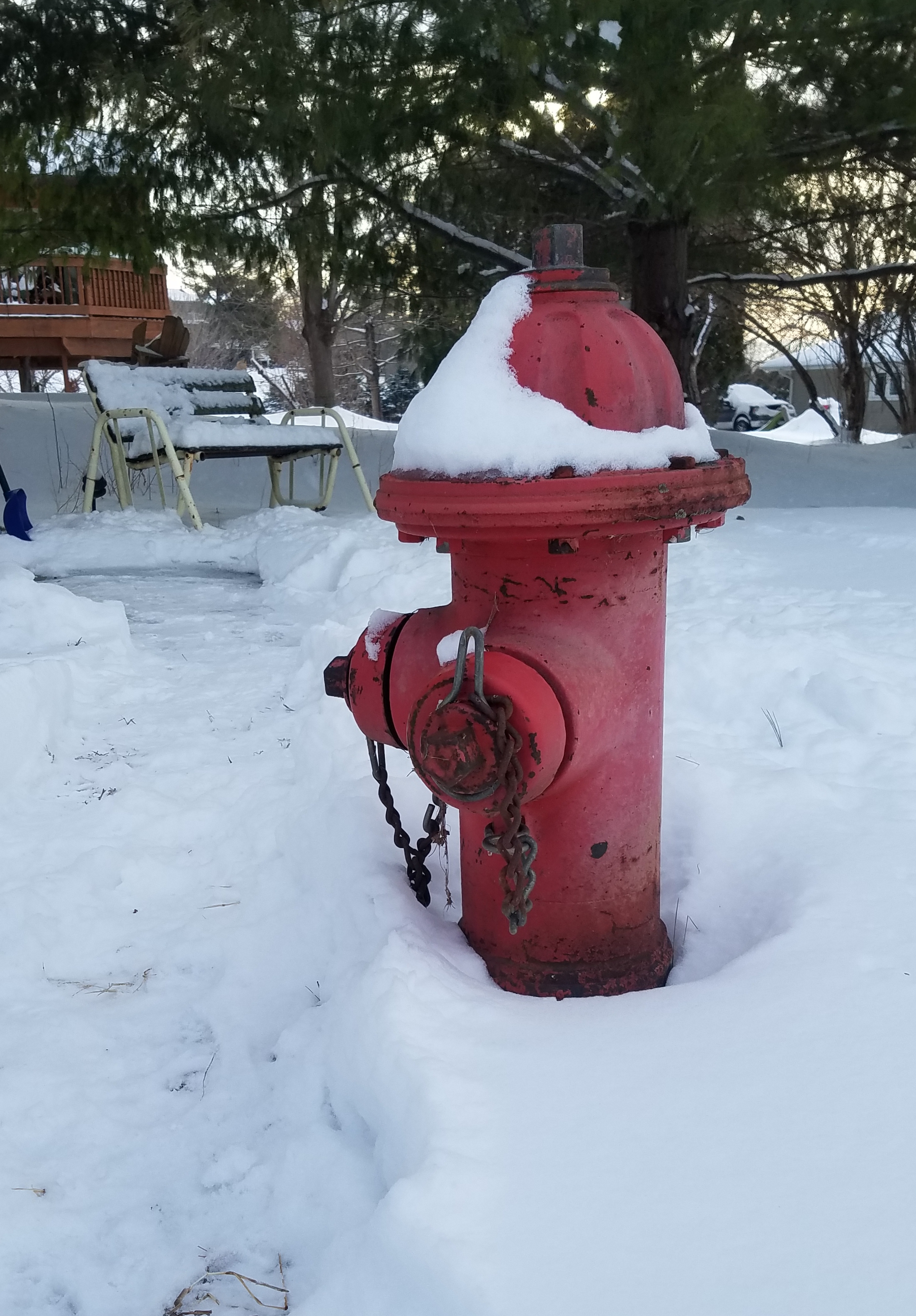
Inconsistent winter weather disrupted fruit tree plans. On Wednesday snow melt began flowing in the gutters and downspout. It felt safe enough to make a trip through melting snow pack to the composter near the garden. A slushy mix returned to the end of the driveway. Weather has been weird.
It takes several days of subzero temperatures in a row to prune fruit trees. I prefer a week of ten or twenty below zero yet we haven’t had that. I also seek to harvest scions, (pencil shaped fruit tree cuttings) to graft on root stock. I would save the Red Delicious apple tree which was damaged in the Aug. 10, 2020 derecho. It served us well while it was whole. Trees need dormancy for scions to work and we haven’t had that either.
This week has been a fake spring. It’s still winter, for Pete’s sake! Yet the buds on trees look healthy, like they are ready to sprout. The lilac bushes were leafing just last month. I wouldn’t mind spring’s arrival yet I want a winter too.
At least the onions and shallots planted Jan. 6 are germinating.
We bunker in to avoid the coronavirus and wait for a deep freeze and dormancy it would bring. These days have been good for writing.
It is difficult waiting for winter and fruit tree work when what we really want is a normal spring. Today, I’d settle for a normal winter so I can harvest scions.
Portion of mailer from Congresswoman Mariannette Miller-Meeks.
My member of congress sent a couple of official mailings since she was elected to the U.S. House of Representatives. They are purported to be government business, yet any such outreach is obviously also political. These questions seem intended to frame political discussion going into the midterm election. I’m not going to reply in this format, yet I will submit my answers via message on the Miller-Meeks official website. Here are the questions and my answers.
What are your thoughts on the issues at our southern border?
Enable the Biden-Harris administration to manage border crossings along with the border state governors.
Should government be more involved in our health care system?
This is not a simple answer. Yes, regulation is needed, and as long a people can’t get access to care for any reason, there is not enough regulation and government support. At the same time, health care providers need to be able to make a living and I agree with the Obama administration in passing the Patient Protection and Affordable Care Act that there is a role for for-profit health care providers and their employees. Since the federal government created all veterans, it continues to be needed to regulate and improve the care system for active military personnel, veterans, and their families. I fully support the Biden-Harris administration’s efforts to manage the current global pandemic of the coronavirus.
Do you believe reducing federal regulations and red tape are more likely to 1. create jobs and improve our businesses, 2. allow corporations to harm employees and consumers or 3. other?
See previous question for my thoughts about government regulation of the health care industry. Since the government has been captured by undue influence from corporations that provide healthcare, and industry capture already harms employees and consumers, the best course of action is to reform campaign financing and reduce the ability for healthcare corporations to donate to members of congress and political action committees in order to influence governance.
How should Congress tackle our $29 trillion debt?
Of the suggested answers, raising taxes on the wealthiest Americans is first priority and overdue. The Trump tax cuts should be reversed as quickly and completely as possible as they drive a significant portion of the debt. In addition, the Congress needs to audit the military budget, which has seemed for some time to be out of control and enriched beyond the country’s national security needs. Why would the Congress approve a higher budget than the Biden-Harris administration requested? They shouldn’t. The Social Security Administration is self-funded and has a plan for when it begins to run out of money in 2034, namely, reducing benefits. Any debt reduction plan should include shoring up the protections for our seniors and disabled after 2034. We shouldn’t wait until then to start working on it.
Which issue should be Congress’ top priority right now?
If we don’t address the environment, the country we have now won’t exist. Mitigating both the causes and effects of the climate crisis should be the Congress’ top priority.
Should federal control and funding of education be reduced?
The states have proven incapable of providing racial equity in education, so there is a role for the federal government and funds are required. All federal funding of home schooling, charter schools, private schools, religious schools, and any school not defined as a public school should be phased out with a rapid off ramp for federal funding. This should be a discussion, not a mandate. The Choice Act takes us in the wrong direction.
I’ve been reading more obituaries lately, partly because of my main writing project, and partly because as I age, long-time friends and acquaintances are passing. Survivors put the best face on the deceased in an obituary. That is okay. I wrote a draft of my own obituary to make it easier on my survivors. Not everyone does it and that’s okay, too.
As a proof reader at the local weekly newspaper I edited the obituary section. Mostly, they needed work in terms of format, grammar and punctuation. It was easy to tell when a funeral home used a template. I tried to make them grammatically adequate and positive regarding the life of the deceased. It was a minor part of the job yet I enjoyed it. No one ever complained.
An obituary requires specific information and it should all be accurate: birth date, death date, and if married, a wedding date. Survivors are a nice addition, yet we don’t need to read the names of all the great, great grandchildren or pets. Spouse, children, parents, siblings and partners, if any, are enough. The author should mention a career although an obituary is not a resume. What the deceased did in retirement is good if they were lucky enough to live so long. The obituary should make the deceased stand out without portraying them as being too highfalutin or better than everyone else.
Instead of “devoted wife,” I’d like to read how impossible the marriage was because she was a shrew. I’d also like to hear how the husband spent all his time at the bar after work improving the cirrhosis of his liver. I don’t suppose my wishes will be granted.
Military service is typically mentioned, although is not really necessary. Uniformed service is nothing special unless one served in a combat zone. I read this in an obituary about someone I had been with twice. The header was “Another of the ‘Greatest Generation’ has passed.”
How fitting that his death came in alignment with Veteran’s Day, for he was a true patriot. He is a decorated veteran of World War II, having been awarded the Purple Heart and Bronze Star medals for his actions during combat operations in the Ardennes Forest, known as the Battle of the Bulge. He was an infantryman in the 23rd Armored Infantry Battalion, 7th Armored Division, and fought across Belgium in the winter of 1944-45.
If they had mentioned it while living, I may have thanked them for their service and talked about General Anthony McAuliffe’s negotiations with the Germans in the Ardennes. McAuliffe told them “nuts,” in case you forgot or didn’t know. I might have mentioned my own trip to the Battle of the Bulge site during the 1970s.
Where this ramble is going is whether what people say about each other is real. It is as real as it can be, I believe. At the same time, I read accounts of history in which there is no agreement over simple things. Spelling of the name of a person can vary radically. Dates were not the forte of 19th Century rural communities. Everyone knew at the time when someone was born, yet when a relative made it to the county seat to have the birth recorded, time could pass and with it some of the specifics.
When it comes to public events, vagary is endemic. In the case of the 1927 lynching of Leonard Woods in Pound Gap between Jenkins, Kentucky and Pound, Virginia. There are multiple stories of what happened and depending upon to whom one listens there are many interpretations. What stands out to me is the local sheriffs did not write down a single license plate number of the hundreds of vehicles driven and parked at the site of the lynching. Sometimes people don’t want to say what happened.
Leonard Woods Lynched — Leonard Woods, a black coal miner from Jenkins, Kentucky, was lynched near here on the night of 29-30 Nov. 1927. Officers had arrested Woods for allegedly killing Herschel Deaton, a white man from Coeburn, Virginia, and had taken him to the Whitesburg, Kentucky, jail. On the day of Deaton’s funeral, a white mob numbering in the hundreds broke into the jail and brought Woods close to this spot, where they hanged, shot and burned him. No one was ever arrested. In the aftermath, at the urging of Norfolk editor Louis Jaffé, Norton’s Bruce Crawford, and other journalists, Virginia Gov. Harry F. Byrd worked with the General Assembly early in 1928 to pass the nation’s first law defining lynching as a state crime.
From what I’ve read, these words are true. They are not the whole story and maybe that’s my point. The historical society put the best face on this murder. I want to know the rest of the story.
The gardening season kicked off in Big Grove Township with onion and shallot planting on Thursday. I planted two varieties of shallots and five of onions. After consultation with farmer friends, I decided to start earlier this year to see if my starts had a better result for planting in the spring. The trays will rest on a heating pad until they germinate. I ordered onions starts from the seed company again as an insurance policy.
Friday was the coldest day of winter thus far. It reached ten degrees below zero and ambient temperature is expected to remain below freezing until Monday when sub-zero temps return. If the forecast holds, I plan to be pruning trees Monday as the sap will have stopped flowing by then. Like with anything relying on weather, I’ll wait to see what happens.
Friday was trash pickup day. There was no trash in the trash cart and the recycling cart was less than a third filled. Because of the cold I left them in the garage this week. We are getting good at reducing our household waste.
We have provisions enough to last a couple weeks without leaving the house. This week, the county public health department suspended COVID-19 case investigation and contact tracing. They issued a press release, which said, in part,
During the past week, there has been a 250% increase in cases from the previous week. The total amount of cases in the past week reached an all-time high of almost 1,400 positive individuals. Due to this dramatic increase, Johnson County Public Health no longer has the ability to contact everyone who tests positive to conduct case investigations and contact tracing. JCPH will continue to monitor COVID-19 cases in high-risk groups and coordinate with organizations who experience a rise in cases, evaluate capacity, and keep the public informed of changes in our COVID-19 response.
Email from Johnson County Public Health dated Jan. 5, 2022.
This is what it looks like when a pandemic inundates the public health system. They can’t do their normal work because there are too many cases of COVID-19.
It is probably best, with the cold, the raging pandemic, and a full pantry and refrigerator, we stay home and bunker in. There is no lack of things to do. We want to live until spring to plant these onions and shallots in the ground. The 2022 gardening season has begun.
Iceberg lettuce with ranch dressing and black pepper.
When there were decent heads of organic iceberg lettuce at the grocer I bought one. We usually don’t eat lettuce unless we grow it. Iceberg lettuce is much maligned and actually pretty good. It made a nice winter treat.
I placed the unopened bag on a refrigerator shelf where it rested for a week. It yielded some wilted leaves for soup and four 3/4-inch slabs like the one in the photo.
We like the lettuce my farmer friends and I grow. With implementation of row cover in my garden, the kitchen had the leafy greens most of the season. I can’t imagine buying another bag of loose, mixed greens at the market. It is never as good as home grown and recalls for contamination have been too frequent. The whole head of iceberg was just the pick-me-up needed to inspire spring planting.
Garden planning is proceeding slowly yet I know what I’m doing about lettuce. I had about twelve feet of row cover last year. Under it I planted radicchio, lettuce and herbs. This year I have materials for 36 feet of row cover.
I expect to do a better job of rotational lettuce planting so I don’t have too many heads ready at the same time. I count nine varieties of lettuce in my seed drawer. Of those, Magenta is our favorite. I also have a stack of arugula seeds, six varieties. I’d like to get to the point where arugula grows wild so no planting is required. I hear tales of chefs who dug up wild arugula (a.k.a. Rocket) and transplant it to a raised garden plot where it thrives. If I could succession plant it this year, that would be good enough for 2022.
Lettuce is a cash crop for local farmers. They sell it to restaurants and make good margin. It seems normal to pay $5 for a bag of local lettuce at the farmers market. As long as I grow my own, it’s a bargain.
Because of high winds I’ve been indoors all day. Gusts approached 40 miles per hour, began around midnight, and continued all day. A small snow drift formed across the driveway.
I had the last of the iceberg lettuce for lunch. While eating it I thought I’m ready for spring.
Bob Woodward and Robert Costa. Photo Credit – The Guardian
The effort to disrupt the Electoral College vote counting at the U.S. Capitol on Jan. 6, 2021 was appalling. It was made worse by the fact a sitting U.S. president, in order to overturn a legitimate election and cling desperately to power, organized, led and encouraged a mob. When events turned deadly, the president failed to call off the demonstrators in a timely manner. By any definition, what happened that day was insurrection.
Peril by Bob Woodward and Robert Costa is the first draft of historical narrative of events leading to that day and its aftermath during the first months of the Biden-Harris administration. The authors interviewed more than 200 people for the book and it reads like history. It’s not that. It is more like an extended newspaper article. Discovery of new aspects of the events leading to Jan. 6 have been released almost daily. The pace of new information is expected to accelerate in 2022. This book is what we have now to provide an overview of what happened.
To the extent Peril recounts what happened, it is useful the way a newspaper article is useful. It left me wanting to know more. It is neither the best written political book, nor does it provide meaningful insights. Its narrative is believable yet incomplete.
The good news about Peril is that it took less than 48 hours to read. Combined with our first winter storm and in between snow removal, cooking, and indoor work, it made an engaging companion. There will be better books written about Jan. 6 once the United States House Select Committee on the January 6 Attack finishes its work. For the time being, Peril can accompany us on the journey to determine what happened and what a voter can do to remedy the causes of this doleful day.
As an American the need for action is obvious. Reading Peril is an efficient way to get caught up after the end of year holidays. What comes next is an open question.
Republicans in the Iowa legislature are best to start with the schools. That is, choke funding, limit collective bargaining with union employees, restrict local control during a pandemic, and control the curriculum, especially as it pertains to racial equity. If Republicans don’t do these things, as children become educated they will vote them out of office when they get their first chance.
Public education is the largest line item in the Iowa annual budget approved by the legislature. How the legislature and governor handle education determines to a large extent whether Iowa is a desirable place to live. Republicans would like to significantly reduce the influence of public schools and their budget priorities show it. Issues with the Republican plan for Iowa’s schools are obvious.
There are not enough substitute teachers to fill in for sick and quarantined employees.
The Davenport school district cancelled school this week because of a shortage of bus drivers. Other districts did too.
Parents of students with disabilities can’t find paraeducators.
The legislature plans additional state control over compliance with CDC guidelines regarding vaccines in schools: not just COVID-19 vaccines, but the science of immunization as well.
Discussion of centralized control of school curricula is not finished. Legislators want to mandate a peculiar history of the United States be taught and are willing to legislate what that is. Efforts to teach racial equity are expected to be hobbled.
The legislature encourages use of public funds for private schools.
This Republican malarkey is far from over. In a Jan. 2 Washington Post article, Laura Meckler wrote, “The GOP’s case (in the midterm elections) will center on displeasure over pandemic-driven restrictions, including school closures and mask mandates, as well as the racial equity work underway in thousands of districts. … What’s clear is that the pressure on schools on both fronts will intensify.”
In this context, the Cedar Rapids Gazette reported Republicans in the Iowa Legislature are seeking a way to eliminate state income tax. Flush with one-time money, Republicans are looking for ways to spend it. They have the individual income tax in the crosshairs.
“It’s appropriate to call it a moon shot because you’d have to live on the moon to think that it was a good idea,” House Minority Leader Jennifer Konfrst told the Gazette. “It’s a political ploy, it’s a starting point, it’s a moon shot and it would have huge ramifications in the state one way or another for everyday Iowans. It is an extreme proposal to say the least.”
Education is the foundation of what makes living in Iowa a valued experience. Legislators should start with the schools, yet when we look at what Republicans have done, reasonable people scratch their heads and say, “Not like that.”
If readers have not done so, it is time to engage in what the legislature does in the second session of the 89th General Assembly beginning Jan. 10. It is also time to get to work to elect Democrats during the midterm elections. Republican control of our government has been a disaster. Just take a look at public schools.
I unlocked the door to the village well for two technicians. Today’s task was short: they drew raw water samples from the Silurian aquifer for analysis. We didn’t chat much. I stayed outdoors while they worked because the coronavirus is surging.
It has been cold with about six inches of snow on the ground. I stay on paths that have been cleared so I don’t turn an ankle. That means I started a compost bucket in the garage until the path to the composter near the garden is clear. Winter is just beginning. We are heading into a cold spell with subzero temperatures forecast the rest of the week.
There are limits to how long I can work at my writing table. I acquired provisions to last two weeks during a trip to a local commercial center. Maskless minions were everywhere. Luckily, there were few of them out early in the morning and I could avoid them. Bloomberg is reporting the U.S. today exceeded one million COVID infections in 24 hours, doubling the figure from just four days ago and setting a global record.
I appreciate being able to go on walkabout. Even if it is only to visit the village well.
Starting an autobiography is easy. Finishing it… is something else.
I began my autobiography a dozen times over a period of decades, and each time it found no conclusion. Last year, while making substantial progress, I had an epiphany. I had no idea what the process should be. I start 2022 with a work plan to remedy that.
Process became a collection of things.
At first I sat and wrote about whatever came to mind, about 150,000 words in 2021. I merged this writing into a single document (with multiple backups). After all that writing, I determined another, better method was needed to write. Too much of the blogger in me was coming out in my daily writing.
I had to get a better plan written down. I began with 3 x 5 inch index cards in a rough outline of topics, one per card. I made a Word document with a more detailed outline. It included most of what was on the cards and more. Finally, after a year of writing, I wrote a Word document called “big sections” which is a list of the chapter headings. I printed it out and placed it on my white board. The big sections will change going forward, yet I developed a way to add topics as the meaning of them was discovered or developed. It took last year’s writing experience to sort out what I would include in the finished product in the form of chapter headings.
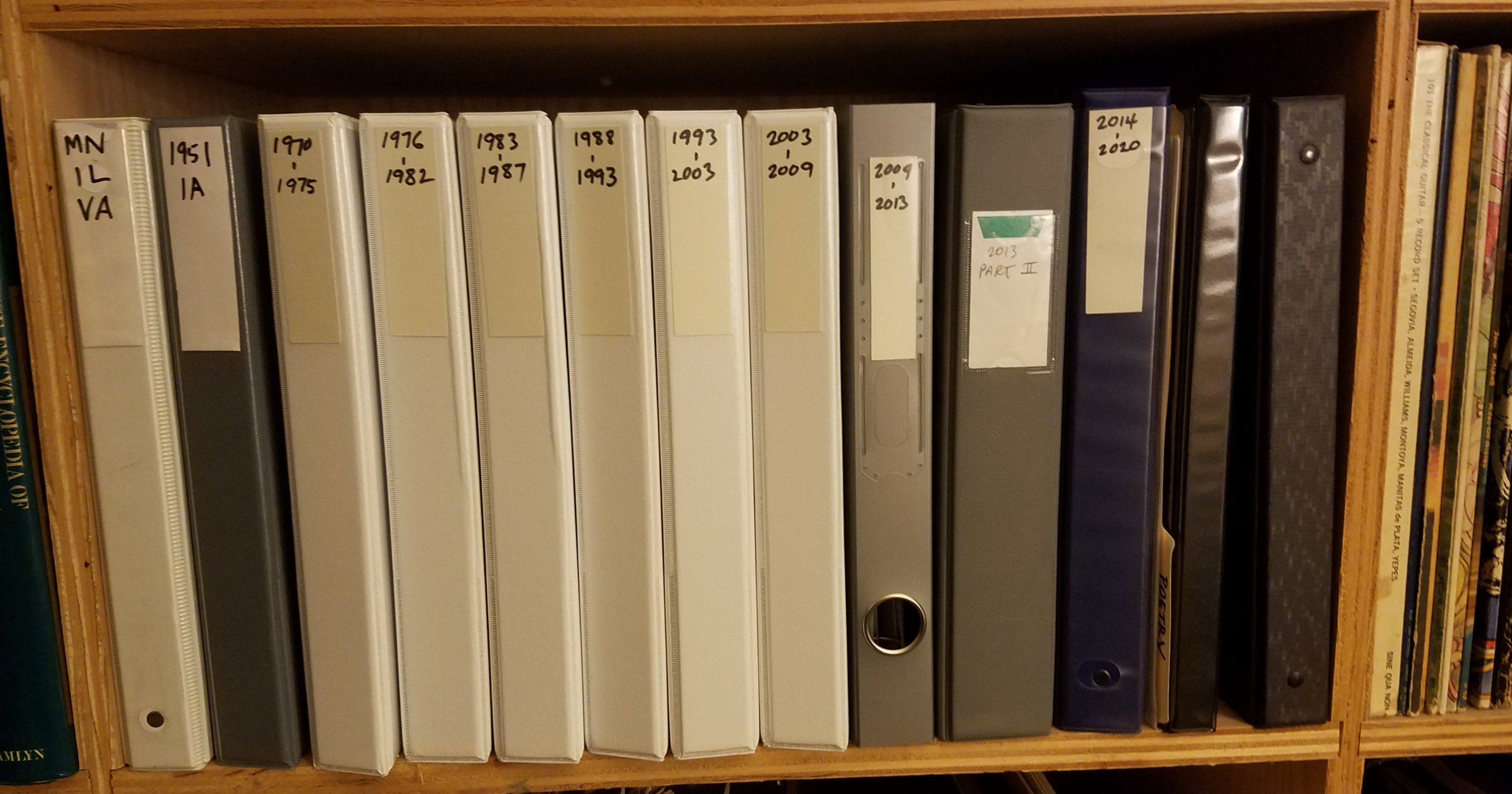
As written on Dec. 16, 2021, I made a shelf of three-ring binders to contain my rough draft. I set aside my 2021 draft document and began a new rough draft which I expect to print and place in the binders. The binders have become a storage place for documents and writing I find along the way. As I write the 2022 draft, documents in the binders will be used as reference. I expect the number of binders to increase as writing proceeds, with the printed draft in front of each chapter heading and source documents behind it.
A main challenge is to follow Robert Caro’s advice to turn every page. At present I don’t know where all those pages reside. I organized my collection of personal journals beginning with school work in 1966. I have a shelf of books which contains my blog writing since 2007. I also placed the letters written to Mother from her estate in three-ring binders. There is a significant trove of emails in electronic form dating to 1999. In a pile on a table are stacks of clippings of opinion pieces, letters written to the editor, and articles I wrote as a freelance journalist. These documents alone are a lot.
What is more challenging is the many boxes of documents and artifacts stored throughout the house. I haven’t counted, yet there are scores of them. They settled in beginning when we moved here in 1993, and I can’t say what is in them with specificity. The way they exist is not in usable form, so I’ll have to open and go through them.
I developed a discovery process to interface with source material. The idea is to methodically go through everything to decide whether it goes in the autobiography, will be stored elsewhere, or discarded. If a particular container is useful to the autobiography, I’ll write about what is in it.
The format will be what I call “rushes,” a name taken from daily rushes in the film days of motion picture making. I’ll encounter an artifact and if applicable, will write a rush, and then edit and place the rushes into the main autobiographical document. I’ve been writing rushes since the beginning of last year. This formalizes what I’ve already been doing.
Along the way, I will edit the main draft of the autobiography for continuity, grammar, spelling, and better word choices. Once the whole document is done, and I’ve examined all the artifacts, true editing will begin. This will lead to eventual publication of the work in an undetermined format, although it likely will be both on paper and in electronic format.
The first year of writing my autobiography felt productive. What I learned makes me optimistic about progress this year. I don’t know if I’ll finish the first draft this year. I know it will be better than the draft I produced in 2021. There is clarity about process, better than there was. Like any process, it will be subject to improvement as I write and learn.
Ruth Bader Ginsburg Official Portrait. Photo Credit: Wikimedia Commons
The final book I read in 2021 was My Own Words by Ruth Bader Ginsburg with Mary Hartnett and Wendy W. Williams. It is a compilation of writing by Ginsburg framed by the co-authors as autobiography.
In 1993, when Ginsburg was sworn in to the Supreme Court, I was busy living: moving from Indiana to Iowa to take on new work at the corporate headquarters of the company with which I would finish my transportation career. I wasn’t paying much attention to this supreme court appointment. Maybe I should have been.
Reading My Own Words was part of expanding my range of what types of memoirs have been written. It became more than a writer’s exercise. I realized on how many important decisions Ginsburg opined, and the prominent impact her work for the court had on my liberal sensibilities. Her writing on gender equity, presented in this book, is particularly noteworthy.
My Own Words was for me an infrequent foray into the judicial branch of government. A justice’s official writing, mainly in the form of court documents and opinions, is a matter of public record. To a large extent their work eclipses the personal story of a justice’s life. I am more interested in Ginsburg’s remarks on Brown v. Board of Education, Loving v. Virginia, and Burwell v. Hobby Lobby Stores, Inc. than I am in her opera-going habits with Justice Antonin Scalia or her twice-weekly workouts in the Supreme Court gymnasium. I do not own a Notorious RBG t-shirt and am unlikely to get one, even after reading this engaging book.
The writer’s question was how did she handle her prolific writing as it relates to autobiography. I read reviews that expressed disappointment this wasn’t an “actual memoir.” I don’t understand that criticism. As a public figure, one of the most prominent in the United States, we come to the book knowing more about Ginsburg’s personal life than normal. News media of the time tended to focus on the fact her spouse was an excellent cook rather than her intellectual capacities as a jurist. The latter is clearly more engaging.
If you are a liberal, read this book. If you are a conservative, read this book. If you are engaged in society with its cultures around abortion, gender equity, corporate influence, equal protection under the law, or how the supreme court works, I recommend it as a primer. While Ginsburg was a liberal jurist, the lessons she presents in these writings apply to us all. Highly recommended.







 Journey Home
You must be logged in to post a comment.