The WordPress.com stats helper monkeys prepared a 2014 annual report for this blog. The meaning of these statistics is unclear, except to say that I am thankful for people who read my writing in this space.
Best wishes for a happy new year.
Here’s an excerpt:
The concert hall at the Sydney Opera House holds 2,700 people. This blog was viewed about 8,300 times in 2014. If it were a concert at Sydney Opera House, it would take about 3 sold-out performances for that many people to see it.
LAKE MACBRIDE— Just before running my mobile phone through the washing machine, I searched the Internet for Hyemeyohsts Storm.
There were a few search results— what little information there was full of controversy. It was 2 a.m. and I hadn’t turned the lights on.
The year Seven Arrows was published, Chuck Storm was a lecturer in the Department of English at the University of Iowa, where he taught a course titled, “American Indian Signs and Symbols.” His wife Swan accompanied him everywhere he went, and would roll cigarettes for him as he told stories once a week for a couple of hours. That was before smoking was banned in classrooms.
I got an A in the course. Everyone did. Storm confronted the administration and made a case for the grade, and got his way. A lot of people who attended the classes weren’t registered. To call it a “class” was a stretch, as the curriculum was disjointed and sometimes incoherent, if one existed at all. What happened each week just happened, and I suppose that was part of the learning.
Storm welcomed us to visit their apartment, and one evening I did. Unannounced, and perhaps a little rude, I appeared at their door, and Swan welcomed me in. They were working with someone who had a issue with film. He was wrapped in celluloid from which he broke free. Afterward, Swan used a hand sweeper—the kind I use to pick up pine needles after the Christmas tree is removed—to clean the carpet, then we dispersed for the evening.
Seven Arrows was a work of fiction, and as such, it was easy to accept. While it claimed to be “the first book about the Ways of the Plains People to be written entirely by an Indian,” it was sometimes uncertain which stories were part of oral tradition, and which were fictionalized.
A number of modern writers have called Storm a fake Indian.
“Hyemeyohsts Storm, whose first name is hard to spell and to say, was another faker who made a minor fortune with his fake Indian book, Seven Arrows,” Dr. Dean Chavers wrote in the Native American Times. “It tried to be a genuine representation of the ceremonies of the Cheyenne people, but it came out as hippie mish-mash, just right for the 1970s.”
Why life would lead me here is uncertain. A whim from the beyond, as Meyer Baba might call it. What I know is I wasn’t ready to replace my mobile phone, or to consider negativity clouding the view of life as I knew it four decades ago. Perhaps it was just a night storm.
After discontinuing our subscription to the daily (except Sunday) newspaper years ago, I began freelancing for them. Feeling a need to subscribe again, I did.
The carrier came and left no paper on the inaugural subscription day. Perhaps communications between sales and circulation is not all it could be, although friction between these entities has been a bone of contention since I learned the structure back in the 1960s. For my part, I’ve always been an operations guy. Leave the delivery of services to me, and production and sales to someone else. Still, no paper despite my distraction recounting personal history.
Complaining is not my bag. At least that’s what I believe. While developing a tolerance for the human condition, sometimes I fall short. When we know a little bit more about something, like the structure of newspapers, one can get a bit whiny. That is not becoming of the 60-something.
Yesterday I distributed some 1,400 samples of a pastry confection to people in the warehouse. There were a lot of smiles as the imminent Thanksgiving holiday precipitated whole families arriving to shop together.
I enjoyed their conversations—carried on as if I wasn’t there. Men discussed how women could use a food item. Parents and grand parents marshaled children as they navigated the tall steel stacked with palletized product. Patrons with Irish whiskey in their carts lingered in the cheese aisle living large with dairy. It was a specialized soup of humanity and I was ladling it into my bowl attentively.
What I can say about my work in the warehouse is limited. Since I need the income to support my writing, one dasn’t disrupt things. Framing only general and positive remarks in public, there is a story to tell, but it must be told later, after I move on to what’s next to pay the bills. One always believes there will be a next thing.
But this morning, right now, I am writing. For now, that’s enough to accept the varied and imperfect life I have been living.
BIG GROVE TOWNSHIP— There was trouble last night at the cemetery, the first such trouble since I was elected township trustee.
It had to do with who could be buried in whose plot, and the trustee who coordinates plot sales and burials wanted to discuss the issue. The funeral is Friday, so no time for dalliance. We are meeting at 8:30 a.m.
Two years into my term, being a township trustee has provided a steady stream of learning about our community. There has been time to consider things, and almost no controversy—just repeated expression of wills about what should get done and how. Any conflicts that surfaced were quickly resolved.
I’m confident we will figure this one out.
Yesterday it was shown that Mary Landrieu did have 59 votes to proceed on Keystone XL, and that’s all she had. The bill overriding the executive process on evaluation and approval of the project now goes into the dustbin of the 113th Congress. It likely will be back next congress.
I spent part of the last two days transcribing testimony to the Environmental Protection Agency (EPA) on reduction of greenhouse gas emissions, carbon dioxide particularly.
“I began my career as a summer intern at EPA 42 years ago under what has euphemistically become known as Russell House One,” Dianne Dillon Ridgely said. “I was a 19-year old kid. And what is most dramatic is much of what we addressed that summer—in terms of air pollution, in terms of the public’s engagement on power production—are exactly the same things, particularly in terms of coal, that we are still addressing and fighting 42 years later, and to me that is really a sad commentary.”
Ridgley is a 42-year veteran of governmental action (or inaction) on clean air and clean water, having been appointed by Presidents Clinton, Bush 41 and Bush 43 to international delegations to address environmental issues. We’re still addressing them. There is hope the EPA’s actions won’t be blocked by the 114th Congress, something the presumed Senate Majority Leader Mitch McConnell indicated is high on his to-do list. Time will tell, but I believe we are on the right side of history regardless of what the Congress does.
My last workday at the local paper was Sunday. It will feel a little weird to be able to focus on my writing on the weekends instead of proof reading the paper. The bucket of part time paid jobs is down to three, and one of those is finished the second week in December. When the number surged to eight last summer, it was too much to juggle. Having found a bottom, the goal for next year is to keep what remains, and use it as a base. In addition, I will seek paid writing jobs and temporary positions and opportunities that can add a few C-notes to the treasury each month. What remains is that I work to support my ability to write.
Hope against hope, I want to get out in the yard and mulch the leaves, and shorten the grass. For that to happen, the snow needs to melt, the yard dry out, and half a day of warmer temperatures roll in. In these days of crazy weather, that is possible, however improbable. That’s where this Wednesday finds me.
Every possible moment was spent producing copy. It is what I hoped for for so many years. A side-effect was the displacement of blog writing as I scurried to make deadlines and accommodate demands for my time. It’s good work if you can get it, and life-changing.
Whether paid work will persist is uncertain, but I felt confident enough to part ways with our local newspaper where I proofread stories and wrote articles about the school board, city council, and a couple of other topics. 39,100 words were filed in 44 stories since January with compensation of $2,125, or less than the amount of our property tax for the period. I’ll finish my last work there this weekend.
What’s next is freelancing for the Iowa City Press Citizen and a slate of business development activities to identify additional paid writing opportunities. I’d get that organized if it weren’t so busy writing.
There is the slate of work that is not writing also begging for my time. For now, that work pays the bills and flows into the well of experience from which I draw for writing. For now, it is enough.
What it has meant is less time to write here. I hope to return to regular blog writing soon. It is uncertain when that will be.
CORALVILLE— The League of Women Voters forum last night was a bust for the candidates in my house district. The league puts on a good show at the table, but only a limited number of constituents were present, and the television feed went to only one of six county precincts in the district. Major outlets published limited accounts of the action, but mostly the evening passed and little news came out of the forum. It’s been that kind of year in the most local of local politics.
The forum enabled me to get away from writing and household chores for a while to socialize. I’ve never been part of the drinking culture that plagued more famous writers, and might have come into play if there hadn’t been the forum. I have been hearing a lot about drinking on the radio while driving across the lakes to work.
“I belong to the drinking class,” sings Lee Brice in his country hit “Drinking Class,” released in August. Country music today is full of stories about using alcoholic drinks to celebrate or escape unpleasantness in life. I hear enough of them during my 20 minute commutes to the warehouse to see the pattern.
“Monday through Fridays we bust our back,” the song goes. I don’t know who, except a small minority of people, works that kind of job, so the song seems more aspirational of lifestyle— a form of hope to define culture around externals that seem ersatz and manufactured.
“What I’m really needing now is a double shot of crown,” sings the protagonist in the Lady Antebellum song “Bartender.” On Friday night she seeks relief from a relationship gone bad. “There’s only one thing left for me to to do. Put on my favorite dress and sky-high leather boots, check the mirror one last time and kiss the past goodbye.”
The signs and symbols are archetypal. Shots of Jack Daniels and Patron, jeans that are painted on— stereotypical images of guys who get rowdy and women locked into frames we had hoped were long gone from the culture.
Aw naw, somebody just bought a shot of that Patron.
Hang on, we’ve been here all night long.
Aw naw, it would be so wrong
If we didn’t dance one more song,
Show off those jeans you painted on…
“On” doesn’t rhyme with “song,” but we can accept it in the vernacular of bar culture. What impresses about this music is the way it draws from people’s everyday experiences to paint a picture of longing and possible fulfillment or caesura.
James Joyce’s “Araby” in Dubliners, is a variation on this theme, albeit a bit obscure for the drinking class. It’s more about me that this story came to mind.
What innumerable follies laid waste my waking and sleeping thoughts after that evening! I wished to annihilate the tedious intervening days. I chafed against the work of school. At night in my bedroom and by day in the classroom her image came between me and the page I strove to read. The syllables of the word Araby were called to me through the silence in which my soul luxuriated and cast an Eastern enchantment over me. I asked for leave to go to the bazaar on Saturday night.
Much different and yet similar. I’d rather listen to the song about lighting watermelon candles upstairs, “Doin’ What She Likes” by Blake Shelton. “Fixin’ up a pitcher of margaritas,” and then calling the fire department when the watermelon candles ignited the bathroom, is a different and more interesting kind of disappointment than in the Joyce story. To weave a story with that imagery requires talent, and it resonates with people.
I’ll continue to listen to country music in the car, but am not ready to join the drinking class. For now, the occasional political event will have to serve as release in a life of work.
LAKE MACBRIDE— Intermittent rain fell throughout yesterday. Fallen leaves were dampened, and for a while, runoff flowed in the ditch. Apples clung to the tree, waiting another day to be picked.
We needed rain, but then we didn’t as crops stood in the field drying before harvest. It was a writer’s day, one for gathering material. Today will be the crafting of stories—a rarified trip into the imagination to produce more tangible results.
There are two hard parts about writing.
The first is finding meaningful venues. My process began with keeping a journal, writing letters to the editor, and commenting on a local radio station. When I look back at this work from the 1970s, it was raw, and rough, and in many cases, stylistically challenged. But there were venues, and I made something of them.
My first article outside public forums was written after a trip to Belgium and published in the newsletter of the Center for Belgian Culture of Western Illinois. I published a series of three articles after a vacation while serving in the U.S. Army in Europe, the first appearing on Nov. 27, 1977. A friend who was editor patiently waited as I drafted, typed and mailed the copy from my apartment near the Mainz railway station. As busy as I was in a mechanized infantry battalion, it is a wonder these articles were even produced.
My current work appears here, on Blog for Iowa, and in three newspapers for whom I am a part time correspondent. The newest freelance job, for the Iowa City Press Citizen, was added to the mix yesterday. 2014 has been a year of learning the peculiar requirements of writing for a newspaper, and doing it. By year’s end, I will have written about 50 newspaper articles. Between journal writing, blogging and newspaper writing there are venues enough to find meaningful expression, at least for now.
The second hard part about writing is staying focused. Sitting at the work station and crafting words and phrases on the computer screen or on paper. This takes discipline, and a willingness to avoid distraction. Some days it goes well, and others less so.
By design, today will be a day of writing. There are four articles in the works, and with a full slate of part time jobs to pay bills, it has to be. The rain left last night, and the chance of precipitation is zero throughout today. There will be a temptation to head outside to pick apples and peppers, or to work in the garage on a dozen projects, but it must be resisted. Even now I procrastinate—the writer’s natural inclination.
Yet when inspiration comes from a mysterious source, the words flow, almost automatically. It is those times we treasure as we write. Yet they don’t come without discipline and work.
To get to today took work, and some persistence. When I began writing four decades ago, I didn’t know how it would turn out. Now that I am here I can see the sacrifices that were necessary in the form of an unconventional approach to paying the bills, and a willingness to make sacrifices to see the world and gain understanding of part of it.
LAKE MACBRIDE— It has been a while, more than a year, since the television has been turned on with any regularity. I fired up the tubes to view President Obama’s address to the nation on the campaign in Syria, and occasionally we follow extreme weather, but mostly the set rests darkly in the corner, collecting dust.
That’s not to say we disconnected. We cut back the service to basic cable to save a few budget dollars, and maintained what we had for the bundling with Internet service. With the recent demise of my laptop, and acquisition of a desktop to replace it, I have less screen time generally. The computer has become a work station in a life with many of them— a post-television life of screen time.
Early on, I realized the boon to productivity that was word processing software. It’s hard to believe how much time was spent typing and re-typing a finished paper or article on my Smith Corona and Olympia machines. I kept the typewriters for sentimental reasons, and don’t know if I could find a new ribbon should I want to use them again. While we lived in Indiana, I bought a word processing machine and produced some documents that survive, including a journal— electronic word processing was a miracle.
On April 21, 1996 we bought an Acer home computer and logged on to the Internet at home for the first time. Making the decision to add the $25 monthly subscription to an already tight budget was a big deal. There’s no going back now, and communications services is a big chunk of our monthly budget, one I would like to cut back on.
Now there’s the hand-held mobile device with an Internet connection and many applications. It is used mostly to check email and news, and every once in a while, I make a phone call. Owning this machine has made a laptop less relevant, and communications with people who matter easier.
With the conversion of the industrial economy to one based more on services, the most important element, one that changed everything, has been constant human contact. At the warehouse, I interact with hundreds of people each day when working a regular shift. At the orchard, on a busy Saturday I will greet 500 people or more. It is this human contact we crave, despite how it drains energy from our day.
When we lived on Madison Street, before I entered first grade, I longed to stay up and watch “You Bet Your Life” with Groucho Marx on television. My parents would not allow it for reasons that have become obscure in the river of time. Partly they felt I should be in bed by 9 p.m. when the show aired, but there was more.
As I moved through the grades and left home, television viewing was always a second tier activity, one for after a day’s work was done, whether it be school work or a shift at a job. When I lived in Germany I bought a television late during my tour of duty, and got rid of it after a few months. There is no going back to television now. I’d rather spend my time with people, and see the diverse human experience for myself.
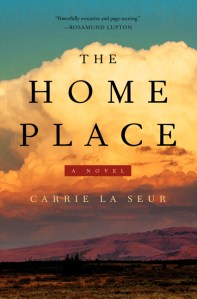
The Home Place by Carrie La Seur Photo credit: Harper Collins
Why do we read fiction? To find books like The Home Place by Carrie La Seur.
For most of us the exigencies of an engaged life leave us drained of energy, with diminished capacity to cope with complexities. Working multiple part time jobs, facing economic realities and people problems far scarier than any fiction, each day can leave us worn and used— more than we thought was possible. A good novel can be both welcome respite and escape from all of that, which is what I found in The Home Place.
I don’t know La Seur hardly at all.
We worked briefly together, along with many others, on an advocacy campaign to stop three coal fired power plants from being built in Iowa. We stopped two out of three.
I offered to volunteer for her Plains Justice, but the person who interviewed me never called back.
My experiences of Montana are quite different from those depicted in the book. If fiction is to be successful, it must be true to the author’s own experience rather than worrying much about others. The book seems deep in that.
What matters more is La Seur did not get the memo from authors like Tom Wolfe, Norman Mailer, Joan Didion, Hunter S. Thompson, Truman Capote and others that there was a new journalism that blended fiction and non-fiction. I’m glad she didn’t, or if she did, that she rejected the notion to present a novel more traditionally.
For what we need is twofold— an escape from the quotidian struggle for existence in a turbulent world, and ability to reach catharsis. The Home Place provided both.
The book seems well written and engaging. La Seur’s personality resonates throughout the pages, and she seems an active participant in the narrative. Whether that is good or bad is for others to consider. For me, I needed a break, and The Home Place provided that.
LAKE MACBRIDE— As I pulled out of the parking garage at the warehouse, my mobile phone rang. It was the orchard calling to say the family event was cancelled due to the rain storm so I wouldn’t be working. Unhesitatingly, I redirected the car, considering what to do with newly found time.
The first option was to attend the fundraiser for my state senator. He and his wife had visited the warehouse to gather provisions for the event. I had asked for the address to send a check since I would be working. Having given my regrets, I headed home.
A few weeks ago the newspaper published a story about a cupcake baker who set up shop on the road to the warehouse. Years ago, a trucking firm sold their large terminal on a corner lot to a developer, and a commercial strip mall has been expanding there for a number of years. The cupcake purveyor located in some of the new space.
There were young children with parents at the counter and tables. The din was so much I could barely hear the person at the counter ask if it was my first visit. It was. She explained the offerings, and I picked tiramisu and vegan which I expected from proofreading the newspaper article. The cupcake had a very thick layer of butter cream frosting— too much really. A return seems unlikely, but I wish the company well. They aren’t going for the cranky writer crowd anyway.
What I needed was sleep. Upon arriving home, I headed to the bedroom for what was to be a nap. I woke three hours later, having slept soundly.
Fruit flies showed up for the first time this season flying above the kitchen compost bucket. They have been a long time coming, beginning to appear only a couple of weeks ago in the enclosed garden compost bin. Whatever the delay, they weren’t missed. I need to empty the bucket daily.
After making a snack, I returned to bed and slept through until I could sleep no more. I awoke realizing there is life to be lived, and had better get to it.
You must be logged in to post a comment.