The last few days have been ideal. Rain let up, temperatures dropped to the 60s and 70s, and much about our time on earth is worth living.
These days are golden.
The garden is producing and it has already been an abundant year. Last night I made biscuits with fresh sage and cheddar cheese from my cookbook, split them into a bowl, and spooned homemade vegetable soup on top. It made a fine dinner. There were leftovers.
I’m ramping up for my summer stint of covering Blog for Iowa while our editor takes a break. My first post is scheduled for July 6. In the meanwhile, these days don’t last yet we enjoy them while we can. Or as James Russell Lowell wrote:
And what is so rare as a day in June?
Then, if ever, come perfect days;
Then Heaven tries the earth if it be in tune,
And over it softly her warm ear lays:
Whether we look, or whether we listen,
We hear life murmur, or see it glisten;
Every clod feels a stir of might,
An instinct within it that reaches and towers,
And, groping blindly above it for light.
There have been 7.3 million confirmed cases of the coronavirus worldwide according to this morning’s Washington Post. The virus has killed more than 410,000 of which 112,978 deaths occurred in the U.S. since Feb. 29.
Mitigation of the coronavirus is not going well here. Poorer countries have done much better handling the crisis. Absent leadership, incompetence, and a deliberate decision to treat COVID-19 like influenza for weeks in February and March, combined with a just ‘let it go’ attitude have taken their toll according to one public health official.
On Thursday the Dow Jones Industrial Average plunged 1,861 points when witless traders found out there wouldn’t be a quick recovery from the pandemic. How did they get the notion the recovery would be quick? Praise the Lord I got out of the market when I did.
In any case, the administration has thrown in the towel on their so-called fight against the pandemic and is moving on to the campaign trail. They are having rally attendees sign a liability waiver in the event there is COVID-19 spread at them. Their work has been about re-election since the day after the inaugural address and little else. In the Republican political playbook what’s another 100,000 COVID-19 deaths? F*ck it! Four more years.
Where does that leave bloggers, writers, gardeners and humans like me? We have to adapt to the coronavirus pandemic. Part of the adaptation was forced upon us.
Retiring from retail work on April 28 was an easy calculation. At age 68, with some health conditions and a reasonable pension structure which included Social Security and Medicare, I decided to do without the additional income and potential exposure to the virus. I won’t be going back to the orchard to work in the retail barn this fall either.
For the first time ever my medical practitioner prescribed a medication which I now have to take daily to reduce cholesterol. I asked him what circumstances may result in ending the medication. He said maybe toward the end of life. While it’s not unusual for Americans to be on medication, and I’ve been lucky to avoid it this long, my health and welfare needs more consideration.
Finally, a lot of people remain unemployed and some jobs closed by the pandemic have not re-opened. Many won’t reopen at all or will emerge vastly changed. In any case, other people need the work more than I do. If I generate income it won’t be working as a wage worker for someone else.
What are the possibilities?
Our household spending plummeted since leaving work. The retained value of our balance sheet increased by 3.25 percent since the pandemic began in Iowa. Our personal debt decreased by 50 percent in the same period. We have a possibility of paying off our debt by the end of the year, opening up spending on large projects in 2021. There is a long list of backlogged projects.
I’m already reading more books, 23 since the pandemic began. I don’t know if it’s possible to “catch up on reading,” but many books wait in my queue and I might actually get to a lot of them. This is a positive alternative to spending more time on social media.
The schedule of work outside home is minimal and that enables a focus on home life. Part of that is taking care of health, and part is going through and getting rid of unneeded possessions in preparation for refurbishing our living space. More attention can be paid to the kitchen garden so our diet can improve, providing better nutrition. All this is welcome and showing marked improvement since the pandemic began in Iowa.
How I might re-enter society, being among people I know, doing things together, is missing from adaptation. With continued spread of COVID-19 I won’t join others at events unless I know their social distancing practices. That seems like a lot to ask friends and neighbors just to spend time with them. Zoom meetings aren’t really a replacement for someone who has been very social for as long like I have been. Likewise, with more people at home on the internet our connection isn’t adequate for an uninterrupted Zoom event. How all this gets resolved remains an open question.
Until there is a vaccine with widespread distribution, or some acknowledgement by public health officials the pandemic is over, I don’t see how adaptation can resemble the past. There will be gatherings but for now I ask myself why risk it? That’s going to continue for some time.
Being at retirement age has made adaptation easier. Maybe the best adaptation, the most socially responsible one, is to just fade away into my family, my bloggery, my writing, and my kitchen garden. There are worse fates than that. Eventually an opportunity to re-enter society will present itself but not yet.
We have to look at ourselves in the mirror and consider whether we are racist. It’s not easy to do in the best of circumstances.
Dictionaries consistently define a racist as someone who has a notion that one’s own ethnic stock or genetic makeup is superior.
Which is it, ethnicity or genetics that defines race?
The authority of dictionaries has diminished in society. There are few rules in the living language except we be understood. Haters gonna hate, as Taylor Swift noted, regardless what’s in the dictionary.
I was confronted with the idea there were different races as a child. It was and remains for me an idea. I knew I was different, but superior? I don’t think so. Diversity in the neighborhood in which I grew up meant defining whether one’s family was of German or Irish descent. Racism as we know it today, as in the Black Lives Matter Movement, wasn’t an obvious issue. We were shielded from racism and those blacks we encountered were in a context of their relationship with our father: plantation workers in Florida, co-workers at the meat packing plant, and fellow union members.
What are the genetic characteristics that define race? What cultural behaviors are specific to race? Should we care about race? These are the questions I’m asking while witnessing the resurgence of protests over race after the viral video of George Floyd’s murder.
Our family visited the Gettysburg battlefield when I was a grader. Which side of the Civil War was I on? I felt I had to be on a side. My maternal ancestors immigrated after the war and my paternal ones from Virginia fought on both sides. After a moving childhood visit to the battlefields I adopted the Confederacy as my own history and bought a Confederate flag in the museum gift shop.
We cannot disown our history even if we want or if our current values discredit the peculiar institution of 19th Century chattel slavery in the U.S. southern states. Thanks to the combined work of my fourth grade teacher and my mother I came to realize the racism inherent in embrace of the Confederacy, and that it was wrong. Before long, with their encouragement, I sought and found my own history.
I first encountered systemic racism while serving in the military. I paid little heed to the naming of military bases after notable racists Andrew Jackson and Henry Lewis Benning, where I trained in the U.S. Army. I was stationed at Robert E. Lee Barracks in Mainz, Germany. It was named after the World War II veteran with the same name as the commander of the Northern Army of Virginia. Racism in the military was about more than names.
Daily work was integrated, which is to say as an Army officer I paid little attention to race when giving orders or following them. All but one officer in the battalion was white and the lone black lieutenant and his family lived in a twelfth century castle off base. I visited them a couple times while we served together. In conversations, I came to understand he was held to a different standard because he was black.
When we lived in Indiana I managed an operation that recruited thousands of truck drivers. I became familiar with parts of Chicago and the suburbs because of this work. I hired the first black recruiter the company had and remember the surprised faces when we returned to the corporate office for a meeting. Race made no difference in this hire. I just wanted someone who could do the job.
We rejected an applicant from our new driver orientation and he threatened to call Bobby Rush because he felt we were discriminating against him because he was black. The claim bordered the ridiculous because more than half the group in orientation was black or Hispanic. I don’t recall why we rejected him but I said I’d like to have that conversation and provided my number. Several weeks later we received a letter from Rush’s office and I replied. That was the end of it.
That protesters in our county seat chose to shut down Interstate 80 in response to the murder of George Floyd was predictable, expected, and ineffective. It’s something, yet I’m not sure exactly what. In 1971 I was part of a group of protesters that shut down Interstate 80 near the Dubuque Street exit in response to the Vietnam War. We built a bonfire in the Eastbound lane feeling we had to do something to disrupt business as usual. What more usual thing is there than traveling on an interstate highway? Law enforcement attempts to keep the interstate open, although there was a report one of the Coralville exits was closed by them in anticipation of protests. Protesters have to do something to gain attention enough to create a fulcrum point for change. I support their actions and also believe there has to be a better way.
What does the Black Lives Matter Movement mean to me? In our rural subdivision the only time race comes to the surface is when it is scratched. If there is talk of a black family moving in neighbors assert property values will decline.What does one do with that? I point out to them the assertion is patently false and reject it. Most people here don’t scratch the surface of race to avoid such conversations.
If George Floyd’s murder was a turning point in how racism is viewed in the United States then some good will come of it once he is mourned dead and survivors heal. We must look ourselves in the mirror on racism. If we can’t then we probably are racist and don’t want to admit it. If so, Floyd becomes just another black man who died at the hands of police as white hegemony continues a while longer.
My religious education taught we are all equal in God’s eyes. That’s how it’s supposed to be in the United States. Yet slave owners sought to justify the peculiar institution using the same Bible I read today. In the end, we have to ask ourselves if we are racist, not because we seek an answer, but because in asking we open the possibility of a remedy to today’s long-standing problem. We seem so far from that now.
The absence of definitive guidance on what society should be doing during the coronavirus pandemic led us to a path of individual choices.
When Iowa Governor Kim Reynolds proclaimed the disaster emergency on March 9 few of us knew what to expect. Sadly, three months later that continues to be true.
Our social behavior is developing around risk avoidance, some of it informed, some less so.
Jacque made us facial masks on the sewing machine. I carry three of them in a plastic bag on the car seat to use when in public. Most frequently I wear them while shopping for groceries, and at the drug store, convenience store and at medical appointments. When I return home I wash my hands, change clothing, and if I’ll be inside the rest of the day, take a shower. I wash the masks after each wearing.
At the farm I don’t wear a mask because the crew has been self-isolated together since the pandemic began. The risk of me being exposed there is minimal. Since I’ve been tested, limit my activity, and maintain social distancing, I seem unlikely to bring it in. They developed a social distancing method of share delivery and are doing everything they can to avoid getting sick. An outbreak would be disastrous for them, their customers, and the business.
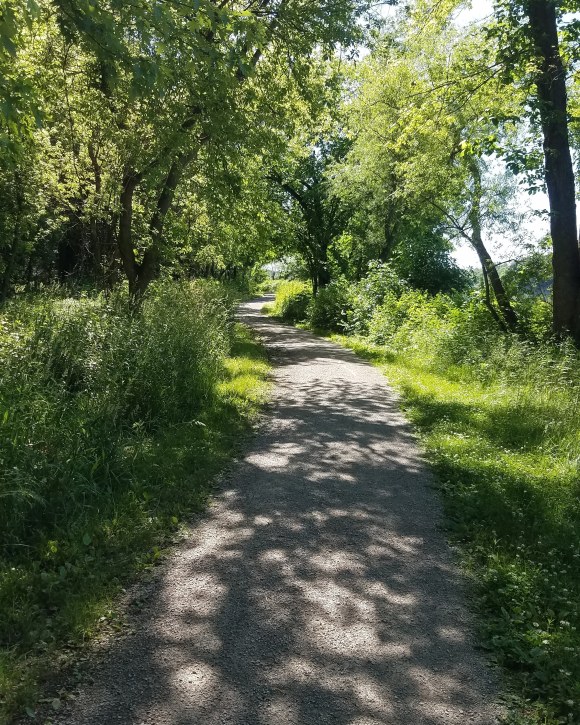
I don’t wear a mask to the state park trail and very few people I’ve encountered there do. Because it is outside and there is room enough to maintain social distancing the risk of contracting COVID-19 there seems minimal. I avoided going to the park for the first two months of the pandemic yet the need for exercise outweighed the risk of exposure to the coronavirus.
With more people home during the day the number of contacts with neighbors has increased. I don’t wear a mask while I’m with them because these encounters are pop-up activities of short duration. I have yet to see anyone in the neighborhood wearing a mask. The letter carrier and parcel delivery drivers are a source of potential contamination although a necessary service as our number of trips off the property has decreased. We sanitize packages and let them sit on the landing before opening.
Our main approach to risk management is reducing activity away from home and social distancing when we are out and about. It serves us well in that neither of us has been sick since the pandemic began. I don’t believe our experience and behavior is much different from any Iowan who takes the coronavirus seriously.
Clearly the pandemic will be of longer duration, so how should risk of COVID-19 spread be managed? There is little guidance from our government and public health guidance seems so universal it’s hard to figure how it impacts us in our actual lives. As a former career transportation and logistics professional I’m familiar with risk management. The pandemic is just one more layer added to risks already managed.
When I worked at the home, farm and auto supply store I got sick a couple of times a year. I caught something at work that caused runny nose, coughing, congestion or some combination of those ailments. The need for income outweighed potential health risks. When we entered the pandemic I reassessed and reversed my approach. I haven’t been sick since I walked out the door for the last time on April 2.
My point is we take risks in everything we do. During the coronavirus pandemic we must get better at doing so because the lives of our family and everyone with whom we come in contact depend upon it. The question never was “should we open up the economy?” The better question is what are the conditions upon which we can re-engage in society? How do we know it is safe enough to send our children to school, return to paid work outside the home, and participate in mass recreational events like concerts, sporting games, fairs and local festivals? If anything, we assumed those activities were safe before the pandemic, even though we knew, subconsciously at least, that safety has a broad spectrum of risk and no human activity is completely safe.
What are reasonable risks? Lacking appropriate guidance from experts each of us is making up our own rules, our own trade-offs between risk avoidance and participating in life. There is no going back to life before the pandemic. How do we restore enjoyable aspects of our lives with less risk of contracting COVID-19?
I don’t have definitive answers except that we are on our own. We are doing our best and for the time being, until we figure this out, that may be the best we can do.
If daily life took its course without our engagement we would be reading more words and fewer books.
With the rise of social media a lot more words are being published and many readers get “glued to their phones” as they take in all the words and video they can within a circle of friends and followers.
Long form reading in books is an essential part of staying informed. It took a conscious effort to stop my entropic slide to reading no books each year to include long-form reading in daily life. Ironically this began by using the social media tool Goodreads. By setting a low annual goal of 16 books per year in 2018 I surpassed it and have increased my book reading every year since. In the first five months of 2020 I read 26 books.
Reading short pieces, newspaper and magazine articles, and social media posts is an important part of securing new information about our lives in society. At the same time erosion of book reading leaves us the less.
The current book on my night stand is Save the Plums: My Gourmet Memoir by Ruth Reichl who spent ten years as editor in chief of Gourmet magazine. An intellectual masterwork? No. I found Reichl’s reference to William Carlos Williams annoying, yet the pace is quick, the chapters short, and the language a straightforward narrative. It’s how a person with a specific experience wrote autobiography. The more experiences of writing styles we have, the better writers we can be. If you forced me to put this book in a category, it is summer reading and a part of a broader universe of reading material.
We seek in reading, in any format, an understanding of the person behind the writing. When I review my social media feeds, some people I know personally and have done things with. Others I know by their writing. There’s a reason it’s called “social media.” There are people behind the posts or at least that’s what we hope.
That is less true of book reading where the author may be present in every page yet strive to minimize their personality or presence in the words. Can a book stand separately from it’s creator as a work of art? I don’t see how it’s possible to separate the work from the author’s social context. In that regard, historians are the worst. There is an ideology of history writing and to attempt to hide or diminish it is a disservice to the reader (Oscar Handlin). There is a politics and poetry of writing history. There are books on those subjects. It is possible, and I’d argue necessary, to both adore historians (Robert Caro) and despise them (Doris Kearns Goodwin) that has nothing to do with the information presented on a book’s pages.
I look at reading the way I view being a food consumer: I seek to know the face of the farmer and in the case of reading, the face of the author. That’s true of any reading I do. I am more likely to trust, read and comment on something an acquaintance posts because we physically met and I’ve followed them in social media long enough to understand something about their social context. The same is true for writers in mass media. I want to know who they are and what their history is rather than read a single sensational story. As a reader and human, I’m in it for the broader picture.
The rise of artificial intelligence is producing computer generated writing. I think we need to inoculate ourselves against this fake writing by spending time learning about authors and reading their published work. As the noted philosopher Taylor Swift wrote, “the fakers gonna fake, fake, fake, fake, fake.” We need to be able to shake them off. That requires us to be informed readers.
If we are going to read more at least some part of our lives should be engaging the authors of those words. Obviously it’s less possible for dead writers. Yet we are living now and should be spending part of our time reading full-length books both as a supplement to short form reading and as escape from it. Entropic decline in long form reading is something we must address in our lives. That is, unless we accept the mutation of humans will eventually include genes for mobile phone adaption.
When the news goes to hell, like it did on Friday, I retreat.
In an on line chat about poetry I wrote a follower, “Hope things are going better in Canada than they are here.”
“They are, very much so here in B.C.,” he responded. “I’m not a flag waver type but this present moment produces a real sense of refuge.”
On Friday moving to Canada was not out of the question.
To where did I retreat? I worked outdoors from 7 a.m. until 4 p.m. on Saturday. I harvested grass clippings for mulch, put in the seventh garden plot, and called initial garden planting done.
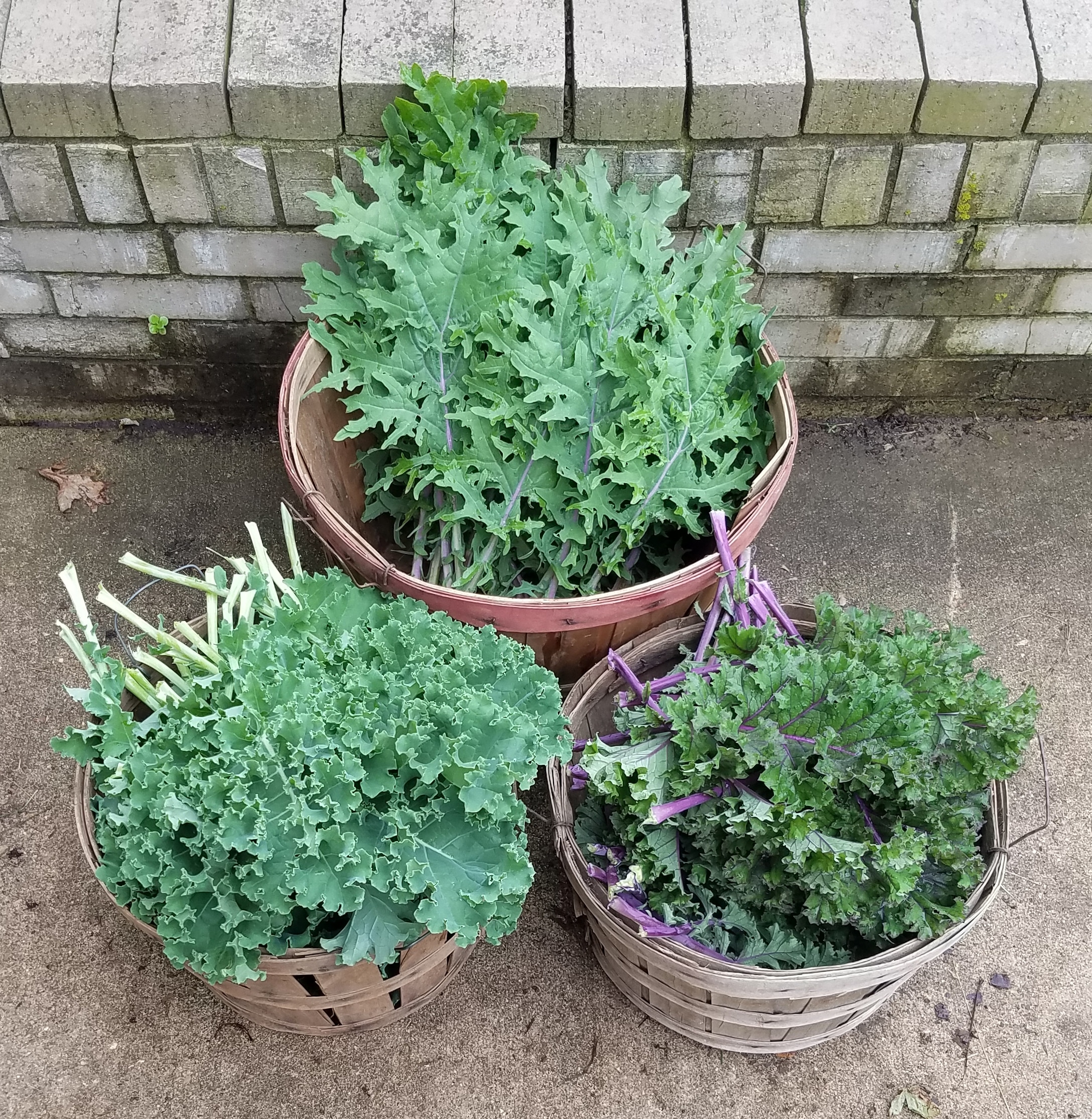
I picked kale and delivered it to one of the library workers. Our public library remains closed because of the coronavirus pandemic yet they continue to run limited operations behind locked doors. Next week they begin curb side materials pickup as they determine how best to reopen. The local newspaper featured a photograph of the librarian wearing a mask in from of the building. Our library is the most obvious local indicator of the progress of the pandemic and economic recovery.
Once again, a video shared in social media — the May 25 murder of George Floyd by a police officer in Minneapolis — sparked demonstrations and violence broke out in cities around the United States. Coverage dominated the news, eclipsing every other story, including the coronavirus pandemic which has now resulted in more than 100,000 U.S. deaths according to official statistics. It is a sign of the times I didn’t hear of Saturday’s demonstrations in the county seat, or in nearby Cedar Rapids until after working in the garden. There were no demonstrations where I live.
The thing about a retreat is it has a fixed beginning and end point, leaving us with the question what do we do next? It’s not complicated.
Above everything else, addressing the lack of leadership in our current government is a priority. That means voting the Republicans out of office in the 2020 and 2022 election cycles. It is difficult to see how any substantial change will be possible, in any area of society, until that is done. I’d much rather be writing about the climate crisis, income inequality, and social justice. For that to have meaning, we need leadership to set different priorities and move the country toward solutions. We can point out solutions to the climate crisis and income inequality, and that black lives matter all we want. To make a difference, our only hope is to change our government.
My last paycheck from a job was in April after retiring from the home, farm and auto supply store. Our expenses came down dramatically during the pandemic so there was money left from our pensions to pay down debt and donate to political campaigns. We’ll be doing more of that. Better than that will be to develop a positive message about who we are as Iowans and as Americans and to share that broadly. Living with a demagogue as president has been frustrating. We have to believe our best days are ahead of us and take action to work toward that end.
Mustard greens – walnut pesto with a flat loaf of freshly baked bread.
On Friday I planted the rest of the tomatoes and the sweet, bell peppers. I’m running out of room for hot peppers so I harvested mustard greens and made pesto with ingredients from the pantry. I’ll use that space for a variety of hot peppers.
I have more seedlings than will fit in my seven garden plots so choices must be made. The last plot will be cucumbers with room for whatever else will fill the space, likely the single zucchini plant that germinated, and more hot peppers and tomatoes.
Succession planting is important to space management but the ice box is filled with leafy green vegetables and a family can only eat so many per day.
Rain is forecast in the next hour. As soon as the sun rises I want to harvest turnip greens to make the last of the vegetable broth for canning.
I’m trying to get better at growing bell peppers. Here’s a passage from the Jan. 18 barter proposal to my farmer friend Carmen:
We talked about mentoring on how to grow bell peppers. The idea we discussed was me spending some individual time with you discussing seed variety, irrigation systems, weeding, fertilizing, pest control and other issues, then helping you grow this year’s crop. While this means more labor on my part, I consider that part of the learning process for which I’d be bartering, not an added expense to you. As the crop comes in I would want a fair share for fresh eating and freezing as long as the harvest continues, some prime quality and seconds depending on what’s available. What is the value of that learning experience? I don’t know but I’m willing to settle the remaining accrued value for it, making us even.
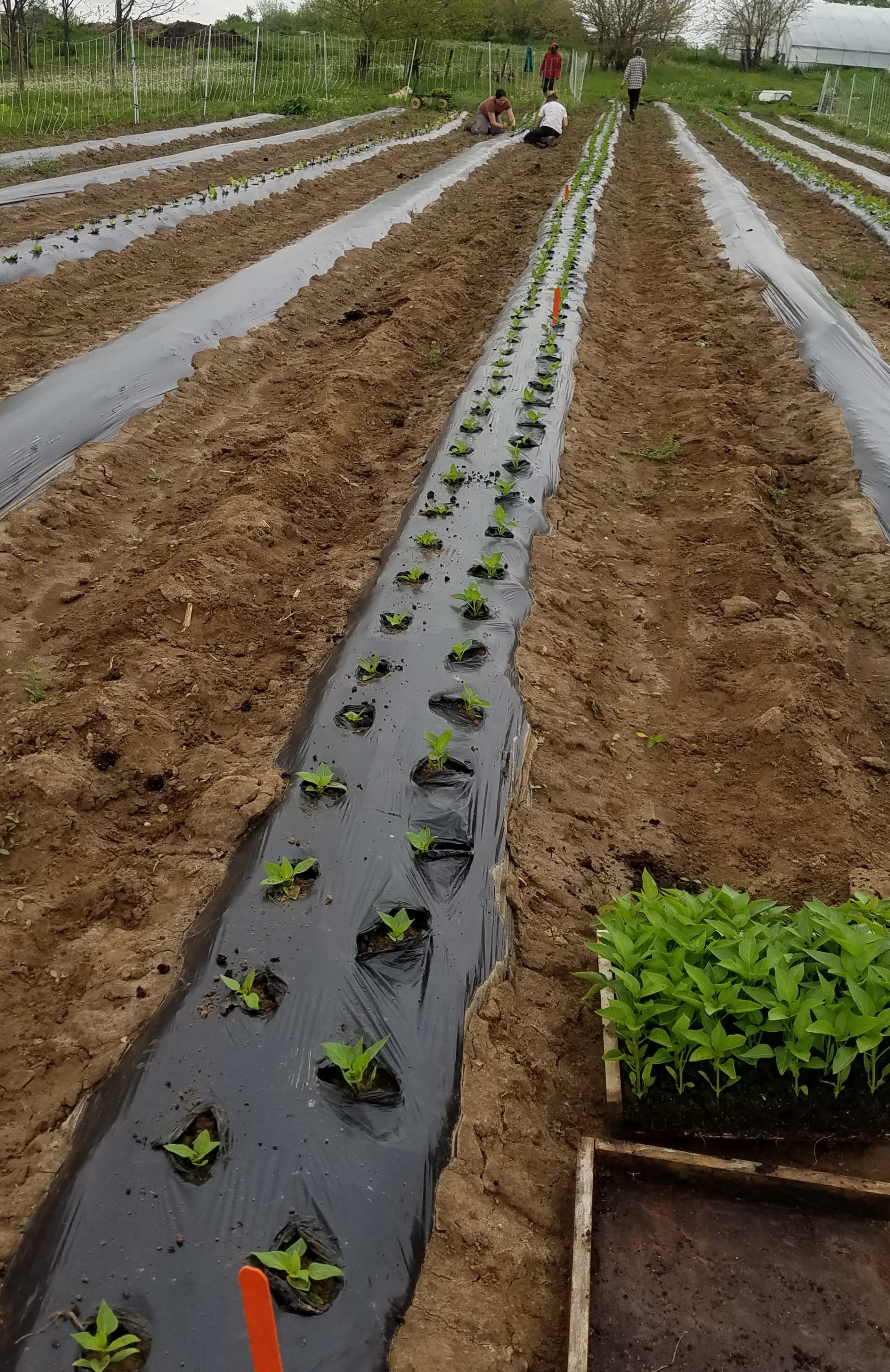
Thursday I spent a couple of hours at the farm planting peppers. Below are comparison photos of the farm’s peppers and the row I put in my garden yesterday.
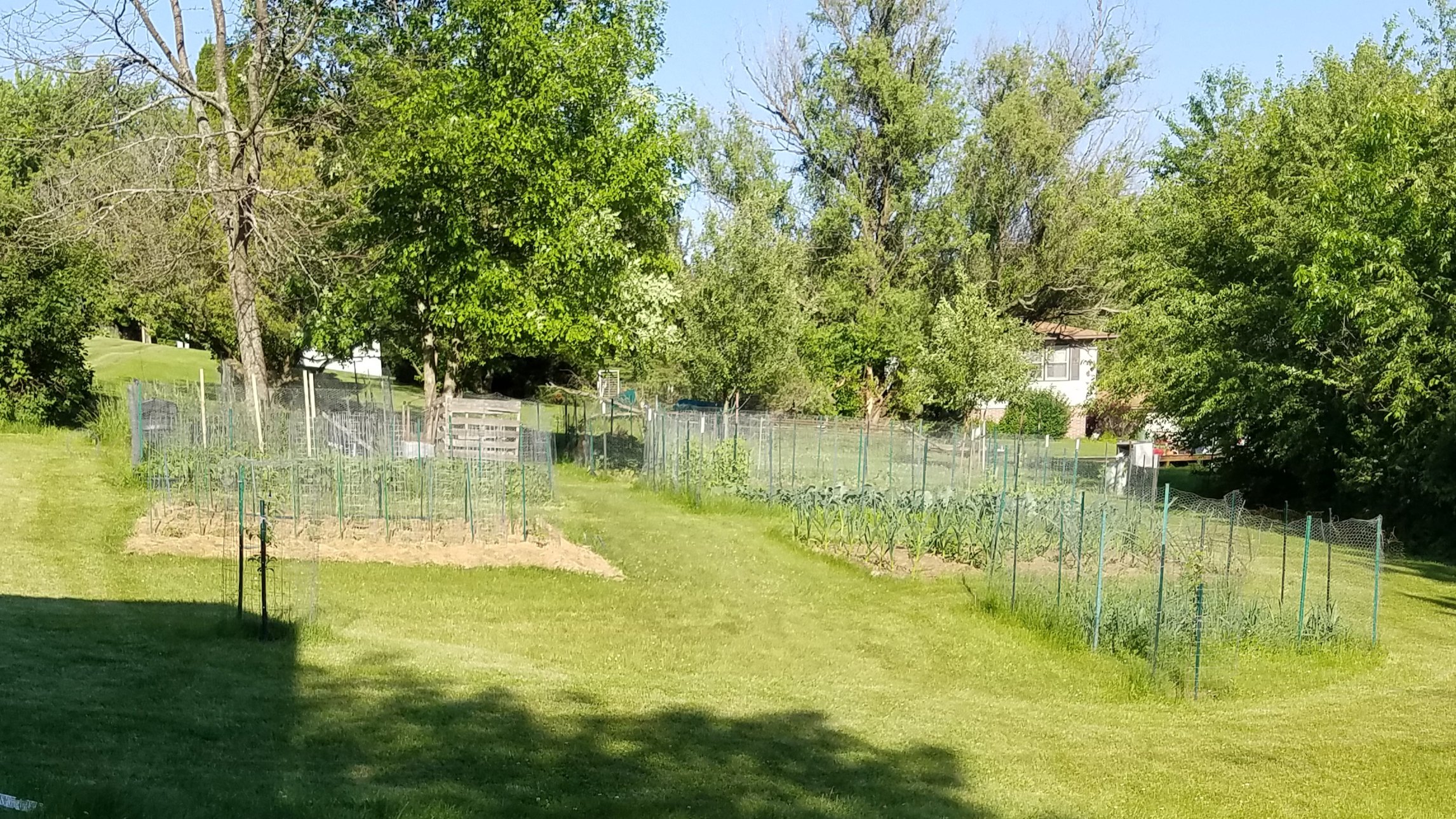
Pepper row at Local Harvest CSAPepper row in my garden.
At the farm they have a mechanical device to lay plastic for the rows. It creates a berm of soil in the middle of each sheet into which seedlings are planted. There is drip tape irrigation under the plastic. In my garden I manually made the berm with a hoe and garden rake, then covered it with a 48-inch layer of landscaping fabric. I placed grass clippings on each side. I have no drip tape and therefore need to make sure peppers are adequately watered.
The seedlings I used were a combination of ones I started and the main crop peppers at the farm. I also put in six plants of Guajillo chili peppers and two each of Serrano and Jalapeno. Fingers crossed I produce some peppers out of this.
A lot of weeding remains to be done. Also remaining is the related grass clipping collection for mulch. For that to happen I need a solid block of weather without rain. Doesn’t look like that will happen today.
I picked the first bunch of Red Russian kale and gave it to folks at the public library.
Despite the coronavirus, life goes on.
I spent a couple of hours at the farm learning how to grow bell peppers. Growing hot peppers has not been an issue. A generous supply of garden-grown sweet bell peppers has eluded me. By taking time to learn the process with more experienced hands I hope the harvest will be better this year. Fingers crossed.
Writers block hasn’t been a thing for me, but maybe it now is. Everything feels in between. In the third month of the pandemic I’m looking for new goals, new projects on which to work. I look at the calendar and realize the limited time left this year. Here’s hoping I find worthy projects pronto.
I began writing in grade school. The earliest remaining written document is a letter to my parents from YMCA Camp.
I reported having fun.
When reading those handwritten words, forgotten memories emerged. They reside in my brain like fossilized footprints from yesterday’s muddy garden. Such memories mean something. I can say with some certainty camp was fun.
When writing about worklife I seek several things. Partly I want to understand my own work history. It is more than a small chore to write a timeline of a life’s main events. Seeking that will aid telling my story.
More than a timeline I seek to understand why I worked and how it affected me. When I took my first job as a newspaper carrier the work was possible, something boys my age just did. I took a job in high school at a retail store called Turn-Style which was an entry into after school work life. It was possible and common among my classmates to have an after school job. Both of these early jobs funded activities that would have been less likely if I didn’t have income. The most significant activity Turn-Style funded was buying a used car and fuel to keep it going.
During the summer of 1971 I returned home from college. Like most of my male high school classmates I was able to find a summer job in industrial and manufacturing plants in the Quad-Cities. I landed at Oscar Mayer’s slaughterhouse working on the maintenance crew. It was dirty and hard work but in three months I made enough (at $4.04 per hour) to pay the sophomore year college expenses my scholarship didn’t cover. I learned how to clean a lard rendering tank among other valued skills.
After college the employment situation in Davenport seemed dire. Globalization was beginning to take hold, with some jobs moving to Mexico or overseas. It impacted the community with layoffs and those easy to find manufacturing jobs were less easy to secure three years later. I also did not want to get caught up in being a “shoppie,” working a career in manufacturing.
I didn’t have high expectations but after working a couple of low-wage jobs to make ends meet I enlisted in the U.S. Army and was gone for four years. Because of the G.I. Bill, I attended graduate school and got my M.A. in 13 months without other paid work. There were no good or exciting job options in 1981 after graduation so I applied and went to work at the University of Iowa.
After meeting my future spouse at the university, and getting married in 1982, I took a job in transportation and logistics with CRST Inc. in March 1984. I spent more than 25 years doing that type of work. I earned enough money so Jacque could work at home until she was ready to enter the paid workforce again.
Beginning in July 2009, I retired from CRST Logistics with a sheet cake and going-away gifts to enter a period of low wage work. In all I logged 24 different jobs and work activities since then — some paid and some volunteer. There was a lot of diverse experience in all that, about which I’ve written in this blog. What I’m left with today is being a blogger, writer, gardener and human.
While frequent blog posts are an important part of my writing, there is more. The coronavirus pandemic has been an opportunity to consider my writing and develop other projects including a memoir. I’m not finished working yet the number of paid jobs is close to zero as we enter the third month of the pandemic. It provides a perspective that might not have been otherwise possible.
As the sun rises on a forecast dry day I plan to work in the garden planting tomatoes, peppers and cucumbers. While I do, I will consider what’s next for me and the meaning of my years in the workplace. The pandemic isolation brings this into focus.
I hope what I write next is as meaningful as that letter to my parents written so many years ago. If it isn’t, at least we’ll have vegetables.
My first job in grade school was as a paper boy for the Des Moines Register.
I wanted a paper route. It was what boys my age did. After discussing it with Mother, she arranged the job by calling newspaper circulation desks. The Register route was available.
It was a long, morning route because the Register wasn’t as widely circulated as our home town newspaper, the Times-Democrat. I could ride my bicycle and get the papers delivered with plenty of time to get ready for school.
Before long, I changed to an afternoon Times-Democrat route located on Marquette Street between West Central Park and Locust Street. The Times-Democrat had morning and evening editions at the time. Less walking, more deliveries, and more money for me. I kept the route until high school when I was told it was time paper boys moved on to other things. Having a little money, maybe a couple of bucks a week, made a difference in my life and in the range of activities possible in grade school.
I made weekly collections from subscribers on Fridays. Some subscribers were the worst. They were never home on Friday and when I finally found them on other days they would deny they owed for multiple weeks. My collection pages had a coupon that indicated each week that was due so I knew where each account stood. I gave customers the coupon for a week after they paid. When they got four weeks behind and didn’t pay I called the newspaper to cut them off. My supervisor never wanted to do it because the newspaper had subscription targets. Statistically, the majority of my customers were nice and paid on time. However I do remember the deadbeats. In retrospect, my margins sucked but there was enough money to satisfy my nascent financial needs.
On Saturdays I paid my bill for the bundles of papers dropped on the corner of Marquette and Lombard Streets. I took a city bus from nearby Mercy Hospital to what was then a thriving downtown Davenport. I spent parts of every Saturday morning downtown, beginning at the newspaper office on East Third Street.
One of my favorite downtown places was the automat at the M.L. Parker Department Store where I occasionally bought a pre-made hamburger and warmed it under an infrared light bulb. We didn’t have such a heating device at home. I stopped at W.T. Grant, F.W. Woolworth and occasionally went to Petersen Harned Von Maur, inconveniently located across a busy Second Street. I also stopped at Louis Hanssen Hardware Store where they had a centralized cashier operation connected to the sales floor by a small trolley system. There was a coin shop which was almost never open as early as I was downtown. The idea coins that passed through my hands on the paper route were worth more than face value was fascinating.
In 1964 a friend and I rode the bus downtown. After paying my bill we went to the local Democratic party office and stuffed envelopes for Lyndon Johnson’s presidential campaign. Our motivation was to trade labor for an LBJ for the USA button. After finishing with the Democrats we walked a couple of doors down to the Republican party office and did the same thing for a Goldwater button. The idea our families would vote Goldwater for president was ridiculous. Father had worked hard to organize for JFK and was doing the same for LBJ. It felt weird being in the Republican campaign office but I brought home a button which had “Au H2O” printed on it anyway.
My male schoolmates were also shoplifters at the downtown department stores. Having a steady income from my paper route, I never shoplifted. From time to time I met up with my mates at one of the movie theaters for a matinee. They compared the results of their thievery that morning. For a while they stole bottles of men’s cologne which they tried to sell me. What would I do with cologne? Retail managers wised up to what was going on and secured the products in display cases. That apparently ended such thievery.
My interest in meeting my friends was to see movies at a reduced price of 35 cents. Most of what we saw was related to World War II: The Longest Day, The Great Escape, The Bridge on the River Kwai, and others. When the cost of a matinee went up to 50 cents, I felt we were being gouged.
One time we saw an ad for a movie in Rock Island about the Batman. Someone had compiled all 15 episodes of a Batman serial made in 1943 by Columbia Pictures. The Batman television show became a popular topic on the school playground, so we wanted to see the serials. We took the bus downtown and walked across the Centennial Bridge for the matinee. I told Mom what we were doing so she wouldn’t be surprised when I was gone for so long. I remember it was a very long walk across the Mississippi River although worth it because I now knew something others didn’t about the Batman.
In the mid-1960s working as a newspaper carrier expanded my horizons. I got to see how my customers lived and had a chance to explore a world outside the confines of our neighborhood. I found there was a broader world where everyone did not share the same values we did at home.
I felt the relationship with my manager was good, although my daily work was disconnected from him. I was always the last to know about sales promotions and newspaper policy that pertained to me. It led to an attitude that I would do my job as I saw best without worries about my supervisor or whether I was right or wrong in what I did. That proved to be a defining aspect of my character at the beginning of my work life. Being able to work on my own without regular, direct supervision became part of who I was and remained so for the duration of my work life.
My first work experience was positive and that made a difference as I progressed through life. Adapting to work in a positive manner was an important part of the working class home in which I came up. It prepared me for the challenges of a career yet to come.




 Journey Home
You must be logged in to post a comment.