Categories
Work Life

Exiting the Land of Awesome

Paving the Road
Paving the Road

LAKE MACBRIDE— During the last two months my work performance with a temp agency was described as awesome more times than can be counted. It was a bit startling insofar as the word “awesome” was not a regular part of the vocabulary of managing people during my 25 year career in transportation. The tendency of managers and supervisors was to take people down a peg rather than lift them up. Yet in 2013, awesome I came and awesome I exited the temp job, with repeated entreaties to return if my situation changed. Things may change, so the door was left open.

The reason for the awesomeness was good work habits drilled into us by the nuns and clergy in elementary school. They taught us there was a way to behave in society and, separate from religious life, respect and diligence were expected and freely given outside the enclave of a Catholic grammar school. It was a matter of exercising our free will.

When agreeing to work for the temp agency, I showed up on time, made an effort to understand and comply with the work rules, and didn’t cause any trouble. This very basic outlook toward work is apparently lacking in the majority of people who find their way to temp jobs— hence, I was awesome.

While tempted to linger on, I would have gone broke keeping the temp job. What was attractive about it was no one knew or had heard of me before I walked in the door. It was a clean slate where employees were judged on the quality of work, with clearly defined processes and measurements. The conversations I had with colleagues were genuine and fulfilling. It was a form of acceptance that was severely lacking in other experiences.

The temp job provided valued insight into a world of labor and management in contemporary Iowa. After exiting the land of awesome, there is freedom to write more in public about outsourcing, labor and management based on my experiences. As understanding and recovery from the manual labor comes, I will.

Categories
Living in Society

On Senate Adjournment and Health Care

Dome IA State CapitolBIG GROVE TOWNSHIP— In her remarks before adjournment sine die of the first session of the 85th Iowa General Assembly, Senate President Pam Jochum made a statement that included the following, “the biggest challenge of this session was how to help Iowans who, despite working every day, still cannot afford health insurance.”

The Iowa Senate addressed the issue in Senate File 446, the health and human services budget, which was 60+ pages and reported from the conference committee late yesterday. Some house members wanted to read the bill before voting, and were concerned that there would be time. It was difficult determining the status of things in the wee hours of this morning, but the house adjourned until 9 a.m. this morning, giving legislators time to pull an all-nighter and read the bill.

At the warehouse where I work with some of the same people Senator Jochum referred to in her statement, there is neither a health care plan provided, nor is there adequate pay to enable workers to buy a health insurance policy. This forces employees to seek medical care in their social networks and on the open market, and is at the core of the problem SF 446 seeks to address. Like it or not, business interests drive dependence on programs like Medicaid.

It is unclear by how many layers temp jobs like mine get outsourced: at least two or three. The job is organizationally far removed from the parent company that ultimately buys our labor. American business, in its global footprint, bankruptcy declarations and restructuring, mergers and acquisitions, and increased outsourcing, successfully stripped away the part of employee compensation related to providing health care, while improving productivity and decreasing the cost of labor.

For a single person, buying private health insurance can cost $350 per month or more. For a family of two, a monthly premium can be more than $800. Do the math. At an hourly wage of $9.25, with limited overtime, and no paid holidays, disability insurance or sick leave, a person can expect to earn just short of $18,000 per year, taking home about $15,000. There is no room in the budget for health insurance.

Why do people take jobs like mine? Regardless of the social commentary about living wages, minimum wages, prevailing wages, and general working conditions, the money is green at outsourced jobs, and people need it to help get by. There appears to be no shortage of people willing to work slightly above minimum wage, without benefits.

My co-workers have no time to worry about getting sick, or about how to pay for health care. The presumption is any illness will get treatment in one’s social network, with a visit to a clinic, emergency room or doctor’s office being the last resort. Whatever the Iowa government does with the Senate’s health and human services budget, it will be a band aid on a problem that wants a better solution— one that lies more in the global business community and with workers than with government.

We’ll see the Iowa house reaction to the senate bill today. Presumably the conference committee had support for the bill before reporting it out of committee. Here’s hoping the legislative band-aid does some good if and when it is signed into law.

Categories
Writing

Transplant Promotion

Local Harvest CSA
Local Harvest CSA

RURAL CEDAR TOWNSHIP— A group of us transplanted eggplant seedlings from a sprouting tray into individual soil blocks. The work brought new learning about how to do this important work. Naturally, my native practices left something to be desired.

The key is to make sure the tap root of the plant, identifiable because it is very long, gets completely covered with soil. The other thing is to plant the seedlings with the first leaves as close to the top of the soil as possible. Previously, I left some of the stem exposed, thus making survival riskier. It goes without saying, and is likely part of genetic breeding, to pick the biggest seedlings for transplant. The new work was considered a promotion, although there was little rank among today’s group of workers.

After finishing transplanting some workers headed to the field to pick asparagus and I tagged along to see how they did it. Another learning process, and bonus dividend of this year’s work at the CSA.

The talk of the day included my onion patch, spring garlic, and questions about seedlings, basil, parsley, and the time to plant tomatoes. The farm began planting tomato seedlings yesterday, and based on our discussion, I am going to hold mine, at least until this weekend. They are about the point of being root bound in their cells, but I want to make sure we are past the frost.

Our household received a bulk mail post card from a competing business— someone who is taking market share from small CSAs like ours. We discussed it as a competitive reality to be dealt with.

There is not enough discussion of the impact of capitalization on local food, and I generated an idea for a future post. Between giant growers like Earthbound Farms Organic, and our CSA there is a middle range of farm operations that are well capitalized, and impact how local food is perceived. They trade on leveraging other growers, the previous marketing of local food, and consumers who have heard little about the local food movement. Watch for that one.

On the home front, the apple blossoms are falling like drops of silk, with or without a breeze, indicating the bees are doing their work. The lilac bushes are in full bloom, generating an aromatic that prompted memories of many happy spring days spent in Big Grove.

Categories
Home Life Work Life

Saturday Miscellany

Lettuce Patch
Lettuce Patch

BIG GROVE TOWNSHIP— The editors are in Jamaica on vacation, so work at the newspaper was rearranged to finish the proof reading today and create tomorrow as my first day off paid work since Good Friday. The fill-in copy layout person wanted Mother’s Day off work, so I finished my part of producing the weekly newspaper before lunch.

I called Mother today and had a long chat. For the first time in a long while, she had listened to some of my advice and reported she took it. The two of us are not much for the Hallmark Holidays, but we have a special call each year on or before Mother’s Day. I am thankful to be able to hear her familiar, octogenarian voice letting me know what is going on in her life.

Otherwise, today has been a miscellany— some of which is worth recounting, the rest, not so much.

Censored on the Internet
Tweet Expunged

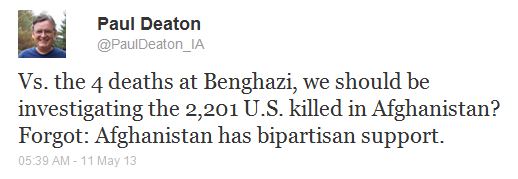
For the first time, one of my tweets on twitter was expunged. A person is not saying much, if from time to time, someone doesn’t react negatively to it. Don’t know why it is gone, but I suspect someone ratted me out to the twitter-gods on the Internet. It was likely over the use of a question mark rather than a period. The reason I have a copy is Iowa City Patch re-tweeted me, generating an email with the content.

Rand Paul gave a speech at an area fundraiser today, giving credence to the idea that his presence is to help Republicans organize for the first in the nation 2016 Iowa caucuses. Paul’s visit was intended, at least partly, to generate some interest among no preference and Democratic voters. From reading other accounts of the event, the Republican party faithful represented most of the attendees. Rand Paul ≠ Ron Paul, and there could be trouble for the Republican organizers trading on the Paul name. Trouble would be fine with me.

In our state representative’s weekly newsletter, he outlined the reason for his opposition to new nuclear power, especially in rural Wilton, where he lives. It is more than the NIMBY (not in my back yard) approach he mentioned at the Morse town hall meeting. He suggested, perhaps unintended, that the issue will be a live round during the second session of the 85th Iowa General Assembly.

Garrison Keillor’s “A Prairie Home Companion” plays on the kitchen radio Saturday nights beginning at 5 p.m. I have been listening off and on since graduate school. For a while, one of Keillor’s prominent sponsors has been Allianz, the German financial services company. The International Campaign to Abolish Nuclear Weapons (ICAN) pointed out that Allianz owns 4.45 percent of the shares of the top 20 producers of nuclear weapons. Allianz has investments in Alliant Techsystems, BAE Systems, Boeing, Lockheed Martin, Northrop Grumman,  General Dynamics, Honeywell International and others.

ICAN has called for divestment in these securities, and I have been pondering what to do since hearing. Long standing behavior is hard to change, especially when part of our lives is built around it. I have invested a lot in “A Prairie Home Companion.”

It is habit and memory that turns on the radio. Memory can’t be changed, but habits can. Familiar and comforting as ” A Prairie Home Companion” is, I’ll find something else to do while preparing our Saturday night meal. It is a disappointing development in a world full of wonder.

Categories
Work Life

Saturday Morning after TGIF

Screwdrivers
Screwdrivers

LAKE MACBRIDE— There was a time when our life on the Iowa prairie resembled what now is referred to as the middle class. My mother worked at home and at the school cafeteria, and my father had a shift job at a meat packing plant, Monday through Friday. We kids went to school and church, played in the neighborhood, and from time to time, our maternal grandmother came over for Sunday dinner. We had little money, and didn’t need much. After Dad’s death I found one of his pay stubs in his basement workshop indicating $89 per week.

Dad was involved with our family, the union, politics and getting ahead. After work on Fridays he would head to Pete’s Midwest Tavern to socialize, and blow off some steam. On Saturday mornings he slept as late as he ever did, his wedding band and watch on the bedside table until he rose. As he struggled to get ahead, he took up golf as a means of socialization and networking, although he didn’t call it that. Eventually, Saturday morning sleep-ins were replaced with an early tee-time. It turned out he was good at playing golf, not quite a scratch golfer.

It’s been a lot of years since Dad passed on— it is difficult to tell, beyond the gene pool,  whether I am like him or not. He would likely disapprove of my current temp job as a shift worker, as he had better things in mind for me. He never said exactly what, but provided career advice, “don’t become a grease monkey— keep your hands clean.”

After a week of warehouse work, my workmates and I do thank God when Friday arrives. It is a bit lame that I don’t know if bars are open after midnight. Always, I have headed home, although someday my younger cohorts may invite me out after work. I would go if they did.

My hands swell from the manual labor I perform. I take off my wedding band and place it on the dresser near where the watch I haven’t worn since the 1990s rests, its battery dead. I sleep in on Saturday morning, and it’s okay to break from society and its conventions.

The way the phrase “middle class” is used today seems spurious. A marker for a political agenda, rather than a condition or status in society. Demographically, the term is meaningless because of the vast range of economic status of the group falling between the haves and the have nots— the have somethings.

I feel working class when sleeping in on Saturdays, tired from the preceding week of manual labor. Whatever one calls it, luxuriating in being who we are is important to maintaining our sanity in a turbulent world. Even if it only lasts for the brief time between sleeping and waking on Saturday mornings.

Categories
Work Life

Plasma Sales and Politics

LAKE MACBRIDE— The Cumulus radio station in Cedar Rapids was advertising how a person could earn up to $340 per month selling their plasma. It’s enough money that it was worth a look to see if plasma sales could fit into our bottom line. It sounds kind of grim, but people do it all the time.

Plasma is the pale, yellow liquid portion of blood that helps our bodies control bleeding and infection. When one donates plasma, our blood is removed and the plasma separated before blood is returned to our body. We generate more plasma within a couple of days so twice a week donations are usually possible.

Donating takes about an hour and plasma collection centers make it easy with a straight forward, step-by-step process. Importantly, they explain how payment is loaded on a debit card. It is literally using one’s body as an ATM.

Several self-employed and low-wage earners in my circle use plasma sales to supplement monthly income. Got a toothache? Better schedule some sessions at the plasma center to get dollars to pay the dentist. One suspects residents of our nearby college town use the cash for cigarettes, sugary drinks and beer, but in any case, plasma sales can be a reliable and steady source of income if one meets the requirements for donating.

The money could be put to good use. For example, it could be used for political donations. That way, when a political telemarketer called, I would know my approximate annual budget, and be able to say, “Yes. I’ll donate that $100, which will take me four plasma sessions.” Politics would literally be based on blood money then.

We could go a step further and say that all financial contributions to politicians had to originate in plasma sales. There would be a natural limit to how much a person could donate, and a restriction could be placed on corporations that said something like, corporations can make political contributions, but such contributions must be paid via the plasma of shareholders, imposing a natural limit to money spent by corporations during political campaigns. I bet corporations would exercise their free speech differently under such a rule.

If my modest proposal about political contributions through plasma sales seems a bit edgy, I am pretty sure it would work. Importantly, it would set a human limit on political contributions. Having skin in the game would take on a whole new meaning. Most Americans are asleep at the wheel of politics, and would not contribute, so there is little danger of a glut of plasma on the market.

If times get tough, I’ll re-visit adding a plasma sales income line to our household operating budget. For now, I’m just glad I don’t have to do it.

Categories
Work Life

On Manual Labor

LAKE MACBRIDE— A priest used to joke with me about doing manual labor. It was a pun comparing working with your hands to the common Spanish name Manuel. The context was work we were doing with undocumented immigrants, many of whom were from Mexico and countries further south. When one explains the pun, it loses something, and all that is left is hard work that someone has to do— and the living people make while doing it.

The kind of labor new immigrants perform, farm work, landscaping, roofing, housekeeping, restaurant work and others, is a basic component of society’s economic model, including in Eastern Iowa. From reading Peter Kwong’s book The New Chinatown, the propensity for immigrants, documented and non-documented, is to take any kind of paying work to pay for their passage, which sometimes included coyotes or snakeheads, and secure the possibility of American-style freedom. Some of my more cynical friends might say that America offers the freedom to work for less.

During my career as a manager, I performed little physical labor. Sure, we hauled groceries collected for the local food bank to the trucks, and after the 2008 flood hit Cedar Rapids, we helped employees muck out their homes, but the main work we did was office work. That I would now include manual labor in the mix of a sustainable life on the Iowa prairie is indicative of three things.

Manual labor jobs are available. In my case, from the conception of the job opportunity until hiring was less than a week. Once I began work, conversations with others revealed many job opportunities in a variety of settings. On some days it seems like every one of us is on the move from this job to a better job, and the manual work we perform is a compromise to bring in some cash now.

A certain level of fitness is required. Endurance, use of the extremities and normal musculoskeletal development are all important. My life has been blessed with good health, and relevant to manual labor, has been free of back injury. I can do the work.

When jobs pay below a living wage, the presumption, often unrealized by the worker, is that a broader social support network is needed to take care of the rest of life not covered by wages. Those that have such a social support network are more likely to get what they want out of working with their hands.

The sustainability model I described previously wouldn’t make sense unless there were some activities dotting the matrix. Manual work serves the need to prime the pump, enabling the model and allowing for entry into a progressive path to prosperity.

One comment. The literature on immigration and how people get started on a path toward the American dream is well documented by others with much better credentials than mine. What is different, and why I write about it here, is the transformational effect of having the experience, rather than living it vicariously, filtered by other writers and the media. This may be the only way to fully understand what manual labor means to economic progress. It may be the only way to sustain economic progress.

Categories
Work Life

From Middle to Working Class

Construction Site
Construction Site

LAKE MACBRIDE— Today’s usage of the phrase “middle class” is meaningless. It is a marker for a world dreamed up while writing talking points for political campaigns. A middle class so created, never existed. It was as if we took the broken theories promulgated during the rise of mass society, and switched things around so that economic means was the determinant of whether one was or was not in the middle class. With the one percent of wealthiest people at the top, and roughly 15 percent of people who live in poverty at the bottom, the 84 percent in between are now dubbed middle class.

In our cultural background is the idea that we were all created equal, and have innate talents, some more so than others, that could and should be developed so that by application of native skills we can rise and fall in society. The so-called American dream is centered around this notion.

To some extent, the story is re-enacted as occasionally a mail room clerk rises to become chief executive officer of a large corporation. Such instances of rise in a workplace are limited in number, increasingly so, as businesses consolidate, on a global scale, under fewer corporate CEOs. In this world, the society of business is better served by increasing the number of people available to become mail room clerks, at the lowest possible wages, than by creating opportunities to get out of the mail room. Such stories are important to keeping people in their place in the economic pecking order, and I suspect that is why they are so popular.

If “middle class” is a meaningless phrase, “working class” is not. The long story of immigration to North America includes countless people who traded work for passage across the Atlantic and a chance for freedom and prosperity. I am thinking of my own ancestors and their cohort, who arrived in the 17th century in what would become the state of Virginia. They came, not as landed gentry, but as working people, delaying start up of their own farms to work for someone else who needed labor, and to secure it would pay travel costs to secure indentured servitude. This story is also part of the American dream— that through individual efforts and sacrifice, a person could become a landowner, and thereby rise in society. There were likely more indentured servants that rose to become landowners than mail room clerks that became CEOs, but their story is told less often.

Indentured servitude doesn’t exist in the same way in the 21st century, but it serves as an example of how people will make deals with the capital class to get ahead. Such deals include working for a labor broker to earn less than a living wage, in some cases, less than minimum wage, so that business can have sufficient low-cost labor to meet its needs. Without a sufficient working class, the capital class would be out of business. Working class rights, not middle class rights, should be the focus of our political leaders. It’s not, at least that I can see.

If one sits in lunchrooms and listens to working class concerns, the conversations are not about the minimum wage, unions, or much at all to do with the relationship between labor and capital. The discussions are about personal relationships, health issues, post-traumatic stress disorder of veterans, and addiction to tobacco, crack and sugary drinks.

While being a member of the working class doesn’t provide a pension, or health insurance, or security of almost any form, it is how a large segment of Americans live. We ought to be hearing more about it from the corporate media, from politicians, and from each other. If we believe in the possibility of social progress, our focus should rightly be on the working class, as it is here that the American dream was born. Neglected, it is where the dream will die.

Categories
Work Life Writing

Sustaining a Creative Life

Barn WallLAKE MACBRIDE— Today, the key element in sustaining a creative life in Big Grove Township is magnesium sulfate, or Epsom salt. A thirty minute foot bath provides a form of relief few other things can provide. I recommend it, although for the most part, people already know about it, and for some it works, for others, not so much. Well-cared for feet are something we take for granted, but shouldn’t, because they are an important foundation to creativity.

When I was at university, I shared a house with a constantly changing group of creative people. We had our own rooms, and shared the living room, bathroom, and kitchen. Every once in a while we had a joint clean up activity, although housekeeping was not a priority. My contribution was to attempt to keep the kitchen clean, and recall doing a lot of everyone else’s dishes. I didn’t mind and enjoyed seeing pots and pans my grandmother had given me mixed in with everyone else’s kitchen gear.

Writers, poets, musicians, artists, a drum maker, a publisher, an aquarium builder, a travel guide and emerald seller, an auto mechanic, and guests of all kinds passed through the doors of that place. Some found notoriety in what would later become the city of literature, but mostly, people were not well known, except to each other.

I briefly shared my room with some buddies from Davenport. One went on to become a librarian. Another, who practiced martial arts, moved to California, and eventually got a credit on the Hollywood movie “The Matrix.”

A woman arrived halfway through my stay. She found a part time job, and spent every morning at a table in the entryway writing. As an early riser, I often ran into her, but tried not to interrupt. She hooked up with a poet, and eventually left with him for California, taking one of my grandmother’s saucepans with them on the train. I don’t think we called it hooking up during the early 1970s.

Later, the poet was known to sit at a typewriter with a gallon of cheap wine and write until he finished the bottle. This lifestyle is said to have led to his early death. I don’t know what happened to her.

That house was a place to camp out while pursuing other things. For me it was finishing a mandatory, but uninspiring bachelor’s degree. It was there I spent a morning tie-dying T-shirts while listening to my commencement address on the radio. I declined a job offer from the Oscar Mayer Company, which had provided a four year scholarship. When the summer ended, my sparse belongings went into storage, I took what money I had, converted it to American Express traveler’s checks, and went to Europe with my backpack for what began without a plan, but ended being twelve weeks of youth hostels, art museums and train rides. My backpack was stolen when I arrived in France, and that is another story.

There is no defined path to sustaining a creative life. Instead, we secure food, shelter and clothing, protect our health and well-being if we are able, and go on living. If we are creative, it is that spark of interest in society that sustains us, or can, if we recognize it— and Epsom salt and other common elements to help ease the pain of living.

Categories
Kitchen Garden

In the Greenhouse

Bedding Plants
Bedding Plants

RURAL CEDAR TOWNSHIP— It’s the fifth week of making soil blocks for the farm, and flats of seedlings are filling the tables. It is warm inside the greenhouse, and most days I work in jeans and a T-shirt. There is a sense of accomplishment, even though nothing has been planted in the ground except a few items in the hoop house.

There is a small community of growers and talk centers around plants and ultra-local events. Soil quality, weather, temperatures— all leading to a bigger question— when to get into the ground during this cold spring? On a farm there will be a practical answer to this question. Here’s hoping to get out of the greenhouse soon, and into the fields.

GARDEN NOTES: On the home front, I dug, raked and planted the first seeds in the garden. A two foot by ten foot patch where I broadcast Arugula (Rocquette) on the eastern end, and the remainder in a mix of three 45 days to maturity lettuce seeds (Black Seeded Simpson, Gourmet Blend, and Simpson Elite). The watering cans went missing, so I dumped dishpans full of water into a colander to diffuse the initial flow. It worked well.

Inside, I set up a table near the only south-facing window, where I consolidated all of the indoor seedlings. Things are coming along nicely— for the most part. After consulting with the CSA, I abandoned the project of starting onions from seed and replanted those cells with Cayenne pepper seeds. The Rosemary mostly did not take, so I marked the ones that did and planted broccoli in the rest of those cells. I made what I am calling “bombs,” planting all of one kind of seeds in each of several old flower pots. A basil bomb, a mint bomb, and an arugula bomb will hopefully be available for the kitchen. Some have already sprouted.