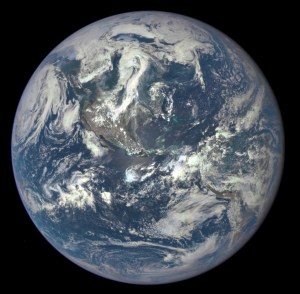
Image of Earth 7-6-15 from DSCOVR (Deep Space Climate Observatory)
Regardless of winners, there are only two issues that matter on Nov. 6: climate change and nuclear weapons. They represent the only existential threats to society as we know it.
Will Democrats or Republicans do a better job addressing climate change responsibly? I don’t know.
Stakes have gotten higher.
The Intergovernmental Panel on Climate Change issued an Oct. 6 report which said the impacts on humans of letting the planet warm by 1.5 degrees Celsius are bad. If it gets warmer they are worse.
The good news is there is time to address it. It will be hard.
“Limiting warming to 1.5 degrees Celsius is possible within the laws of chemistry and physics but doing so would require unprecedented changes,” said Jim Skea, Co-Chair of IPCC Working Group III.
Humanity does not have a good track record of making sensible change.
The IPCC indicated society has between 10-14 years to address global warming before it reaches a tipping point after which it becomes uncontrollable.
In other words, it will be incumbent upon elected officials to address humanity’s contributions to global warming regardless of party.
Please vote, and consider what candidates might do to address climate change as you do.
Image of Earth 7-6-15 from DSCOVR (Deep Space Climate Observatory)
It is no surprise the Heartland Institute hosted a conference called “The America First Energy Conference” for climate change deniers on Aug. 7 in New Orleans.
Heartland is the libertarian think tank that teamed up with Philip Morris to deny the health impacts of tobacco use. Climate change denial is high on their priority list.
“The day-long conference reflected the political rise of global warming skeptics in Donald Trump’s America that is occurring despite mounting scientific evidence, including from U.S. government agencies,” Reuters correspondent Collin Eaton wrote, “that burning oil, coal, and natural gas is heating the planet and leading to drought, floods, wildfires, and more frequent powerful storms.”
“The leftist claims about sea level rise are overblown, overstated or frankly just wrong,” Heartland president and CEO Tim Huelskamp said in an interview with Reuters. Regarding the United Nations’ findings on climate change, he said it was “fake science” motivated by a desire for “power and control.”
An irony is the conference is being held in the American city most impacted by extreme weather made worse by climate change. New Orleans has not recovered and may never recover from the August 2005 Hurricane Katrina.
“One of the country’s largest credit rating agencies has put New Orleans and other coastal cities on notice: prepare for the effects of climate change or risk a hit on your credit score,” according to Tristan Baurick at the New Orleans Times-Picayune. When the risk analysis community says it, it must be real.
Climate change is real, it’s happening now, and human activity is a primary contributor to extreme weather events like New Orleans experienced.
The rise of a conference like this is attributable almost entirely to the rise in prominence of libertarian billionaires with a long range plans to re-make American society to their liking. They believe their liberties have been infringed upon by government regulations and the Trump administration has been removing barriers to the practice of unfettered capitalism. That’s not good for you, me, or the people of New Orleans.
It is shocking how much the Trump administration has deregulated government in less than two years. The fact the Environmental Protection Agency is deregulating asbestos, a known carcinogen banned in 55 countries, is a sign of how far they will go. The only check on such behavior is for Democrats to win a majority in at least one chamber of the next Congress during the 2018 midterm elections, or to vote Trump out in the 2020 general election. Much damage has already been done. Some of it can’t be reversed.
I met a nine-year-old from Saudi Arabia recently. He lives with his extended family on the Arabian Peninsula and has come to Iowa the last couple of years to visit his mother before school starts in September. We talked about the weather.
“It sure is hot,” I said.
“Yes, but I don’t believe it is climate change,” he replied.
“No, probably not,” I said. “It’s August in Iowa.”
It is one thing for children to learn the difference between weather and climate change. When adults in the room deny the science of climate change, it’s something else. It’s clear there were few adults at the conference in New Orleans.
Governor Kim Reynolds proclaimed counties in Iowa to be a disaster because of severe weather. It is time to act on climate.
Tornadoes tore through Marshalltown, Pella and Bondurant last Thursday as I got off work at the home, farm and auto supply store. It doesn’t appear anyone was seriously injured or died, although damage to the communities was substantial. Photos and video posted on social media depicted a horrible scene.
Are these storms due to climate change? We know Governor Kim Reynolds issued 11 disaster proclamations since June 11 for severe weather, heavy rains, storms, tornadoes and flooding. Something is different about our weather. Even a casual observer understands our climate changed and contributed to these extreme weather events.
Additionally, the seasons have been out of wack this year. A late spring, early high ambient temperatures, and more frequent storms make our weather exceedingly weird. Iowans have noticed and are talking about it. It’s not a random occurrence.
Ben Santer, an atmospheric scientist at the Lawrence Livermore National Laboratory, led a study of four decades of climate data that concluded human activity is disrupting our seasonal balance. That is, the seasons don’t proceed through time the way they did. Eric Roston at Bloomberg wrote a more accessible article about the study here.
“Poring over four decades of satellite data, climate scientists have concluded for the first time that humans are pushing seasonal temperatures out of balance — shifting what one researcher called the very ‘march of the seasons themselves,’” Roston wrote. “Ever-mindful of calculable uncertainty and climate deniers, the authors give ‘odds of roughly 5 in 1 million’ of these changes occurring naturally, without human influence.”
While an individual study is one thing, the science of climate change is clear. I wrote about it in 2014:
People seeking scientific proof of anthropogenic global climate change are barking up the wrong tree. The goal of science is not to prove, but to explain aspects of the natural world. Following is a brief explanation of climate change.
Around 1850, physicist John Tyndall discovered that carbon dioxide traps heat in our atmosphere, producing the greenhouse effect, which enables all of creation as we know it to live on Earth.
Carbon dioxide increased as a percentage of our atmosphere since Tyndall’s time at the beginning of the Industrial Revolution. As a result, Earth’s average temperature increased by 1.5 degrees Fahrenheit.
The disturbance of the global carbon cycle and related increase in carbon dioxide concentrations in the atmosphere is identifiably anthropogenic because of the isotope signature of atmospheric carbon dioxide.
We can also observe the effects of global warming in worldwide glacier retreat, declining Arctic ice sheets, sea level rise, warming oceans, ocean acidification, and increased intensity of weather events.
It is no wonder the vast majority of climate scientists and all of the national academies of science in the world agree climate change is real, it is happening now, it’s caused by humans, and is cause for immediate action before it is too late.
Ed Fallon lives and works in Des Moines and has long been a friend of Blog for Iowa. Here’s an update on Ed’s current activities from an interview conducted last week via email.
We noticed you are affiliated with Bold Iowa. What is Bold Iowa and what attracted you to pitching your tent with them?
I continue to host the Fallon Forum and direct Bold Iowa. Bold Iowa grew out of the Bold Alliance, which was formed after the Keystone XL fight. Just a year after the alliance started, Jane Kleeb, founder of Bold Alliance, abandoned Alliance chapters in Iowa, Louisiana, Oklahoma and Virginia. We now operate as an independent organization.
What are you working on this summer and why?
We’re focused on supporting the landowners who have filed a lawsuit against the abuse of eminent domain to build the Dakota Access pipeline. Sierra Club is part of that suit. One of the ways we are supporting landowners is to raise awareness of the suit through The First Nation — Farmer Climate Unity March. We are also hosting a series of community forums, setting up editorial board meetings, sending out press releases, and encouraging people to write letters to the editor. If landowners and the Sierra Club prevail in the lawsuit, it could stop the oil from flowing through Iowa, North Dakota, South Dakota and Illinois.
Climate change has been in Iowa news this year more than recently. Have you noticed? If you’ve noticed, to what do you attribute the increased mentions in social and conventional media?
I’ve noticed, although the uptick has been small. Mostly, it seems some editorial boards and a few reporters are beginning to understand that climate change is not just another issue, that it’s a crisis that demands immediate attention.
What would you like our readers to do to support your causes during the remainder of 2018?
March with us Sept 1 – 8 from Des Moines to Fort Dodge, following the pipeline route through Story, Boone and Webster Counties. Contact media about the importance of the lawsuit and the urgency of climate action. Most important, vote in November for candidates who take climate change seriously.
Listen to the Fallon Forum live Mondays, 11:00-12:00 noon CT on La Reina KDLF 96.5 FM and 1260 AM (central Iowa). Add your voice to the conversation by calling (515) 528-8122.
Earth Day is and will always be about this photo taken by the Apollo 8 astronauts on the first manned mission to the moon.
“The vast loneliness is awe-inspiring and it makes you realize just what you have back there on Earth,” command module pilot Jim Lovell said from lunar orbit.
With a perspective six inches from our noses, we often forget who we are and how we fit into the vast reaches of the universe. We are a speck in a place larger than we can imagine.
When I participated in the first Earth Day as a senior in high school, the idea we should work together for peace, reduce pollution, and care for the environment seemed obvious. Even much reviled President Richard Nixon got it — society had to do something to address clean air, clean water and endangered species.
Earth Day is a chance to revisit this iconic photograph. When we consider a broader perspective, as the photograph encourages us to do, little has changed on Earth since it was taken. Our troubles seem petty compared to the overriding fact Earth is our only home. We are all in this together.
As much as societies seek to delineate metes and bounds, there are no borders on the globe. There is only one society of which we are all a part.
This Earth Day I’ll be working at home in my garden. A late spring created pent up demand for outdoors work. For the last four weeks, one excuse after another delayed needed work, yet now I’m ready to release the floodgates.
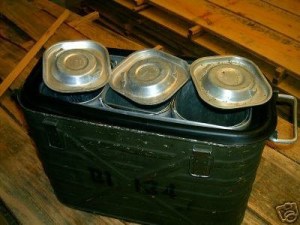
I first drank coffee in the Army… on top of a hill… during the dead of winter… from a mermite can.
Steam rising from the lid proved irresistible when ambient temperatures were below zero and we had just slept on the ground. What else were we going to do but drink coffee? It was there.
We each have a personal history of drinking coffee. I asked one of the greenhouse seeding crews if they remembered their first cup. Some had specific memories, others did not. For me, it was the windy hill in Germany back in 1976.
Coffee was first discovered in Ethiopia in the 11th Century and spread throughout the temperate zones of the planet. It is currently being grown in more than 60 countries. Brazil, Vietnam, Columbia, Indonesia and Ethiopia are the largest coffee producers by annual export weight. Coffee has become ubiquitous as any foodstuff can be.
Making Coffee
The sources of our coffee are under pressure because of climate change. Yields are declining in part because a warmer atmosphere holds more water vapor, creating unseasonable and extreme weather events. Likewise, warmer temperatures expanded the range of the coffee berry borer. Coffee rust is a detrimental fungus increasing its range as the planet warms and winters no longer kill it off in mountainous regions where coffee grows. The impact of global warming caused climate change is not trivial.
We would like to drink a cup of Joe without worry. When we go to the warehouse club there is a long, abundant aisle of coffee produced all over the world. A cup of coffee continues to be affordable at restaurants. It hardly seems like a problem. It isn’t… at least not now.
The science of global warming is virtually undisputed. What seems less certain is how it will impact our personal lives going forward. The Earth’s ecosystem is complex and specific regions have had different issues. We’ve had our share of droughts in Iowa, but there has also been enough rainfall to produce crops. Some days it seems the only persistent idea about Iowa’s climate is that rain remains. When it comes to coffee, what happens six inches in front of our noses is not as important as the global environment in which humans live.
There’s the rub.
With the 2016 election of a Republican to the White House, all eyes are diverted from our most pressing problems. Challenges to the study of climate change is one of those pressing problems and not only because I may be deprived of my daily cup of coffee.
The administration walked away from policy decisions we’ve made to reduce greenhouse gas emissions. It is cutting funding for climate research. It is censoring and targeting government scientists. One could reasonably say the government under Republicans has abandoned science as a consideration in policy-making.
As Americans, we know what to do. We must repudiate the direction Republicans are taking our society by voting them out in the 2018 and 2020 elections. I’d rather linger over my morning coffee than get involved in politics again. However, personal political engagement is the price of a livable future.
It’s a scary article with frightful truths circulating on social media.
Half truths according to Michael E. Mann, director of Earth System Science Center at Penn State. Mann wrote onFacebook:
Since this New York Magazine article (“The Uninhabitable Earth”) is getting so much play this morning, I figured I should comment on it, especially as I was interviewed by the author (though not quoted or mentioned).
I have to say that I am not a fan of this sort of doomist framing. It is important to be up front about the risks of unmitigated climate change, and I frequently criticize those who understate the risks. But there is also a danger in overstating the science in a way that presents the problem as unsolvable, and feeds a sense of doom, inevitability and hopelessness.
The article argues that climate change will render the Earth uninhabitable by the end of this century. Extraordinary claims require extraordinary evidence. The article fails to produce it.
If we are clicking on New York Magazine for our information about the threats of climate change then now, more than ever, it’s clear mental health care is needed in whatever healthcare bill Congress passes this year.
Taking action on climate (or anything else) based on fear would be as scary as Wallace-Wells’ article.
On Sunday, Al Gore was in the news about his climate work.
“Those who feel despair should be of good cheer as the Bible says,” Gore told Lee Cowan of CBS News. “Have faith, have hope. We are going to win this.”
The need to act on climate is all around us according to Gore.
“It’s no longer just the virtually unanimous scientific community telling us we’ve got to change,” he said. “Now Mother Nature has entered the debate. Every night now on the television news is like a nature hike through the Book of Revelation. People who don’t want to use the phrase ‘global warming’ or ‘climate crisis’ are saying, ‘Wait a minute. Something’s going on here that’s not right.'”
Gore is right. Don’t despair. Act on climate.
If you don’t know what to do, The Climate Reality Project provides an action kit to get you started. Click here to find it.
We survived U.S. failure to ratify the Kyoto Protocol to limit greenhouse gas emissions and will survive if Republicans drag us out of the Paris Agreement after the 2020 general election, as was announced June 1 in Washington, D.C.
Make no mistake: it is a disappointment that Republicans plan to exit the agreement.
Outside the symbolism for their political party — which I can only characterize as a finger-involved and not-safe-for-work gesture to the rest of the world — the engine driving greenhouse gas reductions is picking up velocity and will not be stopped by any one person or group.
The United States is not the only country on Earth. 194 countries remain in the agreement as the U.S. joins Syria and Nicaragua as the only states outside it. China, India and the European Union have said they will step up to fill the leadership void the U.S. created by its announcement.
Here’s the bottom line: even without the federal government involved, cities, states, businesses, colleges, and citizens across the US are driving a shift to clean energy and bringing down emissions. Just like the Paris Agreement intended.
With Republicans stepping back, it’s up to the rest of us to step up in a big way and keep this momentum going if we want to protect our environment.
Earth is our only home. Consumerism, irresponsible development, environmental degradation and global warming have negatively impacted where we live.
Our work goes on. The Republican decision to exit the Paris Agreement is not the end of the world. Not even close.
~ Published in the June 8, 2017 edition of the Solon Economist
While in Europe, Pope Francis and the G7 leaders bent President Trump’s ears about climate change.
The Pope presented a copy of Laudato Sí: On Care For Our Common Home, his encyclical on consumerism, irresponsible development, environmental degradation and global warming to the U.S. president. He told Pope Francis he would read it.
Reports indicate the six other G7 leaders presented arguments for the United States to stay in the 2015 Paris Agreement on mitigating the effects of climate change. Trump would not commit to doing so by the time he boarded Air Force One for the trip home.
“The entire discussion about climate was very difficult, if not to say very dissatisfying,” German Chancellor Angela Merkel said. “There are no indications whether the United States will stay in the Paris Agreement or not.”
That Trump failed to be part of the G7 consensus on climate may or may not be a sign of his intent. One never can tell with this president.
“I will make my final decision on the Paris Accord next week!” Trump tweeted.
That Trump was willing to listen to his European peers and the Pope indicates he may have an open mind about the accord. However, late yesterday, Jonathan Swan and Amy Harder of Axios reported, “President Trump has privately told multiple people, including EPA Administrator Scott Pruitt, that he plans to leave the Paris agreement on climate change.”
Despite the advocacy workshop for exiting the agreement EPA has become, the result of the president’s decision-making process may be more complicated than making a simple announcement.
Exiting the Paris Agreement would take at least four years. The agreement does not permit states to exit until three years after entry into force (Nov. 4, 2019). It would then take at least a year to finish the process. In that time, Trump could change his mind.
If Trump decides to exit, he would be “willfully, nonchalantly vacating leadership of the world,” former U.S. ambassador to the United Nations Samantha Power said. Another country will step in to fill the leadership vacuum, presumably China with the world’s second largest economy.
A bone of contention with Pruitt and advocates in the hydrocarbon business is the existence of the Clean Power Plan first published by the EPA in the Federal Register Oct. 23, 2015. On March 28, President Trump signed an executive order mandating EPA review the plan. Unraveling the Clean Power Plan is not as simple as signing an executive order. Whether or not the U.S. exits the Paris Agreement, the regulation may stand.
It is significant the first nation Trump visited in his presidency was Saudi Arabia. Saudi Arabia has almost one-fifth of the world’s proven oil reserves and ranks as the largest producer and exporter of oil in the world. Despite concerns about human rights and the treatment of women in the kingdom, Trump seemed elated about the arms deal he made during his visit. His rhetoric isolating Iran may be no more complicated than wanting to take their oil. Iran ranks fourth in proven oil reserves behind Venezuela, Saudi Arabia and Canada.
That 195 states could enter the Paris Agreement was remarkable. Whether it will hold if the U.S. exits is uncertain. Regardless of politics the science on global warming has been identified since the 19th century.
On the morning after the 45th President’s first foreign trip the direction of his administration on climate change is obvious. Government climate change web sites and regulations are officially “under review” in multiple agencies. At the same time the hydrocarbon business is moving to roll back regulations that seek to reduce carbon emissions. The idea of leaving fossil fuels in the ground is not embraced in this White House.
“I think there is a better than 50/50 chance that the Trump administration will stay in the Paris agreement,” Nobel Prize winner Al Gore said. “I think odds are they will stay in.”
Snow fell in darkness leaving a thin blanket of white.
The pin oak tree began shedding last year’s foliage indicating warm weather activated new leaf buds and pushed out the old.
Seems weird to rake leaves in February. More to the point, it’s not normal.
In a couple of hours I return for a fifth season at Local Harvest CSA. The main spring task is soil blocking 72 and 120 cell trays for seed starting in the germination house. Part of my arrangement is keeping some of my own seedlings there. When I’m finished with the farm’s trays, I’ll make one 72 and one 120 tray for myself and seed them with kale, celery and basil. I’m hopeful they will do better than in the south-facing window in our bedroom. Getting my hands dirty with soil is a great way to get ready for spring, three weeks away by the calendar.
Other chores on my white board include doing taxes, computer file backup, cleaning the car, preparing the garden for spring and Belgian lettuce planting this week (traditionally March 2). I made extra servings of spaghetti with tomato sauce for lunches and want to make a batch of taco filling for breakfast on work days at the home, farm and auto supply store. There’s also more writing projects.
During a Climate Reality Project conference call on Thursday, a friend from Waterloo and I decided to work on a project with other friends from Waterloo-Cedar Falls. I’ve done two presentations there and look forward to more meaningful work. We’re planning luncheon, maybe next weekend.
This last lap in the workingman’s race looks to be action packed with local food, environmental and cash producing projects coming into focus.
Night’s snowfall melting in the sun makes way for budding plants in a grey and brown landscape. It is almost time to wipe the whiteboard clean and begin anew.







 Journey Home
You must be logged in to post a comment.