I added a walkabout to my daily routine. Once the sun rises, and after I finish daily writing, I leave by the garage door and walk the property line of our 0.62 acre. Each day I saw something unanticipated.
The condition of trees, activities of squirrels and birds, and windblown trash deposited on our lawn. The walkabout provides an opportunity to take stock of our land and consider what needs doing, what should be left alone. I’m discovering a lot of neglected work.
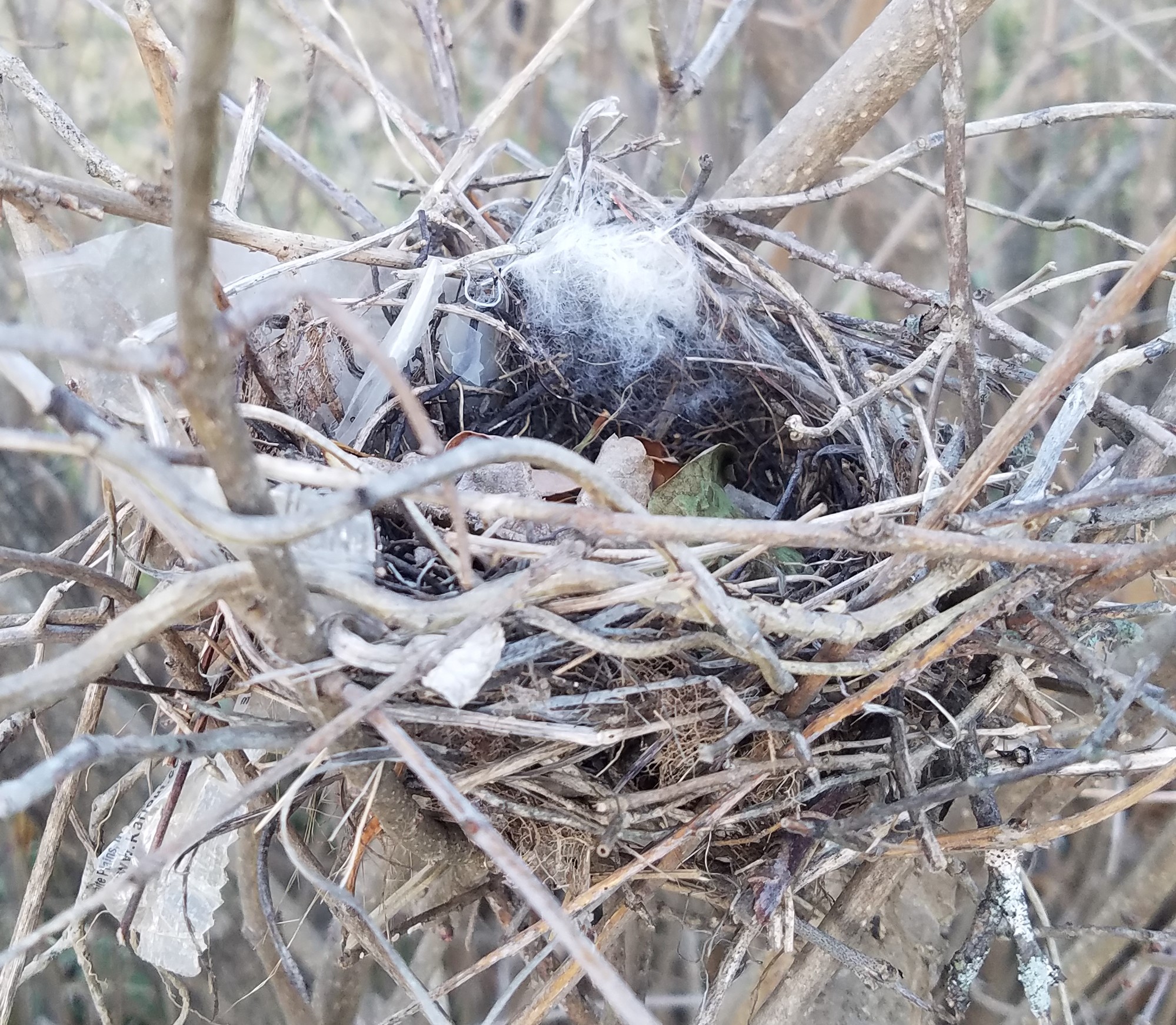
There are at least three bird nests I’ve found. I’m amazed at how they take found objects and craft them. Anything pliable seems a likely building material, including plastic wrap and bits of fiber. I don’t remove the nests unless they fall from the tree or bush. For the most part they are woven into live branches with a sense of permanency.
I’d forgotten how large our yard is and how many distinct landscapes are in it. As we head into winter the walkabouts will be a time for observing, thinking, and planning our landscape. I don’t know how I went so long without this as part of each day.
2021 has been a great year of progress in the kitchen garden. As the seed orders find their way to us via U.S. Postal Service, some reflection on the positives seems in order.
Apples
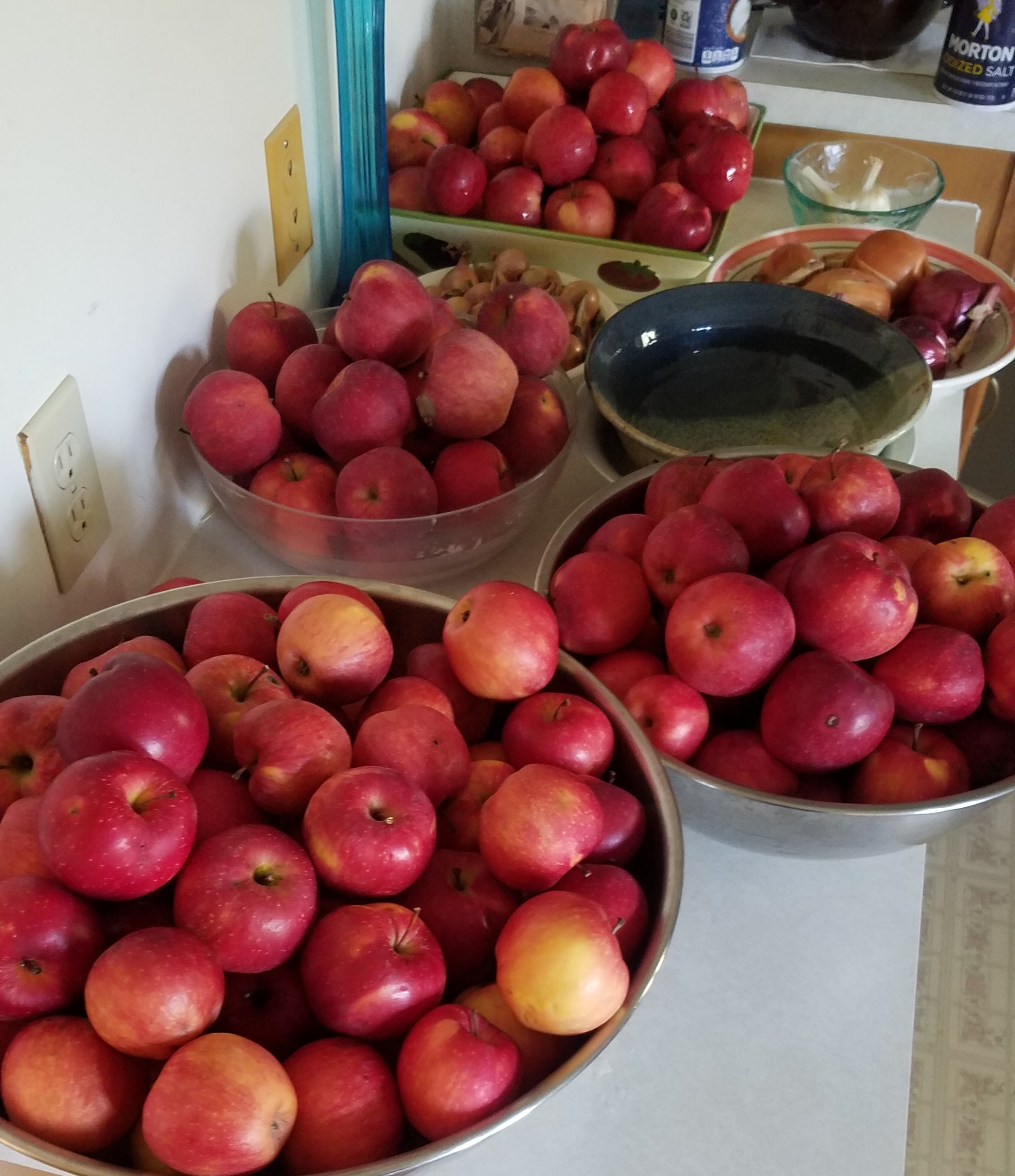
This has been one of the best years for apples. In our yard the three legacy trees bore abundantly and we used them for everything we needed. At the orchard (by this I mean Wilson’s Orchard and Farm, where I worked from 2013 until 2019) there was an abundant crop to supplement the two varieties that yielded here. The pantry is loaded with everything we need in terms of processed apples. We should have enough apple butter, applesauce, dried apples and cider vinegar to last two years until the next big crop. If our trees bear next year, that will be a bonus.
We had enough to take what we needed, let our neighbors pick some, and plenty for the deer once we harvested the best ones. The combination between our trees and a nearby commercial orchard meant we didn’t have to buy a single apple from the grocery store.
Vegetable broth
Each garden year begins with a couple dozen quart jars of vegetable broth. As I grow a diverse number of greens, I switch which ones dominate. Turnip greens have produced a consistently tasty broth, yet they all are good. We use this broth to cook rice, in soups, and as an alternative to using oil when frying vegetables for some dishes.
Guajillo Chilies
It took a few years but the integration of Guajillo Chilies into our cooking is complete. The main product is a cooked and preserved pepper combined with garlic, salt and apple cider vinegar in a food processor. Once the fresh chilies are gone, this becomes the main way I use chilies in cooking. I tried the technique with jalapeno peppers and while a little hotter, it also serves for our culinary needs.
Polish-style Soup
When growing up, Mom’s cooking was pretty “American.” That is, outside the occasional Polish-style ravioli brought home from visits to LaSalle, Illinois, Polish heritage cooking was absent. That was also true of memories of my maternal Grandmother who often found paid work as a cook in settings where American cooking prevailed. It was discovery of the cook book Treasured Polish Recipes for Americans by the Polanie Club that enabled me to come to terms with my heritage.
Based on studies of the soup chapter, I developed a consistent soup recipe that uses vegetables grown in our garden. The ingredients in the book were the same as what I have been growing for years. The main characteristics of the soups are they are thickened with barley, I add lentils as a source of protein, and use onions, celery, broccoli stem, parsley, grated zucchini and other frozen vegetables from the growing season. I use whatever greens are in season, and frozen kale if they are not. I also add potatoes, turnips, and whatever root vegetables are on hand. Settling on a soup recipe has been a long time coming.
Sweet Bell Peppers
After years of experimentation I finally produced enough bell peppers to eat raw, use in cooking, and preserve in the freezer. This was a watershed year.
Tomatoes
I grew the largest number of tomato plants ever and had plenty to eat fresh, can, freeze, and give away. The main successes were:
Developing a method to extract moisture and freeze the pulp into small servings using a cupcake pan was a breakthrough. The idea is to use a couple of tomato “buttons” to make pizza sauce for our weekly, home made pizza. I use them in everything to add a small amount of tomato sauce when needed.
I learned to grow enough Roma tomatoes so I can use them to can whole. I’m still working off a backlog of preserved tomatoes, but the system is in place for growing to match canning needs. Romas are the best to can whole.
Our local food bank welcomed my extra tomatoes. My weekly seasonal donations took the pressure off of using tomatoes in a timely manner.
I grew a wider variety of tomatoes this season, maybe 25-30 varieties. The benefit was I discovered some new favorites and we had tomatoes for every dish throughout the season.
I can extra liquid from tomatoes if I don’t use it fresh. I try to use everything and the canned liquid goes into soups.
I planted earlier than my peers in the local food movement and because of that, I had tomatoes earlier than they did. I risked frost only once or twice and using old bed sheets to cover the plants, was able to make it through without damage.
Squash, eggplant and cucumbers
I’m pleased with the way the squash came out. There was plenty of zucchini, and pumpkins and acorn squash produced beautiful fruit that tasted good. A little goes a long way with zucchini and I grew and preserved enough for soup all winter. I also froze cooked pumpkin flesh in one cup sized buttons to use in pumpkin bread.
A little eggplant goes a long way for us. I had six or seven varieties of seeds and planted some of each. I’m looking for enough to make one or two eggplant Parmesans and roasted rounds for the freezer. I had plenty this year.
The cucumber crop wasn’t as big as we’d like although it produced enough for plenty of canned sweet pickles to last us until next year. I’m on the way to striking a balance of varieties to meet our needs and this will be an ongoing experiment.
Garlic
The garlic crop was the biggest yet with large heads, about 75 of them. The disease that was prevalent last year was absent this year. That’s because I was particularly diligent to pick clean cloves for seed. The main uses are fresh in cooking and in the prepared chili sauces mentioned above. I still harvest enough green garlic from the volunteer patch I planted decades ago.
Celery
There was a new celery seed this year and it produced a better crop. We eat celery fresh in season and use it in cooking. The extra gets sliced in soup style and stir fry style and we produced a lot of it this year. We’ll be eating it all winter.
Greens Patch
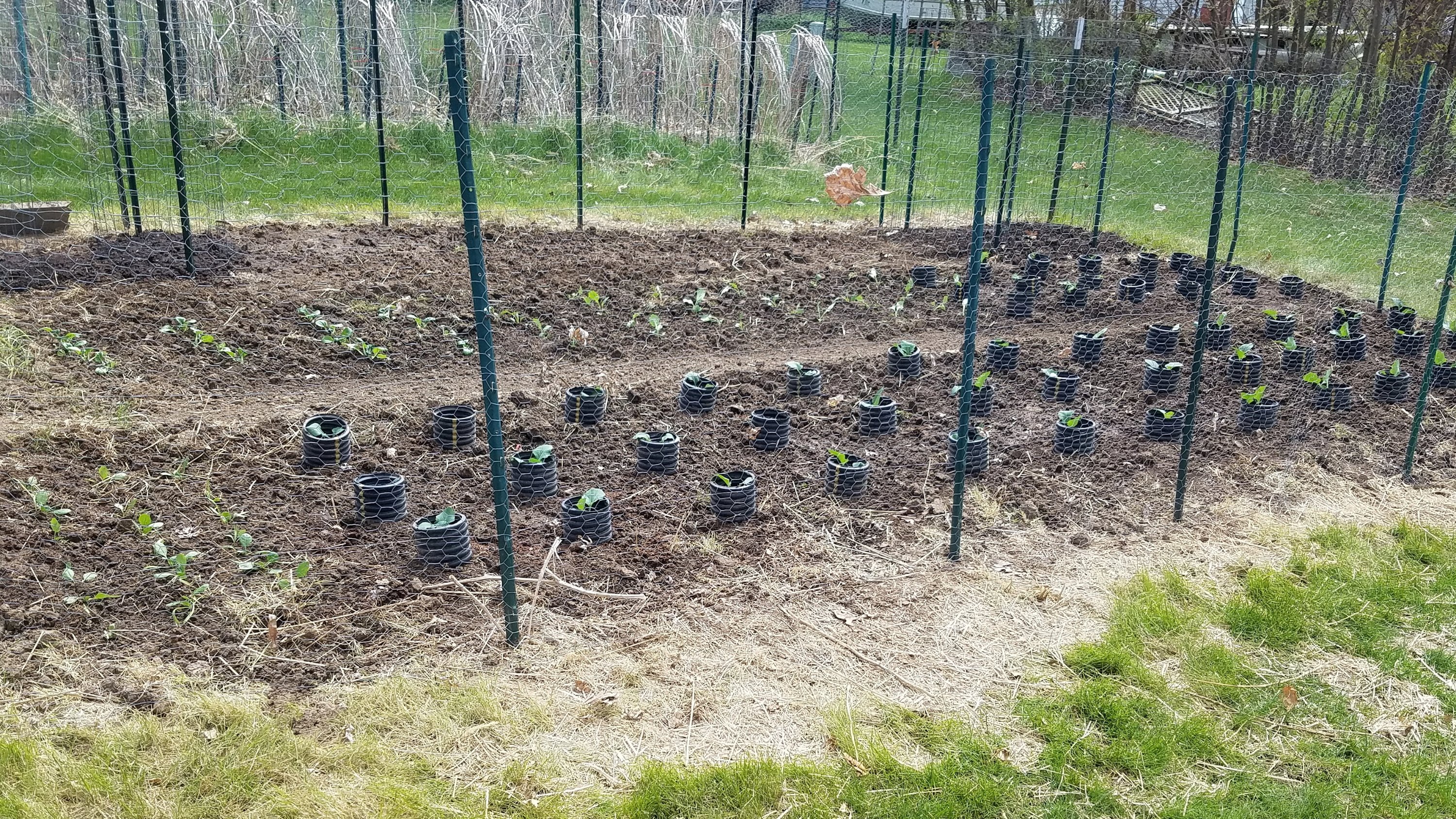
I set aside a plot for cooking greens and the concept proved to be useful. We had greens for the entire season. The main change was cutting back the number of kale plants and planting chard , collards and mustard as alternatives. I also grew several kinds of cruciferous vegetables like kohlrabi and bok choy. I plan to further develop this concept.
Onions
I grew seven varieties of onions and shallots and would term it a success. It is the second year of having a big crop and the quality was quite good. I used a mixture of plants I started from seed and starts from the seed store. The starts from the seed store, along with the shallots, did the best. The challenge is picking storage varieties and then using the shorter storing onions first. This all worked out in 2021.
Herbs
I successfully grew parsley for the first time. There was plenty of it to use fresh and I used the cupcake pan method to freeze some in water to add to soups during winter. I also had plenty of chives, savory, rosemary and basil. I froze many parsley stems for use in winter cooking. I feel more confident after this season and will likely expand my herb growing next season.
Row Cover
I bartered for some row cover and used it to grow an eight foot row of lettuce and herbs. It made a huge difference. It enabled succession planting in a way I hadn’t had before. More planning is in order for 2022 to make row covered vegetables a bigger part of the garden.
When we took the land after the 1832 Black Hawk Purchase, it was decimated to make neatly cut rectangles of farmland. People are used to that now. Today Iowa farmland is used mostly as a production landscape for hogs, cattle, corn and beans. For too long, Iowa’s air, water and land have been used like an open sewer to support these operations. Farmers are used to what they know and don’t want to change. That’s true for people besides farmers.
Iowa is not an empty place where someone can do what they want with the land. A utility should not be able to build pipelines and transmission lines, or construct large-scale wind farms and solar arrays with impunity. The current crop of Iowa farmers is possessive of the right to their land and to use it as they see fit. They believe they know better than government what works here and what doesn’t. They don’t want infringement on their rights. The myth of farmers as the original environmentalists persists despite evidence to the contrary.
When solutions to the climate crisis require cooperation between large corporations and Iowa farmers there is resistance.
The new carbon capture and sequestration proposals of Summit Carbon Solutions and Navigator CO2 Ventures will confront these well-established beliefs. Even though a prominent farmer, Bruce Rastetter, is behind Summit, the rollout will follow a path familiar to anyone who knows the history of electricity transmission lines and oil pipelines here. Farmers will push back.
Donnelle Eller of Gannett stated the obvious about Summit in Monday’s Iowa City Press Citizen, “The company, a spinoff of Bruce Rastetter’s Alden-based Summit Agricultural Group, says the project would help ethanol and other energy-intensive ag industries remain viable as the nation seeks to cut greenhouse gas emissions in half by 2030 to address climate change.” The Iowa governor spoke about a low carbon economy, but failed to mention climate change or how CCS fits in such a framework. This underscores a key problem with CCS. They are just out there and bottom line, it’s backers don’t give a hoot about climate change. It’s another opportunity for capital investment which could yield big profits.
The sides are already lining up for this fight.
Opponents of CO2 pipelines have also been opponents of the Rock Island Clean Line and the Dakota Access Pipeline. Rural Iowans do not speak of one mind on this yet a common theme is big money, not farmers, are behind these transmission schemes. They claim the voices of farmers are not being heard. They also claim climate change is a lie.
What is the purpose of CCS if not to address climate change? That’s the wrong question. These projects are about investing capital to get a return on investment. If the government is a source of start-up capital, more’s the better for investors. The words “climate change” aren’t needed in this transaction.
“The world must reach net-zero CO2 emissions by 2050 in order to achieve the 1.5 degree Celsius global average temperature increase limit,” according to Summit’s website. “A dramatic increase in carbon capture and storage (CCS) is crucial to achieving net-zero CO2 emissions.”
The second sentence is unlikely to be accurate. The problem is Summit and Navigator seek to change nothing about industrial use of fossil fuels. They seek a profit from ethanol plants and other CO2 emitters who keep on doing what they are doing now. CCS has become a gigantic boondoggle instead of a solution to climate change.
“Climate and other environmental and public safety concerns about CO2 pipelines are important,” Ed Fallon wrote in a Nov. 11 email. “But as with Dakota Access Pipeline, in terms of mobilizing the broadest possible coalition of opponents, the strongest argument is the abuse of eminent domain.”
In a filing with the Iowa Utilities Board, Janna Swanson, whose land the Summit pipeline would cross, had this to say about the project and climate change:
There are a whole bunch of plans to mine our tax money for revenue and the excuse is Climate Change. When using that as an excuse then any action against humans is justified.
Summit Carbon Solutions will want the right of eminent domain. They will say that because of Climate Change that their business model is for public use.
When one paints with that wide of a brush then no one’s property is off limits for anything. No one has rights.
Let’s be clear. Summit and Navigator are in the CCS business to make money, as much of it as they can. Comments like Swanson’s are setting up climate change as a talking point instead of the reality of extreme weather it is and that must be dealt with.
It is early in the process yet already many comments have been made to the Iowa Utilities Board regarding the potential CCS proposals of Summit and Navigator. If you’d like to make a comment, here’s the information.
Written comments or objections to the proposed pipeline can be filed electronically using the IUB’s Open Docket Comment Form, by email to customer@iub.iowa.gov, or by postal mail to the Iowa Utilities Board, Attn: Docket No. HLP-2021-0003 (Navigator) and/or Docket No. HLP-2021-0001 (Summit) , 1375 E. Court Ave., Des Moines, IA 50319.
The downside of the CCS approval process is it turns rural Iowans against a second science-based phenomenon. Only 56.5 percent of Iowans are fully vaccinated against the coronavirus. There is no inoculation against extreme weather made worse by climate change that Iowans already experience.
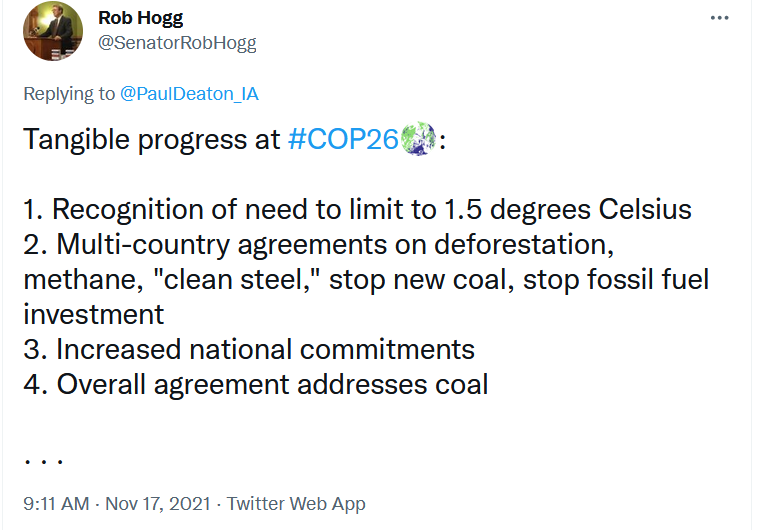
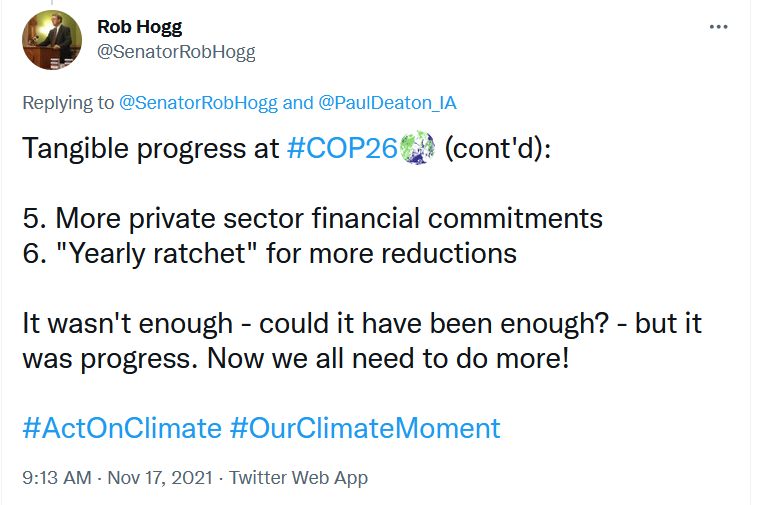
The 26th Conference of the Parties in Glasgow, Scotland seemed like a dud. My friend Rob Hogg corrected me on Twitter, posting:
So there were some positive developments. I’m reminded that zero countries is the number living up to their 2015 commitments to reduce greenhouse gases at COP 21 in Paris, France. It is difficult to let go the negativity when it comes to our collective lack of action on climate change.
On a video call a friend asked if we had installed solar panels to generate electricity for our home. I know our financial condition well enough to say it is unlikely we will because of the up front capital expense. We are doing okay financially yet know our limits.
“When it comes to climate change, we can’t afford to go backward—or even stay where we are,” former president Barack Obama said. “If we are going to act on the scale that’s required to combat this climate crisis, we all need to step up and meet this moment together.”
What does “together” mean? It means governments and a select group of non-governmental organizations and rich people that have the means to address climate change at scale. Behind Obama’s statement is the assumption we live in a democracy. Increasingly, we don’t, as floods of dark money buy our government, including the court system. An individual’s local actions matter, yet they are not enough, especially if one is the only person on the block generating electricity from solar panels.
Former Vice President Al Gore weighed in on COP 26:
Statement from Former US Vice President Al Gore on the Outcome of COP 26
“The Glasgow Climate Pact and the pledges made at COP 26 move the global community forward in our urgent work to address the climate crisis and limit global temperature rise to 1.5°C, but we know this progress, while meaningful, is not enough. We must move faster to deliver a just transition away from fossil fuels and toward a cleaner and more equitable future for our planet.
The progress achieved in the lead-up to and at COP 26 was only possible because of the power of people – young and old – using their voices to demand action.
Thanks to that advocacy, for the first time in 26 negotiations, leaders at COP 26 agreed to language that calls for a phase down of coal power and fossil fuel subsidies – a critically important step forward. Even more important, the deal significantly accelerates the timeline for nations to revisit and strengthen their net zero goals, calling for updates from every nation by the end of next year and a global convening by the UN Secretary General in 2023 to focus on more ambitious goals for cutting emissions dramatically by 2030. But despite that progress, there is much more that must be done – especially to deliver meaningful climate finance for both mitigation and adaptation to developing nations.
Ultimately, the outcome of COP 26 shows us that it has never been more important to hold our leaders accountable to their words and pledges. Advocates for climate action cannot – and must not – let up.
Six years ago, the Paris Agreement set a clear direction of travel that is moving the world away from greenhouse gas pollution and toward a sustainable future. The deal reached at COP 26 reflects the progress we’ve made in the intervening years and shows that the global community of nations is now in agreement that the era of inaction on the climate crisis must come to a swift end.”
Now is the time for government leaders, policymakers, business leaders, consumers, and activists in every nation to redouble their efforts and use the Glasgow Climate Pact as a springboard from which to drive bold action that will keep the goals of the Paris Agreement alive.”
It’s easy to become overwhelmed by the scale of the climate change problem. It is a problem, although against all reasonable efforts to educate, even that is in question for many people.
I wrote to my federal elected officials about how climate change impacted my life. I heard back from Rep. Miller-Meeks and Senator Grassley and am assessing their responses. I’m using my voice to raise the issue with my federal elected officials. Their response falls flat.
We have the tools we need to solve the climate crisis. That seems certain. Yet a society that is interested in supporting the richest among us more than taking care of each other is morally bankrupt.
The latest revelations about the Trump administration’s efforts to manipulate the Centers for Disease Control and Prevention at the beginning of the coronavirus pandemic are evidence that the highest office in government was willing to use mass-death as a political weapon at a cost of hundreds of thousands of lives. What kind of human can support that? Yet Trump flags fly unabated in our neighborhood. It is clear the previous administration was going to do nothing about the climate crisis. If they get back in office after the 2024 elections, they will set about undoing what Biden got started to address climate change and more.
In this context it is important to ask, “What will it take on climate change?” From these quotations and more, we know it will take action on a scale only governments can provide. Yet we can’t be reduced to helping political candidates we favor get elected. There is something more at stake. Regardless who holds political office, governments must act on climate change. There will come a time, and soon, when it will become obvious to even the most prominent naysayers we have to act. So we keep plugging away and hope we are not already too late.
Like most people, I want a decent meal when it is time to eat. In 2012, I launched a major study of the local food scene and was not disappointed in the results coming into and out of our kitchen. By working at a number of farms, growing and expanding our home garden, and participating in legislative advocacy, I learned so much about where food originates and conditions which engender growth of a variety of fruit and vegetables.
The impact of local food systems on our home life reached its peak in development of the kitchen garden idea. Now that the work is finished, I have less interest in writing regularly about food. It is an assumed part of a background against which I pursue other interests. I’ve learned what it means to know the face of the farmer. I maintain an interest in doing so. I just won’t write about it as often. Mainly, others are doing a better job of writing about our food system.
Food is basic to a life. It is not the most important thing. I am glad for the work I did, yet I feel it is finished. It is time to concentrate on more important aspects of life. It is time to keep a focus on life closer to home.
Like it or not, Iowa Republicans have hoodwinked us into a carbon capture and sequestration method of addressing the climate crisis. It is common sense that hooking a polluting ethanol plant, coal-fired electricity generating station, or a propane grain drying operation to a mechanism for carbon capture does nothing to address the root cause of pollution. Nonetheless, here we go.
On June 22, 2021, Governor Kim Reynolds “signed Executive Order 9 launching a task force to explore carbon sequestration and the opportunities it presents for further economic development in the state of Iowa,” according to a press release.
Because of our existing supply chain and emphasis on renewable fuel infrastructure, Iowa is in a strong position to capitalize on the growing nationwide demand for a more carbon free economy. Iowa is a recognized leader in renewable fuel and food production, and this is another opportunity to lead and be innovative, invest in Iowa agriculture, and facilitate new sources of revenue for our agriculture and energy sectors. I am proud to bring together an impressive team of stakeholders that will help formulate smart, commonsense policy recommendations on this issue ahead of the 2022 legislative session.
When we talk about the decarbonization imperative across the global economy, carbon capture and sequestration has only limited use. As is typical of statements from the Iowa governor, there was no mention of the climate crisis in the release.
Having been forced to deal with carbon capture and sequestration as a public issue, advocates need references to understand what it is, its consequences, and risks. Below are some links to get started. Expect this post to be updated as new information is found and becomes available.
How to submit an objection with the Iowa Utilities Board:
Written comments or objections to the proposed pipeline can be filed electronically using the IUB’s Open Docket Comment Form, by email to customer@iub.iowa.gov, or by postal mail to the Iowa Utilities Board, Attn: Docket No. HLP-2021-0003 (Navigator) and/or Docket No. HLP-2021-0001 (Summit) , 1375 E. Court Ave., Des Moines, IA 50319.
I viewed the S&P Global Market Intelligence discussion between reporter Taylor Kuykendall and Former U.S. Energy Secretary Ernest Moniz on Nov. 8. The thirty minute video is worth viewing to hear Moniz on major technologies and technological developments that will help prevent and mitigate the effects of global warming on humans.
Dr. Moniz answered the question I posted in the YouTube chat: “Regarding CCS (carbon capture and sequestration), how important is it to leave sequestered carbon in the ground? If a market for CO2 were developed, would there be an interest in digging it back up?”
He sort of laughed at the idea of “digging it up” as something that would not be done, yet gave an answer I hadn’t expected. There may be engineering applications to use captured CO2 in order to address our goal of net zero emissions by 2050, rather than burying it in geologically stable underground rock formations. This has been a point of contention with opponents to the Summit project.
Summit Carbon Solutions, an Iowa company, has proposed construction of a pipeline to transport liquefied CO2 captured from ethanol plants and other Iowa industrial producers to North Dakota for sequestration. The Iowa Utilities Board approved public hearings in the 30 counties the proposed pipeline would cross. One of the sticking points between activists who oppose the pipeline and the company was about Summit making a written commitment to leave any sequestered carbon in the ground permanently. CEO Bruce Rastetter indicated they would not make such a commitment because markets may be found for captured CO2. Moniz’ comments yesterday indicated such markets are under study and may be developed in order to address the climate crisis.
Is carbon capture and sequestration technology a hero that will help society reach net zero emissions by 2050, or is it a villain that will violate landowner rights and cause more pollution than it prevents? Fossil fuels should be left in the ground.
The highlight of Moniz’ interview for me was that advocates against the Summit Project (or the similar Navigator CO2 Ventures project) have a lack of big picture information about addressing the climate crisis using carbon capture and sequestration technologies. The information has not been readily available.
Ed Fallon of Bold Iowa isn’t perfect. However, he is a veteran of multiple pipeline fights. In a Sept. 23 blog post he outlined his concerns about the Summit project. He claimed Summit plans to use sequestered CO2 for “fracking” instead of sequestering it in the ground. He also claimed Summit wasn’t being transparent about their intentions. Summit denies these claims. Fallon is the right person to engage in a pipeline fight, yet his blog post lacked a depth of understanding of CCS beyond his immediate concerns. Ed could use more information as could we all.
Over the coming weeks, I intend to remedy the lack of accessible information about carbon capture and sequestration. In a series of articles, I will explain what it is, evaluate whether the Summit and Navigator projects are boondoggles designed to skim taxpayer money for the richest Americans, and what plans exist for implementing CCS as a solution to the climate crisis. Hopefully, with a better understanding of the technology and its proposed applications, advocates for and against it will have a better base of information to address the climate crisis. Stay tuned.
The automobile sat in the garage since I returned from provisioning last Wednesday. There is plenty to do at home and I’m getting better at organizing each week. The last three days felt like a “weekend,” something I haven’t felt in a long time.
Absent work outside home, the days can turn into an endless stream of the same. By scheduling certain types of activities for different days of the week, a sense of normal is returning after the disruption of the coronavirus pandemic and ending paid work. I make the weekend seem as it is by intent.
If anything, I miss being with people and doing things together. While taking my daily walk I encounter neighbors I’ve known for years. There have been good conversations on the trail, yet it’s a different kind of interaction. I miss meeting younger people and doing things with them in society. Partly, my cohort is getting older and has less relevance to youth. However, it’s the isolation that has been challenging to embrace.
The public response to the pandemic is shifting. Last week a COVID-19 vaccine was approved for children aged 5-11. Locally, there was a rush to get it, yet a large segment of the population could care less. They say the coronavirus is with us forever, we must get used to it and develop natural immunity through exposure. Getting vaccinated for COVID-19 is recommended by most medical authorities, including the Centers for Disease Control and Prevention.
The current seven-day moving average number of deaths per day attributed to COVID-19 is 1,110. In 2020, COVID-19 was the third leading cause of death in the U.S. behind heart disease and cancer. It is difficult to accept a thousand deaths per day from COVID-19 as the new normal yet people who once said getting vaccinated was a personal choice are now saying vaccination is bad. Scheduling a booster shot of the COVID-19 vaccine is on my to-do list for today, so you know where I stand.
To maintain good mental health we need structure in our lives. When confronted with a decision of what to do next, the part of the week devoted to planning pays dividends. If things keep going how they did the last few days, weekends will take on new meaning. They will be differentiated from the rest of the week and become something to which I look forward. Lately I’ve been enjoying Sunday afternoons working on sundry projects without structure. I hope they continue.
The pandemic changed our lives permanently. Humans will figure out a way to cope with it or die trying. My recent activities serve as an example of human resilience. If anything, humans are that. It turns out, so am I and I’m happy to have my weekends back.
We often co-exist with an illusion we have unlimited time to live our lives. Living each moment, our fundamental outlook is there will be another. Many of us believe that each new moment has the potential to be better than the one in which we find ourselves. It may be true, yet there are limits.
When I retired April 28, 2020, at the beginning of the coronavirus pandemic, I wasn’t ready. I looked forward to getting dressed in my uniform (jeans, a shirt with the company logo, and hard-toed boots), driving across the lakes in my 1997 Subaru, and working an eight-hour shift that had a unique yet recurring set of variables that demanded something from me but not a lot. It was a retirement job to pay bills until Social Security kicked in at the full rate. I exited the work force with eyes open to avoid contracting the coronavirus.
I want another source of steady income.
If I return to the workforce, it will be on my terms, avoiding any public-facing job because of infectious diseases living in members of the public. That was a lesson of my last employment. I spent a lot of time sick before the pandemic because of contagious people.
While transferring files from my 2013 CPU to the new one I found file folders with ideas for earning money. Some of them brought income, yet not enough to rely on them without other sources. Having retired from my main career in 2009, I spent time exploring alternative forms of employment that would help pay the bills. It was a mixed bag, the best part of which was meeting so many people. A fellow couldn’t live on it.
We have a decent home life. I improved my gardening and cooking, and I’m writing more. I am focused on being a better photographer. I don’t view any of these activities as sources of income. If I have an abundance from the garden I may sell it at the local farmers market or donate to the food bank. Freelance writing brings something in, but it is lowly paid work. I would rather enjoy this creativity for what it is: a regular decent meal with ingredients I grew, and a legacy of writing. From time to time a subject gains a broader readership, as in the recent school board election coverage. There is personal satisfaction in it and that’s enough.
I resist commercializing our home life. A life worth living has some privacy. I enjoy creative outlets provided by gardening and meal preparation, opinion pieces to newspapers, and posting photos on Instagram. I attempt to refrain from stupid stuff on Twitter, which is my main place to mouth off. I am careful about what I say and depict about our private lives on those platforms.
What will I do with this moment? Write a few more words, edit, then hit schedule so it posts at 5 a.m. comme d’habitude. I look forward to breakfast as it’s been 11 hours since eating anything. There are onions and garlic from the garden… and a half used jar of Guajillo chili sauce I made. I’ll concern myself with breakfast just as soon as I finish this post. The anticipation makes life worth living.
Image of Earth 7-6-15 from DSCOVR (Deep Space Climate Observatory)
We witnessed climate change in Eastern Iowa. For me, it’s personal.
• The 1993 flood delayed progress building our home as we moved from Indiana.
• We experienced multiple straight line wind events that damaged the house, uprooted trees, blew down large branches, and tore through our neighborhood.
• Record flooding in 2008 filled much of the Iowa and Cedar River basins, backing up water into the Lake Macbride watershed to within 100 yards of our home. It made roads around us impassible and devastated many nearby places.
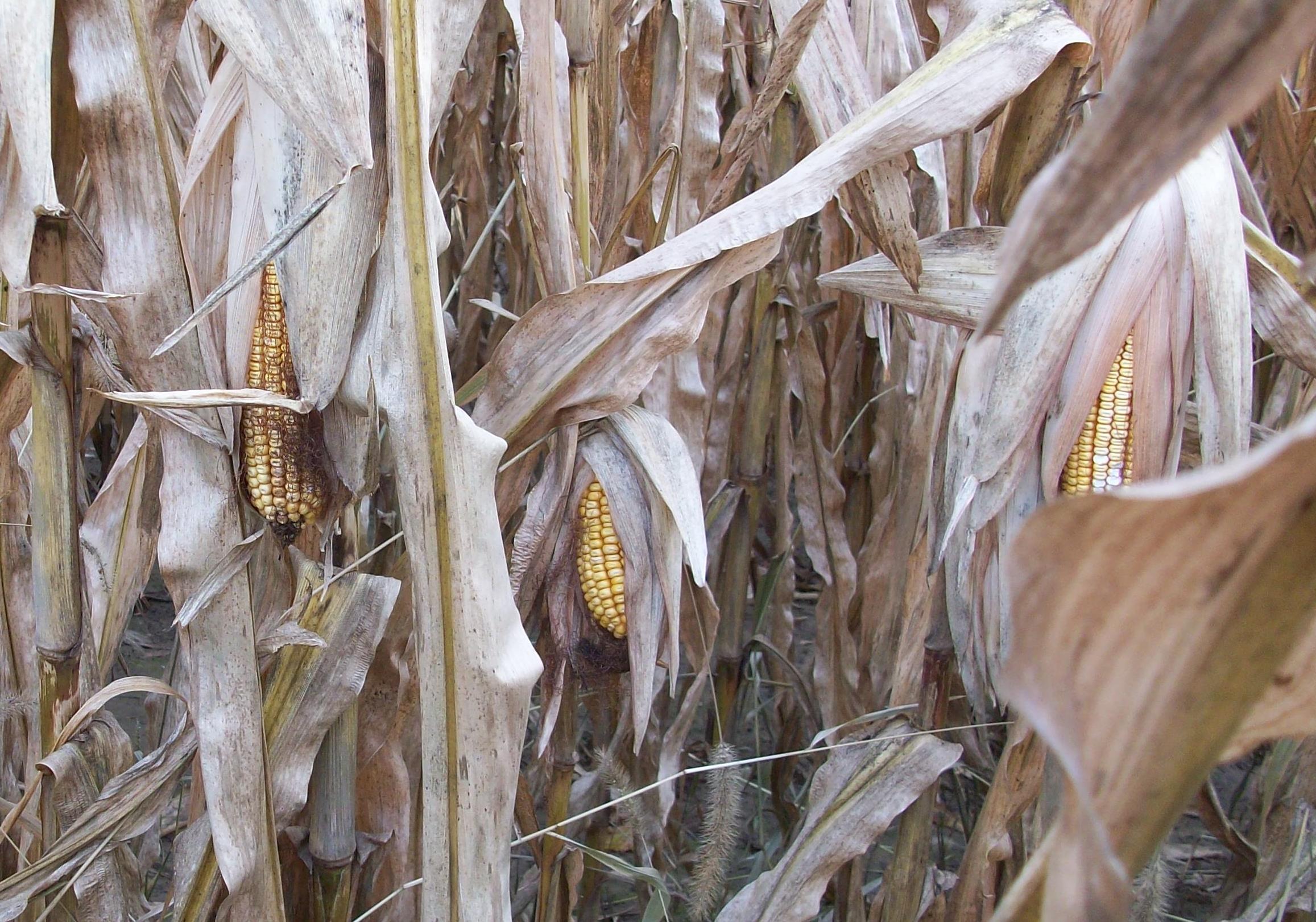
• Record drought in 2012 made life outdoors miserable. It negatively impacted crops. Corn yield in Johnson County decreased from 171.9 bushels per acre in 2011 to 132.4 in 2012, a 23 percent drop.
• There was a derecho on Aug. 10, 2020. In our yard it took down one tree and damaged several others. My greenhouse lifted into the air like Dorothy’s farmhouse in the Wizard of Oz. Winds up to 140 miles per hour destroyed 70 percent of the tree canopy in Cedar Rapids.
I know about climate change from living it, as do most Iowans. It’s time for our Republican members of Congress to work with Democrats and take action to mitigate it.
~ Published in the Iowa City Press Citizen on Oct. 30, 2021.



 Journey Home
You must be logged in to post a comment.