Categories
Environment Sustainability

Issues Come Home to Roost

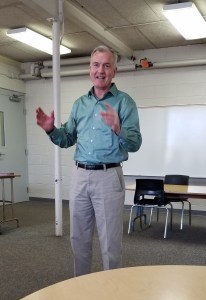
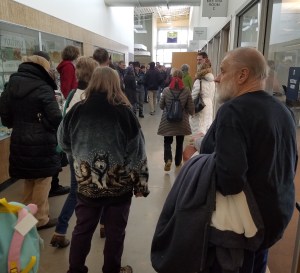
Democratic Committee Volunteers Meeting in North Liberty, Iowa

In September I asserted we should be working to stop nuclear weapons and protect the environment. A year into Trump’s first term it’s clear I understated this need.

The Trump administration rolled out it’s nuclear posture review and oh brother. Obama was bad enough with the $1 trillion modernization plan he negotiated with Arizona Senator Jon Kyl to get the New START Treaty ratified. Our new president is off the charts mad regarding the nuclear complex, or as Rolling Stone‘s Matt Taibbi described him, “insane and ignorant.” There’s a lot to do to resist.

On the environment, it’s as if the Trump administration handed the keys to the front door to the wolves who have been howling and trying to get inside where we live. Ryan Zinke at Interior has reduced the size of some national monuments to make way for exploitation of oil and gas deposits; Scott Pruitt at the Environmental Protection Agency seeks to roll back regulations that protect us to loosen the regulatory chains he claims bind business; Rick Perry at Energy seeks to change the paradigm of growing renewable energy resources to one of increasing stockpiles of coal, oil and uranium. The plan was preconceived and executed with dizzying speed.

What to do to resist?

The focus has to be on electing Democrats in the 2018 midterm elections. Reason doesn’t matter to the Trumpkins. They understand political power. All efforts for the next eight months should be toward re-taking the U.S. Senate and/or House of Representatives, and to make inroads in the state of Iowa by electing a Democratic Governor and re-taking the house or senate or both.

It’s really that focused, that simple. Will a Democratic government get us what we want? The Obama administration nationally and the Culver-Judge administration in Iowa stand as examples it won’t. Regaining political power will re-establish our dominance and hold the wolves at bay, and that may be the best we can hope for this year.

It would be something positive in a government currently overrun with pirates seeking to loot the treasury and pillage the commons. As a society we can do better than this. We must pick our battles carefully and from today’s vantage point there is a lot to bring us together to stem the tide against reason. Nuclear abolition and protecting the environment are both worth our efforts. There are broader currents to bring us together during this election cycle.

Categories
Living in Society

Politics Saturday

Lake Macbride

Across the lakes in North Liberty, the first meeting of the county party’s arrangements committee will convene today at 10 a.m. Having served on platform, and with limited interest in credentials, rules and nominations, it’s the only one for me if I want to engage in local politics.

Caucuses are over with a bit of afterglow. According to our data management/membership chair John Deeth, Johnson County turned out 973 caucus-goers, tripling the previous record for an off-year caucus.

We are now in the primary phase of the 2018 midterm election campaign and it’s time for candidates to start their first canvass if they haven’t. Today, few primary voters even know who the heck some of these people are. It will be best if one of the Iowa gubernatorial candidates wins the primary with 35 percent of the vote. If no candidate wins that primary and it goes to convention, expect more division among Iowa Democrats. The key for personal survival is to pace ourselves if we want to be useful.

It is early to make primary picks as the filing period has neither opened nor closed.  At the same time, it’s hard to imagine anyone else jumping into the governor’s race. After two conversations, including an in-person one last night, I’ll be supporting John Norris for governor.

I found him near the sign-in table at a house party in Coralville and asked my question. There is a bill in both chambers of the legislature to deregulate public utilities. As former chair of the Iowa Utilities Board, I expected Norris to have some insight. He wasn’t familiar with the bill but said that deregulation would hobble Iowa’s renewable energy program. He obviously enjoyed talking about the subject and gave me a new perspective. We covered MidAmerican Energy, Bill Fehrman, vertical integration of Iowa wind farms, merchant sales of electricity and its relationship to public utilities, the nuclear plant in Palo, the impossible idea of building new nuclear power plants, and his work with energy policy and climate change in the Obama administration. There’s not much daylight between us here.

That was generally true about Norris’ policy discussion in a 17 minute speech for about 50 attendees. I felt déjà vu as I had been in that room before with another candidate and campaign. Norris laid out the issues the way I would, in similar language, emphasizing what I also felt was important. This was particularly true with the discussion about mental health services for children, and reversing the damage done by the 87th Iowa General Assembly to collective bargaining, women’s reproductive rights, and voter rights. With so many of my political friends already supporting John Norris, adding my name to the volunteer list became easy.

I haven’t gotten too deep into other statewide Democratic primaries. I expect to support Deirdre DeJear for secretary of state and the rest are undecided. In the three-way primary for Senate 37 I’m supporting Zach Wahls. Jodi Clemens has not drawn a primary opponent in House 73 and she’ll get my support after the primary.

I haven’t been paying enough attention to even know who-all is planning to run for county supervisor, although it’s already more people than the two seats up this cycle. Incumbents Mike Carberry and Janelle Rettig are both expected to run for re-election with Carberry already announced. Pat Heiden is making her second attempt at a supervisor primary win. Based on scuttlebutt that’s always circulating among township trustees, someone else could throw their hat in the ring. We’ll see how that race develops.

The other part of being useful in politics is knowing where one stands on the wicked problem of flipping the statehouse. Saturdays like today help iron out where things stand. Politics Saturdays are essential to personal balance and moving the ball forward.

Caucus attendees are activating to do something in November for a better politics. I’m with them and plan to help get the rest of the electorate activated as well.

Categories
Living in Society Work Life

Taking Stock

Box of Work

We’re prepping for our annual inventory at the home, farm and auto supply store.

That means counting and labeling everything in the warehouse, and getting every possible item to the sales floor where hired staff can count it and customers can find it to buy it.

Inventory occupies a big space in the life of a retail outlet.

So it is with everything at home while getting ready for full retirement in 36 days.

We benefited from building a new home in 1993 by having to do very few major repairs. We changed the roof once, repaired the garage door, and that’s it. We’ve cycled through major appliances — refrigerator, dishwasher, washer and dryer — but have had very little work on the structure itself. A lot of little things require attention now.

In a flurry of emails this week I confirmed four part-time, seasonal jobs this year. One is writing for Blog for Iowa this summer, and the others are farm-related. Combine home repairs, these four jobs, my community organizing work, and political work during the midterm election cycle and there will be plenty to keep me busy in 2018.

Last night I ran into my former state representative Ro Foege at the warehouse club. I automatically shook his hand then apologized for spreading germs from my recent illness.

“I just came from the capitol,” he said. “I was exposed to a lot worse up there.”

I have a different view of political engagement this year. Mainly I want to be a helper of younger people who are engaging in politics. That means volunteering where I can, encouraging people, and contributing in ways people ask.

The metaphor of WYSIWYG, taken from the advent of computer graphical user interface, is an apt model for what I’m doing. The operative function of building an electorate presumes nothing and is rooted in a belief the 2018 general election electorate is not pre-made. It is being formed as we proceed through time and events toward election day. We have to pay attention to what is happening in real time and modify our activities to create a successful process.

It began with this week’s off-year caucus and engages voters with our many primary candidates for statewide and local offices. I see four remaining milestones for building the electorate: the June 5 primary, summer parade season, the fall campaign beginning on Labor Day, and the final week before the election. If we work early and smart, we should know where we stand as election day approaches. We should not freak out, just do the work.

Tonight after a shift at the home, farm and auto supply store I plan to meet Iowa gubernatorial candidate John Norris at a house party in Coralville. He may be the one for whom I’ll vote in the primary. More importantly, I want to see who is turning out for Norris and ask one or two questions if there is an opportunity. It’s not about my single vote, but about understanding the process. It’s not about me or him but who we are as Democrats in a state Donald Trump won by more than nine points. It’s about taking stock of our lives and effecting change in our government.

As some caucus-goers said Monday night, “we have to do something in November.”

Categories
Living in Society

WYSIWYG — Iowa Caucus

Caucus-goer

When it comes to the Iowa caucus, there’s little use pondering what might have been.

Despite a winter storm that brought roughly six inches of snowfall, attendance at our precinct caucus was stronger than in previous years when the weather was perfect. In 2014 four of us attended the Big Grove precinct caucus. This year there were eight, including the precinct captains for the 2008 campaigns of Barack Obama, John Edwards and Hillary Clinton. What was different about this off-year caucus is people I had not seen much in public showed up and hung around talking long after the caucus adjourned, mostly because “we have to do something in November.” We shared a sense that we are stronger together.

WYSIWYG. The caucuses are an interface with the electorate as it is being created, long before most voters engage in primary or general election campaigns. What you see is what you get.

Five rural precinct caucuses convened together at 7 p.m. at the new middle school. We heard from surrogates for a few statewide and local candidates and collected money for the state and county party. We broke into precincts to elect delegates and alternate delegates to the county convention, solicit volunteers for the platform committee and committee on committees, and elect two members of the party central committee. We did all that, ratified our slate, and adjourned by 7:30 p.m. While my car warmed up in the parking lot I keyed in our results with my mobile device on an Iowa Democratic Party web site.

When I arrived home, Jacque remarked, “you’re home early.”

“I was in charge,” I replied.

The morning after I hope we can get past zero sum gain politics where when someone wins, someone loses. The conversation our caucus had after adjourning centered on health care and the treatment delivery system — a complex problem, a wicked problem.

Wicked problems are not engineering problems, they can’t be solved. What we can do is work together to find common ground and solutions that work.

I hesitate to assign deep meaning to what happened last night. It was a glimpse at what the future will be, still a rough draft, with much uncertainty. The story of this electorate is being written in real time. It will be written by us all.

Categories
Living in Society

Brief Political Briefing

Jackie Norris in Coralville, Iowa Feb. 1, 2018

Jackie Norris spoke on behalf of her husband, Iowa gubernatorial candidate John Norris, last night at the Johnson County Democrats central committee meeting.

In terms of political star quality, Norris’ light was brighter than anyone else in the room. A long-time and well known political operative, she served as Michelle Obama’s first White House chief of staff.

Her connections with the group were deep, revisiting the 1984 presidential campaign of the Rev. Jesse Jackson and a host of others during her ten minute speech. I re-read our correspondence from 2008 for this post and was reminded how persistent, diligent and professional she was then and still is.  I’ve often thought she should be running for governor instead of her husband.

There were more political speeches than usual at the last central committee meeting before the group is re-elected at Monday’s Iowa caucus.

Secretary of State candidate Deidre DeJear spoke. She seemed credible and was very well-spoken. Already I like her better than perennial candidate Jim Mowrer who announced for Secretary of State first. She seemed so fresh, and alive last night. Just what Democrats need going into the midterms.

All three announced candidates for State Senate District 37 spoke to the group. Their names are Eric Dirth, Zach Wahls and Janice Weiner. As mentioned previously, I’m with Wahls, but Weiner gave the strongest speech in the room.

The question no one is asking about the Iowa Democratic gubernatorial race is will Fred Hubbell continue to donate to Iowa Democratic candidates if he loses the primary? In 2014, he was the largest single donor to Jack Hatch’s gubernatorial campaign at $75,000. During the last 16 years, he gave $550,885 to Democratic candidates, according the the campaign finance website Follow the Money. While I don’t hear people talking about this aspect of the Hubbell campaign, it’s an idea I’m putting out there. I suspect candidates are treading water on this. They want to win the primary but in a midterm cycle, general election campaign money will be more difficult to raise. Donors like Hubbell will be needed more than ever.

I continue to have laryngitis so I quarantined myself in the back of the room. By the end of the meeting, a number of people joined me in back. I guess that means politics is contagious.

Categories
Living in Society

Politics and Real Zach Wahls

2018 will be an amazing year for Democrats, win or lose. Even so, I’ve been slow to engage, that is, until Zach Wahls announced his campaign for State Senate District 37.

First I said no politics until after the June 5 primary. An aging, low-wage worker doesn’t have bandwidth for everything and I know both my limits and what politics can demand.

That didn’t last long. I volunteered to be temporary chair at our Feb. 5 precinct caucus.

However, the 2018 political campaign began for me at 8:54 a.m. Jan. 13 with this.

Zach Wahls had been in Tipton for a morning meet and greet at D’Alicias Cupcakery and Cafe. He held his first campaign event in the City of Solon that afternoon.

Wahls is running in the June 5 Democratic primary against Janice Weiner to replace retiring State Senator Bob Dvorsky in the general election. The filing period doesn’t start until February, so there could be other candidates for this open seat. No Republican has declared in the race.

Janice Weiner in Tipton, Jan. 13, 2018

I was in Tipton to speak at a gathering of Indivisible Iowa and Weiner spoke as well.

Weiner’s credentials are impressive, especially her work for the U.S. State Department and as a Stanford intern working on policy for then San Francisco Mayor Dianne Feinstein.

Her uphill climb to a primary win will be a lack of name recognition, and articulation of her views and credentials. Wahls’ challenges are different and unique.

If people know Zach Wahls, it is likely from the speech he gave in Des Moines in 2011. As of today it has more than 3.2 million views on YouTube and created an internet sensation. He must balance internet celebrity with grassroots campaigning among people who may not have heard of him. He had a great start in Solon.

Zach Wahls and Marcia Gaffney in Solon, Iowa, Jan. 13, 2018.

About 35 people, young and old, gathered at Solon’s old middle school on a winter Saturday to meet and hear Wahls. Political pal and city councilor Lauren Whitehead and I organized the multi-layered event. Attendees who came and went during a two-hour period included a small group of boy scouts, school-age children, long-time political activists, local business people, a labor leader, Democratic central committee members and the president of the Solon School Board, a registered Republican.

Wahls gave a brief speech regarding his personal history and three legislative priorities: healthcare, education and workers’ rights. He took questions as long as people asked them and impressed with his depth of knowledge about policy issues that mattered to attendees. Wahls has experience in public speaking since the viral video but seemed genuine and unrehearsed in answering questions about tax policy, education, Medicaid, mental health, labor, law enforcement, water quality and other topics. He hung around after the formal part of the gathering to speak individually and take photos. He even helped clean up the room.

The real Zach Wahls literally hit the streets on Saturday where I met him. As district voters get to know him there is a lot to like. He gained at least this supporter in the process.

Categories
Living in Society

Through a Glass Darkly

Sutliff Bridge at Night

For now we see through a glass, darkly; but then face to face: now I know in part; but then shall I know even as also I am known. ~ 1 Corinthians 13:12 (King James)

The story of Paul of Tarsus, his conversion and writings are essential to my world view. Paul stands equally with René Descartes in forming a view that isolation from what exists, then taking measured actions to engage, is what we humans can do to get along in society.

When I was a grader I discovered if you write people, they may write back. With that in mind, I wrote my State Representative at the beginning of the second half of the 87th Iowa General Assembly.

Bobby,

Good luck with the 2018 session.

As I have in the past, I’ll let you know my priorities as bills advance in the legislature.

Republicans have an opportunity to turn around the tax situation in the state. I believe the only chance for success is to review the entire income and expense process in a holistic manner and effect changes that balance the budget on both the revenue and expense sides. State law requires a balanced budget. Taking continuous budget cuts because the revenue side is out of whack is not sustainable.

The context of the new federal tax law is important, but the state should not presume tax cuts are needed. It means making administration more efficient, funding compliance efforts for existing laws, and reviewing every decision made regarding taxation since Governor Branstad was elected in 2010. Insufficient attention has been paid to whether his solutions worked or not, and Medicaid privatization stands out as something that clearly isn’t working for parties involved. Republicans have teed up a big opportunity this session. What kind of legislators will you be?

My hope is you will encourage members of your caucus to avoid partisan solutions and use your votes to make a difference for everyone in the district.

A group of farmer friends would like to attend an early listening post, so please keep me informed when and where they will be held. I favor the ones in Bennett, Lowden, Wilton and Durant since there is a better cross section of the district in attendance. We’d go anywhere in the district to hear you speak. :)

Thanks for your work in the legislature.

Regards, Paul

Categories
Living in Society Writing

Five Easy Things to Improve Our Politics

Corner of Main at Market, Solon, Iowa

In a hopeful year, the U.S. Congress is back to work, on Jan. 8 the state legislature convenes the second half of the 87th Iowa General Assembly, and grassroots politics begins another cycle with the Feb. 5 annual Iowa caucuses.

Politics affects us all.

In a time when there is no time for us to get anything done, here are five easy things to improve our politics.

If you are free Feb. 5, attend your political party caucus, which begin at 7 p.m. Republicans and Democrats agree when to hold precinct caucuses and these meetings represent a chance to see what having an R or D next to your voter registration means.

Subscribe to elected officials’ newsletters. All of our federal and state representatives have a newsletter. If you don’t know who represents you, in the Solon area it’s currently U.S. Senators Chuck Grassley and Joni Ernst, U.S. Representative Dave Loebsack, State Senator Bob Dvorsky and State Representative Bobby Kaufmann.

Take time to learn about the gubernatorial candidates and vote in the June primary. Both major political parties have a primary election for governor.

Worry less about process and more about values. So many voters get tied in a knot about what governing bodies should and shouldn’t do before enacting laws or ordinances. The better question is what do our representatives stand for? Their values are clear in votes they have made.

Be civil when talking about politics with friends and neighbors. If you can’t, then change the topic to the weather. Most important is taking time to listen, followed by thinking before opening your mouth. It’s possible to hear people out with whom we disagree without discussions escalating into an argument.

Use these five ideas and I believe you will agree a better politics is possible.

~ Published in the Jan. 11, 2018 edition of the Solon Economist

Categories
Living in Society Social Commentary

We’re Going Home — Bob Dvorsky

State Senator Robert Dvorsky Photo Credit – Iowa Legislature

State Senator Bob Dvorsky’s decision to retire at the end of his current term hits close to home for a lot of reasons.

He represented our family since we returned to Iowa in 1993. During the time since then he became a key player in Democratic politics and in the Iowa Legislature.

He did a lot for Iowans when Democrats held the majority in the Iowa Senate. He also worked to get things done regardless of which political party was in control.

With Bob Dvorsky in office, politics became personal in a way it hadn’t been before.

I began corresponding with him on issues shortly after he was elected to the Iowa Senate. My last letter from him, a response about the no wake issue on Lake Macbride, was dated April 25, 1996. A few years later I became politically active again and saw him everywhere, eliminating the need to write.

During the decades I’ve known him, I can’t recall a single time Bob didn’t seek me out for a brief conversation, whether at the capitol, at a political event, or at my workplace. He knew the owners of the company where I spent most of my transportation career, and after my retirement we encountered each other at the warehouse club where I worked part time. He was always positive and encouraging.

I understand he’s turning 70 next year and has had a good, 32-year run. He’s going home like so many in our generation. Bob’s retirement is a mile marker on my own journey home.

When people say all politics is local, I think of Bob Dvorsky. He’s been a friend and mentor who represented my interests in the legislature. I wish him well in the second half of the 87th Iowa General Assembly and ever after.

Categories
Living in Society

December Special Elections

Rural Polling Place

Special elections are interesting because they occur off-cycle by definition and are all about building a unique electorate from scratch. There were two notable special elections yesterday, in Iowa’s third Senate District to fill the vacancy created by the resignation of two-term senator Bill Anderson, and in Alabama to fill the vacancy created by appointment of four-term U.S. Senator Jeff Sessions as U.S. Attorney General.

Turnout is almost always lower in special elections and that creates unique opportunities for different results. A local example was the March 2013 special election to fill Sally Stutsman’s seat on the Johnson County Board of Supervisors after she was elected to the Iowa House of Representatives. Republican John Etheredge won against Johnson County Democratic Party Chair Terry Dahms in a surprise victory that made him the first Republican elected to the board since 1958. If you didn’t know, Johnson County is the most Democratic county in Iowa.

In the third Iowa Senate District, Democrat Todd Wendt faced off against Republican State Representative Jim Carlin. Unofficial results are Carlin won the election 54 percent to 46 percent for Wendt — a solid win. There are plenty of summaries of the race and I like the coverage by the Sioux City Journal’s reporters Brent Hayworth and Mason Dockter here.

The vote numbers tell the story of this deeply Republican senate district. During the 2014 general election 22,262 votes were cast in Senate District 3. Anderson ran unopposed and won with 17,176 votes. According to unofficial results, Carlin totaled 3,591 votes last night, and Wendt 2,988, for a total of 6,579 or 30 percent of the votes cast the last time the district was on the ballot. What that means is Wendt made a respectable showing in a district President Donald Trump won by 41 percentage points, defeating Hillary Clinton 68 percent to 27 percent in the 2016 general election. I hesitate to draw many conclusions from this or any special election. Wendt received a lot of help that would not have been possible in a general election, but in the end he didn’t prevail. Had the Democrat won last night, I believe he would have been sanded off in the woodshed of the 2018 general election the way John Etheredge was in Johnson County.

My experience with Alabama is limited.

In a carload of GIs let loose for the first time in weeks from Officer Candidate School at Fort Benning, Georgia, we headed to Phenix City, Alabama to get tattooed. I’d be sporting ink if the town hadn’t closed down early on a Saturday night for “moral reasons.” When I traveled to Fort Rucker to visit a friend from Germany I noted anti-pope scrawling on roadside telephone booths. I drove past the Auburn and Tuskegee campuses noting the contrasts between them. At Tuskegee students wore uniform-appearing white shirts, looking professional, whereas Auburn students made no impression but seemed to be vague, indistinguishable white protoplasm. I have relatives in Alabama who left the Catholic Faith to join an evangelical sect near Huntsville. We don’t talk any more.

Last night’s special election in Alabama had a lot of moving parts and that’s what made it interesting. Democrat Doug Jones won the election with 49.9 percent (671,151) of 1,344,406 votes cast compared to 48.4 percent (650,436) for Republican Roy Moore and 1.7 percent (22,819) for write-in candidates, according to the New York Times. If there were a one-half percent difference between Jones and Moore, Alabama law would trigger an automatic recount. There is a sea of internet ink about the race. I prefer the Washington Post piece by Sean Sullivan, David Weigel and Michael Scherer here.

My filter for Fox News is author Stephen King, who tweeted last night, “FOX news is sayi g ‘Doug Jones is already a lame duck.’” FOX News is wrong in the assertion Jones will be ineffective. With the U.S. Senate currently standing at 52-48 Republican to Democratic, Jones will make a difference beginning whenever Majority Leader McConnell decides to seat him. One suspects Jones will take his seat after the vote on the conference bill on tax reform.

There are some reasons to believe Jones could be sanded off in the woodshed of the 2020 general election when his term expires. Here are mine:

Higher turnout in a general election will favor the Republican.

Don’t expect Alabama Republicans to pick another flawed candidate like Moore in 2020. They may be backward compared to other states, but they are not stupid.

Jones was able to hire seasoned political consultant Joe Trippi for the special election because of nationwide focus on the race and the campaign donations it generated. Democrats will invest a lot of money and effort in 2020, but it will be spread across the nation.

Higher than expected turnout among black voters contributed to Jones’ win. There is backlash among black voters who found their best candidate in Jones but have adopted a wait and see attitude to determine whether or not he addresses key issues they face. Especially important is the Alabama black voter suppression effort on full display during this election.

Jones’ victory is a significant step toward Democratic control of the U.S. Senate after the 2018 election. It also had an electorate set in time, only partly related to general election electorates that consistently produced Republican Alabama senators. Democrats should be heartened by the results of Jones’ win, stay focused on the prize, and study his and Wendt’s electorates to learn how they produced the results they did.