Categories
Living in Society Social Commentary

Data Points To Corporate Influence

U.S. Capitol, Washington, D.C.

Is the Ohio federal court’s recent release of Drug Enforcement Agency data about manufacture and distribution of oxycodone and hydrocodone pills significant?

Maybe.

I found last week’s Washington Post presentation of scrubbed data engaging for the ten minutes or so it took to drill down to Iowa and the county in which I live. Readers can do likewise by clicking here.

The data doesn’t change much. If anything, it confirms what I wrote in 2016:

Fanning the embers of opioid abuse into a raging wildfire serves the interests of Big Pharma and its minions in the U.S. Congress. The opioid epidemic represents another opportunity for corporations to mold government in a way that serves their interests.

According to data, Iowa took delivery of 562,927,414 of these pills manufactured by Actavis Pharma Inc., SpecGX LLC., and a few other companies between 2006 and 2012. They were delivered to Walgreens, Wal-Mart, Hy-Vee, and a number of other independent and chain pharmacies.

I live in Johnson County, which took delivery of 12,158,306 pills, or enough for everyone to have about one per month. Two days a week I drive by the Walgreens in Coralville which received the highest number of pills in the county. I had no idea, and in the long view, I’m not sure it’s significant. In part, the opioid epidemic is driven by availability and ease of access. The drug companies are making sure the pills are available.

There is a human aspect of the massive distribution of narcotics. The Washington Post intends to mine the data for stories beginning with those of southwestern Virginia where my father’s family first appeared in the 17th Century, and distribution of opioids was highest in the country. I haven’t enjoyed the coverage of Norton, Virginia and surrounding Wise County.

For comparison, Wise County took delivery of ten times the number of oxycodone and hydrocodone pills as Johnson County, Iowa, with the highest number delivered to Family Drug in Big Stone Gap. In Norton, Virginia, 306 pills per person were delivered according to the Washington Post. Dennis Boggs of Norton summarized the problem to the Washington Post. “There’s not a lot to do,” Boggs said. “It gives them something to do around here.” He was talking about using these legal narcotics.

“What they did legally to my state is criminal,” Senator Joe Manchin III (D-W.Va.) told the Post. “The companies, the distributors, were unconscionable. This was not a health plan. This was a targeted business plan. I cannot believe that we have not gone after them with criminal charges.”

Manchin has a point and it serves mine. Pharmaceutical companies are executing a business plan, one that includes substantial influence of the Congress. If the human misery of easy opioid availability is hard to take, look at it from a business standpoint. Companies are working an abstract plan designed to maximize revenue and profits within current regulatory framework. Once lobbyists have set the rules for prescription, manufacture and distribution of opioids like oxycodone and hydrocodone, such regulation turns out to be very little regulation at all, at least when it comes to protecting the public.

This distribution of oxycodone and hydrocodone is a different face on the same problem, the influence of corporations on our government. It is important not to be distracted by the drama.

Last year Governor Kim Reynolds signed HF 2377 into law. The law focuses on narcotics users and those who prescribe them in hope of reducing the number of opioid users in Iowa, according to the governor’s press release. The vote for the bill was unanimous in both the Iowa House and Senate. Given the comparatively low level of opioid pill distribution in Iowa, revealed by the Washington Post data, aren’t there other, bigger problems for political focus? Things like fixing Iowa’s disastrous privatization of Medicaid which impacts lives as well.

Data can measure the success or failure of HF 2377. What is hard is to measure the intent and human impact of large corporation business plans. The newly revealed data is pointing to corporations as the problem in the opioid crisis.

~ Written for Blog for Iowa

Categories
Environment

Getting Attention on Climate Change

Ed Fallon in His Garden

Ed Fallon is a friend of Blog for Iowa and we support what he does with his radio program and his advocacy against oil and natural gas pipelines in Iowa.

He caught the attention of Democrats in Cedar Rapids last weekend with a performance art piece, staged by his group Bold Iowa, in which three individuals posed in a gallows with a noose around their neck, standing on blocks of melting ice under a sign that said, “As the arctic melts the climate noose tightens.”

While many on social media and in-person viewers of the piece took a dim view of this direct action, if you know Ed at all, not thinking things through is a feature, not a bug of his work. There is no denying deterioration of the Greenland ice sheet, the Arctic, and the Antarctic ice shelves is a planetary problem that could cause environmental disruptions not seen in living human memory. Bold Iowa’s performance piece was successful in that social media was abuzz discussing its meaning and appropriateness. It was unsuccessful in that major media outlets did not appear to be covering it with the notable exception of the Cedar Rapids Gazette which ran a story on Wednesday framing the piece a racially callous because of its use of a noose, invoking for some an association with lynching in American history.

“We underestimated the way it may trigger folks who either are concerned about the rise in racism in this country, in many respects because of Donald Trump,” Fallon said in an interview with the Gazette. “And also people who were affected by a family member who maybe committed suicide by hanging. … Our focus is to get people to understand just how urgent of a situation climate change is. We really are at a point where human extinction is a possibility.”

In a July 16 email, Fallon wrote he planned to write a blog post about the incident while promoting his Fallon Forum podcast, saying,

Pascha Morgan joins (the Fallon Forum) to discuss Bold Iowa’s provocative performance art, which involved a gallows (representing the threat of extinction) and large blocks of ice (representing accelerated ice melt in the polar regions).

Bold Iowa’s action demanded that Democratic presidential candidates make human survival their first act as president. The banner above the gallows declared, “As the Arctic melts, the climate noose tightens.”

The action received some enthusiastic support. Yet despite what organizers thought was clear messaging, it also experienced some strong pushback. In addition to this week’s live on-air discussion, I’ll publish a more in-depth blog later this week, responding to criticism of the action and apologizing to people offended by the imagery.

Thursday, July 18, Fallon made a post titled An Error of Judgement on the Bold Iowa website. In it he apologized to people offended by the imagery of the noose and accepted full responsibility for what he called an error in judgement. The post also ran as an op-ed in this morning’s Cedar Rapids Gazette.

Our support for Ed Fallon’s work continues. If one reads Fallon’s book Marcher Walker Pilgrim: A Memoir from the Great March for Climate Action there is a clear sense of the haphazard way Fallon goes about planning direct action. The fact is people continue to talk about the performance art piece five days after it happened. To the extent fingers are pointing at Ed’s quirky and in this case considered yet somewhat tone-deaf approach to direct action as the problem, the performance art failed.

Listen to the Fallon Forum live Mondays, 11:00 – noon CT on La Reina KDLF 96.5 FM and 1260 AM in central Iowa. The program is also available on podcast later in the day at FallonForum.com.

~ Written for Blog for Iowa

Categories
Environment Living in Society

Algae and the Politics of Denial

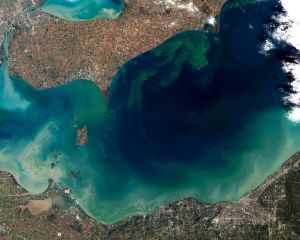
Algae Bloom in Lake Erie, Oct. 5, 2011. Photo Credit – NASA Earth Observatory

During his July 8 speech on the environment, the president mentioned his administration’s fight with “toxic algae” in Florida 50 miles from his Mar-a-Lago resort.

Bruce Hrobak, a bait and tackle shop owner in Port St. Lucie, Fla. gave a testimonial at the event about the great job he thought the federal government did to help his business which was “devastated by toxic algae from Lake Okeechobee.” His praise was about more than the government.

“You jumping into this environment brings my heart to warmth, knowing that what you’re doing is going — is the truth,” Hrobak said. “It’s going wonderfully. My business in 2018 was so horrible, we — I own two stores — we closed several days a week because of, you know, the algae and people being frightened, if they were afraid to touch the water and everything. I have a marine mechanic — I just wanted to say really quickly — has a bad infection in his arm from the marine algae and stuff.”

Mr. Hrobak gushed about the attention his problem had received and mentioned his wife was yelling at him less because business was better this year. People laughed and applauded. Rhetorically anyway, Trump halted advance of the red tide.

Iowans are familiar with the problems of algal blooms. The nutrient-rich soup that comprises our lakes and streams has been a hindrance to public recreation. We’ve restricted access to public beaches and educated kayakers, swimmers and boaters about the dangers of exposure to blue-green algae and the microcystins they produce. Iowa’s response to the problem amounts to shrugging our shoulders.

The Iowa Department of Natural Resources doesn’t plan to follow new federal recommendations for beach water quality that could lead to more public warnings about toxins in the water, according to a June 20 Cedar Rapids Gazette article by Erin Jordan.

Instead of adopting federal standards for algal contamination, an Iowa Department of Natural Resources spokesperson told the Gazette, “The group does not agree with the formula and science used to develop the eight micrograms per liter for cyanotoxins microcystins standard.”

Arguing with science is the new normal for government doing what it wants. The other new normal is the president asserting he has addressed a problem when in fact he is ignoring it.

Mother Jones reported July 12 on a toxic algae problem not being adequately addressed by the administration:

In June, the National Oceanic and Atmospheric Administration projected a Massachusetts-sized dead zone would alight upon the Gulf of Mexico, driven by a vast algae bloom fed by fertilizer runoff from the upper Midwest. As the bloom decays, it sucks oxygen out of the water. As a result, as NOAA puts it, “habitats that would normally be teeming with life become, essentially, biological deserts.”

And on Thursday, NOAA predicted that Lake Erie, which provides drinking water to 11 million people, will also experience a massive harmful algae bloom, starting in late July. The bloom is fed largely by phosphorus runoff in the Maumee River basin in Ohio, where the land is dominated by corn and soybean farms as well as massive indoor hog farms. Phosphorus is a key nutrient for plant growth, and farmers apply it to fields in the form of fertilizer (which comes mainly from phosphate mines in Florida) and hog manure.

People argue in social media that algae blooms are a naturally occurring phenomenon, that they are nothing to worry about. While that is partly true, they do occur naturally, they are fed to grow very large by agricultural runoff. For political reasons, government won’t connect the dots and take action on the much larger issue of nutrient runoff.

“Science is a fundamental part of the country that we are,” Neil deGrasse Tyson said. “But in this the 21st century, when it comes time to make decisions about science, it seems to me people have lost the ability to judge what is true and what is not… When you have people who don’t know much about science standing in denial of it and rising to power, that is a recipe for the complete dismantling of our informed democracy.”

The president is addressing red algae in his back yard. What has he done about blue-green algae for the rest of us? He denied us a solution and distracted us from the problem. This while his minions in the audience for the speech stood and applauded.

We’ve go to do something better.

~ Written for Blog for Iowa

Categories
Living in Society

Toward a Challenger for Joni Ernst

U.S. Senate Candidate Theresa Greenfield, Walker Homestead, Johnson County, Iowa. July 14, 2019

Two of three people running for the Democratic nomination to be U.S. Senator from Iowa spoke at State Senator Zach Wahls’ birthday fundraiser at Walker Homestead in Johnson County on Sunday.

Clutching a microphone in one hand and her hand-written speech notes in the other, Theresa Greenfield of Des Moines went second to last in a 90 minute series of speakers that included five presidential hopefuls.

Eddie Mauro of Des Moines had arrived early to the event and introduced himself to some of the more than 200 attendees. When he stepped onto the stage surrounded by straw bales, he was the last of twelve speakers.

Kimberly Graham, a Democrat from Indianola, was first to announce her bid to challenge U.S. Senator Joni Ernst. While she did not attend Wahls’ event, there was substantial press coverage of her May entry into the race.

Of the three candidates, Theresa Greenfield is said to be the front runner, however, there are challenges ahead for whoever is the party’s nominee. Joni Ernst won the 2014 general election with 52 percent of the vote and in a recent Ann Selzer poll, more than 57 percent of Iowans approve of the job she is doing. The goal for Democrats is to prevent Ernst from becoming an institution, making her a single term senator.

Democratic activists I know haven’t begun to dial into the U.S. Senate race yet, focusing more on the February 2020 presidential caucuses. Following are some links to information about the three Democratic candidates, including the verbatim about page from their websites.

Kimberly Graham

Launch video

Website

About Page:

I’m Kimberly Graham. I never thought in a million years I’d run for office. But it’s time for a government “by the people, for the people.”

Senator Joni Ernst campaigned on a promise to “make ’em squeal” in Washington D.C. and get rid of corruption, but the only people squealing are Iowans harmed by her votes.

Because our “By The People, For The People” campaign will be funded only by donors like you, and *never* by corporate PACS, the NRA or the Koch Brothers, I won’t be influenced by lobbyists and companies whose only interest is increasing their wealth. Instead, I’ll be representing the majority: you and Iowans who deserve better representation than you’ve been receiving.

What I’ve seen from Washington D.C. the last couple of years is the rich getting richer, the poor getting poorer and the middle class shrinking. We need more people from working-class backgrounds serving in government, representing the majority of us and not mega-corporations. So I’m running for United States Senate.

I lived in rural Iowa longer than anyplace else, for 24 years. I chose to raise my son in Indianola.

My maternal great-great-grandfather had a farm in Zearing and my paternal grandmother was born in Mt. Ayr. My dad was one of 11 siblings born in Des Moines. He was a Marine, later a bridge-builder, and mom was a clerk at the phone company. Neither of them went to college but had good union jobs and worked hard to give my brother and me a solid working-class upbringing.

I’ve been working since I was 14: in a dry cleaner, as a waitress, store clerk, and housecleaner. I worked my way through college. I wanted to help people for a living so I went to law school, paying my own way and taking out student loans. I still have student loan debt. Now I work as an advocate for abused or neglected kids in court.

Living in rural Iowa and raising my son, I watched as the furniture, clothing, shoe stores, and other businesses on the square closed after fast-food chains and mega-stores moved in.

I’ve watched farmers struggle with increasing costs while being paid less for crops, with fewer companies from which to purchase seed and being treated unfairly as our current president enacts tariff after tariff, harming family farms. Iowans want and deserve a level playing field and a real chance at thriving small towns and thriving cities.

I’ve watched medical insurance premiums, mine included, rise to the point that families are paying more for medical insurance than for housing. Many simply can’t afford insurance anymore. Medical care costs of a serious illness are bankrupting families and forcing them to spend their life savings. It’s not right, that in the wealthiest nation on earth, this is happening.

In my work as the guardian ad litem and attorney for kids of participants in Family Treatment Court, I’ve watched the opioid and meth epidemics rip families apart and damage our communities. I’ve seen veterans return from service, experiencing trauma, and not receive services quickly or locally enough.

Iowans deserve better. As I mentioned above, Senator Ernst campaigned on a promise to “make ’em squeal” in Washington D.C. and get rid of corruption, but the only people squealing are Iowans harmed by her votes. I support major campaign finance reform and sweeping anti-corruption legislation to return our government to The People. We must get Big Money OUT of politics. No more politics as usual.

I’m running for U.S. Senate because the government should truly be “by the people, for the people.” It should work for the benefit of the majority, not the small number of wealthy. I’m not worried about them. They’ll be fine whether they have 50 million dollars a year income or 40 million. But I am worried about the rest of us.

We need Medicare for All, farmers to be treated fairly, good jobs all over the state and a level playing field so monopolies can’t destroy farms and small towns. Iowans need clean air and water, a justice system that treats everyone fairly and equally, and good public schools that provide the same high-quality education to all children, regardless of whether they live in Clive or Creston. We need representation in the U.S Senate that isn’t bought by corporations, drug companies or any special interests.

My goal is to be the best senator money *can’t* buy. Please join me in a movement For the People, By the People of Iowa.

Theresa Greenfield

Launch video

Website

About Page:

Theresa Greenfield grew up on a family farm, where she and her four siblings learned the value of hard work and self-reliance. Her father Derald encouraged his daughters to do everything the boys did on the Greenfield farm, and at 16, Theresa and her sister began helping with the family crop-dusting business, meeting with farmers to negotiate terms, and mark out fields while Derald was in the air lining up his plane for the next job.

When the farm crisis of the 1980s hit rural families like Theresa’s, she did not give up on her dream to attend college. With the help of financial aid and multiple part-time jobs, she put herself through school. Theresa married and as she and her husband were expecting their second child, he was killed in an accident at his job as a union electrical worker. Theresa set out on a path to provide for her two boys as a single mom.

Theresa worked as an urban planner and then joined Rottlund Homes, where she rose quickly through the ranks and soon moved to Des Moines to lead the company’s Iowa Division. Today, she serves as President of Colby Interests, one of Des Moines’ oldest family-held real estate and development companies. She lives with her husband Steve in Des Moines and together they have four grown children: Tanya, a media specialist; Nick, a horticulturist; Phil, a healthcare consultant; and Dane, a soldier in the U.S. Army.

Now, more than ever, Iowans need more leaders like Theresa in the U.S. Senate: a farm kid with farm kid values whose get-it-done attitude will help get things done for working families — from investing in education, to making it easier for small businesses to thrive, to cutting healthcare costs.

Eddie Mauro

Recent Video

Website

About Page:

Eddie J Mauro is a business owner, father, coach, community volunteer and former teacher who is committed to working hard to improve the performance of our government and empower people.

Additional links to resources about the candidates would be welcome in the comments.

UPDATE: On Monday, Aug. 26, Michael Franken announced his intent to run for the Democratic nomination for U.S. Senate in Iowa. View his launch video here.

~ Written for Blog for Iowa

Categories
Living in Society

Can Democrats Change The ‘Roberts Five’ Majority?

U.S. Supreme Court

If Democrats hope to undo the conservative lean of the United States Supreme Court it won’t be as simple as Republicans had it in 2016.

Many said the 2016 general election was as much about the Supreme Court as it was about electing a president. It was a unique historical opportunity, where appointing two associate justices could impact the court for decades, with Iowa’s senior senator Chuck Grassley playing a key role as chairman of the Senate Judiciary Committee.

With the 2005 appointment of Chief Justice John Roberts and two recent associate justice appointments, Neil Gorsuch and Brett Kavanaugh, Republicans have remade the high court in a way that consistently delivers opinions in favor of their interests.

Senator Sheldon Whitehouse (D-RI) wrote about the Supreme Court and the “Roberts Five” majority in an April Issue Brief for the American Constitution Society:

It turns out that Republican appointees to the Supreme Court have, with remarkable consistency, delivered rulings that advantage the big corporate and special interests that are, in turn, the political lifeblood of the Republican Party. Several of these decisions have been particularly flagrant and notorious: Citizens United v. FEC, Shelby County v. Holder, and Janus v. AFCME. But there are many. Under Chief Justice Roberts’ tenure through the end of October Term 2017-2018, Republican appointees have delivered partisan rulings not three or four times, not even a dozen or two dozen times, but 73 times. Seventy-three decisions favored Republican interests, with no Democratic appointee joining the majority. On the way to this judicial romp, the “Roberts Five” were stunningly cavalier with any doctrine, precedent, or congressional finding that got in their way.

These cases fall into four categories according to Whitehouse.

(1) controlling the political process to benefit conservative candidates and policies;
(2) protecting corporations from liability and letting polluters pollute;
(3) restricting civil rights and condoning discrimination;
(4) advancing a far-right social agenda.

Even if a Democratic president returns to the White House in 2021, something far from assured, there may be only two opportunities to appoint associate justices when octogenarians Ruth Bader Ginsberg and Stephen Breyer die, retire or otherwise move on. Such appointments wouldn’t impact the ideological balance of the high court. In fact, if justice were blind, would there even be an ideological balance to talk about?

No amount of liberal outrage will fix this Republican-made court. What’s a Democrat to do?

First, understanding what’s taking place in the Roberts Court should be a high priority. A beginning is to read Senator Whitehouse’s article here to understand the damage done since Roberts was appointed chief justice.

Second, the Republican strategy of holding judicial appointments open until a Republican president was elected was a multi-year, long-term strategy that worked. Whether or not politicizing the court system is a good idea, one has to ask, what is the Democratic plan to change the mix of justices? There may be one. If there is, how is it actionable for rank and file voters? I’m not sure chasing third tier Democratic presidential candidates around Iowa before the caucus is a positive contribution to the effort.

Finally, Democrats must do a better job of picking their battles. Outrageous behavior is a feature, not a bug of the Trump administration and Republican legislators. There will always be an outrage as long as Trump is president, because if nothing is going on, he will gin something up. When Republicans make us feel outraged, they also maintain control of public dialogue. In order to break their hold on voters we must work differently that we have recently. It begins by de-emphasizing social media and talking directly to friends and neighbors about how to resolve the issues society faces.

It’s not a flawless approach, however, we have to do something.

~ Written for Blog for Iowa

Categories
Living in Society

Can A Democrat Beat Kentucky Senator Mitch McConnell?

Former Marine fighter pilot Amy McGrath announced she was running to beat Kentucky U.S. Senator Mitch McConnell in the Nov. 3, 2020 general election.

She raised $2.5 million during the first 24 hours after her announcement.

With 20 years in the United States Marine Corps and 89 combat missions under her belt, she demonstrated substantial courage and grit. If she can focus on one thing, beating McConnell, she may have a better path to election than any other recent challenger.

People are nit-picking her campaign apart after her July 9 announcement and it boils down to one thing: do Democrats want someone to take on McConnell or not? It won’t be easy for McGrath and it wouldn’t be easy for anyone. If there are better candidates out there, they should step forward.

What seems obvious from the blow back to McGrath’s campaign is we need a reminder of why Mitch McConnell has to go. Here’s Thom Hartmann interviewing Senator Jeff Merkley on that topic at Netroots Nation over the weekend.

It’s hard to tell whether anyone can beat Mitch McConnell in Kentucky. Democrats must step up and have Amy McGrath’s back if they are serious about taking the senate back.

Here’s McGrath’s biography from her campaign website:

Amy McGrath, a retired US Marine Corps Lieutenant Colonel raised in Kentucky, is running for the US Senate to fix Washington and give Kentuckians back their voice.

Amy was born the youngest of three children to Donald and Marianne McGrath. Her father was a high school English teacher and her mother was one of the first women to graduate from the University of Kentucky medical school.

When Amy was 13 years old, she dreamed of becoming a fighter pilot, but women were not yet allowed to serve in combat roles in our military. So she wrote to her elected officials to ask them to change the law. She never heard back from her senator, Mitch McConnell.

Amy graduated from the US Naval Academy and overcame the odds to become the first woman in the Marine Corps to fly a combat mission in an F/A-18 fighter jet. She served 20 years in the Marines where she flew 89 combat missions in Iraq and Afghanistan, targeting al-Qaida and the Taliban, before retiring and moving back home to Kentucky to raise her family.

Amy lives in Georgetown, Kentucky, with her husband Erik, a retired Navy pilot and registered Republican, and her three children, Teddy (7), George (5), and Eleanor (3).

Amy became a Marine combat pilot to fight and defend her country and now she is taking the fight to Washington to solve the problems Kentuckians face in their every-day lives. Amy was a registered independent for 12 years, so she always prioritizes practical solutions over partisan interests. She’s not running for Senate to get rich and join the Washington swamp. Amy is ready to take on career politicians like Mitch McConnell and bring accountability and leadership back to Kentucky.

To learn more go to amymcgrath.com.

~ Written for Blog for Iowa

Categories
Living in Society

At a Potluck Dinner

Mixed cucumbers and squash, July 12, 2019.

I sliced fresh cucumbers on the mandolin and dressed them with a mixture of olive oil, homemade apple cider vinegar, salt and pepper for the potluck.

Not sure how much to take, I used all the Tasty Jade Asian cucumbers I picked in the morning. It made a generous offering.

The dressing took place on the hood of my car in the parking lot for the event. Didn’t want the salad dressing to break, and the possibility of finding more ingredients along the route to the potluck kept options open until the last minute.

An octogenarian friend suggested it’s important to put your name on a potluck dish. I made a card, wrote the ingredients on it, and signed at the bottom. What’s in the dish seems more important than who made it, especially for people with dietary restrictions, but I seldom question my friend’s potluck wisdom. I made my name legible.

On a warm, summer afternoon in a park in North Liberty we gathered and enjoyed each other’s company. The potluck was the July meeting of our county’s Democratic central committee. It was an official meeting, but very informal. This being Iowa, a good percentage of the group included young political organizers for presidential campaigns, the Iowa Democratic Party, and other campaigns. There are a lot of elections between now and Nov. 3, 2020. By the way, Democrats, like most potluck attendees, are a bunch of gossips, the author included.

If people believe the way to learn about candidates and their policies is to attend large town hall meetings, they are wrong. Whatever I learned and continue to learn is done in small bits over a very long time with people I’ve come to know well. I didn’t realize that until I was able to suppress my driving social style and actually listen to people. Most elected officials are real people with real interests of their own. If they come to a potluck at all, that’s a sign they are accessible… and human.

There was no real news out of the potluck. It was the kind of warm summer evening of which there are too few in life. Suffice it there were many positive interactions before I headed home along Mehaffey Bridge Road.

Categories
Living in Society

Support for Rita Hart

Rita Hart Photo Credit – Candidate Facebook Page

I first heard Rita Hart, candidate for U.S. Congress in Iowa’s second district, speak on Friday, June 26, 2015, at Gil’s Restaurant, Ballroom and Limousine Service in Clinton at the Clinton County Democrats Hall of Fame Dinner. I have no recollection of what she said as the number of speakers was large, and my memory not as good as it used to be.

I’m supporting Hart for Congress for three reasons: she is a two-term former state senator, as our lieutenant governor candidate in 2018 she helped organize the second district for Democrats, and she has an education and farming background. I already sent a small donation.

Of the two announced Democratic candidates, I know the other better, Newman Abuissa of Iowa City. I like Abuissa a lot, and am aware of his contributions to Iowa Democratic politics and the peace and justice movement. However, this is his first campaign for elected office and we need an experienced campaigner to keep this seat Democratic. Hart has a D behind her name, won her two races for state senator, and has the bona fides of a campaigner to support it. That’s enough for this open race, one of many important ones in the 2020 general election.

What about policy, one might ask. I didn’t agree with every vote Dave Loebsack made during his tenure, and don’t expect I will like every vote Rita Hart makes. I no longer seek a perfect candidate and Dave Loebsack’s endorsement of Hart is what I needed to hear before putting a check mark next to her name on the primary ballot.

View Rita Hart’s Announcement video here.

View Rita Hart’s TED Talk titled Re-envisioning Education – Seeing Schools Differently here.

Donate to Rita Hart’s campaign here.

Follow Rita Hart on Facebook and Twitter.

~ Written for Blog for Iowa

Categories
Living in Society

We’ve Got to Do Something

U.S. Capitol, Washington, D.C.

Over the weekend Erin Murphy, a Lee Enterprises Des Moines based reporter, said it was quiet in Iowa’s congressional primary races.

“Perhaps in the coming weeks and months, some of these quieter primary races will become more crowded,” Murphy wrote in the Quad City Times. “For now, though, the fairly low level of interest from candidates has been surprising.”

Murphy recounted the five 2020 congressional delegation races, noted who was in each race, and which were conspicuous by the absence of a declared candidate from one party or the other (a Democrat in Iowa 4 and a Republican in Iowa 2*). It is a long time until the June 2020 primary election, so Murphy’s surprise seems premature, even if he acknowledged the 11 months in the article.

My sense, from talking to Democratic voters, is there is near universal belief “we have to do something.” By that, they mean overturn Republican control of the presidency, keep the U.S. House and retake the U.S. Senate, and win one or both chambers of the state legislature. People are dead serious about it and seem willing to devote resources to making it happen. They will be sure to show up to vote in the general election.

The disconnect, and maybe the premise for Murphy’s article, is between the “we have to do something” feeling and nominees produced by the party. Voters I talk to don’t care that much about who is nominated for Congress and U.S. Senate unless they are an incumbent. They just know what we have now isn’t working.

I know what that’s like. We had to do something toward the end of George W. Bush’s first term. My response was to pick a race, focus, donate money, and volunteer every chance I got. I felt long-time Congressman Jim Leach had to go. While the Democratic challenger Dave Franker wasn’t the best candidate, everyone who volunteered on his campaign worked hard toward his election. “It didn’t work out well,” I mentioned to Dave Loebsack via email when he established an exploratory committee for the Second District Congressional seat in March 2005.

I put 2004 behind me and re-started my effort to ouster the incumbent. Voters I spoke with on the telephone and in person had turned against the once popular Leach. It almost didn’t matter our candidate was Dave Loebsack, because the expressed need for change was so prevalent. We went into election night not knowing if we’d win but hopeful based on the large number of voters who’d had it with the incumbent. As we now know, Loebsack was successful in defeating him.

I haven’t started door knocking or calling voters in 2019. As I mentioned, “we have to do something,” and that’s similar to 2006 which was the beginning of a Democratic wave that culminated in a national trifecta in 2008.

Why is it so quiet in the congressional races in July? I’m not sure that’s an accurate statement. Maybe there are less candidates running, however, the noise, if there is any, is more among rank and file Democrats, particularly those who are normally less active, taking it all in and discussing politics with friends and family. They need space to consider candidates in lives that don’t normally revolve around partisan politics. Outside the presidential preference at the February caucus, most don’t really care who nominees are as long as there is a D behind their name and candidates act like it. People are making room for politics in busy lives, but it hasn’t the high priority that will drive a more exciting race of the kind Murphy was expecting.

Resolved not to let Trump and the Republican policies stand, people seem hunkered down trying to make a go of it in an economy that favors the wealthy and where corporations strive to squeeze regular people out of every last dime. Maintaining the type of resolve needed to change our government takes energy, just a different kind than what’s represented in an active, multi-candidate primary.

People say an open primary and debate between multiple candidates is good for the party. I don’t know about that. Rank and file view it differently and people seem to take stock before declaring candidacy, realizing the financial investment in one of these five races will be significant. Maybe what you see is what you get and others don’t want to run of office.

July 2019 may be the quiet before a political storm that’s brewing next year.

* On July 8, Erin Murphy reported that Bobby Schilling filed paperwork with the Federal Elections Commission to run for Congress in Iowa’s second district as a Republican.

~ Written for Blog for Iowa

Categories
Living in Society

Can Educationism Solve Anything?

Big Grove Township School #1

Blaming the woes of society on our K-12 education system is a habit I need to break.

In the post below the target was a failure to teach children about their responsibilities when signing student loan papers. A high school graduate is an adult at age 18 in our culture, so when taking on debt that has the potential to cripple them for decades, they should be equipped to know what they are doing.

Parents also play a key role in educating youth, however my grievance with the way the Iowa legislature funds public schools is they are not spending enough money where it is most needed, and the results show in the form of an ill-educated electorate that makes what I believe are bad decisions.

It is unfair for me to pin this on public schools as State Senator Claire Celsi immediately pointed out:

In the July issue of The Atlantic, author Nick Hanauer addresses the tendency to blame public schools in an article titled, “Better Public Schools Won’t Fix America:”

Long ago, I was captivated by a seductively intuitive idea, one many of my wealthy friends still subscribe to: that both poverty and rising inequality are largely consequences of America’s failing education system. Fix that, I believed, and we could cure much of what ails America.

This belief system, which I have come to think of as “educationism,” is grounded in a familiar story about cause and effect: Once upon a time, America created a public-education system that was the envy of the modern world. No nation produced more or better-educated high-school and college graduates, and thus the great American middle class was built. But then, sometime around the 1970s, America lost its way. We allowed our schools to crumble, and our test scores and graduation rates to fall. School systems that once churned out well-paid factory workers failed to keep pace with the rising educational demands of the new knowledge economy. As America’s public-school systems foundered, so did the earning power of the American middle class. And as inequality increased, so did political polarization, cynicism, and anger, threatening to undermine American democracy itself.

Hanauer assigns blame to our economic system: income inequality and the fact workers are underpaid.

“Allow economic inequality to grow, and educational inequality will inevitably grow with it,” he wrote. “By distracting us from these truths, educationism is part of the problem.”

While sad that my participation on Twitter is sometimes a distraction, eventually I can get around to a more reasonable position thanks to the commentariat. One commentator accused me of adopting the policies of U.S. Senators Chuck Grassley and Joni Ernst. That’s not the case, but at least we didn’t have to invoke Godwin’s Law to resolve the issue. Despite any issues with an ill-educated electorate, hope for a better world remains.

Read Hanauer’s entire article here.

~ Written for Blog for Iowa