The remaining two Bur Oak trees in the garden made an abundance of acorns this year. They are weighing down the branches so they almost touch the ground. Acorns are welcome nutrition for squirrels who took up residence in trees I planted after moving to Big Grove in 1993. These particular oak trees were planted from acorns harvested the year our daughter graduated high school and left home. There were three trees, one for each family member, but the August 2020 derecho took one of them out.
The plan is to remove one of the remaining two after the garden finishes this year. It will allow the final one to grow to maturity. By the time it does, I’ll likely be too old for much gardening yet I hope to be able to appreciate its native glory.
It took an hour to harvest tomatoes yesterday. There were two and a half gallons of San Marzanos, a milk jug full of mixed cherry tomatoes, and a bushel of slicers. Today’s plan is to clean them all, remove the imperfect ones to make tomato sauce, and organize what’s left for optimum storage and use in the next couple of days. Tomatoes planted under the oak trees are looking better, so there will be a harvest of plums and Amish paste for canning. This season is running late across the garden.
While I reached into tomato cages to take fruit from the vines I thought about next year. I plan to continue the trellis system for cherry tomatoes and plant two additional long rows, one of mixed slicers and one of San Marzanos, Granaderos, and Amish Paste. The trellis will be longer, as we are using more cherries in the kitchen. It needs to be more sturdy so I may invest in t-posts for the upright supports and place them closer together. They will be flanked by the other two rows, which in turn will be flanked by bell peppers on one side and a mix of eggplant and hot peppers on the other. That would allow focus on that particular garden patch at the same time of year. One can tell fall is not far away by this contemplation of next year.
Where the garlic will go this fall is not decided. This year’s crop continues to cure in the garage and the heads used have been healthy and tasty. I planted 100 head last fall and it produced plenty for the kitchen. Almost every seed planted yielded a head. When the curing process is finished, I’ll save the best heads for seed. This garlic originated on Susan Jutz’ farm and has been planted year after year for a very long time. It has good characteristics and stores well.
Soon I will mow the harvested garlic patch and use the plot to store grass clippings. With the recent rain, the yard grass is long and will make plenty for storage. I also need to tear down the failed onion patch and prepare it to store fencing. I need a sunny afternoon for this work.
We move through the gardening season so quickly any more. In late August, the work continues to be about tomatoes, peppers, greens, celery, and eggplant. Cucumbers and zucchini are about done. I hope to plant lettuce before the week is done. Acorns forming on oak trees are the sign I had better get going.
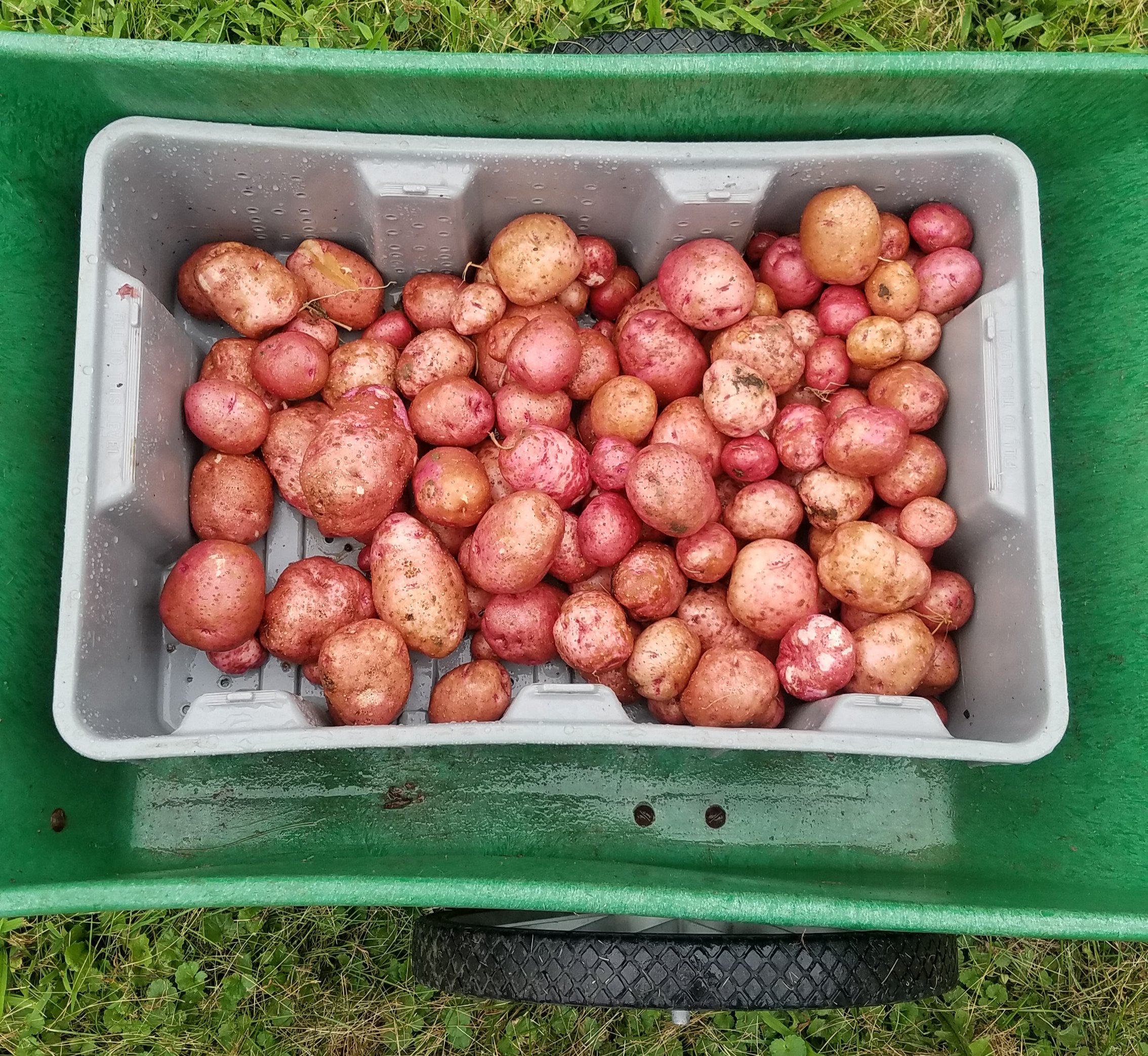
The rest of the potato harvest. It was a good crop.
In August there is plenty of extra garden produce for donations to the local food pantry. Potatoes are popular and I could easily have donated this whole bin. They all would have been taken. Potatoes are elemental.
After a period of rodents eating potatoes while they were still in the ground, I decided to plant in containers. That solved the problem. When I think of the future, I should plant six instead of four containers so I have more to donate. What we have will serve us until they are gone before the end of the year.
We cook potatoes in four primary ways: roasting; grated to make hash browns; as an ingredient in soup; and boiling. All of the smallest ones are used for soup. Every once in a while I use boiled potatoes to make potato salad. Whatever I make with potatoes gets eaten up because they are especially good.
I used to leave the containers buried and replant in the same location each season, using a little composted chicken or turkey manure as fertilizer. This year, I moved them and used soil from the two composters. The production was robust. Given the small amount of time and care it takes to grow potatoes, it is well worth it to have a fresh, great-tasting vegetable. Digging up the containers and harvesting potatoes has become a milestone in the garden season.
The food bank is a nice option to get what I produce into the hands of people who need it. The garden is at the point there are too many cucumbers, tomatoes, zucchini, and bell peppers. There will never be too many potatoes. It’s hard to believe a few years ago we didn’t have a food bank. It has become a vital part of the community in which we live.
We have been blessed with some perfect June days. Temperatures have been moderate and when it rained, it was the gentle kind that nourishes everything it touches. We can’t get enough of these long, beautiful days.
The garden is producing an amazing amount of greens: arugula, spinach, chard, collards, kale, mustard, turnip, lettuce and others. The season is only just beginning.
I’m halfway through the garlic scape harvest. Everything planted the last few weeks has taken and the greenhouse is emptying. There is weeding to do, a lot of it. At the same time there is a brief caesura. I can breathe.
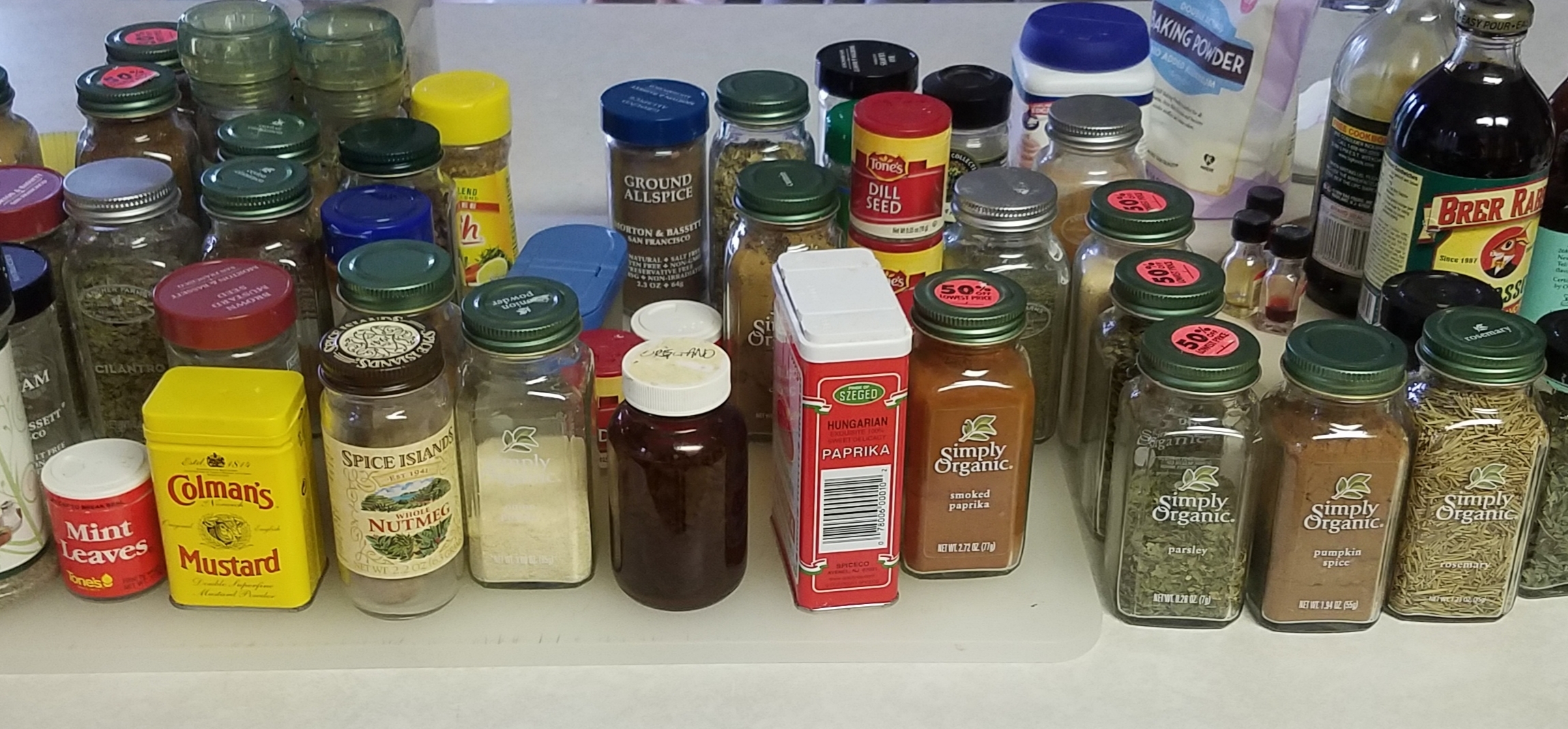
Herbs, spices, seeds, and flavorings arranged on the counter.
When the world seems to be falling apart on a path toward chaos, then oblivion, we draw into family. My spouse and I set a meeting to go through herbs, spices, flavorings, extracts, sweeteners and seeds. That’s right! We put it on our calendars and everything. I baked a vegan rhubarb-applesauce cake before we began and that helped us along.
We both use the kitchen and things had gotten out of control. We were determined to remedy that. It turned into a two-day project during which we learned something about ourselves.
There were so many items tucked away in multiple places, just collecting them in one place was a major project. A few found their way from Indiana to Iowa in 1993 when we moved to Big Grove. Others migrated from our child’s kitchen in Colorado ten years ago. I had two shelves in the pantry where I crammed jars and bottles since I built the shelves. Over the stove, in the cupboard, in the turnabout, stuff was everywhere. We truly had no idea what we had in case a recipe called for something.
We set no firm time-line for disposition. If the item was unique, or we hadn’t used it in a while, we were more likely to keep it for potential use. There were a number of containers with no expiration date. There were also those I grew in the garden or foraged. We tended to dispose of bottles with a best by date of 2009 or earlier when it had one. The oldest was dated 2002. It was not an absolute rule. What mattered more was the aroma of each bottle gauged against future use. At the end of the first day, I had a five-gallon bucket full of discarded herbs, spices and flavorings for compost. The compost pile will be fragrant in a different way for a while.
This seemed like a bigger project than it should have been yet it is only the beginning of downsizing the number of possessions in our household. The project created many different interactions between us and the end result was positive. Practice makes perfect, they say.
Organization might help us maintain a grip on what’s in the pantry so our meals can be better for the knowledge. It was a positive way to spend an afternoon. There is plenty of negativity away from our little enclave. We were able to avoid it for a while. The fresh cake helped.
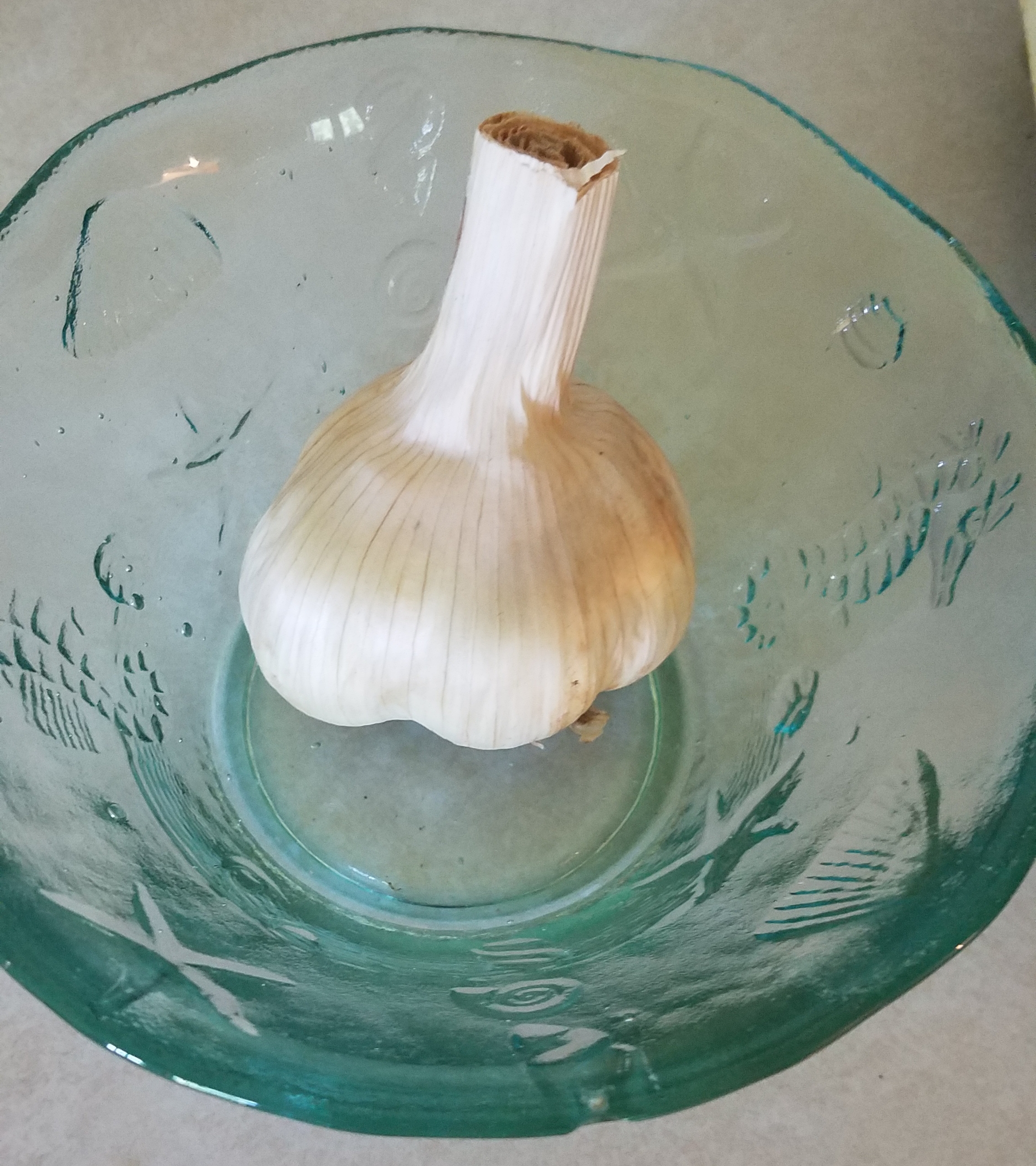
The last bulb of garlic from the 2021 garden is ready to use. By the time we consume it, scapes from the new crop will be available. This is where a gardener wants to be.
Since I began following the garlic-growing practices of my farmer friends, it has been an unmitigated success. Using seed from the farm, I grew my own seed for the following year crops with plenty for the kitchen. I also increased the size of the garlic patch this year. The plants looks healthy and should be ready to harvest in July.
I cut all the scapes to encourage the bulbs to grow large. Scapes serve as a replacement for garlic until the harvest.
Next steps in the cycle are to clear off the table in the garage and convert it into a drying rack later this month. Garlic is an important vegetable in a kitchen garden. Once one learns how to cultivate it, it is clear sailing to great culinary dishes.
Sandy is the spark plug of our community, especially when it comes to services for senior citizens, yet more than that. We met Saturday morning at a political event at the public library. A primary election is coming up on June 7 and there is stuff to discuss.
I asked Sandy about donating garden produce to the food bank again this year. She said the food bank would welcome the contributions and local donations were an important part of providing fresh food to people who need it. “I’m trying to slow down,” she said, explaining that some younger people were now taking donations on Mondays. Sandy turned 87 last September so there is nothing to say about her slowing down, other than she earned it. No one can replace what she has done for the community. We are grateful for any time with her.
For dinner I pulled something from the freezer and noticed the item was not hard, as it should be. The thermometer registered 50 degrees, precipitating “oh noes!” I spent an hour emptying everything into five-gallon buckets for composting. A lot of work went into preserving the food. Such is life: eventually our efforts become compost.
The two apple trees planted in 2020 are in bloom. That means a few apples, we hope. When one plants trees it is hard to avoid a long-term perspective. If there are apples, we’ll enjoy them.
Home alone, I made a spicy dish for dinner: red beans and rice. There is no recipe, yet it was everything to which decades of kitchen and garden work led me. Supper was life, as good as it gets. The process of anticipation, planning, and pulling items from the freezer, ice box and pantry culminated in deliciousness. The meal was why we pay attention to flavor rather than the names of dishes or ingredients.
I didn’t know I needed spring break, yet here we are. The combination of my spouse helping her sister move to a new home, 45 mile per hour winds and cold temperatures for two days, and a form of isolated winter exhaustion led me here. Break will continue until I see my doctor later this week. I already have my blood test results and the key numbers improved from six months ago. I noted Earth Hour last night and feel rested and ready to get into the garden and yard. The winds subsided overnight.
Saturday I spent five hours participating in the county Democratic convention via Zoom. I don’t like virtual events, yet they are efficient. I’d rather be talking to political friends and acquaintances in person. The upside of a virtual convention is when it is over, there is no need to use an automobile to get home. A couple of notes.
1984 was my first Johnson County Democratic convention. Most people were nice, although I was frustrated with the process. The county convention revisited decisions made at the precinct caucuses and walked away from what voters said they wanted in favor of special interests. That burned me on politics for a while. Since then we spent six years in Indiana. When we returned to Iowa, I was not active in politics for ten years, until 2004. The virtual event was reasonably organized, yet kinda sucked. What’s a person to do? An old Polish proverb applies, “Not my circus, not my monkeys.”
Age is not treating some of my long-term cohorts well, at least from the images presented on Zoom. There are a number of new people, likely more than half. I’d rather step back from organized politics. I volunteered to be a delegate to the district and state conventions to make sure enough people were available to fill 74 slots. The district convention is at a nearby high school across the lakes. When it was time to ratify the slate, all slots weren’t filled. People don’t seem that engaged in politics this year, even if they should be. That may be bias created by the virtual format, yet I’m seeing the same thing in every segment of local culture.
There were ten platform amendments submitted at the convention. The platform is irrelevant, mostly because Democratic candidates for office don’t support every plank, even if they acknowledge a platform exists. Why does the county party spend time on it? The answer, I guess, is it is a way of life for party members who want a shared experience in articulating their beliefs. As a writer, I get plenty of that from elsewhere. As long as we keep the platform’s irrelevance to formal policy in mind, and don’t expect candidates to fully support it, let platformers platform.
I’m preparing to write about my senior year in college when I lived in a small house on Gilbert Court in Iowa City. Artist Pat Dooley rented it from a local businessman and managed the many residents who came and went during that six month period. It was a small, decrepit three-bedroom structure built on a stone foundation. According to Google maps, it has now been demolished.
Dooley was part of a group of writers and artists loosely referred to as “Actualists.” He did the cover art for The Actualist Anthology edited by Morty Sklar and Darrell Gray. Gray overnighted with us for a brief period before leaving Iowa for California. Many Actualists visited our house at Dooley’s invitation, where we socialized in the common room. Alan and Cinda Kornblum, Jim Mulac, Dave Morice, Sheila Heldenbrand, John Sjoberg and Steve Toth stopped by more than once, as best I can recall.
By 1974, I finished required coursework for a major in English and needed to fill out the total number of required hours. My coursework during that final undergraduate semester included French conversation, separate classes in ancient and modern art, Harry Oster’s American Folk Literature, and early modern philosophy. I hadn’t prepared for a career during university, although the Oscar Mayer Company, for whom I worked two summers, called to offer me a job as a foreman in the Davenport meat packing plant. I declined.
There are a couple of additional days before I must get to work in earnest. Spring break, while unexpected, is not over.
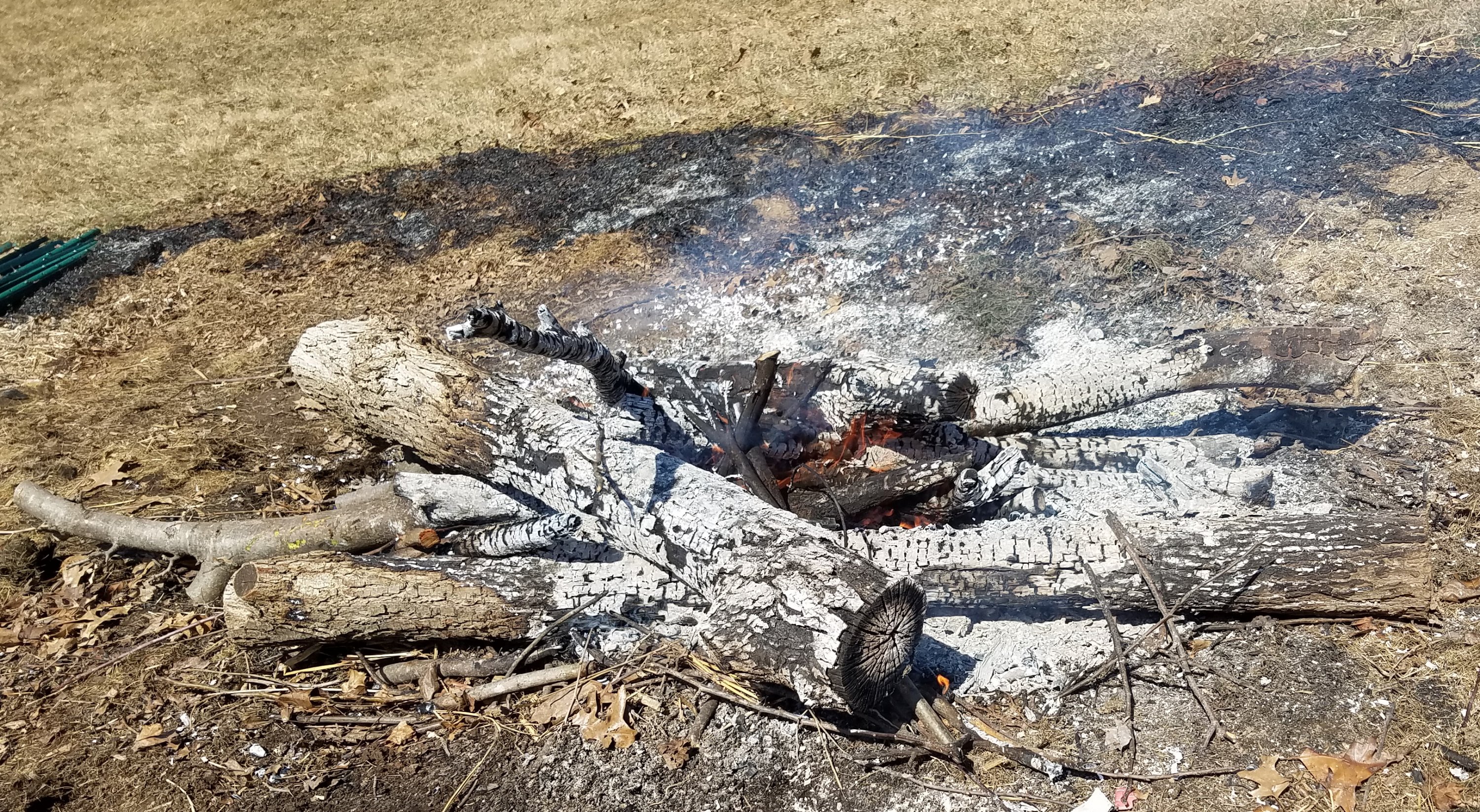
Gardening season begins with a spring burn pile. Usually there are plenty of branches from winter tree pruning and windfalls. As elements return to the soil, our hope in the sustainability of life is renewed.
I lit this year’s burn pile with a single match applied to shredded paper. When I went to bed, embers were smoldering. The next day warmth radiated from the ashes even though a light rain had fallen. When the fire depletes its fuel, I’ll rake the ashes evenly over the soil and turn them into it.
I’m ready to garden.
How should I write about the garden this year? What terms should I use? What phraseology is best? What goals do I have for readers, and for myself? What is the lexicon of gardening?
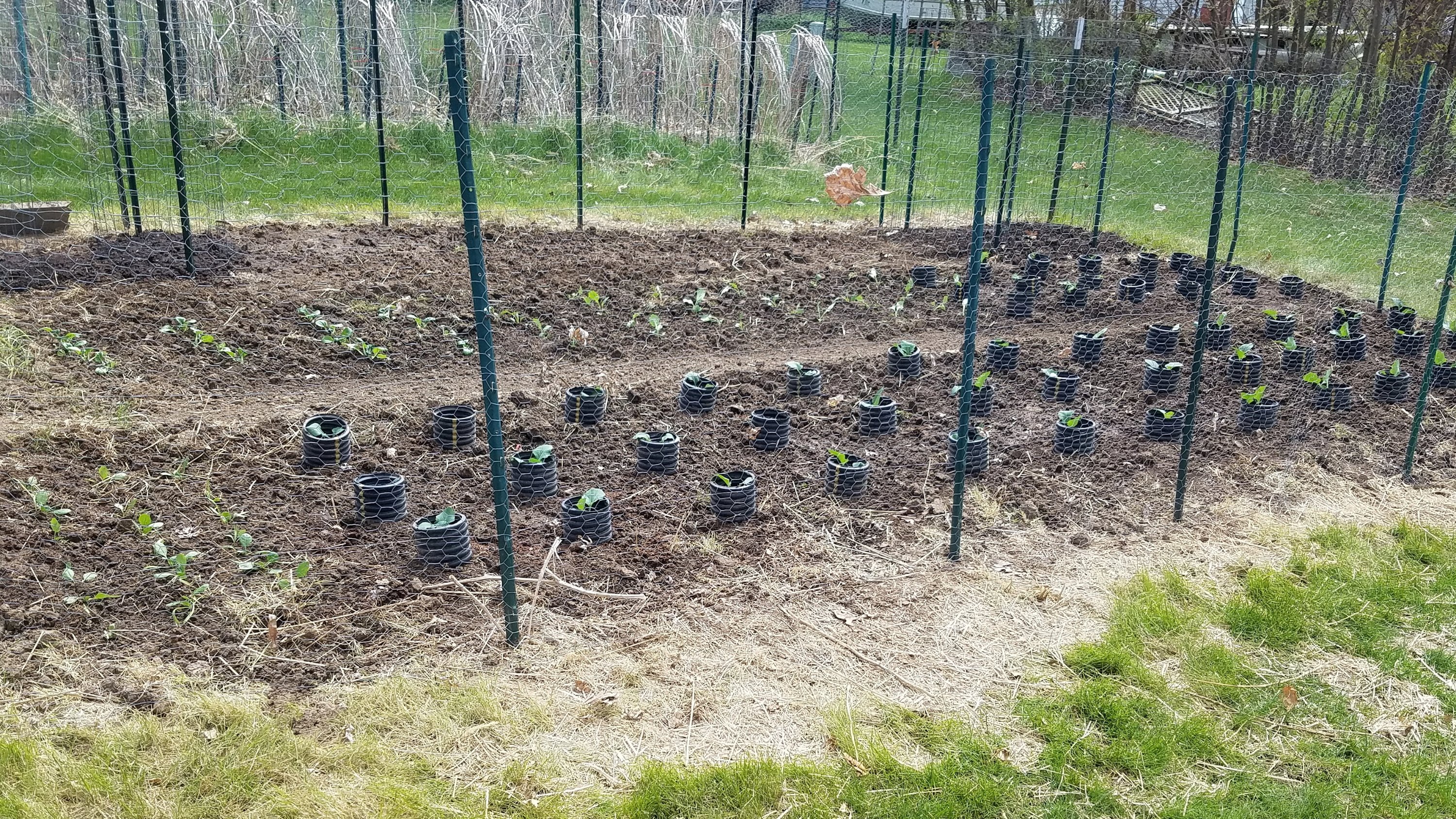
This year I adopted a spreadsheet to track my seed planting, so no need to record that here. There are eight trays of seedlings started in the house. Once the weather breaks, I’ll set up the greenhouse. It is becoming routine. This is a year for recycling everything I can: ground cover, row cover, stakes and fencing. I’m seeking to optimize the gardening space to grow more food we’ll use. Over the last ten years certain plots have become predictable: garlic, tomatoes, greens, and squash. Same way with crops: there are a couple dozen we favor.
There was a sense of discovery in posts I previously wrote. I have come to know most of the crops that grow here, so discovery is mostly over. While being an adherent to a process of continuous improvement, I’m at a level where experiments are each of limited scope. For example, I’m trying San Marzano tomatoes to be used for canning this year. To detail such efforts seems a bit boring both to write and to read.
In college I read British romantics: Wordsworth, Coleridge, Blake, Keats, Byron, and the Shelleys. I understand the depopulation of the British countryside and increase in industrial activity in cities. Boring! I keep their books yet I don’t see returning to them any time soon. I seek to engender no romantic fantasy about gardening.
Growing a garden is an economic engine. Whatever I can grow at home is something I don’t have to buy from others. Perhaps the biggest money-saver is vegetable broth made diverse greens. Broth is expensive to buy and cheap to make. The quality of homemade is hard to beat. Once I’ve written about my vegetable broth, though, what else is there to say?
The idea of a kitchen garden needs further exploitation this year. Integrating what I grow and preserve with what we use is an important feature of the process. How many jars of pickles will we need? Not as many as I have been canning. Are we better to make sauerkraut or should we manage excess cabbage in the refrigerator, using it fresh? Based on the amount of old jars of kraut on the shelf, we don’t need to make much of it. Do I need to plant more fruit trees? At my age, whatever I plant won’t be productive soon enough to do much good. There is plenty to be done in a kitchen garden. I’m not sure how much people want to hear about it.
Each day, I walkabout the yard to review daily progress and consider the garden plots and how they should be planted. That process lives in the present and no amount of writing can render it otherwise. I’m not sure I want to write it down. What I know is the brush has been burned. As soon as the weather breaks, I should dig up rows for early planting. Just getting it done is satisfaction enough.
2021 has been a great year of progress in the kitchen garden. As the seed orders find their way to us via U.S. Postal Service, some reflection on the positives seems in order.
Apples
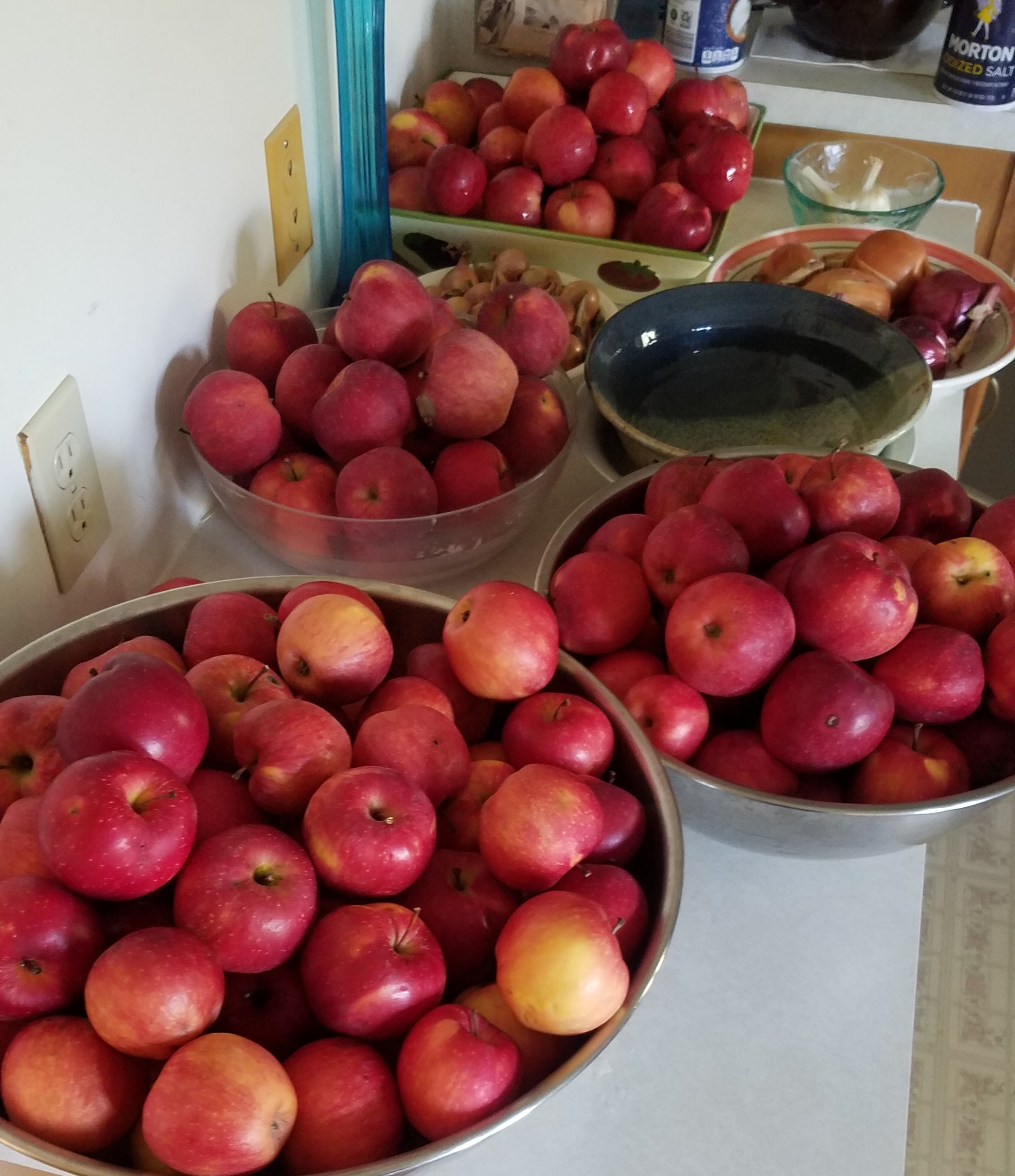
This has been one of the best years for apples. In our yard the three legacy trees bore abundantly and we used them for everything we needed. At the orchard (by this I mean Wilson’s Orchard and Farm, where I worked from 2013 until 2019) there was an abundant crop to supplement the two varieties that yielded here. The pantry is loaded with everything we need in terms of processed apples. We should have enough apple butter, applesauce, dried apples and cider vinegar to last two years until the next big crop. If our trees bear next year, that will be a bonus.
We had enough to take what we needed, let our neighbors pick some, and plenty for the deer once we harvested the best ones. The combination between our trees and a nearby commercial orchard meant we didn’t have to buy a single apple from the grocery store.
Vegetable broth
Each garden year begins with a couple dozen quart jars of vegetable broth. As I grow a diverse number of greens, I switch which ones dominate. Turnip greens have produced a consistently tasty broth, yet they all are good. We use this broth to cook rice, in soups, and as an alternative to using oil when frying vegetables for some dishes.
Guajillo Chilies
It took a few years but the integration of Guajillo Chilies into our cooking is complete. The main product is a cooked and preserved pepper combined with garlic, salt and apple cider vinegar in a food processor. Once the fresh chilies are gone, this becomes the main way I use chilies in cooking. I tried the technique with jalapeno peppers and while a little hotter, it also serves for our culinary needs.
Polish-style Soup
When growing up, Mom’s cooking was pretty “American.” That is, outside the occasional Polish-style ravioli brought home from visits to LaSalle, Illinois, Polish heritage cooking was absent. That was also true of memories of my maternal Grandmother who often found paid work as a cook in settings where American cooking prevailed. It was discovery of the cook book Treasured Polish Recipes for Americans by the Polanie Club that enabled me to come to terms with my heritage.
Based on studies of the soup chapter, I developed a consistent soup recipe that uses vegetables grown in our garden. The ingredients in the book were the same as what I have been growing for years. The main characteristics of the soups are they are thickened with barley, I add lentils as a source of protein, and use onions, celery, broccoli stem, parsley, grated zucchini and other frozen vegetables from the growing season. I use whatever greens are in season, and frozen kale if they are not. I also add potatoes, turnips, and whatever root vegetables are on hand. Settling on a soup recipe has been a long time coming.
Sweet Bell Peppers
After years of experimentation I finally produced enough bell peppers to eat raw, use in cooking, and preserve in the freezer. This was a watershed year.
Tomatoes
I grew the largest number of tomato plants ever and had plenty to eat fresh, can, freeze, and give away. The main successes were:
Developing a method to extract moisture and freeze the pulp into small servings using a cupcake pan was a breakthrough. The idea is to use a couple of tomato “buttons” to make pizza sauce for our weekly, home made pizza. I use them in everything to add a small amount of tomato sauce when needed.
I learned to grow enough Roma tomatoes so I can use them to can whole. I’m still working off a backlog of preserved tomatoes, but the system is in place for growing to match canning needs. Romas are the best to can whole.
Our local food bank welcomed my extra tomatoes. My weekly seasonal donations took the pressure off of using tomatoes in a timely manner.
I grew a wider variety of tomatoes this season, maybe 25-30 varieties. The benefit was I discovered some new favorites and we had tomatoes for every dish throughout the season.
I can extra liquid from tomatoes if I don’t use it fresh. I try to use everything and the canned liquid goes into soups.
I planted earlier than my peers in the local food movement and because of that, I had tomatoes earlier than they did. I risked frost only once or twice and using old bed sheets to cover the plants, was able to make it through without damage.
Squash, eggplant and cucumbers
I’m pleased with the way the squash came out. There was plenty of zucchini, and pumpkins and acorn squash produced beautiful fruit that tasted good. A little goes a long way with zucchini and I grew and preserved enough for soup all winter. I also froze cooked pumpkin flesh in one cup sized buttons to use in pumpkin bread.
A little eggplant goes a long way for us. I had six or seven varieties of seeds and planted some of each. I’m looking for enough to make one or two eggplant Parmesans and roasted rounds for the freezer. I had plenty this year.
The cucumber crop wasn’t as big as we’d like although it produced enough for plenty of canned sweet pickles to last us until next year. I’m on the way to striking a balance of varieties to meet our needs and this will be an ongoing experiment.
Garlic
The garlic crop was the biggest yet with large heads, about 75 of them. The disease that was prevalent last year was absent this year. That’s because I was particularly diligent to pick clean cloves for seed. The main uses are fresh in cooking and in the prepared chili sauces mentioned above. I still harvest enough green garlic from the volunteer patch I planted decades ago.
Celery
There was a new celery seed this year and it produced a better crop. We eat celery fresh in season and use it in cooking. The extra gets sliced in soup style and stir fry style and we produced a lot of it this year. We’ll be eating it all winter.
Greens Patch
I set aside a plot for cooking greens and the concept proved to be useful. We had greens for the entire season. The main change was cutting back the number of kale plants and planting chard , collards and mustard as alternatives. I also grew several kinds of cruciferous vegetables like kohlrabi and bok choy. I plan to further develop this concept.
Onions
I grew seven varieties of onions and shallots and would term it a success. It is the second year of having a big crop and the quality was quite good. I used a mixture of plants I started from seed and starts from the seed store. The starts from the seed store, along with the shallots, did the best. The challenge is picking storage varieties and then using the shorter storing onions first. This all worked out in 2021.
Herbs
I successfully grew parsley for the first time. There was plenty of it to use fresh and I used the cupcake pan method to freeze some in water to add to soups during winter. I also had plenty of chives, savory, rosemary and basil. I froze many parsley stems for use in winter cooking. I feel more confident after this season and will likely expand my herb growing next season.
Row Cover
I bartered for some row cover and used it to grow an eight foot row of lettuce and herbs. It made a huge difference. It enabled succession planting in a way I hadn’t had before. More planning is in order for 2022 to make row covered vegetables a bigger part of the garden.
Like most people, I want a decent meal when it is time to eat. In 2012, I launched a major study of the local food scene and was not disappointed in the results coming into and out of our kitchen. By working at a number of farms, growing and expanding our home garden, and participating in legislative advocacy, I learned so much about where food originates and conditions which engender growth of a variety of fruit and vegetables.
The impact of local food systems on our home life reached its peak in development of the kitchen garden idea. Now that the work is finished, I have less interest in writing regularly about food. It is an assumed part of a background against which I pursue other interests. I’ve learned what it means to know the face of the farmer. I maintain an interest in doing so. I just won’t write about it as often. Mainly, others are doing a better job of writing about our food system.
Food is basic to a life. It is not the most important thing. I am glad for the work I did, yet I feel it is finished. It is time to concentrate on more important aspects of life. It is time to keep a focus on life closer to home.




 Journey Home
You must be logged in to post a comment.