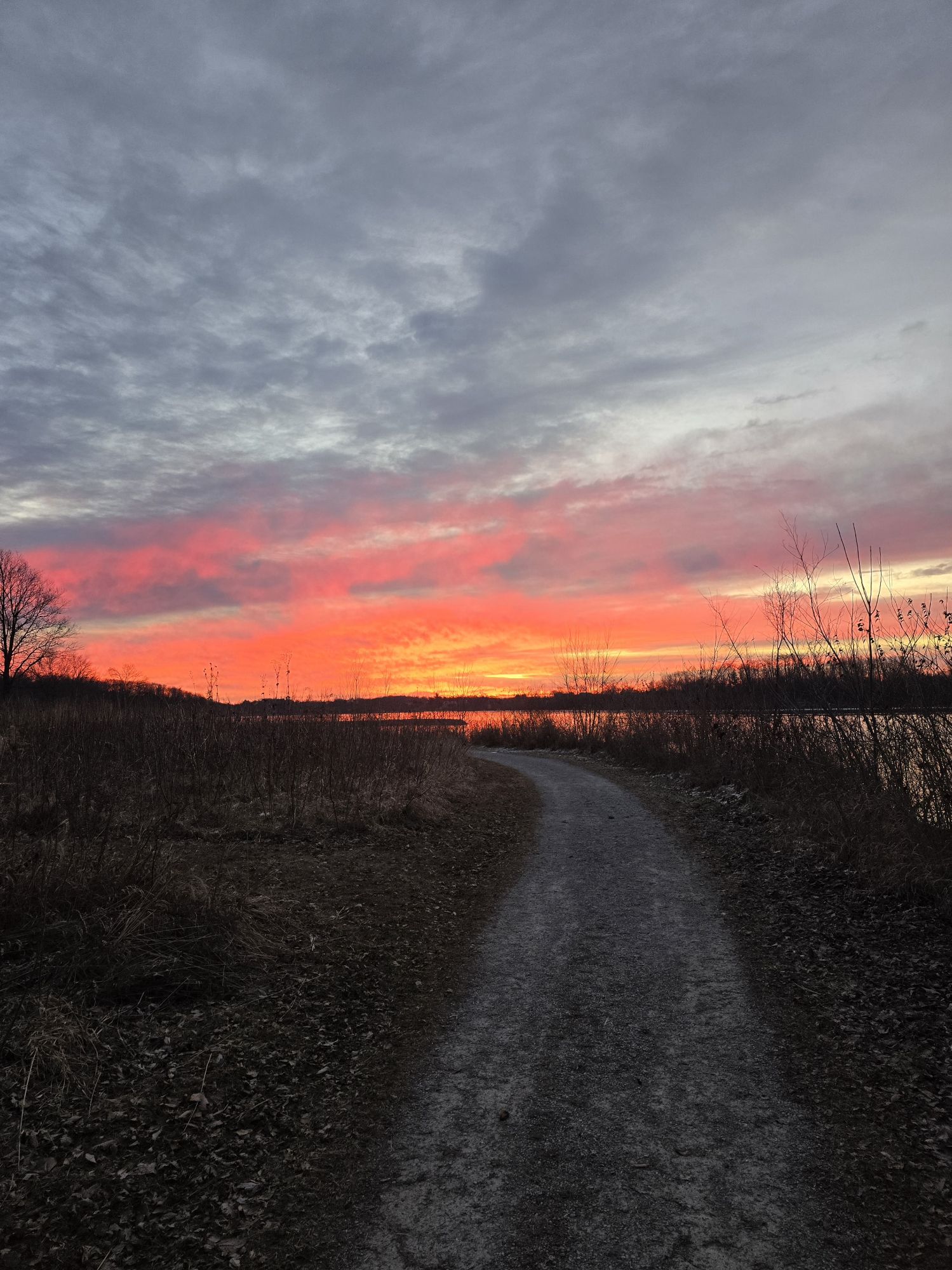
I got restless the afternoon of New Year’s Eve. My spouse was away for the holiday so I called the shop about 1:10 p.m. and asked how late their oil change service lane would be open. I left immediately for the small city to our north. They were closing early because of the holiday yet got me in. The engine oil could have easily gone another 1,000 miles yet I needed to do something to get out of the house. Being among people was my best choice.
I arrived with time to spare, drove my vehicle into the service lane, and left them the keys. In the waiting room, I read on my mobile device and in the book I brought. Time passed quickly before the technician came out to brief me and then lead me to the cashier. I wished him a Happy New Year.
While paying my bill I suggested to the young cashier she be careful if out driving late that night. She said she was staying home, which made me think of our child in another state who was also staying in. I wished the cashier a Happy New Year and she reciprocated. When I finished at the shop, I drove to the nearby hardware store.
I didn’t really need anything, yet wood shims had been on my list for a month. About eight employees gathered around the checkout counter chatting, with myself and one other being the only customers. It was a slow business day, one of them said. One helped me find the shims and I wished her a Happy New Year. Same greeting for the cashier. Both seemed surprised I would say that, yet returned the greeting. What has happened to us as a society? These common courtesies used to be easy, natural, and quite normal.
Next stop was a nearby grocer. I don’t usually frequent this one yet I wanted to get celebratory snacks to ring in the new year. They didn’t have what I wanted so I improvised. I wished the stocker a Happy New Year. At the checkout was a man about my age, although shorter and wearing a name tag. He looked like he was carrying a heavy emotional load so I wished him Happy New Year. He didn’t smile or return the greeting. While heading toward home, I hoped I did something positive for him.
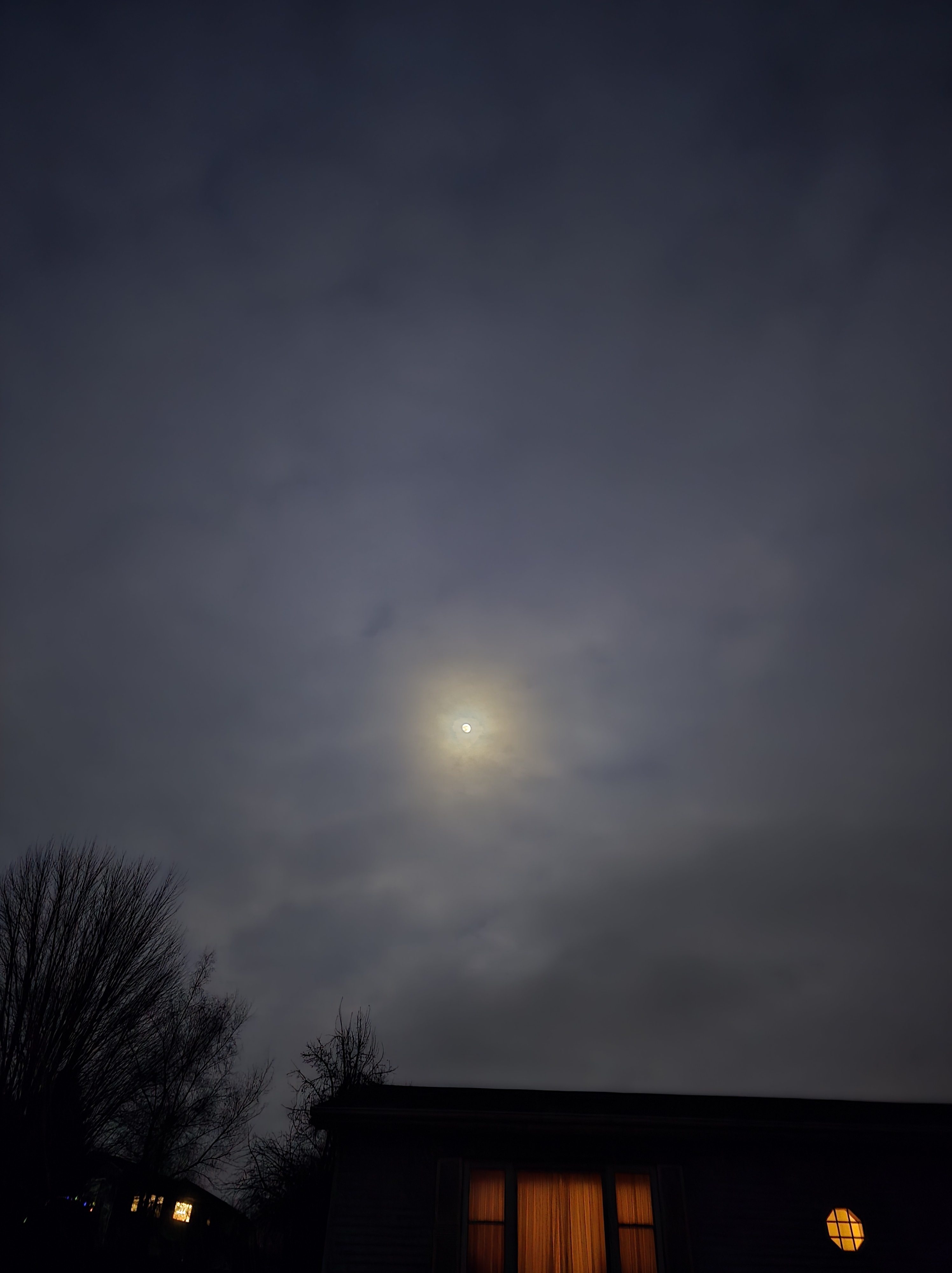
After my repast I went out for a walk around the neighborhood. The ambient temperature was above 40 degrees so I didn’t wear a coat. I don’t usually walk in the neighborhood, preferring the state park trail. Houses had outdoor colored lights for the holidays. Human activity was minimal. The moon rose over the house.
Was I lonely or simply alone. Probably a bit of both as I finished my walk and headed indoors toward the light. Of the New Year’s Eves I experienced, this one was not bad. There is hope for the future and I survived to live another year. That’s saying something.
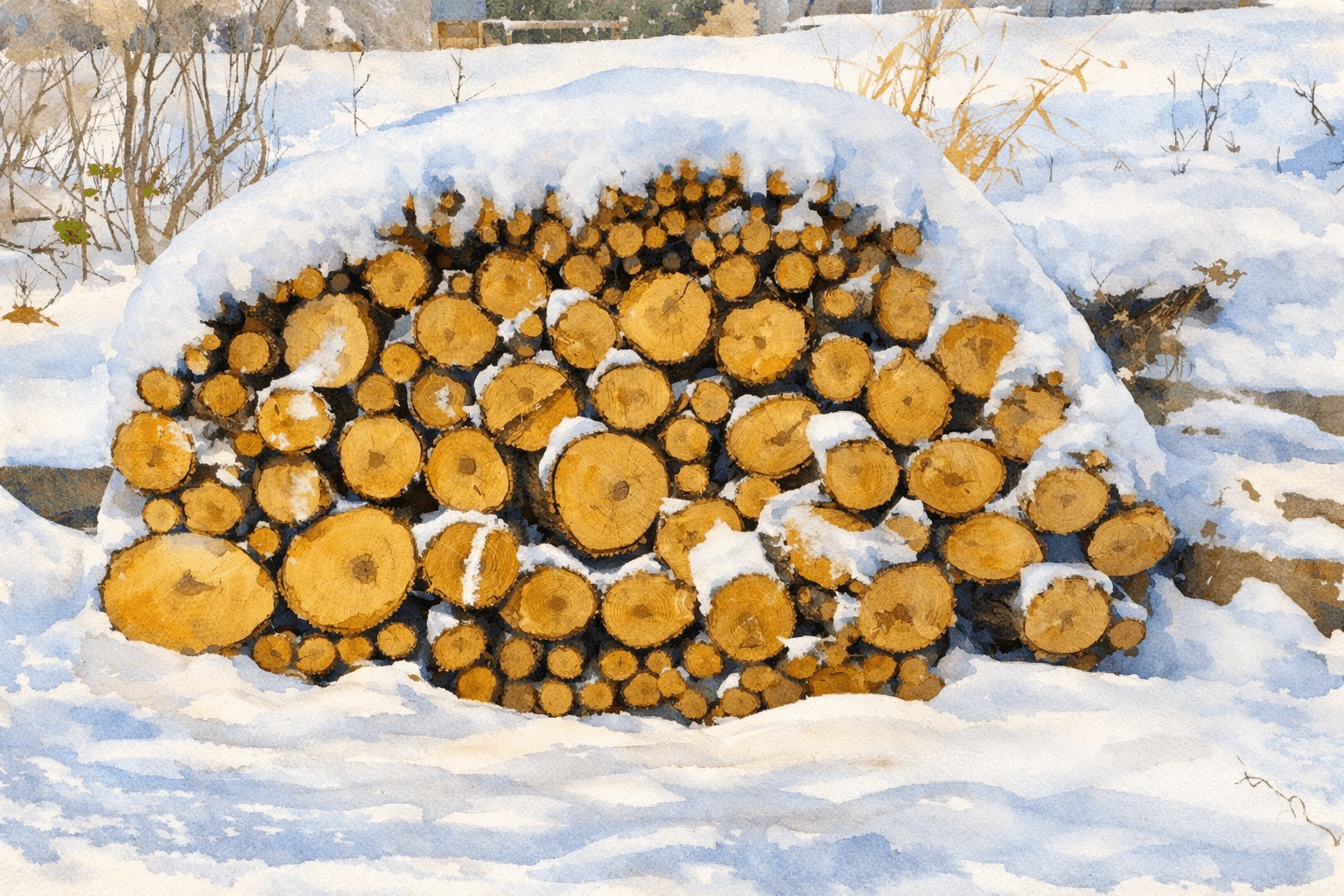
Artificial intelligence rendering from my photo of a woodpile.
2025 has been a crappy year in some ways and a good year in others. On the crappy side, our president is undoing much of the good that has been in place since World War II. He and his collaborators in Iowa are changing society in a way that will have long-term negative effects. On the good side, I stepped back from society to get my own house in order so I can contribute effectively to driving Republicans out of power. The latter outweighs the former in importance.
I don’t know what happened to me during the coronavirus pandemic. I was diagnosed with diabetes mid-2019 and have been treating it by controlling diet. It is working. Things went well before and during the early part of the pandemic, but as I retired from paid work and stayed home more, maintaining my health became a challenge. In 2024, I tested positive for COVID-19 and literally felt like I was going to die. In 2025, I began to turn my health around. I started logging my meals, exercise, and weight on My Fitness Pal. My weight reduced by 12.2 percent and BMI went from 36.8 to 32.3 during the year. During a recent visit to the clinic my practitioner told me to keep doing what I am doing, so I will.
I wrote already about my writing. All I have to add on the last day of the year is I feel more confident than ever as a writer. 2026 should be a good year.
Mine is a world of ideas and reading is essential. I wrote about The Great Sort, which was the first major review of books I collected beginning when I was a grader. In the last year, I donated more than a thousand to Goodwill and the local public library used book sale. There is at least another thousand to go. The important thing about this year’s project is not the downsizing. It is development of a new way to acquire and read books.
Notably, a substantial percent of the 71 books I read this year were checked out from the public library. That was huge, and according to library data, I saved $821 by doing so. How do I get ideas for which books to read? I get newsletters from several large publishers yet a main part of it is by querying the library’s new arrivals on its website. There was more related to reading happening in 2025.
I have been on social media since about 2007. One of the uses is to find new ideas and books I should read. The contribution social media makes is I get real people’s ideas about what to read in the context of their social media account. It is a more solid recommendation than if I knew little about the referrer. Part of this is I take chances on authors with limited distribution of their work. It has been a positive experience.
The best thing about acquiring books to read this year began during the pandemic. The Haunted Bookshop is one of the few remaining used bookstores in the county. Its proprietor, Nialle Sylvan, has changed how I select books and helped improve the quality of writing I have been reading. During the pandemic, the shop’s business plummeted. I felt badly about the situation and asked her to pick $50 worth of books and I’d buy them. That worked out well enough that this year I gave her more information about what I was reading. The last batch of books she picked for me has been so engaging I had to put some of them down because I didn’t want the experience of reading an author to ever end. The writing was so good! That is rare. Long story short is if you can find a bookseller like Nialle Sylvan count yourself lucky.
I want to talk about menu planning in our household in 2025. We do it now, mostly a week in advance. This takes the stress out of daily questions about what’s for dinner. It created an environment where I could focus on developing new dishes, something for which I have ample creative energy. Who knew planning meals could be such a benefit?
In the entry box I asked, “When did I make my first message on ChatGPT?” The machine, which prefers pronouns you/it, didn’t know. More precisely, it replied, “I don’t have access to the exact timestamp of your very first message, but I do have a reliable estimate.” It was in late May this year, according to the machine’s best estimates. Sounds earlier than I thought, but what do I know. That’s why I asked.
I am figuring out how to use artificial intelligence effectively. The reason I use the words “artificial intelligence” is what I am learning on ChatGPT is applicable everywhere ai is used in my world. This includes Google, my bank account, this blog, and a host of other applications. They are not all the same artificial intelligence, but the kernel of getting information I need is a similar process in any of them. It is a helper, although I don’t usually mention I use it in the Twitch chat I frequent because millennials and Gen-Z folk are skeptical of ChatGPT specifically and ai in general. As content creators, there may be concerns about ai taking over the space and putting them out of business. The energy use is a concern as well.
People ask, “What about the energy artificial intelligence uses?” Hannah Ritchie, who I think is brilliant, posted the following around the time I started using ChatGPT:
My sense is that a lot of climate-conscious people feel guilty about using ChatGPT. In fact it goes further: I think many people judge others for using it, because of the perceived environmental impact.
If I’m being honest, for a while I also felt a bit guilty about using AI. The common rule-of-thumb is that ChatGPT uses 10 times as much energy as a Google search [I think this is probably now too high, but more on that later]. How, then, do I justify the far more energy-hungry option? Maybe I should limit myself to only using LLMs when I would really benefit from the more in-depth answer.
But after looking at the data on individual use of LLMs, I have stopped worrying about it and I think you should too. (Email from Hannah Ritchie on May 6, 2025).
For the time being, I will restrain myself by not mentioning ChatGPT on Twitch. That is, unless the chat is about ai, which it was yesterday. In those cases, I drop Ritchie’s name with a quote. Bread on the water.
Things I use ai for are related to living in the real world. How should I organize my workshop tools? How should I manage a photoshoot of a political rally? How can I improve my exercise regimen? Please explain this piece of legislation so I can understand it. Here is my schedule for starting garden seedlings, how can it be improved? How do I solve the problem of binders in a casserole that lacks eggs and cheese? Why does cornstarch get such a bad rap? The machine is quick, its access to information is broad. It uses the same language to answer that I used in my queries. I am convinced the machine has read the work of Dale Carnegie.
I asked about data privacy and the machine gave me good tips about how to use not only their service, but would apply to my internet traffic generally. Things like speak in generalities, be mindful of what you put out there, and how to use controls built into the app to minimize how much of me is out there. So far so good with this tool. I plan to continue.
The good in 2025 definitely outweighed the bad. Republicans are not going to go away, so I need to be ready for the 2026 Midterms. This cycle, I will likely use my new ai helper to be a more effective canvasser.
By late Sunday night, I was ready for the deathly weekend to end. An acquaintance my age, with whom I worked at a transportation and logistics firm, died unexpectedly of a heart attack. His obituary was in the Sunday newspaper. There were the shootings in the news: Brown University in Rhode Island, and Bondi Beach in Australia. Then came the apparent murders of Rob Reiner and Michele Singer in California. It was public death overload.
It didn’t help the bitter cold kept me inside most of the weekend. I cleared snow from the driveway, but that’s about all the time I was outdoors. The saving grace was the visit of our child beginning Friday. They couldn’t make it home on Saturday because of the blizzard. They left Saturday morning, then turned the vehicle around, and headed back when the Interstate proved to be impassible. The extra night was a blessing for parents.
Despite the deaths, things weren’t all bad this weekend.
The bean soup and cornbread tasted good and was well-received Friday night.
I finished reading The Frozen River by Ariel Lawhon. It’s the kind of novel I enjoy reading, set in a time before electronic devices dominate society.
I read Adrienne Rich’s 1991 book of poetry, An Atlas of the Difficult World: Poems 1988-1991. I found it hard to access yet there was at least one relatable poem.
Preparing enchilada sauce began a process of re-thinking how I make it. I tried substituting a slurry of all purpose flour, vegetable oil, and spices for arrowroot as a thickener. This approach has potential. More to come.
Used an aging can of pumpkin puree to make pumpkin bread. The results were so-so. Next time, I’ll use pumpkin I preserved myself.
I drafted another chapter in my autobiography.
Boxed up a donation of books for the public library used book sale.
Ambient temperatures warmed to the upper-20s on Monday, which meant a break from bitter cold. I’ll work to make this week better than the bitter weekend just past. Hard to keep a positive outlook sometimes, yet we must.
Dec. 15 is the deadline to sign up on the ACA marketplace for health insurance effective Jan 1, 2025.
When I left the company and career of 25 years, securing health insurance was an issue. That was July 2009. There were no easy options, so I stayed on COBRA coverage.
The Consolidated Omnibus Budget Reconciliation Act (COBRA) gives workers and their families who lose their health benefits the right to choose to continue group health benefits provided by their group health plan for limited periods of time under certain circumstances such as voluntary or involuntary job loss, reduction in the hours worked, transition between jobs, death, divorce, and other life events. Qualified individuals may be required to pay the entire premium for coverage up to 102% of the cost to the plan. (U.S. Department of Labor website).
COBRA was expensive, so I looked around. I found the Iowa Farm Bureau offered a health insurance plan which was less expensive with reasonable coverage. More than farmers bought their plan, and so did my spouse and I. It wasn’t the best policy, yet it was good enough and met our needs.
The Patient Protection and Affordable Care Act (ACA) was signed into law on March 23, 2010. When the ACA marketplaces were organized, I completed an online form and found that with subsidies, I was eligible at a lower cost than we were paying the Farm Bureau. I signed up for a plan and stayed with the ACA until I was eligible for Medicare.
Today, with Medicare supplemental insurance costs, our health insurance bill for two people is about $935 per month, not including dental or vision coverage. I looked at buying a plan for dental, yet the cost of paying regular care out of pocket was less expensive. The same with vision. Eye treatment related to a health condition was covered under the health plan. The cost for this is slightly less than what I was paying for COBRA in 2009.
The poverty guideline for a household of two is $21,150, according to the U.S. Department of Health and Human Services. Our income is more than that, yet many struggle to bring that much home. Health insurance on such income? Without government help people can’t afford it.
All of this serves as a long build up to the significance of today.
I previously wrote the following about deadlines to sign up for health insurance on the ACA marketplace:
To be covered Jan. 1 you have to be enrolled by Dec. 15 and have paid your first premium. At this late date, I doubt Congress is going to act on the subsidies. In fact, last week, the U.S. Senate rejected extension of ACA subsidies proposed by both Democrats and President Trump. Here is from the website:
December 15: Last day to enroll in or change plans for coverage to start January 1. January 1: Coverage starts for those who enroll in or change plans by December 15 and pay their first premium. Open enrollment continues until Jan. 15 but there would be a lapse in coverage if you wait until then.
For people who don’t have health insurance now, the Dec. 15 deadline is meaningless. Even the Jan. 15 deadline can be difficult without the means to pay for a policy. There is a lot more to say on this topic, yet Tick! Tock! Life is going by at the speed of an eighteen wheeler with the hammer down.
I agree with U.S. Senator Bernie Sanders it is time to guarantee healthcare for all in the United States.
According to the most recent data, the United States spends $14,570 per person on healthcare compared with just $5,640 in Japan, $6,023 in the United Kingdom, $6,931 in Australia, $7,013 in Canada and $7,136 in France. And yet, despite our huge expenditures, we remain the only major country on Earth not to guarantee healthcare to all people as a human right. (It’s time for the US to guarantee healthcare for all, U.S. Senator Bernie Sanders, The Guardian, April 29, 2025).
President Obama was handicapped by the influence of insurance companies while he negotiated the ACA. It is remarkable any healthcare bill at all was enacted into law. Step-by-step, Republicans are stripping away the meat of the ACA, and will continue until all that is left is its bones, which they will grind up for fertilizer. Eliminating the ACA subsidies is just one part of a long plan to remove all the good things the ACA accomplishes.
If you look at my personal journey on retirement health insurance, it was only with Medicare that my worries about how I would pay a medical claim were addressed. Before that, my privileged status as a white male who was able to find a job with health insurance enabled me to find care. The care was never what I wanted, but I didn’t go broke because we had bills after our child was born in a hospital, or a major surgery.
It is easy to say there should be, as Senator Sanders says, Medicare for all. Getting that done in the United States is nearly impossible with the influence of special interests and their money in Washington, D.C. This is what makes healthcare an abomination in America. I know we can be better than this.
There was a time when I attended estate and farm auctions and bought things on the cheap for later projects. The years since then can be measured in decades. At a point in my life when I have to either do something with stuff, or otherwise dispose of it, I got out the top and legs of a table I bought for a buck at auction. It was time to make something. Since I rearranged the garage, I have space for a work table that is shorter than the custom-height workbench I made when we lived in Indiana.
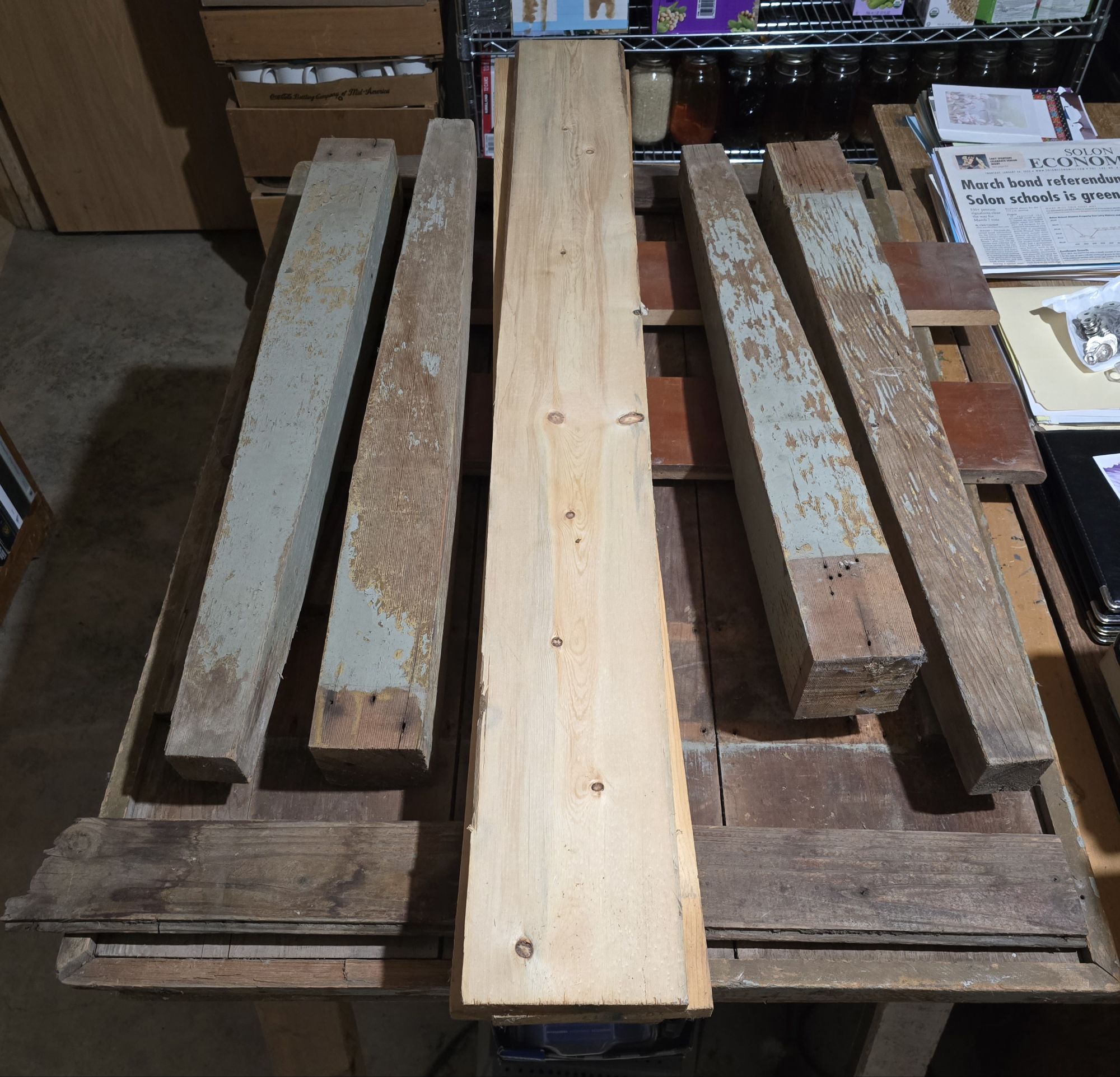
I went through the woodpile and found planks to make an apron and five of rescued lumber to reinforce the top. I laid the materials out on this workbench made of sawhorses and thought about what I would do for a couple of weeks.
After looking at local hardware stores and large online retailers, I finally found a packet of figure 8 steel desk top fastener clips with screws. They are not commonly available. To make a recess in the apron for the fastener, I got a 20 millimeter forstner drill bit. $20.12 all in.
After 12 cuts on the radial arm saw, I was ready to assemble. I spent about three hours on the project before my attention began to wander. I am better at recognizing when that happens, so I knocked off for the day. If everything goes together as planned, it will take an hour or two to finish assembly.
After a few hours of furniture building I had to take a break.
I don’t plan to refinish the wood. Inside the garage it will be protected from the elements. I expect it to get scuffed up with heavy use, so what’s the point of a coat of paint or finish? The wood it’s made of has been around for a long time, based on the assembly techniques my predecessor used to build it.
Fingers crossed the final assembly passes muster and I can begin using the new table immediately. One never knows about these things until the work is done and the piece is in operation.
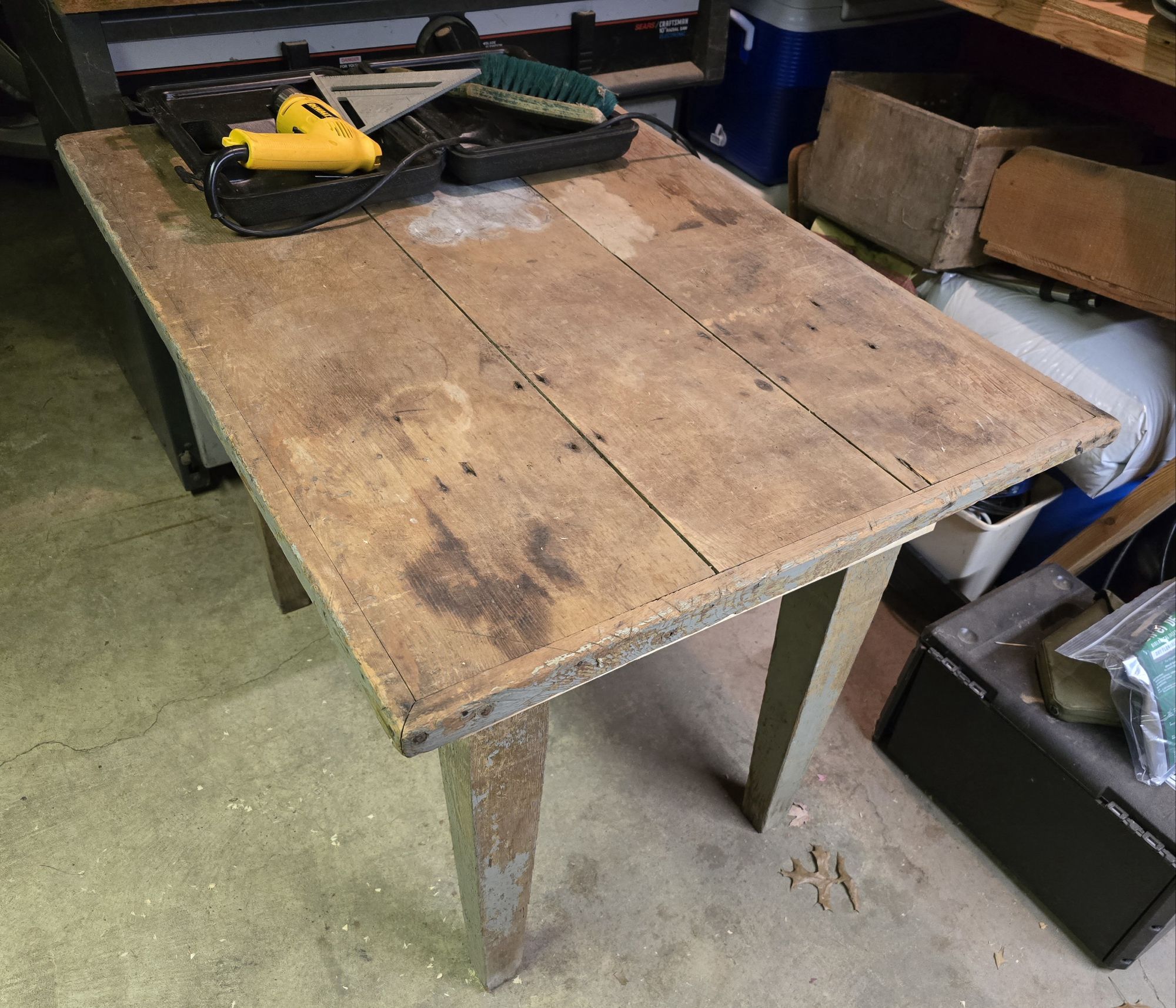
Here is the finished product in the garage.
Table made from a top, four legs and salvaged lumber.
It’s bigger than I thought, but I will adapt. No adjustments were needed.
The idea of a routine is anathema to my way of life. All the same, one of the most significant struggles during and after the coronavirus pandemic has been making my days productive. While economic concerns have not disappeared after retiring on Social Security, I don’t want to be locked into a routine. Personal preferences aside, there is a scientific reason to develop and follow a routine.
Routines are linked to better health, academic success and even resilience. We can all take simple steps to synchronize our activities with our circadian rhythms and biology. Small tweaks in the timing of things can pay off. (As a doctor, here’s my simple, science-backed schedule for a healthier day, Dec. 1, 2025, Washington Post by Trisha Pasricha, M.D.)
That damn biology! How limiting!
Working with ChatGPT, I developed a daily plan to help structure my time at home. I had not thought about compartmentalizing routine activities, yet this plan does so and has produced better results that free me of worry about how I spend my time. The three morning and two afternoon work sessions with a short break between them has been revolutionary.
I began developing this Daily Plan a few years ago. Then, it included only items in the first three bullet points. By expanding it to encompass the whole day, and implementing some basic science about circadian rhythms, my life has been better. It’s a never-ending process to refine this. My daily plan will get its first major test as I finish my second book this winter.
In general, I take Sundays off a plan and let my life free-form for a while. That has proven to be a useful break from regimentation.
When we moved to Big Grove Township, I took out a map and compass and drew a circle to indicate where we wanted to live after beginning work on the southwest side of Cedar Rapids. Having lived in the city previously, returning there was not a positive option. We looked at potential homes within the circle, including a couple in Williamsburg — a good distance from work. The housing market was tight in 1993, with homes sometimes selling the day they went on the market. We ended up buying the lot where we built our home, and for multiple reasons, it has been a good setting for our lives.
My commute to work was 18 miles or 25 minutes. Why would I live so far from work? I wanted to maintain a separation between work and my family and creative life. Back then, I embraced the automobile culture and that aided my decision. Early on, I learned the importance of a buffer between my two lives.
Until entering the military I had lived in a city or community that either was walkable or had reliable, inexpensive public transportation. In Army basic training and officer candidate school I lived in a barracks with everyone else. When I received my commission, I moved to officer quarters at Fort Benning. I could still walk to classes yet when I arrived in Germany, I would need a vehicle. I bought a yellow pickup truck in Georgia and had the military ship it to Europe.
When I arrived in Mainz in 1976, the kaserne where the troops were stationed was in another city called Mainz-Gonsenheim. Martin Luther King Village, where officers, non-commissioned officers, and their families were housed was too far away to walk to work. Some of my fellow officers who were married did not care to live in military housing at all and picked rentals in other nearby villages. They found separation from the military was good for their family life. It is a lesson that stuck with me.
I have been cognizant of the difference between city and country living for most of my adult life. In many ways, increasingly in the age of internet communications and mobile devices, city vs. country is a false distinction. That is particularly true in Iowa where country folk trade grain internationally and need to stay in touch with markets all over the globe. What is the difference between Wall Street and Martelle? Not as much as people would have us believe.
There is something to be said for the automobile culture that dominates rural areas. As a gardener, I need supplies from multiple vendors, including soil mix near Tipton, and fertilizer near Monticello. Driving to these vendors saves money in terms of a potential dealer mark up on the items. Similarly, if I need groceries, in a vehicle I can bypass the local grocer and drive to a store more suited to my needs. We rely upon having a vehicle in a small, rural subdivision.
Our neighborhood is walkable, if by that one means enjoying the solitude of nature. I’ve been talking a daily walk ever since I could no longer jog on the trail. Even at sunrise I encounter others I know who walk or jog on the trail, so there is a sense of society. Some of those folks have been neighbors since we arrived in Big Grove Township in 1993. Having a nearby state park is not really the meaning of having a walkable community.
In Germany I needed a vehicle to get to work. At the same time, I lived near the main railway station and all of downtown Mainz was within walking distance. When I had free time, I would walk by myself or with a friend all the way down to the thousand-year-old Mainz Cathedral or to the opera house. If I needed groceries yet didn’t want the the American fare at the post exchange, a German grocer was located near the train station. I did not have an intimate relationship with the city, yet I learned to wear proper walking shoes there.
My maternal grandmother lived in downtown Davenport where she could walk to get most things she needed, well into her 80s. She got basic groceries at the Walgreens near her apartment. She continued to work as she aged and there were several work sites near her apartment. Growing up on a farm in rural Minnesota, the family took the horse and wagon to town when they needed something. Otherwise they made do in place, without leaving the property. She brought that farm culture with her to living in a large city.
The draw a circle on a map method of picking a place to live worked out for us. Now that I retired, we live in a quiet, safe place where two or three trips a week to town is sufficient. If I didn’t have a Powerball gambling habit, there would be less trips. I retain the automobile culture, yet inexpensive delivery of almost every commodity needed for living is readily available. Once we cut loose from the vehicles, I found life is even more livable than it is with them. That is important when picking where to live.
Since our family moved to Big Grove Township, I volunteered to make lives better. Any monetary considerations were insignificant. A regular person does not volunteer in the community for the money. Part of living a sustainable life in rural areas is contributing to the general well-being. I did what I could. I felt blessed and had to give back to the community in which I lived.
Within the first year we arrived, the home owners association asked me to join the board. I did. These organizations get a bad rap. In our case, we managed the association like a small city. We provided a public water system, a sanitary sewer district, road maintenance, refuse hauling, and real estate sales and purchases. Over time, we upgraded the roads from chip and seal to asphalt, dealt with changing government standards related to arsenic in drinking water, reduced the number of wells from three to one, complied with changing Iowa Department of Natural Resources standards for wastewater treatment plant effluent, handled a lawsuit, and coordinated activities like road use and maintenance with neighboring associations. If the board doesn’t do these things, they don’t get done. Everyone is the better for such volunteer boards. I served, off and on, for over 30 years.
In 2012, when only one candidate was running for two township trustee positions, I ran a write-in campaign and won. Being a township trustee included managing emergency response and a volunteer fire department with other townships and the city. Toward the end of my tenure, we formed a new entity to manage emergency response. We maintained the local cemetery, and supervised a pioneer cemetery where the first person to die in the township was buried. This work helped me understand how tax levies work and how they were used to support things the county did not, things like a small fire department or saving someone’s life in an emergency. There was only a single conflict during my time on the board, about the main cemetery. All of the trustees showed up at the cemetery to resolve a dispute with an individual. No one wanted the job of township trustee and someone had to do it, so I stepped up.
When the local seniors group had an opening on their board, I volunteered and became its treasurer. This lasted about two years, but it provided insight into this segment of the community. Everything we did, from providing community meals to giving home bound people rides to medical appointments to arranging outings around eastern Iowa, served an often neglected segment of the population. It was a great opportunity to learn about the life of our senior citizens before I became one myself.
The contribution to society with the most personal meaning was financially supporting construction of the current Solon Public Library building, occupied in 2001. We didn’t really have the money in our budget yet having a decent public library is something we valued. We found the money to donate. The small city library went from being located under the city band stand, to a store front, to the old jail, to a modern building specifically designed to be a library. In the beginning, the library was staffed with volunteers from the Solon Young Women’s Club and the Solon Study Club. Today, there are full and part-time paid staff that work alongside volunteers. A library is something the whole community can use. I am proud to have helped build ours.
There are other ways I gave back to the community. Giving back is a personal value to hold dear in turbulent times. We should all find ways to give back to society in this Trumpian time of self-interest. If we don’t, who will?
The year is half done and it’s time to check the compass to see if I’m heading the right direction. Maps will be required, so I got out some of my favorite ones and considered where I’ve been and where I might go from here at mid-year. This process isn’t really scientific.
I know the region of Fulda, Germany as well as I know Big Grove Township, probably better. Getting out the same old maps is comforting… a reprise of what is possible in a life. It’s a fit thing to do on a Saturday as June ends and the days get shorter. It is easier to chart a course by knowing where we’ve been.
Saturday mornings do not mean the same thing they did. When I was a grader, Saturday meant taking the city bus to downtown, paying my newspaper bill, and eating at the automat in the department store or at the Woolworth’s lunch counter. I often hung out until the movie theaters opened for a 25-cent matinee. It was an outrage when the price increased to 35, then 50 cents. At university, Saturdays meant time to catch up on studies and enjoy the quiet while everyone else attended a home sporting event. After university, as I entered the work force, Saturdays were a time to relax for a few hours before heading into a work place. I rarely worked only five days in a week, especially in the military and after beginning work in transportation and logistics. When I retired, it got increasingly difficult to tell one day from the other without looking at a calendar. The meaning of Saturdays eroded, although hope for meaning persists.
This Saturday morning began with a restless night. I woke just after midnight and finished reading the current book. I couldn’t get back to sleep so I got up just before 2 a.m., did my exercises, and made coffee to start my day. I finished my to-do list, made refrigerator pickles with yesterday’s harvest, and then went back to bed just before dawn. After a couple hours sleep, I got up again, turned the coffee warmer back on and went for my normal daily hike along the state park trail. There were a lot of people on the trail, dressed in brightly colored workout clothing. While I didn’t know many of them, it felt like being part of a community. The only ones who did not say “hi” back were men with earbuds distracted from nature’s beautiful morning.
It was going to be another hot afternoon, so I got to work soon after arriving back home. I changed into my overalls and mowed the ditch, which likely burned more calories than the trail hike. I worked for a while in the garden and then headed inside to take a shower and got out my compass.
Writing. I’m back to work on the second volume of my autobiography. The main task is to set aside a couple of daily hours for new research and writing. When we moved to Big Grove Township, our child was eight. I’m enjoying reconstruction of what our lives together were like during the time before they entered college. This part is pleasurable to remember and write about.
Reading. I read 43 books in the first six months. This year is different in that I am interfacing more with the public library. In addition to saving money on buying books, the range of my reading increased. The public library makes it easy to see what new books are being shelved, and the wait-time to borrow a copy of something in which I find interest is usually short. I even recommended a couple of books for purchase and without exception, the library did buy them. I hope there will be more of that ahead.
As owner of thousands of books, there are already plenty of them in the house to read. My best hope is to find work related to my autobiography and put them at the front of the reading queue. Part of me wants a process for picking the next book. Part of me wants to leave the choice full of whimsy and spontaneity.
Physical Condition. Improving my physical condition is a must. I lost 20 pounds of weight since January 1, and according to the doctor I need to lose a lot more. 30 minutes of brisk daily walking has been good. Working in the garden has also been positive. When the garden season began, I could hardly get up from being down on my knees. Now, I don’t even think about it and get right up when I am finished with something. The key changes this year were the increased physical activity combined with tracking how much I eat in an application. There are issues with the app, but it does help me stay focused on what I am feeding myself. The result has been a slow, steady weight loss since I began using it. I don’t see anything changing in the next six months. If I continue as I have been doing I could reach target weight before the end of the year.
Kitchen Garden. In addition to making vegetable broth, pesto and pickles, I’m looking to stock the pantry and freezer with produce I grow myself. This year looks to be a big apple year, so I need to save energy to process and stock up on related products. Garden abundance will guide my efforts here. I need to go with the flow.
Working in the Garage. Working on the Indiana section of my autobiography has me reprising this activity. I put the flag up over the garage door and work outside with creative impulse, modeled on what I did in Indiana when our child was living at home and entering school. It’s not the same as then, yet it is a form of nostalgia in which I am not afraid to indulge. More of that in the coming months. In many ways, it reflects who I am.
Curating Artifacts. It is incumbent on septuagenarians to cull the good from the not so good as far as souvenirs, photographs, books, clothing, tools, supplies, and everything else accumulated in a lifetime so those left when we pass on don’t have to deal with them. I admire Mother for doing this in the final years of her life. The photographs are the hard part. Spending time with a batch of 50 images should take ten minutes or less. Invariably it can turn into a several hour project because of the way memory is invoked. If I did one thing in the rest of 2025, it would be to develop a process that allows memories to arise from the well of lived human experience, and then find a different home for 90 percent of my artifacts. That merits some time.
Financial Stability. We depend on pensions and there is a known problem with Social Security. I wrote about this in 2017, and while the date changes along with the program, politicians have not done much to address this gap, then forecast in 2034. The Congress should address this now, although there is little visible interest in doing so. Senators like Elizabeth Warren and Bernie Sanders have a plan. The Congress needs to take the issue up and fix the program. That or tell us to get screwed now.
As Saturday morning turned to afternoon I felt recovered from a restless night. For the time being I can afford health care and medical visits, improve my eating habits, and get on with my writing. In many ways, the second volume of my autobiography will be the high water mark. Once I finish writing it, I plan to edit both books for publication and get them out there as ebooks and paper books, using one of the services. I know the way to accomplish this, so I can put away my maps until needed again. I’m not ready to get rid of them.
I met Murray through my part time job in high school. He went to West High School, and I went to Assumption. Today, I might call him a gear head. Maybe I called him that then.
He was building a “hot rod” at a gas station on Brady Street. When I last saw it he had stripped it down to the frame. Part-by-part he assembled it himself. He planned to use it to “ride the ones” (driving the one-way streets in downtown Davenport with other high school aged kids with cars). I don’t think he had any other real plans for his hand-made car. It seemed to be more about the process.
“Right to repair is a legal right for owners of devices and equipment to freely modify and repair products such as automobiles, electronics, and farm equipment,” according to Wikipedia. “Right to repair may also refer to the social movement of citizens putting pressure on their governments to enact laws protecting a right to repair.”
In the late sixties, we hadn’t heard the term “right to repair.” Murray assumed he could do what he wanted to get his vehicle street legal. He knew what being street legal meant. Today, manufacturers are tightening the screws on repairing vehicles, farm equipment, and electronic devices, blocking users and owners from working on their stuff. It seems anti-American… and wrong.
I don’t think denying the right to repair will stand in 21st Century America.
My maternal grandmother had no hesitation about taking apart her stove and fixing a burner. She was born in the late 1800s, and that’s what she learned growing up. When I saw her do this, the stove came with her rented apartment. A younger person might have just called the landlord.
When I studied the rural Minnesota community where my great, great grandfather settled, there were two blacksmith shops in a community of about 200 families. At a distance from major commercial centers (if such even existed in the 1800s), and with Original Equipment Manufactured parts distribution (not called that or even in existence then) a long and slow process, locals devised indigenous solutions to mechanical problems with available materials and said blacksmiths. This seems so American, so pragmatic.
No one would argue about modern day equipment, vehicles, and farm implements being more complicated than they were in the late 1800s. If a wheel fell off a wagon and broke, the owner would mend the wheel, axle, or both and start operating it again. The computer technology embedded in modern equipment was in an unforeseeable future. Likewise, computer-aided design enabled such precision that would be hard to replicate using a hammer, anvil, and heat. Where is the balance between the owner of a piece of equipment fixing it themselves and the manufacturer insisting that only they had the expertise to do so? This aspect of society is changing and to many of us, it make no sense.
I lost track of Murray when I went to university. Last time I saw him he was working at a gas station on Riverside Drive in Iowa City. Sometimes I think about what society is losing with fewer gear heads and people like my grandmother around. We changed in ways that shut the door on returning to a life where folks knew how every device in their home worked and how to fix it. It is one way our lives have gotten poorer with increased technology.
Some Friday night I’ll have to go ride the ones in my home town to see if teenagers still do. Somehow, I doubt it.
You must be logged in to post a comment.