This is my first attempt to grow onions at home and there’s a lot to learn. Once the seeds germinated, I moved them upstairs into sunlight. They grew long and spindly, laying down over each other in the tray. Carefully, I trimmed the tops to about two inches and they sprung up. The expectation is they will start to right themselves and grow more vertically. The backup plan is to buy and beg some onion starts in case these don’t mature. For the time being I’m not giving up on them.
Georgia Southern Collard, Ferry-Morse, 75 days. Pak Choy Toy Choy, Ferry-Morse, 30 days. Teton Hybrid Spinach, Ferry-Morse, 45 days. Cilantro, Ferry-Morse, 28 days.
Space is beginning to fill with trays.
I delivered a box of flower seeds for the farm’s coming garden class at a local food pantry.
We talked, a lot, about everything. We were chatty.
I enjoy my time with eight people talking and seeding trays of soil mix. I don’t say a lot, just do my work and bask in the sounds of another day on the farm.
The lamb count is now 40 and there are five new goats.
A friend grows straw for the home, farm and auto supply store and he isn’t in the fields yet. The ground is frozen.
In addition to producing wheat straw he grows commodity crops and has a tough row to hoe… literally.
I enjoy interacting with him and his crew as they remove a hundred bales from a gooseneck trailer and put them on pallets. Once re-stacked, I move them indoors with a lift truck.
I have been drafting emails to groups of which I am a part since I woke. Gotta stay on top of all that so when the ground thaws I can get my spade in it. Not yet… but soon.
Today I planted Belgian lettuce. There is nothing particularly “Belgian” about the seeds. According to my maternal grandmother it is called Belgian lettuce because it is planted March 2. It’s the tradition and that’s that.
I planted arugula as well because when everything is mixed together in a salad it will taste great. I planted:
Lettuce
Mesclun Mix of Seven Varieties, Ferry-Morse, 40-80 days.
Kale is a money crop in my garden. By that I mean I learned how to grow it and have had success most years since. I distribute a lot of free kale to friends and neighbors. Today was the day to plant it along with broccoli. The varieties are:
Something was weird about the Calabrese seeds from Ferry-Morse. It appeared broccoli seeds were mixed with another kind, rendering the packet pretty useless for predictability. I planted some of each as the main broccoli crop will be Imperial anyway. We’ll see what happens.
Sundays in the greenhouse have become a day to which I look forward. The goats are due to drop kids any day, and of course we are well into lambing season. Our crew of five or six people works well together. I enjoy the conversation with twenty-somethings, although some of them will soon turn thirty.
I’m not sure the onions planted previously will make it. Some of them are tall and spindly. Others haven’t come up. The soil is damp so we’ll see how they come out. At this point if they fail I can get starts elsewhere.
My small, portable greenhouse arrived this week. Instead of keeping flats of seedlings on a short stack of pallets near the garage door and moving them inside at night, I’ll keep them here. I’m not sure how exactly it works, but look forward to learning.
The weather has made this year’s start better than 2019. Let’s hope it continues.
I planted our first Big Grove Township garden in Spring 1994. What I grew is lost in memory.
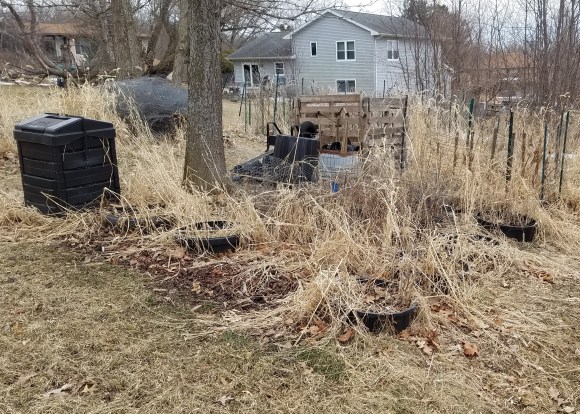
Yesterday the original plot looked a wreck with desiccated weeds and a hodge-podge of sunken containers, fencing, two composters, a wheel barrow, an old wash tub, six-inch pieces of drainage tile resting on a couple of pallets, and a locust tree. The locust tree was intended for transplant but it got away from me.
I don’t know if the locust tree will recover from last winter’s extremely cold temperatures. The tips of branches in the crown did not leaf out last spring. If it doesn’t recover I’ll take the tree out even though the shade it provides protects plants and conserves moisture during our increasingly hot, dry summers. The plot was not meant to be a permanent residence for trees.
A friend in Cedar County gave me black plastic tubs in which feed for their animals was delivered. I cut large holes in the bottom for drainage and buried them to grow potatoes, radishes, lettuce, basil and sundry root crops. Mostly it was for potatoes which when planted in the ground fed small rodents who thrive with us in the garden. The containers worked to keep them away from the roots.
Composters are necessary for a garden to turn organic matter into fertilizer. One is an open air composter made from pallets retrieved from the home, farm and auto supply store. Garden waste goes in there. The other is a sealed, black plastic container for organic household waste such as peelings, fruit cores, and other fruit and vegetable matter generated from the kitchen. That is, it used to be sealed. Over the years something got inside and has been pushing stuff out of the entry point chewed into the plastic. I should fix or replace it. Until I do it remains a place to dump the kitchen compost bucket and produces some usable compost. The next time I move it there will be compost.
If I had a garden shed I would not use the plot for storage. I continue to think about building a shed, but that’s as far as it has gotten. It won’t be this year, or probably next.
Despite all the useful clutter, the plot continues to be productive. Last year I grew broccoli, eggplant, radishes, basil and beets there. The year before I grew cucumbers. The containers are always busy with multiple crops each year. As I plan this year’s garden I see better utilization of this plot.
Ideas about 2020 in plot #1: Belgian lettuce on or about March 2; potatoes in containers on Good Friday; radishes in a container; a crop of something, cucumbers, eggplant, or maybe hot peppers to change from cruciferous vegetables planted here last year. These are ideas, and the beginning of planning. We’ll see how it unfolds, although Belgian lettuce seems certain a week ahead of the date.
I remember digging this plot in 1994, measuring the distance from the property line, a memory of nothing growing in the yard except grasses and a mulberry tree in the Northeast corner. I barely knew how to garden then. In the interim, my views of how to garden have changed for the better.
Based on the 15-day weather forecast, winter is finished. As temperatures climb and the remaining snow melts we had just better accept it we won’t have had much of a winter. It is time to lean into the growing season as soon as Mother Natures enables us. Soon it will be Spring.
I planted leeks in soil blocks at home today. They were,
King Richard, Johnny’s Selected Seeds, 75 days. One row of ten.
Megaton, Johnny’s Selected Seeds, 90 days. Three rows of ten.
American Flag, Ferry-Morse, 150 days. One row of ten.
This is a further experiment in starting plants at home. In the past I hadn’t paid attention to different leek growing times but American Flag is double that of King Richard. I double seeded King Richard and American Flag because they are from previous seasons. If both seeds sprout in each cell I’ll thin them.
My 2013 decision to develop a barter arrangement with my friend Susan Jutz helped resolve a couple of issues.
I needed the cash income plus a share of the vegetables she grew. More importantly than income, I wanted to become a better gardener and needed a mentor.
By almost any measure our relationship was successful and endured even as Susan sold her farm and moved out of state.
On Feb. 1, 2013 I sent this email proposing an arrangement at her Local Harvest CSA:
Susan:
Hope you are staying warm. I have an interest in developing a deeper relationship with producing local foods. While our kitchen garden is doing well, I want to explore the possibility of doing more with local foods to provide a source of income. This is a long range project, and if you offer it, I would like to exchange my labor for a share of your CSA this season.
I think you would find this a cheap and reliable source of farm labor, and what I would get out of it would be a deeper knowledge of how you do your work.
What do you think?
Regards, Paul
We worked through details that lasted not only that season but established a continuing relationship now entering its eighth year. I expect the conversation about local food to continue this month with Carmen, Susan’s successor. Greenhouse work usually begins in February.
The Community Supported Agriculture model is the workhorse of the local food system. Instead of producing a few fungible commodities, CSA farms produce many types of vegetables in many varieties, providing a weekly share for members who buy in at the beginning of the season. They also leverage other producers to provide eggs, meat, bread, jellies, jams, and other items they don’t produce for their customers. On Carmen’s farm she produces grass-fed lambs and goats. The presence of livestock on a farm is an important part of reducing reliance on chemical fertilizers. Some CSA farms are more diverse than others but the salient feature is that the main consumer model is changed to include a share the farmer provides.
Operating a small farm is challenging. It requires hard work and specific knowledge about a wide variety of issues. It seems like more work than people with a big job at a large-sized employer are used to. There is also more risk during a growing season. Most local food farmers I know do something off the farm to supplement farm income. Every one of them has a positive disposition despite the challenges.
There is an ongoing discussion about alternatives to the CSA model.
Chris Newman of Sylvanaqua Farm in Virginia posted an article on Medium in which he wrote, “The romance of neoliberal peasant farming blinds us to our collective power.” Newman’s assertion is small family farms are not competition for, or a sustainable answer to burgeoning consolidation of agriculture. He touched on a number of obvious points, beginning with farmers markets.
Farmers markets are nice for consumers, but expensive to participate in. If some local food farmers produce for the seasonal markets they compromise their flexibility and scalability, he said. I don’t know about the operational advantages of a local food cooperative because many farmers already coordinate activities with each other. A farmer of meat, vegetables, flowers or the like can do better to avoid such markets. At a minimum one requires additional outlets to extend sales beyond the farmers market season.
Newman lays out the challenges small family farms face regarding workforce in a labor intensive business. Putting together a workforce that accomplishes weeding, cultivation, planting, harvesting, pest control, and everything else isn’t easy when the operating assumption is some percentage of workforce will volunteer or work for very low wages. Newman’s idea of forming a cooperative addresses the wage issue but also seems overly idealistic.
In his book The New Farm: Our Ten Years on the Front of the Good Food Revolution, Ontario farmer Brent Preston tells the story about how he and his spouse found sustainability in the local food movement by transitioning away from farmers markets to wholesale production and sales. This book is a must read for people interested in the local food movement.
Michelle Kenyon, executive director of Field to Family, is establishing a food hub in Johnson County. She’s been featured in the local newspaper. The idea is simple from a farmer’s perspective. Got too much basil? Bundle it to specs and sell to the food hub.
Having an outlet for a farm’s produce is important. Few local farmers follow the traditional CSA model of sharing the farm produce exclusively with members. That would mean all of the extra basil in my example would go to members who would presumably become rich in pesto and pasta sauce. Separating food production from CSA membership provides options for additional revenue streams such as selling to a food hub, to restaurants and to retailers.
A smart farm operator won’t put all their eggs and produce in single basket. They manage a portfolio of revenue streams based on farm production, but include variation in how customers are approached. So often, just having an item when others don’t makes a big difference in exploiting some types of “pop-up” marketing opportunities.
I would like to establish independence from the farms on which I’ve worked since 2013. Controlling everything would free me from outside responsibilities and enable re-designing my garden to expand and produce extra crops that could be sold to others. That has always been a small part of my garden operation but as I progress through my transition to “retirement,” any income generated could help supplement our structure of pension, Social Security and savings. For the time being, I look forward to returning to the farm for another spring of soil blocking. Looking back at this email to Susan, it’s clear I was not wrong to pursue the opportunity.
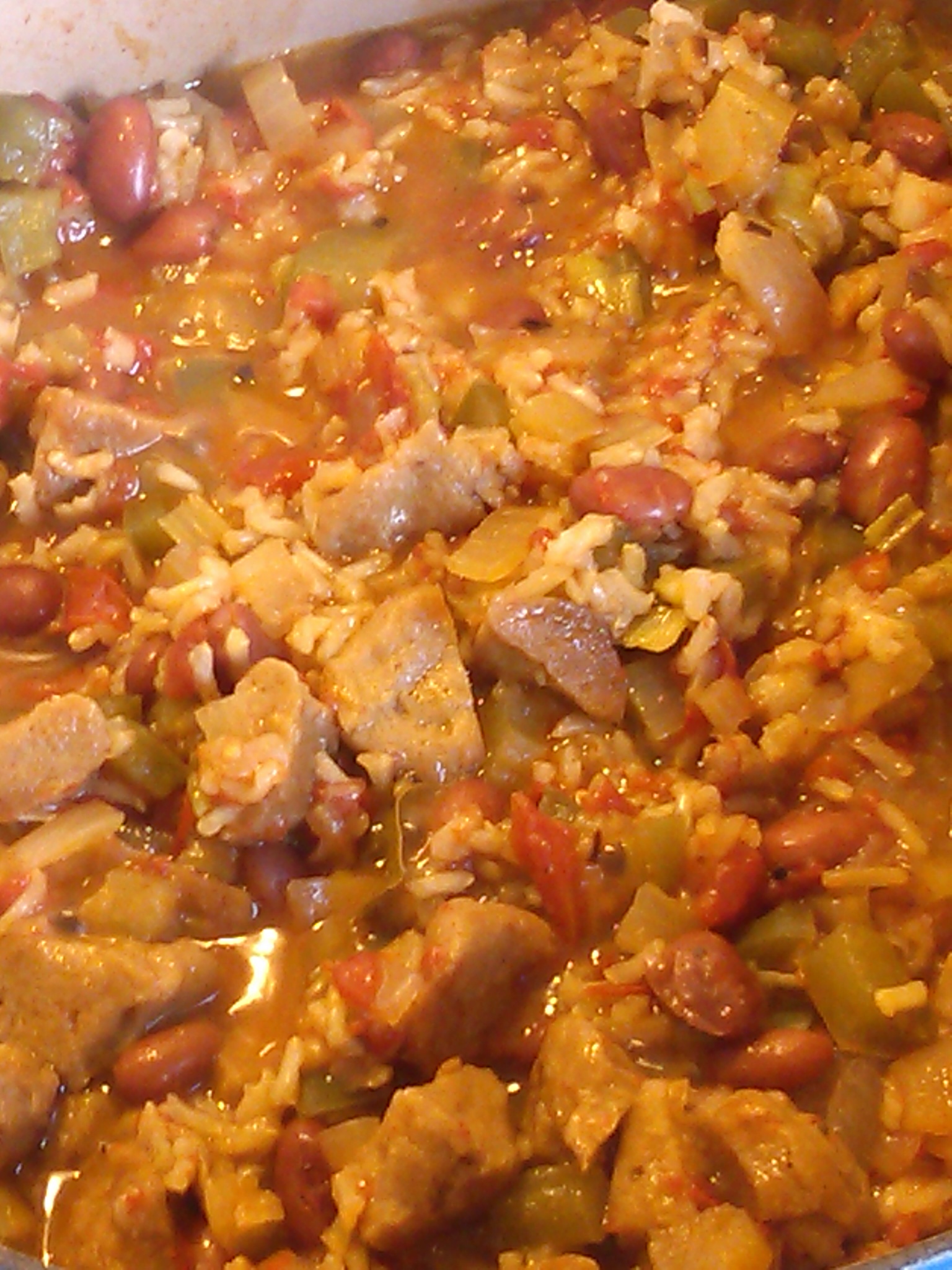
Preparing to cook red beans and rice has been a year-long process because most of the ingredients were produced in my garden or on farms where I work.
The garden produced red beans, okra, tomatoes and celery. Local farms produced onions, garlic and bell peppers. I also grew red pepper flakes and blended the powdered dry spices. Pantry staples of extra virgin olive oil, all purpose flour, and long grain brown rice were USDA organic but not produced in Iowa.
I invested several hours preparing a luncheon meal and time was worth it because of the flavor.
In the morning we discussed my 5-1/2 quart Dutch oven, the enamel of which is wearing off the inside. I’m don’t favor replacing it. Not because of the $350 price tag for a new one from Le Creuset. With a bit of cooking oil on the bottom to prevent rusting it will serve many more years. It is my go-to pan for making red beans and rice. It has been a reliable part of our kitchen.
Cooking is a ritual that evokes memory and skill in bringing a dish together. I soaked a cup of dried red beans in the Dutch oven overnight, then cooked them with half a diced red onion until tender but not mushy. I drained the beans and reserved the cooking liquid, letting them sit on the counter until ready to make the dish.
Around 10 a.m. I started work.
I fried a couple of home made vegetarian burger patties from the freezer and set them aside to drain. (Andouille sausage would be more traditional).
Heating the dutch oven, I added two tablespoons of extra virgin olive oil and cooked a generous tablespoon of red pepper flakes. I diced half a large onion, red bell peppers, and celery stalks and sautéed them in the oil-pepper mixture with a little salt. Once they began to soften I added two cloves of minced garlic and added home made seasoning — think powdered garlic, curry powder, paprika, and powdered hot, red peppers. I added a few dashes of prepared hot sauce from the refrigerator and stirred until everything was incorporated.
Next came additions. I deglazed the pan with a pint of diced tomatoes. Next, a cup each of sliced okra and long grain, brown rice. I stirred in two tablespoons of all purpose flour, then the cooked beans, until everything was incorporated. I tried not to bust up the beans.
What liquid to use was an open question. This time my answer was two cups of the bean cooking liquid (that’s all there was) plus two cups of water. Other options I considered were canned tomato juice and home made vegetable broth. The flavor of the bean cooking liquid made it a good decision.
Stirring everything together, I brought it to a boil then turned the heat down to a simmer, cooking until the rice was done and most of the liquid had been absorbed. Toward the end of cooking I crumbled the burger patties and folded them into the mixture.
It was ready to eat at noon, making four to five portions.
We seek opportunity to follow our creative impulses and cooking is primal. It provides an opportunity to shed anxiety from quotidian affairs, if only for a few hours. A recipe makes the experience replicable but not really. Cooking is a story of how we sustain ourselves in a turbulent world.
The inbox — digital and physical — overflows with unattended mail, outdoors work remains if snow melts and we get a few days of dry warmth. There’s laundry to do, winter reading to arrange, apples to preserve, a house to clean, and cars to winterize — a whole life compressed between first snowfall and January. Any remaining goals for the year need prompt action. November and early December can be a frantic rush to the finish line.
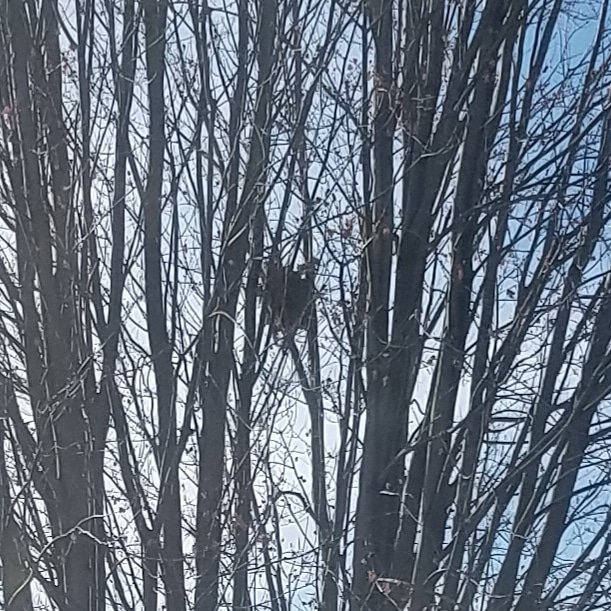
As leaves fell from deciduous trees a squirrel nest revealed itself high in our maple tree. I’ve hoped for this many years. What was a vacant, treeless place when we arrived in Big Grove has become a habitat. Wildlife sighting is frequent. In addition to newly resident squirrels, birds, foxes, raccoons, opossums, field mice and voles, deer, and every other type of animal native to the area shows up here and return. When I spend time in the garden or look through our windows to the yard I feel the community even if I’m the only human around.
I have a bottle of Jameson purchased years ago. It sits in a crate unopened because I have been too busy for kicking back and sipping. Maybe I need to take a lesson from the orchard operator and relax for a while. At least before accepting that winter will arrive and all that means.





 Journey Home
You must be logged in to post a comment.