Categories
Kitchen Garden

Hints of Autumn

Trail walking before dawn.

Ambient temperatures were in the high 40s as I made my way along the state park trail. The chilly air stimulated bare skin exposed by my short sleeve t-shirt. Even though it was before 6 a.m. three others were out running. Two had lights and one did not. When younger, I used to run five miles each morning in moonlight, so I never carry a light. I memorized the trail and know where the one tree root crosses so I don’t trip on it in the dark. Darkness dissipated as Earth rotated, bringing us into the light.

The weather has been perfect for about a week. It is the kind of summer weather we seek. Thursday the high temperature was below 70 degrees.

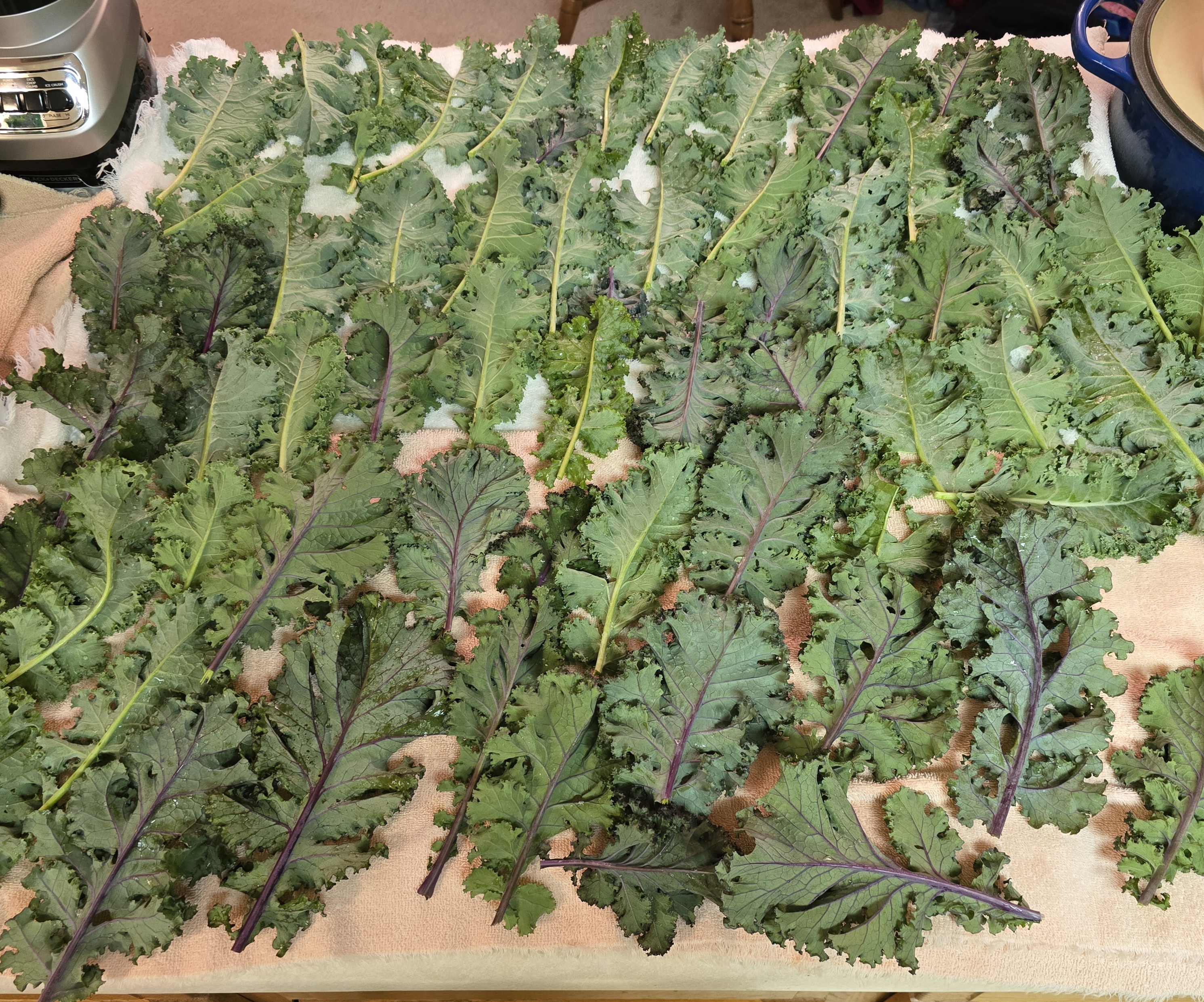
The garden is winding down, with only one or two varieties of tomatoes left ripening. There are also hot peppers which will produce until the first hard frost. Leafy green vegetables continue to grow but the freezer and refrigerator have enough to last until next year. I pick what we need to eat fresh and leave the rest. Apples are aplenty. I will end up leaving a lot on the tree for wildlife. Autumn is not here, yet we can sense it is close.

I made enchiladas for dinner on Thursday. I modified my standard ingredients, substituting fresh tomato sauce for the canned I use in winter. There are still garlic scapes in the refrigerator, so I used those too. It is an easy meal for after a long day of working with apples.

The garden garlic has been racked in the garage for three weeks and is ready for trimming and storage. I’m not in a hurry to get that done. Using a small fan to blow on it helped them dry more quickly and thoroughly.

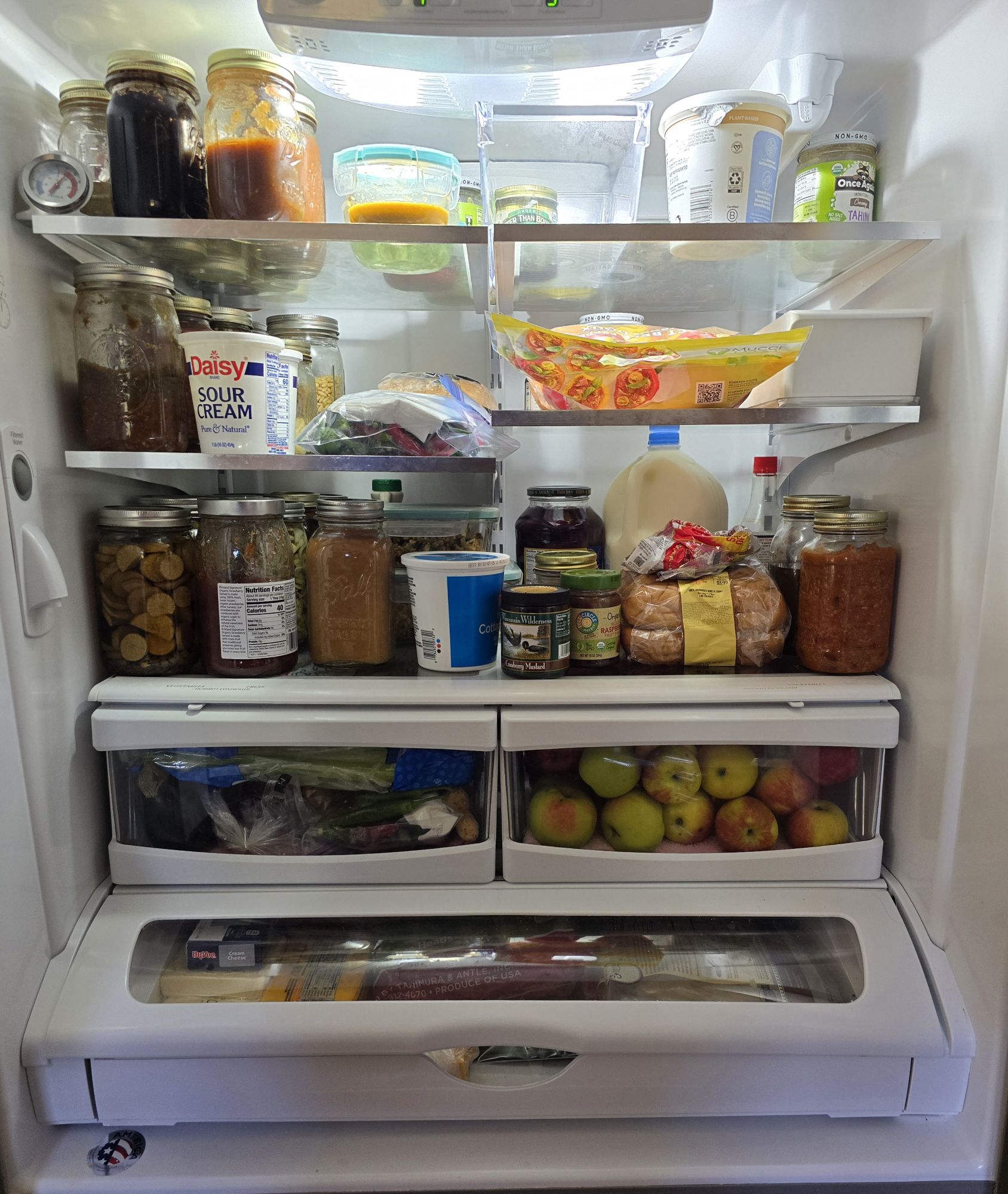
I have five bins holding a bushel and a half of apples, sorted by juicers and saucers, downstairs near the furnace. I plan to fill the other three bins and then turn to sauce first, followed by juicing. We don’t eat much applesauce, mostly using it to substitute for an egg in vegan corn muffins. Once a year we make an applesauce cake. The refrigerator drawer can take a few more of the best apples for storage. This year has been a mad rush in the garden.

When I tear down the squash patch I expect to find a winter squash or two. That operation was ill-advised in that I couldn’t get to the vines and lost track.

The acorns on the Bur Oak trees are full sized. I expect squirrels will make quick work of them.

Such is my life in Big Grove Township. We live our best lives here… as best we can.

Categories
Kitchen Garden

Deep in Apple Season

Low hanging fruit.

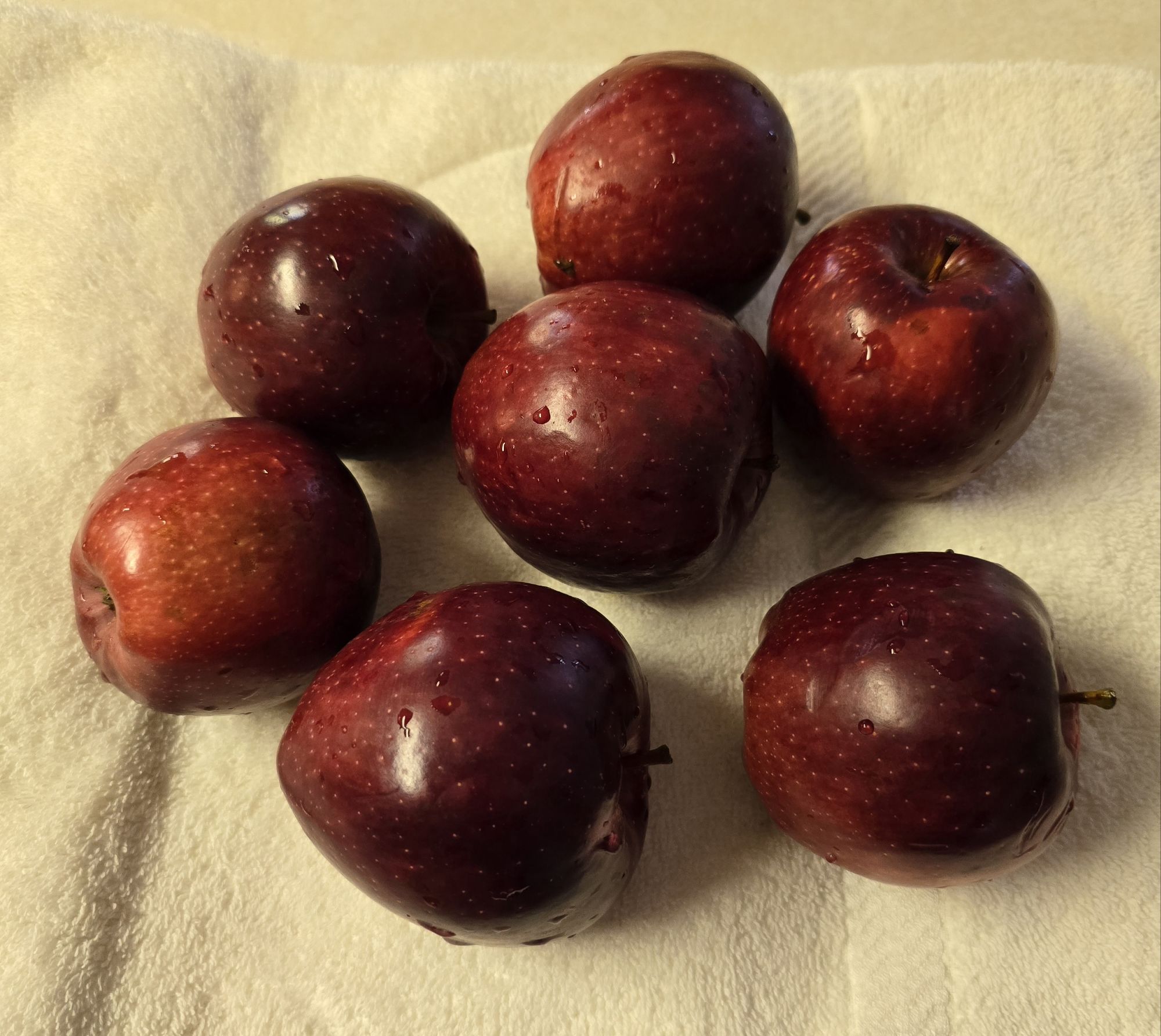
Apple season begins in earnest as Red Delicious ripen. I’ll pick the best few dozen for storage and make cider vinegar and applesauce with the rest until my allocation of pantry space is filled. I didn’t know it at the time, yet this is why I planted apple trees.

The Red Delicious harvest began Tuesday and it won’t take long to fill all eight of my tubs with fruit. After that, kitchen work begins as I race the clock to meet goals before the rest of them fall from the tree.

The most challenging work is running three or four bushels through my small juicer. It is worth the effort to have apple cider vinegar. I also jar a couple of quarts of fresh apple juice.

The other four trees have finished. By far, the best flavored apple was first to ripen: Zestar! I canned pints of applesauce from most of the harvest. Crimson Crisp and Earliblaze filled the time gap until Red Delicious ripened. I labeled each jar of applesauce with the variety of apple. The best of each variety was washed and placed in a refrigerator drawer for storage. I should have fresh apples at least until January.

This activity signals the end of summer. 2025 has been a great one for garden produce. Maybe once all the work is done I can kick back and take it easy for a couple of days. I’m not there yet.

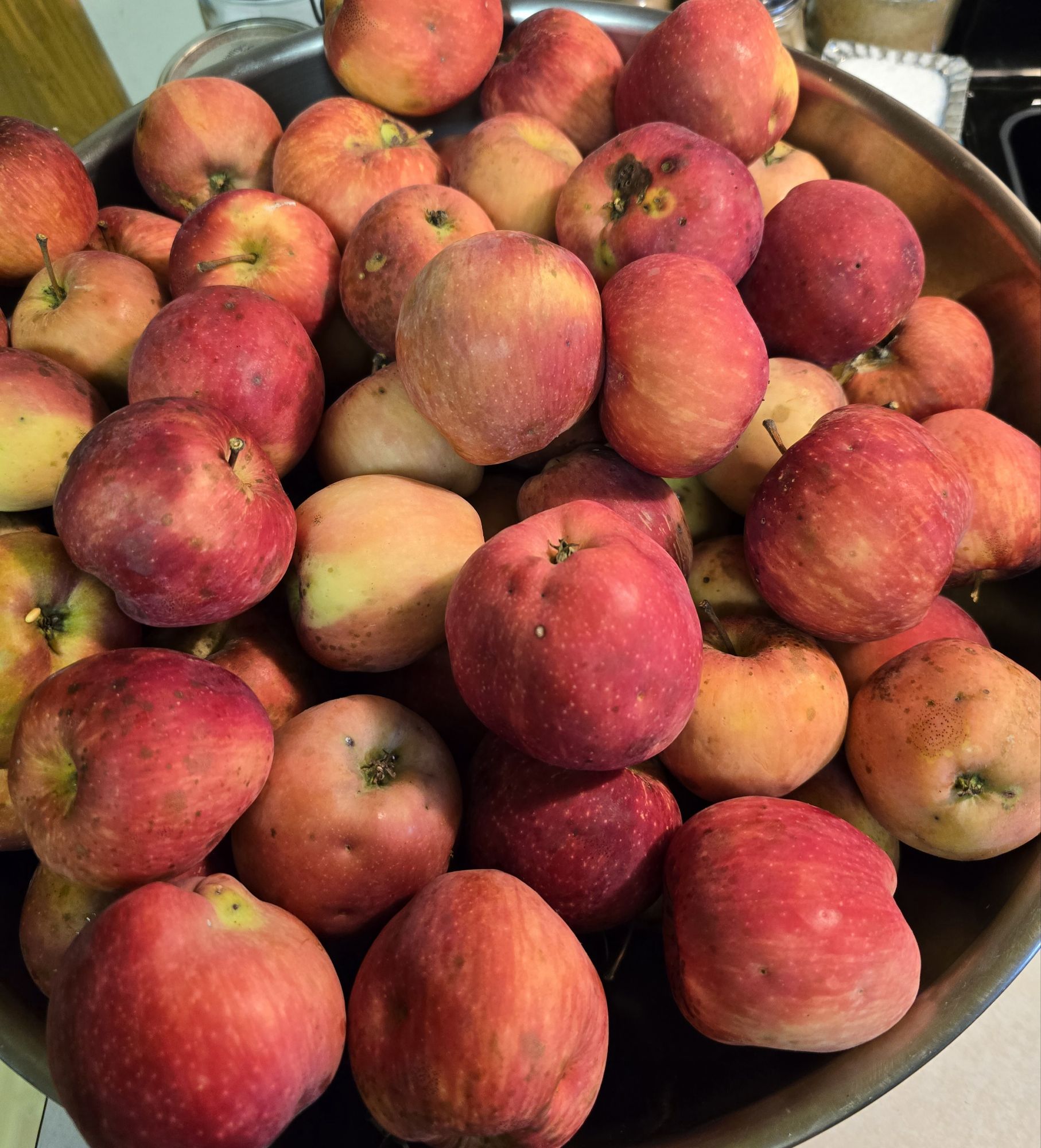
First wheelbarrow full of apples.
Categories
Kitchen Garden

Pears Are In

“There are only ten minutes in the life of a pear when it is perfect to eat.”  ~Ralph Waldo Emerson

A gardener learns to take bits of fruit and vegetables and make something of them. These pears came from the tree outside our kitchen, a tree that has been producing almost every year since it was planted in 2003. Most of the fruit goes to wildlife, yet I picked this bowl full to make sure we took advantage of the sweetness inherent in them while we can. They did not disappoint.

Here is a post written in 2014 during pear harvest. I feel much the same way today:

Pear Harvest

Our pear tree is very tall. So tall the highest fruit can’t be reached without a ladder and a picker. Even then, some will be left on the tree.

That’s okay because the shelf life or pears is very short, and we have all the pear butter we can use already in the pantry from last year. We’ll bask in the glory of fresh, organically grown pears for a week or so, and give a lot away during that time.

The money spent to purchase this tree was paid back years ago. Just this year, I paid attention to how to harvest them, and found this information from Stark Brothers to be useful. If left on the tree, pears ripen from the inside out and taste mealy. Don’t want that.

This one tree has been the perfect producer for us. Not too many pears, and not too few.

It turns out I’m okay with eating pears for a few short weeks when they come in, and have little craving for them the rest of the year. One more way to sustain ourselves throughout the year with local food without eating the same thing over and over.

Categories
Living in Society

Taking Stock of Summer

Tomatoes, fresh from the garden.

I’m getting to a place where I wrote the best of what I will about Labor Day. In 2022 I wrote this post, which covers the bases. No need to re-write it this Labor Day weekend. There is more to life than annual traditions.

It is no secret unions are in decline. In his new book, Coming Up Short: A Memoir of My America, Robert Reich points to the problem. The post-World War II economy was so affluent that unions did not seem necessary to most people in the wake of reforms that happened during the Franklin Delano Roosevelt administration. As a result, there was less impetus to form unions, and in right to work states like Iowa, a union could represent a workplace but workers were not required to join. The latest from the Bureau of Labor Statistics (2024) is, “The union membership rate of public-sector workers (32.2 percent) continued to be more than five times higher than the rate of private-sector workers (5.9 percent).” As we know from the administration’s move to invalidate union contracts among Veterans Affairs workers, the pressure will be on to diminish union strength among public-sector workers.

While summer is not over, the garden is winding down with leafy green vegetables, tomatoes, hot peppers, and apples remaining to be harvested. Instead of time off this weekend, I need to focus on work in my kitchen and garden, then digest what just happened. Short version: I withdrew from in-person society and reduced my contacts with people I know to focus on the immediate place where I live. I strove to make that life better.

Vegetables and fruit grew as well as they have ever done in my garden. The abundance produced from a small number of seeds and minimal cultivation is astounding. In particular, the green beans, cucumbers, and leafy green vegetables have been of good quality and mostly pest free. All five apple trees produced fruit. So did the pear tree. This year has been a bin buster.

As my concept of a kitchen garden matures, I have become a better meal planner and cook. One of the benefits of writing a meal plan has been a reduction in our grocery bill. If we write the meal plan to the garden, and then shop to the meal plan, the tendency is to spend less money, waste less food, and cook better meals. When I go to the grocer, my cart looks a lot different from other shoppers (yes, I look). More fresh fruit and vegetables and a small percentage of branded products. Life around the garden and kitchen makes more sense. I’m thriving in it.

Right now I have three pots going on the stove: two tomatoes and one hot peppers. Learning to process these items took time, but I know where I’m going. I mostly can tomato puree from plum tomatoes. I pickle a couple of quart jars of sliced hot peppers and then make a hot pepper paste to use on tacos. I learned to can only what we need.

This summer I exercised daily, even when the weather kept me indoors part of the day. That, combined with counting calories, led me to lose about a pound of weight per week. I have a way to go to get my BMI below 30. However, I feel healthy and that is important.

It has been a summer of plain folk living our best life. There are challenges, yet it was a decent summer in a turbulent time. For that, I am thankful.

Categories
Kitchen Garden

It’s Tomato Time

Tomato harvest Aug. 19, 2025.

Garden tomatoes are a highlight of the Iowa growing season. Growing them is a skill I learned and modified so there are enough for household needs, plenty to give to friends and family, and a generous donation to local food pantries.

There really is nothing like eating a garden fresh tomato a short distance from where it grew from seed and ripened.

For six weeks or so, we live in bliss.

Categories
Kitchen Garden

Arrival in a Thunderstorm

Sunset after a two-hour thunderstorm.

We have visitors from the east this weekend. On Friday they drove through an Iowa summer thunderstorm in an open-bed pickup truck laden with boxes of household goods for storage. The load was well tarped and secured. Some of the boxes got a few drops of rain, but mostly the first principle of transport came into effect: secure your load properly to avoid problems. We hardly used the tall stack of towels I got out to dry the boxes.

The lightning and thunder were exceptional. Enough of it to make a show. Not too much to worry. A few lightning bolts hit close to home, yet for the most part the storm did its work and moved through the area without incident. It saved me from worry about watering the garden.

These August days are busy in the kitchen garden. Apples, pears and vegetables are abundant and both the garden and kitchen are full of them. I enter either place, and suddenly, four hours filled with work rush by. Being engaged in the conversion of nature to foodstuffs seems righteous. Neither “farmer” nor “gardener” nor “cook” are the right words to describe this. It is an amalgam of living in the present, tradition, education, and experience. I don’t feel any specific descriptor is needed.

We cleaned off the dining room table to sit and talk. I made a simple repast of cut garden vegetables, fruit, cheese, and crackers for the visitors. We talked about what we would accomplish this weekend, not thinking too much about the future or the past. As the United States has its authoritarian moment, such discussions define us… help us cope… make us better people.

It is an escape from the storm that has already moved on and left us living.

Categories
Living in Society

Vegetable Prices Jump

Cherry tomatoes picked Aug. 14, 2025.

When a person grows a garden they don’t think much about the price of vegetables at the grocer. All the same, when the Producer Price Index for fresh and dry vegetables jumped by 38.9 percent in July, everyone should stand up and take notice.

“The increase is the biggest one-month move for a summer month in almost a century,” according to NBC senior business correspondent Christine Roman. Why? Unpredictable weather, including drought. The ongoing roundup and deportation of immigrant agricultural workers. Tariffs on food. It is a commonplace that margins in the grocery business are thin. These disruptions in the process that produces our food have and will cause a price increase for consumers as wholesale purchasers pass through some or all of their additional expenses.

When I return from the garden with a tub of tomatoes, apples, or greens, I have forgotten how much I spent on the seeds, supplies and equipment to produce it. I looked at my spreadsheet and found it was $921, thus far in 2025 for the entire operation, including the repair bill for my John Deere. Is it a bargain? That question is out of the scope of my gardening. Learning to produce a year’s worth of garlic is a skill that is hard to price. I generate my own seed garlic, so there is almost no financial cost to produce it. Sweat equity is also difficult to price.

The increase in the Producer Price Index for vegetables is a bellwether for other things going on in the economy. Climate conditions, labor, and tariffs will impact pricing on items other than food. The conclusion to be drawn here is everyone should begin conserving resources if they haven’t already. I doubt this once in a century price increase is the last, and we will need every dollar we can squeeze from our budgets. Hear of belt-tightening? Feel lucky you still have a belt.

For now, the refrigerator and freezer are full. The pantry is as well stocked as it has ever been. Produce continues to grow in the garden and will continue until the first hard frost. I knew living on a fixed income would be challenging. I just wish our government would take its knee off our throat, back off, and give us space to breathe.

Categories
Creative Life

Friday Gallery

Some of this week’s photographs.

Categories
Kitchen Garden

Final 2025 Garlic Report

2025 Garlic just in from the field.

This year, I produced 103 head of garlic from 103 cloves planted in March. Without doubt, a person can plant garlic in the spring and get a decent crop. I plan to return to fall planting later this year.

There were four or five wet stalks that pulled off, yet the rest of it looked as it should. If anything, there were more smaller heads. That is likely due to the shortened growing season. There are plenty of large heads to seed next year’s crop.

I racked them up in no time.

2025 garlic racked and in the garage.

Because of the moisture from recent rain, I set up a small fan to circulate air around them while they dry. Once they feel less “wet” I will put away the fan and let them cure without it. It usually takes about three weeks.

Small fan to circulate air between the racked garlic plants.

Growing my own garlic has been life-changing. There is no going back.

Categories
Kitchen Garden

Apple Management

Crimson Crisp apples from the garden, Aug. 12, 2025.

These two Crimson Crisp apples fell from the tree during Tuesday morning’s thunderstorms. They looked undamaged so I picked them up and ate one of them for an afternoon snack. “Delicious,” he punned. They need to be picked. Apples are beginning to back up in the kitchen, so I better get going with the process.

Stories of my father’s people were about apples. The women worked in an apple canning plant and grew multiple trees on their properties. My great aunt Carrie said she ate apples every day of her life. She passed on a simple recipe for fried apples. Of course the men worked mining coal. Father was lucky to escape such a future when he was a teenager.

I wrote before about my father and apples here. This is the salient memory from that post:

Father taught me to eat apples after a trip on River Drive to buy a bushel.

It seemed unusual to secure so many at once, but he knew someone, and with a limited weekly income from the meat packing plant, the family took what help he could find.

Dad used a knife to cut away bad spots and avoid eating worms. I remember him rocking in a chair eating apples with a paring knife after dinner. He didn’t call them “knife apples.” I coined that term when describing the fruit from our trees. (Knife Apples, Paul Deaton, Oct. 10, 2014).

When we moved to Big Grove Township, I planted six apple trees at the time of my mother-in-law’s death. Three of those remain, one Red Delicious, and two Earliblaze. They are all reaching the end of their lives, but as long as they produce, I don’t cut them down. Recently I planted one Zestar! and one Crimson Crisp in a different spot in the yard. This year is the first all four varieties are producing.

Now that I have a producing orchard, what next?

I grew out of the idea of processing every possible apple into something. Apples now get divided into three major categories. The best ones are tucked away in a refrigerator drawer for eating with a knife. Most of those do not have visible imperfections. The seconds are saved for making three major products: Apple butter (usually 12 pints per major harvest); apple sauce (a dozen quarts and two dozen pints); and apple cider vinegar to fill all my containers. I need about 3-4 gallons this year. When the vinegar jars are filled, I usually reserve a quart or two of fresh apple juice for drinking from the refrigerator. Any other apples are comprised of fallen fruit and the least desirable of what I pick (small or too many imperfections). These go in a pile near the lilac bushes on the property line. They usually sit there decomposing from now until winter, yet in the spring they have all been eaten by wildlife who need winter food.

I used to make dried apples in a dehydrator, but just don’t eat them. Once they get used up from last time, that will be the end. In short, I process to make what I make and anything else goes to wildlife. Extra apples are not usually shared. It takes a certain type of outlook to turn a gnarly apple into applesauce or vinegar. Wildlife don’t complain and eat everything I put out for them.

The main challenge in apple management is getting everything done before they start going bad. That’s where I currently am. The Zestar! have been processed, there are two containers of Earliblaze in the kitchen waiting for processing and a lot on the trees, I’ll pick Crimson Crisp today or tomorrow, and Red Delicious, which is my workhorse apple, are still ripening and won’t be ready for another month or so. Apple management is a process of continuous improvement. Re-defining and knowing what I want is important to keeping my sanity in this busy time of the garden year. Apples are worth the work.