Children running among my garden plots with inexpensive butterfly nets. From the house I can see only butterflies and nets bobbing to and fro above garden greenery.
Sometimes they leave their toys in the garden. I walk them across the property line to the scrub woods where they make a camp during cooler weather.
Life at home is tolerable.
Once I get too far out of a limited social circle it’s less so. My furthest reach was to the farm where I worked mostly in isolation to prevent the five quarantined farmers from getting sick. Other than that, grocery shopping, fuel, and a couple of trips to the orchard are the extent of my travels since March. I don’t feel comfortable doing any of it but feel I have to get out of the house and experience the reality of the pandemic.
Rain was forecast all day Wednesday although the forecast was worse than the actuality. After morning showers it hardly rained, enough so patches of the ground remain wet the next morning. The furthest I went from the house was to the garden and the mailbox, both within 80 feet. I encountered no other human during these trips.
COVID-19 reached the staff and residents of the elderly care center this week. To my knowledge it’s the first any area people contracted the coronavirus. The care center has been on lock down since the pandemic began so this is a new development.Someone must have brought it in.
On the positive side, I’ve written an outline of recurring tasks to give my days structure. The biggest gap is determining what projects I should be working on. There are projects needing attention, for sure, and little will to take them up.
For now I’ll settle for the sound and constant bobbing of young children in our yard. And waiting for something, what exactly it is will be revealed. At least that’s the hope.
It’s been 12 days of riding my Puch Cavalier 10-speed bicycle.
I’ve had it since 1980, one of the last built in Austria. When we married, my wife had a women’s Puch 10-speed in the same color. When not being used they hang together in the garage.
Taking up bicycling again is a treatment for diabetes. My medical practitioner explained the health benefits of exercise in a way his predecessors at the clinic did not. Now I’m regularly riding 4.875 miles daily, weather permitting.
Why 4.875 miles? At first I just went out and rode. We live near the midpoint of a five-mile trail in the state park. I took turns riding from our home to either end and back. I figured it was a five-mile ride. Then I got an SY Bicycle Speedometer and Odometer. Once it was installed and adjusted I gained precision. Each day since then the odometer had the same reading, 4.875 miles.
Work was completed on another trail that leads from here to Waterloo in one direction, and to West Branch, Iowa City and Coralville in the other. A fellow gets tired of riding the same route every day so I’ve been exploring.
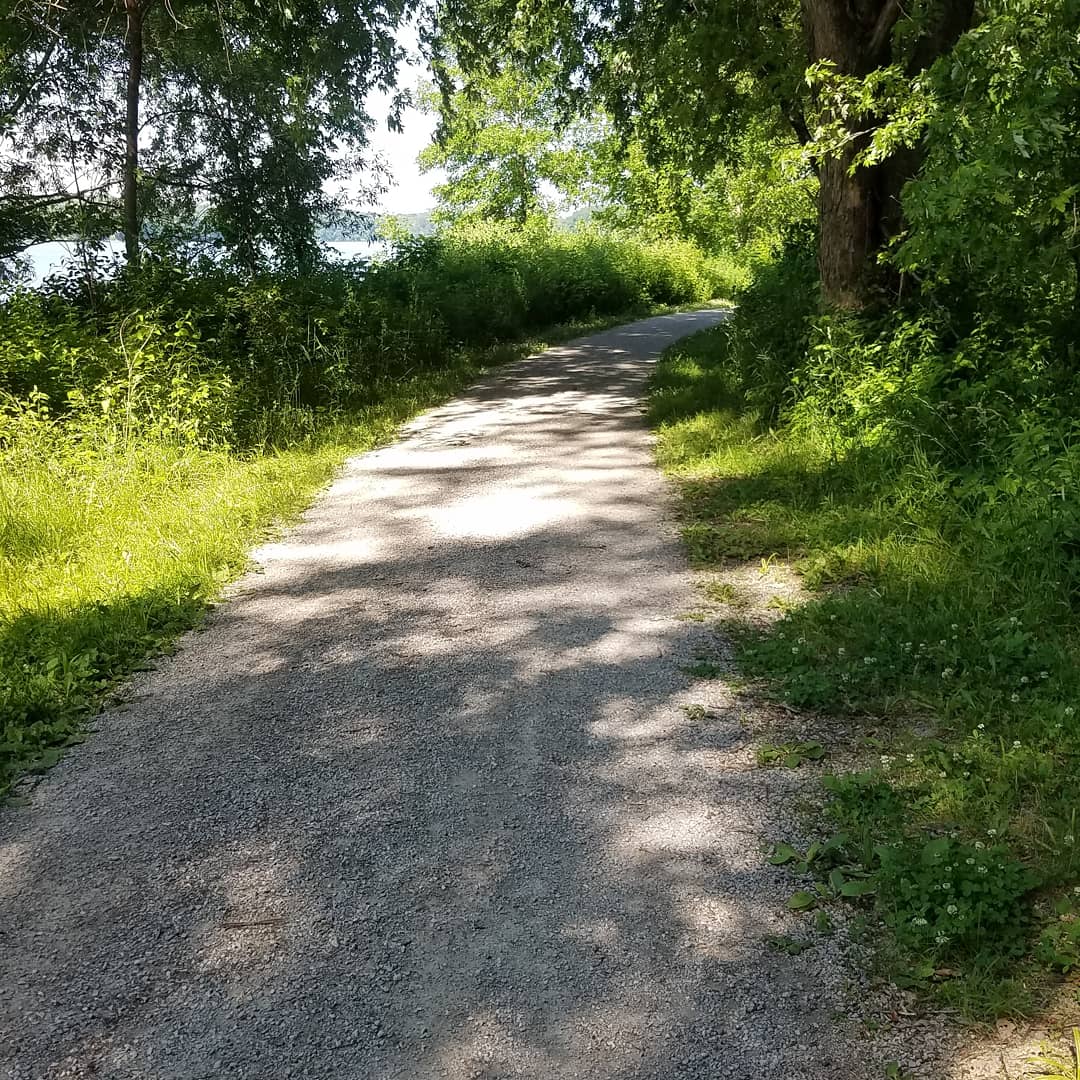
My current ride takes me from the garage down to the state park trail, then west until a road leading to the highway intersects. I pedal up that long, gentle incline to the highway and turn east. I ride along the highway until it intersects with the new trail at the roundabout. Then I follow the trail until it returns to the state park trail and turn west back to my entry point and home. The long initial incline gives me a workout, as does the long descent during which I see how fast I can go. My average speed is 10 miles per hour and the fastest just at 22. It takes about 27 minutes to make the route.
Hopefully the exercise will help my A1C, which measures what percent of my hemoglobin is glycosylated. The goal is to reduce it to less than 5.7 percent by the time I go back for a follow up in September.
A younger version of me wouldn’t be satisfied with 4.875 miles. I’ll get tired of the same route after a while, once it becomes too easy. The next goal will be to ride over to Ely on the new trail. For now my heart beats faster and I work up a sustained sweat. Doing that daily for an extended period of time is goal enough for now.
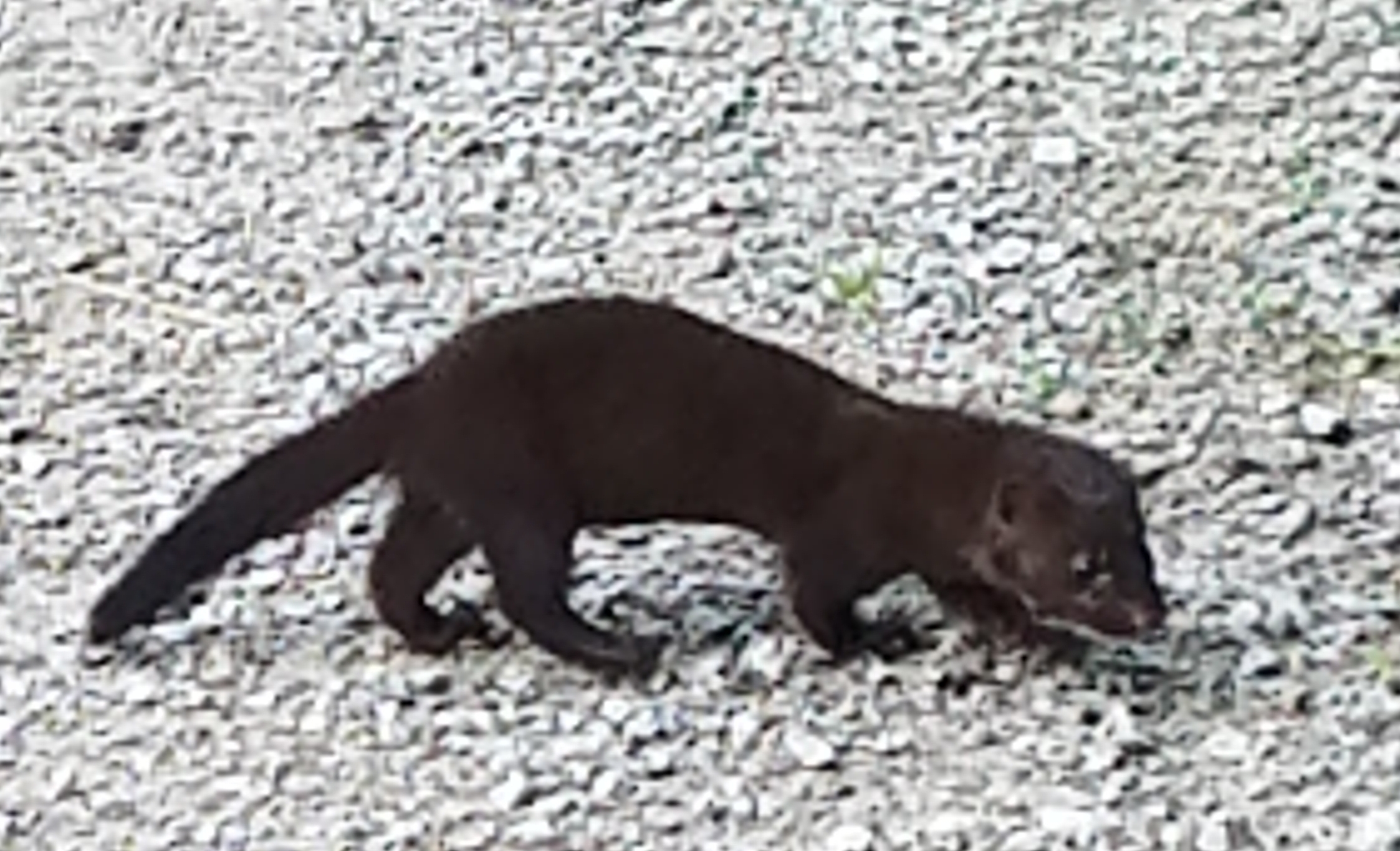
On Thursday I saw an animal eating fallen mulberries on the trail. The state park has an abundance of wildlife — every Iowa species is believed to live here. I didn’t recognize it and posted this photo on Twitter.
An abundance of responses identified it as a mink. I looked it up and it resembled a mink pictured on the internet. Most likely it is an American mink with more of them around the lake shore. Mostly minks are carnivores so the mulberry-eating was unexpected. Harrowing tales of chicken murdering ensued as the post got many engagements.
Every day we find something new is positive. When our curiosity wanes or we feel we’ve seen it all… that’s not good.
The newspaper reported another local theater troupe cancelled the rest of the season because of the coronavirus pandemic. Old Creamery Theatre sent termination letters to ten staff members Thursday night. The creative arts are really taking a hit during the pandemic. In addition to Old Creamery, Riverside Theatre had to give up its performing space, and bigger companies like Cirque du Soleil filed for bankruptcy. Live theater and concerts have been shut down with only a few productions testing a re-opening in the COVID-19 time.
Major theme parks like Walt Disney, where our daughter works, continue to furlough employees. As they begin to open up, the question is whether employees will be recalled, if the furloughs will continue, or will the endgame be being laid off. Live entertainment may never be the same if the coronavirus isn’t mitigated. As we know, that’s not going well in Iowa or in the United States.
I worry about independently-owned bookstores. There used to be many places to buy used books. Over the last couple of decades they consolidated, went on line, or went out of business. The selection has gotten worse. The main used bookstore in the county seat is Haunted Bookshop and I’m trying to support them as they continue to operate curbside pickup.
At first I bought a gift certificate to hold until they reopen. When it became clear re-opening was not in the near-term, I devised a poetry buying scheme. On Wednesday I wrote note saying, “Choose and mail me a book of poetry that I don’t already have once a month. Surprise me.”
I had criteria:
Short works by living poets. Short = around 100 pages or less. Up to 200 pages okay. About the length to read in a couple of sittings.
Less interested in comprehensive collections. For example, Crow by Ted Hughes but not Collected Poems of Ted Hughes.
I recently read and enjoyed Mary Oliver, Amy Woolard, Lucia Perillo and W.S. Merwin.
I’m looking to expand my reading and open to about anything. No Atticus or Rod McKuen.
Iowa connection would be a bonus, but not necessary.
Run the title by me before shipping so I can check to make sure I don’t have it.
These are not strict rules but guidelines. (Except for the part about Atticus and Rod McKuen).
Last night I received a favorable response. We are going to try the arrangement out. I’d rather make a monthly trip to browse the store. Until they are ready, this will have to do. Hopefully I will discover new poets in the process and they will have another small source of revenue.
I watered the garden shortly after sunrise. Our yard is the only one in the neighborhood where clover is allowed to grow. I do this so rabbits have something to eat besides burrowing under the fencing into the garden, and to attract bees and other pollinators. Last time I mowed, I set the deck high enough so all of the flowers wouldn’t be cut. It’s time to mow again and that’s my plan for the weekend.
When my medical practitioner diagnosed plantar fasciitis in 2015 it mean I had to give up running. I’d been running for exercise since 1976 when I enlisted in the U.S. Army.
Doc suggested bicycling. I took my Austrian-made Puch Cavalier ten-speed down from the hooks in the garage and delivered it to the bicycle shop where I bought it in 1980 to get tuned up. Parts were scarce for the old bike, but the technicians found them. I brought it home and hung it in the garage where it stayed until this month.
During a recent medical check up I asked again about running. I needed more exercise and my feet felt better. I could run again, I thought, maybe not five daily miles as before, but something. He said if I returned to running, plantar fasciitis would flare up again. I started walking and it wasn’t enough.
On June 18 I dusted the bicycle off and rode for the first time: about five miles. I’ve been out the last four days and expect to continue bicycling, gradually increasing my daily distance.
I’m a cautious bicyclist. I have a good sense of myself on the bicycle and know how to use the derailleur gears as they were designed. I couldn’t locate my helmet or riding gloves so I adjusted our daughter’s helmet so it would fit. I put a fanny pack over the handlebars to hold my mobile device and the garage door opener. I still have the plastic water bottle I got when the bike was new. I have two pair of bicycling pants with the cushion in the crotch. I’m wearing my old running shoes for now.
While I was in graduate school I ran and rode a lot. I would run from my apartment on Market Street in Iowa City out to the Coralville dam and back. Afterward I rode the bicycle for another ten miles. I was a restless soul then. I made all the usual rides: to Sand Road Orchard; to Kalona before dawn where I saw kerosene lamps illuminating homes and barns; to Stringtown Grocery; to the Kalona cheese factory; through Hills, Lone Tree and Wellman. I was a primitive rider, having no training and an undisciplined approach. I made a century ride with the Bicyclists of Iowa City and experienced glycogen burn out. At the time I didn’t know what was happening to me and it was a little scary. Not freak out scary though, and I made it home safely.
I need more exercise. It’s cheap medicine. Today I rode 7.6 miles with a goal of being able to make it to Ely without stopping. After that, who knows? For now it’s enough to feel the cool breeze as I ride and make progress toward an unspecified goal.
My farm friends with community supported agriculture operations take the coronavirus pandemic seriously.
On one farm the crew wears personal protective equipment while working and changed the interaction with customers to control exposure to spread of COVID-19.
On another, the farmers decided, before most planting began, to have the entire crew move to the farm and by self-isolating reduce the risk of COVID-19 spread. They also changed the interaction with customers and cancelled the annual potluck because they believe the coronavirus will not be controlled by autumn.
If any of my friends contracted COVID-19, it would have severe consequences for the operation, including the possibility of ceasing deliveries to customers, at least for a while.
While we deal with the coronavirus an explosion of insects is preparing to assault our garden. In the last 24 hours I observed Japanese Beetles, Colorado Potato Beetles, squash bugs, cabbage worms, and many other species. While the invasion was anticipated, I choose to grow organically so using commercial chemicals to hold them in abeyance is not an option. My main tools are vigilant inspections each morning, hand picking the bugs off the plants when I see them, and for the squash beetles, a mixture of castile soap diluted with water in a spray bottle. To be honest this is just part of nature, and I do my best to protect the yield, giving up as little as possible to insects.
I’ve been making a shopping trip every other week to the wholesale club. Yesterday would have been my day to go but after considering the produce from the garden and what was stored in our pantry and freezer, the only thing we needed was milk.
I’m not lactose intolerant. Maybe I shouldn’t be drinking fluid milk, but I do. With the pandemic it’s a bit stressful sourcing the next gallons. Really that’s all we needed in the grocery category. What to do?
Hell if I was spending 90 minutes driving across the lake, past the Trump bar and the jail Hillary house, near the convenience store where young male adults with large Confederate flags mounted on their pickup trucks congregate, past the correctional facility to the wholesale club where milk is cheap. Too much else was demanding my time.
The options in the small city near where I live did not seem safe from spread of the coronavirus. Three convenience stores sell milk and it’s fresh. The cashiers wear masks and have those plexiglass protectors at the register. It’s the customers with no PPE that cause concern.
There is a grocery store in town. Their milk is also fresh. I’ve not been there since the governor declared the pandemic emergency. The unknown is often an issue. It’s just a gallon of milk… were there better options than the unknown?
I wasn’t ready to give up. There is a dairy store in the next town where the milk comes from their cows. I remembered when they reopened early in the first phase they did curbside pickup. They were taking the risk of COVID-19 spread seriously. I drove the six miles, put on my mask and went in.
The store is always spotless. Three cashiers were all wearing masks, as were other customers inside. I didn’t feel like a freak with my mask, wearing one was accepted behavior. The milk cost more than double what it would have at the wholesale club. The added cost was worth it for the time and gasoline savings. It was also a stress reliever.
I got two gallons so I don’t have to go shopping again soon.
Between showers I hope to accomplish some gardening tasks yet most of the day will be spent indoors: in the kitchen, garage, and at my work desk. There’s always something to do.
The Washington Post reported the White House is preparing for a fall resurgence of the coronavirus. My analysis: we couldn’t wear masks in public for 3 months so now we will have to wear them for a couple of years until a cure is identified and implemented.
The president held a campaign rally in Tulsa, Oklahoma on Saturday with 6,200 attendees. Some number of those were paid actors, campaign and White House staff, plainclothes security and the like. By the way, who pays people to attend a political rally?
In pages of commentary, few pointed out that people getting together for a big political rally during a pandemic would not be supported by those with common sense. The lower than expected turnout is evidence people continue to protect themselves first. Tomorrow he is holding another rally in Arizona where the number of diagnosed cases of COVID-19 spiked over the weekend. I don’t know much about who is running his campaign but these pandemic rallies can only reflect poorly on the president and raise the question, why is he holding them? There is no good answer.
I’m anxious to move on from writing about the coronavirus pandemic. The pandemic affected almost every part of my life and frames what I do going forward. All the same, the circle of people with whom I have contact is small. It includes my spouse, the farmer where I worked this spring, and neighbors I encounter at home and while trail walking. I tested negative for COVID-19 on June 16, but if I were positive it would be pretty easy to trace my contacts because they are so few. I don’t like the lack of broader contact with people.
Yesterday at the farm, Carmen came to the greenhouse and took a chair for a conversation while I worked. In the time before the coronavirus there would have been a seeding crew working alongside me. The greenhouse used to be a bustling place. With the pandemic it’s been just me with a couple of check ins from Carmen during my shift. The work gets done yet I yearn for the conversations with a variety of workers. We discussed a long list of farm and garden topics during my last shift of the season.
I spent one day in the field this year. My special project was learning to better grow peppers. Part of that was planting pepper seedlings with Carmen’s sister. The rest of the crew worked the same field and maintained social distancing while Maja and I worked and talked. It was a highlight of the spring.
The sound of rainwater falling in the drainpipe started. Maybe I won’t get out to the garden to check on broccoli, trim the tomatillo plants, and pick some greens. We’ll see how the day unfolds. Living in the actuality of it may be the best I can do on this stormy day.
There have been 7.3 million confirmed cases of the coronavirus worldwide according to this morning’s Washington Post. The virus has killed more than 410,000 of which 112,978 deaths occurred in the U.S. since Feb. 29.
Mitigation of the coronavirus is not going well here. Poorer countries have done much better handling the crisis. Absent leadership, incompetence, and a deliberate decision to treat COVID-19 like influenza for weeks in February and March, combined with a just ‘let it go’ attitude have taken their toll according to one public health official.
On Thursday the Dow Jones Industrial Average plunged 1,861 points when witless traders found out there wouldn’t be a quick recovery from the pandemic. How did they get the notion the recovery would be quick? Praise the Lord I got out of the market when I did.
In any case, the administration has thrown in the towel on their so-called fight against the pandemic and is moving on to the campaign trail. They are having rally attendees sign a liability waiver in the event there is COVID-19 spread at them. Their work has been about re-election since the day after the inaugural address and little else. In the Republican political playbook what’s another 100,000 COVID-19 deaths? F*ck it! Four more years.
Where does that leave bloggers, writers, gardeners and humans like me? We have to adapt to the coronavirus pandemic. Part of the adaptation was forced upon us.
Retiring from retail work on April 28 was an easy calculation. At age 68, with some health conditions and a reasonable pension structure which included Social Security and Medicare, I decided to do without the additional income and potential exposure to the virus. I won’t be going back to the orchard to work in the retail barn this fall either.
For the first time ever my medical practitioner prescribed a medication which I now have to take daily to reduce cholesterol. I asked him what circumstances may result in ending the medication. He said maybe toward the end of life. While it’s not unusual for Americans to be on medication, and I’ve been lucky to avoid it this long, my health and welfare needs more consideration.
Finally, a lot of people remain unemployed and some jobs closed by the pandemic have not re-opened. Many won’t reopen at all or will emerge vastly changed. In any case, other people need the work more than I do. If I generate income it won’t be working as a wage worker for someone else.
What are the possibilities?
Our household spending plummeted since leaving work. The retained value of our balance sheet increased by 3.25 percent since the pandemic began in Iowa. Our personal debt decreased by 50 percent in the same period. We have a possibility of paying off our debt by the end of the year, opening up spending on large projects in 2021. There is a long list of backlogged projects.
I’m already reading more books, 23 since the pandemic began. I don’t know if it’s possible to “catch up on reading,” but many books wait in my queue and I might actually get to a lot of them. This is a positive alternative to spending more time on social media.
The schedule of work outside home is minimal and that enables a focus on home life. Part of that is taking care of health, and part is going through and getting rid of unneeded possessions in preparation for refurbishing our living space. More attention can be paid to the kitchen garden so our diet can improve, providing better nutrition. All this is welcome and showing marked improvement since the pandemic began in Iowa.
How I might re-enter society, being among people I know, doing things together, is missing from adaptation. With continued spread of COVID-19 I won’t join others at events unless I know their social distancing practices. That seems like a lot to ask friends and neighbors just to spend time with them. Zoom meetings aren’t really a replacement for someone who has been very social for as long like I have been. Likewise, with more people at home on the internet our connection isn’t adequate for an uninterrupted Zoom event. How all this gets resolved remains an open question.
Until there is a vaccine with widespread distribution, or some acknowledgement by public health officials the pandemic is over, I don’t see how adaptation can resemble the past. There will be gatherings but for now I ask myself why risk it? That’s going to continue for some time.
Being at retirement age has made adaptation easier. Maybe the best adaptation, the most socially responsible one, is to just fade away into my family, my bloggery, my writing, and my kitchen garden. There are worse fates than that. Eventually an opportunity to re-enter society will present itself but not yet.
Shopping in person is my least favorite thing in the third month of the coronavirus pandemic.
I dislike losing control and exposing myself to maladies real and imagined. Since the pandemic is real, personal shopping activities are reduced to a minimum. That bodes ill for the economic recovery. Our household will be just fine with less shopping.
Some stores require customers wear a mask and others don’t. I have two clean, homemade masks in the car with me and wear them into retail establishments. Most retailers have taken action to protect their workers, but customers? “The customer is always right” has taken on new meaning.
In our neighborhood things are loosening up. We live next to a large lake. Foot traffic to the boat docks and trail was heavy over the long weekend as families made their way to get out of the house. A couple of residents are planning yard sales in early June. Rest assured there will be no social distancing in those driveways and garages. One neighbor plans to walk the streets to distribute popsicles in celebration of a child’s birthday. Don’t get me started on the ice cream truck that plays an annoying version of Scott Joplin’s The Entertainer while hawking wares. At least the parcel delivery drivers wear masks, if the USPS contractor does not.
The small town convenience store is a barometer of what’s going on in the community. I had to get gasoline to finish mowing so I stopped at one on the way to the CSA to pick up our weekly share. I paid at the pump. Tension rested over everything as I stood fueling. They were busy yet activity seemed subdued compared to previous holiday weekends. No one was wearing protective equipment. I used only my right hand to touch anything. When I got back in the car I cleaned up with a sanitizing wipe kept for that purpose.
I didn’t go inside to play the lottery, which I normally like to do. Last time retail clerks wore masks and gloves, although they hadn’t put up a plexiglass barrier like other convenience stores. That was several weeks ago and they may have changed. Money is dirty whether there is a pandemic or not.
We are out of milk. That’s the sign it’s time to make a shopping trip. Dread it though I do, I’ll venture out. I have a list so I can spend the least possible time inside the store. There won’t be any impulse purchases today and that’s bad for the economic recovery as well.
Being an American is a mixed bag. We have some of the smartest people on the planet working on big issues, but everyday folk could care less. Part of the problem is a lack of political leadership. Part of it is tied to a progressive deterioration of learning. Everything gets politicized and in practice facts have been cut loose from their mooring. We are on our own to study and make a determination of what to do with our lives. Some call that “freedom.” I call it re-inventing the wheel.
If the past weekend taught anything it is summer will not be repressed. People have priorities and one of them is re-enacting trusted and valued behaviors. In the age of the coronavirus people will have their summer. I believe most of us will survive. What do I know?
Friday J.C. Penney filed Chapter 11 bankruptcy, another victim of the coronavirus pandemic.
To say I disliked the in-store experience is an understatement. To say how much I loved the on-line experience is impossible. They are a great alternative to Amazon where we can find affordable attire. Fingers crossed they come out of bankruptcy.
What will a retail experience look like on the other side of COVID-19? I don’t think anyone knows.
I’m reading another Obama administration memoir, this one by Ben Rhodes. I also read Samantha Power, David Plouffe, Jill Biden and Michelle Obama. On the bookshelf waiting is Susan Rice… I’m just passing time though, until the big guy’s book is finished and released.
It’s hard to believe the Obama administration existed at all in the age of Republican control. It’s like an Arthurian legend we lived through except now it is transformed into myth. So much so it’s easy to believe it never happened. It did happen and the memoirs serve to remind us of another possibility than the one dominated by a needy president.
I stopped and stood outside the garage breathing the fragrance of lilacs. They are close to full bloom and won’t last much longer. It is difficult to stop and experience flowers yet we must. A lot depends on the fragrance of lilacs.
I participated in a Zoom conference with friends yesterday afternoon. We are on the last mile of cable with our internet provider and the connection is sometimes inconsistent. After being dropped five times during the call I gave up. It was good to see everyone again, even if intermittently.
Life on the other side of COVID-19 will be different. For me, it precipitated full retirement and that change alone is big. There’s more though, and not just about one person’s experience of the pandemic. If anything, we are getting used to living with less. That should be good for us, and good for society. I’m confident J.C. Penney will try to adapt to the new reality. If they don’t, the world will be the less.
Rain fell on Big Grove Township last night and this morning.
Lilacs are in full bloom with branches weighed down by residual raindrops. It will be a day indoors to cook, to clean, to read and write.
The second batch of vegetable broth quarts has 20 minutes left in the water bath. Once sealed, cooled and dated they will join the others on the shelf. I heard one of them fracture when I submerged it in the hot water. Old Mason jars don’t last forever.
While digging in the cupboard to find 14 empty quart jars there was an old one with colored glass and a sharp edge on the lip. It had been chipped and was unlikely to hold a seal. I placed it in the recycling bin.
It’s another day in the coronavirus pandemic when we wait to see if the federal government begins to manage the crisis. Our governor gave the okay for beauticians, barbers, hair stylists and massage therapists to go back to work. I’ve seen a production of Sweeney Todd so I’ll continue with my aches and pains and let my freak flag grow back so I can let it fly once the rain ends and the pandemic has run its course.




 Journey Home
You must be logged in to post a comment.