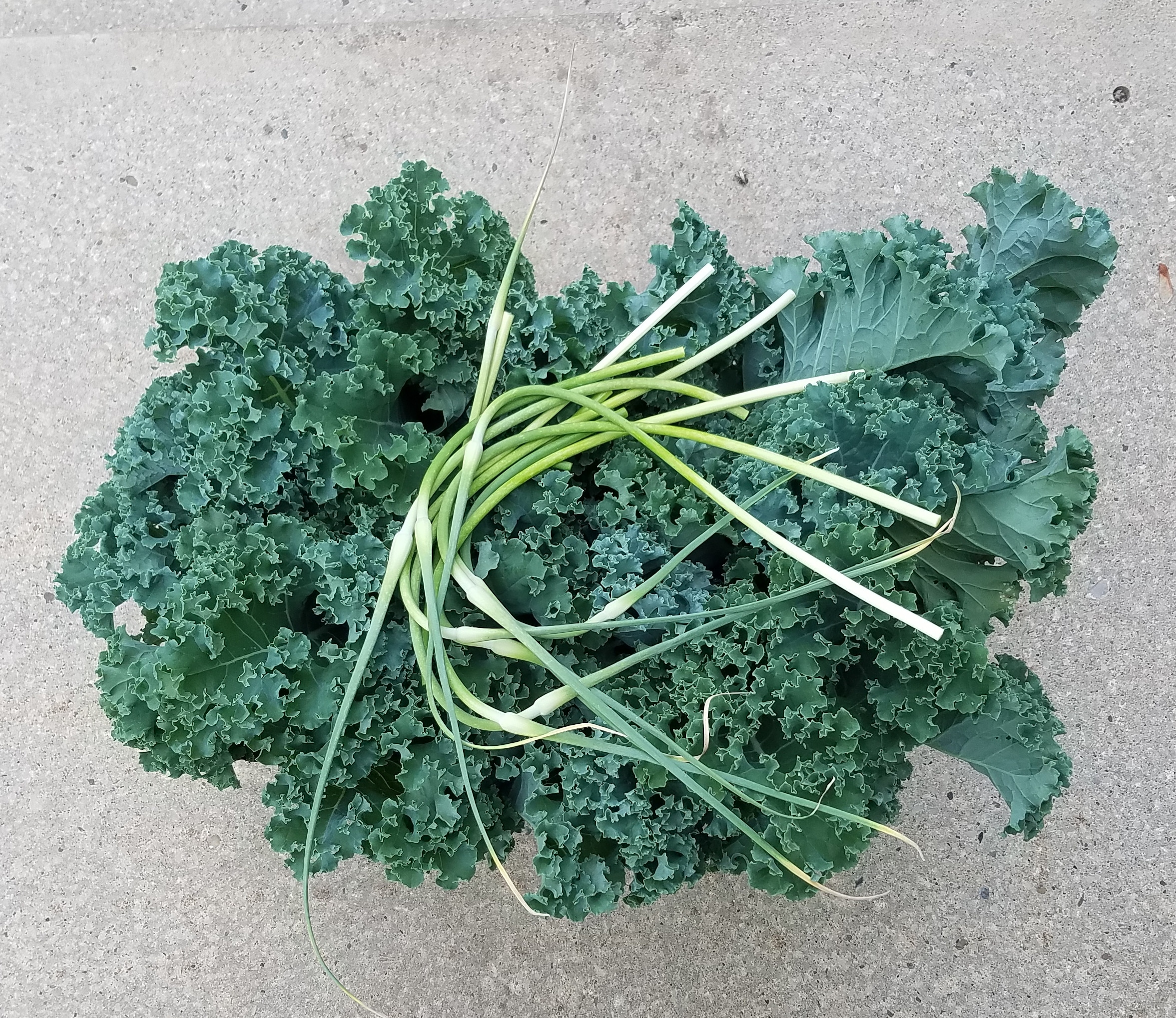
Second food bank donation: Winterbor kale and garlic scapes.
After ending her relationship with a large entertainment company in Florida last November, our daughter decided to move to the Midwest to pursue creative endeavors. Her new apartment rental agreement starts July 1. We plan to make some storage space in our home for extra possessions in case she needs it. Logistics and storage is part of what a parent offers an adult child.
We’ll see if storage space is actually needed. I looked at her new apartment online at a real estate marketplace company website. It appears she will have plenty of room as she is moving from a situation where she rents a single room in a house shared with others to a three-room apartment. She is planning the move and we are standing by to help as we are asked.
The storage space here can likely be created by discarding packing material accumulated over the years. Once finished with that, I’ll consolidate building materials in one spot and use the platform of the loft bed I built for her in college for any new storage items. Prepping the space is likely a one-shift job.
Since we married, we lived in five different places, including the current home since August 1993. The idea of us moving seems like too much work. Our home has become our main financial investment and the majority of our net worth. We are lucky to have a home we own outright. Even if financial conditions get dire, we’ll try to retain ownership.
After years of accumulation — from settling estates, from auctions and tag sales, from failing to dispose of outdated clothing, appliances and the like — we are filling it up. That needs to change as we prepare the home for our aging. For the time being, we can still make more space.
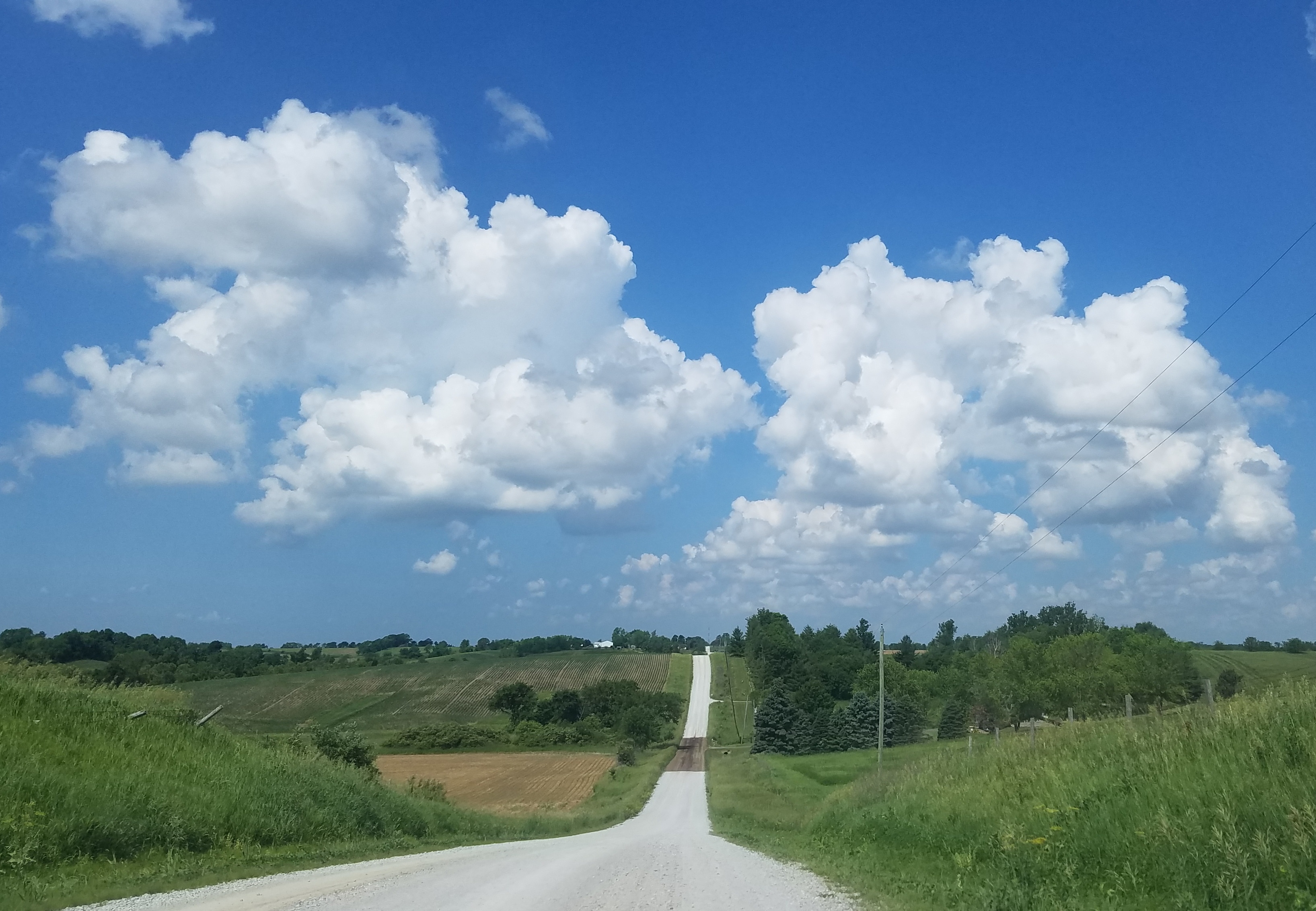
We rely on the county secondary roads department to keep farm-to-market routes in good shape. Each spring, gravel roads need grading and gravel application. While they are not well-traveled, people notice if they are in disrepair. Secondary Roads did a great job on those I use, like the one in the photograph taken after my shift at the farm.
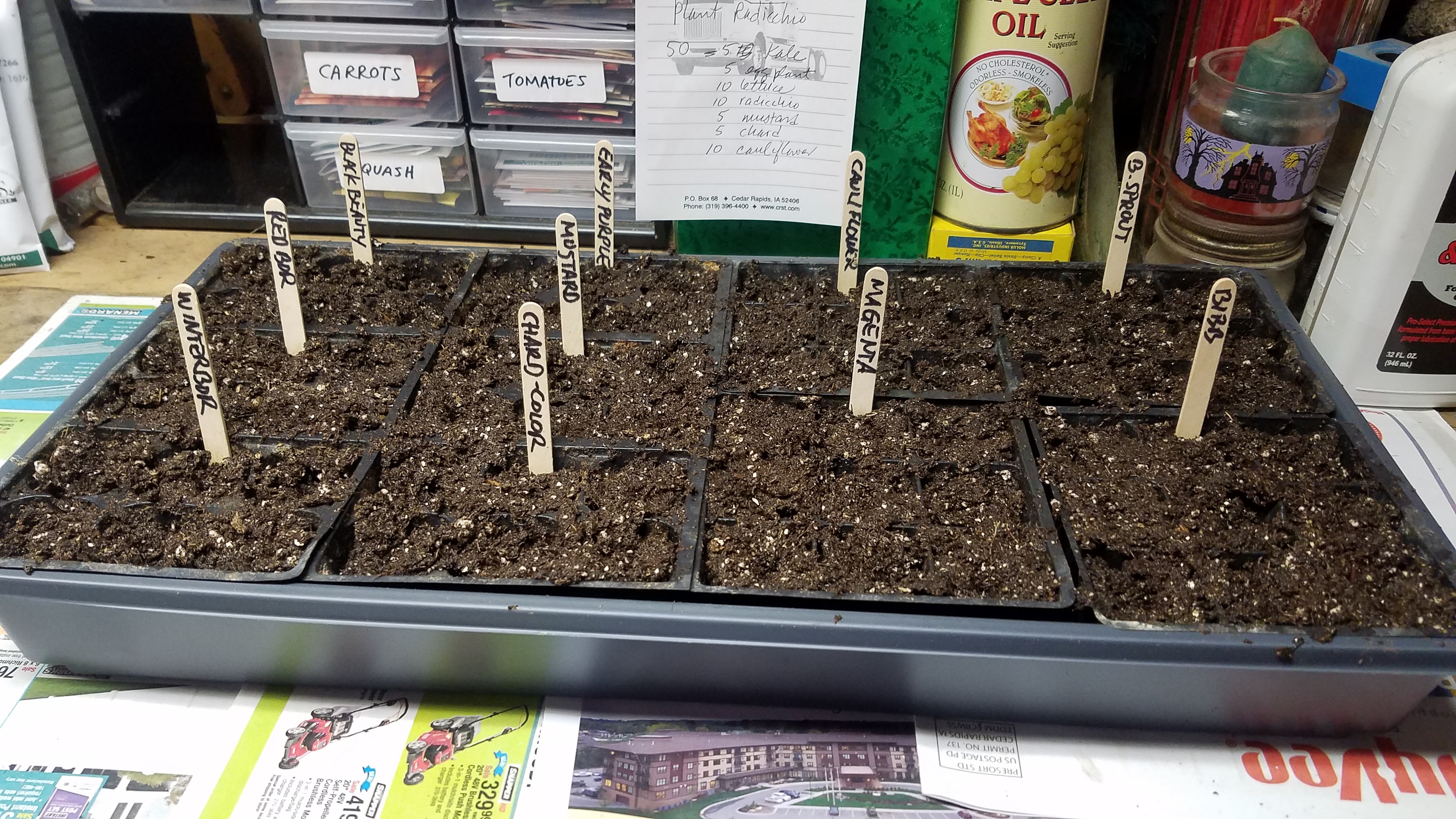
My soil blocking at the CSA is winding down. Yesterday I started early because of mid day heat. I showered afterward and went to the wholesale warehouse to get provisions. That’s my work for the week so the next scheduled trip off property is not until Monday to deliver produce to the food pantry. That is, unless she calls ready to come home.
Having the house to myself is a little weird. I set up a music station on the dining room table. The three-in-one device plays radio, compact disks or audio cassette tapes. We keep things pretty quiet most of the time, so it is evidence of temporarily letting loose. Last night I played my Greg Brown CDs. Brown tells a story I’d like to believe about Iowa.
The menu I wrote for the both of us is out the window. There was leftover rice so I used it with other bits and pieces from the ice box to make a dish: leftover beans, kale, onions, bell pepper, and seasonings. That served as breakfast and dinner on Wednesday.
In addition to drinking a Coca-Cola on Tuesday, last night I drank the first beer since March 13, 2020 at the beginning of the pandemic. I bought a case of Stella Artois at the wholesale warehouse and with temperatures in the upper 80s, I relished the first taste.
There is a big bowl of limes to be used up. I have something mixed with vodka in mind, although I am no mixologist or hard-liquor-drinker for that matter. For complicated reasons I am reluctant to open the bottle of Stolichnaya Russian Vodka purchased at the Me Too grocery store in Cedar Rapids around 1986. I hauled it out to Indiana and then brought it back to Iowa. The label says, “Imported from the USSR” and that’s half the story of its travel. Once I open it it’s a matter of time before it will be gone. I’ll probably hang on to the unopened bottle a while longer. In all this time, only about an ounce has evaporated through the sealed cap. I’m not keen on vodka consumption anyway.
Peas are ready to pick in the garden, so that’s first up when the sun rises. Some kind of stir fry will follow. There will also be soup today. Ambient temperatures are forecast for the 90s this afternoon, so garden work will be finished early, and most of the day will spent indoors.
It seems too hot for early June. The drought in Western states is horrific. The Colorado River basin is disastrously low on water and it seems doubtful rain will come in needed amounts. My worry is the drought is creeping eastward. I lived through the 2012 drought and worked outdoors in it. I don’t want to repeat that experience, yet may have to. Fingers crossed we get back to normal weather before long.
Associated Press ran a story on June 1, dateline Keokuk, Iowa, “Past the point of no return?” Iowa Dems hopes fading. It was a bit of a downer based on interviews with prominent Eastern Iowa Democrats bemoaning changes in the electorate that resulted in what we now know was a Republican rout in the 2020 general election.
The article featured the Second Congressional District race, which Republican Mariannette Miller-Meeks won by six votes. Even this week some Democrats grumble, “count all the votes.” The race is over and candidate Rita Hart has not announced a rematch in 2022. The contest should never have been that close.
Johnson County, where I live, may be a liberal bastion in the state, yet that has little relevance to statewide elections. Even my precinct, in Iowa’s most liberal county, felt the sting of across the board Republican wins. My neighbors chose Donald Trump as president, Joni Ernst as U.S. Senator, Mariannette Miller-Meeks as U.S. Representative, Bobby Kaufmann as State Representative and Phil Hemingway for County Supervisor. Had there been two more Republicans in the race for county supervisor, they would likely have won here too.
So yeah, we Democrats are licking our wounds. We believed the results of the 2020 election would be much better than they turned out. What we didn’t expect was Secretary of State Paul Pate’s decision to mail an absentee ballot request to all registered voters because of the coronavirus pandemic would net so many Republican votes. The trope that increased voter turnout helps Democrats turned out not to apply.
What else are Democrats doing? Life goes on. We’re re-grouping.
Like most everyone in the electorate, we have lives that take precedence over politics. In my community that means continuing work with neighbors that never stops for elections. Unless I look at the county voting records, I don’t know if many of my neighbors are Democratic, Republican or something else. We felt the coronavirus pandemic here. One neighbor died of the virus and at least half a dozen got COVID-19. The condolence card I sent to the widow was no different based on party affiliation. As more people get vaccinated against COVID-19, thanks to the Biden administration’s work on vaccines, we’ll exit the pandemic and take up many of the things we used to do in early 2020. A lot of my neighbors are presidential election voters, so politics is not a constant priority.
Most of my political friends are wondering which Democrats will run for office in 2022. The governor and U.S. Senate races are at the top of the ticket, and there are plenty of public sources for information about which Democrats may be running for what. Rank and file Democrats are keeping our powder dry until we know who will run to replace Governor Reynolds, Senator Grassley and Representative Miller-Meeks. There is only so much to do before there is a candidate.
We are all watching the national political scene because it impacts Iowa politics as much as anything. The expectation here is now that a grand jury has been convened in New York, Donald Trump will be brought up on criminal charges. I read an article about how he could run for president from prison. There’s no telling anything to true Trump believers.
As far as the national Democrats go, they struggle to get their voice heard amidst the noise of FOX News, talk radio, social media and, increasingly, at large employers who have disclosed their politics. According to these right-wing outlets, Democrats can do no good. I mean, God help us if the Vice President of the United States posts on Twitter, “Enjoy the long weekend.” The flippin’ sky must be falling to hear their side of it. Information about the good Democrats have done during the Biden administration — and there has been a lot of good — is being actively suppressed. Active Democrats I know are trying to understand what the administration is doing and find ways to inject that into the negativity so prominent in daily life.
To answer the AP article question, no, Democrats are not past the point of no return. We are living our lives, keeping our powder dry, and preparing for the next opportunity to mount a campaign to win in 2022. In a way, that’s what Democrats always do. We don’t expect to take guidance from the media or Republicans.
167.7 million Americans have been vaccinated against the coronavirus. That’s 50.5 percent of the total population, according to this morning’s Washington Post. Society is loosening a bit, although when I went shopping last week, most people were wearing face masks in the store.
My sister-in-law came for a visit on Friday, the first time the two sisters spent time together, in person, since the pandemic began. A return to doing certain things has a trajectory of its own. People feel comfortable being together without a significant risk of dying or getting sick. COVID-19 may be lurking in the background, but being vaccinated, we feel okay forgetting about it for a while.
This summer will be a time of re-making how our small family lives. The Memorial Day weekend traditionally, unofficially, kicks off summer, so this post is some thoughts about what is next.
During the coronavirus pandemic we paid off our debt and improved retained earnings on our balance sheet by 12 percent. The pension structure we planned, with Social Security and Medicare at its core, will serve us well for the next 10-13 years. If the Congress does not address the projected shortfall after 2034, our pensions could be reduced. Developing a plan to deal with this possibility is in the mix of priorities, yet not high on the list.
I have little desire to be a wage earner again. I do seek some supplemental income aligned with my interests. No hurry here as we are getting along for the time being.
We’ve been blessed with reasonably good health. Improved diet and daily exercise are both important. So are regular visits to the doctor.
The pandemic changed our transportation needs. Our 1997 and 2002 automobiles need upgrading to a single, newer one with appropriate range to meet our lifestyle. The move will likely be to an electric vehicle, a new one. The question of hauling stuff like bales of straw, garden supplies and home improvement materials remains to be addressed.
This blog changed into something else during the pandemic. I welcome whatever changes are needed to make it relevant going forward. My morning habits have become ingrained. It’s hard to imagine starting each day differently from the way developed during the last 15 months.
Big projects. It became clear that I can work on only one big project at a time, whether it is right-sizing number of possessions, writing, gardening, preparing the house for our aging, or whatever. An air traffic controller can land only one plane at a time and so it is for us. This brings clarity and focus.
Finally, having an active, healthy mind is important. Some things we can’t control, yet a life of engagement in society can maximize use of our critical thinking capabilities… as long as we don’t begin tuning into FOX News. Reading the newspaper and linked articles on Twitter is part of this. Engaging in politics, social justice, and the climate crisis is another. It goes without saying that being supportive of our small family is also important to mental health.
There’s a clear path to finishing the initial garden planting today. My garden work is one of the few things that hasn’t changed because of the pandemic. Let’s hope that remains so going forward.
During Wednesday’s walkabout there was frost on the ground. It was clearly the last frost of spring. It’s time to plant warm crops in the ground and get ready for summer. Here we go!
Some parts of our lives stand out more than others. For me, the summer of 1996 was one of them.
At the transportation and logistics company, after taking every assignment offered — some I liked and others I did not — I was transferred back to operations as weekend manager. My schedule was Friday through Monday with three days off. I supervised everything that went on for a growing firm operating across North America.
Our daughter was coming into her own, finishing fifth grade that year. The new job enabled me to spend more time with her and I did.
We didn’t go far from home. Mostly we went to the nearby state park. Sometimes we bicycled to town and had breakfast or lunch at a restaurant. Other times we drove to the beach and went swimming. We picked wild black raspberries along the trail. It was a great summer at the core of my memories from when she lived at home. We get only so many times like that.
As I prepare for a long day in the garden I’m heartened by memories of life with family. I think often about the summer of 1996. The present is much different. The state park trail is ravaged today compared to then. Derecho damage remains, and development continues to encroach on the natural beauty that once was here. Our patch of wild black raspberries is gone in favor of a junction for the natural gas company. Sad, yet changing times, I guess.
There was a time I enjoyed being in the country with its neat, rectangular farm fields, sunshine, and long vistas. No more. Farm operations result in contaminated water, which in turn closed the beach when we swam that summer. The beach has been closed the last few years. Likewise, the scent of livestock wafts over our house from time to time. Not often, but enough to remind us there are 24.8 million hogs in Iowa, or about eight per human. The popular phrase to describe what Iowa has become is “a low education, low wage, extraction economy state.” There is no longer anything bucolic about being in the country.
There is no going back to the summer of 1996, except in memory. Just as the Mill Creek sawmill cut up the original stands of forest to create today’s rural landscape, life has irrevocably changed. We have a choice: linger in memory or continue forward. Both have a role to play. As annual seedlings wait in the greenhouse for sunrise, human nature doesn’t give us much choice. We are compelled to start anew.
May we do so cognizant of what was lost, what we have, and what we may lose through neglect. My wish for today is to make new memories as good as those of the summer of 1996. It may be difficult, yet the possibilities are endless, at least that’s what we are told.
People don’t use the word sexagenarian much. Because of lack of use one associates it with being a sexpot or something related to youth. Let’s face it. After turning sixty aging accelerates. Most of us are not as sexy as we may think, despite genetics, efforts, and vague intentions. It’s more like we are clinging to youth rather than embracing our experience.
My sixties have been about life after the big job. During my last year in transportation and logistics I was tracking to make more than $100,000 annually. Since then, it’s been about making do on a much lower income. I turned 60 more than two years after leaving my career and despite a couple of bumps, have been okay financially.
A person who said being sexagenarian is about getting ready to turn seventy would not be wrong. Septuagenarians and octogenarians have to make do with less. Practice makes perfect, or rather semi-perfect. Life is what you make it, they say. I’m spending more time doing what I want. 70 is coming right up and I haven’t thought about life as a septuagenarian. Having given up on youth, I suppose I’m clinging to middle age. I need to let go of that, too.
In graduate school we studied aging in America and part of aging is being a survivor. Since 2018, too many friends, mostly younger than me, have died. More than a dozen neighbors died during the last couple of years and only one of them from COVID-19. Should I survive, being a survivor is going to get worse. Planning to survive is part of being a sexagenarian.
The decision to retire at age 58 was sound. Had I continued, the kind of stress I experienced would most certainly have led to a premature death. After losing interest in my career, I luckily recognized it was time to go and did. As a result, I’m here to tell about it and using my sexagenarian years to prepare for and live a more varied retirement.
However, the word sexagenarian just sounds wrong. I’d rather have no part of it even though I’m close to outliving those years. Like with anything, we believe the best is yet to come, regardless of the weight of an aging frame. A sexagenarian knows better.
For the first time since February 2020 I got a haircut at a professional shop. Despite two home haircuts during the coronavirus pandemic it was shaggy.
It felt good seeking a professional now that I’m fully vaccinated. The mask-wearing stylist asked me how I wanted it cut. As usual, I didn’t know. I suggested we look at the various sized combs that go with the electric clipper and she pulled four of them out of her drawer. We settled on number six.
My instructions were the same as always: tapered in back, a part on the left side, and cut it short in front so the outdoors wind doesn’t blow it into my eyes. We both wore masks during the session.
Getting my hair shorn was a welcome break from a year of contagion.
As part of a new Saturday tradition, I made a pot of vegetable soup.
Mine is a variation of Krupnik, which is a thick Polish soup made from vegetable broth, containing potatoes and barley (kasza jęczmienna, archaically called krupy — hence the name). I modified the traditional recipe, eliminating meat, mushrooms and dairy, and adding dried lentils for protein. I also used up items in the freezer — shredded zucchini, leeks and green beans. It’s a thick, hearty soup that goes well with a slice of bread. It makes an easy dinner that can simmer on the stove all day, with leftovers. While Mother and Grandmother didn’t make the soup, they would likely recognize mine if they were still living.
On Friday we have an appointment to get the second of two doses of the Pfizer COVID-19 vaccine. It’s a necessary step along the way toward returning to a semblance of normal. It will take 10-14 days after the second shot for our bodies to build immunity. After that, we’ll follow CDC guidelines to begin to engage in society again. It’s been a long road.
There is not much unique about this information. It reflects a shared experience not only in the small community where we live, but by fall, for most Americans. President Biden indicated last week vaccines will be available for all who want it. We’re hoping enough people get vaccinated to abate the pandemic this summer.
With our only child living many miles away, our Sundays are usually just the two of us. There are phone calls and occasional video conferences, yet the isolation is palpable. I’m not sure that will change once the coronavirus pandemic is over. We developed new habits and a new way of living that folds into the isolation. It is good preparation for aging.
I’m glad to be finished with dangerous work. My days of working in steel mills, packing houses, and manufacturing plants are behind me. I didn’t realize the risk of infections that came with retail work until retiring. I haven’t been sick since leaving the home, farm and auto supply store. Likewise I haven’t flown on an aircraft in a long while. Last week, I bought gasoline for one of the automobiles for the first time since December. The reduction in work and travel-related risk is positive. Yet I yearn to be with people.
When the coronavirus recedes I plan to seek some form of work. Because of our pensions and relative good health we are okay without it. I want to interact with people, in person. For now I’ll tend my garden and conserve resources… and make Polish soup on Saturdays.
A year ago yesterday the World Health Organization declared the coronavirus a global pandemic. It has been a weird year.
March is full of anniversaries: March 7, the governor activated the state emergency operations center for COVID-19; March 8, the state hygienic laboratory reported the first three Iowa cases of COVID-19; March 9, the governor signed the first Proclamation of Disaster Emergency Regarding COVID-19; March 24 was the first Iowa death attributed to COVID-19; and March 29, the president extended the federal stay-at-home order until April 30. That’s in addition to the historic anniversaries like the beginning of spring, our daughter’s birthday, and recurring tasks of the month to begin planting for the garden, return to farm work, and sweep sand from the road in front of our house to use next winter.
The good news is our families and the families of friends well-survived the pandemic, thus far. Now that production and distribution of the COVID-19 vaccine has ramped up, there is a chance for every adult in the U.S. to be vaccinated by the end of May. That would make Memorial Day something worth celebrating.
How has my life changed during the last 12 months? There are some obvious ways. I left work I had been doing for others. My last day at the home, farm and auto supply store was April 2, 2020, then I did not return to the orchard in autumn or to the farm in late winter this year. I haven’t eaten at a restaurant — either dine-in or take out — since my friend Dan and I had lunch at Los Agaves restaurant on March 13, 2020 — no bars or coffee shops either. I started checking the air pressure on the auto tires because we went weeks without using one or the other. I moved all the neighborhood meetings to telephone conference calls and participated in any other groups to which I belong via video conference ( I am not a fan of Skype and Zoom meetings). I perfected a recipe for home made pizza and read 66 books. I began riding my bicycle. One of the few things that didn’t change was work in the garden, although it benefited by my being at home more.
There were less obvious changes:
Using up the pantry and freezer.
Reduction in food variety.
Wearing holes in my socks.
Laundry once a month.
Taking naps.
In beginning my autobiography, I wrote a lot of words. The value of the project has been considering where I came from and who I have become, with an eye toward the future. It is a fit undertaking for quarantined times.
The emotion I feel after a year of restricted activities is of longing. I’d like to get back to in-person society and social events. We are heading that direction with the Biden-Harris administration. It can’t come soon enough.
I don’t know if a celebration is in order. These anniversaries are more like the terrorist bombing of Sept. 11, 2001. We don’t like them but feel obligated to mention them. And so, it goes, in Big Grove Township.
We received a final tax document last week — an explanation of the coronavirus relief check sent on the last day of 2020. There is about a month to file taxes on time in the United States. I do ours and help our daughter with hers. It’s time to get to work on them.
The only time I had a problem with filed tax returns was when the accountant applied a tax credit incorrectly. We had to pay it back with a penalty. The following year, I decided to complete our returns myself. It was a good decision.
In other times I would post the YouTube video of the Beatles song Taxman from Revolver. The album was released Aug. 5, 1966, the summer before I started high school, in my second year of learning to play the guitar. I remember winning a copy of Revolver at a Freshman dance that year. I’m not sure it is an accurate memory. It was when I met my friend Joe, who would attend Georgetown after high school and then become a physician.
I had not worked a job that produced a W-2 form in 1966, and wouldn’t until 1968 when I earned $934 in taxable income working as a stock boy at the Turn-Style Department Store.
In the 21st Century gig economy I’m not sure how people contribute to Social Security and Medicare without employer deductions and taxes. The reason we are able to survive on our Social Security pensions is we contributed for most of our working lives and the benefit is based in part on how much one earned:
Social Security benefits are based on your lifetime earnings. Your actual earnings are adjusted or “indexed” to account for changes in average wages since the year the earnings were received. Then Social Security calculates your average indexed monthly earnings during the 35 years in which you earned the most. We apply a formula to these earnings and arrive at your basic benefit, or “primary insurance amount” (PIA). This is how much you would receive at your full retirement age—65 or older, depending on your date of birth.
Your Retirement Benefit: How It Is Figured, Social Security Administration, 2013.
In a gig economy the margins are often quite thin for gig workers. The idea of paying Social Security and Medicare taxes gets sanded off in the woodshed of economic survival. The government program worked for us and will — at least until 2034 when the trust fund is projected to begin losing value unless the Congress fixes it. However, it doesn’t work for individuals unless they pay in at a predictable pace. I haven’t read a study of the impact of the gig economy on Social Security and Medicare, but would.
In 1966 I wanted to learn: to play the guitar, do well in my studies, and get along with my cohort. The future was open ocean and my boat had been christened by grade school nuns as college bound. I can’t recall thinking about taxes during that time, not even once.
To participate in high school one required some cash. There were expenses, although not many. I had to give up my newspaper route after eighth grade, so I paid for dances, books, guitar strings, bus fares, and school activities with my savings and allowance. I was privileged to be able to live in Northwest Davenport where Father held a union job, I had access to funds, and the neighborhood was safe. Those were the best times, full of hope and opportunity. I thought to myself, maybe I could record an album like Revolver some day.
Whatever the combination of privilege, economic security, social stability, and a peaceful home created, I benefited from it. I continue to benefit. My life hasn’t turned out as expected, yet in 1966 my expectations had not been completely formed. I stay out of trouble today, in part because I realize I must pay income taxes. It is a baseline for participation in American society and I’m in.


 Journey Home
You must be logged in to post a comment.