Categories
Environment

Interview with Ed Fallon

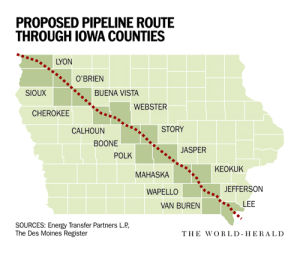
Bakken-Pipeline-Proposed-RouteBlog for Iowa caught up with Ed Fallon in Iowa City at a March 11 fundraiser for his Iowa Pipeline Walk along the proposed route of the Dakota Access oil pipeline from the Bakken shale formation through Iowa to Illinois.

Fallon presented a slide show of his experiences on last year’s Great March for Climate Action across the U.S., and answered questions during an event attended by about 35 supporters.

Discussions ranged over a variety of related topics. Two seemed most important: eminent domain and an environmental study of the Dakota Access pipeline.

Rep. Bobby Kaufmann (R-Wilton) is leading a bipartisan effort to restrict use of eminent domain by private companies like Dakota Access in Iowa.

“I intend to introduce legislation in the Government Oversight Committee,” Kaufmann said in an email to constituents. “My committee is funnel proof and next week I will introduce an Eminent Domain Omnibus bill that will attempt to address the numerous eminent domain abuses going on throughout the state.”

When asked about the legislation, Fallon acknowledged the several bills filed regarding eminent domain had not yet been finalized into one.

“My biggest hope is it defines public use so clearly that you can’t come in and build a pipeline across Iowa and use eminent domain to build that,” Fallon said. “Because it’s not oil that’s being used here, it’s not being produced here, it’s being refined in Texas and shipped for the most part overseas.”

A bipartisan group of legislators sent a letter to the Iowa Utilities Board asking the regulatory body commission an environmental impact study of the proposed Dakota Access oil pipeline.

According to the Cedar Rapids Gazette, the letter raised eight concerns:

1. Safety risks and hazards associated with the product(s) to be transported through the pipeline;

2. Potential damage to water, land, soil, water, air and wildlife/wildlife habitat during construction;

3. Threats to the environment, farmland, wildlife and public health as a result of spills or explosions;

4. Spill prevention and clean up provisions;

5. Liability for damages to both public and private property and sufficiency of resources to cover such liability;

6. Adequacy of inspection/monitoring/enforcement mechanisms and resources;

7. Responsibility for planning, training, and equipping for emergency response;

8. Indirect impacts of the oil extraction process facilitated by the pipeline that may affect public health and safety as well as environmental security.

“If studying the environmental impact is something we do before we decide to move forward on this, then that has value,” Fallon said. “But if it’s something we do after the fact, after the damage is done, after the decision is made, then it’s kind of a moot point.”

During the question and answer session, Jack Knight of the Allamakee County Protectors indicated that delaying the IUB approval process through an environmental study was a valuable tactic in preventing the oil pipeline from being built.

Opponents of the Dakota Access oil pipeline have a bigger issue and Fallon touched upon that during our interview.

“Based on what the entire scientific community is telling us, that oil needs to remain in the ground,” he said. “Really this conversation about the pipeline is a sidebar, but a really important one.”

For more information about Fallon’s work, Blog for Iowa recommends, “Hitting the Pavement,” in the March 16 issue of the Newton Daily News, or follow him on FallonForum.com.

~ Written for Blog for Iowa

Categories
Environment Living in Society

Train Wrecks and an Ag Summit

Galena Train Derailment

As punctuation to my article Why Bakken Oil is Dirty, last Thursday’s BNSF oil train derailment in a remote area near Galena, Ill. tells the story better than I could.

It is the third Bakken oil train derailment in the last three weeks according to National Public Radio.

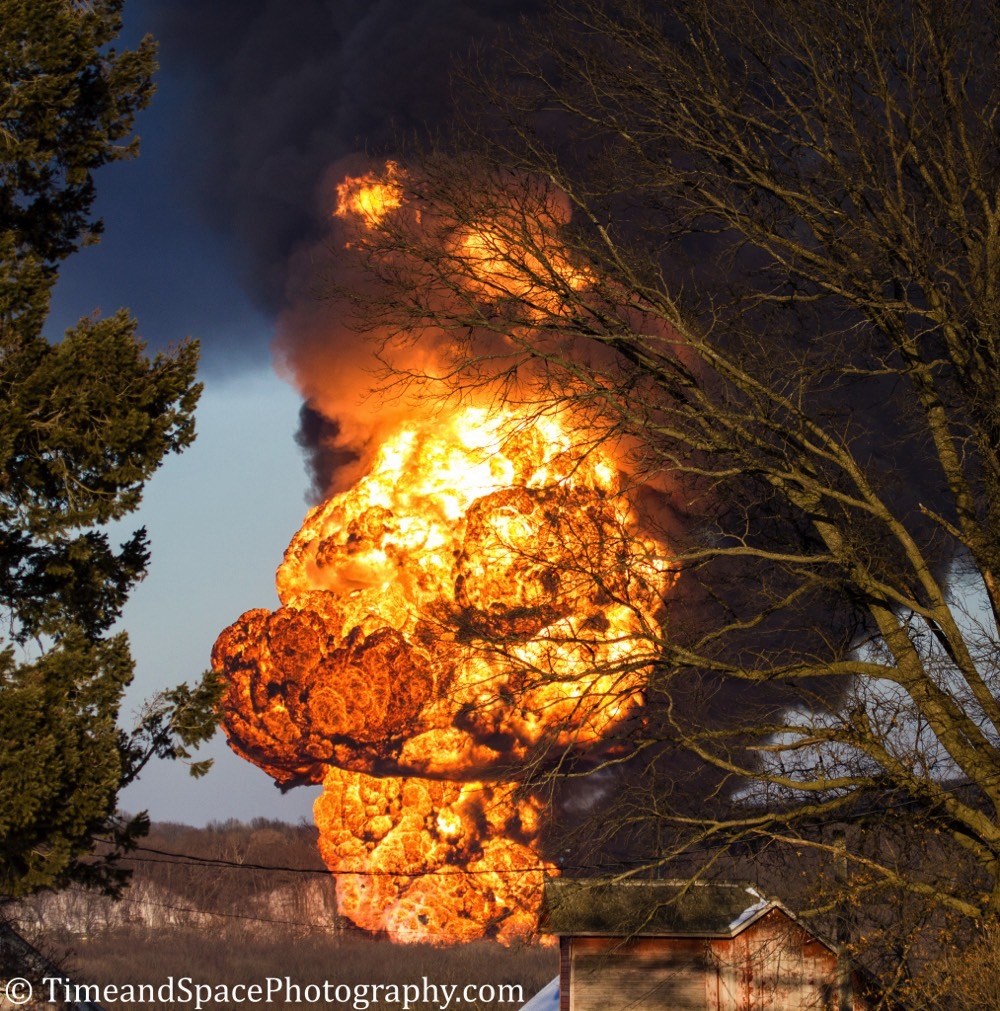
Carrying light sweet crude to market from the Bakken field, the train derailed on tracks inaccessible to first responders, rupturing at least five tank cars of 21 that left the tracks, igniting a pyre that could be seen for miles. No one was injured and officials are investigating the causes. Because of the location, accessible only via a bicycle path, fire fighters decided to let the fire burn itself out. Remediation of the oil spill will be difficult because of the location, but no oil has made its way to the Mississippi River yet. As I write, the fire is still burning.

BNSF was quick to report the rail cars were a newer, safer model voluntarily designed to be less prone to rupture. Critics say it’s not good enough. Being a level headed Iowan, I’m willing to wait until the investigation is complete before condemning anyone but ourselves and our addiction to fossil fuels.

“In the coming days, we need to look at not just the safety of the rail cars, but the safety of what is being put into those cars,” U.S. Senator Dick Durbin told NPR. “There is mounting evidence that stricter standards are needed in the handling of Bakken crude which appears to be particularly volatile. We can’t wait. The safety of our communities depends on it.”

News coverage of the accident revealed that the State of North Dakota will require oil producers to remove excess natural gas from the crude oil before shipping it by rail to help reduce volatility, according to NPR. What exactly that means, and whether it will make a difference is uncertain. It confirms what I said in my last article about the volatile nature of the Bakken crude oil being shipped, and the role the refining process plays in its volatility.

Photo Credit: Quad City Times

While the Galena fire burned, Bruce Rastetter’s Des Moines Ag Summit proceeded on schedule, serving up Republican nostrums the way cattle in a CAFO are fed. All twittering eyes were on the summit, leaving a void among Democrats. Democrats don’t have anything similar to this, so it was a great way for Republicans to build party support. Disagreement and agreement with looney ideas is part of Republican party-building, and they are getting better at it with each election cycle.

Iowa Citizens for Community Improvement, who demonstrated at the Ag Summit and held their own event, are neither Democrats nor lefties, despite repeated corporate media attempts to characterize them that way. In my experience, they are issue-oriented individuals who band together to make points about life in Iowa, using visible, direct action tactics in their advocacy. The reason they receive media characterization at all is Democrats cede the space to Republicans on these presidential candidate cattle calls. There is nothing else for political reporters and bloggers to cover.

Rastetter contributed over $60,000 to the Branstad-Reynolds re-election, and $1.49 million to various candidates over the last 16 years according to FollowtheMoney.org. Who is the Democratic equivalent? Maybe Fred Hubbell, who gave $60,000 to the Hatch-Vernon campaign.

Hubbell may be well known to political insiders but most Democrats only know vaguely that he is an attorney, if they even know that. He would be no useful substitute to the hated, loved, and very public Rastetter.

Democrats had the Harkin Steak Fry as a comparable event, although last year’s was to have been the last. Maybe it will return, but that’s up to Harkin, not us.

For the first time in a long while, I didn’t hear that our county party was having an off-year caucus last week until after it had begun. I arrived home from work just as it was finishing. If a couple of people hadn’t been covering it on twitter, it would have passed unseen. That’s a train wreck of a different kind.

As we hope for spring, society begins to make more sense. For now, winter’s cold remains, and there’s plenty to keep us busy as we sustain our lives on the Iowa prairie.

Categories
Environment

Are Property Rights a Climate Action Tool?

WHY-WHY-NOT-MELBOURNE2-4_0For many, protecting property rights is high on the list of priorities. It’s the American way, shouldn’t it be so? A related and perhaps better question is whether climate advocates should use eminent domain as a tool to advocate against energy related projects.

Answers are elusive.

When the U.S. Supreme Court decided in Kelo v. City of New London that the general benefits a community enjoyed from economic growth qualified private redevelopment plans as a permissible public use under the Takings Clause of the Fifth Amendment, property rights advocates were up in arms. There is a role for eminent domain when governments initiate the process, but private developers should have no such rights, they said.

Kelo may mean that when U.S. infrastructure projects are developed by foreign corporations (TransCanada Corporation’s Keystone XL Pipeline) or by U.S. corporations (Energy Transfer Partner’s Dakota Access Pipeline or Clean Line Energy Partners’ Rock Island Clean Line), foreign or private domestic entities have the right to initiate condemnation process and take easements and other property to build their projects.

In a March 2 article in the Des Moines Register, William Petroski reported, “a majority of Iowans support plans for a crude oil pipeline in Iowa and a wind electricity transmission line project, but they overwhelmingly oppose the use of eminent domain for both projects.”

Politicians have argued that these projects create jobs, decidedly temporary ones, and in today’s economy people should accept such jobs, implying they should also cede eminent domain rights to U.S. or foreign corporations. This couldn’t have been clearer than the Keystone XL Pipeline bill passed in the U.S. Congress, vetoed by President Obama.

Kelo is not without emerging challenges.

On Feb. 18, the Iowa Supreme Court heard oral arguments in Clarke County Reservoir Commission v. Edwin D. and Deloris A. Robins Revocable Trust. The case is an appeal of an April 8, 2014 lower court decision wherein “Judge Sherman W. Phipps of the Fifth Judicial District of Iowa ruled in favor of CCRC’s ongoing Squaw Creek Watershed project, confirming it is for a public use, public purpose or public improvement as defined in the Iowa Code,” according to Amy Hansen of the Osceola Sentinel-Tribune. Developers seek to make a recreational lake much larger than the size required to serve water needs for the community to enhance property values as they sell adjacent lots.

Whatever the outcome of challenges to the Kelo decision, climate advocates are damned if they do and damned if they don’t regarding use of eminent domain as a tool. The contrast between the Rock Island Clean Line and the Dakota Access Pipeline exemplifies the problem.

On Aug. 20, 2014 while on the Great March for Climate Action, David Osterberg of the Iowa Policy Project said Iowa needed a way to get wind-generated electricity out of western Iowa to markets. His view is not unique among climate action advocates. The Rock Island Clean Line offers one such solution, but some property owners along the proposed route won’t allow an easement voluntarily. Osterberg said the Rock Island Clean Line wasn’t perfect, but it did offer a solution to shipping electricity to markets. The implication is that eminent domain may have to be used by a Texas company to build the project, although Osterberg did not say that specifically.

Use of eminent domain to stop the Dakota Access Pipeline is favored by climate action advocates. Because Bakken Oil is dirty, advocates seek to obstruct access to market through Iowa. Eminent domain has made unlikely partners in the Iowa legislature, where Senator Rob Hogg, who has given more than 100 presentations for The Climate Reality Project founded by Al Gore and is author of America’s Climate Century, began partnering with Rep. Bobby Kaufmann, a crop and livestock farmer and small business operator who is also a member of the Farm Bureau and National Rifle Association, to oppose the Keystone XL Pipeline on eminent domain grounds.

As the Iowa Utilities Board evaluates the proposal for the Dakota Access pipeline, eminent domain has more traction than the argument that fossil fuels should be left in the ground because of their contribution to anthropogenic climate change. Climate action advocates favor the latter argument, but will support the former.

Property rights advocates like Kaufmann are unlikely to go both ways on the eminent domain issue.

“The Bakken (Dakota Access) Pipeline and the Rock Island Clean Line should pick out baby names and choose a honeymoon destination, because the two issues just got married,” said Kaufmann in a Jan. 31 interview with the Solon Economist. “You’ve got two different companies that want to ship two versions of energy. They’re both private Texas companies and both want to ship a product out of our state without allowing anyone in our state to tap into it.”

Use of eminent domain hinges upon “public use.” Set aside creation of a number of temporary jobs and the public use of conveyances for energy related products is elusive, especially with the Dakota Access Pipeline. In any case, corporations benefit more than people in both Iowa projects and with the Keystone XL Pipeline.

Property rights can be a tool for climate action advocates, but it has been an imperfect one at best.

Categories
Environment

Why Bakken Oil is Dirty

Bakken-Pipeline-Proposed-RoutePeople who care about hydraulic fracturing say the oil coming from the Bakken formation in North Dakota, Montana and Saskatchewan is dirty. It is. All oil is dirty, and my two cents is we should leave what’s there in the ground. That won’t go over well in North Dakota where discovery of the Parshall Oil Field in 2006 created an oil boom.

What makes Bakken crude oil problematic is that it contains more volatile organic compounds (VOCs) than oil shipped from wells in other regions of the country. This makes the oil more flammable, so when there is a train derailment, as there was in Lac-Mégantic, Quebec in 2013, the oil easily ignites and creates hell on Earth. (Read Adam Federman’s article in Earth Island Journal here).

Because so little public study has been conducted on Bakken crude oil and the operations that produce it, scientists don’t fully understand why the oil is so flammable. There are suspected causes.

The Bakken formation shale oil boom developed from almost nothing to more than a million barrels of crude oil daily in a short period of time. According to Federman, the infrastructure doesn’t exist in the Bakken to fraction off the VOCs as is done with other oil production facilities. The oil is shipped with the VOCs in it, making Bakken crude oil more flammable. There’s more Bakken crude oil today, it poses a real threat to public safety, and the transportation modes used are not regulated well enough for the commodity’s characteristics.

One of the frequent concerns in the Bakken is there are not enough suitable rail cars available to meet shipping needs. Lack of transportation capacity to get the oil to market is an issue. This created a business opportunity, and that’s what the Dakota Access pipeline is about.

Debate over trucks vs. rail vs. pipeline to transport Bakken crude oil is wasted time. Each mode of transportation has its own issues, and most transportation experts agree pipeline is the safest of the modes of transportation. Regardless of transportation mode, if there is a spill, first responders will be required to deal with a commodity on which they have in most cases received inadequate training. That problem could conceivably be fixed, but awareness of the issue hasn’t adequately emerged as we wait for the Iowa Utilities Board’s public healing on the Dakota Access oil pipeline.

Combine the increased flammability of Bakken crude oil with lack of proper shipping regulations and capacity, and we know why it is called dirty oil.

Categories
Environment

Hegemony of Bad Ideas

Sunset
Sunset in Colorado

LAKE MACBRIDE— Leadership on what matters most for our future will come from outside the United States. It’s not that Americans are bad people— for the most part, we aren’t. However, many of us have mistaken the advancement of bad ideas as the right ideas, and there is a difference.

The most recent example was last week’s vote on an amendment to the National Defense Authorization Act (NDAA). The NDAA is one of the few pieces of legislation that still works through the legislative process the way most of them did back when Congress did more legislative work. Rep. David McKinley (R-WV) offered an amendment which would “prevent the White House from sending funds to the U.S. Global Change Research Program National Climate Assessment, the Intergovernmental Panel on Climate Change’s Fifth Assessment Report, the United Nation’s Agenda 21 sustainable development plan, or the May 2013 Technical Update of the Social Cost of Carbon for Regulatory Impact Analysis Under Executive Order 12866.” McKinley questions the validity of climate science research generally, but, according to his website, also argued that reducing the use of coal wasn’t worth the harm it would do to the economy. The amendment passed the House, and is expected to advance to the Senate.

I understand coal country better than most mid-westerners. My family tree has long roots in Appalachia, predating the discovery of coal in Boone County, West Virginia by John Peter Salley in 1742. My career in transportation and logistics took me to Boone County and I learned about its dependence on coal. When the Coal Valley News announced our truck driving school, it was front page news, next to a story about United Mine Worker layoffs in the county seat.

Meeting with businesses, the governor’s office, the school board, local residents and others, I got to know the issues around coal. People didn’t like the mine owners and operators, but were dependent upon them. If life has changed from company-owned coal camps for most, coal camps still exist along with poverty and an extreme dependence on coal to extract a life. The question, “what are we supposed to do without coal?” resonates there if answers don’t.

There is no greater good in McKinley’s legislative work, and there is little point in arguing with climate deniers like him. The preponderance of evidence is that climate change is real, it is happening now, and its effects are causing harm. As the business community wakes up, we are increasingly able to place a dollar figure on the social and economic costs of global warming and related climate change. Economics will drive action to mitigate the causes of climate change, as making a profit remains paramount for businesses. Like it or not, West Virginia, part of mitigation of global warming means drastic reductions in the amount of coal used across the globe.

At the same time, bad ideas like McKinley’s have enough support to advance, making the U.S. Congress less relevant in addressing the most important issue of our time. That’s why I say leadership on climate change, as well as on nuclear abolition and other threats to life as we know it, will come from outside our country. For whatever reason, too many Americans embrace bad ideas to sustain the political will for positive change.

What I don’t get about West Virginia and coal country is that while there is a church in almost every neighborhood, another argument should resonate equally with self-serving economic interests, but doesn’t.

If God is the author of creation and wants humans to do anything, high on the list would be to care for creation. We have not upheld that responsibility even though it transcends politics. Instead, people like McKinley look to mammon for their inspiration, forsaking all of us in the process.

Belief in God is not the same usage as belief in climate change, because the efficacy of the harm done to humans by climate change will out regardless of what people believe or don’t believe. Like many concerned citizens I feel we must wake up to the threat to human health posed by climate change before it’s too late. If the U.S. won’t lead, then others will, because taking action won’t wait for U.S. politicians to get on board with the obvious.

Categories
Environment

Letter to the Editor

Self Portrait in ShadowTo the editor,

It is ironic that Gary Wattnem, a career ophthalmic instrument salesman, can’t see clearly enough to support Senator Rob Hogg and Representative Bobby Kaufmann in their opposition to the Keystone XL pipeline, based on eminent domain concerns. In his recent letter to the editor, Wattnem signed as a U.S. Army officer, reminding us that old soldiers never die, but in his case, should consider taking Douglas MacArthur’s example and just fade away.

Under the Obama administration, there has been a resurgence of domestic oil production. “For the first time in nearly two decades, we produce more oil here in the United States than we buy from the rest of the world,” said President Obama on Jan. 16.

According to former oil man T. Boone Pickens on a recent episode of Iowa Press, the U.S. exports three million barrels of light sweet crude each day because of development in the Bakken and Eagle Ford formations, and West Texas. If refineries would retool to process light sweet, said Pickens, the oil could be used domestically. If foreign oil were a national security issue, that’s what we’d do.

Keystone is about getting tar sands oil to the global market, not about U.S. national security. Condemning U.S. property to serve the interests of a Calgary, Alberta based company would be plain wrong.

By throwing his uniform around the issue, Wattnem tarnished the rest of us who served.

Categories
Environment

Common Ground on Keystone XL

State Capitol
State Capitol

Joint Statement by Senator Rob Hogg and Representative Bobby Kaufmann on Keystone XL Pipeline:

BIPARTISAN OPPOSITION TO KEYSTONE PIPELINE IN IOWA BECAUSE OF EXPECTED USE OF EMINENT DOMAIN

DES MOINES– Two Iowa state legislators– Senator Rob Hogg (D-Cedar Rapids) and Representative Bobby Kaufmann (R-Wilton)– joined today to call on Congress to oppose the proposed Keystone XL pipeline because of the expected use of eminent domain in the development of the project.

“I urge you to stand with those land-owners who do not want this pipeline running through their property,” wrote Rep. Kaufmann in a letter to Congressman Dave Loebsack of Iowa’s Second Congressional District.  “The interests in oil profits should not supersede the rights of property owners.”

“It is not in America’s national interests to allow a foreign oil company to condemn American farms and ranches to take foreign oil to the Gulf Coast for sale on the global market,” wrote Sen. Hogg in a letter to Congressman Bruce Braley of Iowa’s First Congressional District.  “The Keystone pipeline threatens America’s land, water, and wildlife – Congress should say no, the State Department should say no, and President Obama should say no.”

Senator Hogg and Representative Kaufmann’s letters were also submitted to the U.S. State Department in advance of the March 7 deadline for public comments on the Environmental Impact Statement on the proposal.  The public can submit comments at the following web address:  http://www.keystonepipeline-xl.state.gov/

Download PDF of Senator Hogg’s letter to Rep. Bruce Braley here.

Download PDF of Rep. Kaufmann’s letter to Rep. Dave Loebsack here.

Categories
Environment

Closure on the Garden Season

Iowa Row Crops
Iowa Row Crops

LAKE MACBRIDE— Taking down the fences and mowing the garden plots brought a sense of closure to this year’s growing season. It’s over, and it was time. The remaining fall task is to plant garlic, and while it is late for that calendar-wise, if the warmth continues, the roots may get a couple of week’s growth before frigid temperatures set in and produce normally. With the variability in our weather, all bets are off about predictability. Why not plant garlic? The worst that could happen is it fails to grow, and we have plenty for winter eating.

Yesterday, the U.S. Environmental Protection Agency (EPA) announced a proposal to reduce the renewable fuel standard for ethanol. This is a first, and within hours, Iowa governor Branstad reacted negatively toward the idea (statement here). The New York Times posted a valuable article on the issue here. The EPA’s proposed 2014 renewable fuel standard program is here. The Wikipedia article on ethanol is here. While widely expected, the EPA announcement kicks off what is expected to be resounding resistance here in corn country.

The world has changed since ethanol was first blended with gasoline, and it is appropriate to re-evaluate the percentage mixed with motor fuels. Following is my take on the matter from a Big Grove perspective.

It is hard to argue with governor Branstad’s statement, “the EPA has turned its back on rural America, and our economy and family farms will suffer as a result. Corn prices have already dropped to the cost of production, and this will likely further squeeze corn producers and negatively impact income growth in rural America. We have more than 50 ethanol and biodiesel plants in Iowa, and these EPA reductions would negatively impact thousands of Iowa jobs.” All of this is true, but what the governor didn’t say is that if anything, Iowa farmers are resilient. Re-directing growing patterns to deal with the over-abundance of corn is possible and should be done.

People seem to forget that the gasoline gallon equivalency of ethanol is 1.5:1. This means it takes one and a half gallons of ethanol to create the energy of one gallon of gasoline. The reason ethanol blended motor fuel costs less at the gasoline pump has little to do with the energy it produces, and everything to do with the current structure of federal government subsidies. Ethanol is not cheap by this standard, or by any reckoning.

This week, U.S. crude oil production exceeded imports for the first time in more than 20 years (USA Today story here). To the extent ethanol use increased in response to domestic oil production declines, that trend appears to have been reversed, precipitating a need to re-evaluate the renewable fuel standards. The bad news is the increase in domestic crude production is due to the environmentally questionable process of hydraulic fracturing. In any case, as a society, we should reduce the amount of fuel we burn to supply energy, so this is a red herring argument. We should divest ourselves of fossil fuels.

Ethanol has provided a market for corn growers, comprising as much as 40 percent of sales. Some argue corn for ethanol has less market share when the value of distillers grain and other by products are considered, but in any case, a lot of the corn crop goes to ethanol production. This market is at the core of governor Branstad’s argument against revising the fuel standards. The thing is, either Republicans want society to suck at the pap of big government, or they don’t. This is the core hypocrisy of a group that seeks favorable treatment on only those issues that effect their segment of society. The EPA rules, once finalized may impact corn markets, and in the end, the markets will set an appropriate price. Farmers, like everyone else, will have to deal with it.

Finally, there is a criticism that the corn crop should be going to food, not fuels. In a self-serving way, industrial farmers tout their ability to feed the world. Freeing up some of the corn crop to serve a growing global population should be a suitable market, right? Have you ever bitten into a kernel of No. 2 field corn? Without processing it’s hardly food for humans. The overall trend for food production will be to produce it locally and sustainably, something that sending vessels full of Iowa grain to Asia and Africa does not accomplish. While a short term market for grain exports may exist, in the end, large scale buyers, will produce the same crops much closer to home.

Anyone who has studied the matter can’t believe corn ethanol production is good for the environment. The EPA is on the right track, and the public comment period enables people who are impacted by the proposed rules to have their say. Not sure what ore we want from our democracy.

Categories
Sustainability

Iowa’s Campaign to Stop New Nuclear Power

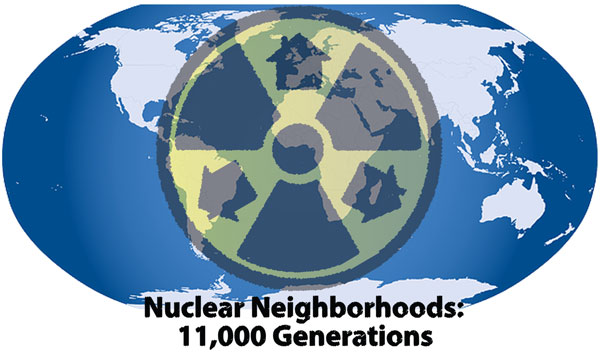
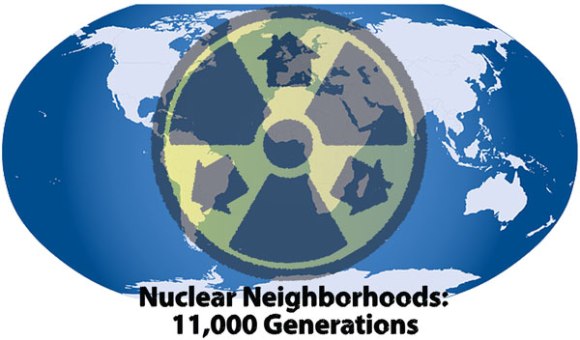
Nuclear NeighborhoodsPrepared remarks delivered by Paul Deaton at the Iowa City Public Library on the 68th Anniversary of Hiroshima, Aug. 6, 2013.

Thank you Maureen McCue for the kind introduction. I want to recognize some of our colleagues in this work who are in the audience tonight.

Well we held back new nuclear power in Iowa. Isn’t that great?

In February 2010, I wrote the first of a long series of posts on Blog for Iowa about what I believed to be the legislature’s infatuation with nuclear power during the last four sessions of the Iowa General Assembly. I wrote, “I heard the words ‘zero sum gain’ applied to MidAmerican Energy’s process toward change for the first time. It seems to fit. A zero sum gain is a situation in which a participant’s gain or loss is exactly balanced by the losses or gains of the other participant(s). If the state wants to move forward with nuclear power, it’s okay with MidAmerican Energy, but they are a business, so the customers will have to pay.”

The customers will have to pay. That pretty much sums it up. What’s missing is no one knew how much a new nuclear power plant would cost, then, or now. For this and other reasons, the people of Iowa decided there were better ways to generate electricity.

During this presentation I want to talk about what the nuclear power discussion was, and what it meant.

At the beginning, the legislation seemed on a stealth track toward passage without opposition. Physicians for Social Responsibility joined with an extensive and diverse coalition who found common ground in opposing nuclear power in Iowa. By the end of our work, according to public polling, a vast majority of Iowans opposed new nuclear power and some legislators who had supported House File 2399, the nuclear power study bill, and House File 561, the nuclear power financial bill, had changed their minds.

What I want to cover in my remaining time is three things: the campaign to stop the nuclear power study, the campaign to stop the nuclear power finance bill, and then some general remarks.

Before beginning, I want to set the framework in which the nuclear power discussions occurred.

The electric utilities in Iowa are looking at a 50-year horizon that compares where we are now with regard to electricity generation, to where we will be. Electricity generation is currently a mix of nuclear, coal, natural gas, wind and hydroelectric. The nuclear and coal plants are making their exit at the end of their life cycle, so the question is what is next?

After defeating two of three proposed coal fired power plants in the state, combined with our recent success in holding back nuclear, we seem bound to keep hydro the same, generate more wind and solar electricity, use no new nuclear or coal plants if we can manage it, with natural gas as the flexibility in the system to meet so-called baseload electricity needs.

Demand growth for electricity is slowing to less than one percent per year, so the primary issue is capital investment to replace depreciated generating capacity. Pretty tedious stuff for the environmentalists among us, but where Warren Buffett and others like him invest their billions is a real issue for us, with real world impacts on the environment.

When we talk about these big picture solutions, however, the missing piece of the puzzle is distributed generation. That is, how individual homes and businesses might produce their own electricity on-site, and sell excess capacity back into the electrical grid.

As prices come down for wind and solar, distributed generation becomes more viable, and could tilt what the regulated utilities do. The thing is, how long can we wait to take CO2 emissions out of the mix? The inconvenient truth is that we can’t wait.

Another thing to note is that while burning natural gas produces about half the CO2 emissions compared to burning coal, the gain for the environment is mitigated by methane leakage along the pathway from extracting the gas to delivery at the power plant where it is burned. Like with any energy source, burning natural gas should be considered in the context of its entire lifecycle. In that context, its greenhouse gas emissions are not much better than coal, if not worse, depending upon the amount of methane leakage.

From the preamble of House File 2399:

“It is the intent of the general assembly to require certain rate regulated public utilities to undertake analyses of and preparations for the possible construction of nuclear generating facilities in this state that would be beneficial in a carbon constrained environment.” There is a lot to unpack there, and the bill had additional aspects I have eliminated to save time. Suffice it to say House File 2399 passed both chambers of the legislature, and on April 28, 2010, Governor Chet Culver held a signing ceremony for what he called the “Nuclear Energy Jobs Creation Bill.” In a letter that is available on Blog for Iowa, Culver wrote, “this bill gives Iowa utilities and consumers more tools to make decisions on our energy future. The study will give us a clear idea of what the future for nuclear and alternative energies may hold in Iowa.” On June 4, 2013, MidAmerican Energy announced the study was complete, and they would be refunding a portion of the $14.2 million dollars collected for the study from rate payers, beginning this month. There was no mention of the words wind, solar or alternative energy in the 50 page final report from MidAmerican Energy to the Iowa Utilities Board. Governor Culver was wrong about the study’s purpose, as he was about many things.

Now let me talk about House File 561, the nuclear power finance bill.

On Monday, March 28, 2011, Wally Taylor, counsel to the Iowa Chapter of the Sierra Club presented an analysis of the Contruction Work in Progress or CWIP bill that eventually became House File 561. Iowa’s version of CWIP was much worse than those passed in other states in that its main purpose was to codify specific costs that rate payers would pay, up front, should the electric utility decide to apply for and construct a nuclear power plant. It included every cost the industry could envision. Among them, it defined “prudent costs” for the Iowa Utilities Board (IUB), when what would have actually been prudent was leaving costs to the board members discretion, rather than being directed by the legislature. It instructed the IUB on calculation of allowed debt and return on equity, something that should also have been left to the discretion of the IUB after performing due diligence on a proposed project. The bill also exempted nuclear power from the requirement, applicable to all other electric generation plants, that the utility has considered other sources for long-term electric supply and that the proposed plant is reasonable when compared to other feasible alternative sources of supply. There were other considerations, and in the end the legislation, if passed, would be biased to favor nuclear power over other methods of electricity generation.

By the close of session, House File 561 failed to gain traction in the Iowa Senate, as most familiar with our campaign are aware.

In closing, let me say something about new nuclear power. In its current state, no privately held company in the United States would take on the risks of nuclear power without significant government and rate payer subsidies. Period. If they would, the Nuclear Regulatory Commission is open for business, and accepting applications.

When we talk about subsidies, first, there is the risk of disasters as happened in Chernobyl and Fukushima. To encourage nuclear power, the U.S. Government created the Price Anderson Act which puts a ceiling on the losses that would be paid by a nuclear power plant owner in the case of a similar disaster. You and I would pick up the excess costs through our taxes.

Second, the Department of Energy owns and is responsible for nuclear fuel throughout its life cycle. While nuclear power utilities charge a small fee per kilowatt hour to help pay for disposal of their nuclear waste, every power plant’s disposal costs are underfunded. This underfunding is complicated by storage that could last for multiple millennia.

Any executive of a public utility, as a matter of personal competence, would want to know how much building a new power plant would cost. In the case of nuclear power, no engineer has a sharp enough pencil today to accurately predict the costs. When MidAmerican Energy CEO Bill Fehrman was asked how much a new nuclear power plant would cost during the last three and a half years, he constantly dodged the question, perhaps because he simply did not know. House File 561 got people like Mr. Fehrman off the hook, by transferring those financial unknowns to rate payers.

When nuclear power came into being in the wake of the Atomic age, whose birth we commemorate today on Hiroshima Day, it was scaled big. In retrospect, if used, nuclear power should have been modeled on the technology of nuclear submarines.

It seems likely the engineering challenges of small modular reactors (SMR) could be met and resolved, as could the issue of nuclear waste disposal. We are not even close to resolving either of those issues.

As MidAmerican Energy wrote in their report, “SMR licensing and SMR pricing could influence the decision to deploy nuclear generation in Iowa,” confirming my point― the technology is not ready for a proposal to the NRC.

We haven’t heard the last about nuclear power. But unlike the time prior to the fight to stop these bills, to stop nuclear power in Iowa, advocates are now ready to take up the fight anew if called upon.

Thank you for your time and attention. We’ll have a question and answer period at the end.

I’ll turn the discussion over to Dr. John Rachow who will speak to the issue of radioactive nuclear fuel. Thanks again.
Categories
Reviews

America’s Climate Century by Rob Hogg

America's Climate CenturyIn America’s Climate Century, Iowa State Senator Rob Hogg asserts, “climate change is the defining historical issue of the 21st century.” If it is, one wouldn’t know it from listening to people, and that seems the point of the book: to educate citizens of the potential negative effects of human-caused global warming, to persuade about the immediacy of the problem, and to outline ways for citizens to engage in solutions.

As Hogg points out, there is broad consensus in the scientific community that the planet is warming and the cause is related to human activity. As a member of the Iowa Senate, Rob Hogg is one of a very small number of the 150 members in both chambers willing to work on addressing climate change. This book is a plea for like minded citizens to join him. We should.

The book is written by an Iowan to encourage advocacy and this perspective informs the narrative. If you live in Iowa and are concerned about the consequences of climate change, you should consider reading America’s Climate Century. It is a primer of key issues, with step-by step suggestions on how to advocate for political change that will address them.

America’s Climate Century was a quick and engaging read, with personal anecdotes and bullet pointed to-do lists. Whether one knows a lot or a little about greenhouse gas emissions and their consequences in the form of global warming and more frequent and intense weather events, the book was informative and easy to understand.

I found value in reading the book and recommend it to others whether you live in Iowa or elsewhere.