Former Secretary of State Mike Pompeo appeared at the Machine Shed Restaurant in Urbandale Friday morning, kicking off the 2024 Iowa Republican presidential nominating contest. He didn’t stop to speak to the press.
Republicans said they would hold a 2024 precinct caucus as usual regardless of whether Democrats do. A majority of Iowa Republicans favor Trump 2024 according to recent polls.
For his part, Joe Biden said he plans to run for a second term at his inaugural press conference last week.
Bloomberg reported U.S. cases of COVID-19 are rising again. It’s still bad in Iowa. Maybe it’s due to events like Urbandale where people gathered in public without social distancing or masks. The crowd looked pretty old and mostly male. Maybe they are all vaccinated, he laughed. News photos depicted what appears to be an aggregation of various daily coffee gatherings that occur around the state among retired and mostly male locals. Seeing Pompeo was something different to do, I suppose.
These days I have limited interest in politics. We are living in a time of Republican dominance in Iowa and I have no interest in watching the horror show. Yet I’m drawn to it… political stories in newspapers and on Twitter. One supposes I have an addiction. I don’t seem motivated enough to beat the addiction…yet. Likely, I’m in denial.
Part of my addiction is isolation resulting from the continuing coronavirus pandemic. In isolation, every human contact takes on increased importance. In normal times, it was easier to select which issues to work on and which to leave to others. Pandemic-caused isolation makes ridding myself of the addiction more complicated.
I intend to continue to vote, and will likely donate a few dollars to good candidates when I can. Anymore, political engagement is mostly determining whether a candidate is a Democrat. Advocacy has been co-opted by national players and the federal judiciary is in process of re-making the assumptions upon which my advocacy was once predicated.
Like anyone, I will try to help my local candidates. I can’t go cold turkey from politics. At the same time, I expect to get better focused on a handful of issues I deem most important. Readers of this blog know it’s the environment and its biggest threats: a warming plant, nuclear war and armed conflict.
There are many factors, physical, mental, emotional, and biological that make quitting politics difficult. It’s the rural Virginian in me that keeps me engaged. A low level dosage won’t cure me yet like the COVD-19 vaccine, it may inoculate me from the distractions that are possible. I should lean on my Polish ancestors who just came here, went to church, and made a life.
In any case, I’m addicted to politics and can’t let it dominate my life.
Last week we located our scars from the polio vaccine. It was fun as we reminisced and discussed a friend who got polio as a child. It was important for everyone who could to be vaccinated against polio.
Today it’s important everyone who can get the COVID-19 vaccine.
My perspective is from serving six years on the county board of health. Vaccines can and do prevent illness, of that there is scientific evidence.
Why get the vaccine? First, it reduces the likelihood of contracting COVID-19 which causes sickness and sometimes death. That’s motivation enough for most. Being vaccinated also decreases the amount of time we must live with social restrictions because of the coronavirus pandemic. Everyone I know is tired of the restrictions now in their second year.
Some people pooh, pooh the vaccine and the pandemic and while illogical, that’s their choice. At the same time, we would all like to get out of the pandemic and return to a semblance of normal. People who don’t or won’t get vaccinated are holding the rest of us up.
Eventually the population will reach what’s called “herd immunity.” Medical experts are not sure if a person gets COVID-19 once they will be immune because people have contracted COVID-19 multiple times. As you may have read, the vaccines currently approved by the FDA are very effective.
We’re retired so we can wait out herd immunity as evidenced by a drastic reduction in the COVID-19 case count. People want to get on with a more normal life, though. So we did the neighborly thing and got vaccinated. I encourage readers to do likewise if they can.
~ Submitted as a letter to the editor of the Solon Economist
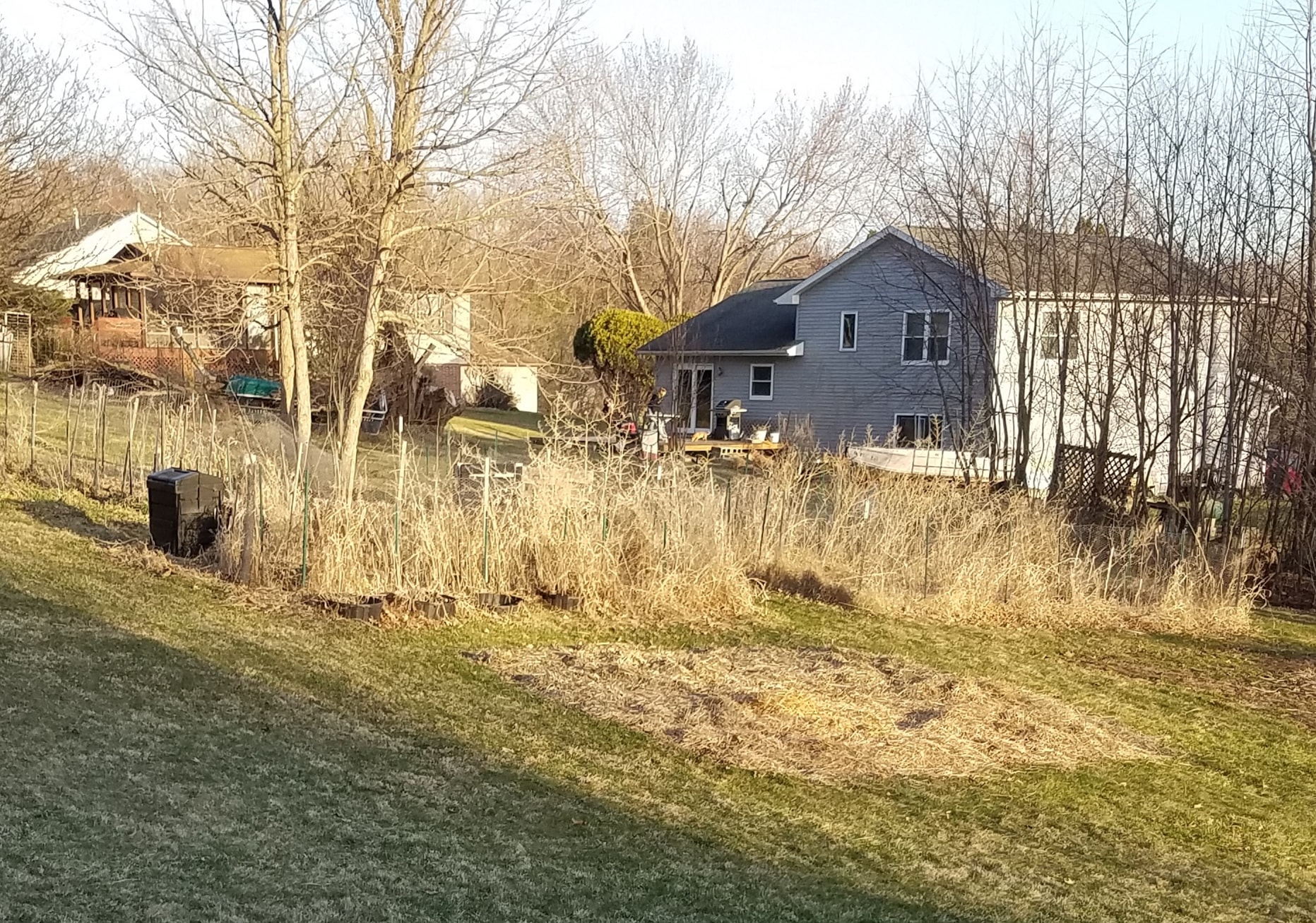
Saturday was a punk day because of Friday’s COVID-19 vaccine booster shot. I felt tired most of the day, took a long nap, and curtailed outdoor activities even though skies were clear and temperatures moderate. I took this photograph of the garden as the sun set. It’s a starting point for the gardening season.
Garlic is poking through the straw and everything else needs clearing. The forecast today is a high of 65 degrees, so if I feel better, I’ll be out in the garden. I need to be out in the garden.
We have three head of fresh garlic left from last year. After using it, there is a pint of pickled garlic, and a jar of commercial chopped garlic to use. If we can’t make it to scapes, I’ll buy some elsewhere to see us through.
The pandemic had us cooking more at home, resulting in flats of empty Mason jars stacking up. Maybe ten dozen have been emptied since harvest. We are almost out of prepared vegetable broth, so I plan to make seven quarts from the freezer to tide us over until turnip greens are ready.
It’s not just me. A lot of us want the coronavirus pandemic to be over. There are some positive signs. At the Friday vaccination clinic one of the people administering shots said there were less than half a dozen coronavirus hospitalizations at the University of Iowa Hospitals and Clinics. No one there was on a ventilator. Outbreaks have been reduced to close to zero at Iowa nursing homes. The media narrative changed rapidly when supplies of vaccine boosted by the Biden administration’s efforts began to arrive. The pandemic is not over, yet as we see the number of cases and deaths decline, there is hope.
Gardening continued during the pandemic. It has been a source of normalcy. As the new season begins, I’m ready to see what adventures arrive in our patch of Big Grove Township. It’s been a long, isolated winter that on this first day of Spring appears over.
The schools and most of the neighborhood are on spring break so I’m taking one as well. I’m not sure when I’ll return to posting, and to be honest, I’m not concerned about that now.
I’m worn down by the coronavirus pandemic and need to give writing a rest. Friday we get our second dose of the Pfizer COVID-19 vaccine. By April the antibodies should have formed and I’ll be ready to go again.
As always, thanks for following and reading Journey Home. May this post find you well and strong.
As part of a new Saturday tradition, I made a pot of vegetable soup.
Mine is a variation of Krupnik, which is a thick Polish soup made from vegetable broth, containing potatoes and barley (kasza jęczmienna, archaically called krupy — hence the name). I modified the traditional recipe, eliminating meat, mushrooms and dairy, and adding dried lentils for protein. I also used up items in the freezer — shredded zucchini, leeks and green beans. It’s a thick, hearty soup that goes well with a slice of bread. It makes an easy dinner that can simmer on the stove all day, with leftovers. While Mother and Grandmother didn’t make the soup, they would likely recognize mine if they were still living.
On Friday we have an appointment to get the second of two doses of the Pfizer COVID-19 vaccine. It’s a necessary step along the way toward returning to a semblance of normal. It will take 10-14 days after the second shot for our bodies to build immunity. After that, we’ll follow CDC guidelines to begin to engage in society again. It’s been a long road.
There is not much unique about this information. It reflects a shared experience not only in the small community where we live, but by fall, for most Americans. President Biden indicated last week vaccines will be available for all who want it. We’re hoping enough people get vaccinated to abate the pandemic this summer.
With our only child living many miles away, our Sundays are usually just the two of us. There are phone calls and occasional video conferences, yet the isolation is palpable. I’m not sure that will change once the coronavirus pandemic is over. We developed new habits and a new way of living that folds into the isolation. It is good preparation for aging.
I’m glad to be finished with dangerous work. My days of working in steel mills, packing houses, and manufacturing plants are behind me. I didn’t realize the risk of infections that came with retail work until retiring. I haven’t been sick since leaving the home, farm and auto supply store. Likewise I haven’t flown on an aircraft in a long while. Last week, I bought gasoline for one of the automobiles for the first time since December. The reduction in work and travel-related risk is positive. Yet I yearn to be with people.
When the coronavirus recedes I plan to seek some form of work. Because of our pensions and relative good health we are okay without it. I want to interact with people, in person. For now I’ll tend my garden and conserve resources… and make Polish soup on Saturdays.
A year ago yesterday the World Health Organization declared the coronavirus a global pandemic. It has been a weird year.
March is full of anniversaries: March 7, the governor activated the state emergency operations center for COVID-19; March 8, the state hygienic laboratory reported the first three Iowa cases of COVID-19; March 9, the governor signed the first Proclamation of Disaster Emergency Regarding COVID-19; March 24 was the first Iowa death attributed to COVID-19; and March 29, the president extended the federal stay-at-home order until April 30. That’s in addition to the historic anniversaries like the beginning of spring, our daughter’s birthday, and recurring tasks of the month to begin planting for the garden, return to farm work, and sweep sand from the road in front of our house to use next winter.
The good news is our families and the families of friends well-survived the pandemic, thus far. Now that production and distribution of the COVID-19 vaccine has ramped up, there is a chance for every adult in the U.S. to be vaccinated by the end of May. That would make Memorial Day something worth celebrating.
How has my life changed during the last 12 months? There are some obvious ways. I left work I had been doing for others. My last day at the home, farm and auto supply store was April 2, 2020, then I did not return to the orchard in autumn or to the farm in late winter this year. I haven’t eaten at a restaurant — either dine-in or take out — since my friend Dan and I had lunch at Los Agaves restaurant on March 13, 2020 — no bars or coffee shops either. I started checking the air pressure on the auto tires because we went weeks without using one or the other. I moved all the neighborhood meetings to telephone conference calls and participated in any other groups to which I belong via video conference ( I am not a fan of Skype and Zoom meetings). I perfected a recipe for home made pizza and read 66 books. I began riding my bicycle. One of the few things that didn’t change was work in the garden, although it benefited by my being at home more.
There were less obvious changes:
Using up the pantry and freezer.
Reduction in food variety.
Wearing holes in my socks.
Laundry once a month.
Taking naps.
In beginning my autobiography, I wrote a lot of words. The value of the project has been considering where I came from and who I have become, with an eye toward the future. It is a fit undertaking for quarantined times.
The emotion I feel after a year of restricted activities is of longing. I’d like to get back to in-person society and social events. We are heading that direction with the Biden-Harris administration. It can’t come soon enough.
I don’t know if a celebration is in order. These anniversaries are more like the terrorist bombing of Sept. 11, 2001. We don’t like them but feel obligated to mention them. And so, it goes, in Big Grove Township.
We received a final tax document last week — an explanation of the coronavirus relief check sent on the last day of 2020. There is about a month to file taxes on time in the United States. I do ours and help our daughter with hers. It’s time to get to work on them.
The only time I had a problem with filed tax returns was when the accountant applied a tax credit incorrectly. We had to pay it back with a penalty. The following year, I decided to complete our returns myself. It was a good decision.
In other times I would post the YouTube video of the Beatles song Taxman from Revolver. The album was released Aug. 5, 1966, the summer before I started high school, in my second year of learning to play the guitar. I remember winning a copy of Revolver at a Freshman dance that year. I’m not sure it is an accurate memory. It was when I met my friend Joe, who would attend Georgetown after high school and then become a physician.
I had not worked a job that produced a W-2 form in 1966, and wouldn’t until 1968 when I earned $934 in taxable income working as a stock boy at the Turn-Style Department Store.
In the 21st Century gig economy I’m not sure how people contribute to Social Security and Medicare without employer deductions and taxes. The reason we are able to survive on our Social Security pensions is we contributed for most of our working lives and the benefit is based in part on how much one earned:
Social Security benefits are based on your lifetime earnings. Your actual earnings are adjusted or “indexed” to account for changes in average wages since the year the earnings were received. Then Social Security calculates your average indexed monthly earnings during the 35 years in which you earned the most. We apply a formula to these earnings and arrive at your basic benefit, or “primary insurance amount” (PIA). This is how much you would receive at your full retirement age—65 or older, depending on your date of birth.
Your Retirement Benefit: How It Is Figured, Social Security Administration, 2013.
In a gig economy the margins are often quite thin for gig workers. The idea of paying Social Security and Medicare taxes gets sanded off in the woodshed of economic survival. The government program worked for us and will — at least until 2034 when the trust fund is projected to begin losing value unless the Congress fixes it. However, it doesn’t work for individuals unless they pay in at a predictable pace. I haven’t read a study of the impact of the gig economy on Social Security and Medicare, but would.
In 1966 I wanted to learn: to play the guitar, do well in my studies, and get along with my cohort. The future was open ocean and my boat had been christened by grade school nuns as college bound. I can’t recall thinking about taxes during that time, not even once.
To participate in high school one required some cash. There were expenses, although not many. I had to give up my newspaper route after eighth grade, so I paid for dances, books, guitar strings, bus fares, and school activities with my savings and allowance. I was privileged to be able to live in Northwest Davenport where Father held a union job, I had access to funds, and the neighborhood was safe. Those were the best times, full of hope and opportunity. I thought to myself, maybe I could record an album like Revolver some day.
Whatever the combination of privilege, economic security, social stability, and a peaceful home created, I benefited from it. I continue to benefit. My life hasn’t turned out as expected, yet in 1966 my expectations had not been completely formed. I stay out of trouble today, in part because I realize I must pay income taxes. It is a baseline for participation in American society and I’m in.
The specificity of the garden project is comforting. There is a clear beginning and end. The work product will be useful. It is eminently do-able in a single work shift. I crave more of that over the complicated and grand-scale projects lingering on my to-do list. I yearn for resolution of the vagaries of living in the coronavirus pandemic.
When the Aug. 10, 2020 derecho shook loose buckets of sand anchoring the portable greenhouse to the bricked pad, its time had come. The wind lifted the greenhouse straight up in the air and tumbled it into the next door neighbor’s yard, destroying it.
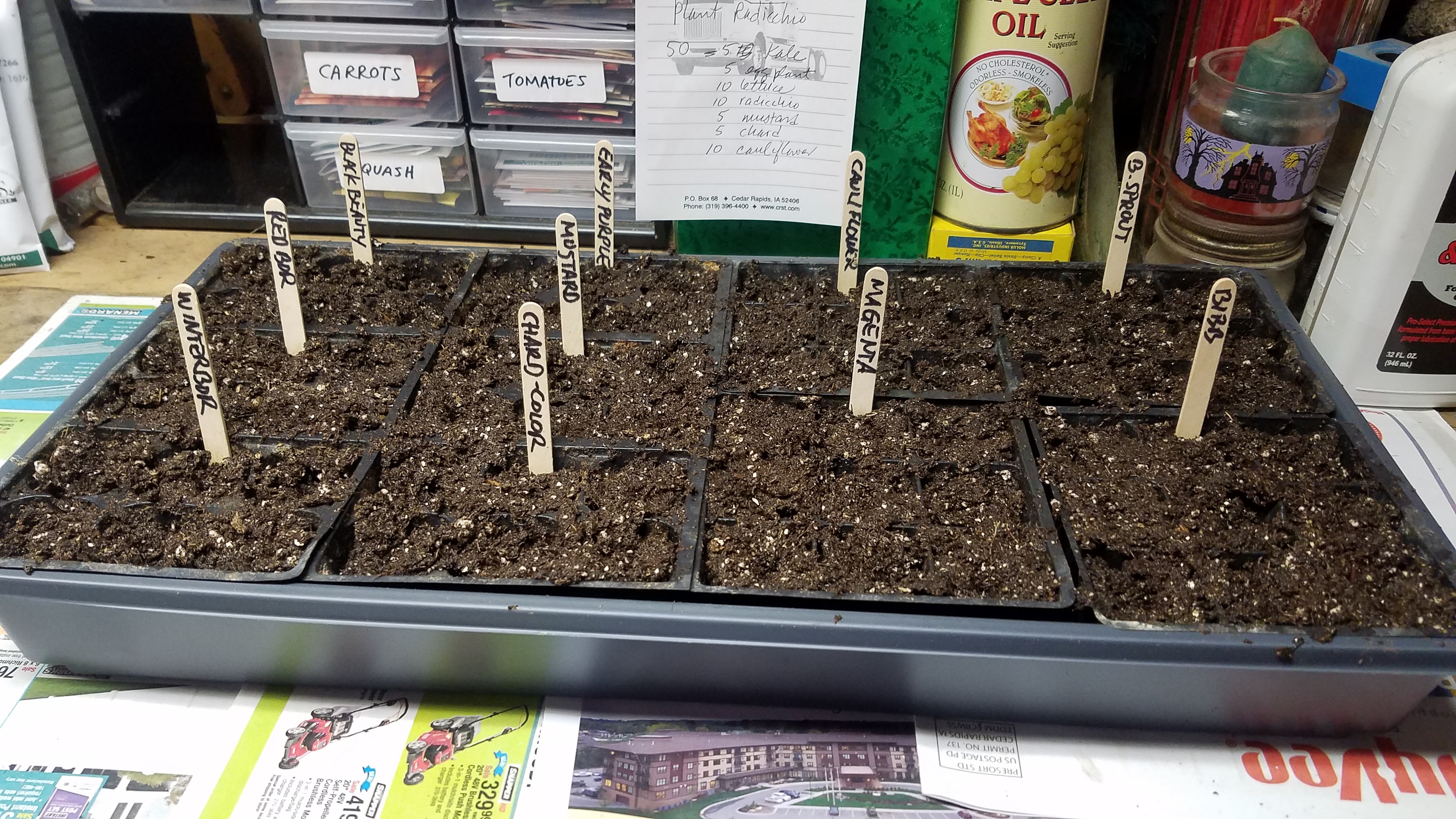
I bought a replacement as I’ve come to rely on having my own greenhouse to start seeds and store garden seedlings.
Snow cover melted enough to shovel the rest of the pad and install the new greenhouse. The road in front of our house is dry so I can sweep road sand into buckets to hold this one down. It will be the first outdoors project other than snow removal this year.
The coronavirus pandemic created vagaries that plague us in daily life. The governor’s most recent proclamation found me in the “vulnerable Iowan” category because I’m over 65 years of age. She encourages me to continue to limit my activities outside home, and encourages others to stay away from me. Fine. I’ve done that by provisioning in town every other week. Provisioning trips were the only time I left the property since the proclamation was released Feb. 5. Everything else we need, which isn’t much, we get delivered to home. This part is easy.
We are scheduled for a booster of the Pfizer COVID-19 vaccine on March 19. The pharmacy sent a confirmation email yesterday. What happens after that is unclear. Epidemiologists say we are waiting until presence of the coronavirus in the community is limited. Not sure what that means. There is no reasonable indication of what social behavior in the post-pandemic world looks like. I’m thinking of getting rid of the personal-sized pizza pans I use for entertaining. Should I?
I look forward to sweeping up the road sand and clearing the space for the portable greenhouse. It’s something to latch onto and call finished in a day. Yet I yearn for more, for resolution of the uncertainty of our current lives. It’s not existential angst. It’s simple things like how many gallons of skim milk should I buy at the warehouse club. If things were normal, the number would be one.
I need the greenhouse space soon andplan to work on the project as winter snow melts in Iowa. After that, I’ll pick another, then another, until a sense of normalcy returns.
The thaw began and there is no stopping it. The ground remained covered with snow for most of February, yet no more. Snow cover is slowly melting and will soon be gone. Above the septic tank was first to go.
36 hours after the COVID-19 vaccination I still feel normal. Even the soreness around the injection spot feels better. I emailed the farm to see if we can make arrangements for my return after the booster shot in a couple of weeks. The farmers are all twenty and thirty somethings so their priority group has not been approved for vaccination yet. There are protocols to negotiate before making my way back to farm work.
I applied to be a mentor in the Climate Reality Leadership Corps U.S. Virtual Training beginning on Earth Day. There are three virtual trainings this year, one in the U.S., one for Latin America, and one global training. To find out more, follow this link. If I’m accepted, this would be my third time attending, the second as a mentor. I’m feeling bullish about reengaging in society after getting the first dose of vaccine.
Democrats got solidly beaten in the 2020 Iowa general election. I’m not sure what I want to do to help rebuild the party. I’m also not sure the party can be rebuilt in a way to win elections anytime soon. In any case, it’s time for the next generation to take the reins. While I will remain supportive, I’m stepping back. Politics won’t be a priority as we slowly exit the coronavirus pandemic.
Getting out of the pandemic is a first priority. We are doing our part to follow the governor’s guidelines and hope others will too. What’s certain is I’m getting spring fever and can’t wait to get outside and do normal things again. It’s only three weeks until Spring!
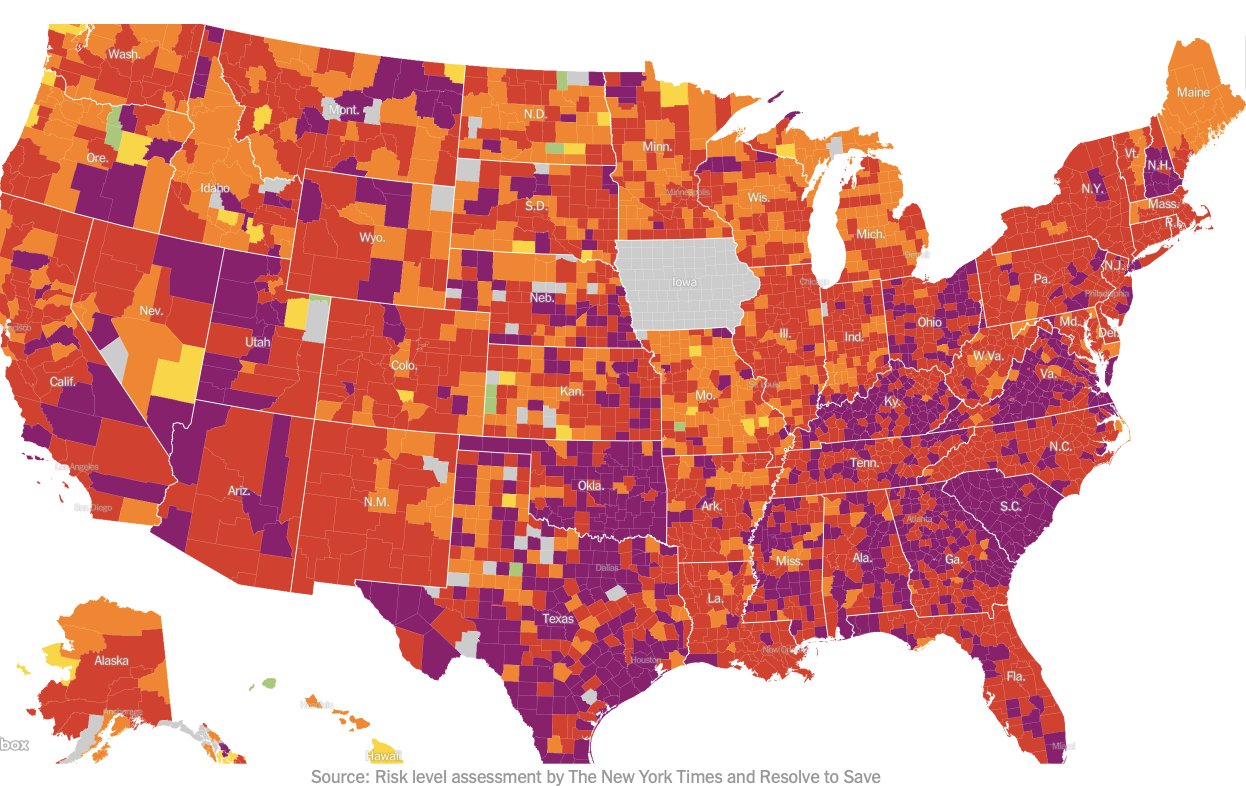
New York Times COVID-19 Tracking Map Feb. 26, 2021. Iowa ceased reporting by-county statistics last week.
The science of inoculation for infectious disease has long roots. “Inoculation against smallpox is believed to have been practiced in China as far back as 1000 BC, and is reported to have been common in India, Africa, and Turkey prior to its introduction into western societies in the 18th century,” Matthew Niederhuber wrote while at Harvard University.
There continues to be debate in he United States about inoculation and its cousin vaccination. That is, if by debate one means people jabbering at each other without knowing what the heck they are talking about.
I got the first of two doses of the Pfizer COVID-19 vaccine the first opportunity I had at 2:15 Central Time on Feb. 26, 2021. I was chair of the county board of health. What would you expect me to do but get it? A vast majority of people should get vaccinated if they have the chance, close to 100% of the population. It is up to government to make sure they have the chance. Whether enough will is an open question.
The program that brought a vaccination clinic to our community — with dozens of volunteers and a sophisticated level of logistical organization and expertise — was part of the Biden-Harris administration’s effort to speed up vaccination by distributing the vaccine through commercial pharmacies. The time line is short and simple. On Feb. 2 — 13 days after inauguration — the White House announced the First Phase of the Federal Retail Pharmacy Program for COVID-19 Vaccination. Three days later, on Feb 5, I received the first of several organizing phone calls to create a mass clinic, a partnership between the local pharmacy, the Solon Senior Advocates and a community church. Yesterday and today is the clinic for which all appointments are taken. The action was swift and effective. It was the result of a president who knows what he is doing in a public health emergency.
The State of Iowa is not that well organized. A Republican lawmaker asserted this week at the State House the pandemic was over. The Iowa Department of Public Health ceased reporting a by-county breakdown of key statistics related to the pandemic. Republicans literally pretend the state is ready to get back to normal even if the coronavirus doesn’t care about that. Surviving a pandemic is one of the reasons we need a strong federal government: states like ours can’t get needed things done.
Our city’s only pharmacy coordinated arrival of the vaccine and the event. They hoped to vaccinate 500 people using Iowa Department of Public Health criteria, including people like me who are more than 65 years old. The clinic is a 65+ only event organized by groups that work with senior citizens constantly.
If we are lucky, and that’s a big if, things will resemble normal again come the end of year holidays or in the first half of 2022. That is a conservative estimate based on input from the scientific community that works with infectious disease.
Let me go back to the first paragraph about the introduction of inoculation to prevent infectious disease in Western societies.
On a November day in 1721, a small bomb was hurled through the window of a local Boston Reverend named Cotton Mather. Attached to the explosive, which fortunately did not detonate, was the message: “Cotton Mather, you dog, dam you! I’ll inoculate you with this; with a pox to you.’’ This was not a religiously motivated act of terrorism, but a violent response to Reverend Mather’s active promotion of smallpox inoculation. The smallpox epidemic that struck Boston in 1721 was one of the most deadly of the century in colonial America, but was also the catalyst for the first major application of preventative inoculation in the colonies. The use of inoculation laid the foundation for the modern techniques of infectious diseases prevention, and the contentious public debate that accompanied the introduction of this poorly understood medical technology has surprising similarities to contemporary misunderstandings over vaccination.
This was the same Cotton Mather involved with the 1692 witchcraft episode in Salem Village. Mather and his father, Increase Mather, are often blamed for a fanning the flames of public hysteria and delusion born of ignorance and superstition of the time regarding witchcraft. Not so fast, wrote historian Stow Persons in American Minds. Witchcraft is more complicated than that. So it is with inoculation and vaccination. Cotton Mather’s redeeming grace, even to the most skeptical modern readers, was related to introduction of inoculation to prevent smallpox. Here’s what you might not know.
Cotton Mather is largely credited with introducing inoculation to the colonies and doing a great deal to promote the use of this method as standard for smallpox prevention during the 1721 epidemic. Mather is believed to have first learned about inoculation from his West African slave Onesimus, writing, “he told me that he had undergone the operation which had given something of the smallpox and would forever preserve him from it, adding that was often used in West Africa.’’
During Black History Week I’m highlighting the source of the idea of inoculation and vaccination in Cotton Mather’s African slave. The lessons to take from this weekend’s clinic in Solon are cultures other than American made significant contributions to the science of infectious disease, the federal government must be involved in mitigating a pandemic like the coronavirus, and sticking one’s head in the sand of ignorance won’t get us back to normal in a post pandemic society.
We must act positively in our communities and in conjunction with scientific experts. If such experts are not available at the state level, then we do what we can ourselves, including local coordination of federal programs.





 Journey Home
You must be logged in to post a comment.