Categories
Living in Society Reviews

Book Review: Give Us the Ballot

Berman

The word “progressive” got bandied about more this year than it has in a while.

Who is a progressive? Who is a “real” progressive? Who will continue a progressive legacy after the 2016 election?

Hillary Clinton and Bernie Sanders debated what it means to be a progressive at the beginning of the 2016 Democratic presidential nominating process, with both claiming progressive bona fides.

Here’s what I say. You are not a progressive unless you have read Give Us the Ballot: The Modern Struggle for Voting Rights in America by Iowa’s own Ari Berman.

In this extensively researched, easy to read text, Berman reminds many of us of the reason we became politically active: as a way of engaging in progress toward racial and social justice centered around the Voting Rights Act (VRA) signed into law by President Lyndon B. Johnson on Aug. 6, 1965.

There has been a concerted, well-planned effort to suppress provisions of the VRA. The June 25, 2013 decision by the Supreme Court of the United States to overturn Section 4, which required certain states to get pre-clearance of changes to voting laws from the Department of Justice, was only the most obvious, recent incident. Berman’s account of the Nixon and Reagan administrations provides insight that de-fanging the law was part of Republican intent from the beginning. My reaction was incredulity at everything that was happening before my eyes without me understanding it.

Berman interviewed Rep. John Lewis extensively for the book (along with many others) and it shows. Lewis wrote in the Washington Post,

“(Give Us The Ballot) should become a primer for every American, but especially for congressional lawmakers and staffers, because it so capably describes the intricate interplay between grass-roots activism and the halls of Congress . . . Congress must fix the Voting Rights Act, and Berman’s book explains why, without passion or favoritism. It is the first history of the contemporary voting rights movement in the United States. It is long overdue, but Berman’s extensive reporting makes it well worth the wait.”

It’s hard to disagree.

Be a progressive. Read Give Us the Ballot this summer.

~ Written for The Prairie Progressive
Categories
Environment Reviews

Book Review – A Sugar Creek Chronicle

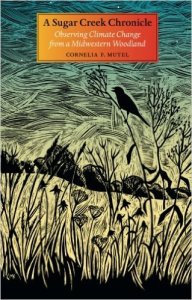
A Sugar Creek ChronicleIn A Sugar Creek Chronicle: Observing Climate Change from a Midwestern Woodland Connie Mutel produced an engaging narrative of her efforts to cope with change while living on a parcel of Oak – Hickory forest in Northern Johnson County, Iowa.

The narrative is about climate change as the title suggests. It is also rich with descriptions of the flora and fauna of the region and how her life as a Midwestern ecologist, wife, mother, and cancer survivor has changed and is changing because of our warming planet.

It was hard to put the book down once I started reading.

The narrative is a combination of autobiography, new journalism, scientific research and advocacy for the political will to take action to mitigate the causes of anthropogenic global warming and its impact on our climate before it’s too late.

What makes the book important is less the scientific discussions about climate change, and more how Mutel copes with a life she believed held stability and predictability as key components. In telling her story Mutel articulates a personal perspective of current scientific research about climate change in a way that should provide easy to grab handles on a complex topic.

The idea that carbon dioxide causes global warming is not new. Around 1850, physicist John Tyndall discovered that carbon dioxide traps heat in our atmosphere, producing the greenhouse effect, which enables all of creation as we know it to live on Earth. That story has been told time and again.

The benefit of reading Mutel’s observations is one finds a lot in common with her life, on many levels. Her inquiry into global warming and climate change provides us a window not only to her world, but to ours.

~ Posted on Amazon.com.

Categories
Environment Reviews

Reading Naomi Klein

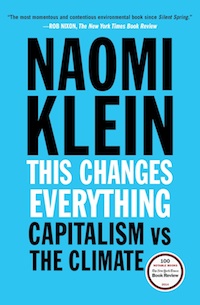
This Changes EverythingUnlike the climate crisis story spoon fed to us in decreasing numbers of corporate media stories, in social media memes, and in fleeting conversations at community gatherings, in This Changes Everything: Capitalism vs The Climate, author Naomi Klein said there is a nascent, global movement preparing to take climate action.

“The climate movement has yet to find its full moral voice on the world stage,” Klein wrote. “But it is most certainly clearing its throat—beginning to put the very real thefts and torments that ineluctably flow from the decision to mock international climate commitments alongside history’s most damned crimes.”

If you haven’t read Klein’s 2014 book, you should. Not because of a desire to take sides in the public discussion of global warming and the need to keep global temperature increase to two degrees or less. But because a). reading a paper book can be good for us, and b). with Klein you can hear her broader story and learn new things. Here’s more on why you should pick up a copy at your library or bookstore if you haven’t already.

In Iowa, as home to the first in the nation caucuses, we are inundated with stories about politics. Elections matter, and we have seen how in the Republican awakening after Barack Obama’s 2008 election. Progressives hardly understood that Republicans, though in the minority in the Congress, would exercise such power that much of Obama’s agenda was sidelined from the beginning. Republican comebacks in 2010 and 2014 have turned the congress from Democratic to Republican, and right-wing hardliners have more input to the legislative process than their numbers warrant. Taking climate action in Congress has, for the most part, been a non-starter.

“It’s not just the people we vote into office and then complain about—it’s us,” Klein wrote. “For most of us living in post-industrial societies, when we see the crackling black-and-white footage of general strikes in the 1930s, victory gardens in the 1940s, and Freedom Rides in the 1960s, we simply cannot imagine being part of any mobilization of that depth and scale.”

“Where would we organize?” Klein asked. “Who would we trust enough to lead us? Who, moreover, is ‘we?'”

Klein’s book frames answers to those questions: People are organizing everywhere, resisting unbridled extraction of natural resources by corporations. “We” includes almost everyone.

This Changes Everything reviews the recent history of the climate movement. It covers extreme extraction of natural resources that leave behind waste heaps, fouled water and polluted air, then are burned and produce atmospheric gases that warm the planet. Everyone from fossil fuel companies to environmental groups have been involved in what Klein calls “extractivism.” There is a growing resistance, including environmental groups divesting from investments in the fossil fuel industry, indigenous people mounting court battles, and community groups violating international trade agreements to move to renewable energy sources. The book is a snapshot of where the climate movement currently stands.

While Klein has her point of view, she depicts the complexity of a global network of fossil fuel companies seeking to extract hydrocarbons scientists tells us must be left in the ground. While the resistance may not have found its full moral voice, Klein’s book makes the case it won’t be long and recounts the significant inroads indigenous people and communities near extraction sites are making.

When we talk about taking climate action, Naomi Klein’s work should be part of our conversation.

~ Written for Blog for Iowa

Categories
Reviews

Book Review – The Home Place

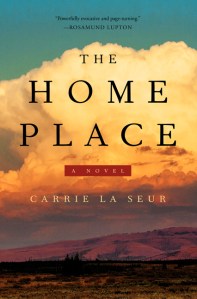
The Home Place by Carrie La Seur
The Home Place by Carrie La Seur Photo credit: Harper Collins

Why do we read fiction? To find books like The Home Place by Carrie La Seur.

For most of us the exigencies of an engaged life leave us drained of energy, with diminished capacity to cope with complexities. Working multiple part time jobs, facing economic realities and people problems far scarier than any fiction, each day can leave us worn and used— more than we thought was possible. A good novel can be both welcome respite and escape from all of that, which is what I found in The Home Place.

I don’t know La Seur hardly at all.

We worked briefly together, along with many others, on an advocacy campaign to stop three coal fired power plants from being built in Iowa. We stopped two out of three.

I offered to volunteer for her Plains Justice, but the person who interviewed me never called back.

My experiences of Montana are quite different from those depicted in the book. If fiction is to be successful, it must be true to the author’s own experience rather than worrying much about others. The book seems deep in that.

What matters more is La Seur did not get the memo from authors like Tom Wolfe, Norman Mailer, Joan Didion, Hunter S. Thompson, Truman Capote and others that there was a new journalism that blended fiction and non-fiction. I’m glad she didn’t, or if she did, that she rejected the notion to present a novel more traditionally.

For what we need is twofold— an escape from the quotidian struggle for existence in a turbulent world, and ability to reach catharsis. The Home Place provided both.

The book seems well written and engaging. La Seur’s personality resonates throughout the pages, and she seems an active participant in the narrative. Whether that is good or bad is for others to consider. For me, I needed a break, and The Home Place provided that.

Categories
Home Life

Friday in Iowa: Summer Reading

Photo Credit: Haunted Bookshop

The phrase “summer reading” evokes when we took off from school, and had leisure time between Memorial Day and Labor Day. For some it still involves barbecuing, boating, swimming, vacations and a host of activities tied to youth. Today, people continue to summer, but briefly and in competition with the constant clamor of the exigencies of modern life. People are busy trying to survive and get ahead, all the time, and there is less time for reading. Here are a few of my picks for reading during summer 2014.

Books

The classic novel of summer is The Great Gatsby by F. Scott Fitzgerald, and I recommend a second look.

My summer fiction reading will include The Home Place by Carrie La Seur. La Seur is the founder of Plains Justice and a practicing attorney in Billings, Montana, where she has family roots. The Home Place is La Seur’s first novel, due to be released July 29. A section of the book, can be found in New Voices in Fiction Sampler: Summer Selection, which can be downloaded free for Kindle here.

On the wonky side, check out Capital in the Twenty-First Century by Thomas Piketty, translated by Arthur Goldhammer. Piketty writes that the main driver of inequality is return on capital exceeding the rate of economic growth. Check out a section from the introduction here. Also a bit wonky, but very readable is Eric Schlosser’s Command and Control: Nuclear Weapons, the Damascus Incident, and the Illusion of Safety.

If you have not read Maya Angelou’s I Know Why the Caged Bird Sings, it is worth the time, even though it was published in 1969. “The first in a seven-volume series, it is a coming-of-age story that illustrates how strength of character and a love of literature can help overcome racism and trauma,” according to Wikipedia.

Poetry

Pick one poem, any one, and read it… aloud. Then read another. Go to the public library and find the poetry section. Spend an hour browsing through whatever comes into view. Readers will develop their own interests, but in my to-read pile are The Oldest Map with the Name America by Lucia Perillo, Collected Poems by Vachel Lindsay, Miracle Fair by Wisława Szymborska-Włodek, The Spirit Level by Seamus Heaney, An Inconvenient Genocide by Alicia Ghiragossían, and Scattered Brains by Darrell Gray.

Screen Time

Turn off the television. It won’t kill you. In our house, we haven’t disconnected from cable, but we shed the premium channels, including MSNBC, long ago. We rarely turn on the T.V. and life has been better. I suppose if we cared about the World Cup, we’d watch more.

That said, we have screen time, and using it efficiently is an important endeavor, equal in importance to the time we spend in the real world, talking and listening to real people. In many respects, time in front of the screen has replaced television and print media and can provide value.

This summer, Blog for Iowa recommends you check out some new authors who post on the Internet, including current fave Art Cullen of the Storm Lake Times, and the blogs Leaf and Twig, A Buick in the Land of Lexus, and ICI & LA NATURE PICTURES: Walk and Bike in France.

Best wishes for great reading this summer. Don’t forget to bookmark Blog for Iowa and check back often.

~ Written for Blog for Iowa

Categories
Reviews

America’s Climate Century by Rob Hogg

America's Climate CenturyIn America’s Climate Century, Iowa State Senator Rob Hogg asserts, “climate change is the defining historical issue of the 21st century.” If it is, one wouldn’t know it from listening to people, and that seems the point of the book: to educate citizens of the potential negative effects of human-caused global warming, to persuade about the immediacy of the problem, and to outline ways for citizens to engage in solutions.

As Hogg points out, there is broad consensus in the scientific community that the planet is warming and the cause is related to human activity. As a member of the Iowa Senate, Rob Hogg is one of a very small number of the 150 members in both chambers willing to work on addressing climate change. This book is a plea for like minded citizens to join him. We should.

The book is written by an Iowan to encourage advocacy and this perspective informs the narrative. If you live in Iowa and are concerned about the consequences of climate change, you should consider reading America’s Climate Century. It is a primer of key issues, with step-by step suggestions on how to advocate for political change that will address them.

America’s Climate Century was a quick and engaging read, with personal anecdotes and bullet pointed to-do lists. Whether one knows a lot or a little about greenhouse gas emissions and their consequences in the form of global warming and more frequent and intense weather events, the book was informative and easy to understand.

I found value in reading the book and recommend it to others whether you live in Iowa or elsewhere.

Categories
Reviews

Reinventing You by Dorie Clark

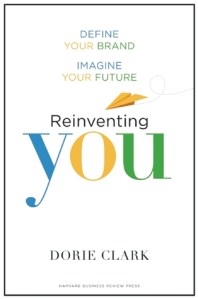
Reinventing YouReinventing You: Define Your Brand, Imagine Your Future” by Dorie Clark is worth a read for its useful nuggets of advice and for the perspective she spent years developing and refining. Many of us in the baby boom generation need to be reinventing ourselves to deal with a changing retirement picture and the related need to work long into retirement, both for our economic viability and for social enrichment. Read her book for an insightful perspective that can be useful not only to boomers.

I met Clark at a political workshop in Cedar Rapids, Iowa a few years ago, and found her personal anecdotes about fundraising to be useful and spot on. She was not afraid to tell us to do the hard work, and if one followed her advice, superior results could be attained. I felt similarly when she wrote in “Reinventing You” about the 360 interview, something that in some businesses has become a stale and mechanical process driven by professional human resource managers. She breathed new life into this long-standing process. While what Clark proposes is often hard work, based on my past experience with her advice, I would be willing to try it and hopeful for positive results after reading “Reinventing You.”

Some of what Clark writes is time-tested advice on things like highlighting our differences for competitive advantage and the role of volunteerism during transition. She adds a layer regarding social media which is important to consider. There was plenty of sound new advice in the book on topics that were already familiar.

I found the book engaging and a quick read, offering pragmatic advice as I transition into what’s next. You might too.