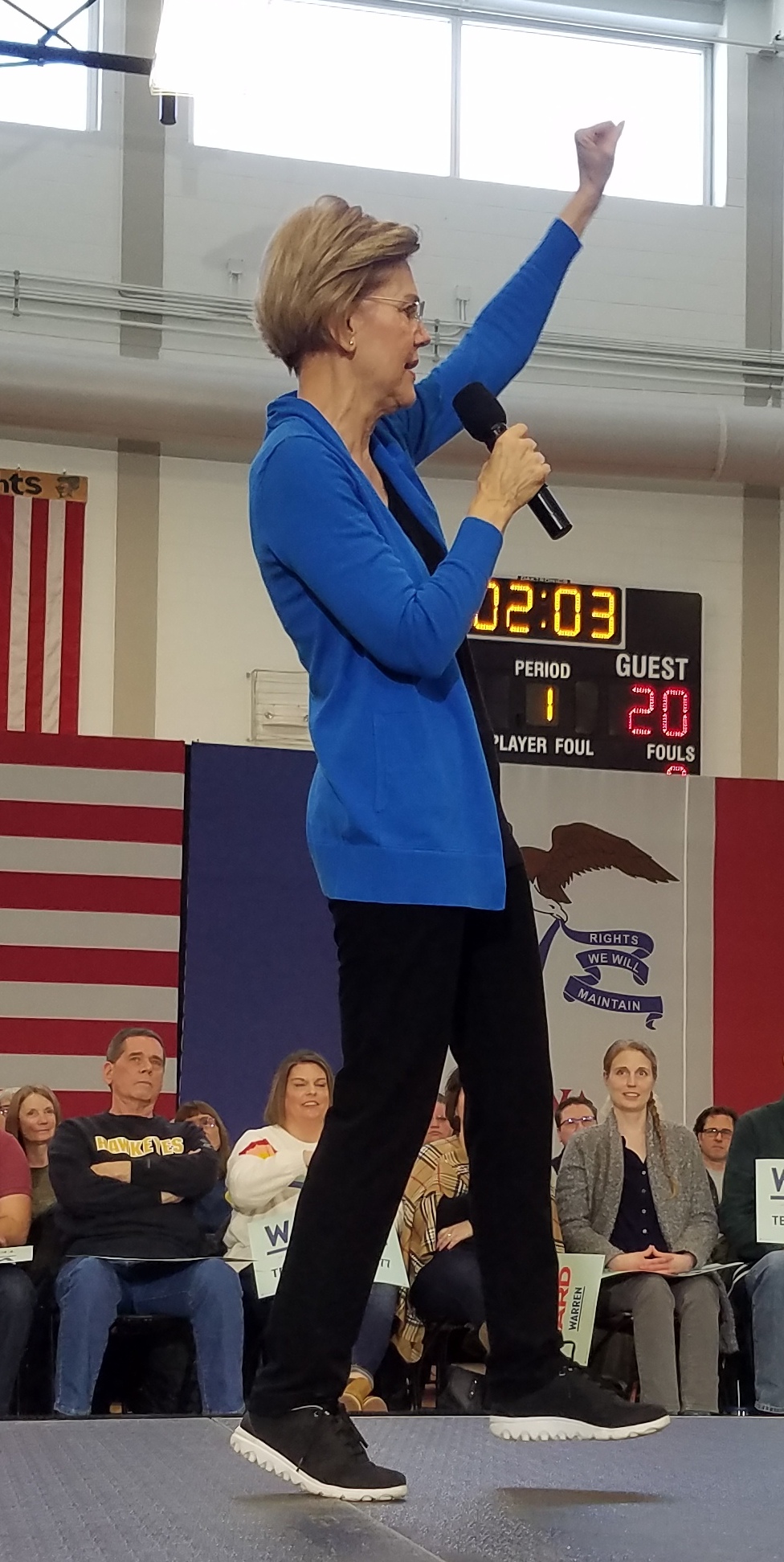
Elizabeth Warren at North Central Junior High School, North Liberty, Iowa. Dec. 21, 2019.
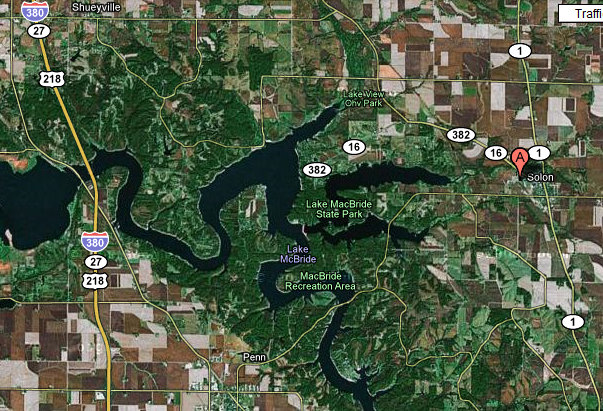
On a clear, beautiful day when ambient temperatures reached into the 50s, I drove across the lakes to North Liberty where Elizabeth Warren held a town hall meeting.
James Q. Lynch of the Cedar Rapids Gazette estimated 500 attended. There was not a lot of other action in the area to occupy us the Saturday before Christmas.
It was Warren’s first town hall meeting since the Dec. 19 Democratic candidate debate.
Warren’s campaign staff will be released for the holidays on Monday so the weekend was a busy time for them and staff of several candidates touring Iowa, notably Amy Klobuchar, Cory Booker, Pete Buttigieg, Michael Bennet and Joe Biden.
This was my fourth Warren town hall this cycle. I know the pitch well. Her presidency would focus on the long-standing issue of corruption in government. Corruption has been present since the founding, although is more visible today, blatantly so. That Warren makes addressing corruption the centerpiece of her campaign and potential presidency is most of what attracts me.
Each time I’ve heard her speak I learned something new. The first question was what to do about the media environment that contests basic truths and contributes to a lack of legislative progress. Warren pushed back on this, using her family as an example.
She has three brothers of which one is a Democrat and two are Republicans. She and her siblings debate politics yet often agree on issues, she said. She expanded that to say there is much agreement among people in society regardless of their politics. What puts the brakes on solving problems, especially big problems like the climate crisis, environmental quality, finance, and excessive student debt, is corruption by powerful and moneyed interests. She has a plan to address that. Having such plans is a hallmark of her campaign.
The recent Solon School Board election highlighted how right Warren is to push back on the media as the main problem confronting us. Our election was hardly covered by news media outside our local newspaper and me. It is easier to find common ground when our children’s education and future are at stake. I knew the political party registration of the six candidates but that played only a minor role is picking two for whom to vote. Somewhere in the wilderness between relevant local politics and the national government things get lost.
Warren talked about how a toaster oven caught fire in her kitchen when she was a young mother. Eventually regulation solved the problem by requiring an automatic shutoff switch in such small appliances. The same basic principal of problem identification, scientific investigation, and working through potential solutions until one could be found and regulated has other, more profound applications. It is a common sense approach at a time when common sense seems sorely lacking in our politics and government.
I drove home immediately after the event, retracing my route. Neighborhood families were out walking on the trail and working in their yards in the mild weather this Winter Solstice. It was great to hear Elizabeth Warren again in Iowa. I’ll miss it when the Democratic National Committee eventually removes our first in the nation status. That is not today.
Mother sent this email on Aug. 13, 2000, after a family reunion in Davenport, Iowa.
The Nadolski family reunion was held on the 12th of August, 2000 at Fejervary Park in Davenport, Iowa. The reason that park was chosen is that in the old days we often had family picnics there and when they where alive, Catherine and Frank Nadolski held court, she in her dark flowered dress with a lacy collar and he in his dark pants, white shirt and suspenders. They sat in a prominent position, where they could see everything that was going on.
Grandpa would take his cane and hook a child around the waist, or sometimes the neck, and pull them toward him so that he could ask them questions and, I presume, when you gave the right answer to his question he sometimes gave you a nickel. Of course, a nickel meant much more then than it does now.
You could get an ice cream cone for a nickel or a candy bar. Grandma sat in her place and rarely smiled and didn’t ever have a conversation with me, or any other kid that I saw. Their daughters and their daughter’s families would provide the food and take the opportunity to have a good time together.
The kids all loved it. It was a fine park with swings and slides and Indian Rock to climb on and we had the best time. The food was always the best.
Traditional Polish foods as well as plenty of potato salad, deviled eggs, hot dogs and cakes and pies and my personal favorite, bologna with mustard on white bakery bread. I don’t think any of the families where rich, certainly we weren’t, but the pleasure of the moment and the memories of those simpler times in our lives is priceless beyond all wealth. When ‘family’ was not only a bunch of people with a genetic link, but a group of people with a palpable connection. Not only that, we could see our connection right there in Fej park; she in her long dress and he with his cane. They where and are our connection. The genes that live in all of us and show up in so many faces. The driving force that impacted on the way each of us have lived our lives.
It was with those memories and the warm heart they produced that I attended the first ever family reunion that I know of. I had looked forward to this occasion for the better part of this year and I will tell you that it did not disappoint. God gave us a glorious day. It was an unusual August day for Iowa. Usually it is very hot and humid in Iowa in August, very often with temperature in the 100s and humid as a swamp, but we really lucked out, or maybe it was a little Divine influence with so many Nadolskis up there.
I went to the park early so that I could really spend the whole day there and it was a lovely setting and so peaceful in the morning. Lots of trees around and plenty of room for the kids to run around and still be seen by their parents. I stayed and visited for a while with Marge and Bob and Sue Ellen and her daughters and then I had to run home and get the rest of my stuff and when I came back to the park, the people started to arrive. This was the best part. Seeing the people come. Many familiar faces and some that I had never seen before. There where people there from the families of Aunt Tillie, my mother Mae, Aunt Pauline, Aunt Barbara, Aunt Eleanor, Aunt Johnnie, Uncle Harry, and Aunt Marie.
It was lovely to see all the cousins come. Their families with them. I don’t think I ever saw so many smiling faces. Cousins who lived far apart getting to know each other again. Sisters and brothers talking, head to head about the old times. Cousins who never knew each other finding out that they had a common bond, like my kids talking to one of their cousins whom they had never met who told them ‘I loved Aunt Mae’ and my kids and Katie’s kids finding out that they weren’t the only ones who knew or loved their remarkable grandmother. The laughing about old times and the tears when the memories became so painful. One of the most prevalent common bonds among us was that we had all lost someone who was a Nadolski. Those moments when the memory of those members of our family who have gone forever brought a lump to the throat and took us back to when they where here. Oh how those sisters and Harry would have loved being there. Can’t you just see the wide smiles and joy in their eyes. Shirley said that they where sitting in the rafters of the shelter, looking down and smiling at us and I believe she was right.
I know that like all of you, I would give anything to have 5 more minutes with my mother. I know in my heart I can’t, but it is gatherings like these that help keep her and all of them alive.
Soon there where more people than I could count. 128 signed the book, but I know there where about 200 there. It was just great. Kids running around having a ball. Groups of grownups who just all looked like each other.
People laughing and crying; renewing friendships and just getting to know each other. The universal fun of watching children play; seeing a grandma and grandpa with fear in their eyes looking for a misplaced child; women talking about absent children and grandchildren; husband and wives just smiling with warm eyes at their spouses having such a happy time with their cousins; soon to be Grandma, patting the pregnant belly of a daughter-in-law; hugs and kisses from distant cousins; groups loading up a car and making a potty run; kids trying to toast marshmallows on a fire that wasn’t there; Dad’s watching the kids while Mom got caught up on the gossip; the food line with so much amazing food (one thing for sure, we all know how to cook); kids amazed that they can have as much ice cream as they want; everyone there because on Saturday, August 12, 2000 this was the place they wanted to be.
The most heart rendering moment was when a young man talked to my sister and said that he belong to the family, but he wasn’t sure how. He thought he was a descendant of Aunt Eleanor. That was so sad to me that someone wasn’t sure where they fit in the family and, paradoxically, so joyous because he had sought out his family and found them.
I also want to talk about a generation that is rapidly disappearing. It is my generation. When Uncle Floyd died recently, we lost the last one of that generation. We are now the older generation. We lost so many of our generation in the past few years and we are dwindling down to fewer than I can believe. So I want to talk about those of us who are first cousins who where there. Kenny and Marge who are the last two of Aunt Barbara’s children; LeRoy who is Aunt Johnnie’s son; Midge and Jimmy who are Aunt Eleanor’s children; Jan who is Uncle Harry’s daughter; Shirley and Winifred (Tiny) who are Aunt Pauline’s daughters; Larry who is Aunt Marie’s son; and Catherine and Lorraine who are your Aunt Mae’s daughters. When grandpa died in 1951, he had more than 80 direct descendants, most of whom where first cousins and there just aren’t enough of us left. It is good to know that many of us get together from time to time and we enjoy each other’s company but I sure would like to see more of my extended family. A lot of what keeps us from seeing family is just pure and simple geography. I have stayed in Davenport but it seems as though no one else did. Midge, Jimmy and I are the only ones left in Davenport. Hard to believe.
To those of you who couldn’t be there, we missed you. To those of you who were there, we where delighted to see you. To all of you, always remember that ‘we are family’ and the family is everything.
Thank you for reading, following, liking and commenting on my posts. You helped make 2019 a record year for this place in cyberspace.
The holiday season began in our house with yesterday’s thirty-seventh wedding anniversary. We’ll make a pot of chili with cornbread for Christmas eve, then settle into the rest of the seasonal slowdown: noting my birthday a few days later, then arrival of the new year.
Whatever end of year holidays have become they also are caesura in a life clinging to hope. There is a lot on the docket for next year. For now, it’s the in-between time and that’s good enough.
Best wishes for a peaceful season and a happy New Year from this writer in Iowa.
My history begins with today’s vantage: looking backward in time from an unfinished writing space in our Big Grove Township home. Such perspective helps our story makes more sense than it did while living it.
I understand all of my writing — countless emails, letters, social media posts, and blog posts — is derived from experience residing in memory. Sometimes it is unique, sometimes not.
I look, as if in a deer stand along a familiar pathway, hoping to encounter a subject, without its being aware. Armed with my senses, and hope I will find uniqueness in quotidian moments, I endeavor to capture such fleeting essence.
In that light I write this autobiography.
It is unthinkable that we are here only to consume, grow and die. There is a greater purpose, and in writing, I hope to reveal it to those close to me, to any reader who finds these words, and importantly, to myself. I find purpose in every piece I write, just as in more practical work like planting a seed, driving a lift truck, making the bed, or speaking in public.
There is a necessary organizational component to writing a longer piece. We shouldn’t be consumed with organization. Like an underground coal miner we need a framework of timbers, buckets, picks and shovels, water pumps, labor, and air circulation to do the work. We also need freedom to follow the seam where it leads.
Sometimes a remembrance stands alone as a solitary and specific instance of creation. Yet most memories are part of a social context. Understanding social context can make the narrative ours with broader applicability.
My autobiography is not as much about me, as it is about the people places and processes of which I have been a part. My task is not to chronicle events and ideas that were my experience. It is to tell a story of a life beginning in the present. It will include characters, locations, processes and events. Writing is a way to learn how to do that. Autobiography seeks ways we are unique grounded in shared experiences. If it is that, a finished work is more likely to have relevancy.
Writing autobiography is an American thing. I studied at university under Albert E. Stone who edited J. Hector St. John de Crèvecoeur’s Letters from an American Farmer. We Americans, especially in this century, often seem completely self-absorbed. There is a native impulse to write or tell a single, brief narrative of our life when more accurately it is a combination of essential, defining moments and multiple, broader narratives. At the root of autobiography, we must answer the question Crèvecoeur did, “What then, is the American, this new man?”
I will follow an outline. It is important to note the perspective of the present necessitates blending memory and experience into a life story. Likewise, the process of writing is an interrogatory, the answers to which must come through structured thought and research. I seek to gain understanding of which I am not now possessed.
I have a pile of subject cards on my writing table. I envision a story board, with segments centered around organizing principles, such as the locale, ideas, processes, and characters that have helped define me. Just as artists create self-portraits, this autobiography would also be one in a series of them.
There is something about the idea of artistic creation. While process is important, imagination is too. As I endeavor to capture fleeting moments of insight about our lives in society I eschew automatic writing and everything that means. From my perch near the lake I hope to take flight from time to time and bring back essential materials to make an engaging story. Whatever I write will be my story, crafted by two working hands and centered on a vision of understanding I discovered early on.
Fingers crossed the narratives have broader appeal.
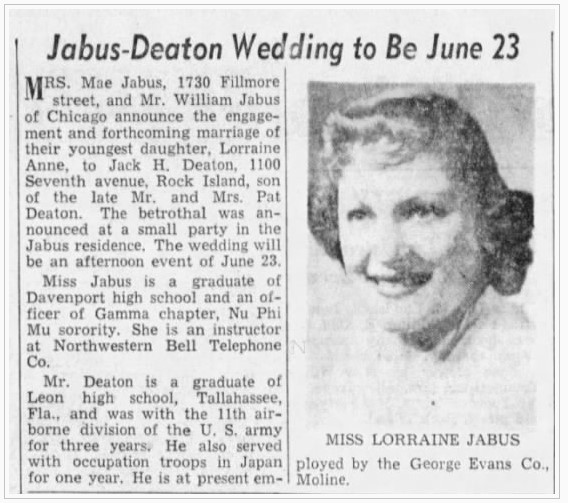
Wedding Announcement in the Daily Times, May 23, 1951.
When researching our lives, official publications like my parents’ wedding announcement in the May 23, 1951 Daily Times are never completely accurate.
William used the Polish spelling of his last name, Dziabas, rather than the anglicized version, Jabus, Grandmother did. Why was he in Chicago and Mae in Davenport? Despite Mother writing about it in a partial memoir, we’ll never fully know.
The article omits Father’s step mother, who lived in Rock Island well into my lifetime. I corresponded with her by mail but we never met. She said her marriage to Grandfather was a “business arrangement” in a letter. The business was named the Deaton Diner and she kept his name until she died, burying Grandfather and two subsequent husbands in a row near her eventual grave. She was known by the sexton at the cemetery but not a significant part of my life.
Despite the partial picture official announcements present, they detail biographical information that might otherwise be lost. Mother talked about graduating from Davenport High School and working for the phone company until her 90th birthday this year. The clipping is evidence. Our family visited Leon High School during a trip to Florida before Father died. I visited his alma mater while working in South Georgia for a logistics company. Father was a welder at George Evans Company according to the story. He seldom talked about his military service although an omitted fact — he was born in Virginia — was a primary influence when I was growing up.
As members of society we publish official notices to mark rites of passage. When I found this clipping by chance on the internet, it made my day. Official notices provide an opportunity to sand off the rough spots in our lives as we pass through milestones. As a biographer one has to ask whether to present the narrative as-is, or to embellish it with additional facts derived from experience outside its context. My answer is to present the artifact with sparing interpretation.
While presenting artifacts, I’m also weaving a narrative, something derived from both artifacts and experiences. The artifact never really stands alone. It becomes part of a narrative reduced to writing or told orally time and again until it becomes part of our world. Where such narratives will go remains uncertain. They have a basis in clippings like this wedding announcement.
(Editor’s Note: I’m working on a longer, autobiographical piece this winter. From time to time I’ll post findings from our family archives. The following was dated Dec. 11, 2010).
If I get this one chance to remember my maternal grandmother, what would I say?
That she was part of our family since my earliest remembrances.
That she encouraged me as her aunt had not encouraged her, that horrible instance when playing the piano would never be possible.
That she worked as a seamstress into her 80s and worked hard in what we would call menial positions.
That she reaped the benefits of the social programs of FDR and because of them, was able to live on her own until finally she had to go to the Kahl home, a place she had worked earlier in her life, to be tended by the Catholic charities for whom she had also worked.
That she had suggestions for how to life my life, but they were neither mandates, nor things I would not do willingly.
That she had become a part of my life, incorporated into my being like mixing pancake batter.
That she would come to adore her great granddaughter and be the first to offer her a piece of meat at a family meal.
That she would be sorely missed when she died while we lived in the Calumet.
I read with interest Monte Whitlock’s exhortation in the Dec. 2 Cedar Rapids Gazette that, “every American should vote Republican next election.”
Despite the author’s assertions, I decline to follow his advice. He presented no evidence of his claims, and as a life-long Democrat I need to see something before changing my views.
What interests me is that he even wrote to the newspaper. Views like his are found more frequently in the realm of talk radio and cable news shows. Public engagement is a good sign that all hope for our governance is not lost. I disagree with what Whitlock said but don’t argue with his right to hold opinions and write about them. I’m glad he wrote to a newspaper to get his views in the public domain.
Solon, from which the author hails, is a place with a strong Trump following. One can count at least five blue and white Trump banners flying in front of homes here. It seems a bit early for yard displays, but the fandom is evident.
The main question I have is will Trump supporters abide by the 2020 general election if Democrats win? I hope so.
~ Published Dec. 9, 2019 as a letter to the editor of the Cedar Rapids Gazette
Thanksgiving was a quiet day at our house. Neighbors were off with their parents, and the two of us prepared a simple meal of holiday fare.
We made some of our favorite dishes — home made baked beans and wild rice. Both of these have complicated recipes so they are relegated to days that can be devoted to cooking.
I worked the phone in the morning, but after that, could be found in the kitchen. I left the house one time — to empty the compost bucket.
The meal was a success, although the baked bean recipe requires some tweaking. I wrote it in my red book of recurring recipes with a note for next time.
The surprise was that seeing the pie pumpkin on the counter I decided to cook it, even though it wasn’t on the menu. I made a loaf of pumpkin bread and roasted the seeds. I made two cups of cooked pumpkin into one-cup balls and froze them for later. I served sliced pumpkin bread with home made apple butter on top at the meal.
Today I return to the home, farm and auto supply store where it is the eight-hour Black Friday sale. I have to be there when the doors open at 6 a.m. I also work on Saturday and there are plenty of uses for the extra money. For now, it’s my main source of socialization outside of home.
I placed a couple of on line orders this week. One for the bulk of my garden seeds for 2020 and another for a sweatshirt a size smaller than I have been wearing. I’ve maintained the 14 percent weight loss created by my anti-diabetes regimen and the current size is too bulky. We’ll see how that goes.
Our daughter had a twelve hour shift working for the mouse yesterday. At a thousand miles away it’s too far away and too busy there for a visit. Thanksgiving was the two of us sustaining a life in a turbulent world.
It’s no surprise someone like me would choose blogging as a form of political and social engagement.
During the 2004 primary and general elections, with an accompanying increase in the importance of the internet, short-piece writing was a way to combat the effectiveness of conservative media while providing an outlet for creative impulses.
I wrote letters to the editors of newspapers and in 2007 started a blog.
In their book Fault Lines: A History of the United States Since 1974, authors Kevin M. Kruse and Julian E. Zelizer wrote:
Seeing the success conservatives had had in the 1990s using innovative media forms like talk radio, the internet, and cable to challenge a Democratic administration, liberals tried to form the same sort of media resistance now that there was a Republican in the White House.
Among other things, the 2004 presidential election campaign gave rise to Air America Radio, The Daily Show with Jon Stewart, The Daily Kos, and Talking Points Memo. During the second term of the Bush administration, localized, self-financed blogs began to appear in many states, such as Iowa’s John Deeth Blog, Blog for Iowa, and Bleeding Heartland.
Caucusing for John Kerry was the beginning of my return to politics after a long hiatus to pursue career-minded support for our family. My first blog posts were the text of a letter to the editor about John Edwards, a piece on Norman Mailer, a report on the Iowa Democratic Party’s Jefferson Jackson Dinner, and a report on a fund raiser for county sheriff and board of supervisor candidates. My readership has been small but the creative outlet was important.
Posts on the Blogger platform served as an experiment in using the new format. I decided it would be viable and wrote on May 31, 2009:
During the last 560 posts on Big Grove News I have reflected what is going on in our world from the perspective of a small property in Big Grove Township. I was encouraged to write this blog by our daughter to bridge the distance between Iowa and the then far away Walt Disney World. It was never meant to be anything but a way to communicate with those closest to me. It is rooted in that English literature history of text and diary, and I attempted to make the language my own. It is that, rough and fractured at times, and in my view, a few times pretty good. I am glad for this gift of the internet and the way it has brought our family closer together.
And now we come to what modern social networking has become. Not only do we meet and discuss ideas with people. We engage in exposition with these same friends, acquaintances and strangers through social media on the internet. As I went through the time since my Nov. 10, 2007 post in Big Grove News, I have learned how to use the internet as a way to connect with people. Looking back on the Big Grove News posts, I can see that I began a journey out of the English literature tradition of text and diary into something else.
My friend Aletia Morgan encouraged me to join Facebook and it opened up a new world of communication that has replaced the printed newspaper that used to find its way to our mailbox. On Facebook I can publish links, photographs, notes and video clips and circulate them in a way that seemed impossible before. I can read about what my “friends” have posted and what ideas they are considering. When we get together in person, I find it has enriched our relationship. They say it is hard to manage more than 150 relationships with people in life and there is likely a limit to how many Facebook friends we can find meaningful. The thing is, we have to tend to these relationships by thinking before posting and making sure we purge inactive relationships and replace them with ones that have more hope. We are still exploring the world of Facebook and other social networking media.
There are other social media and they are each equally important. LinkedIn brings people into the network who do not want to use Facebook. Twitter is another blog feed that is better than conventional news media in keeping us informed about what’s going on. Flickr is a way to post photographs and make them visible to a wider audience. Figuring out how to use all of this has been a process, one that will continue as the social networking media develops. It is so much easier to stay in touch with people using these tools.
After that, I moved to WordPress.
Fast-forward to 2019 and I’ve been able to develop a readership based partly on this blog, but also on other social media. I continue to write posts because they are being read by a broader audience. Last Thursday at a political fund raiser, several people remarked about my writing and that type of recognition also keeps me going.
I’m also getting better at writing posts that get broader circulation. This year the number of views on this site hit a new record high. This is attributable to posting about things few others are covering.
My coverage of the November Solon School Board election drove new records. No one in other media was covering the race and there was a significant interest in selecting two of six candidates running for election. While people were posting comments about the race in other social media, no one was writing stories analyzing the race. The combination of unique content and ability to post in social media brought a record number of viewers to my site.
My posts about Democratic presidential candidates were also top viewed posts, including those about Julián Castro, Marianne Williamson and Pete Buttigieg. At the time, few were covering these candidates and my succinct and timely reports from local events drove viewership.
There was also the news that Congressman Dave Loebsack was retiring. My history with Dave began with a 2005 email after he announced his exploratory committee. When he took the step from considering to announcing retirement, I had enough background with his campaigns and career in the Congress to understand what happened and quickly posted about it in a meaningful way.
I like being read. If I weren’t, I would stop writing. What matters more is making a difference in society and to the extent I can keep mining contemporary experience for events and phenomena that merit wider consideration, I expect to continue to gain wider readership. That makes writing in this format something I value.
Like a coat rack in the back hallway of our childhood home I hang memories on each of the American presidents who held office since graduating from high school.
The worn hooks are Richard Nixon, Gerald Ford, Jimmy Carter, Ronald Reagan, George H.W. Bush, Bill Clinton, George W. Bush, Barack Obama and Donald J. Trump.
The memories are personal and integrated into who I am as an American living in Iowa. To the degree I’m American, these memories are sharable.
Book ended by the most reviled, Reagan and George W. Bush also deserve their own special place in hell. I worked to find some redeeming qualities about each of them. It was hardest with the current president.
I looked up President Trump’s inaugural address and listened to it again. My memory was turning off the video on inauguration day after the sentence, “This American carnage stops right here and stops right now.” The speech came from left field, from a country I did not know.
Watching the entire speech for the first time yesterday I can see why his core supporters like him. I can also see truth in the Politifact fact-checking of the speech. Trump referred to “all Americans.” Since day one of his administration I haven’t felt included in this group. That feeling has been stoked ever since with little hope of resolution. For Trump, “all Americans” includes only his supporters.
The other memory of Trump is how outside interests funded by dark money have run the administration. It began when the Heritage Foundation sent out swat teams to investigate each aspect of the executive branch shortly after the inauguration. It continued with the Federalist Society proposing judges to fill the many vacancies held open by Senators Mitch McConnell and Chuck Grassley while Barack Obama was in office. Grassley recently pointed to Trump’s policy regarding the appointment of judges as a key reason for Republicans to hold their nose and support the president’s re-election effort. My memory is Trump as the disengaged, self-centered billionaire in an office he recognizes he has no capacity to manage.
While Ronald Reagan ranks among the worst presidents, his administration was buffered by his affable manner and effective use of media to convey a sense of warmth as him minions stripped away a society risen from the ashes of the second world war. His work was intentional and directed, like all of the Republicans who held this office. Reagan must be given credit for the intermediate-range nuclear forces agreement (INF) with the Soviet Union. It was a big deal then and gave those of us in the nuclear freeze movement hope. Trump, with the counsel of John Bolton, threw the INF into the trash heap.
My memory of George W. Bush is from Philadelphia, shortly after the terrorist attacks of Sept. 11, 2001. I was on Interstate 95 heading into the Bartram Gardens area where I managed a trucking fleet. Bush’s motorcade was on the other side of the interstate heading back to the airport to return to Washington. In that moment, whatever hope I had Bush would pull the country together after the terrorist attacks was dashed. He made the trip early in the morning and finished by 10 a.m. It was a publicity event that had little impact on the national interest. It was unclear to me why he would spend so much money for what must have been a one to two hour publicity event. I remember other things didn’t make sense during the Bush administration. More than this, his invasion of Iraq made the least sense and proved to be a costly error. That is, unless one was a contractor who profited from the debacle.
Richard Nixon was proof there would be consequences for lying liars who held the office of president. He did form the Environmental Protection Agency but that was only a calculation that doing nothing to protect the environment would hurt him politically.
Gerald Ford was a non-entity who was not Nixon and that is my memory of him. Instead of seeing his failure to get a grip on the economy, I entered military service and spent most of my time in a confined silo that interacted with the presidency in a much different way. I accepted the premise of his presidency, that it was a time to heal after the disaster that was Nixon.
Conservatives who gave us Reagan ultimately didn’t care for George H.W. Bush. Bush’s foreign affairs experience helped his administration deal with the breakup of the Soviet Union without going to war. The United States became the only super power under his leadership. In domestic affairs, Bush was a supporter of the Americans with Disabilities Act. While he had some redeeming qualities, conservatives continued to have too much sway in his administration. I was satisfied when Bill Clinton defeated him in the 1992 general election.
I also have memories to hang on Democratic presidents. None of them were saints. All of them did things I didn’t care for. They were welcome respite from a conservative movement that continues to gain strength long after the coalition that elected Ronald Reagan was formed. My story about Democratic presidents is for another day.



 Journey Home

You must be logged in to post a comment.