Davenport, Iowa
Nov. 27, 1976

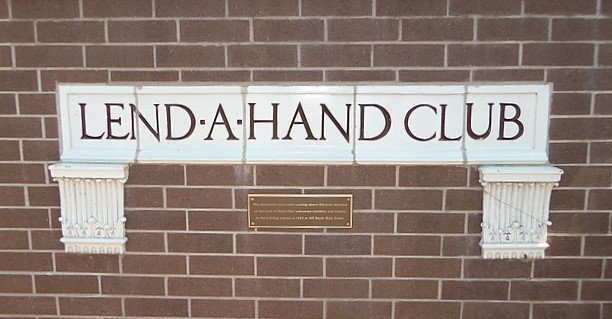
Today I visited my grandmother at the Lend-A-Hand and we ate ravioli from LaSalle, Illinois. They hand pack it there and it is a treat for us whenever we get a chance to make some.

I wonder sometimes about the brand names that grace our pantry - Kraft, Nabisco, Campbell's, Carnation, Betty Crocker, Aunt Jemima, Libby's, Quaker Oats, Folgers, Post, Hershey's - and marvel at the simplicity of the containers in my grandmother's shared kitchen.

There are milk cartons with all the ladies' names on them, and bulky, shapeless packages, with the owner's names written on them, old butter dishes covered and taped shut, white and tan boxes each with only the owner's name on them. It seems fitting that the name of the consumer rather than the producer, or canner appear on the foods awaiting the pot.

Perhaps these women are not swayed by the numerous labels enticing them from the shelves of the supermarkets, maybe they have learned that a carrot is only a carrot no matter who has laid hands on it.

But food is food and when one has it, one is grateful.

Editor's Note: This passage is from my personal journal. The Lend-A-Hand Club was established in Davenport, Iowa in 1886 as a chapter of the International Order of the King's Daughters and Sons. It became an affiliate of the national network of Lend-A-Hand Clubs launched during the 1870s by Edward Everett Hale, a Unitarian minister who had risen to nationwide prominence as an abolitionist and writer for the Atlantic Monthly prior to the American Civil War. The club was a place for young women who lived and worked away from home to associate in a safe environment.
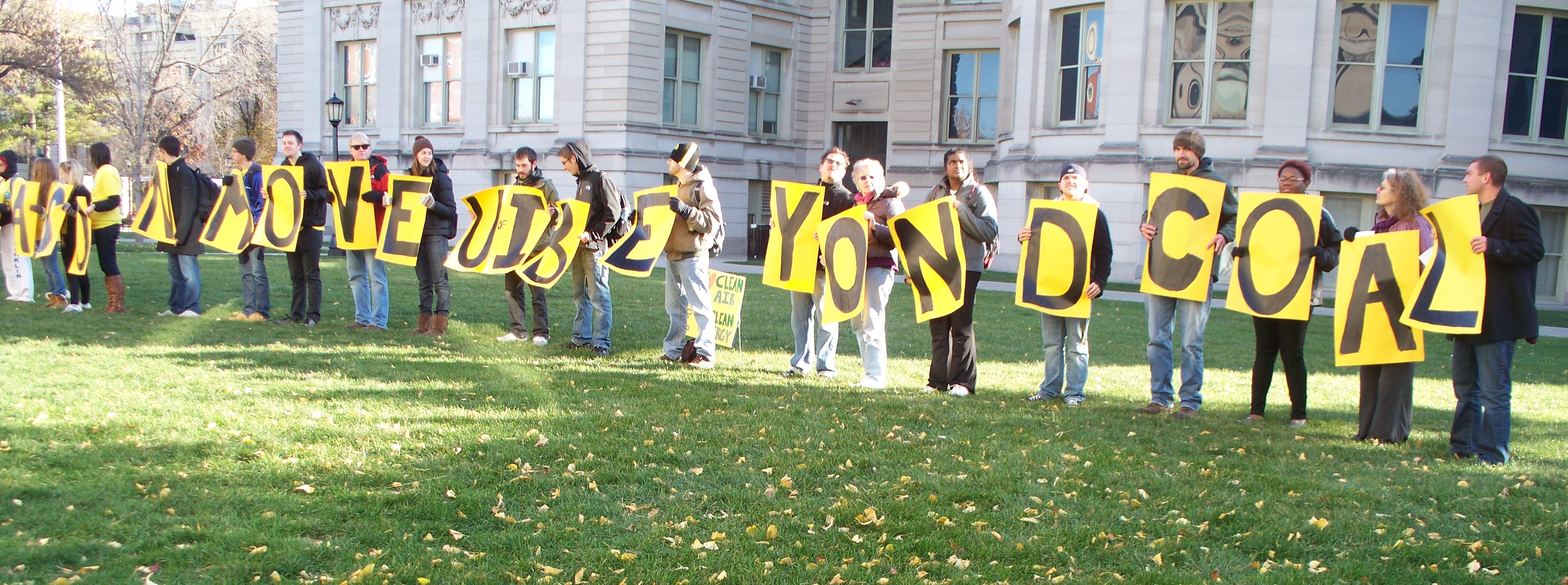
Move UI Beyond Coal, near Jessup Hall on the University of Iowa Pentacrest. Photo by the Author on Nov. 16, 2011.
In 2019, the University of Iowa signed a 50-year contract for a consortium of private companies to operate their coal-fired power plant and more. They should have phased out the coal plant and initiated a plan to transition to alternatives to provide the electricity and steam required. No one was listening to any of the advocates for shuttering the plant. They hadn’t been listening for years. It was an inside deal in an increasingly less than transparent state government.
In return for a $1.2 billion cash payment to fund an endowment, the university assumed different responsibilities regarding the facility. The consortium attorneys contend they didn’t understand their role and did not meet contractual obligations, according to the lawsuit. For Pete’s sake, not even three years in and there is a lawsuit? Shaking my head.
In November 2011, there was a demonstration at Jessup Hall on the University of Iowa Pentacrest urging then president Sally Mason to cease operation of the coal-fired power plant. We delivered a petition to her office. There were speeches on the steps of Jessup Hall. I gave a speech, among others.
Our deeds that day fell on deaf ears.
I remember when mass mobilizations and demonstrations could accomplish positive things in society. The best example was in 1974 when we drove Richard Nixon to resign from office as president. Those days are no more.
Instead of making social progress, big money politics of a wealthy consortium wielded their power to make more money. Filing a lawsuit is just part of the deal, even if the details over which they are suing should have been clarified well before a signature was inked.
Because the state, and the board of regents, is involved, taxpayers will ultimately pay for the suit. That’s not the future we had hoped for when we advocated for the University of Iowa to go beyond coal.
It snowed most of Saturday and I blew the driveway once. It’s winter in Iowa. That’s what we expect. I’m waiting for three days in a row of below freezing ambient temperatures. Once that happens, I’ll prune trees for the year, especially the fruit trees. I expected to have finished that winter work, yet with a warming climate, who knows if it will even happen this year.
I’ve been posting a few poems and hope readers enjoy them. I don’t know the person who wrote some of them almost 50 years ago. Most of what I wrote as poetry wasn’t the best. A few of them seem serviceable. The rest reside in my journals and papers. Prose has been my main thing since the beginning.
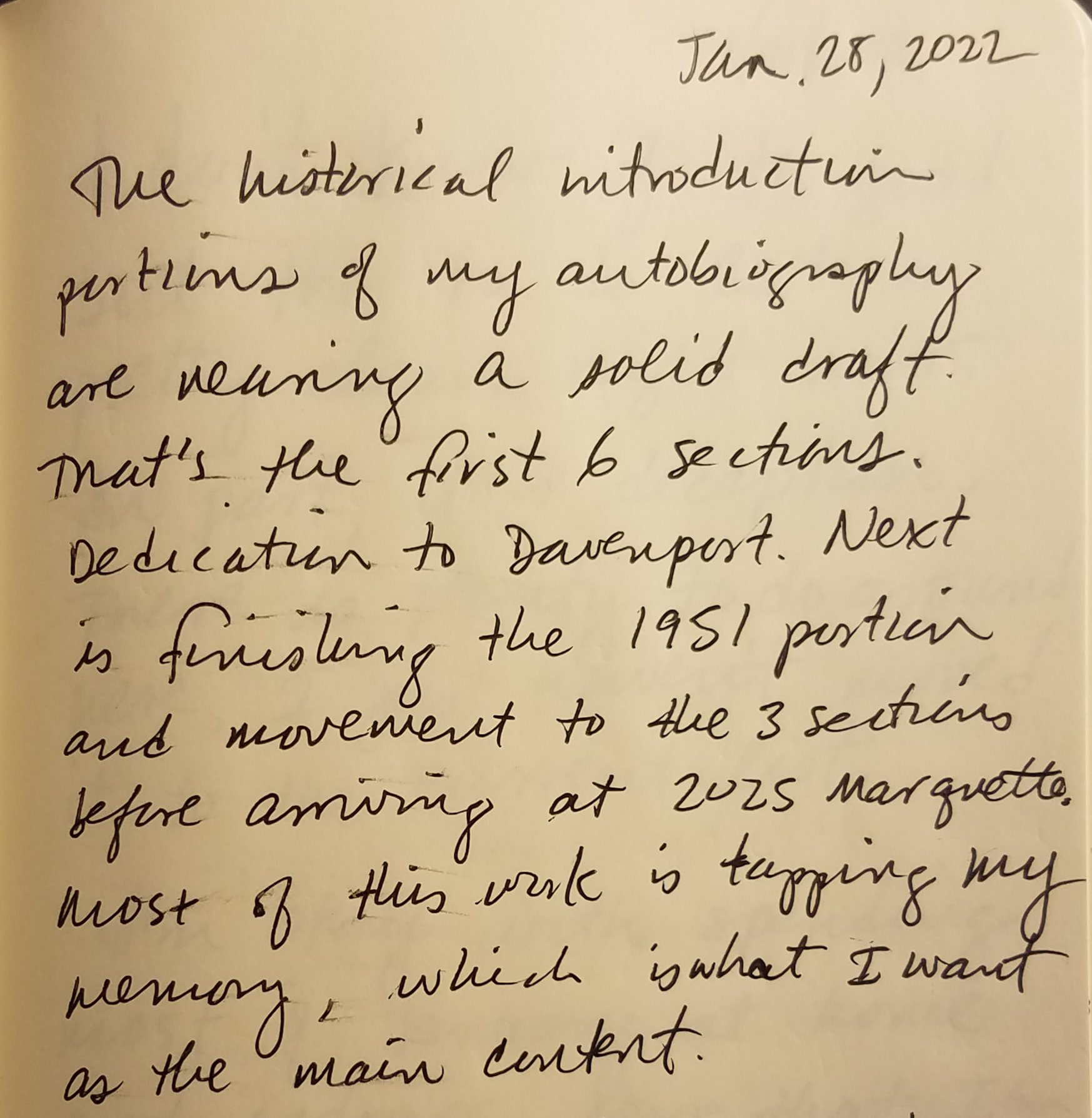
I’m at a transition point in my autobiography beginning after university graduation in 1974. Before then, I did not keep a diary or journal, and the paper trail of my life was scant. After that, beginning with my trip to Europe that autumn, there is a nest of supporting documents. The paper context of my life increased dramatically each year after 1974.
The first ten sections of the work in progress were written from memory and research into the historical record. The next 20 or so sections will benefit from journals and other papers yet to be rediscovered. These are different kinds of writing and I’m having to adjust.
I don’t want to simply print my journal. I also don’t want multiple long, sequential excerpts. The debate I have with myself is whether and how to modify old journal writing to support the current narrative. With 92,262 words and 355 double-spaced pages written one might think I’d have figured that out. I’m used to the type of writing I did in the first third, so it came easier than what’s ahead. I didn’t really think about changing how I write until I got to this point in the chronological narrative.
The next four-year section of the book is about military service. In addition to a journal, I have file folders on all the military operations I was in while stationed at Lee Barracks in Mainz-Gonsenheim, Germany. There is a whole banker’s box full of those. I also used a camera to take photos. Just in those three categories there is a lot to read, understand and assimilate. I also have artifacts like clothing, plaques, and dishes. I have a piece of a sign brought back from the West-East Germany border. It gets complicated.
Most journals are edited into the book. I can’t bear the thought of overuse of the words “that,” “the,” and “many.” Likewise, some of the sentence construction is beginner-style writing. I use the phrase “lightly edited” to describe what I’m doing when I change the source document. If the narrative is strong enough, readers will join for the journey, I believe.
My main interest in life has been in being a writer. I eschewed a university course of study that would get me a job. I didn’t know what it meant to be a creative, yet that’s what I wanted. Society falls short of offering paid work like that. Over the years, especially during my transportation career, the writer side of me was suppressed from time to time. It has always been present.
Some writers do very well. Some scratch out a living. Some work for someone else and do their writing on the side. Now that I’m living on a pension, I can focus my efforts on finishing this book and identifying the next project. As a septuagenarian, there are only so many projects that will fit in.
My twelve-week stay at a 5,175 square foot Queen Ann Victorian that had been divided into apartments was an important turning point in my life.
Even though Fall 1975 was the first time I lived alone, there was a lot of stuff to cram into a single room with a shared bath at 1028 Mississippi Ave. in Davenport. I parked my 1961 Chevy Impala on the street, and had a telephone connected. I cleared my mind of the distractions of living in a busy, rundown neighborhood on Seventh Street. I rested, attended events and considered my future. It was calm before the storm.
I began with a journal entry on Sept. 11, 1975:
This new apartment already begins the rebirth which is so much needed by my soul at this time. The neighborhood is quite quiet and the apartment that I rent is at the end of a small hallway off the main one.
Across the street is another large house that has been subdivided into apartments and it is quite a ways away. Further up the block there is a Jewish synagogue, Temple Emmanuel. The river is about three or four blocks away.
It seems there are some well to do neighbors to the south of this building, who at this time are having a dinner party of some sort. But at the same time I believe the area is on the fringes of the poverty area mostly to the west. The wealthy area of the town, the Heights, is to the east.
The landlord’s brother lives upstairs in the attic and he mysteriously comes and goes. “Sometimes he’s there, sometimes he’s not. Ask him if you need anything,” the landlord said. Time will tell as I ask God to manifest His will. My major tasks at this time are to set up my own household for what is to be the first time. All for the honor and glory of God.”
Personal Journal, 1028 Mississippi Ave., Davenport, Iowa, Sept. 11, 1975.
The previous six years, since leaving home for university, were a period of experimentation and trial of one thing or another. If anything, my activities resulted in me being what I was and being able to live with myself.
There were things I would have liked to change, like getting off the graveyard shift at the dairy store, and better nutrition. Those things could be worked on. At the time, I felt closer to God than I had for a long time. “He gives me strength,” I wrote.
During my time there I read and wrote in my journal, attended local events, made trips to Chicago, Des Moines, and Iowa City, and prepared for the big project that felt imminent. I didn’t know what that was when I moved in. I viewed myself foremost as a writer, although I didn’t have enough income to do anything but get by.
I attended a Chaim Potok reading at Temple Emmanuel, a Mike Seeger performance at Saint Ambrose College, and heard a lecture by Philip Berrigan at the Friendly House. I was struck enough with Berrigan to write a quote about his notion of life in my journal, “exerting one’s will over this existence to make a life.” That’s what I thought I wanted to do.
I invited Mother over for dinner and made tuna and noodle casserole. It was the only prepared dish in my culinary repertory in 1975. She tolerated the meal, and we went for a walk to nearby Prospect Terrace Park. While my apartment was modest, it served as a good place to sort out my life. It was fitting my first dinner guest was Mother.
I explored my religious self during this period. In part, it was a reaction to living alone.
What are the problems that face me? It seems that the biggest one is that of faith. I believe that God is manifest in this world, something which I did not or rather suspended belief for a while, yet I cannot come to accept the Church as his manifestation. There are others similar to me in this sort of belief, but I do not seek the approval of other people in my beliefs. That is something I have taken upon myself to bear. In this belief, I am quite alone, although I seek communication with others, it is only for the making contact with God in their souls that I do this and in behaving in ways people seem to have difficulty in understanding me. Be that as it may, I am.
Personal Journal, 1028 Mississippi Ave., Davenport, Iowa, Nov. 2, 1975.
A year earlier I considered entering the Roman Catholic priesthood, yet that seemed like a wrong path. My friends talked me out of it.
The transition at Mississippi Avenue was in part a lack of other intellectual outlets. I met with and spoke to a lot of people at the dairy store. I encountered people I’d known a long time. There was no likely relationship-building as I sold them a pack of cigarettes or gallon of milk. I was cognizant of the fact most old friends did not hold my employment at a dairy store in high regard.
I planned my next move, signed my enlistment papers on Nov. 14, 1975, and left work at the dairy store on Dec. 14. The apartment near the Mississippi River served me well
I feel like I live in John Irving’s fiction. It’s mostly because he writes about things that resonate personally.
In The Last Chairlift he wrote about the 85th and 87 Infantry which were part of the Tenth Mountain Division during World War II. I was stationed in the 87th Infantry while I served in the U.S. Army in Europe. While there, it was part of the Eighth Infantry Division. When 8th ID was deactivated, the 87th Infantry was reunited with the Tenth Mountain Division based in Alaska.
I don’t know if I ran into Irving when I lived in Iowa City from 1970 to 1974. I remember seeing him in the English-Philosophy Building, but that could have been like one of the ghosts in The Last Chairlift. I may have imagined it. I know his novel The Water Method Man‘s main character lived at 918 Iowa Avenue in Iowa City. While reading the novel, I walked along Iowa Avenue from the Pentacrest to look at the house. That novel was published in 1972.
It is the familiarity with objects and places in his fiction that draws me in. Irving is one of the few fiction writers whose writing resonates. In Act III, my reading accelerated until I couldn’t put the book down. Few novels I read have this effect.
What surprised me about reading this and other Irving books is his work rarely appears on lists of banned books that circulate in Iowa and elsewhere. Perhaps he is not read by evangelical Christians, or librarians know enough to avoid placing his fiction in the stacks. Any engaged person should read his work.
I enjoyed The Last Chairlift a lot. Highly recommend!
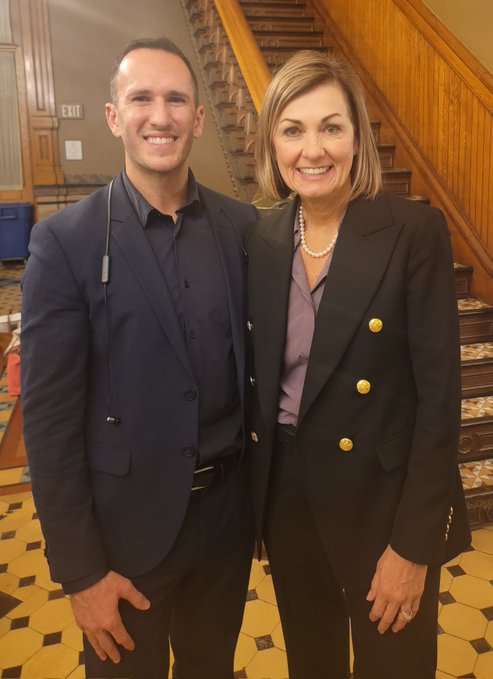
Corey A. DeAngelis and Iowa Governor Kim Reynolds at the statehouse on Jan 24, 2023.
Toward the end of Monday afternoon I was following three live video streams opened in browsers on my desktop. With recently improved data stream from our internet service provider, and an upgraded router/modem, the video was crystal clear, the sound excellent. I didn’t like all I was hearing.
One window was a Twitch streamer during a session titled “Makers and Crafting.” They were making chain mail for use with a cosplay character. I enjoy Makers and Crafting streams more than those that play video games or are “just chatting.” It felt like we were getting something accomplished.
The other two streams were the Iowa House and Senate debates over the governor’s public money for private schools bill, the Students First Act. There was never a question the bill would pass. This morning it is heading to the governor’s office where she is expected to sign it yet today. I couldn’t listen to all the speeches and shut my desktop down around 5 p.m. to prepare dinner. Everything we expected was happening and I couldn’t bear watching the disaster in real time.
As unsettling as anything about this bill was the photograph of lobbyist and consultant Corey A. DeAngelis with the governor. The out of state consultant has been pushing for the bill and with the governor’s assistance, he got his way. This photo reminded me of a photo then-governor Terry Branstad took with Drew Klein of Americans for Prosperity when the legislature gutted Iowa’s collective bargaining laws for public employees. Apparently Iowa Republican governors have an affection for lobbyists when they destroy long-established traditions.
In the post I made about this bill I wrote, “Since Jan. 1, 2017, Republicans held a trifecta, controlling the governorship, and both chambers of the legislature. They are remaking everything about state government, and in turn, about Iowa. Schools are just one part of their agenda.” According to DeAngelis and company, the governor is not finished with school choice in this session of the 90th Iowa General Assembly. I doubt she is finished re-making Iowa.
The Democratic planning for and execution of a 2022 campaign was lackluster at best. While some candidates, like state senate candidate Kevin Kinney, had money and hired an organizer, others didn’t have good planning, execution, or adequate financial resources. It was like Democrats forgot how to campaign since Obama won Iowa in 2008 and 2012. I appreciate the work House Minority Leader Jennifer Konfrst and Senate Minority Leader Zach Wahls are doing to rebuild the party. It is not fast enough to make a difference this and probably the next couple of sessions.
On Saturday the Iowa Democratic Party State Central Committee is electing someone to replace Ross Wilburn as chair. I hope they pick someone young and energetic because what the state party has been doing of late won’t cut it if we want to claw our way back into legislative leadership. We have good people in the party. I hope one of them steps up, wins, and does well.
What matters more is the Democratic state central committee is increasingly irrelevant to people like me. Of course, I retired and am a pensioner now, so less people will take me seriously. If the party’s future is in younger, new people, I’m all for it. I have plenty to do in the coming years and crossing politics off my list would be a boon.
As the 90th Iowa General Assembly revs up with an early win for the governor, they have much they want to do in the next two years. I doubt I’ll like much of it. They followed commonplace advice that if one is to eat a bucket of frogs, eat the biggest frog first. With the Students First Act out of the way, and with it the big distraction it was, Iowa Republicans can be expected to continue remaking the state in their image. For me, that means it’s time to head for the exits.
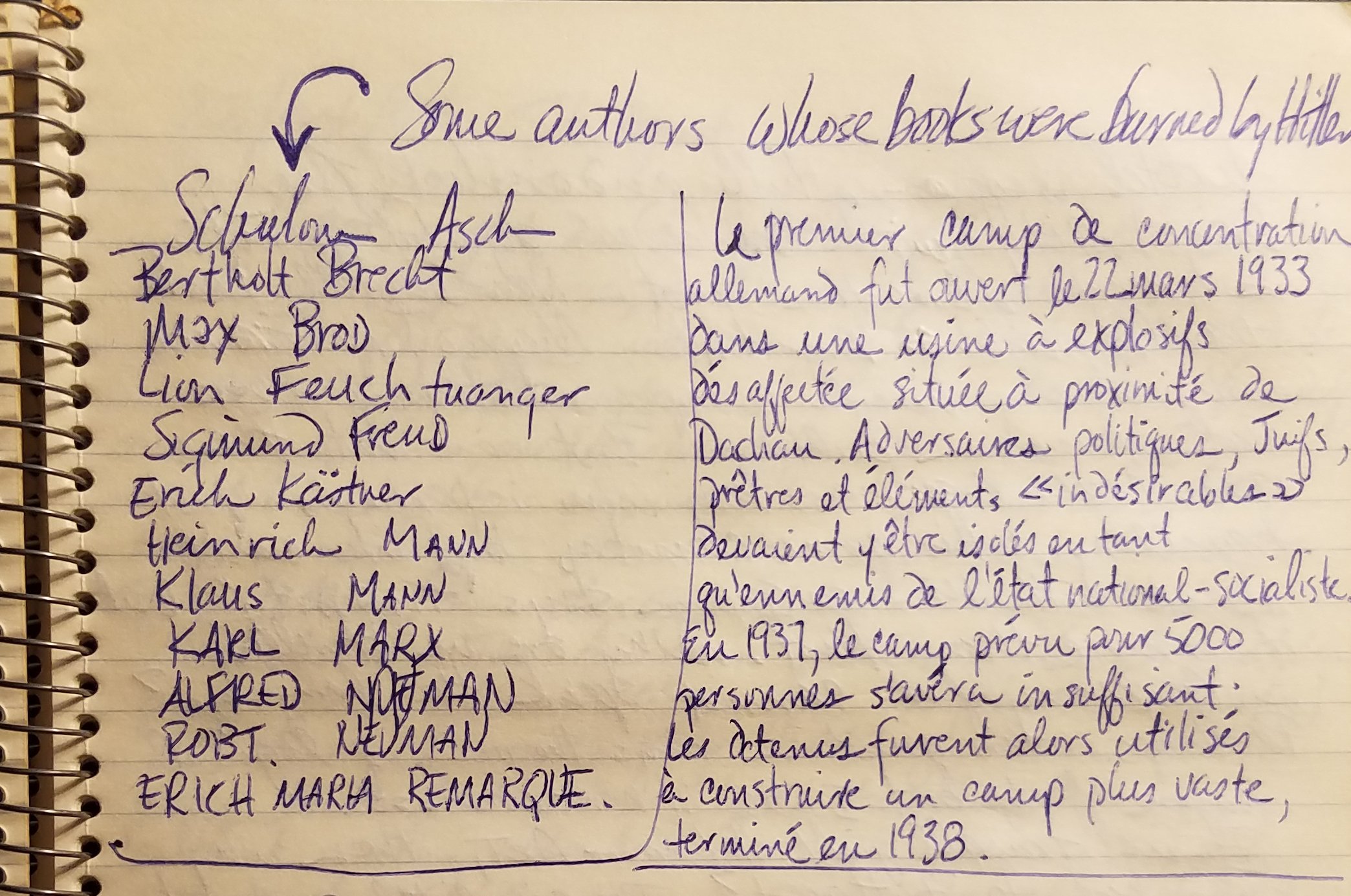
Handwritten journal after a visit to the former Dachau concentration camp by the author. October 1974.
I’ve been reading journals written while I was traveling in Europe during the Fall of 1974. I wasn’t very good at journaling 50 years ago.
“An Italian whose uncle is a cardinal took me to the Vatican to get me a ticket to the papal audience tomorrow,” I wrote. Today, I would rewrite this sentence in different ways: reduce word count, clarify, simplify. I would add more detail and maybe another descriptive sentence.
I’d like to read about that general audience with Pope Paul VI today. I have to rely on my faulty, septuagenarian memory and a couple of photographs to get me through revisiting that time. My journal is lacking if my memory is not.
For some reason or in these events and environments I dream very much, dreams which I have never had so many of before ever. My archeologist friend from Australia says that they are the result of being in strange surroundings and my body trying to cope. If what he says be true then the distinction between my mind and body is even more subtle than I had imagined.
Personal Journal, Winston Churchill Gardens, Salisbury, England Aug. 27, 1974.
Good God! what awful writing! The punctuation! I hope I am better than that now.
I made a special trip to Ravenna to see the Byzantine mosaics I studied in art history class at university. I had been practicing my Italian for weeks to prepare for this less traveled destination. The mosaics did not disappoint. However, my journal did. The entries in Ravenna were mostly about the logistics of closing down my tour and heading back to Iowa. Feeling like Henry David Thoreau, I enumerated my expenses in the journal instead of observations about the ancient artwork. I bought a book, Ravenna: An Art City by Giuseppe Bovini, to aid memory in later years.
I began journaling after graduation from university. My first book of journals was stolen when I stayed at a youth hostel in Boulogne, France after crossing the English Channel. The thief swiped my whole backpack! All I had left was a small blue shoulder bag Grandmother made for me that contained my passport, American Express traveler’s checks, my camera, and a few other necessities. I had to spend part of the $2,000 I brought with me replacing the bag and buying clothing: an unwelcome expense.
I continue to journal. In 2007 I began using Moleskine plain notebooks, although I also use up whatever notebooks are on hand. Moleskine products are getting a bit expensive. While designed in Milan, Italy, they are manufactured in China. The margin on these popular notebooks must be substantial. Their future is uncertain when I have a dozen or so spiral notebooks, bought for a dime each, in inventory and a need to cut expenses.
The 1974 journal is useful in recalling things. In the first draft of this section of my autobiography, I completely forgot about the papal audience. In addition to the journal, I have enough artifacts collected on the trip to remember what happened.
I possess living memory of those places. If the poorly crafted journals do anything in 2023, they prompt those memories, however imperfectly. I was a different person in 1974. Alone in Europe, I did what I could to express what I was experiencing. Without a steady travel companion for conversation, I wrote in my journal. We do the best we can.
I am thankful to have made that trip. I am thankful to be living with the ability to remember it.
1,515 students attend four schools in the Solon Community School District this year. There is a $25 million bond referendum election in March, and a school board election in the fall.
I plan to cover both elections.
The school board terms of Adam Haluska and Jami Wolf expire this year. Neither has formally announced whether they intend to seek another term.
The school does well on key statistics, beginning with a student:teacher ratio of 16:1. The district ranks in the top five percent of districts in the State of Iowa, top ten percent in math proficiency, top five percent in reading/language arts proficiency, and 95 percent of students graduate. While less diverse than an average Iowa K-12 school system, it maintains a seven percent minority enrollment with 33 students of two or more races, 58 Hispanic students, eight Asians, and seven blacks. The school system attracts young families to the area. For these reasons and more, I expect the community to support the bond referendum.
The special election for the bond is set for March 7, 2023. The district posted an explainer about the bond referendum here. The lengthy language on the ballot is as follows on the Johnson County Auditor website:
Public Measure LX Shall the following public measure be adopted?
Shall the Board of Directors of the Solon Community School District in the Counties of Johnson and Linn, State of Iowa, be authorized to contract indebtedness and issue General Obligation Bonds in an amount not to exceed $25,500,000 to provide funds to construct, furnish, and equip an addition to Solon Intermediate School building and improve the site; to renovate, remodel, improve, repair, furnish and equip Lakeview Elementary building and improve the site; to renovate, remodel, improve, repair, furnish and equip the Transportation Center; to construct, furnish, and equip a new Administrative building and improve the site; to construct, furnish, and equip a new multi-purpose indoor activity facility and improve the site; and to install a new field at Spartan Stadium?
Public Measure LY Shall the following public measure be adopted?
Summary: To adopt a Revenue Purpose Statement specifying the use of revenues the Solon Community School District will receive from the State of Iowa Secure an Advanced Vision for Education Fund.
In the Solon Community School District, the following Revenue Purpose Statement which specifies the use of revenues the Solon Community School District will receive from the State of Iowa Secure an Advanced Vision for Education Fund shall be adopted.
To provide funds to acquire or install information technology infrastructure (including improving buildings or sites for the purpose of accessing broadband digital telecommunications) and school safety and security infrastructure.
To provide funds to build and furnish a new school building or buildings; to build and furnish addition(s) to school buildings in the District; to remodel, reconstruct, repair, expand, and improve the school buildings in the District; to purchase and improve grounds; for demolition work; to furnish and equip district facilities.
To provide funds for the purchase, lease or lease-purchase of buildings, equipment (including transportation and recreation equipment), or technology and to repair transportation equipment for transporting students as authorized by law, to implement energy conservation measures, sharing or rental of facilities including a joint infrastructure project for the purposes of offering classes under district-to-community college programs as authorized in Iowa Code Section 423F.3(3)(c), procuring or acquisition of libraries, or opening roads to schoolhouses or buildings.
To provide funds to purchase land as part of start-up costs for new student construction program or if the sale of the previous student construction was insufficient to purchase land, and to purchase construction materials and supplies for a student-constructed building or shed intended to be retained by and used by the District.
To provide funds to make payments to a municipality or other entity as required under Iowa Code Section 403.19(2).
To provide funds for demolition, cleanup, and other costs if such costs are necessitated by, and incurred within two years of, a disaster.
To provide funds to establish and maintain public recreation places and playgrounds; provide for supervision and instruction for recreational activities; or for community education purposes.
To provide funds for the payment of principal and interest or retirement of general obligation bonds issued for school infrastructure purposes, energy improvement loans, loan agreements authorized by Iowa Code Section 297.36, sales, service and use tax revenue bonds issued under Iowa Code Section 423E.5 or Iowa Code Section 423F.4.
To provide funds for property tax relief; and
To provide funds for other authorized expenditures and purposes as now or hereafter permitted by law and designated by the Solon Community School District.
It being understood that if this proposition should fail to be approved by the voters, such failure shall not be construed to terminate or restrict authority previously granted by the voters to expend receipts from the Secure an Advanced Vision for Education Fund.
If approved, this Revenue Purpose Statement shall remain in effect until replaced or amended by the Solon Community School District.
Public Measure LZ Shall the following public measure be adopted?
Shall the Board of Directors of the Solon Community School District, in the Counties of Johnson and Linn, State of Iowa, for the purpose of purchasing and improving grounds; constructing schoolhouses or buildings and opening roads to schoolhouses or buildings; purchasing of buildings; purchase, lease or lease-purchase of technology and equipment; paying debts contracted for the erection or construction of schoolhouses or buildings, not including interest on bonds; procuring or acquisition of libraries; repairing, remodeling, reconstructing, improving, or expanding the schoolhouses or buildings and additions to existing schoolhouses; expenditures for energy conservation; renting facilities under Iowa Code Chapter 28E; purchasing transportation equipment for transporting students; lease purchase option agreements for school buildings or equipment; purchasing equipment authorized by law; or for any purpose or purposes now or hereafter authorized by law, be authorized for a period of ten (10) years, to levy annually, a voter-approved physical plant and equipment property tax not to exceed One Dollar Thirty-Four Cents ($1.34) per One Thousand Dollars ($1,000) of the assessed valuation of the taxable property within the school district commencing with the levy for collection in the fiscal year ending June 30, 2027, or each year thereafter?
There will be additional posts as the election dates approach.




 Journey Home
You must be logged in to post a comment.