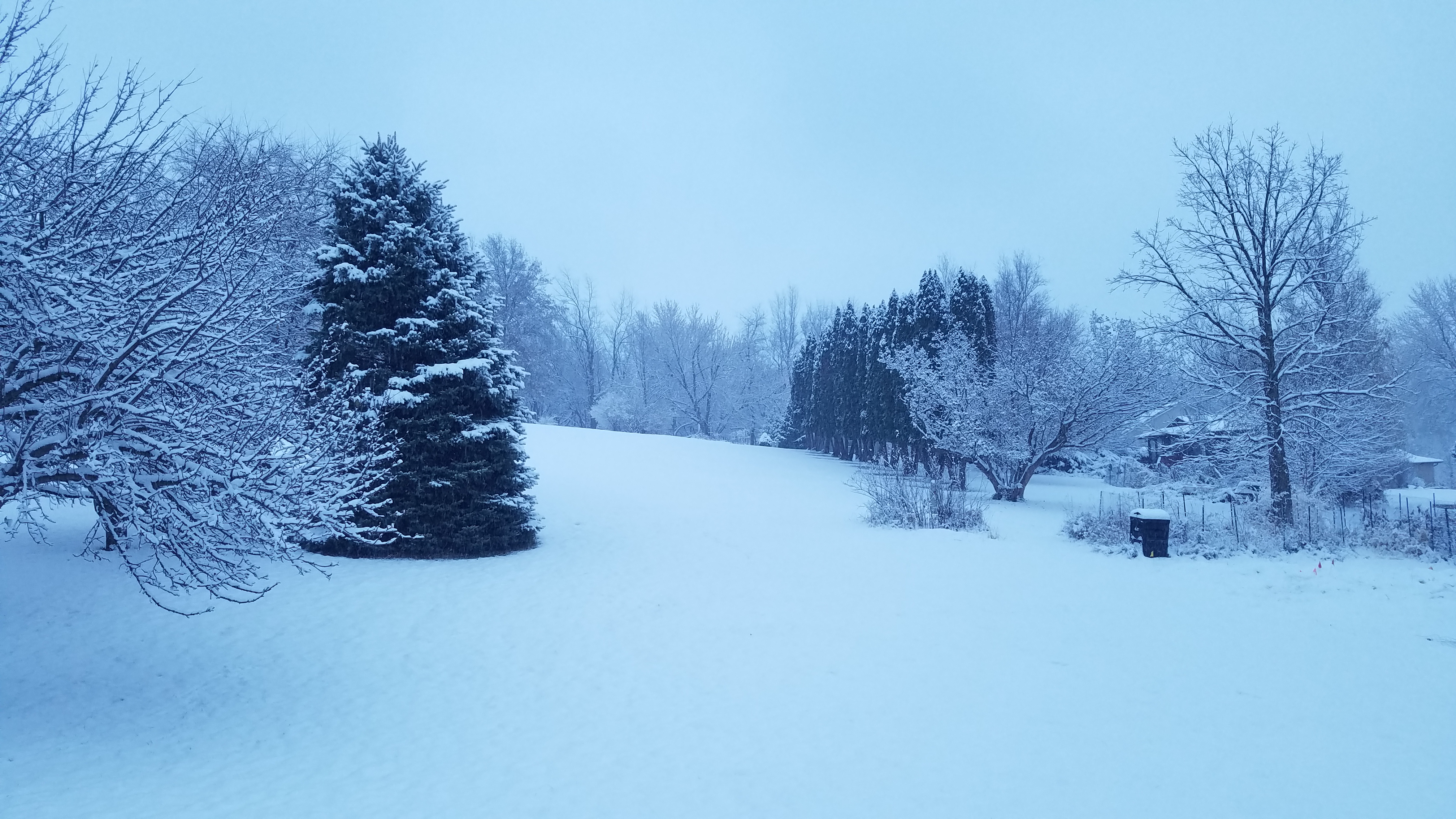
The sky spit a few flakes of snow at me during the trail walk this morning. As warm as it’s been, none of it is expected to stick. Water is slowly draining from the watershed back into Lake Macbride. Perhaps the worst of the drought is past. Fingers crossed.
We are in that time between Christmas and New Year’s Day, a time to take stock of the preceding year and look toward the future. For as much time alone as I’ve had, I’m way behind. I wrote a 2023 Highlights post back in November, yet I need something more to bring closure.
This was a tough year financially. We hope things will lighten up in 2024. In 2022 we had to replace the car and the freezer. It turned out one could not get new parts for a 20-year old automobile. In 2023, the big expenses got worse, including three major appliances, the HVAC system, and the septic tank pump. The result of these physical plant failures was we took two loans and are paying down our credit card balance. The good news is these repairs should last a while. The washer and dryer are likely to be the soonest needing another placement. The last ones we bought lasted about twelve years, according to the receipt. There should be time to catch a breath.
The main non-writing work this week is planning the garden. The seed orders usually have gone in by now, so I’m behind here as well. There will be a significant expense in hardware in 2024 as I develop the deer fencing better than it was this year. The portable greenhouse wore a hole next to the zipper, so it needs replacing. Getting this done will be the main part of a single day.
Seems like there is a lot to be planned for 2024. Maybe if I set some New Years Resolutions… no, that never works. I may have to wing it while hoping for the best. There have been worse times.
We celebrated a minimalist Christmas this year. My spouse and I left the holiday decorations in their boxes, did not plan a special menu, and made some cards to send to a few friends. Ambient temperature was 53 degrees Fahrenheit at 3 a.m. on Christmas Day, and rain is in the forecast. It will be a time for reflection.
The first Christmas I think of is when I was in first grade. I had a discussion with Mother about whether Santa Claus was a real person, and that year imagined I saw him flying through the sky with his reindeer. Father spend a lot of time in the basement of our rented home near Wonder Bakery on River Drive. He was building me a desk to keep in my room for school studies. I rapidly outgrew it and still have it. Our child indicated they don’t want it when I’m gone. I’m okay with finding another home for it.
Midnight Mass was an annual Christmas activity after we moved to Marquette Street in 1959. I remember walking the block and a half to the church as snow fell upon us. It was one of the best-attended services of the year, so we had to go early to ensure getting a seat. My maternal grandmother was the main force of religion in our family and she herded us along. Holy Family Catholic Church was a center of our family life. Mother and Father were married there, Grandmother worked as a housekeeper in the rectory. Mother worked in the school cafeteria. I was baptized and confirmed there, as were my siblings, and we kids attended grade school at the parish school.
When I left home in 1970, Christmas became mostly a time of traveling home for the holiday. At university, I didn’t want to stay in the dorm over the long Christmas break, so I went home. I do not have living memory of those Christmases. It was never the same after Father died in 1969. When I enlisted in the military in 1976, I came home for Christmas maybe once. It was a long way from Germany where I was stationed.
After our wedding we split holiday time between Ames and Davenport where our parents lived. When our child was born, it felt important for grandparents and great grandparents to have time with them and the end of year holidays were a good time to do that. It was never our holiday because of the travel. It was an important duty of parenting we fulfilled as best we could.
Since our child left Iowa in 2007, Christmas has been hit or miss. There were good ones, and average ones. At some point we stopped doing anything special. We haven’t unboxed the decorations in a few years. We make an effort to call important people in our lives, yet that gets spread over the time between Dec. 18 (our wedding anniversary) and New Year’s Day. Christmas Day is no longer as special as it once was.
According to the Social Security life expectancy calculator, a reasonable expectation is I will have 14 more Christmases and my spouse will have 16. I expect to do everything possible to make them the best we can. Merry Christmas dear readers. Have a happy 2024!
The Big Myth: How American Business Taught Us to Loathe Government and Love the Free Market by Naomi Oreskes and Erik M. Conway is a keeper. It was written in the context of a number of contemporary books that outline the role of market fundamentalism in our society. The authors present a convincing case that U.S. Government is smaller than many other industrialized nations and could be better used than it is. The reason our government is not better used is that on the spectrum of free markets to government control, a small group of people have perpetuated the myth that the free market can solve all of our ills and government is too intrusive. They intentionally retard social progress. The book is not a quick read, yet it is vitally engaging throughout.
If you are familiar with the work of Jane Mayer, Nancy MacLean, Anne Nelson, Anne Case, Angus Deaton, Matthew Josephson, and Dahlia Lithwick I recommend reading The Big Myth.
Having married just after Ronald Reagan was sworn into office, I lived through much of the second half of the book. The history Oreskes and Conway wrote is illuminating. What I suspected, and the authors confirmed, was that market fundamentalists found a way to use popular culture to indoctrinate the population in basic tenants of their beliefs. Whether it was the collaboration between Laura Ingalls Wilder and her daughter Rose Wilder Lane in the Little House books, Ayn Rand’s work in Hollywood censorship, Ronald Reagan’s work for General Electric, or Milton Friedman’s numerous and widely read opinions, op-eds and columns, there was an intentional effort to add a layer of conservative ideology to mass culture. Call it what it is: propaganda.
The book made me reflect on how my basic views toward life in society were influenced without me knowing it.
My self-view is one of self-reliance. I stand on my own two feet and endure whatever challenges come my way, hopefully successfully navigating them. I wrote something similar to this many times over 50 years of writing. After reading The Big Myth, I realize this mental attitude may have been a form of indoctrination by active, libertarian agency that found its way into literature, movies, and television programs to which I was exposed from an early age. While self reliance is not bad, that it became part of my mental outlook through indoctrination is not good.
I am not freaking out! The disturbing part of libertarian propaganda about market fundamentalism is the absence of any alternative response. In fact, conservatives constantly accuse liberals of brainwashing children in public schools, to the extent the Iowa Legislature passed a significant private school voucher law to address their fears. Why aren’t liberals in the game? They, like me, likely didn’t understand how deep the propaganda went. There have been few comprehensive stories written about what libertarian radicals have been doing for a hundred years. Oreskes and Conway remedied that.
Pick up a copy at your independent bookstore or, if they have it, from your public library. The Big Myth is essential reading as Republican extremists work to undo American democracy with the backing of large-sized business interests. We can do better than that.
Adam Smith’s The Wealth of Nations is a book seldom read in its entirety. Libertarians went through multiple iterations of winnowing the more than five hundred fifty pages into something more readable, something more closely matching their ideological viewpoint. One time, they serialized a right wing version in Reader’s Digest. I will never read it. I don’t know anyone who has read it, certainly not Iowa’s current crop of right-wing politicians. They may know the phrase “invisible hand” even if they don’t use it when enacting policies that make life worse for many Iowans.
The invisible hand is a metaphor for the unseen forces that move the free market economy. Ronald Reagan referred to it as the “magic of the marketplace.” With economic freedom comes prosperity they say. Only it doesn’t. This is truly magical thinking.
This week it was announced Koch Industries is buying the Iowa Fertilizer Company in Wever. This facility has been a story of money changing hands among large, wealthy entities from the gitgo. The $110 million in financial incentives from the state finally comes home to roost with a company that is so deeply embedded in Iowa Republican politics we forget to notice their presence. Is this Adam Smith’s invisible hand of the market, or just the greedy hands of industrial capitalists?
Right wingers believe in the efficacy of the people as individuals with each making their own decisions in a free market economy. This holiday season they emphasized their belief that people, as a group or social class, don’t mean much of anything to them as they work to please corporate sponsors.
Last night, Governor Kim Reynolds released her Christmas message to Iowans, which I quote in full:
“From a humble stable in Bethlehem more than 2000 years ago, the world was given the greatest gift of all time, a newborn King sent to bring light to the world.
“This Christmas season, the part of the world where Jesus was born is impacted by war. And yet, his promise of peace is everlasting.
“As we gather to celebrate this joyous holiday with family and friends, let us be reminded of the many blessings that we enjoy as a free people and the responsibility we have to each other as children of God.
“On Christmas and always, may we be the light in the darkness.
“Kevin and I, and our family, wish you and yours a Christmas filled with joy and light.
“God bless you and Merry Christmas.”
Office of the Governor Press Release, Dec. 22, 2023.
Let this sink in: “Let us be reminded of … the responsibility we have to each other as children of God.”
That is, unless one is poor and can’t afford health insurance. By privatizing Medicaid, the state created an expensive, inefficient process that denies care to some who need it. In that case forget about our shared responsibility to provide needed health care.
That is, unless one is a child who qualifies for the free lunch program where Governor Reynolds on Friday rejected available federal funds to pay for a summertime EBT card for hungry children. In that case, you can go hungry, and by the way, she said, you need to go on a diet because you kids are obese.
That is, unless one lives in our substandard nursing homes where the state is as much as 41 months behind in conducting annual inspections in violation of federal regulations. In that case you can just drop dead.
Where is the idea of Christian charity to bind us together in meeting common needs? Where is the invisible hand to lift up the poor and provide adequate opportunity to achieve minimum financial needs? I submit it is busy in the pockets of the wealthy, delivering government benefits that frame their success, of a kind the poor will never see.
This Christmas season we must vow to change how we treat the poor with our votes… in 2024 and beyond. Republican politicians are not listening. Voting them out of office is the only thing they might understand.
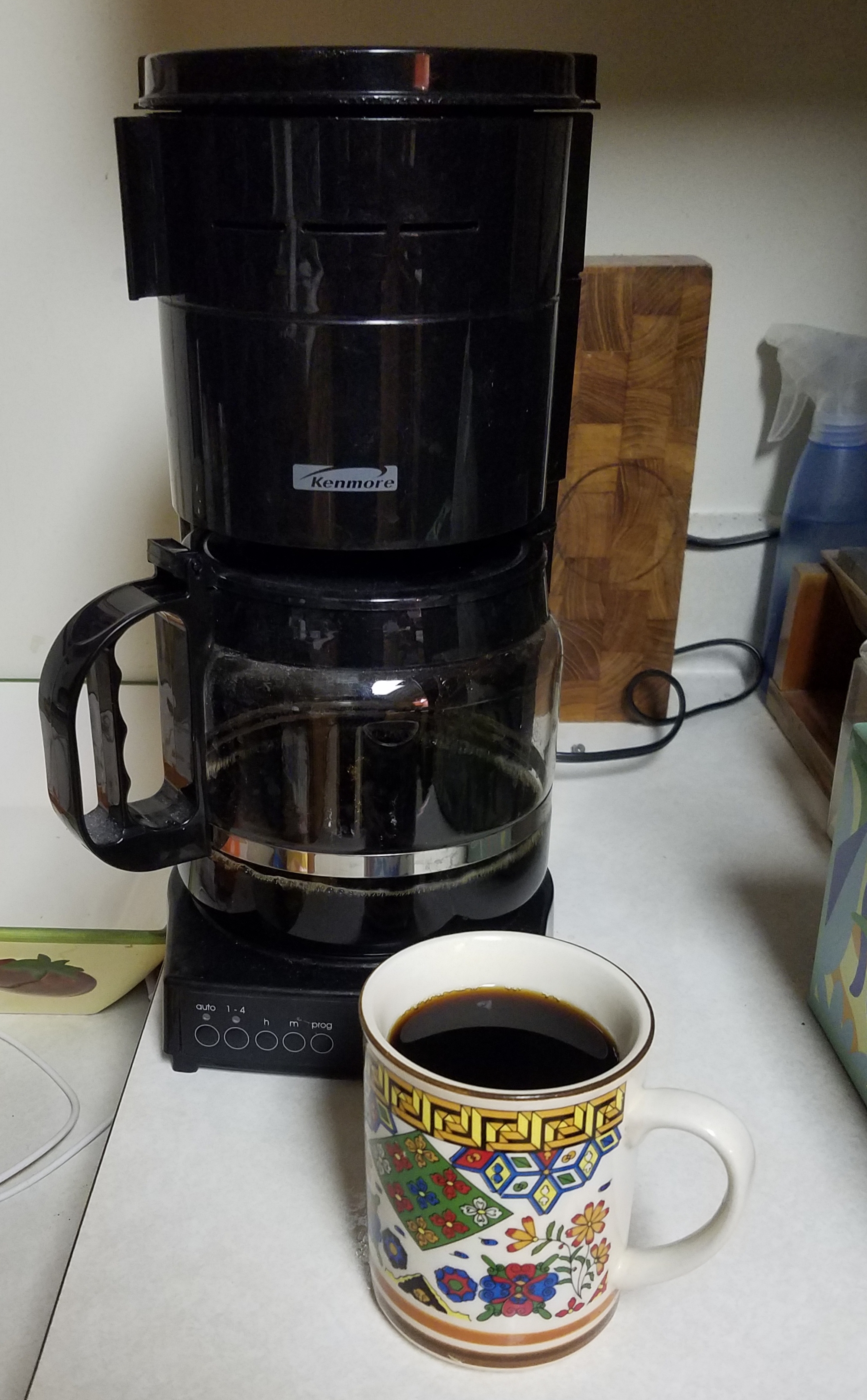
Got out my Kenmore drip coffee maker and the brew is noticeably better.
47°F at winter solstice last night in Iowa. That’s very warm for the beginning of winter. Rain is forecast most of today so I began indoors exercises to compensate for not getting out on the trail: dumbbells, walking in place, calisthenics. Today, I need to revise the daily outline that drives my morning.
By daily outline I mean the 8-1/2 x 11 inch piece of paper on a clipboard next to my writing table. It contains the sequence of events for most days. It occurred to me, after reading how other writers work, that I should clear clutter from early morning activities and write while still rested. Revision of the outline was needed and straight forward.
There is getting up, which includes taking blood pressure, stepping on a scale, dressing, making coffee and taking my morning vitamins. Checking my mobile device is in there, yet I want to delay that until after a couple of things.
First is reading 25 pages or more each day. I take my coffee to the living room, grab a blanket from the rocking chair, and settle down with coffee to read. I am a slow reader, yet I want to get this done before the day gets away from me. Sometimes, if I can’t sleep, I’ll read in bed although that is never the plan. Depending on my level of interest in the current book, this takes about an hour.
Second, the big change is to record progress in Goodreads, refill my coffee, and walk immediately downstairs for a writing session. How long that will last depends on the day and what inspiration might be present.
The change is also delaying time with my social media, reading the newspaper, reviewing banking, paying bills, eating breakfast, exercise, and other daily chores until reading and writing are finished. I’m hoping this will provide a clearer mind and better focus on writing. Also, I hope to get more writing done.
I printed the new form. The new daily outline begins tomorrow.
Our holiday season begins Dec. 18 with our wedding anniversary and continues until January. I hope to plan a lot during this time. The daily outline, one more small thing, is done.
On the shortest day of the year, I grabbed a couple of stacks and started going through artifacts of my life. The current pile is mostly cards and notes sent for occasions long forgotten. I developed a new rule: If I can’t recall who sent an item, it’s off to the shredder.
The owner of his namesake home, farm, and auto supply company used to send an annual, hand-written birthday card while I was employed there. Apparently, I kept them all. Amy Klobuchar sent a Christmas card in 2019 when she was running for president. I think she will run again. Tom Harkin’s operation was a Democratic machine and I have a couple of his Christmas cards. I am sorry to see him gone from the U.S. Senate.
My friend Ed sends irregularly arriving letters about the Veterans for Peace chapter we founded. In one was a photograph of 16 of us at the Iowa City Public Library. I pulled that out and put it on the magnetic white board next to my writing table. The group suffered a bit as the World War II and Korean War veterans died. In this month’s letter it was uncertain whether our chapter would survive.
There was a ticket stub from the June 13, 2009 performance of Midsummer Night’s Dream by William Shakespeare. Riverside Theatre produced the play on the Festival Stage at Lower City Park. Our child and I spent several nights there through those years, guarding the property from vandals. After our shift, we had breakfast at Hamburg Inn No. 2. I found a card from Ron Clark and Jodi Hovland thanking us for our support. One season, they both played mechanicals in Midsummer Night’s Dream, although I don’t recall if it was this performance. Theirs were some of my favorite performances in the many Shakespearean plays I have seen.
I found one of the last letters from Mother in an envelope addressed by my sister. Mother apologized for not baking a fruitcake due to complications with the aftermath of a root canal. I’m afraid the fruitcake tradition is barely alive at this point. If we were to make one, it would not be anything like hers. I believe we have family fruitcake recipes stashed away in piles and cookbooks. So, there’s that.
I found a recipe for Date Pinwheels provided by a friend from when we worked at the university. It is written in his hand. I pulled it out of the pile to stick in my hand written cookbook. My spouse and I were visitors to his apartment a few times. He was a fan of the Star Wars movies and had copies on the new technology of VHS video cassette. We watched a movie or two with him on VHS. We won’t be making any date pinwheels because one of us is vegan and we’ve yet to find a good substitute for eggs and butter in baking.
I finished the first stack and the next is a pile of letters, drafts and papers. Most of this pile is related to my autobiography. I kept most letters I received and there are many tucked away in different places. This pile has ones to which I referred in writing the first part of the work.
I printed the State of Illinois Bureau of Labor Statistics Report on the Cherry Mine Disaster on Nov. 13, 1909. My grandfather worked the Cherry Mine although was not present the day of the fire which claimed 259 lives. He worked in several mines over his long career as a coal miner. I learned more about coal mining than I thought possible from reading this report. It explained the mine, how it was dug, and has a detailed description of the sequence of events during the disaster. Being a coal miner must have been a drudgery, one with constant danger of being buried alive. This is a common thread throughout my side of the family where both Mother and Father were descendants of coal miners.
Eventually I will dispose of all this paper. There is too much to leave as an inheritance. The purpose of my autobiography is to distill a narrative from these diverse documents. For now, having gone through them, they are back on the sorting table until I refer to them again. It’s a fit way to spend part of the holiday season.
Unitarian Universalist Society of Iowa City, Dec. 18, 1982.
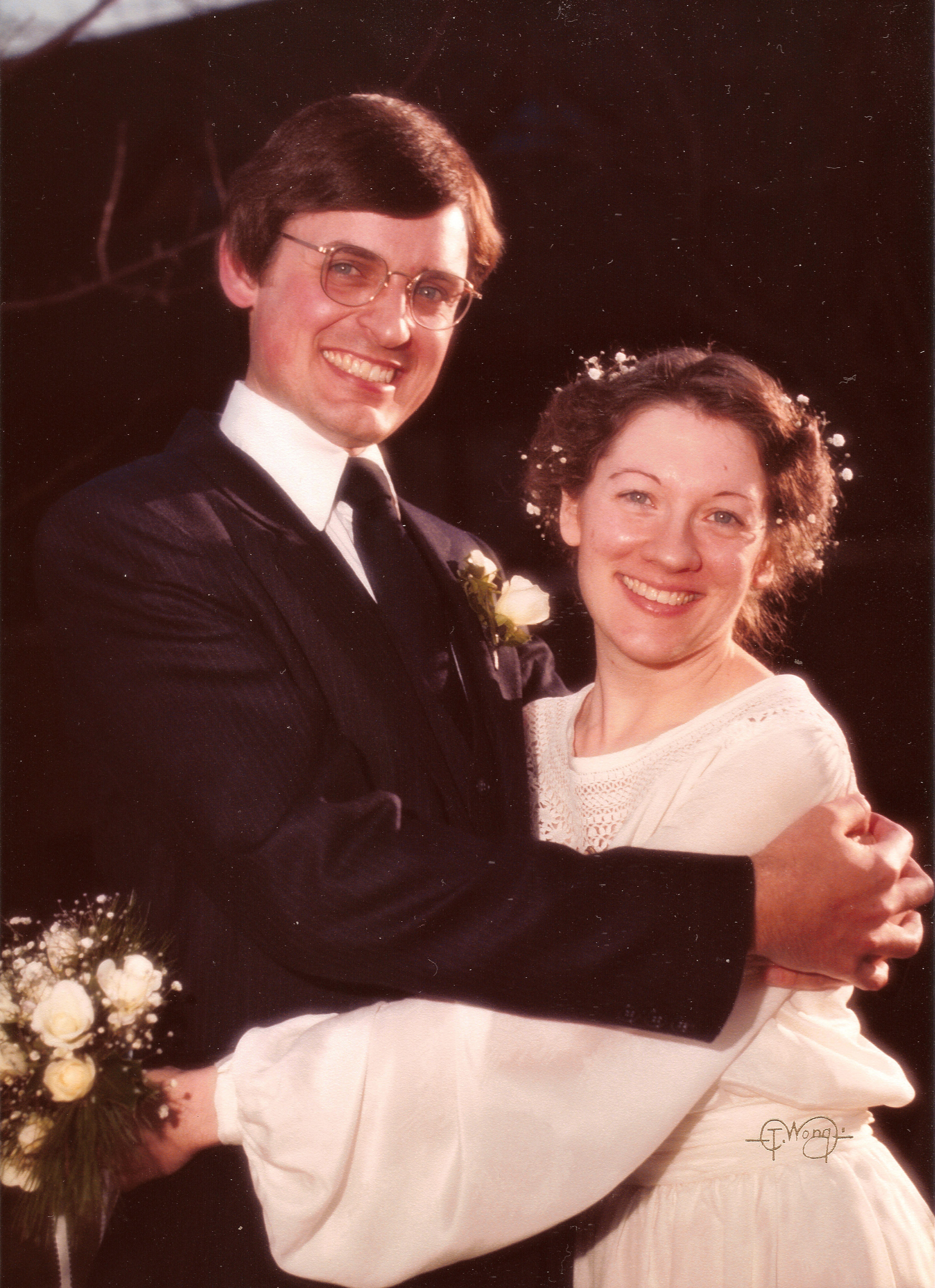
Yesterday we noted it has been 41 years since our wedding. We are still together. We spend more time together and need each other as we age. In these times, that a marriage lasted so long is atypical. That’s us.
I wrote about this moment in my work in progress autobiography:
If one looks at the wedding photograph of us standing in front of the church door, right after taking our vows, it represents what happiness looks like. The day was also a unique embarkation on a search for truth and meaning in our lives.
In the moment of that photograph, on a warm December day, within a small gathering of family and friends, at a modest reception, and with a wedding trip planned, we started the journey we continue today. Words can’t capture how we felt except to say, it was a defining moment full of every potential that life offers.
An Iowa Life, work in progress.
As we age, I do most driving and in-person shopping. Together we nurture our health. Like many marriages, ours had ups and downs. I try to focus on the good as I age. There is no denying we made a happy start. This photo is evidence.
Among other things, participating states pledge to “commit to work together to advance a global aspirational goal of tripling nuclear energy capacity from 2020 by 2050, recognizing the different domestic circumstances of each Participant.” The problem is adding nuclear capacity by 2050 is not fast enough to address the climate crisis. In essence, the declaration is yet another delay tactic by moneyed interests. Like it or not, we are set to blow past a temperature rise of 1.5 degrees Celsius. We can’t wait for nuclear power, especially when effective, easier to implement, and less expensive alternatives are available.
This 60-second video by Stanford Professor Mark Z. Jacobsen cuts to the chase. Time is running out.
Sunday evening, my congresswoman released a statement after attending COP 28. It includes this sketchy language about nuclear power: “advanced nuclear energy is being revisited to provide capacity and dispatchable continual base load to the energy mix.” In other words, she didn’t get the word that ten years ago, Iowa had an opportunity to build new nuclear power capacity and pulled the plug on it.
As Professor Jacobsen said in this video, new nuclear energy is no help whatsoever in solving the climate problem. We should proceed on that basis.
Wikipedia: Substack is an American online platform that provides publishing, payment, analytics, and design infrastructure to support subscription newsletters. It allows writers to send digital newsletters directly to subscribers. Founded in 2017, Substack is headquartered in San Francisco.
Finding an audience is challenging. When I started writing in public in 1974, letters to the editor were the usual way to get people to read my work. I had vague notions of becoming a novelist, yet found it difficult to break from the exigencies of a life to produce a novel. In 2007, I began blogging and that, combined with social media, satisfied and is satisfying my need for a readership. I have modest needs.
I read a large number of WordPress blogs and the writing is usually good. There are about 60 million WordPress blogs. Regardless, most don’t seem to get much traction. While the static format can and does gain readership, authors yearn for something more.
I can see why Substack is more attractive than a static blog. It harks back to earlier days when everyone had a junk mail, or later, a junk email list. We would send out the same newsletter to everyone on the list. Often recipients replied and you knew they read your writing. The efficacy of that was mixed. I look at my daily stats of emails sent from this blog to email subscribers and less than 10 percent get opened. Can Substack, with email delivery, be any better?
A number of Substack missives find their way into my email inbox. The ones I read regularly can be counted on one hand: Heather Cox Richardson, Laura Rozen, Art Cullen, Liz Mair, and one finger left over. Simple fact is there are too many Substacks, not enough time. Julie Gammack has organized a large number of Iowa Substack writers, and listed 45 of them on a Sunday morning email. There are good writers among them, yet there are so many. It is too much work to pan through them all to find nuggets of gold.
I wonder why a writer like Heather Cox Richardson publishes on Substack rather than being syndicated in a couple hundred newspapers. I suppose there is a benefit to being able to hit send on the computer when the piece is done, rather than meeting a newsroom deadline. Hopefully she has many paid subscribers and is getting rich from her Substack. Her reach and influence is a modern phenomenon. She deserves to be well-paid.
I get asked if I am moving to Substack. I am not. I figure to write in public until the 50th anniversary of my first letter to the editor in 1974. After that, I’ll focus on my unfinished autobiography and hopefully complete it by the time I turn 75… or before my mental capacity wanes. Then I plan to take it easy. God willing my eyes hold up and I’ll read more books written by others. I don’t see myself as an audio book guy. I may take up writing letters to friends, although my cohort is beginning to die off. I will continue gardening.
What has been important is building community, now with a new group of people whose interests intersect with mine. That new group will include many more young people, something I find is happening already on my new micro-blogging account on Threads. That is important as I wind down outside activities and focus on writing. If more young people read my posts, that’s what I want. I am far from cracking the code of any kind of viewership.
People will do what they want regarding Substack. I’m of an age where I don’t want to spend time learning something new, especially when I expect to be at writing in public for less than a year more. Like anything, Substack is no panacea for what ails a writer. As they say, though, not my circus, not my monkeys. I say live and let live… on substack if you please.
One of my long-standing beliefs is nearby Iowa City is a safe haven for LGBTIQA+ people. It is a place where people can live without undue fear and be who they are. It was, anyway. I recently heard the LGBTIQA+ community is breaking up. Folks are moving out of state to escape the regressive policies of our Republican state government. Governor Kim Reynolds has been the lynch pin in persecuting LGBTIQA+ folks and her supporters cheer her on. If what I heard is accurate, this is a sad legacy. We need a haven for the vulnerable until broad acceptance of diversity is forthcoming. By the fact of Iowa City being the county seat the haven it has been exists, yet seems under pressure.
I have been insulated from this because I don’t live or do much in the county seat. My LGBTIQA+ friends are long-standing and rooted. They are friends, not members of some group. When we get together we discuss important stuff like which schools are best, which clinics provide good health care, and politics, of course. This is what normal people do.
Changing perspectives of our lives in contemporary society is part of living. As Iowans abandon the countryside in favor of living in large metropolitan areas, there will be diversity in cities. That it is concentrated is more the problem. Like every other time in the state’s history diversity can cause isolation, alienation, and conflict. People literally get run out of small towns and cities because they are different. Unless one was born and grew up in Iowa, there is no reason to stay. My issue as a native Iowan is I don’t know where I would go if I left.
All of this makes life more difficult for an aging American. It would be great to invite LGBTIQA+ family members to move here and find a home closer to ours so we can spend more time together. They could be their authentic selves, including being part of our family. That remains possible in a more liberal county like ours, yet the freedom needed to perpetuate this culture is being eroded.
We’ll see where this ends. What I now understand is I must be more attentive to diversity in the county seat as well as where I live. If I am not, there will be safe havens no more.






 Journey Home
You must be logged in to post a comment.