Barack Obama at the 2006 Harkin Steak Fry. I met him in this rope line.
A friend and I met for coffee across the lakes to prepare for the Iowa Democratic caucus on Jan. 15. I took along one of my volunteer sheets from the 2008 presidential campaign to discuss who we might get to volunteer this cycle.
We found ourselves asking the question, “Are they still alive?” before discussing most of them. Long story short, so many people have moved out of the precinct or died since 2008 voters have gone fully Republican here during the general elections in 2020 and 2022.
People scratch their head about how Iowa could vote for Obama twice, then for Trump twice afterward, as we did in my precinct. My interpretation is Iowans are on the move, including rural, conservative folks who want to get closer to the major metros where the jobs are, yet don’t want to live with all the liberals there. They seem to concentrate in rural and outlying subdivisions like ours. People are also on the move out of state where better job opportunities can be found. Not every one wants to become part of the industrial agriculture operations that dominate business in the state. The exodus is encouraged by repressive governance by the current crop of Republican state officials.
The caucuses are important to Democratic party officials who hope to launch an organizing miracle to turn the state purple (we’ve given up on blue). The truth staring us in the face is without the presidential preference part of the caucuses, people lose interest.
There has been good coverage of the caucuses in the Cedar Rapids Gazette with a special section with all the locations in the Sunday paper. People have every reason to know about the caucuses. We’ll see if they turn out and at what level. For perspective, we had 12 Democrats show for caucus in 2012, Obama’s re-election year. If we did that number a week from today, I’d be reasonably happy.
Dubai, UAE site of COP 28 – Photo by Aleksandar Pasaric on Pexels.com
I met with State Senator Joe Bolkcom before he retired to discuss ways to mitigate the effects of climate change. He told me something important as we finished our conversation. “Join a group and get active,” he said. What does that mean?
With a challenge so big it involves all of the populated regions of the globe, one person’s impact is not as useful as when we work with others to solve the climate crisis. As we face its challenges, it is important for our own sanity to feel like we contribute to solutions as individuals. Actions like reducing gasoline use, reducing natural gas use, reducing electricity use, eating less meat and dairy, and growing some of our own food are all important. These actions matter, yet what matters more is what we, as a society, do collectively. That was Bolkcom’s point.
On Dec. 13, 2023, delegates to the 28th Conference of the Parties (COP 28) agreed to transition away from fossil fuels. This despite heavy lobbying from delegates representing fossil fuel interests to do nothing.
Nearly 200 countries struck a breakthrough climate agreement Wednesday, calling for a transition away from fossil fuels in an unprecedented deal that targets the greatest contributors to the planet’s warming. The deal came swiftly — with no discussion or objection — in a packed room in Dubai following two weeks of negotiations and rising contention. It is the first time a global climate deal has specifically called to curb the use of fossil fuels.
Is the cup half full or half empty? Citizens engaged in solving the climate crisis should take the positive which this agreement represents even though it falls short of our aspirations.
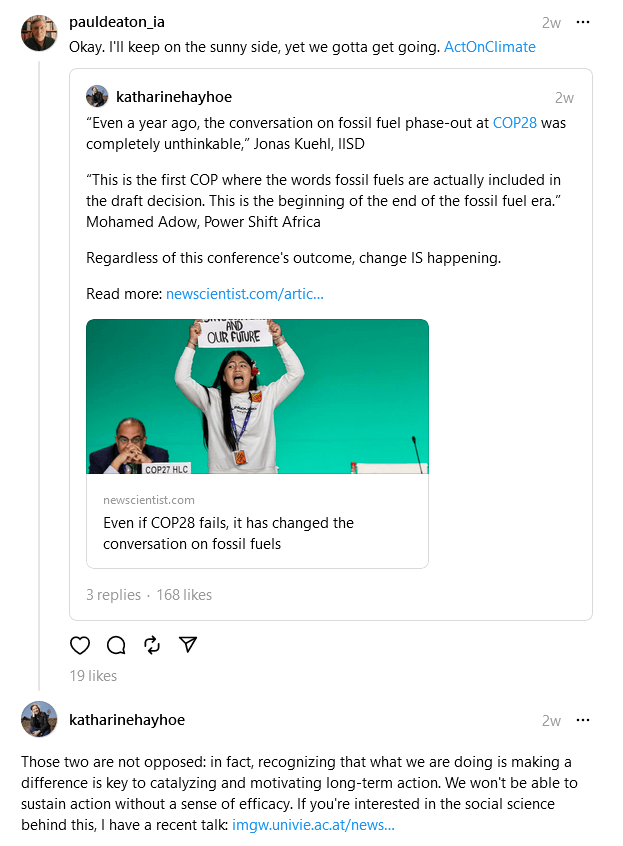
When I activated an account on Threads, one of the first accounts I followed was climate scientist Katharine Hayhoe who is active on that platform. We had this exchange about COP 28, in which I quote-posted her report from COP 28:
As Hayhoe said in the talk referenced above (Here is a link), the challenge is to move from worried to activated. It is not only possible, it is imperative that advocates for solving the climate crisis do so.
Back to my question, is the cup half full or half empty when progress toward transitioning from fossil fuels saw such resistance at COP 28?
Senator Sheldon Whitehouse (D-RI) said after COP 28 closed, “A small, self-interested minority of states cannot be allowed to block the progress necessary to put our entire planet on a path to climate safety.”
2023 was a disastrous year for our climate. We experienced the hottest year on record and the extended Iowa drought impacted corn and soybean yields. Rivers and lakes began to dry up. What gets overlooked is that just as the climate crisis seems to get worse, actions to tackle the problem are ramping up. There were environmental wins out of COP 28:
The cost of solar power has fallen by around 90% and wind by 70% in the past decade.
The majority of new energy capacity being added in the U.S. and globally is solar, wind, and battery storage; these renewables already account for nearly 14% of the U.S. energy production and 12% worldwide.
Electric vehicles are becoming cheaper and more attractive. For the first time, more than one million EVs have been sold in the United States in a calendar year.
At COP28, delegates took a historic step in establishing a loss and damage fund, the latest development in a three-decades-long fight to have wealthy, high-emitting countries compensate vulnerable, developing ones for the harms of climate change.
For more positive news, read Katarina Zimmer’s complete article on Atmos.
Despite its shortcomings, COP 28 marked a major step forward for the environmental movement. For the first time ever, a COP agreement explicitly acknowledges the main culprit responsible for the climate crisis is fossil fuels. While the agreement falls short of what many of us wanted, it still reflects progress in a decades long struggle to address the climate crisis. We should keep on the sunny side and build on this progress by finding other, like-minded people and getting active.
Editor’s Note: This is an excerpt from my autobiographical work in progress.
In life, the world seems unknown until one lives it. Whether or not I would have found CRST, Inc. without my job search is an open question.
CRST, Inc. exploited the 1980 Motor Carrier Act that deregulated trucking and helped break the teamsters’ unions. This legislation passed during the Carter administration and was implemented during the Reagan years. While some trucking employees continued to be represented by the union, their numbers diminished after deregulation. Shippers benefited from lower costs and the expense reduction came mostly from new, non-union companies, made possible by lower wages and fewer benefits for employees. It was another feature of the Reagan Revolution.
Founded as Cedar Rapids Steel Transportation, Inc., on March 1, 1955, when I joined the firm on March 29, 1984, it was very much a “Company on the Grow.” While founder Herald Smith did not have a business education, through entrepreneurial energy, an ability to carve out a niche in the highly regulated transportation business, and a willingness to confront unions and union rules, he was able to establish CRST as a viable entity in the years before de-regulation. When the Motor Carrier Act of 1980 deregulated trucking, Smith, and people like him, took advantage of the new operating environment.
According to In It for the Long Haul: The Story of CRST, published to note the company’s 50th anniversary in 2005, CRST Inc. was the third company in the nation to secure 48-state operating authority after deregulation. Smith sought to eliminate the part of his business that was unionized, reducing pay and benefits, and creating cost efficiencies to support a lower rate structure. He did this by hiring independent contractors who owned and leased their own tractor-trailer rigs to CRST, Inc. and by acquiring companies that had non-union company drivers and then keeping them that way. This practice kept the number of union employees in decline as the company continued to grow.
By the time I joined the company, annual revenues were about $60 million and the “tough on employees” environment that characterizes many entrepreneurial businesses was evident throughout the organization. To me, it was something new and exciting, a natural extension of having served in the United States Army. I looked forward to the new opportunity.
I remember walking into the operations office during my job interview and saying to myself, “I hope I don’t have to work in that room.” In the office of what had previously been an LTL cross dock, was the core of the operation: van operations from the Midwest to the east coast, flatbed, and trip lease. Van operations had an island of workstations in the center, with additional work stations around the perimeter. A number of employees were smokers and a grey haze of tobacco smoke filled the room. The language was on the blue side, indicating an acceptable means of expression and interacting with others. It was a mostly male environment, although there were some women, most of them working in clerical positions behind a glass wall on the East side of the room when I entered that first day.
I had applied for a position in the shop, but my interviewer thought I was overly qualified for the position. He referred me to operations. The supervisor had been with the company a long time, was a Vietnam veteran, and had an office in the operations department. He interviewed me and then introduced me to the person who managed a company called Lincoln Sales and Service, which was becoming the growing, non-union part of the company.
Lincoln Sales and Service sought to hire management trainees, train them in the business and then have them open growth terminals throughout the country. All three interviewers treated me well, and with my military experience, they viewed me as having the “aggressive” personality traits they were seeking for management staff.
CRST, Inc. characterized itself in the newspaper ad to which I responded, “CRST is an aggressive, rapidly growing, major motor carrier transportation company based in Cedar Rapids. To help us in our expansion plans, we need a dedicated, career minded individual to fill a management trainee opening in our maintenance department.” Emphasis was on being “aggressive.”
I took notes after my interviews, writing on March 13, 1984: “Impressions: A good company, Iowa owned, they offer good benefits, and an entry a step ahead of other management positions I’ve been looking at. I feel the benefits of the other interviews to date.”
I was interviewed on March 12, went for a company physical on March 13 and was offered the job the same day. That night, I laid out the pros and cons: “PRO: good pay, pay incentives, location, benefits good, family owned (vs. public), I can relate to the people to whom I talked, expanding company, 65/100 of major carriers, chance for advancement, yearly evaluations, interesting, leadership, use more of my skills. CON: 2nd or 3rd shift, relocation in a year.” As indicated, I began work on March 29.
I did my research on CRST, Inc. and the characteristics of the job and company met my expectations.
…the Interstate Commerce Commission’s rigid controls on who could carry what freight at what rates over the nation’s highways were reduced almost to the vanishing point by the Motor Carrier Act of 1980 and by greater leniency on the part of the commission itself. Since 1981, about 9,000 new carriers have thronged into the field. When the 1982 recession almost simultaneously reduced the amount of available freight to be handled, an orgy of rate-cutting and discounting resulted…
…Nevertheless, a few companies, such as CRST, are enlarging their volume and profits even at a time when the industry’s excess capacity still is holding down freight rates. CRST’s success at swimming against the tide is all the more notable because it isn’t one of the giants of the trucking business and because it is a full-load carrier where the competition is the hottest.
Wall Street Journal, Feb. 13, 1984.
Goals for CRST, Inc.
Keep a business journal with entries at least monthly.
Learn the basic elements of the trucking industry…sales, maintenance, administration, terminal operations, etc.
Develop as a person, increasing my ability to communicate and motivate subordinates.
Write an article about my entry level experiences.
Demonstrate my competence prior to the six month review date.
Within one month, draw up a list of quantitative goals and achieve them.
Demonstrate that I am the one in a hundred who can best do the job.
Business journal entry, March 28, 1984.
I started work on March 29 and was one of a class of 16 management trainee and new exempt employees who began training on April 2, 1984. Of the 16, Mike Gannon, now Groups President of CRST International, Inc., is the only remaining person at the company as of this writing.
It was an exciting time, and I was glad to be a part of this growing, Iowa-based company. Too, the initial salary of $17,000 per year was enough to enable Jacque to stay at home while we tried to start a family. Things looked pretty good in March of 1984. Jacque left me a note the morning I left home for my first day of work as a maintenance coordinator.
I encountered no surprises during my first two days with CRST. I trained with the first shift breakdown coordinator in the shop. He was located in the maintenance office, where I met him and other employees who worked there. I got a good feeling for the operations of the company, where they are, and what kinds of maintenance problems the drivers experience on the road. My initial impression is that these are people dedicated to getting the job done right.
[…]
Having been an Army officer, I appreciated the approach the company made to providing training to assimilate me into the company. As a company with growth plans, they recognized the need for training, and while there was not a specific training agenda, the company wanted me to think like the management team did regarding operations. At the same time, having managed soldiers in Germany, I possessed a firm sense of myself and quickly cut through the inefficiencies of my predecessor in the position to make changes to what I felt were more viable solutions to daily problems.
Having this awareness from the beginning of my employment enabled me to make good suggestions for process improvement and at the same time contributed to a disengagement from the prevailing management outlook at CRST. This would be a positive for my career in the first couple of years of my work in transportation. My stock within the company would grow in value. There was a direct consequence on my writing and home life.
Last night I attended my last meeting as a member of the county party’s Democratic central committee. Once I chair my precinct caucus, I’ll be finished with my obligations. Considering it was 2004 when I reactivated in partisan politics, 20 years is enough devotion to this civic duty. It’s time to move forward.
Given my belief in the importance of collective action, what shall I do? I don’t know. Decreased mobility as I age will have me avoiding knocking on voter doors in future cycles. Likewise, the technology that drives human interaction has changed since the days when I could grab a list and make effective telephone calls to voters. Stuff envelopes for mailings? Maybe, yet that has its problems as well. One reason I am leaving active Democratic politics is the old methods don’t work any longer. There are demographic changes at work in my precinct and they have driven the electorate to vote Republican. The local Democratic party hasn’t kept up with the times, God love them.
I may be best at writing about the Iowa political scene. While newspapers are dying (small town Iowa newspaper continue to consolidate or close), when I post something on the Insights page of the Cedar Rapids Gazette, it gets noticed. Same thing with my bloggery here and on Blog for Iowa. I’ve written my share of candidate support/opponent criticism op-eds, yet the times call for something different to dig us out of a hole of ineffectiveness that enables Republicans to thrive.
What seems most important, that few are paying attention to as such, is the further deterioration of the post-World War II consensus that brought unparalleled economic vitality to the United States. Rich folks and libertarians never cared much for the changes wrought by Franklin Delano Roosevelt, and have fought those changes vigorously during the Post-World War II prosperity. It looks like they are finally beginning to win this struggle to the detriment of citizens like me, to the detriment of a Democratic form of government.
People say our politics divide us, but what about it does? The Milton Friedman doctrine that “the social responsibility of business is to increase its profits” is a significant part of why Americans are so divided in our politics. This prevailing culture ran contrary to what skilled workers believe and eroded a key aspect of society for people who sought identity through the workplace. It forced a choice between our values and pragmatism. It has not been good for society. It left a vacuum that remains unfilled. Republicans, including the 45th president stepped in to fill the void with their malfeasance.
We must ask better questions of businesses: What great products do you make? How do your workers buy into the company? Why do corporate CEOs get paid so much? How are you giving back to the community? What percent of revenue is invested in long-term research and development? What do you do to make life better for consumers who use your products? If you outsource parts of your business, what is your moral responsibility to subcontractors? How does your company deal with external costs like its impact on clear air and water? There are other questions inadequately addressed that could occupy a writer’s time in perpetuity.
As I write my autobiography, I’ll dive into my political history, beginning with my favorite story about working for Lyndon Johnson’s 1964 presidential campaign. However, my public presence in politics must change to secure the benefits of living in a democracy. No political party can help much with that. Their role must continue to be to find excellent candidates to run against the Republican machine. I ruled out running for office again. It is time to pass the baton to the next generation of political activists and focus on what I do best.
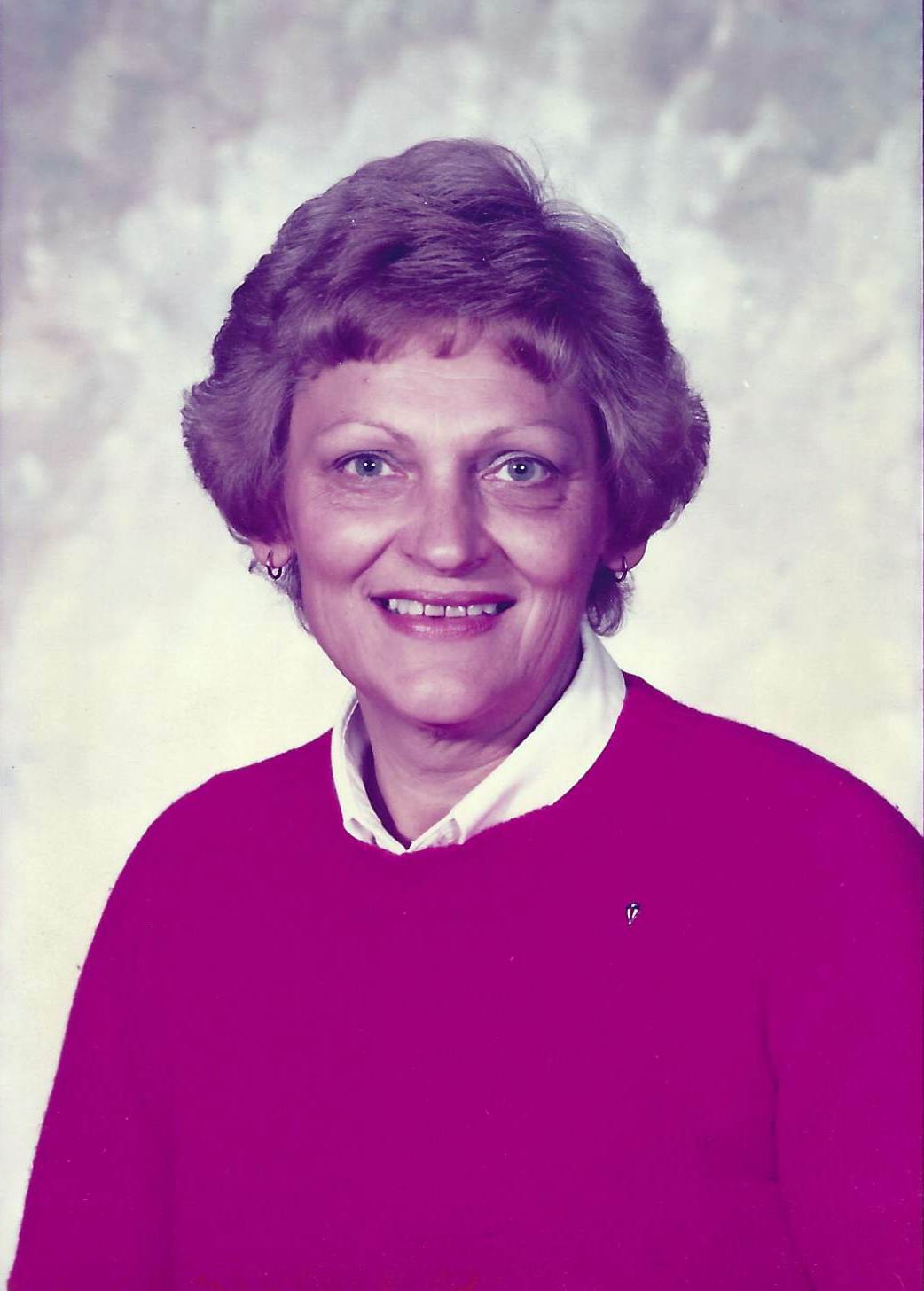
Lorraine Deaton at the U.S. Army Corps of Engineers
While sorting my papers I made a pile of letters from Mother beginning when I left for university in 1970 and ending when I returned from military service in 1979. There are about 50 of them, containing a lot I didn’t realize when I received and read them the first time. What does a person do with such artifacts?
She wrote a lot of them while working at the U.S. Army Corps of Engineers on the Rock Island Arsenal. She mentioned writing them on her breaks, yet from the tenor of the letters, I believe she also wrote them on her work desk. It was her chance to get me caught up on family news while she was working an important job.
The early letters are newsy, yet part of them is also about her adjusting to being widowed at a young age. She didn’t date anyone new for a long time after Father died. She felt socially uncertain about attending parties solo. One summer she had a romance with someone who worked for the AAA ball club in Davenport. When he moved back to California at the end of the season, the relationship was over. The level of confidence she shared with me did not broach my consciousness at the time.
She didn’t know how to handle the fact I enlisted in the U.S. Army after graduation from university. Having lived through the aftermath of World War II, the Korean Conflict, and Vietnam, I’m certain she was concerned for my safety as only a mother could be. She attended my commissioning ceremony at Fort Benning, Georgia and talked about visiting me in Germany while I was stationed in Mainz. We never got her trip to Europe arranged.
She worked several jobs to make ends meet. In addition to her work at the Corps, she worked at a credit union and did keypunch for the American Automobile Association. She liked the keypunch work, as that’s how she got started working for the government. She could go in for her shift, do her work, and leave any thoughts about it behind when she left. Unfortunately the keypunch work was lowly paid and she soon quit because the work did not pay enough.
She often complained in the letters of how tired she was from working. She accomplished a lot after Father died yet I believe she would have been fine had the two of them had a full life together. She made clear in the letters returning to the workforce was something she was forced to do to survive as a widow.
She wrote a long letter after discovering there was an inheritance of land in Virginia. My Great Uncle Roy had been settling the estate of Patrick Henry Addington and Tryphena Ethyl Miller, my great grandparents. They died intestate and there was a matter of land to be divided among many relatives. With the death of my paternal grandmother and my father, those many relatives included me.
In the letter Mother wrote about possible plans for the land. While Great Uncle Roy had been buying everyone out to get clear title, Mother and my Uncle Gene had discussed joint ownership of our share. She described two level surfaces on what would have been our plot, where a house could be built. We would share use of the property, she proposed. Nothing came of this and during a 1983 trip to Virginia, I quit claimed my share to Uncle Roy.
Letter writing is a lost art in 2024. It is a much different thing to sit alone and write to someone we’ve known our whole lives. If I were stationed in Germany today, and Mother were still living, we’d no doubt video chat via Discord or Face Time or Zoom. She did such a good job writing letters I continue to learn from her. For the time being, I’ll keep them.
The recently finished holiday season was good for at least one thing: I spend more time writing. A funk spread over me for a few months as the garden wound down. Now, the desire to write is hard to contain. I feel some of what I recently wrote has been pretty good, both on this blog and in my autobiography. A couple things made the difference.
Perhaps the biggest is by reading more, I’m beginning to gain better understanding of contemporary affairs and connect dots. When I began using Goodreads to track my reading, the goal was to start reading books again. Somehow I had fallen away from book reading. When I made a commitment to read 25 pages per day and began tracking books read, the number of annual books read grew from 24 in 2018 to 69 in 2023. Quantity improved measurably.
Better than quantity, I’ve been able to correlate perspectives of history that didn’t previously come together. Because of my book selection process, I tend to read books with similar themes, with direct consequences. For example, the Reagan Revolution is clearer to me now that I read multiple books from different perspectives about it. As understanding deepens, it lays a foundation and context for my recent personal history. There is no reason to describe the wake of Reagan and neoliberalism, but rather assume it as background and build something positive from there. My recent letter to the editor of the Cedar Rapids Gazette is an example of what is possible.
It may seem like a small thing, but beginning to write Part II of my autobiography using chapters with names helped a lot. Instead of a Jack Kerouac-style automatic streaming of content from memory, the chapter titles break up the narrative and enable the reader (and the writer) to focus on one thing at a time in a long and complex narrative. This was a recommendation of a friend who read Part I early last year. It was a positive addition.
I’m filling in for Dave Bradley at Blog for Iowa until his family gets settled in Indiana. That means I have a commitment to provide at least two posts each weekend. The weekly obligation keeps me thinking about possible topics. At the same time, it helps organize the flow of ideas into buckets for that blog, this blog, letters to the editor, and my autobiography. Having a firm deadline to produce something for an audience helps maintain focus. Dave expects to be away for several months, and it will help my writing.
I deactivated my X account on Nov. 22, 2023 after 15 years on the platform. After giving Threads a thorough beta testing, I found a core group of accounts that provide diversity and interest so when I need social media, I have a responsive place to go. I would like to rebuild what I had on X: a strong group of Iowans interested in politics. It’s happening slowly, but I’m hopeful with a presidential election this year, it will come together by Labor Day. I’m still new there. The biggest change is the weight of X toxicity was lifted almost immediately. That has been good for my writing.
I don’t make New Year Resolutions yet feel like in 2024 I can accomplish a lot on my autobiography. By reading and writing more, the process gets better defined… and easier. That should make the writing better. If the holidays provided a needed boost to my writing, I’ll take it.
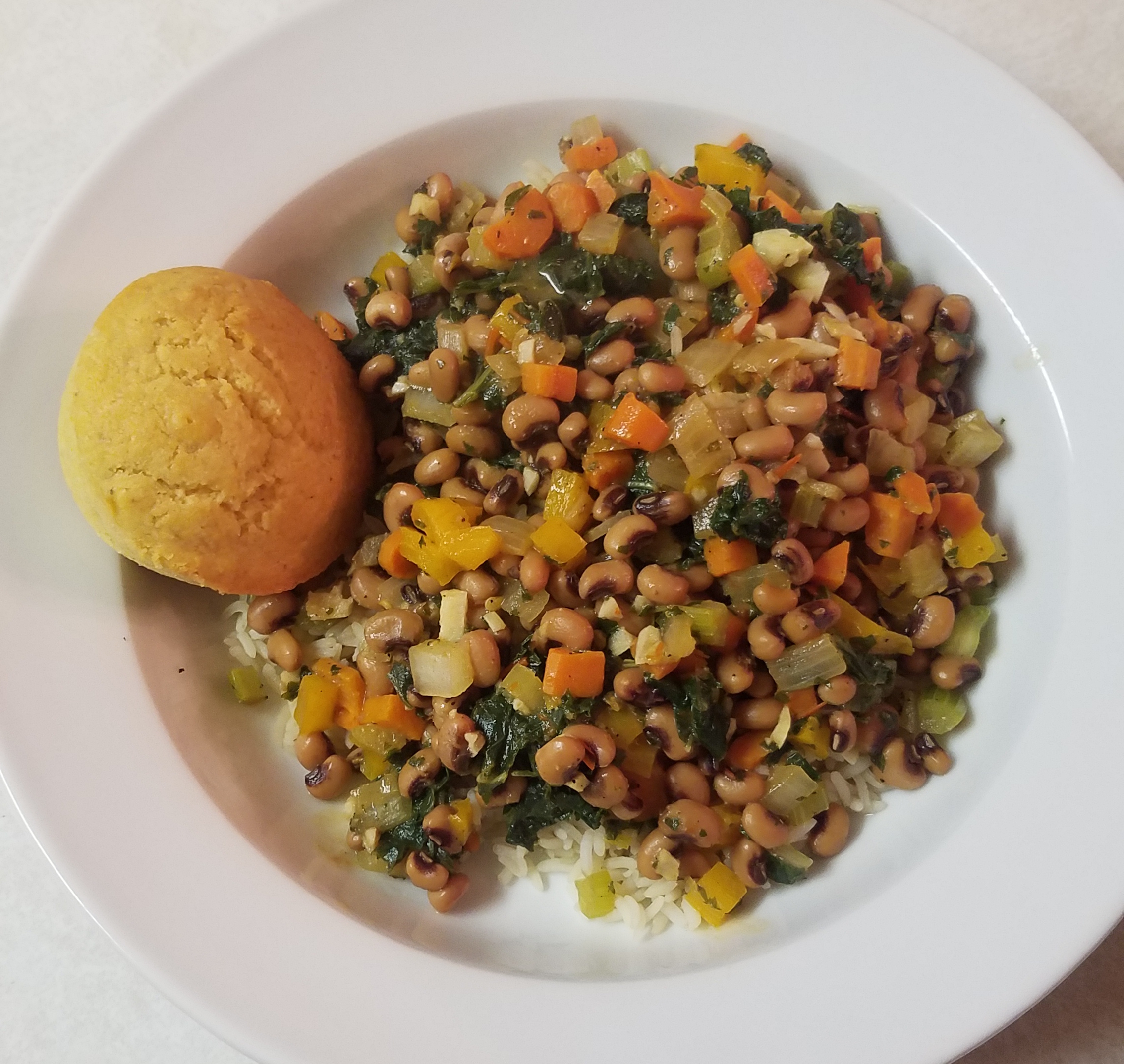
Black-eyed peas, rice, and cornbread for first meal of 2024.
An uncomfortable truth about environmentalism — that no one wants to discuss, especially in Iowa — is the amount of land used to feed and husband animals. To say it another way, the best thing we could do to mitigate the effects of ongoing climate disruption is to drastically reduce the amount of animal products consumed by humans. Not by a little, but by a lot… and immediately.
In his recent book, We Are the Weather: Saving the Planet Begins at Breakfast, author Jonathan Safran Foer wrote about this. In the appendix he discusses how he came to the environmental impact animal husbandry makes. It ranges from 14.5 and 51 percent among different experts. How does one even begin to address this? Here in Iowa, someone who suggests humans stop eating animals and their dairy products wouldn’t get one minute of attention. They would be run out of the state.
The State of Iowa developed into an agricultural state and with reason. The prairie that existed after the 1832 Black Hawk War is almost gone. In its place is a grid of once fertile fields and crop land to take advantage of our temperate climate, rich soil, and adequate rainfall. It seems quite organized in 2024. It is. It is organized to extract as many crops from this ground as it can, growing corn and beans fence row to fence row. If the nutritional content of the soil isn’t what it used to be, there are fertilizers to help. While not all of the corn and soybeans is fed to animals, the contribution Iowa-style farming makes to environmental degradation is astounding.
Safran Foer would have the population take collective action to reduce or eliminate consumption of animal products. As the title of his book suggests, he asks us as to eat no animal products before the evening meal. The problem, he points out, is that people will convert to a “plant-based diet” or “go vegan” in order to check a box, assuage guilt, and feel hope, rather than taking more substantial, collective action to mitigate the causes of climate disruption related to agriculture. This is a problem wanting a solution. Because it is controversial, few appear to be working on it.
As we face the climate crisis, it is important for our own sanity to feel like we contribute to solutions as individuals. Actions like reducing gasoline use, reducing natural gas use, reducing electricity use, eating less meat and dairy, and growing some of our own food are all important. These actions matter, yet what matters more is what we, as a society, do collectively.
While I type this post people are working to expand U.S. export of liquefied natural gas. Government support for this is among the crazy things the Trump and Biden administrations have in common. The level of methane pollution of this export operation is mind-boggling and Biden could do something about it. It is just one example of how collective advocacy could make a difference in reducing methane pollution. Few people even realize what is going on and that’s a problem.
The meal shown in the photograph above has no animal products in it. It was satisfying from the standpoint of living a New Year’s Day tradition, and from a save the planet perspective. I checked off the box and feel good. However, there is much more to do to organize our neighbors and encourage our government to take more affirmative climate action. That is just as important as what we eat.
When we couldn’t get new parts for our 2002 Subaru in 2022, we decided to get a replacement car. First of all, it rots that basic suspension parts are unavailable from the manufacturer of a relatively new and otherwise fine car. Second, we wanted an electric vehicle, yet manufacturers couldn’t even tell us when we could get one. It was more than a year’s wait for some basic models with actual delivery date unknowable, they said. Demand was so high, they apparently didn’t mind missing a few sales. We resolved the immediate crisis by getting a used subcompact that gets 38 miles per gallon of gasoline.
The 45th President had something to say about electric cars during his Christmas message to the nation. He said he hopes supporters of “Electric Car Lunacy… ROT IN HELL.” Our Congresswoman, Mariannette Miller-Meeks is on board with the former president and wrote a column on the topic in our local newspaper, the Solon Economist. Not only does she have her lips busy kissing Trump’s behind, she is unabashedly in favor of the Iowa ethanol and biodiesel crazes. Heaven help us that the Environmental Protection Agency attempt to regulate a livable climate and infringe on our “freedom,” I wrote sarcastically.
Miller-Meeks takes the tone of a serious person, yet she is not one. While her predecessor, Democrat Dave Loebsack supported corn ethanol and biofuels, Miller-Meeks let her membership on the Energy and Commerce Committee, and Conservative Climate Caucus go to her head. She became a parrot for what the oil and gas, and corn ethanol and biofuels lobbies want from Washington. This compared to a legislator that looks out for all of the people she represents.
In her column, she wrote, “For one reason or another, the Biden administration has relentlessly pushed its fixation on electric vehicles (EVs), or vehicles that have an electric motor in place of an internal combustion engine, on everyday Americans.” We know the reason, and I suspect Miller-Meeks does as well. 2023 has been the hottest year in recorded history for our atmosphere and oceans. At this rate, global heating will soar past the recommendations of scientists who study it for a living. The scale of the problem demands bold solutions, which is what the EPA proposed. Is two-thirds of all new vehicles being electric by 2032 the right number? Given the ramp up time and obstruction from the corn ethanol, biofuels, and oil and gas industries, it may not be good enough.
Miller-Meeks took her corn ethanol/biofuels show on the road to COP 28 in Dubai. She had a story to tell which is reprinted below from her weekly newsletter.
At COP, I had the opportunity to speak at the U.S. Pavilion to discuss how our farmers across Iowa and the United States are the backbone of this country and our economy. I highlighted how Iowa is a leading producer of soybeans, corn, pork, and eggs in the United States, even while reducing fertilizer and pesticide use with adoption of sustainable regenerative Ag practices. Further, I mentioned how our farmers help fuel the world with lower carbon, cleaner emissions liquid fuels.
I had the opportunity to discuss how we have taken advantage of the geographic composition of our state to support the entire gamut of renewables, from wind to solar to ethanol, biodiesel, biomass, manure, and compressed renewable natural gas.
In Iowa, we can introduce innovative technologies like carbon capture and underground storage to our biofuel refineries. We’ve added hydropower at Lake Red Rock, and advanced nuclear energy is being revisited to provide capacity and dispatchable continual base load to the energy mix. We have the Ames Lab, one of the U.S. national labs, that adds to the exciting research conducted at the University of Iowa and Iowa State.
We have a story to tell, and I was honored to represent our district and our agricultural priorities at COP28, and I am excited to continue to tell the story about how Iowa is setting the example and creating systems to support and harness clean energy to secure a cleaner, healthier planet for generations to come.
Miller-Meeks Weekly Script, Dec. 17, 2023.
By filling her time at the U.S. Pavilion with all of these things, she avoided addressing the real and increasingly dangerous challenges of a heating planet. While she is good at cramming buzz words into these paragraphs, notably, she avoided mentioning electric vehicles. It may sound like she is saying a lot, but in truth, she is saying nothing but that we should continue the status quo. That is simply not good enough to create a livable world.
Iowans should consider buying an electric vehicle when they need a replacement for an internal combustion vehicle, and vote Miller-Meeks out of office in 2024.
Newman Abuissa, chair of the Iowa Democratic Party Arab American Caucus, speaking at a peace vigil in Iowa City on Dec. 29, 2023.
I studied the Israeli Six-Day War (June 1967) and the Yom Kippur War (October 1973) while I was in the military. We figured with the Vietnam War over, the next major conflict would be over oil in the Middle East. We lifted Israeli tactics and put them into practice in our Mechanized Infantry Division in preparation for the inevitable conflict. General Norman Schwartzkopf, who led U.S. forces during the First Gulf War, served as Assistant Division Commander in the same unit I was in, although after I left Germany.
Besides that, I haven’t studied the Middle East to any extent. It has been a blind spot in my knowledge of history. A friend from high school was serving in the Peace Corps in Israel during 1973. By chance, I ran into him while leaving a youth hostel in Florence, Italy. We walked to Piazza San Marco and chatted about life since I had last seen him stateside. I don’t recall what he said about the war, but it was one contributing factor to his return to the states. When I boarded a bus to Fiesole was the last time I saw him.
A group of local peace activists held their regular Friday afternoon vigil at the University of Iowa Pentacrest on Dec. 29. KCRG-TV was there and wrote this story.
Iowa City, Iowa (KCRG) – The Iowa City chapter of Veterans For Peace held a peace vigil in front of the Pentacrest in downtown Iowa City on December 29th.
They were joined by people from the following groups: Iowa City Action for Palestine, Iowans for Palestine, Jewish Voice for Peace, Iowa Physicians for Social Responsibility, Mennonite Peace Group, Johnson County United Nations Association, and the Johnson County Interfaith Coalition who all spoke at the event.
The chapter’s co-founder Paul Deaton called for a ceasefire as well as allowing unrestricted humanitarian aid into the Gaza Strip.
“There is a need for peace in this world and if we don’t work for peace we won’t have peace,” said Deaton.
‘Veterans For Peace’ handed out leaflets outlining their positions, saying being critical of Israel’s actions is not the same as being anti-Semitic.
The leaflets also stated “Support for Palestinian justice and a cease-fire does NOT equate to endorsement of Hamas.”
The group holds peace vigils every Friday.
Groups come together in Iowa City at vigil for peace in Israel-Hamas War KCRG-TV, Dec. 29, 2023.
I don’t understand the Middle East any better than I did in 1974 when I ran into my friend in Florence. What I do understand is what I told KCRG-TV, “There is a need for peace in the world and if we don’t work for peace we won’t have peace.” Working for peace are words to live by.
On my 72nd birthday I reviewed last year. There was not much on my calendar. As I withdraw into whatever it is occupies my days, what remained were political events, home owners association business, trips to visit our child and my sister in law, and medical appointments. I gardened, took photographs, and went grocery shopping, yet those things don’t go on the calendar as they are assumed.
Nothing stood out and I’m okay with that.
I keep my birthday hidden for the most part. It coincides with the birthday of the State of Iowa, where I live. Celebrate that instead of one more year of an aging septuagenarian. We’ll be better for it.
If I’m granted one more year, I hope to do some good in society. While I let go of things from my past, may there be new adventures ahead. No New Year’s Resolutions, just hope for a better future.
Right now, all I can think about is snow falling on apple trees.








 Journey Home

You must be logged in to post a comment.