Categories
Kitchen Garden Work Life

An Iowa Onion Trimmer

Curing Onions
Curing Onions

Between picture perfect onions and the compost heap lies an opportunity.

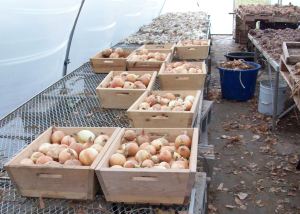
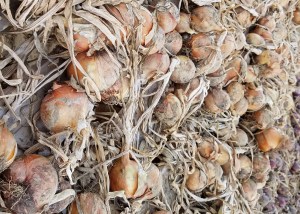
A friend grows onions using organic practices as part of a Community Supported Agriculture project. Onions are harvested from the field then dried in the greenhouse for storage. Sorting, trimming the tops and roots, and removing excess skin comes next.

As an experienced onion trimmer I work for farmers I know and trust. My compensation is an hourly rate above the current minimum wage plus all the seconds I can use. It’s a good deal, so I take it when offered. For an hour or two after a full time job at the home, farm and auto supply company, and on weekends after a shift at the orchard, I work in the onion shed.
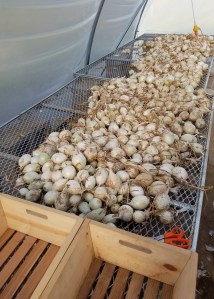
Onion Trimming Work Station

The work is seasonal and temporary. Cognizant of potential competition from other itinerant workers, I work as quickly and as well as I can. The daily chore serves as respite from an intense schedule of lowly paid work that provides income destined mostly to corporations in exchange for stuff needed to operate the household: utilities, insurance, taxes, fuel and the like. I will have worked 100 days in a row by the November election — I’m not complaining, just sayin’.

At the end of each shift in the onion shed, I take home ten or more pounds of seconds. I remove the bad parts in our kitchen and am left with half the original amount in fresh onions. There’ no long term storage for these so they go into the ice box until used. If left on the counter, bad spots would quickly re-emerge.
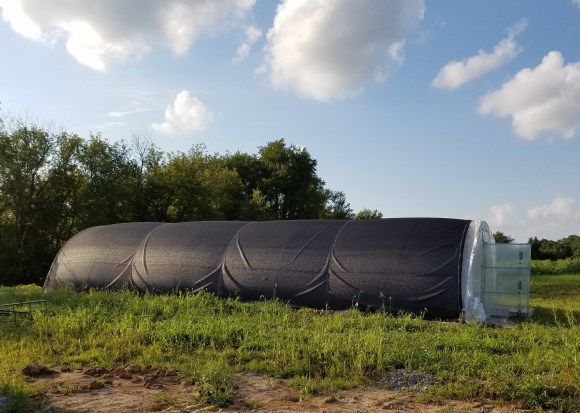
Onion Shed
Onion Shed

I made and canned the first batch of vegetable soup with three pounds of fresh onions and a bit of everything on hand from the farm and garden. By the time the onions at the farm are in storage, there will be enough canned vegetable soup put up to last until the next growing season. Soup that can make a meal.

With the concurrent harvest of tomatoes and basil from our garden, I plan to make and can pints of marinara sauce using a simple, four-part recipe of tomatoes, onions, basil and garlic. Onion trimming blocks out time from vegetable processing, and some good ones will head to the compost bin before I can get to them. I am hopeful about getting a dozen pints of marinara sauce canned.

The life of an itinerant low wage worker lies on the margin between harvest and the compost bin, That’s true for a lot of professions, not just onion trimmers. If you think about it, that’s where we all live our lives in the 99 percent of the population that isn’t wealthy.

I’m okay with working a job with friends doing work that directly impacts our family’s sustainability. It may be easier to take a big job with responsibilities and varied compensation, but I’d rather deal with the questions like whether something can be made of each onion I encounter.

The pile of second represents hope in a tangible and meaningful way. What’s life for unless that?

~ Written for Blog for Iowa
Categories
Living in Society

Looking To 2020

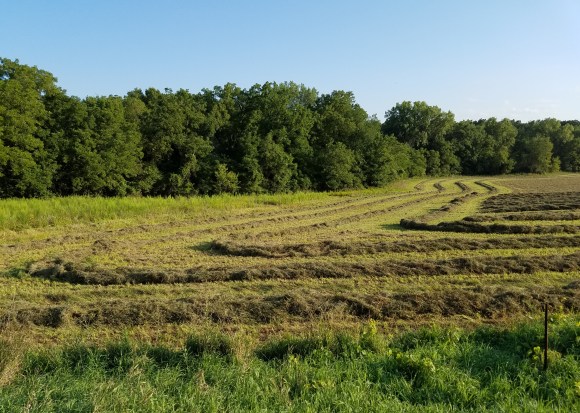
Wind Rows Near Iowa City

The sobering news of the NBC/Marist poll released last week is Hillary Clinton leading the Republican candidate in Iowa by only 4 points (41-37) among registered voters.

In Iowa electing Hillary Clinton president will not be a slam dunk.

If one lives elsewhere in the country, the news was better. Clinton leads the two-way and four-way presidential races nationally and has multiple paths to 270 electoral votes needed to win the election.

Both major candidates remain unpopular. “In Iowa, 36 percent of registered voters have a favorable view of Clinton, versus 58 percent with an unfavorable view,” wrote Mark Murray on the NBC News website. “While Trump is at 31 percent positive, 64 percent negative.”

Clinton is polling well, as she has since announcing her candidacy April 12, 2015. The election is hers to lose, and every indication is she is taking nothing for granted. What mitigates the positives is every conversation I have with voters becomes dominated by how terrible Clinton’s opponent is. He is, and if you feel that way, volunteer or donate to Clinton’s campaign, even if you don’t like her.

Of Iowa’s 1,937,225 active voters, only 615,357 (32%) were registered as Democrats on Aug. 1, 2016, according to the Iowa Secretary of State. Republicans aren’t doing much better at 649,579 (34%). Based on registrations, it should be a fair fight for either party to build a constituency to elect a candidate in Iowa.

It’s not a fair fight, one made worse by the quadrennial Iowa Caucuses. Where to begin about that?

Let’s start with the quote attributed to Albert Einstein, “The definition of insanity is doing the same thing over and over again, but expecting different results.”

Who wants to be insane? None of us who volunteer to work for political campaigns.

I want something that doesn’t exist any more. When my father canvassed for JFK before the 1960 election he used mimeographed sheets made at the union hall. There was a diagram of a generic neighborhood where he recorded the names of voters to help him (and presumably others) keep track of where the election stood. When Kennedy won, we felt our family had contributed significantly to the victory even though he did not win Iowa’s 10 electoral votes.

Deviation from this inclusive, local technique has long been a practice. I associate it mostly with Howard Dean’s 2004 campaign, although others perfected it. Targeted canvassing has been my bone of contention with the Iowa Democratic Party. The practice has broken down neighborhoods in favor of demographic dissection. It isn’t healthy for working together with neighbors to improve our lives, something that should run concurrently with politics.

It’s no secret a large percentage of people seek to avoid conversations about politics and hide their political leanings behind a no party registration. What matters more to those with whom I’ve discussed it is participation in a society in which politics plays a minor role. More engage in politics during the presidential years, but spend the rest of their time living, working and volunteering. It’s the glue that holds what’s good in society together. The current caucus process with two dozen candidates roaming the state and spreading their minority views works against the warp and weave of a just society.

I believe the Iowa caucuses have seen their best years. Jimmy Carter had the right idea after Democrats changed the nominating process in response to the 1968 Democratic National Convention in Chicago. Carter just showed up and met people, as he famously did during the Iowa State Fair. Today, politics has been co-opted by the media and the state fair is a timely example, with a dedicated political soap box sponsored by the Des Moines Register. It’s not unlike any of the other fair exhibits. The nadir of the state fair soapbox for Democrats in recent years was Democratic National Committee Chair Debbie Wasserman Schultz giving out of touch speeches.

The caucuses are getting too large, making it difficult for organizers to find appropriate venues. In our precinct it was a challenge to hold people’s attention until the delegates were selected, after which they bolted and the caucus chair couldn’t fill committee slots for the county convention. Logistics aside, the Iowa caucuses place an inappropriate emphasis on presidential politics almost two years before the election. There is more to life than who’s president. We survived Richard Nixon and Ronald Reagan. We will survive whoever the electorate picks in November.

The opportunity to change this year’s process passed with the state convention and the page turns to the 2020 presidential cycle. Political activists want Iowa to be the first caucus in the nation, but they don’t represent our best interests. They are just one more special interest looking out for themselves. Politics is much broader than the people who caucused for Senator Ted Cruz, the Republican caucus winner in Iowa.

It is time for politically active people to get involved in a way that broadens the electorate and is more inclusive. However, if they don’t heed the message, we’ll find something else to do, raising money for our favorite charities, donating garden surplus to the food bank, and advocating with our elected officials for what is right — regardless of party.

People care about who’s president, but not so much they will set everything else aside. No one wants to be the target of political canvasses. Given the opportunity neighbors will join together to resolve pressing issues, including electing a president. This year presidential politics serves more distraction than help.

~ Written for Blog for Iowa

Categories
Living in Society

Summer Of Weird Normal In Iowa Politics

Farm to Market
Farm to Market

This has been a summer of weird normal, especially for people who follow politics.

Given a presidential contest where many, including this author, predicted Hillary Clinton would be our next president before she announced she was running, nothing has happened to change that potential outcome. If anything, we are more confident than ever she will be our next president.

The focus has been on down ticket races… somewhat.

Last week Michael Barone of the Washington Examiner picked Cedar County, Iowa as a bellwether of the presidential race.

“The Washington Examiner has selected 13 key counties to watch in eight target states with 114 electoral votes that have been seriously contested in recent elections,” Barone wrote. “Each county has the potential to indicate who will carry these states.”

Cedar County owes its place on this list to the fact that it has come uncannily close to mirroring the Democratic and Republican percentages of the target state of Iowa in the last seven presidential elections, never varying more than 1.3 percent from average. Thus it voted 52 to 47 percent for Obama in 2012 and 54 to 44 percent for him in 2008; it voted 50 to 49 percent for Bush in 2004; and in the exquisitely close election of 2000, it went for Al Gore over Bush by a plurality of exactly two votes.

Mirroring percentages is one thing, however, based on my personal contacts with voters in Cedar County during the 2012 election, mirroring is not relevant to current races.

The Iowa Democratic Party placed an organizer in Cedar County this cycle, and if 2012 represents the best efforts to turn out votes for President Obama, 2016 will be even better for Hillary Clinton. That also benefits state-wide candidates Dave Loebsack, and to some extent, Patty Judge. Cedar County voters are willing to split the ticket. Expect them to do so in November.

Democrats are running out of time to nominate a candidate in Iowa House District 73, which includes Cedar County. For practical purposes, the clock ran out a week or so ago.

The Iowa Secretary of State filing deadline for state and federal offices is 5 p.m. on Friday, August 19, and in order to nominate a Democratic candidate, the state party would have to call a special convention that included Muscatine, Cedar and Johnson Counties where the district is situated.

There are plenty of potential candidates, however, those who ran in recent cycles are not interested, and no one else has come forward.

While there has been talk of a write-in candidate, the handicap of not being on the ballot will be a long shot in defeating incumbent Rep. Bobby Kaufmann.

The largest group of voter registrations in Cedar County is no party. On Aug. 1, the Secretary of State reported 3,128 Democratic, 3,792 Republican, and 4,414 No Party active, registered voters. Having worked the district, I don’t put much stock in these numbers. A house candidate from either party could win the district because of no party conversions, the City of Wilton, and six precincts in more Democratic Johnson County.

What makes August part of the summer of weird normal is the lack of political talk about almost anything but the Republican nominee for president. It is normal that a lot of voters activate during presidential election years. What is weird is a combination of things including regular people cozying up to Donald Trump; people who would bleed Democratic if cut saying they won’t vote for Hillary Clinton no matter what; and controversial issues, including climate change, abortion, school funding, incarceration rates, water quality and government spending, being sidelined to watch the national political show.

Life is going on, arguably not in a good way.

~ Written for Blog for Iowa

Categories
Environment

Can Hipsters Stomach The Truth About Avocados From Mexico

Avocado from Mexico

Can consumers buy avocados from Mexico at the grocery store, or in prepared guacamole with impunity?

Probably not.

Last week’s article “In Mexico, high avocado prices fueling deforestation” by Associated Press author Mark Stevenson explained why.

Americans’ love for avocados and rising prices for the highly exportable fruit are fueling the deforestation of central Mexico’s pine forests as farmers rapidly expand their orchards to feed demand.

Avocado trees flourish at about the same altitude and climate as the pine and fir forests in the mountains of Michoacan, the state that produces most of Mexico’s avocados. That has led farmers to wage a cat-and-mouse campaign to avoid authorities, thinning out the forests, planting young avocado trees under the forest canopy, and then gradually cutting back the forest as the trees grow to give them more sunlight.

“Even where they aren’t visibly cutting down forest, there are avocados growing underneath (the pine boughs), and sooner or later they’ll cut down the pines completely,” said Mario Tapia Vargas, a researcher at Mexico’s National Institute for Forestry, Farming and Fisheries Research.

Why does it matter?

Deforestation plays a key role in the release of greenhouse gases. Carbon stored in trees and other vegetation is released into the atmosphere as forests are converted to avocado plantations.

With the advance of climate change, securing adequate water to produce the fruit has increasingly been an issue in avocado growing regions. A video posted by the World Bank explained the problem and how farmers are coping. It’s pretty simple. In recent years there has been less rainfall in Michoacan, desiccating the soil. Farmers divert rainwater runoff to retention ponds for use during dry months. Avocados require twice the water of pine forests they replace, depriving downstream users of an essential resource.

If that’s not enough, these particular forests are part of the Monarch butterfly wintering grounds. Deforestation impedes the butterfly’s evolved life cycle.

You may have seen one of the web ads featuring celebrity chef Pati Jinich promoting avocado use for the trade association Avocados from Mexico. Here is an example:

(Editor’s Note: Sorry, the video was deleted from the Avocados from Mexico Website)

When encountering these ads, I found Jinich endearing and her tips helpful. That is, if I were a user of avocados, something she and the trade association is trying to change with the promotion. My experience with guacamole has been a tablespoon served on the side of Mexican food with other condiments, so not much.

One doesn’t always know what to do about stories like Stevenson’s. How extensive is the deforestation problem in avocado growing regions? How will downstream users react to deprivation of water from the mountains? How are workers treated on avocado plantations? Can we live without Monarch butterflies, and will another plot of forest gone really make the difference for this pressured species?

I don’t know, but here’s a relevant question raised by Joanna Blythman in The Guardian, “Can hipsters stomach the unpalatable truth about avocado toast?”

“When we pick up a fashionable import like avocado,” Blythman wrote, “we need to be sure that it not only benefits our personal health and well being, but also that of the communities that grow it.”

The issues around deforestation are well known. To the extent avocados add to the problem users should be driven to do something.

That may be as simple as asking the server to hold the guacamole.

~ Written for Blog for Iowa

Categories
Home Life

Perhaps It Was a Sign

Water Damaged Memorabilia Drying

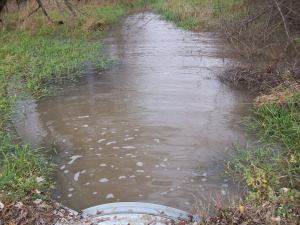
For the first time since we covered our foundation with earth in 1993 we had water downstairs after a heavy rainfall.

Perhaps it was a sign.

As soon as we discovered the problem, we reacted. Later in the day I bought a 20-inch fan at the home, farm and auto supply store to circulate air as the cement floor dries. It’s muffling out every other sound as I write.

Most of our storage items are on pallets, and planning paid off. About half a dozen boxes on the floor did get damp. We caught it soon enough to remove the contents and dry papers out before getting ruined. My musical instruments were also on the floor, but they were dried off before wreckage.

Casualties included a small collection of Franklin Mint items, a box of letters from pre-email days, and a banker’s box full of political memorabilia going back to when I worked on LBJ’s 1964 campaign. It looks like everything will be okay.

We don’t plan to build an ark, and must figure out what is happening then take action. By the end of today, I’ll inspect the wall inside and out and develop an action plan. I’ve learned to pay attention when nature and the forces behind it give us a sign.

The last thing we needed was one more thing on the Big Grove do list. On Thursday I made a schedule at the home, farm and auto supply store during a break. It must now be modified.

Weekend Schedule Draft

With such a schedule it is hard to relax. In fact, it is easy to see why people turn to methamphetamine to get through everything that needs doing in 24 hours. Maybe I need to pull a couple of all nighters, as a substitute since I eschew meth and stimulants except coffee.

A friend of mine who attended Georgetown University continued the collegiate practice of pulling all nighters well into the 1980s as a way of catching up with things that could not be delayed. The trouble is there is no “next day” for me to crash with my constant schedule through the end of the apple season.

Mine is the situation of any low wage worker, and I don’t see it being fixed in the U.S. by the “fight for $15,” an advocacy effort to raise the minimum wage. I will suck the pap of life dry with constant activities regardless of economic status. What would help from government is hard to accomplish: universal health care; bolster Social Security so our pensions will be there;  and preserve and protect the commons. It doesn’t seem like too much to ask.

Onion Trimming Progress

Meanwhile, the onion trimming is going well. Instead of crossing the lakes after work, I head East on Interstate 80 to Highway One and spend a couple of hours in the nearby greenhouse.

I’m about a third of the way through summer onions, after which I’ll do storage onions. The crates are custom made and have slats in the bottom for aeration. As part of my compensation I keep the seconds, so there are plenty of onions in our house for the next few weeks.

It’s all part of sustaining a life in a turbulent world.

Categories
Environment

Chuck Isenhart Addresses Iowa Clean Water Strategy

Runoff Heading to Lake MacBride

On Wednesday, Aug. 3, State Rep. Chuck Isenhart issued a press release addressing the need for Iowa government to update the state’s clean water strategy.

Following a visit to Louisiana, where he consulted with stakeholders regarding Gulf of Mexico hypoxia, Isenhart wrote a letter to Iowa Secretary of Agriculture Bill Northey urging the Water Resources Coordinating Council to adopt a 20 percent reduction in nitrogen and phosphorus load. Read his July 17 letter here.

Isenhart is ranking member of the House Environmental Protection Committee and a leading voice for the environment and on energy issues in the Iowa legislature. Following is his press release in its entirety.

Time to update state clean water strategy

In light of Gov. Terry Branstad’s renewed call for more funding for water quality initiatives, State Rep. Chuck Isenhart (D-Dubuque) has asked the Iowa Department of Agriculture and Land Stewardship (IDALS) to update Iowa’s nutrient reduction strategy to establish performance goals to be achieved with any new money.

In a letter to the Water Resources Coordinating Council — chaired by Secretary of Agriculture Bill Northey — Isenhart has encouraged the body of state and federal officials to recommend that Iowa adopt the interim milestones endorsed by the Mississippi River/Gulf of Mexico Hypoxia Task Force

Northey is co-chair of that task force. Isenhart is ranking member on the House Environmental Protection Committee and liaison to the state Watershed Planning Advisory Council.

The Gulf task force’s 2015 report to Congress called for a 20 percent nitrogen and phosphorus load reduction at the watershed scale by the year 2025.

“After three years of demonstration projects, we know what works,” Isenhart said. “Time to move to the implementation stage and scale up our efforts with widespread adoption of effective pollution-reduction practices. But first we owe it to Iowa citizens to show them how we will be accountable and what their money will buy: How clean will the water be and when will it happen.”

Isenhart noted that, while the Gulf task force is looking for documented results by 2025, Governor Branstad’s funding plan doesn’t kick in until 2029. “That is a glaring oversight, hopefully not intentional,” he said.

During the last legislative session, Isenhart and State Rep. Marti Anderson (D-Des Moines) offered an “Iowa Clean Water Partnership Plan,” based on their participation in the Greater Des Moines Partnership’s Iowa’s Soil and Water Future Task Force.

If adopted, the plan would create a clean water trust fund comprised of both public and private monies contributed by farm producers through water quality checkoff programs. The legislators plan to improve and re-introduce the bill in 2017.

“In the meantime, we will continue to educate and learn from Iowans during the upcoming election campaign season,” Isenhart continued. “We want to know if we are on the right track. We also want to know if Iowa voters still want us to raise the sales tax by 3/8 cent to fund the Natural Resources and Outdoor Recreation Trust fund they put in the Constitution with a 2010 referendum.

“If Iowans still want it — and surveys indicate that they do — that would bring the greatest, most consistent funding that a long-term enterprise like this requires,” he said.

This week, Isenhart is attending the annual meeting of the National Conference of State Legislatures in Chicago. He serves on NCSL’s Natural Resources and Infrastructure Committee.

Isenhart has offered an amendment to the NCSL water policy directive that would prioritize nitrogen and phosphorus pollution as a water quality improvement objective in the Mississippi River basin and “wherever such pollution from pervasive point and non-point sources creates serious hypoxic conditions in waters of economic, ecological and/or recreational significance.”

The proposal also calls on the federal government to “foster and assist in the financing and support of working groups of state legislators within major watersheds where water pollution is a multi-state responsibility.”

Such working groups or compacts could be formed to “coordinate the development of strategies, policies, statutes, regulations and spending priorities for the attainment of clean water, including goals, timelines and accountability for performance,” Isenhart explained. “Right now, many state legislatures are AWOL when it comes to clean water. We need to get in the boat.”

~ Written for Blog for Iowa

Categories
Living in Society

Kim Weaver For Iowa’s 4th District

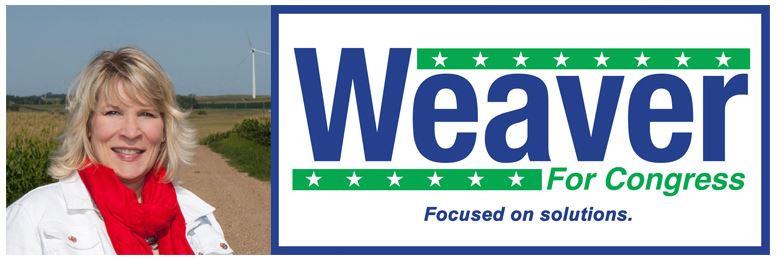
Weaver for CongressKim Weaver believes 2016 is the year to retire Republican Steve King from Congress.

What makes her effort different from those of Jim Mowrer, Christie Vilsack, Matt Campbell, Rob Hubler and others?

The political climate of intolerance and hate people like Rep. King foster has reached its limit, creating a backlash among lifelong Republicans.

Weaver hopes to build a coalition using the unique opportunity 2016 presents.

“The other night I had an interesting conversation with a friend who will no longer be voting for Donald Trump, Steve King or any other Republicans,” Weaver wrote in a fundraising email.

“I watched this lifelong member of the GOP burn his Republican National ID while standing around a bonfire. He told me that he feels betrayed by the party and regardless of the outcome he doesn’t know how we will ease the tensions within nation’s polarized political system. To confront the global crises the world looks toward America for leadership and solutions. He said the divisive rhetoric this year short circuits conversations after a few seconds. From across the fire he looked at me and said, ‘All of this intolerance and hate is crazy. It’s gotta stop.'”

Kim Weaver is a proud native Iowan. Born in Des Moines, she graduated from Roosevelt High School and obtained a bachelor’s degree in communications from Iowa State University. After college she married and later moved to Sheldon where she raised her three children and built a career. Weaver appreciates the value of community and the belief in hard work Iowans hold dear. She is dedicated to taking those values to Congress.

We’ve heard it all about Steve King. Isn’t it time we focused on solutions? That’s what Kim Weaver offers.

Issues most important to Weaver include financial stability for families, student loan debt relief, financial stability for seniors, immigration reform, and making higher education more affordable.

As for King, there is little reason for Iowans to talk about his confrontational and outrageous behavior and statements. In fact, one of my friends had something to say about this.Weaver Tweet

For more information about Kim Weaver’s campaign for Congress in Iowa’s 4th District, visit her web site.

~ Written for Blog for Iowa

Categories
Writing

In An Iowa Kitchen

A Gardener's Breakfast
A Gardener’s Breakfast

The local food movement relies more on kitchens than grocery stores; more on gardens than commercial growers.

While use of locally sourced food by many restaurants has changed to include more of it, a local foods movement cannot be sustained by the hodge-podge of farmers, growers and entrepreneurs who sell locally produced food to restaurants, or for that matter, to grocery stores.

The problems include scalability and sustainability.

We are living in a time where demand for local food exceeds supply. Scaling up to meet demand requires a capital investment most small farmers can’t make. Sustainability relies on creating value along with the food in a way that cooks can afford it and farmers can make a reasonable return on their investment.

Someone recently asked if the area was becoming saturated with Community Supported Agriculture projects and if that’s why some are having trouble growing membership. An answer lies elsewhere. The market for local fresh food has grown so big corporations noticed.

Companies like Hy-Vee, have tapped into the fresh food market by increasing their number of suppliers and offering fresh and local food alongside wares from large commercial growers. They are sucking up market share like a vacuum cleaner as their business model is designed to do – putting pressure on small and mid-sized growers.

Corporate involvement in the local food market is a two edged sword. Growers can sell their best wares to companies like Hy-Vee and get a reasonable return. At the same time reliance on companies rather than CSA members can distract a farmer from his or her core business.

A solution? CSAs should stick to their knitting by getting payment up front and sharing the harvest with members… all of it. It may be tempting to sell some on the side to restaurants and grocery stores, but the further away from the model they get, instead of doing one thing well, everything they do can suffer. In addition, the market share they help corporations grow may be detracting from their core business.

There is nothing wrong with a farmer growing organic greens for restaurant salads and stir fries. In the end, each farmer must make ends meet, and operating a farm —even a small one — is an expensive operation with tight margins. My point is to focus on one thing and do it well.

It is one thing for a farmer to disassemble a barn and use the materials to create raised beds for a ten-person CSA. It is quite another to support a couple hundred families with the variety of produce the market demands. If you ask a hundred CSA members, as I have, why they belong, answers are all over the map. Some want assurance of a grower who uses organic methods to produce food. Some want variety unavailable at Aldi’s or Fareway. Others want to create a cooking experience with young children as part of their education. Most want to feel good about what they are doing with their lives.

One hopes we are beyond the discussion of “food miles” and on to the core value of the nascent local food economy: know the face of the farmer. It’s corollary is know how your food is grown. Try as they might with life-size cutouts of farmers in their stores, corporations have a hard time doing that. Their customers are too diverse, and they have to cater to everyone in the community. If a person combines these two ideas, knowing how our food is produced and creating demand for local, fresh food the local food movement has a chance.

A very few people strive to source every food ingredient locally. It is not with them the future of local food lies. The future of local food is within the potential of every Iowa kitchen.

To sustain the local foods movement requires consideration of what it means to belong to a CSA or buy from a farmers market. Can that fit into culinary habits in a way that is not an encumbrance to what most perceive as very busy lives?

Can kitchen cooks grow some of their own produce? Probably yes, even if it means only a large flower pot with some cherry tomatoes or an herb jar on a window ledge. Even these small things may be a step too far for some.

The trend in food includes extensive prep work done by machines and large companies. Heat and serve has become a by-line for many available grocery items. Along with taking the kitchen work out of meals, risks of contamination have been created and along with it the need for recalls from large processors whose products get contaminated by E. coli and listeria.

In a consumer society it will always be tough for small-scale producers to survive and thrive. That’s why I say the future of the local food movement rests in Iowa kitchens where cooks can use less processed foods and more fresh — secured by buying local and growing their own.

It’s work many can’t do because of choices made about careers and family. What may be the saving grace of the local food movement is the idea of taking control of our kitchens, in part by living and eating local as much as we can.

Categories
Environment

What’s After Paris?

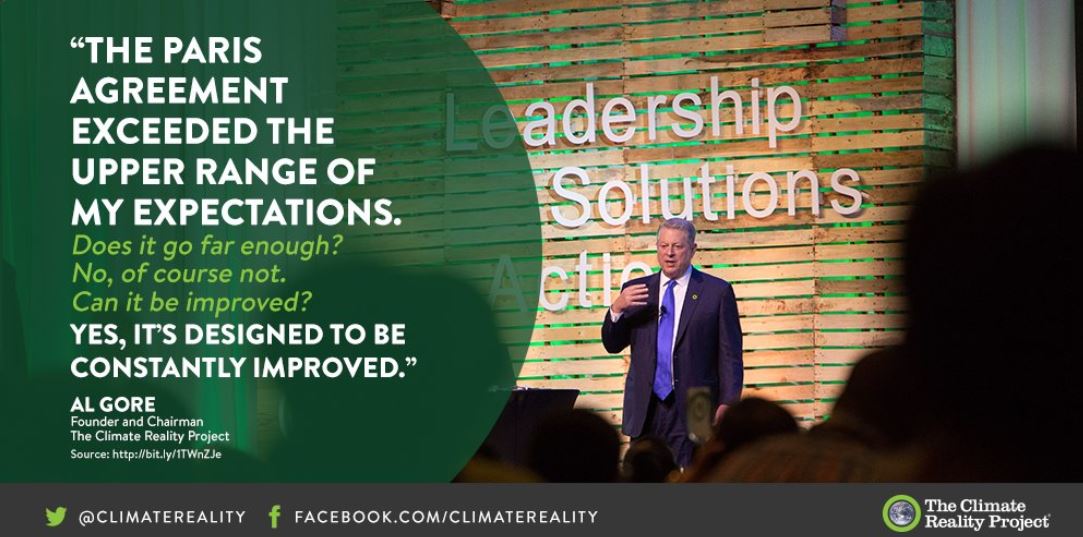
Gore ParisLast week, Al Gore reflected on the ten years since he founded The Climate Reality Project. Following is an excerpt from an email he sent to the Climate Reality Leaders he trained.

Ten years ago, I trained the first group of Climate Reality Leaders in my barn in Carthage, Tenn. I asked them to join me in spreading the word about the urgency of the climate crisis, and I was impressed by the commitment and passion they demonstrated. I’m even more impressed now as the work they’ve done in their own communities and beyond has helped to spark a global movement for action on climate change.

In the decade since that first group came together, I’ve trained more than 10,000 Climate Reality Leaders who are just as committed to making the world a better place for future generations. The Climate Reality Leadership Corps is active in more than 130 countries around the world and represents people from all backgrounds and walks of life. I’ve enjoyed working alongside teachers, scientists, community leaders, business owners, students, and so many others who all share a dedication to promoting solutions to the climate crisis.

Ten years of concerted action by the Climate Reality Leadership Corps came together last year when 195 countries committed to working together to reduce greenhouse gas emissions planet-wide as part of the Paris Agreement. Now, it’s time for us to continue our work together and push countries to strengthen and implement their commitments so we can make the promise of Paris a reality.

Even as we look to the future, I want to make sure we take a moment to appreciate the last 10 years and all of the amazing work that you’ve done to help share the truth about the science and solutions of climate change with your friends, family members, colleagues, and everyone else.

I want to thank each and every one of you for what you’ve done in your own communities to bring attention to the most important issue of our time.

It is easier to play a role in the global effort to mitigate the causes of global warming and climate change when thousands of others are doing the same thing, each in their own way. That’s been my personal benefit from The Climate Reality Project.

I joined in Chicago (August 2013) and have no regrets. I learned the story behind Gore’s film An Inconvenient Truth, and the science behind it. Gore presented a broad mix of information about what is happening in our environment because of global warming and how it impacts communities.

Since then, I’ve presented my story to individuals and groups in the area and seek opportunities to do more. I served as a mentor at the Cedar Rapids training last year and have written about the need to act on climate change in my blogs, and in letters to the editor of our local newspaper. When I worked as a freelance correspondent, climate change informed my world-view and was a context in which I framed stories whether they were about farming or forestry, the school board or city council, or about new business openings or individual achievements.

Talking about global warming and climate change has become part of my life.

If the Paris agreement was the culmination of ten years of work, as Gore said it was, the work is not finished.

With a sharp focus on identifying the impact on our climate of CO2 emissions from burning fossil fuels, Gore and many allies made the point about seeking alternatives. As solar and wind-generated electricity reach price parity with fossil fuels (and they are doing so faster than anyone imagined) the coal industry is in disarray and nuclear power is waning.

There is a cloud on the hopeful horizon of renewable energy. Buoyed by exploration and discovery of oil and shale gas reserves, companies like British Petroleum, once green washing us with their interest in renewables, divested their interests in solar and wind energy this decade to focus on oil and gas.

I predict declining prices of solar power will help it dominate the future of municipal and regional electricity generation. Already companies like Central Iowa Power Company (CIPCO) are changing their tune. Not so long ago they were promoting nuclear power at their annual shareholder’s meeting. Today, they are building solar arrays.

If there is a blind spot in Gore’s laser focus on burning fossil fuels it is the impact of greenhouse gas emissions from other sources. He acknowledges them, but they have not taken the spotlight. There’s work to be done regarding manufacturing, agriculture, mining and other aspects of our industrialized global economy.

Every time I talk to an Iowa farmer Gore’s work can be heard in the conversation. Not so much from me, but from farmers. They’ll tell you the hydrology cycle seems different even if they dislike Al Gore and don’t acknowledge it is related to global warming. They don’t have to and I don’t need ratification of my own beliefs.

Like so many others I am focused on the work of mitigating the causes of climate change. You may not know it, but it is baked into everything I do.

What have you done lately to create a better environment for all of us to enjoy?

~ Written for Blog for Iowa

Categories
Home Life

Sleep Came Easily

Cherry Tomatoes from the Garden

Mounds of grass clippings blocked the John Deere’s steering as I mowed part of the lawn.

The temperature was ideal, the sky clear, and I was alert enough to safely operate the equipment.

To engage the steering I backed off and tried again.

Grass clippings lie in wind rows where I mowed last night. Using a rake and wagon I’ll transfer them to the garden for mulch.

In high summer a gardener/low wage worker/family member finds more to do than there is time. I managed to send a box of kale, fairy-tale eggplant and tomatoes to the library for the workers earlier in the day. They were appreciative.

The garden hose was coiled near the house for mowing. While driving past the garden I noticed the cucumber leaves drooping. I stopped, got the hose back out, and watered. I missed a lot of cucumbers during the morning harvest so I picked them. They filled a crate and created another thing to do.

Dinner was sweet corn on the cob and tomatoes with cheese plate, bread, and blueberry yogurt for dessert. The corn and tomatoes were filling, so I didn’t get to dessert.

After dinner I put cucumbers — newly harvested and those already in the ice box — on the counter after washing them. I sorted and found a place to put them. I hadn’t planned another task, but it needed doing. I’d say I’m in a pickle, and that’s more solution than problem.

As a result of my cucumbering, processing peppers and tomatoes got pushed back.

Sleep came easily after my eighteen hour day.