The weekend began with a trip to the COSTCO bakery where I bought 2.2 pounds of cookies after my shift at the home, farm and auto supply store.
I am celebrating my first Saturday without a work shift since July 26 with, that’s right, cookies!
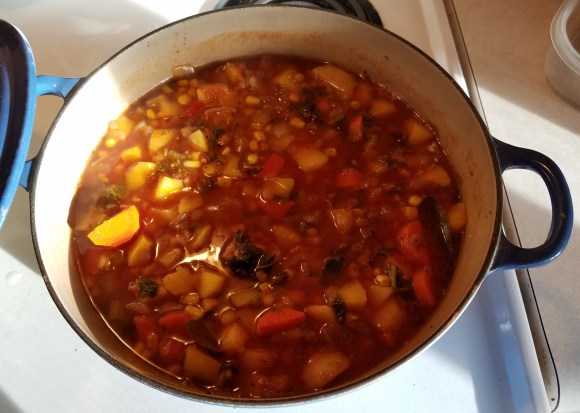
Saturday morning I made harvest soup from bits and pieces in the ice box, pantry and counter. With a sandwich it made a hearty lunch with three leftover quarts of soup for later in the week.
Hot peppers and kale
Gleaning the garden yielded sage, oregano, chives, kale, hot peppers, cucumbers and tomatoes.
After cleaning the vegetables there are bags of herbs and kale in the ice box, Bangkok peppers in the dehydrator, and a big bowl of Serrano and Jalapeno peppers in the ice box. More Bangkok peppers are ripening on the counter. Cucumber salad is in the works for Sunday as is an appetizer for the work dinner later in the evening. It is weird to be harvesting cucumbers and tomatoes in November.
I don’t fully understand the El Niño/La Niña cycle but the weather has been warm. Saturday’s harvest weeks after the normal first hard frost stands as evidence. Climate change is not about the weather per se but warming temperatures in the equatorial Pacific Ocean impact Iowa.
Assorted kale leaves
Photos of fresh produce compliment each day and help us forget about the impacts of changing climate. There is something to be said for a warm Iowa winter. It would be welcomed by most people I know.
The hard frost is coming and with it the end of the gardening season.
In the meanwhile we harvest what we can and make a life for ourselves on the Iowa prairie.
All at once the United States is coming together and the convergence is upsetting.
While members of the white privileged class engaged in the seventh game of baseball’s World Series, a black church was burned in Greenville, Mississippi.
While members of Sioux tribes stand in opposition to the Dakota Access Pipeline crossing land theirs by treaty, white occupiers of the Malheur National Wildlife Refuge were acquitted of wrong doing by a jury in Oregon.
While supporters of the Republican presidential candidate chant “lock her up,” “build the wall,” and “drain the swamp,” the more sane among us work toward a world that can be sustained based on what we know about society and its role in the environment.
It is an America I have known well, one of hate, greed, ignorance, isolationism, violence and intolerance. It pits rich against poor, convincing many to believe they are weak and powerless in an electorate that produced a horror show of incompetence, graft, war-mongering and corruption among elected officials.
Votes matter — now more than ever.
We’ll see voter turnout in the general election together on Nov. 8. The forecast does not look pretty. Many people I meet feel the value of their vote has been diminished. What they don’t always realize is the loss of hope and positive outlook about our lives in society is intentionally manufactured. What’s happened in the post Ronald Reagan era has been a stunning undermining of the fabric of society including governmental institutions being hollowed out predictably and intentionally by the richest Americans to favor their interests.
Congressman John Lewis of Georgia’s fifth district recently posted, “I’ve marched, protested, been beaten and arrested–all for the right to vote. Friends of mine gave their lives. Honor their sacrifice. Vote.”
Voting matters, the powerful among us know it, and voter suppression during this election cycle has no precedents in the 50 years since the Voting Rights Act was signed into law by President Lyndon Johnson. It is the first election without the protections of the law.
When the Supreme Court of the United States struck down Section Four of the Voting Rights Act, Chief Justice Roberts wrote in the 5-4 decision,
“Our country has changed, and while any racial discrimination in voting is too much, Congress must ensure that the legislation it passes to remedy that problem speaks to current conditions.”
“There is no doubt that these improvements are in large part because of the Voting Rights Act,” he wrote. “The Act has proved immensely successful at redressing racial discrimination and integrating the voting process.”
Ask the 200 members of the Hopewell Missionary Baptist Church in Greenville, Mississippi how redressing racial discrimination is going.
We woke up Wednesday to the murders of two Des Moines police officers. A white suspect is believed to have killed two white police officers in premeditated murders. The murders are abhorrent.
“What happened yesterday was calculated murder of two law enforcement officers. Plain and simple, that’s the reality. If someone wants to argue that reality with me, my office is two doors down,” said a visibly frustrated Des Moines Police Chief Dana Wingert.
With due respect to Chief Wingert, we have courts to determine the guilt or innocence of the suspect. Relativism has no place in our justice system. Reality may be arguable, but truth and justice are not.
While fueling my car the morning of the murders, the attendant walked up, wanting to talk about the election.
I said, “have you heard about the murders in Des Moines?” He hadn’t. Despite the speed with which the internet can communicate aspects of our lives, our understanding of current events is uneven at best, deplorable at worst.
Late last night I received an email from a respected friend suggesting a letter to presidential candidate Jill Stein asking her to drop out of the race and support Hillary Clinton. It read, in part,
We have never met in person, but I am writing to urge you to please drop out of the Presidential race and give your vocal support to Hillary Clinton. I completely agree with your policies, and am frightened by many of Hillary’s plans, but we simply cannot risk a Trump presidency, with his finger on the nuclear arsenal — he is insane.
What the hell?
Our country was founded on genocide, built on the backs of slave labor, then taken from us by the richest people in the world. In the 2016 general election we will reap what we sowed.
This dark time in history has few modern precedents. More than anything we cannot afford to relinquish the search for truth, meaning, sustainability and social justice. Not now. Not ever.
On the last shift of the season I walked in the test orchard picking apples.
20 minutes of bliss.
Beginning with a tree the orchard’s namesake planted in the 1980s, I picked a few there then added Connell Red, Regent and Sheepnose to my bag — about six pounds.
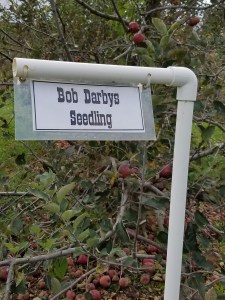
Bob Darby’s Seedling did not make the cut when the orchard expanded. A lone tree sits at the head of the test grove — a reminder of the founder who collected saplings from friends and neighbors to graft to his own root stock as he increased the variety of apples to more than 120.
After cutting and tasting, the whole lot of fruit will be sauced in our kitchen.
Wilson’s Orchard Oct. 30, 2016
And so it is with this and many of the jobs I’ve worked after my career in transportation. It comes down to a beautiful fall day, enjoying the last harvest of this season, and hoping there will be another year.
On my way out of the sales barn the current orchard owner was repairing an extension cord. We live in the same political precinct so local politics was our first topic. Soon we began talking about our customers – how the long, lazy, end of season weekend produced more than its share of long conversations about apples and what people plan to do with them.
I helped a couple from western Virginia near where my father came up find fruit for apple butter. He moved to Iowa to find work when what he described as “Obama’s war on coal” took away his job in the mines. They bought a bushel. We had three separate conversations about coal country, apples, apple butter and getting by. Making apple butter is a family tradition not to be interrupted by the move north.
There were a dozen conversations like this one, each with people of different backgrounds and expectations about apples and local culture. Some found apples in the orchard and those who didn’t bought them from the cooler. I savored each conversation as it happened.
I asked my boss to work next season and he said, “absolutely.”
As long as I breathe air and need paid work to sustain our lives, that’s the plan. Hopefully Bob Darby’s Seedling will survive another year.
Heading into the general election, public life is converging into a melee with an uncertain outcome.
Worklife had me circling the wagons, inner focus broken only by work, social media, and news feeds on my hand-held computer. I engaged with thousands of people, yet remained focused on sustaining a life midst social turbulence.
The streams of politics, environmentalism, justice, and conflict seem heading for an apocalyptic finish line.
Where to begin?
Environmental activism is off track with opposition to the Keystone XL and Dakota Access pipelines. Mode of transportation will never be as important an issue as reducing global greenhouse gas emissions. Oil and natural gas production is predicated on economic models — models that can change dramatically as solar, wind and other forms of renewable power generation continue to be developed and deployed. The same economic, governmental, technology and health factors driving the decline in coal extraction and use can and should be at the forefront of environmental activism regarding oil and natural gas production, distribution and use.
Environmental advocates are distracted by development of the Dakota Access pipeline by Energy Transfer Partners. The pipeline is nearly complete in North Dakota, nearly complete in South Dakota, two-thirds complete in Iowa, and 75 percent complete overall as of earlier this month. The pipeline is not finished but clearly will be despite heartfelt protests.
The issue of land rights has taken prominence among advocates against the pipeline. That fight would more properly be fought in the United States Supreme Court by overturning the June 23, 2005 5-4 decision in Kelo v. City of New London which granted private developers the right to transfer ownership of property as a permissible public use under the Takings Clause of the Fifth Amendment to the U.S. Constitution. Use of eminent domain by Energy Transfer Partners to gain easements for their pipeline may be wrong, however, it is legal. Even if the U.S. Senate confirms a Democratic President’s appointment to the high court, there is no guarantee eminent domain would be taken up nor that Kelo would be overturned. Land rights issues activate people who would not normally be a part of environmental actions. The long-term value of such engagement to the environmental movement is an open question.
I support the Standing Rock Sioux Tribe’s resistance to land acquisition for the Dakota Access Pipeline. A web site No DAPL Solidarity calls for people to take action in support of tribal goals, including going to the site, organizing solidarity actions in our own communities, and sending money. I could do more to support the effort.
Election of anyone other than Hillary Clinton as president would be a setback for efforts to stop the Dakota Access Pipeline, and for environmental issues generally. Clinton may not be the champion for the environment we want, however, election of her main opponent would undo the environmental progress of the last 40 years. Melee may be too mild a word for what may happen after the Nov. 8 election.
More than others, vegetables grown here made it to our kitchen and were used. Herbs, onions, celery, broccoli and green beans are always expected from a Midwestern garden. This year plot three delivered.
The story was of technique.
The plot is shaded by the locust tree each morning with full sun after noon. Almost everything planted here thrived. This year’s production included perennial chives and oregano, spring onions, basil, celery, broccoli and green beans.
I used drainage tile to protect young celery seedlings and it worked. Celery plants grew tall inside the 12-inch by 4-inch tile segments, producing enough for the kitchen with extra to give to library workers. There is nothing like home-grown celery.
The success of this year’s broccoli is attributable to protecting the seedlings as they grew. I put one old tomato cage around each seedling and wrapped chicken wire around the cage. As the plants grew, I removed the cages and put a 4-foot fence around the broccoli — tall enough to prevent top-nibbling by deer and close enough together to prevent them from jumping inside the fence. It all worked, producing the best broccoli crop I’ve had.
More than 100 onion sets produced spring onions well into summer. I tried seeding basil, but it didn’t take. Basil seedlings started indoors produced better results with plenty to make pesto.
What made this plot a kitchen garden was the production of aromatics — herbs, onions and celery particularly. In season I used them in everything.
Plans for next year: Split the chive and oregano plants; more basil; cherry tomatoes where the beans were; eggplant and hot peppers; and peas.
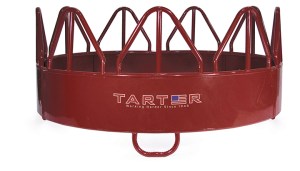
Hay Feeder Ring Photo Credit – Tarter Farm and Ranch Equipment
Something is wrong when the garden produces tomatoes, cucumbers and peppers in Iowa the fourth week in October.
I’ll dice tomatoes for breakfast tacos later this week, Bangkok peppers are in the dehydrator, and cucumbers and jalapeno peppers in the icebox waiting to be used. There is chard and kale, oregano and chives. Those leafy green vegetables usually survive until November, but tomatoes and cucumbers?
Call it what you want but something is happening and we know exactly what it is.
I spent most of Friday working with hay feeder rings.
After re-resurfacing the outside lot where farm equipment is displayed at the home, farm and auto supply store, I assembled and re-merchandised the stock of feeder rings.
I don’t know if it was a day’s work, but spent a day doing it, working slowly and as safely as possible. I was tired after the shift with a hankering to leave everything and head west to work on a ranch — day dreams of a low-wage worker.
The garage was cluttered after a summer of intermittent work.
I checked off each item on the to-do list on my handheld device before heading to the orchard for a shift. I disassembled the grass catcher and stored it; re-mixed bird seed and filled the feeder; checked the air pressure on our auto tires; brought in salt and paper products from the car; stored 40 pounds of coarse salt in tubs for winter ice melting; cleared a work space on the bench; and swept the entire floor. It took about two hours. I wanted more, but time ran out.
Yesterday’s political events had me thinking of Gettysburg, Penn. My parents, brother and sister went there before Dad died. I remember reading President Lincoln’s Gettysburg Address on a placard near where he read it himself. With deep roots in rural Virginia, and ancestors fighting on both sides of the Civil War, it was a seminal experience for me. It began the process of turning me from being a descendant of southerners enamored of romantic notions about plantation life to being an American eschewing the peculiar institution and those who stood for it. To my mother’s probable dismay, I brought home a Confederate flag and hung it in my bedroom. Visiting Gettysburg helped me understand the reality of the Civil War and those who fought and lived through it. I was coming of age.
My parents pointed out the house and farm where Dwight and Mamie Eisenhower lived after his presidency. Eisenhower hosted world leaders there, including Nikita Khrushchev, Charles de Gaulle and Winston Churchill. He also raised Angus cattle. We thought favorably of Eisenhower even if he was a Republican. As Supreme Commander of the Allied Forces in Europe during World War II he was a well known part of our culture. Seeing his farm enabled us to touch reality in his celebrity.
My life is here in Big Grove. I’m not heading west to work on a ranch. I don’t display the Confederate battle flag or think about it much any more. I will re-read the Gettysburg Address as I did this morning and wonder how my ancestors got along with each other after fighting in the Civil War. Perhaps there are lessons for the United States in 2016. I’m certain there are.
Each week I dive into a sea of humanity and end up alone, in the morning, writing about what I have experienced.
Whether the output is political, journalistic, scientific, culinary, agricultural or just being alive, what I write is grounded in a contemporary life viewed through sixty-plus years of personal experiences. It’s all the same process.
Humans are a rough and rowdy bunch. It’s challenging to capture modern life in a way that does justice to its complexity. Photos are not enough, naturalism is fraught with issues. Endemic to it all is the platform and perspective our lives create which position us to view society in the raw.
It can wear a person out. It can also invigorate us.
Each week I’ve been exposed to thousands of people from all walks of life. It is difficult to understand every experience, nor would I want to. It is hard not to cling to positive experiences and ignore negative. Some I meet don’t get outside home much. Others spend much time in the public arena. There are friends, neighbors and relatives with everyone mixed into a seasonal soup of life. Each week represents different ingredients, different flavors.
What matters more to a writer is having something unique to say. We know better what is not unique — set pieces, articles written on contract, photos of cats posted in social media. What it is, and should be, is articulation of experience that creates an understanding of an aspect of a complicated society on our only home and water planet.
It is modern to take raw materials of life and craft them into something readable, usable, and of value. The process is not always positive and writers should be cognizant of their impact in a constantly changing society.
I recall June Helm with whom I studied anthropology. It is impossible for an anthropologist not to influence the culture he or she studies, Helm told us. I took two lessons from this. The transient writer must tread lightly where we travel and work hard to do justice to what has been studied and experienced. The emphasis should always be creating something of value to subjects and readers alike.
As I prepare for this week’s dive into humanity I’m not nearly rested enough. My bones and ligaments ache from age and overuse. My cardio-vascular system seems okay, but one never knows. I can’t see as well as I once did and the looking I’ve developed has me ignoring much that would engage me previously. Imperfect though my platform and perspective may be, I’m ready to jump from the cliff it represents, hoping to avoid the rocks, and go deep into the sea of humanity once again.
Nothing but prairie grasses was on this, or any of the garden plots when we moved here in 1993. Shortly after we dug plot two, I planted mail order trees about 12-inches tall to grow them for transplanting. Due to neglect, the locust trees grew and grew and became a 40-foot giants. One of them blew over in a 2013 extreme storm that passed through. I cut it up and sold it for firewood. The remaining locust tree provides shade for the three northern plots, and adds value to the backyard landscape.
Hosting the two compost piles, the locust tree, and a bed of day lilies, plot two is challenging because of the tree root structure. Pieces of roots as big a two inches in diameter had to be removed for planting. The tree suffered no apparent ill effects after cutting some of the roots.
Radishes and turnips were the first crop, followed by onions. All produced well. After the root vegetables finished, I installed four four-foot tall meshed wire containers to grow cucumbers — pickling and slicers. They produced well. High winds blew one tower over, pulling the roots from the ground and killing some plants. Lesson learned from this experiment is to spread the cages out more and better stake them. After 2016 there is no question cucumbers grow better in the air than on the ground.
Kennebec and Yukon Gold potatoes were planted in big plastic tubs as an experiment. I got the tubs from a friend who gets them with her animal feed. The technique served the purpose of keeping rodents from eating the mature vegetables before I did. Production was okay, although we don’t eat a lot of potatoes in our kitchen. It was enough. I’m not sure the soil composition in the containers was the best. It was mostly compost with some dirt spaded in. Harvest was easy once I turned the weighty tubs over and picked through the dirt for the potatoes. There was no fork or shovel damage to the crop because of the technique.
Burying four more containers about 12 inches in the ground, I planted four types of carrots. The purple ones were a disappointment, but the others produced enough to justify another year. I made a second planting of daikon radishes which produced enough for eating fresh and pickling.
Plans for next year: think and plan more about this plot; move the compost bins to different locations; dig up and move the day lilies to a more decorative place in the yard; plant Belgian lettuce and other early greens; re-mix the soil in the containers and move them along the southern border of the plot for potatoes and carrots; plant radishes and turnips again, adding beets; a second planting is in order after the greens and root vegetables: more thought needed on that. These ideas may change as I give the plot additional consideration.
It’s time to write about this year’s garden — plot by plot.
Dedicated gardeners reflect on the past year and I am mostly serious about gardening.
As the garden has grown, so has my knowledge of how to care for the soil and grow crops. Evaluation of the year just past is part of learning.
Plot one was the first dug during spring 1994.
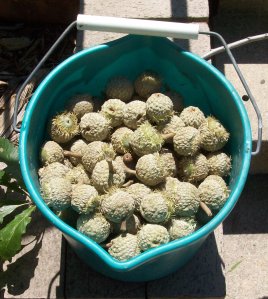
It is dominated by three Burr Oak trees planted from acorns collected the year our daughter graduated from high school. One tree for each of us. It is adjacent to a row of lilac bushes plants in 1994. As drought conditions often plague Iowa, accompanied by scorching heat, it is better to plant some vegetables in a partly shady area. Shade creates a longer growing season for lettuce and reduces the amount of watering needed. The three oaks and lilacs are staying for now, although eventually may be thinned.
On the north side of the plot are some spring flower bulbs transplanted from the Indiana trucking terminal where I worked. They grew in the ditch near Highway 41 and were likely planted by a previous owner. They bloom faithfully each year and need to be dug and separated.
Next to the flowers is what used to be a row of iris. They are dying and what’s left needs to be dug and separated. Only an occasional flower now appears.
The rest of the plot was planted in garlic rescued from the town library. It eventually spread to cover the entire plot. A few years ago I placed tarps over the middle of the garlic patch to store stakes, cages and fencing. Each spring garlic pops up around the tarp perimeter. I harvest it for spring garlic, otherwise let it grow wild.
This year I pulled up one of the tarps and planted Turk’s Turban and Acorn squash. Both produced and some wait on the counter to be used.
This is the first year I tried an annual crop in plot one, and based on the results, I might try more. The near continuous shade makes crop selection the essential dynamic. While we enjoy the spring garlic, we should convert production to a regular, annual cycle of planting and harvesting garlic cloves. It is not too late this year, but with continuous daily work outside home until November, it is doubtful I’ll get a crop in.
Plans for next year: dig up the bulbs, separate and move to a more decorative spot in the yard; try an early spring crop like turnips, beets or radishes; till the entire plot after spring crop, evaluate, and likely plant beans to fix nitrogen in the soil; plant garlic in the fall.
I drove to the county seat to vote after my shift at the home, farm and auto supply store. There were six or seven poll workers — plenty of staff to handle the day’s last half hour of early voting at the auditor’s office.
The orange ballot box was so full the poll worker had to jostle it for mine to fit in.
Surprisingly, or not, this shit show of an election didn’t pull the final curtain after casting my ballot. The proscenium arch has no curtain after this godawful exposition of what politics has become. Trump may burn the theater down before he is through. Throngs of his supporters would cheer.
My next door neighbor called out as I arrived home. In jeans, a sweatshirt and stocking cap she was gleaning her garden before an imminent frost. She offered hot peppers. I declined as our ice box already has more than needed for winter. We conversed for a while about produce and ideas. We didn’t talk about politics.
This morning I left the glow of the computer screen to go outside.
It’s not going to frost this morning. My weather app tells me 32 degrees in the last half hour before sunrise. Ambient temperatures may dip to freezing, but not long enough to damage much in the garden. Experience tells me it won’t get that cold in the micro-climate of our yard. There’s less chill in the air than when I spoke with my neighbor.
As days move through the calendar experience also tells me election day won’t bring the end of politics as we know it. The body politic is ever changing, ever re-inventing itself, sometimes by design, sometimes by unintended consequences. Those of us who believe the framework of society is enduring also see an opportunity in today’s bedlam for positive change.
Not the hope and change Barack Obama touted in Iowa eight years ago. His administration will leave us with mixed reviews and something different. The clear knowledge that for change to come, we can’t lose hope. At the same time, we must work for change that is much needed in the American society we call home. Many of us will find hope in the ashes of the 2016 campaigns and are willing to work to bring change we know is needed.






 Journey Home
You must be logged in to post a comment.