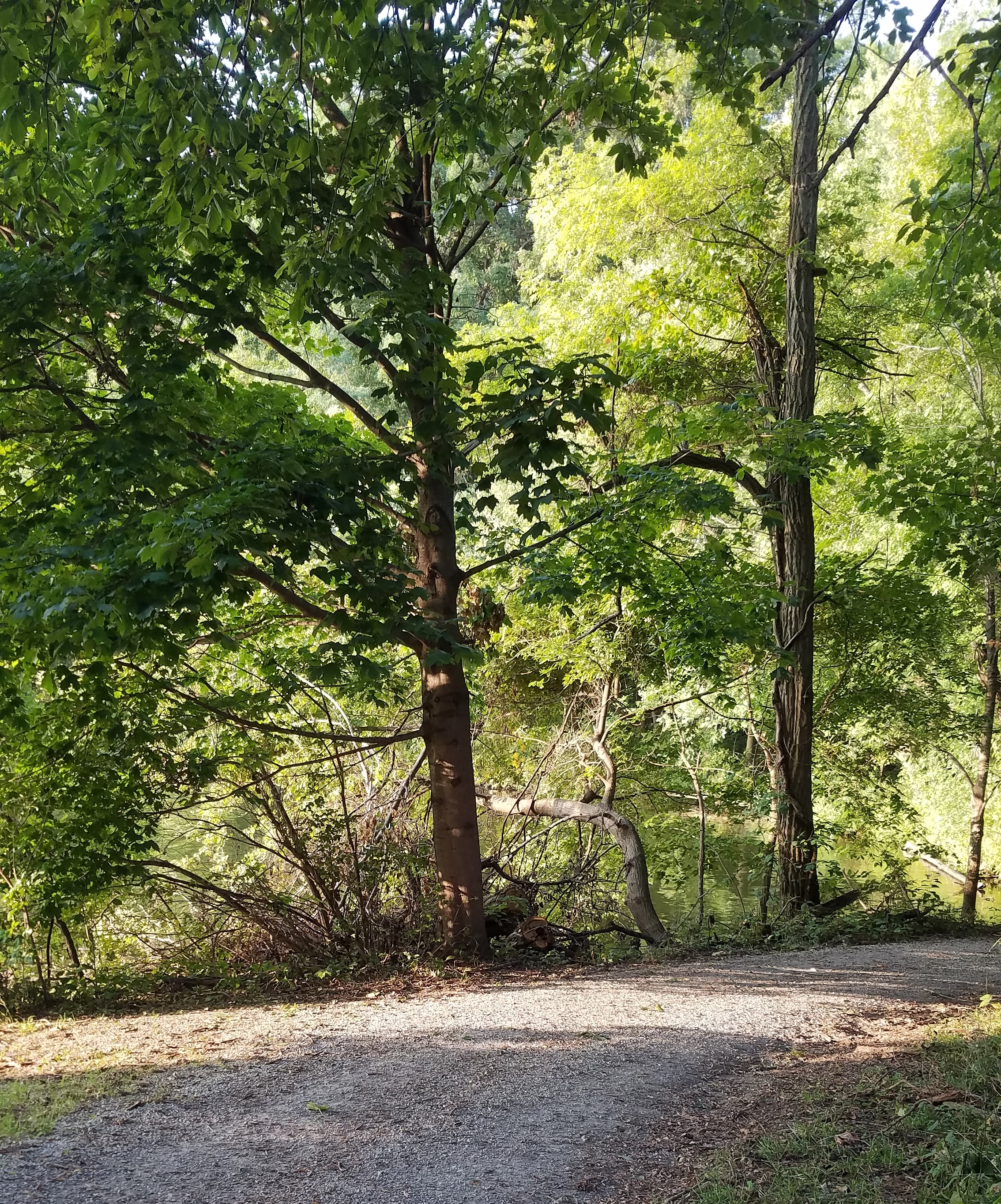
Turn around on the Lake Macbride State Park trail.
Tuesday morning I cut the fallen locust tree trunk into segments and stacked them along with other firewood produced after the derecho.
It will take several more shifts to cut and sort the remaining damaged tree branches. One of the oak trees needs removal once there is room for it to fall. After that I can get the garden ready for winter, beginning with garlic planting in a couple of weeks.
The call of politics dominates my awareness. I spend time each day improving our chances in the Nov. 3 election. I’ll be spending more time. The stakes in this election are too high to sit on the sidelines.
I’ve learned to take care of myself in times of stress. That’s something we all can and should be doing. As the sun rises it’s difficult to see what today will bring. We must be active agents, not only in our own lives but in our lives in society regardless what light shines on us.
Voting begins on Oct. 5, 19 days from now. One can feel the surge of Americans moving toward election day. Part of it we can’t influence. Part of it we can and that’s where I’ll spend my daily political time. I hope readers will join me by making sure close friends and relatives have a plan to vote.
Tomatillo casserole with potato, onion, tomatoes, garlic and basil.
Johnson County, Iowa, where I live, is distinctively Democratic. The Republican Iowa legislature doesn’t much care for our deviance from their plans.
In 2010 we were the only county in the state to vote for Democratic U.S. Senate candidate Roxanne Conlin. In 2014, Johnson County stood alone in voting for Jack Hatch as governor. “We are the most Democratic county in the statewide races by a very consistent margin,” election official and long-time blogger John Deeth wrote.
Said margin doesn’t mean beans in the scope of statewide elections. If one subtracts Johnson County from statewide and presidential results since 2000 the political outcome and the winners would have remained the same.
Let’s be clear, my political precinct voted for Donald Trump by a substantial margin, as did several others. When I write Johnson County is liberal I’m referring to the urban centers comprised of Iowa City, Coralville, and to a lesser extent, North Liberty. Rural areas near Lone Tree, Tiffin and Solon are more like the rest of the state than the liberal metropolis.
Republicans have noticed and are taking aim.
The county would ban concentrated animal feeding operations if we could. There are votes on the board of supervisors to do so. Managing CAFOs was one of the first areas of the law where the legislature preempted local control, saying hog and cattle lots would be managed from Des Moines.
The Johnson County supervisors raised the county minimum wage. Not every municipality in the county went along with the change. Some other counties also raised the minimum wage. The state legislature preempted local control over minimum wage, nullifying Johnson County’s ordinance.
Protesters in Iowa City have long sought to shut down Interstate 80 as a way to stop business as usual and gain attention for their causes. I participated in one such interstate shutdown in 1971. Republicans increased the penalties for this infraction, although the Iowa Highway Patrol, which is responsible for the interstate, hasn’t been able to prevent protesters from attempting to close it. Protesters closing the interstate highway remains a sore spot for Republicans.
There was talk in the legislature of penalizing so-called “Sanctuary Cities.” I worked with a local group of faith and labor leaders to get the Iowa City Council to declare the county seat a Sanctuary City. They declined to do so because of the stigma attached to the appellation. That hasn’t stopped Republicans from calling our county a Sanctuary County, and our cities Sanctuary Cities.
Our county favors reasonable gun control. No one wants to take guns away from everyone. Most of us would ban the AR-15 and other assault and military-style weapons, and better control the way in which sellers at gun shows operate. The Iowa legislature, especially under House Majority Leader Matt Windschitl, will have none of it.
The effect of constant Republican efforts to erode what makes Johnson County a liberal center is not without its effects. The reaction to Republican preemption in governance has been to make us more liberal. At the same time our liberal nature is isolating us within the state.
Republicans keep after us, including attacks on the keystone of our local economy, the University of Iowa. Through decreased funding, and installation by the board of regents of President J. Bruce Herrald, a man without substantial academic credentials, they erode what’s best about the university and as a byproduct, our economic life.
Iowa City is also hard-hit by the coronavirus pandemic. The state would not allow a mask wearing mandate and the city and county implemented one anyway. I was in the county seat yesterday and the percentage of mask-wearing people was about 50 percent. Enforcement is close to zero. It’s no wonder there is uncontrolled spread of the virus in the county.
If the Trump administration ever finishes the U.S. Census count, there will be political redistricting for the 2022 election. Iowa expects to keep its four congressional seats. I expect Johnson County will gain at least one full time state legislator and we will elect a Democrat in that district.
It seems possible to regain control of the Iowa House of Representatives this election cycle and we are working toward that end. People say it’s possible to flip the Iowa Senate as well, but I doubt it. The Republican Party of Iowa is in full campaign mode, defending every seat where a Republican is running. Even former governor Terry Branstad is returning to the state to help with the campaign, announcing yesterday he is leaving his post as U.S. Ambassador to China. If anything, the political landscape will result in Democrats becoming even more concentrated geographically and Republicans harder to beat.
To some extent Johnson County Democrats painted a target on their back by pursuing liberal policies. That leads me to say while Republicans take aim at us liberals, I hope the rest of Iowa Democrats are using the diversion to gather strength and rebuild Iowa as a progressive state. We should be a progressive state and the only way we will return to our roots is by developing a statewide Democratic footprint. I’ve been around long enough to believe that’s possible.
Republican attacks on our county are irritating yet tolerable. They are not going to end soon and hopefully will provide cover for our Democratic friends and allies throughout the state. The Nov. 3 general election will be a bellwether to show us which way the state is going.
A high school classmate died on Sunday. In 2013 he sent a copy of a 54-page draft of his memoir for editing.
I didn’t offer much because his writing was good and it was his story, not mine. Our life experiences were different, tied together by four years we spent in high school together in a cohort of 262 students. If it weren’t for social media we would never have collaborated.
My life has been lived in the second half of the 20th Century and the first quarter of the 21st. I want to tell that story, although I’m not sure how badly.
I wrote many words about my life and part of the task of a memoir is pulling that writing together. It seems important, not urgent. I have a question: what have I done the story of which hasn’t been told by someone else? Not much when we think about it.
Today I see a memoir in two parts. One, a collection of past writing and historical analysis that tells the story chronologically. The second, an analysis of important life events from today’s perspective. Both parts will become big projects.
The first reason for a memoir is to record a history for our daughter. The second is to understand it myself. I doubt my life has much significance beyond family. Although I’ve done a lot, I’ve been a reflection of contemporary times rather than shaping them. I’ve been a regular guy trying to get along and that’s not too special in the broad scope of society.
For the time being I work on a couple of community projects and plan to address the memoir after the Nov. 3 election. A lot depends on the outcome of the election, including whether or not progress is made on a memoir. Here’s hoping for the best.
From drought to rain the last week has been unrelenting.
The garden continues to produce and grass is growing again creating another task once the landscape dries.
Doesn’t look like drying will happen today.
I am helping the local political party distribute campaign yard signs. There are few parts of the county north of the interstate highway I don’t recognize. I’ve gotten requests from voters on some new streets yet when I look for them the same roads and streets are in memory to find them. I remember a lot of door knocking from past political campaigns.
I stopped to refuel my 1997 Subaru Outback. At the convenience store no one was wearing a mask. Not a single person. I couldn’t see through the window whether the cashiers were, although I hope so. Keeping my distance at the fuel pump I sanitized my hands once back in the driver’s seat. Risk avoidance is a key part of dealing with the coronavirus pandemic. I resisted the temptation to go inside and buy a Powerball ticket.
It’s just as well it’s wet outside. I have an indoors project with a deadline and it’s easier to avoid distraction when it’s raining. I’m about to make my second French press of coffee for the day. It may not be the last. I’m digging into the history of our community. There’s a lot of food for thought and memory. It should keep me busy all day.
(Editor’s Note: This article was first posted Sept. 25, 2011 on my blog Big Grove Garden. It is about missing mainstream culture in the late 1970s and captures some of my life while living in West Germany and epiphanies while visiting San Francisco where I jogged on Market Street in the middle of the night, saw DEVO and Sir Elton John perform at the Cow Palace, and stayed in Chinatown while there to attend Oracle Open World in 2006. It is presented unedited.)
By the time I returned from a Cold War West Germany in 1979, I had missed a lot of the music, movies and other artifacts of popular culture of the late 1970s. Jackson Browne, Bruce Springsteen, Talking Heads, Blondie, Sex Pistols, the Cars, the Clash, The Ramones and DEVO, never heard of them. In movies, Blue Collar, Star Wars, The Deer Hunter, Kramer vs Kramer, Norma Rae, Taxi Driver, F.I.S.T., Saturday Night Fever, All the President’s Men, and Dog Day Afternoon were all beyond the ken as instead, we viewed repeated screenings of Patton in forests near the Fulda Gap, our projector powered by generators.
Most of us did not even own a television while we were stationed overseas, preferring to get together at the officer’s club or go hiking and rock climbing in the nearby Taunus mountains during rare times when, for a few hours, we could get away from being a soldier. My vacuum of experience in popular American culture is between the bookends of Jaws, which I saw with house mates when living in Davenport and Annie Hall which I saw in Amsterdam subtitled in Dutch while on leave from my post in Mainz just before returning to Iowa. In retrospect, missing these shared popular culture experiences was a formative influence. Even missing the start up of Saturday Night Live was important.
Instead of music and movies, I took in the stuff of life. The politics of being an occupying force leftover from World War II was real. One of my buddies went on missions to East Berlin where he talked with Soviet soldiers to see what they were up to. Mostly, it appears, they were drinking vodka and we never worried about the threat they may have posed to the West. One time we chipped in and he brought us hats made in East Germany. I still have mine in the closet, as it is very warm.
Our battalion had a severe drug problem. Almost every soldier had some connection to use of heroin or hashish. It was so prevalent, and our enforcement capability so limited, that we would bust someone caught in the act more to ruin their Friday night than send them to jail. Often soldiers caught using drugs in the military were sent to the Community Drug and Alcohol Counseling service. Turned out the counselor supplemented his military pay by selling heroin to his clients. Heroin purportedly coming from Afghanistan through East Germany. Looks like both sides of the Cold War had their problems with substance abuse.
By dealing with existential realities in the military, I was spared the evisceration of everything I knew from growing up in a union household. Popular culture reflected that. The late seventies were a prelude to Ronald Reagan’s supply side economics, and notably the PATCO firings that were a continuation of the assault on unions that began under Nixon. It would have been tough to witness all of that. While I missed the first run of DEVO, I did finally catch up with them.
I got a chance to attend Oracle’s Open World in 2006 while working at a logistics company. It was a time on the cusp of the explosion of hand-held devices and cloud computing we are in the middle of today. Gavin Clarke wrote about the event in The Register, whose tag line is, “Biting the hand that feeds IT.”
More than 40,000 delegates will flood downtown San Francisco’s hotels, restaurants, and transport system, drawn from the developer, customer, and partner ranks of the 21 companies Oracle bought since January 2005 plus those using Oracle’s own middleware and applications.
Keynotes from […] AMD’s Hector Ruiz, Cisco’s John Chambers, Hewlett-Packard’s Mark Hurd, and Sun Microsystems’ Jonathan Schwartz, plus Dell chairman Michael Dell, and Network Appliance president Tom Mendoza who will no doubt pay some kind of homily to the power of their relationships with Oracle on servers, virtualization, and software […]
Even the entertainment is big: […] it’s the rocket man himself Sir Elton John.
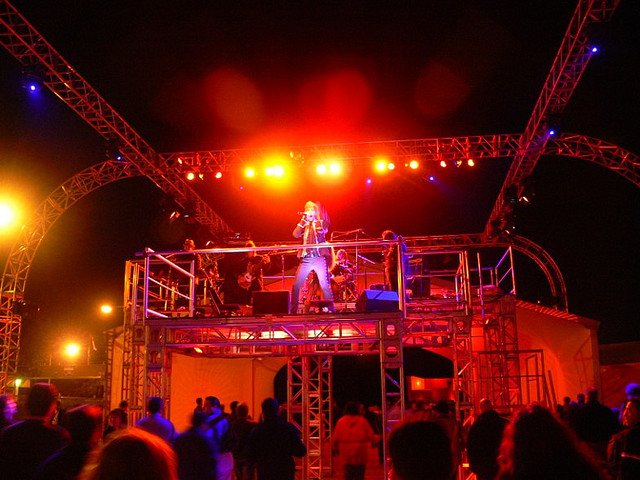
Somewhere on one of the numerous venues arranged by the conference organizers within San Francisco’s Cow Palace, along with Sir Elton John, a dozen bands, circus acts and contortionists, I saw the band DEVO perform for my first and only time. They played Secret Agent Man among others I did not recognize. It made me glad I missed the 1970s culture of the De-evolution of American life that was tied so closely to corporations making things like Goodyear tires in DEVO’s home town of Akron.
I was still on Iowa time at my hotel in Chinatown near the Moscone Center. I went jogging on Market Street in the early morning, encountering an army of homeless people, socializing and sleeping in cardboard boxes and under blankets on the sidewalks. As I ran, I wondered how the popular culture of the 1970s became one more thing to be marketed and bought by consumers. In doing so, it bred a deep cynicism that penetrates our culture today. It also gave rise to today’s self purported “new revolutionaries” of the Taxed Enough Already party, who too have become one more thing to be marketed by the corporatists at Fox News and NBC Universal.
As the sweat built and I headed back to the hotel, missing the late 1970s popular culture did not seem so bad. It enabled me to hope that as a society we were better than this, and that life was about more than militarism, poverty, sex, drugs and rock and roll. For that I am grateful.
If my posts about the climate crisis have been scarce this year it is because of a decision to focus time on political outcomes.
Under Republican governance needed action to protect the environment and take bold action to reduce the constant stream of inputs that warm the atmosphere and oceans seems unlikely. If anything, Republicans are taking us the wrong direction. I spend time each day working to elect Democrats in hope of a government that will take the climate crisis seriously and address the existential problem.
Weather in Iowa continues to be crazy. There was drought, a derecho, and now a few days of almost continuous rain expected to produce flash flooding. This is what the climate crisis looks like. It is not located in a misty future, it is now.
California fires have already burned 2.2 million acres, more than any year on record according to CBS News. It is only September. Half a million people are evacuating parts of Oregon due to fires there. Hurricane Laura brought devastation to the Louisiana and Texas oil patch. Record high temperatures are being set from Florida to California. If you think this is a new normal, you would be wrong. This is the beginning of a very turbulent period of extreme weather. From here it is expected to get worse.
Our current government makes no pretense about addressing the climate crisis. They are simply not going to do it, consequences be damned. That’s why it is important to change our governance and through the ballot box has been a dependable first effort. If we do elect Joe Biden president with a Democratic House and Senate, our work is only beginning. He and his potential administration must be held accountable to make needed change that positively impacts the environment.
Absentee ballots are to be mailed from county auditors in Iowa beginning Oct. 5. The period from then until Nov. 3 will be one of tracking down ballots. In addition we’ll spend time getting people to register to vote and cast their ballot. That will take most of our time and energy.
The climate crisis is urgently important. Just as a lifeguard sometimes must subdue a drowning victim to save them, so we must focus on the election. There will be time to set priorities after we win at the ballot box. If we don’t win, the priorities become much different and the climate crisis more dire.
We are stronger together and it will take all of us to turn the government around in 2020 and beyond. It is past time to act on the climate crisis.
When the real risk of illness or death can be found everywhere, behaviors change. Upon reflection, so can our process for living.
Yesterday, the Washington Post published an article titled 9 everyday experiences the pandemic has endangered — and how they impact our lives. I read it and only one of nine, using cash for payments, impacted my life. That’s one of the problems with this pandemic: one person’s perspective just doesn’t apply to everyone. That’s increasingly American and to the extent our tolerance for diverse opinions is scant, it is a problem for coming out of the virus. If we can’t agree with scientists, including epidemiologists and public health officials, we will not solve the problem of a virus that sickens millions and kills hundreds of thousands.
How do we get out of the pandemic? Given today, I don’t know how we can.
The cost of redemption is subverting our egos, something a large group of people are willing to do, at least long enough to abate the virus. Absent political leadership, such ideas seem futile. As lifelong Republicans are willing to vote for Joe Biden to end the crazy of the current administration, suppression of who we are, while it may get us through the pandemic, is not a longer term solution to social problems.
The pandemic forces us to change how we live. We now have homemade cloth masks to wear in public. If one of us were out more we’d invest in a plastic shield to protect our eyes. We cook all of our meals at home. We rarely leave the property. When our cable to internet access was accidentally cut, our wireless usage more than doubled — we stay connected to the digital world. Increasingly, internet content seems homogeneous.
There are a few changes to daily life I hope continue into the post pandemic period.
Containing Contagion. We’ve not been sick since the governor declared the emergency on March 9, six months ago. In retrospect, not going to a workplace with 80 employees reduced the number of infections I brought home. While I enjoyed the extra income from that retail job, I better enjoyed good health and the absence of colds, influenza and pneumonia. I hope mask wearing, washing hands, sanitizing when soap and water is not available, and maintaining social distancing continues in society long past the end point of the coronavirus pandemic. I’m likely an outlier.
Using Stuff. Our house became over-filled with the unused detritus of living in a consumer culture. The coronavirus pandemic has us using some of that stuff in a way we hadn’t anticipated. I found my webcam and installed it on my desktop to participate in video conferencing. I took my bicycle off the hooks in the garage and have been riding it almost daily. When it breaks down I try to fix it myself and consult with friends and technicians on what to do. I’m cooking more, trying to use up ingredients stored in the pantry and freezer. I developed a process to circulate and wear clothing that is too worn to donate to charity but had remaining use. Our home has become a workshop in a way I have long wanted but was too busy to create.
Kitchen Garden. I abandoned my quest for local food and its meaning. To replace it, I focus on the new term, “kitchen garden,” which represents the intersection between created meals and the farms, gardens, orchards and manufacturers that produce our food. The term “local food” was a construct that no longer serves our purpose. We are consuming more locally produced food than ever by recognizing and living in this nexus.
Wellness. The coronavirus pandemic brought attention to our health and wellness. I get in 25-30 minutes of exercise daily, eat less, and address my health risks. In addition, I write letters (on paper) to a few people, stay in touch via email and social media, and do more neighboring. While the circle of friends radius is shorter, it is more meaningful and that has been better for wellness. It is important to mention the pensions our household receives. The viable economic base they provide makes everything else possible.
Intellectual Development. While my work status is “retired,” I stay busy. The coronavirus pandemic stopped everything in its tracks as I stayed home and followed what government leaders suggested when it made sense. The enlightenment of this self-isolation is that something will be next. I don’t know what it will be, but it will be local, new, and grounded in intellectual pursuit as we tackle issues where I live. There have been a number of locals interested in participating over the years. It is time we break from participation in distant activities to create our own local ones. I’m not sure what that looks like but am motivated because of the pandemic to figure it out.
Transportation. Most days if I leave the property it is to exercise. The number of auto trips is severely reduced as I shop at the wholesale club once every two weeks and go to a grocer less than once a week. I need to rotate the autos so they both get started and driven regularly. Gasoline use dropped 20 percent. When we ran a generator during the derecho recovery we consumed 15 gallons or more. I make occasional trips to the county seat, visited a local nature preserve once, and drove to the TestIowa COVID-19 test site three times. That’s pretty much it. I’ve become comfortable with staying home for several days at a time.
It is hard to say when the coronavirus pandemic will be officially over. It will be with us for a while, I’m sad to say. Amid the sickness, death and financial challenges I find a new way of life and a wavering ray of hope. Let’s hope it persists.
It feels like summer is turning to fall as the general election approaches. It’s the final stretch.
Whether disinformation and obfuscation combined with intentional confusion regarding absentee ballots will be a winning strategy for the president’s re-election remains to be seen. Think about that sentence. What the heck kind of politics is that?
Even with Russian operatives echoing the president’s talking points (or is he parroting them?) the people with whom I discussed the election this weekend feel we have to do something about this president. Even lifelong Republicans feel Donald Trump should be voted out of office and plan to vote for Joe Biden as president.
Perhaps some in the United States support this approach. I believe a majority do not and will show up on election day.
There are some, myself included, who believe where there is evidence Trump should be prosecuted, stand trial, and if found guilty, imprisoned. It’s certain if Joe Biden wins the Nov. 3 election he won’t pardon the then former president after Jan. 20, 2021.
I reviewed our budget and made some political donations yesterday. I will also be spending part of each day working on electing Democrats. On the Labor Day holiday there are no good excuses to hold back. It’s all hands on deck!
A lot is being made about the differences between voters who live in rural parts of the state compared to those who live in our cities and urban areas.
It’s a false distinction. The same social, economic and political forces are at work no matter where one lives. None of it favors regular people like us.
Why does everything cost more? Why do we have to drive so far for health care? Why is our broadband inconsistent at best if we have it? Why can’t farmers sell milk for at least the cost of production? Why are there patents on seeds? Why does new farm equipment cost so much? Many questions, few answers.
Why do more than half of working people in predominantly rural counties work in another county? The answer to this is easy. Farming does not pay unless one is a big corporation. Someone in most farm families has to work outside the farm to make ends meet and such jobs are mostly urban.
When people say of politicians, “We need someone who understands the rural areas,” it is true. It is also code for something: hard work, poverty, a lack of economic justice, and a type of Christian religious faith. For the most part it is about being a Caucasian farmer.
Of recent writers, Sarah Smarsh came closest to capturing what being rural means in her book Heartland: Working Hard and Being Broke in the Richest Country on Earth. The book resonated so closely with how I grew up yet I lived in Iowa’s third largest city. There are differences between the urban county where I grew up and the rural county I know best (Cedar County). Those differences are not significant. Try telling that to someone who lives in a rural area and you’ll find self-righteousness and resentment.
I won’t resolve this false dichotomy. Just as Jack Kerouac’s more conventional first book, The Town and the City gave way to the “spontaneous prose” of On the Road, it is difficult to focus on it for long when so much more about society is engaging.
Suffice it the assertion of ruralness isn’t about being rural. It’s about having dignity, justice and equal treatment under the law. It’s about a return for the hard labor so many farmers invest as part of their lives. At some point labor should be rewarded for its sacrifices instead of return on equity going to the richest people and corporations like Monsanto, Cargill, John Deere, DuPont and Archer Daniels Midland.
Iowa’s well-developed road system is partly to blame for the rural-urban divide. Because of inexpensive gasoline it is easy to drive to a metropolis when shopping for food, building products, household goods and clothing. When there are no rural jobs, a commute of less than an hour might produce income far above what farm earnings can be. Americans, rural or urban, are at a distance from producing their own food, shelter and clothing. Let’s face it. Who wants to live like Old Order Amish? I’ve met enough young people trying to escape that life to say not many. Yet we still see horse drawn carriages using Iowa’s rural road systems.
Use of the rural trope drives me a bit crazy. Not crazy enough to call the suicide hotline, yet enough to be a catalyst. The thing about catalysts is they can get us to where we should be going faster, the way iron is a catalyst for making ammonia. If people who live in rural areas want to get ahead, they need to steel themselves against language that would divide them from the rest of us. That includes their own language. We are stronger together and fabricating a rural-urban divide is counterproductive. That is, if we want society to advance toward something positive.
~ A version of this post appeared in the Sept. 13, 2020 edition of the Cedar Rapids Gazette.
Wednesday started well enough with cool temperatures and a 13-mile bicycle ride. Then I tried to clear the remainder of the locust tree laying across the garden.
The Poulan chain saw started but when I hit the accelerator it died. That was the trouble last time I had it out. I put it on the front steps, got out my Wagner electric chainsaw, and proceeded to make about a dozen cuts. The Wagner has been a great tool, although toward the end of this session it developed a problem I couldn’t resolve. I called the small engine repair shop across the lakes.
They said the electric chain saw repair would likely cost more than the tool was worth. They did work on Poulan chain saws and had space in the work queue to get mine in. With the derecho cleanup, businesses like theirs have been busy. I packed my 1997 Subaru and headed across the lakes. Overnight they adjusted the carburetor, sharpened the chain, and I was good to go. I proceeded to clear the garden of the locust tree.
I’ve been taking my time with the rest of the derecho clean up. I got the fallen branches and my destroyed greenhouse out of the neighbors’ yard the day the derecho hit but have been in no hurry to process the debris. The metal sink I kept in the garden was crushed when the locust tree fell on it. Good sections of fencing and posts were ruined. One of the three oak trees I planted in the garden is leaning due to the derecho wind and weight of the locust tree falling against it.
Some of the vegetables survived although all of the tomato and tomatillo cages were crushed and twisted. Much of my row of peppers was smashed. I’ll get outside to work on it again today and harvest what I can from the wreckage.
We need rain yet none is forecast. As summer ends the pace is picking up. As if it weren’t already at a stunning clip.




 Journey Home
You must be logged in to post a comment.