In 1972, seven days after the Allman Brothers Band released their third studio album, Eat a Peach, they appeared at the University of Iowa Field House. We didn’t know what to expect since Duane Allman had been killed in a motorcycle accident Oct. 29, 1971. I worked a carbon arc spotlight for the show and it was a stunner. Eat a Peach was the last album on which Duane Allman played. This is a recording from it.
During this year’s fifth shift of soil blocking at the farm I got my groove back. That means I maintained a production rate of ten trays per hour. I’ve done better than that, although this year the supplier changed the composition of the soil mix and it’s taking some adjustment. It’s my ninth year at the farm under two different owners.
The farm crew is getting vaccinated against COVID-19 and we’re working through the unmasking process. When I work alone in the greenhouse I’m unmasked, when with others, masked. When the crew makes deliveries, the usual social distancing and masking protocols are followed. There is a fear that contact with so many people carries risk of transmission of the coronavirus. We don’t want the virus brought back to the farm. The good news is we are working through it.
At home, pollination is proceeding. Apple blossoms are open and petals have begun to fall after fruit set. The weather forecast is good for finishing fruit set before a frost. This is a key time in apple production.
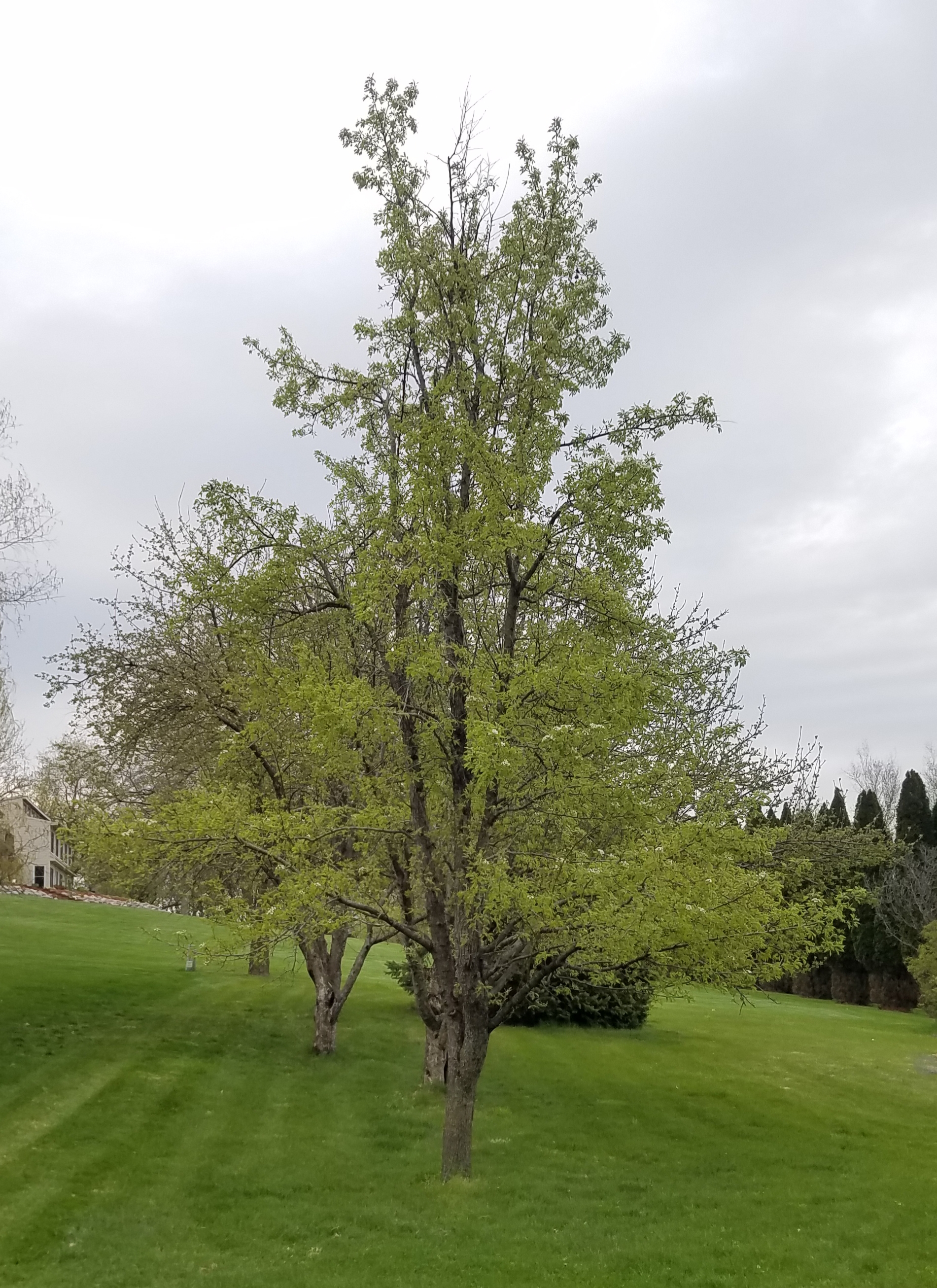
The pear tree has fewer blossoms than in previous years yet there looks to be a harvest. Now that the sun is up, I’ll head out to the garden to take in the fragrances of the flowers before they disappear.
As we enter the spring harvest season the food we prepare in the kitchen gets different. There is an improvised quality to everything because in turning away from the pantry, ice box and freezer, fresh ingredients are incorporated into most every meal. It creates variation and deliciousness.
Our dinner stir fry included Bok Choy, cutting celery and spring garlic. This morning’s breakfast was a pan casserole using leftover rice, Kogi and Broccoli Raab. All of these vegetables were from our spring share at the farm. I take advantage of their high tunnels for early greens.
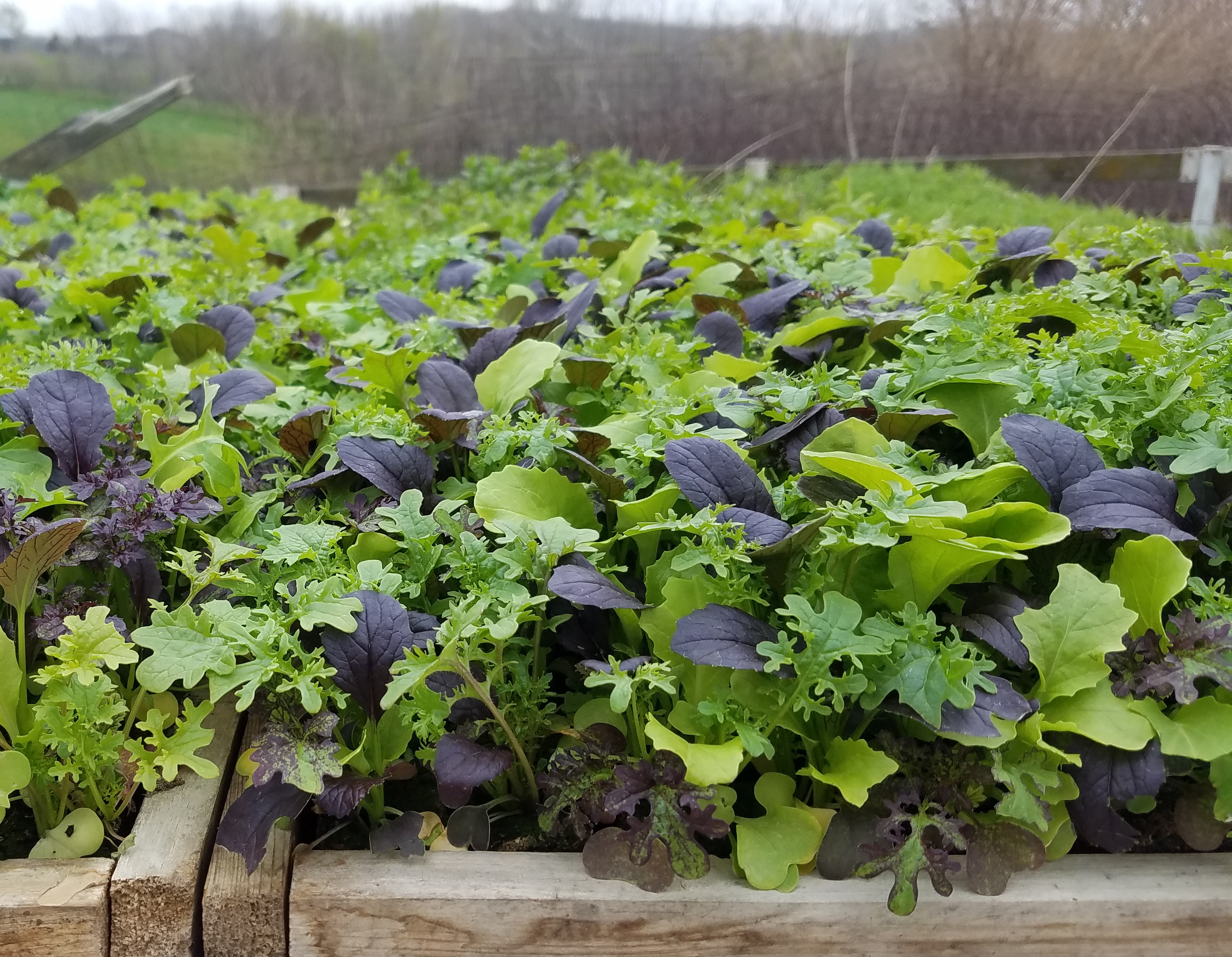
On my daily garden walkabout I checked under the row cover and everything’s doing well. In fact, it is some of the best-looking lettuce I remember growing. I need to learn to grow better lettuce and after a couple of days, it looks promising for this year.
I cut back the dead leaves from the recent frost on broccoli, kale and collards yesterday. They all are regenerating and ultimately survived the frost. I added mustard greens to the row and will wait until after last frost to add chard plants. looks like there will be no shortage of kitchen greens.
The frost killed most of a row of yellow onions so I replanted. This morning the new starts look well. Onions are such an important part of our cuisine, they warrant careful attention.
Celery, leeks, and a patch of spring onions survived transplant and I need to mulch. The lawn is at a point to mow: the first clippings will mulch the celery. There are never enough grass clippings.
Like last night’s stir fry the recipe book is out the window as we live in each moment. I’ve been cooking enough to know what to do, which ingredients to leverage in our cuisine. An anthropologist might be able to describe what I do better. I don’t feel any urge to do much that doesn’t come naturally and based on long learning. Don’t need recipes for that.
I can relax. Pollinators showed up at the apple and pear trees Monday. The relief is palpable.
Ambient temperature soared to 83 degrees and the warmth brought insects drawn to the pollen of open flowers. It’s expected to be warm again today. Hopefully it provides an opportunity for fruit to set.
I woke around midnight with moonlight coming through the blinds on the windows. It was very bright. I couldn’t get back to sleep. I went downstairs and got the copy of N. Scott Momaday’s new book Earth Keeper: Reflections on the American Land that arrived on Monday and read its 66 pages cover to cover.
Momaday strips language describing the earth to essentials. There is scant mention of cultural aspects of American society. His focus is on native oral traditions. It is different from other works by less experienced authors who use certain objects to make a point.
For example, what does it mean to invoke the image of the Piazza San Marco in Venice? For me, it is about art. Here’s what I wrote in my Oct. 9, 1974 journal:
These art works abound in poses like I’ve never before seen. It makes Dejeuner sur l’herbe seem trivial. A sketch book could be filled with writing the numbers of figures. And scores filled with drawings. Yet the true art is seldom, if ever, derived directly from other artists., but through nature. We must remember that art history plays but a small part in the dynamic, changing integrity of life. I seem to be a verb.
Personal Journal, Venice, Italy, Oct. 9, 1974
I’d already studied Momaday, and R. Buckminster Fuller (obvious from the last sentence) by the time I made it to Venice. The main justification of my trip was to see works of art around Europe. I remember Piazza San Marco and walking inside grand buildings that were virtually abandoned. They were preparing for a concert that evening. I remember the piazza flooded while I was there, a shallow pool of water broaching the banks of the Venetian Lagoon. I don’t know if that memory is real.
I wrote the names of 16th Century artists in my journal and compared them to other experiences. In the end, Venice provided an epiphany about the role of art in society. What we write can be more like Momaday: sparing in societal reference points with a focus on traditional narrative driven by the land.
When someone references “Piazza San Marco” it distracts from the point an author is making. Cultural artifacts inserted into poetry or prose don’t always have the same meaning to readers. That can be problematic.
I’m not sure what to make of this. For now, I’m glad pollinators showed up yesterday. I’ll get outside after sunrise and chew on it while planting more of the garden.
I’m hoping pollinators show up in force today. Two apple trees and the pear tree are in bloom. The other apple tree is not far behind them. The lone bumblebee I saw on Friday will have a big task ahead if it’s the only one doing this work.
We got rain yesterday, not much, enough to delay watering the garden. I’m working on the irregularly shaped plot, the one with sunken containers, pallets of supplies, and composting bins. I dug up half the volunteer daylillies and hope to dig up the other half today. Spring transplanting of daylillies is okay if one trims the green portions to about half. They should take once a spot for them is identified. They grow like weeds. They are weeds where they currently are.
A corner of this plot, next to the containers, will be lettuce and radicchio with row covering over them. The long row needs something that can grow without a deer fence. I don’t know if I have that as they eat almost anything. The middle-sized row may be Brussels sprouts which are a long time until harvest. Once they are in and mulched, sprouts are low-maintenance and can grow with a little water and that’s it. If I go through the packed greenhouse I’m confident I will gain inspiration.
It is best to plant the plot so I don’t have to enter it much, because in a moment of losing presence of mind, I installed a wall on three sides of the growing space. Won’t be fixing that this year, though. What was I thinking? I wasn’t.
The sun is up and there’s work to do. I’ll leave you with one of my favorite passages in English literature.
Whan that Aprille with his shoures soote, The droghte of March hath perced to the roote, And bathed every veyne in swich licóur Of which vertú engendred is the flour; Whan Zephirus eek with his swete breeth Inspired hath in every holt and heeth The tendre croppes, and the yonge sonne Hath in the Ram his halfe cours y-ronne, And smale foweles maken melodye, That slepen al the nyght with open ye, So priketh hem Natúre in hir corages, Thanne longen folk to goon on pilgrimages, And palmeres for to seken straunge strondes, To ferne halwes, kowthe in sondry londes; And specially, from every shires ende Of Engelond, to Caunterbury they wende, The hooly blisful martir for to seke, That hem hath holpen whan that they were seeke.
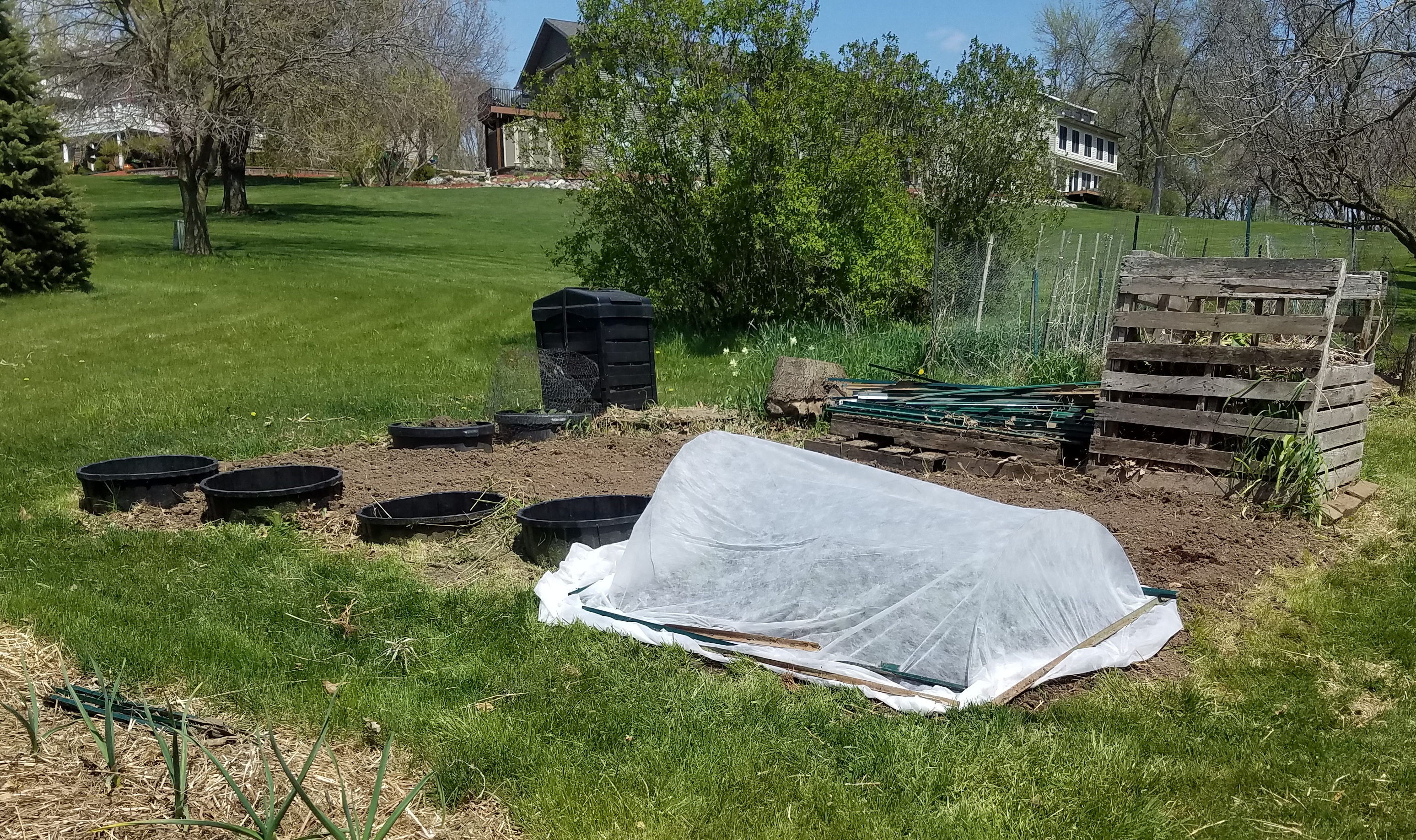
Here’s the plot after working my shift. The row covered part has lettuce, spinach, radicchio and cilantro. The four tubs next to it are potatoes. and two in the background have cruciferous vegetables in one and will have basil in the other.The rest of it was fertilized and tilled.
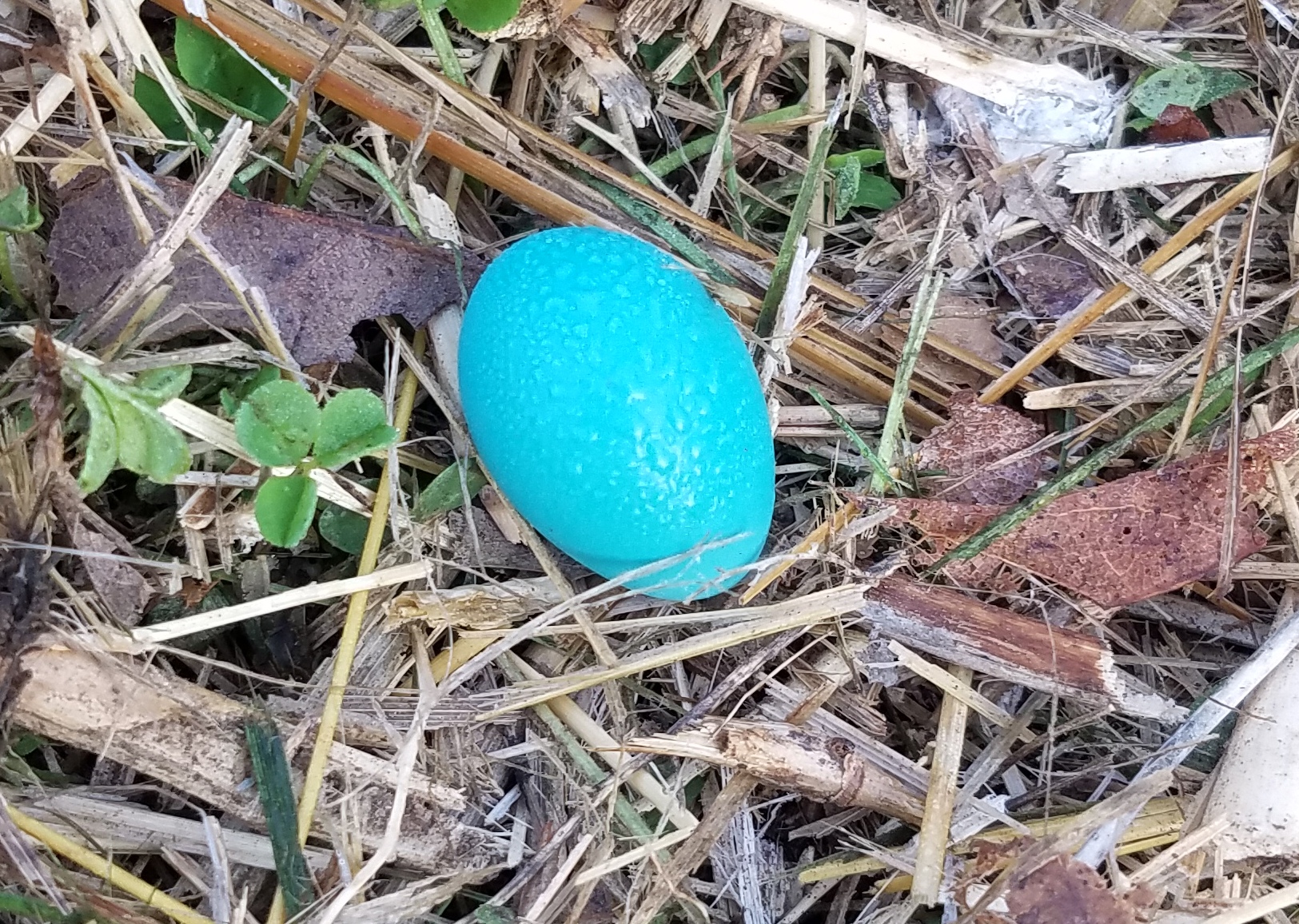
Two robins were moving around the garden in a way that was not normal. The expectation was they would be poking in the ground, searching for earthworms. When I went to water the garden, in the middle of nowhere, I discovered a robin’s egg sitting in the mulch. The birds didn’t appear to know what to do, if anything.
Since there was no nearby nest in which to put the egg, I left it there. It remained intact, yet abandoned, the next morning. On the third day robins continued to maintain a vigil. Without incubation, the egg is a goner.
Three fruit trees are blooming and the fourth is not far behind. Except for a lone bumblebee I have not observed much pollination activity. It looks to be a great bloom, although without pollinators that would be as far as it gets.
The message this morning is there are uncertainties in life to be observed. What we do about uncertainty remains an open question.
I won’t likely be returning to Walt Disney World, yet not for the reasons you might think. In the wake of the coronavirus pandemic, the consumer experience was shattered and one of the broken pieces is doing whatever we did for entertainment. Most of us won’t be going back to the way things were.
When our daughter was 11, I felt an urgency to provide her a theme park experience before she got too old. We went as a family, even though we couldn’t really afford a trip to Orlando. It was new even though it was the 25th anniversary of Walt Disney World. I remember it as a hot yet fun time where we could be ourselves. It was meaningful visiting Universal Studios and Walt Disney World together.
Lately folks are politicizing visits to Disney. Partly they accuse the corporation of playing politics. Please. Corporations have always played politics better than most. What is concerning to some is Disney recently announced cast members are permitted to display tattoos, wear inclusive uniforms, and display inclusive haircuts. I knew about the “Disney look” for many years and couldn’t see how they found enough non-tattooed people to staff the positions. Supposedly cast members being themselves has broken the willing suspension of disbelief many visitors bring with them to the park. Life is apparently crappy and folk need to travel to a theme park to forget about it. That’s a hella way to build a life.
There have always been guests at theme parks with grievances and disappointments. The new grievance of having one’s immersion into make-believe broken because Disney removed the Song of the South from Splash Mountain is something else. Something is missing.
I have no regrets about my trips to Walt Disney World, Disneyland, Sea World, Universal Studios, and the rest. It is a part of my privilege that I was able to go. So many were doing it, theme park trips came to be perceived as a norm for people who had the means.
What the coronavirus pandemic taught me is the important part of visiting theme parts was doing something as a family. It didn’t matter what we did and maybe that’s the point about Disney. Mickey Mouse is getting long in the tooth and society is ready to move on. The coronavirus pandemic changed several Disney employees I know… permanently. They are little different from the rest of us.
I’d like to suspend my disbelief in society’s promise. It’s okay with me if it’s with or without the Walt Disney Company. However, the pandemic taught me there’s a better way in sticking close to home.
Thermal energy came from the pile of white ashes on this year’s tomato patch. It warmed my hands. The embers will exhaust their fuel soon and I’ll spread them on the ground after they cool. Tomatoes will be the last to be planted in a few weeks.
The burn pile was mostly branches from the felled oak tree. Yesterday I cleared three garden plots for spading, tilling, and then planting: more steps on the path to a productive garden.
It looks like Tuesday night’s hard frost killed most of the beets and damaged broccoli, kale and collards. I have plenty of seeds and seedlings for replanting. First we’ll see if the bigger plants recover before yanking them out.
The Washington Post published an article about transportation and the shift to electric vehicles. It gave reasonable consideration to the operating costs of such vehicles, and the trade offs between operating a gasoline powered vehicle and going electric. I found if the car gets parked most of the time, very little gasoline is burned.
Thus far in 2021, I spent $36 on gasoline; in all of 2020, $492; and in 2019, $930. The coronavirus pandemic curtailed our driving and reduced how much gasoline we purchased. Unless one of us returns to working a job, the gasoline we burn for transportation should be minimal.
All the same, the news in the Post article about the inefficiency of internal combustion engines was eye-opening.
Most internal combustion engine cars are so inefficient that the vast majority of energy produced by burning gas gets lost as heat or wasted overcoming friction from the air and road. In other words, instead of filling my car’s 16.6-gallon tank, I might as well put 14 gallons of that gas in an oil drum, light it on fire and watch the smoke drift upward.
When you put it that way, of course we’ll look at buying an electric car. We need to stop burning fossil fuels as quickly as we can.
When I burn brush on a garden plot I’m releasing carbon into the atmosphere, along with returning minerals to the soil. However, what I’m doing is already part of the carbon cycle and therefore a renewable process. University of Iowa chemistry professor Betsy Stone explained it to me:
“It’s considered to be a renewable fuel because we have that carbon cycle going on,” Stone said. “With fossil fuels, we’re releasing fossilized carbon. It goes into the atmosphere and takes millions of years to get back to fossilized form again.”
I cut the stump of the oak tree tall so I could sit on it while contemplating the garden or needing a rest. Yesterday, while figuring out where to plant things it occurred to me burning brush was a good thing. I also thought we should probably get an electric vehicle.
While the first burn is done, I’ll be sitting on that stump coming up with ideas more often. Some of them will make their way into doing things.
Canned beans are a time-saver in the kitchen, especially for weekday meals. I made this recipe from both dried and canned black beans. Flavor-wise, the canned bean preparation was better. There are three parts to the recipe: beans, sofrito and rice.
Drain and wash two 15-ounce cans of organic, prepared black beans and put them into a cooking pan. Add a half cup diced bell pepper, half cup diced onions, two crushed cloves of garlic, and a bay leaf. Cover the beans with broth, tomato juice or water and bring to a simmer.
In a frying pan sautee one large, diced onion, one bell pepper, and three or four cloves of minced garlic. Add a tablespoon of apple cider vinegar and dried spices: cumin, salt and pepper to taste. Also add 1/4 teaspoon ground cinnamon. Sautee until the onions are translucent, stirring constantly.
In a blender, puree half of the sofrito and one cup of the beans. Use enough bean liquid to cover the beans and sofrito in the blender. At this point if there is more than enough liquid to barely cover the beans remaining in the pan, spoon it off.
Pour the puree back into the bean pot along with the remaining sofrito. Add two tablespoons brown sugar and balsamic vinegar to taste (about two tablespoons). Stir constantly on medium heat for about ten minutes.
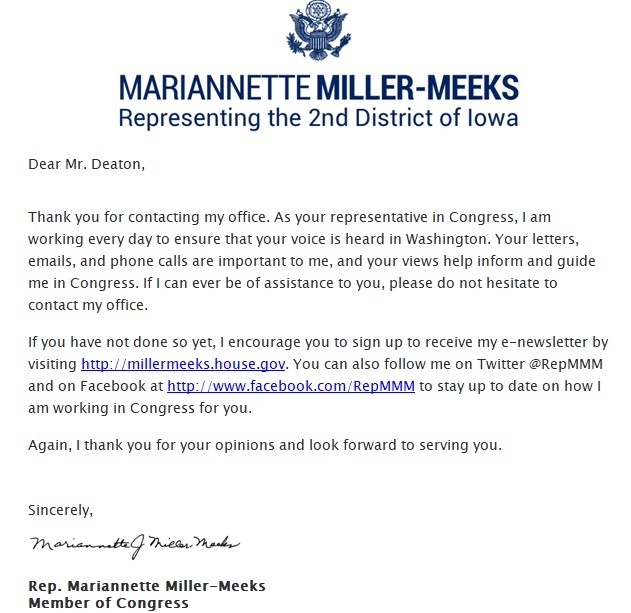
In March I wrote Congresswoman Mariannette Miller-Meeks about the climate crisis as follows:
I hope you will support the efforts of the Biden administration to act to mitigate the effects of our changing climate. Naturally I’m curious about your views on how you might address the effects of climate change while in the U.S. Congress. The approach of the Biden administration regarding mitigation of climate change is such there should be many areas in which to work with them without supporting an overarching environmental bill. I look forward to hearing your policy stances and how you can help address climate change while you are in the Congress. Thank you for your public service.
Here is her unedited response. It is not what I expected.




 Journey Home
You must be logged in to post a comment.