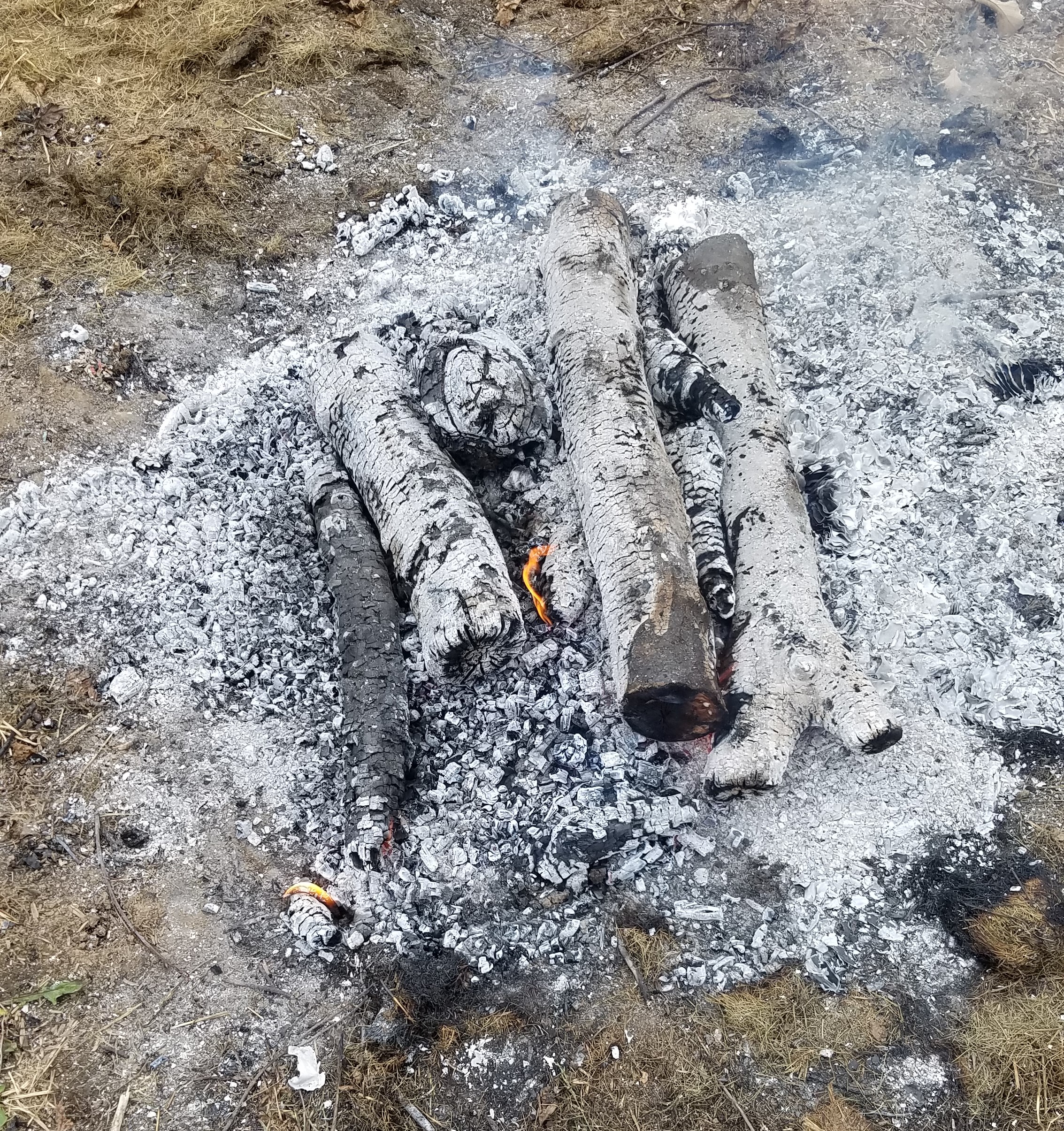
The brush pile included the last branches blown down by the Aug. 10, 2020 derecho. With enough rain to sate the drought, it was time to burn it. By nightfall it was reduced to ash, then a steady rain fell until morning.
One more mowing and I will get the John Deere serviced. After that, it will rest in the garage until spring. Deconstruction of the garden is ahead. I’ll need the mowed lawn to spread things out and organize for winter storage. I want to salvage and reuse landscaping fabric and the staples used to hold it in place.
The compost piles need to be moved and turned. I want to clear the garden plot where they are for more productive use. As my gardening skills improve I want more planting space next year. I have many wants.
I sat on the grass and watched the fire burn. I re-stacked the burning logs with a garden hoe and reduced the perimeter of the fire as it burned. I used old business cards mixed with shredded paper to start the fire. A pile of them lay under the burning branches. Once I turned them over they ignited.
We had an unexpected overnight visitor. I made a pot of chili using a fresh tomato, canned whole tomatoes, two kinds of frozen tomato sauce, and a can of organic tomato paste. It provided flexibility for supper time so we could focus on conversation.
A new day begins in our post derecho lives. The brush pile is gone, preparing a path toward garden’s end and winter.
Trail walking at Lake Macbride State Park on Oct. 25, 2021.
By the end of the year I will be seventy years old. More than anything, I’m glad to have lived this long. The plan is to go on living.
My work life ended last year because of the coronavirus pandemic. I would like a new source of income to supplement our pensions, yet there is only slight financial pressure to locate one. I am not ready to return to retail or any public-facing job as I’m not convinced it would be good for me. Each day without work outside home seems a little weird. I’m trying to adjust to a new path. It isn’t going well.
There is no bucket list because I did most of what I intended going through my days. The list of things I want to accomplish isn’t long: organize and write an autobiography; maintain good health and a decent quality of life. I need to be here for those who depend upon me.
How childcare was handled during my life helped me become who I am. Mother stayed home with us while Father worked at the meat packing plant. She was there for most of the important moments of my life. I don’t know how they made it on less than $100 per week yet we had a good quality of life even after Dad died and as I left home for college. When our daughter was born, I earned enough for my spouse to provide full time childcare while I worked outside home. It freed me for jobs that demanded time and energy. I was able to travel much of the country and see things of which I had no idea. My life would have been different had these childcare arrangements not existed. Now my concern is who will care for me as I become infirm.
Having taken a course on aging in America in graduate school, I feel ready for what is ahead. Coping with sadness and loss is here. So is dealing with physical limitations. I can sense the isolation and loneliness coming. With turbulence in society there is concern for our physical security. Most of all, changes in the environment, in our neighborhood, and in myself will require attention I hadn’t anticipated. For the time being I feel hope these changes can be adequately addressed.
Today it feels comfortable to get in the car and go on a couple hundred mile trip. That won’t always be the case and I’m ready to let go of driving when the time comes. For the moment, our 2002 Subaru won’t last another five years so it will need to be replaced. I did a study of how much we can afford to spend on big purchases over the next ten years based on our income. It is not as much as I would have liked. Fingers crossed, it will be enough.
What I’ll do with my remaining time is unknown. The framework is two stages: the next ten years, and those afterward. If I maintain my health and avoid common diseases (cardio-respiratory, cancer, diabetes, dementia and Alzheimer’s disease, and depression) the septuagenarian years will be a time of getting bigger projects done: writing, home repair and refurbishing, and gardening. After age eighty, should I live so long, the pace of things is expected to slow down. Both my mother and maternal grandmother were mentally alert and active until age 90 so I’m hopeful.
Time goes so fast!
I walk on the trail as often as I can. It is exercise. It is a chance to reflect on my life. It is an opportunity to consider the future. Mostly, though, it is walking. As long as I’m doing it I feel I’ll live forever, even if I know differently. It is always a journey home.
Inch by inch, row by row. That’s how a gardener builds a life. I need a couple of days away from the blog after 97 daily posts in a row. While I’m gone, here’s Arlo Guthrie teaching us how to sing a song. Hope you have a happy time zone!
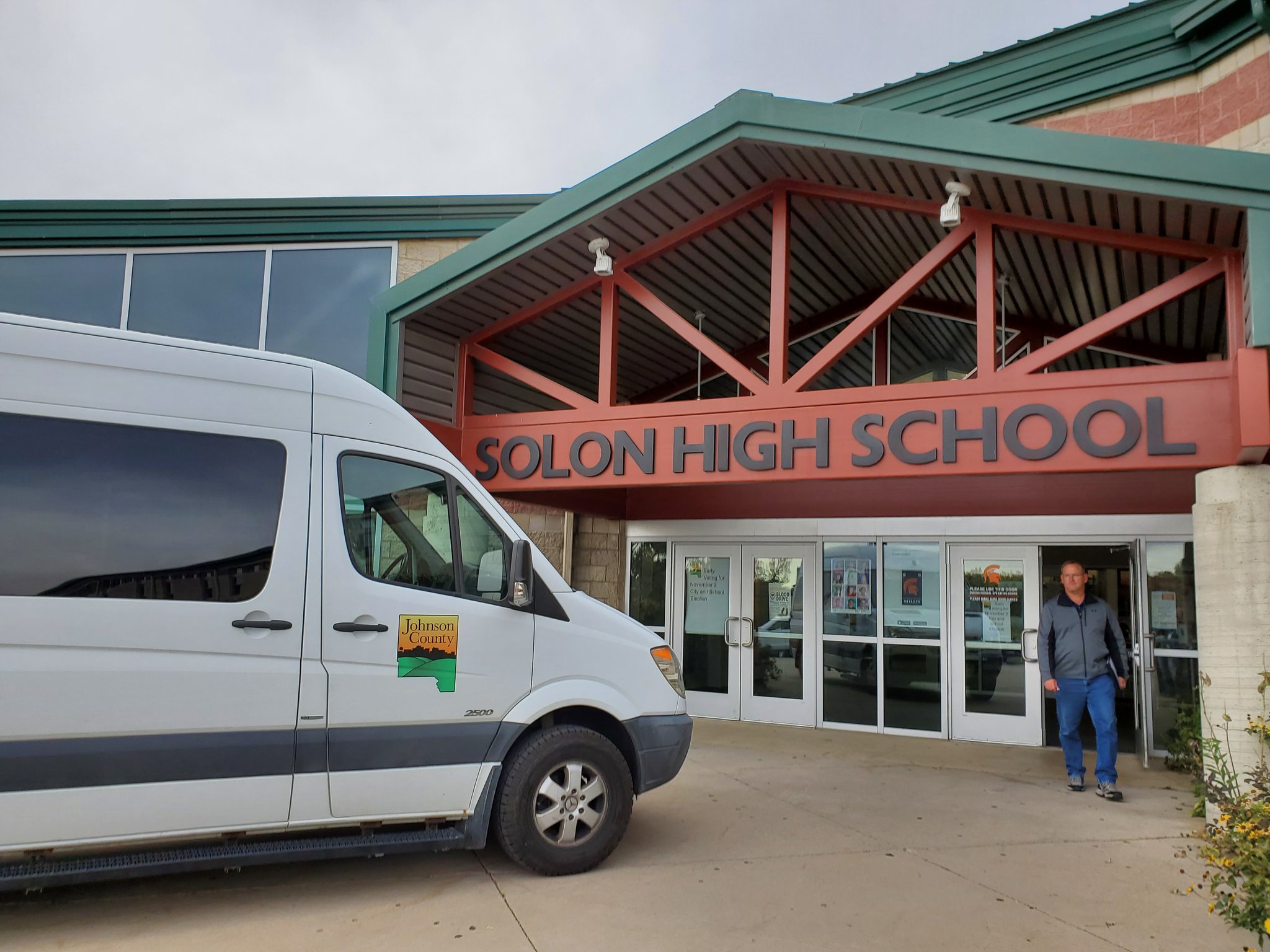
Satellite Voting at the high school on Oct. 22, 2021. Photo Credit: Johnson County Auditor Twitter feed.
On Friday, Oct. 22, 263 voters cast a ballot at the Solon High School satellite voting site hosted by the county auditor. Most were locals. According to John Deeth from the auditor’s office, the party breakdown was 63 Democrats, 121 Republicans, and 79 No Party. School board is supposedly a non-partisan election yet we obsess over party affiliation. In 2019, 1,225 voters (24.3 percent of those registered) cast a ballot and two Republicans won. This cycle voter turnout is expected to be high yet about the same.
That Republicans were the largest group of voters is not surprising. Something that attracts new people to the Solon Community School District is how K-12 schools are run. The community made significant investments in school infrastructure, an attractive feature of the district. Before the coronavirus pandemic, school infrastructure was a main focus of the school board. This is both an adjustment to population growth and feeding it. When I review voter registrations of people living in newly constructed subdivisions, there are plenty of Republicans. Newcomers seem to favor Republican voter registration although I’d like to see a formal study.
We are a community where some voters cling to the Trump administration. If he ran for president in 2024 many would vote for him again. I avoid political conversations unless I know to whom I am speaking, which is typical for many. As a community we get worn out by political talk and seek to avoid it when going about our lives. When I posted a selfie wearing a Biden-Harris t-shirt on social media, a neighbor who planned to vote for them told me they couldn’t do something like that because of social connections at church, work and the schools. The new buzzwords in the community are about running the schools “for the benefit of all students.” This is code for white privilege, increasing insularity of our lives in an age of mass media, and personal disagreements with neighbors and area residents about politics.
Since the 2011 political redistricting, the northeast corner of Iowa’s most liberal county has been turning conservative. In 2012, voters in House District 73 chose a Republican state representative and reelected him four times. In my precinct 2020 voters picked the Republican congressional candidate over the Democrat for the first time since Dave Loebsack first ran for office in 2006. When we moved here there were more Democrats, yet political considerations mattered less than being some distance from work with access to good roads to get there. Good schools were also important. If I were to move again, it would be to a place where being a Democrat would be more accepted.
A local group formed a political action committee to advertise three Democratic candidates for the school board as a change slate supporting school safety during the pandemic. The satellite voting statistics can be understood as a referendum of how well that is going. The low Democratic numbers do not bode well for the Nov. 2 election. There has been a lot of Facebook activity on school board candidate campaign pages, but actual voter turnout among Democrats is lagging expectations.
Despite community uproar about changes in collective bargaining for district employees before the 2019 school board election, voters chose incumbency over change. We’ll see if that’s still the case on election day.
Editor’s note: There were two home football games at 4:30 p.m. (freshmen) and 7:30 p.m. (varsity) the day of satellite voting. The first was not well attended (it was raining). The hope was holding satellite voting at the high school during the Friday games would increase turnout. It is difficult to draw a correlation between the satellite and the games. During the 2020 election cycle, satellite voting at the public library was also well-attended with no such event correlation. I believe increased turnout at the satellite has more to do with promotion during the week immediately prior, combined with high interest in this election.
Click here for all of my coverage of the Solon School Board Election.
Reverse side: illegible postmark and message written in pencil.
This postcard is intended to be a joke. I love it for its gossipy nature. It was written in pencil and the script has all but faded away. The postmark and address are illegible. If there was a written message, it is gone. Names are written next to the figures in the image, but can’t be read. It is reflective of a forgotten time of white privilege.
What world does this represent? The man and women are unlikely married and that alone is noteworthy according to the sender. If Facebook existed at the time of the postcard, an appropriate comment and discussion thread would be forthcoming.
I have used Facebook since March 2008 to stay in touch with our daughter after her move to Colorado after college. She encouraged me to join. I have no regrets.
To feel better about Facebook, I limit use of the platform. I cross post from Instagram, serve as admin for two private groups, and occasionally post some of my writing there. Most of my daily activity is checking notifications and responding as briefly as I can. I respond with a vague notion that friends who show up in my timeline will be those with whom I interact.
As part of my usage, I curate the “life events” part of my profile some Sunday afternoons. At first it was a timeline of selected musical concerts I attended. Eventually I added other significant events like an audience with Pope Paul VI, buying our first home computer, and selected key moments of engagement in society. I work on it from time to time and it encourages me look up dates and record them as a reference for my autobiography. Because I isolate myself from most of what is toxic about the platform my list of grievances is short. The private group with neighbors is particularly useful in my role as president of our home owners association.
While white privilege persists, societal attitudes reflected in this postcard do not. The circle of people with whom one might share such a titillating message is limited to a small subset of those we know. Most think the better of mocking young love in an age where joy is stripped from many aspects of life. We encourage behaviors of white privilege and keep such thoughts to ourselves. The better behavior would be to determine how to recognize and purge white privilege completely from our thoughts and deeds.
The postcard is distinct. Coming from the time it does, I appreciate the ideas behind it. That taunting, juvenile assertion more often found on the playgrounds of graders than in adult society.
To read all of my posts in the series, click on the tag Postcards from Iowa.
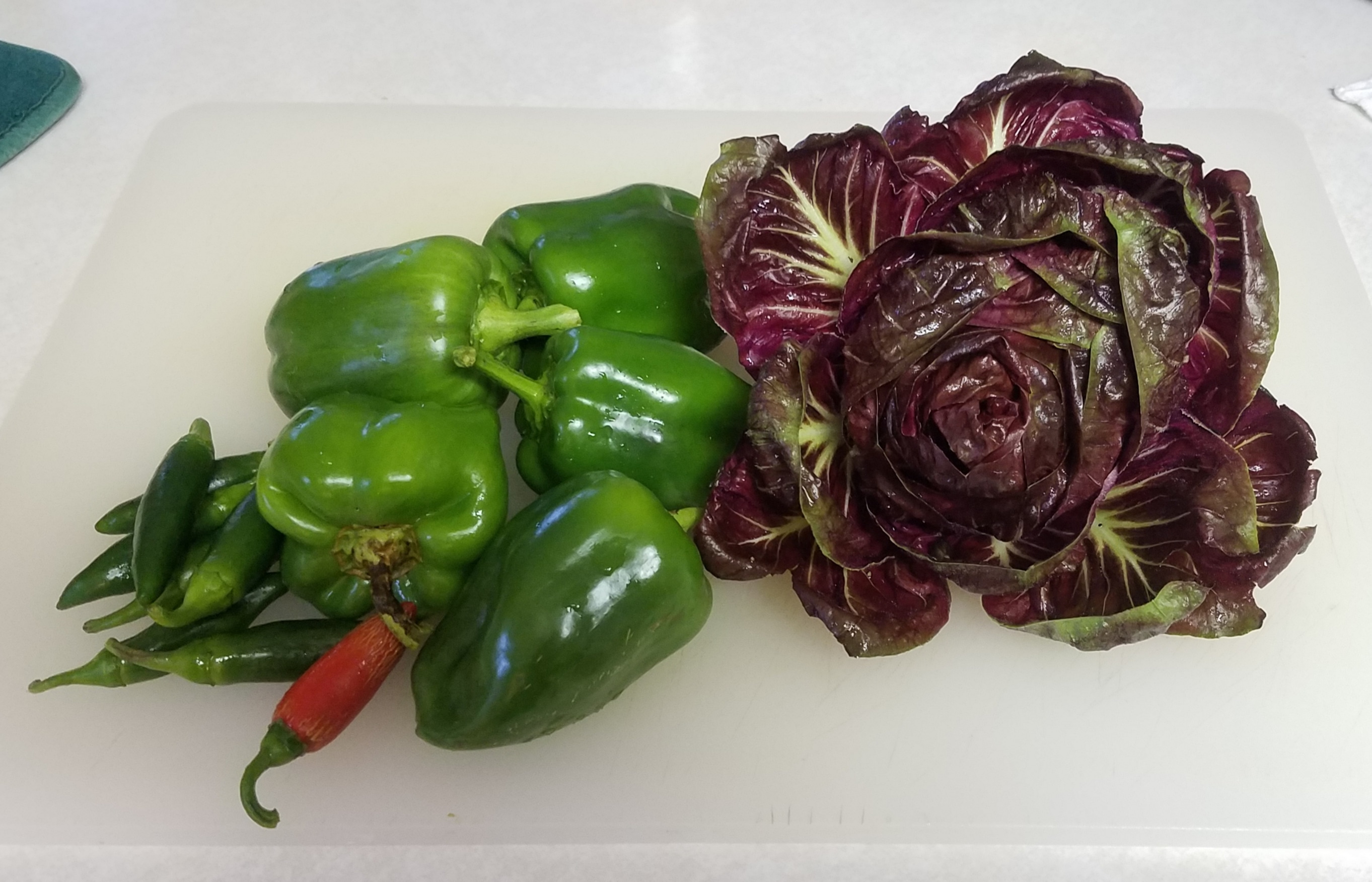
Peppers and radicchio gleaned from the garden before first frost.
Early Friday morning I swept around the furnace so the technician arriving in the afternoon had a clean workspace. Most autumns we have the same company who installed our furnace in 1993 inspect and clean it before winter. It is a good idea.
The technician and I chatted outdoors near the garage door. Having chats like this is becoming a thing for me. I learned about the heating and air conditioning trade in the area: which companies worked on what brands of equipment, which were acquired by a larger company. We talked about how smaller companies maintain parts inventory with so many different brands of furnaces and air conditioners. Some companies will work only on brands in which they specialize. As our furnace ages, it will get increasingly difficult to get it serviced. There will be pressure to upgrade to new equipment. Like with anything in the economy the heating and air conditioning business is in transition.
We talked about electrification of homes and he knew few people who did not use natural gas for heating. If we are to get to a decarbonized economy, natural gas, a fossil fuel, will have to go. The conversation illustrated how far we have to go to leave fossil fuels in the ground and get to zero emissions by mid-century..
MidAmerican Energy supplies our home with natural gas for the furnace and water heater. On Oct. 12, they said, “Based on the market prices for natural gas over the last month, residential customers in MidAmerican’s service area can likely expect their total bills to increase by 46-96%.” We keep the thermostat low already, so we’re looking for ways to stay warm and run the furnace less this winter. We’re not sure what to do differently.
I recently fixed the smoke and CO detector on the lower level, replacing the one that stays plugged in with a new one with a ten-year lithium battery. If I’m still living in 2031, I need to remember to change it out. I should be testing it weekly as well.
Thursday afternoon I checked the garden. Weather forecasts were for a first frost that didn’t actually arrive by Friday morning. I gleaned jalapenos, bell peppers and a head of radicchio. The refrigerator is jammed with jalapenos wanting a dish. It will be some form of jalapeno sauce for use in cooking or maybe as salsa on tacos.
I went outside Saturday morning and frost is in the air. A month into autumn, winter will soon be here. We are ready.
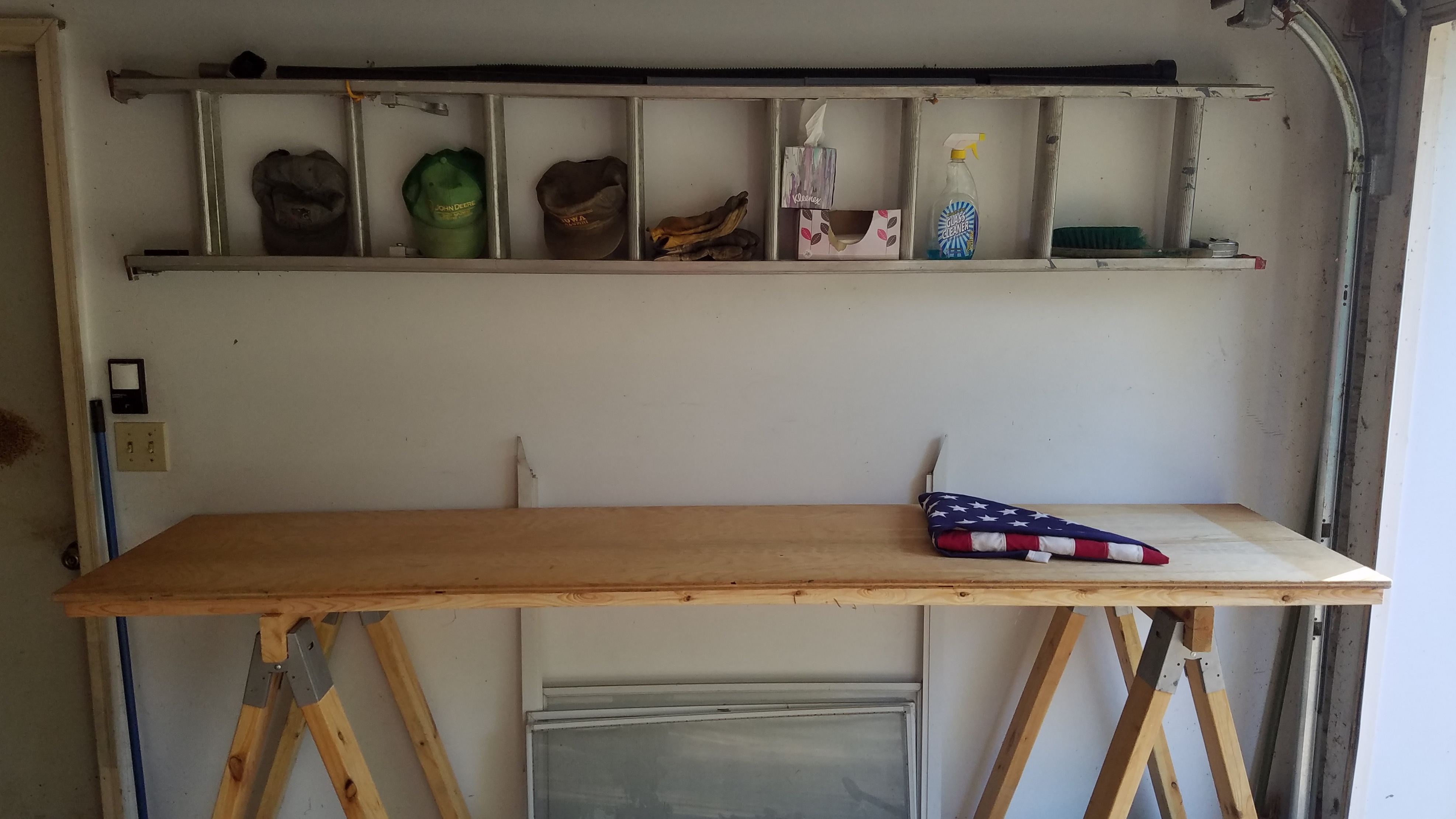
Since we became a one-car family in August the extra garage space filled the way water seeks its own level. Garden stuff, tools and equipment were scattered in every available space. I spent a couple of hours cleaning up and organizing on Saturday. It was a mess, and now is less so.
When I began having larger garlic harvests I cut two by fours to make temporary sawhorses for a drying rack. “Temporary” because I didn’t nail them together so they could be disassembled and easily stored once the garlic cured. In my large panel storage rack I had the remnant of the four foot by eight foot by three quarter inch plywood left from making the platform for our daughter’s loft bed in college. I spread four two by fours across the span of sawhorses and put the plywood on top, finished side up. It made a sturdy table.
I used this surface to clean up the stairway where many cups, COVID-19 test kits, picture frames, and other detritus of living were camped. I also cleared the other sawhorse table near my writing table of its contents. Now I have two transitional surfaces to go through stuff. Three if I can clear the folding table I brought with me from Germany.
In a home, space tends to get used. While approaching septuagenarian status the goal is to clear that space and dispose of old printers and computers, countless electrical cords, and everything not needed for living out the rest of my days. I don’t need one hundred coffee cups. To live a life less on a life expectancy of 15.4 more years (figured using the Social Security online calculator) and more on being here now. That means stop talking about getting rid of stuff and actually do it. No more delays!
Once space was cleared, my daily task list quickly filled with activities related to the disposition of things. I’m a bit excited about the prospect of owning less. We also have plans for new space created. That is, plans other than filling it with more stuff.
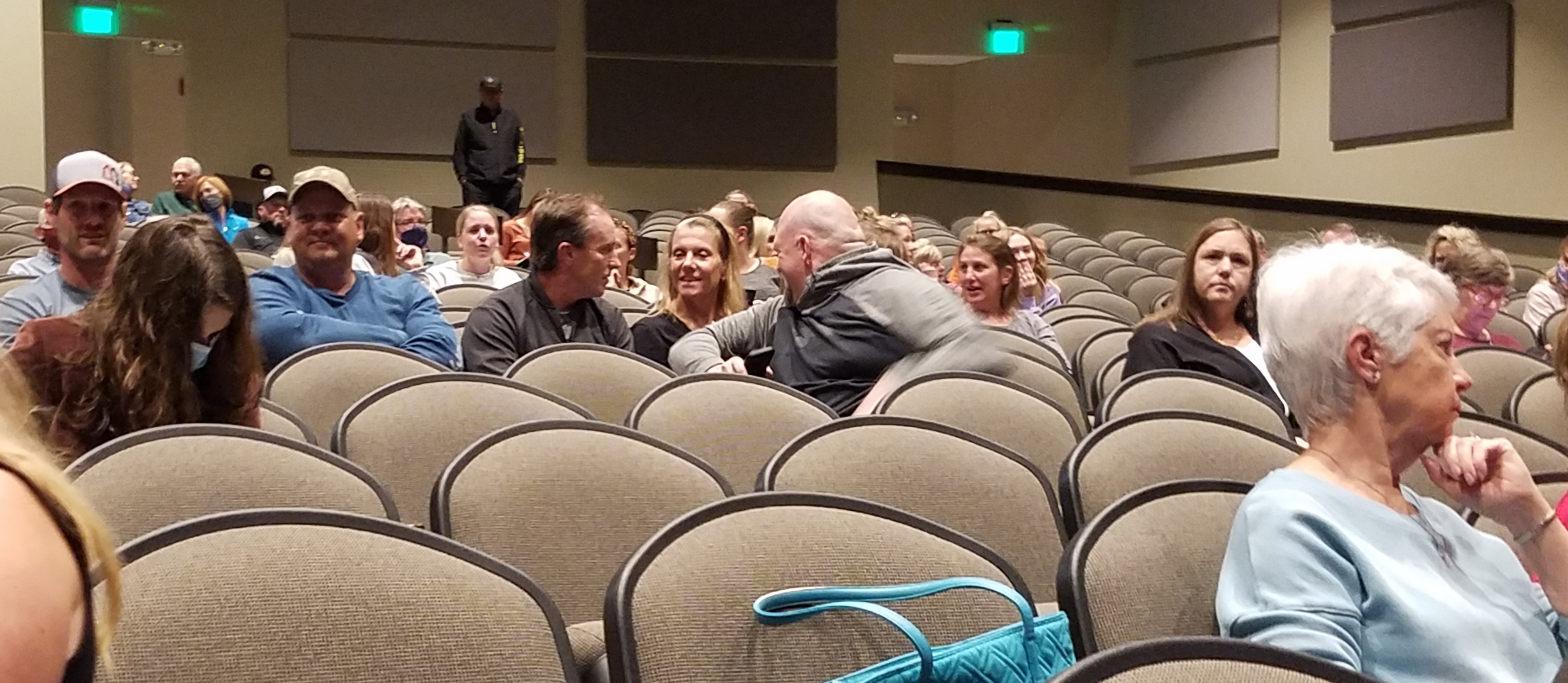
Audience at the Oct. 20 Solon School Board candidate forum.
The Solon Economist hosted a school board candidate forum at the Solon Center for the Arts on Oct. 20. About 80 people were present at the beginning and more than 100 by its end. A majority of seats in the large auditorium were empty.
The winning candidates of the 2019 school board election, Adam Haluska and Jami Wolf, received 447 and 444 votes respectively. Based on last night’s attendance, the 2021 election will be decided by voters who were not at the forum. People appeared to arrange themselves in clusters according to for whom they planned to vote. I doubt many minds were changed by the forum.
Solon Economist editor Margaret Stevens opened the event with remarks. Dean Martin, a former school board member, moderated the event and asked the questions. I counted eight questions in addition to opening and closing remarks by all the candidates. No candidate made any major mistakes and each one demonstrated something positive. Stevens said the forum was being recorded and would be posted on YouTube. Here is the link. I do not plan to get into question by question analysis since voters can look at the hour and a half video for themselves.
This post is biased, as has been all my coverage. My main discussion of the forum was at home with my spouse and will remain between us. My goals in writing in public about the election were stated in my first post:
Make sure there is adequate, timely coverage of relevant events in the election process.
Include all the candidates.
Elect another woman to the board to work toward gender equity.
Make sure no political extremists are elected to the board.
There has been adequate coverage of the candidates by the Solon Economist and Iowa City Press Citizen, including candidate questionnaires. While candidates were asked to respond to a questionnaire from the League of Women Voters, if responses were posted, they are not accessible to me or to other voters in the district. The technical glitch was raised with the League, however there is no resolution as I write. I’ll let readers judge whether my writing contributed something to the coverage.
I did include all the candidates in what I wrote, giving each equal opportunity to choose whether or not to participate in what I did.
Two of the three women are strong candidates, Stacey Munson and Erika Billerbeck. Both have credentials and experience that would add something positive to the school board. They presented themselves with confidence and answered questions directly and thoughtfully. The third woman, Cassie Rochholz, seemed ill-prepared for the forum. When asked how many school board meetings she had attended, her answer was none. It is difficult to understand why a school board candidate would not familiarize themselves with a few meetings given the availability of on-line and recorded options. In addition, Billerbeck and Rochholz were interviewed on air by KCRG-TV after an outbreak of COVID-19 at the schools. Rochholz appeared to be parroting language from others about mask-wearing in schools. In my judgment there are better female candidates than Rochholz to improve gender equity.
Based on what I discovered while writing my posts, I don’t believe any of the seven candidates is a political extremist.
Overall, the forum did little to change my view that this election will pivot on whether or not voters want change on the school board. A mailer from a group called Solon Parents and Teachers to Keep SCSD Safe arrived at home yesterday. Erika Billerbeck, Kelly Edmonds and Michael Neuerburg were advertised as change candidates. Without the mailer or inside information, a voter wouldn’t know they are on a slate. Tim Brown and Dan Coons are incumbents and their re-election would indicate voters are happy with the way things are going. Who is the third no change candidate? There may not be one as the incumbents are strong enough to stand on their own. It is possible voters will pick who they believe is the strongest from the remaining five candidates. A prominent Republican in the district, who was active in the previous elections of Brown and Coons, is displaying a Rochholz sign in their yard. That may be a sign (pun intended).
The county auditor is providing satellite voting at the High School from 2:30 until 8:30 p.m. Friday, Oct. 22. I intend to vote then because if we don’t turn out, it may be less likely the auditor will hold satellite voting here in the future. Whatever you do, if you live in the Solon Community School District, get yourself to the polls on Oct. 22 or Nov. 2 and vote.
Click here to read all of my coverage of the 2021 Solon School Board Election.
On Monday, Oct. 18, I wrote my federal elected officials regarding the climate crisis. If U.S. Senators Chuck Grassley or Joni Ernst, or Representative Mariannette Miller-Meeks respond, I will copy the response below the text.
Dear Senator/Representative,
I hope you will support Democratic proposals to address the climate crisis.
As you well know, global warming is a crisis in Iowa.
I witnessed the effects of climate change multiple times since moving to our home near Solon.
The flood in 1993 delayed progress building our home as we moved from Indiana.
We experienced multiple straight line wind events that damaged the house, uprooted trees, blew down large branches, and tore through our neighborhood.
In 2008 there was record flooding that filled much of the Iowa and Cedar River basins, backing up water into the Lake Macbride watershed to within 100 yards of our home. It made roads around us impassible, and devastated Cedar Rapids, Iowa City and other nearby places.
In 2012 there was record drought which made life outdoors difficult and negatively impacted crops. In Johnson County corn yield decreased from 171.9 bushels per acre in 2011 to 132.4 in 2012, a 23 percent drop.
On Aug. 10, 2020 there was a derecho which took down one tree and damaged several others on our property. My greenhouse lifted in the air like Dorothy’s farmhouse in the Wizard of Oz. Winds up to 140 miles per hour destroyed 70 percent of the tree canopy in Cedar Rapids.
I know about climate change from living it as do most Iowans.
I don’t expect you to agree with everything Democrats propose. We both know that’s not how legislation works. I urge you to find common ground with other members of the Congress and take needed action to prevent and mitigate the worst effects of our warming planet.
Colin Powell and Jin Roy Ryu at dedication of Korean War Memorial in Cedar Rapids, Iowa, June 1, 2010. Photo Credit: Cedar Rapids Gazette.
This post first ran on June 4, 2010. It was a relatively small gathering and I had a chance to shake Powell’s hand. Powell’s view of the Korea-United States Free Trade Agreement was illustrative of his mainstream political and economic values. Powell died yesterday of complications from COVID-19 at age 84.
Colin Powell and Free Trade in Iowa
This week former Secretary of State Colin Powell came to Cedar Rapids, Iowa to dedicate a memorial to 507 Iowans who died during the Korean War. It is past time for such a memorial, and the event brought out Korean War Veterans, legionnaires, politicians and citizens of every stripe. While I was walking from the parking lot at Veteran’s Memorial Park to the seating area, an old van pulled up, windows open and Aaron Tippin’s song about eagles, the flag and “if that bothers you, well that’s too bad” booming into the air, shaking the pavement. A parking lot attendant in a military uniform told the driver, “Don’t turn that off.” It typified the gathering as predominantly working class, veteran and plain folks like us.
PMX Industries, Inc. was the host and funding source for the memorial. PMX is headquartered in Cedar Rapids and is an affiliate of the South Korea based Poongsan Corporation, whose tagline is, “Poongsan Corporation can, and will, contribute to human progress through our superior products.” PMX makes the copper and brass alloys that go into things we use every day, such as coinage, ammunition casings, electrical connectors and lock sets. Poongsan’s Chairman and Chief Executive Officer, Jin Roy Ryu, was present for the dedication, posing for photos with dignitaries and assisting with the unveiling of the memorial. Chairman Ryu is politically well connected in the United States. He translated and published a Korean edition of Colin Powell’s autobiography, My American Journey. The author believes most in the audience had not heard of him. It also seems likely Ryu’s long standing relationship with Colin Powell brought him to Cedar Rapids for the ceremony.
Sid Morris, President of the Korean War Association Iowa Chapter, spoke and PMX President, S. G. Kim, gave a well written speech to mark the occasion. Many of us had come to hear Colin Powell speak.
In a world where cynicism is commonplace, when Powell advocated for ratification of the Korea-United States Free Trade Agreement (KORUS FTA), it was unsettling. It was unsettling partly because of the potential for additional off-shoring of jobs a free trade agreement with South Korea would represent. According to the Office of the U. S. Trade representative, the treaty is signed but not ratified, with the status, “the Obama Administration will seek to promptly and effectively address the issues surrounding the KORUS FTA, including concerns that have been expressed regarding automotive trade.” The author is not the first to be concerned about the treaty’s encouragement of off shoring jobs to South Korea.
More than this reaction, what was bothersome was the way this advocacy was raised in the context of recognition of our Korean War Veterans. Why does there have to be a political agenda behind everything? When I look at the people sitting next to the podium, Cedar Rapids Mayor Ron Corbett, S.G. Kim, Colin Powell and Chairman Ryu, I believe all of them to be decent people. At the same time, in an economy where increasing the number of jobs has proven to be difficult at best, why politicize this dedication to fallen soldiers?
Powell’s assertion was that Korean investments in the United States have created jobs, like the ones at PMX Industries. His reasoning is that presumably there would be more investment by Korean companies in the US with a Free Trade Agreement. No guarantees of that. There would also be a trickle down of jobs related to new access to South Korean markets by U.S. companies. With U.S. productivity on the skids, some of these sales could be serviced through increases in productivity more than through expansion. In any case, the benefits of a Korea-United States Free Trade Agreement cannot be easily reduced to something that would fit in an Aaron Tippin song.
I am thankful that PMX Industries donated the funds for the Korean War memorial. At the same time, the interconnectedness of local politics, jobs and foreign affairs, as represented by the relationship between Jin Roy Ryu, Colin Powell and the Korea-US Free Trade Agreement, indicate again that the powerful influences at work in our lives have their own agenda. That agenda does not always fit the needs of working people.
Long after the applause at their private luncheon at the country club is forgotten, we’ll continue to be here, living our middle class lives in the post-Reagan era.






 Journey Home
You must be logged in to post a comment.