Ambient temperatures were in the mid-40s yet it was the wind, gusting at 25 mph, that made garlic planting impossible. I rescheduled. The soil is right, but I didn’t want to fight the wind. This year’s garlic is an experiment. It is not going as planned.
This excerpt from my journal seems apropos for today.
So be it, a life of creating starts. Here a thermometer installed on the kitchen awning. Here some seeds planted, a corner raked. A book read, a lifelong process, never ending, of small acts, viewable only with an eye more omniscient than mine: as the nuns taught, “All for the honor and glory of God.”
To live a life: this is what is presented.
Like a pioneer, I step into the wilderness. Though others may have lived here before, my presence gives new life to the present. Not forgetting what my ancestors have created, I strike a new path, and though a crowd goes the main road, I’ll take the paths still traveled by deer and rabbits and birds.
I feel the number of people who live engaged in life is diminishing. Many seem to accept that society is a prioiri. What we do takes place in a context set by others. They do not realize that we are the set designers, as well as the authors of this drama. And drama only comes as we will.
We must make a sculpture of the clay of our lives. Something created in a manner that will yield beauty and worth to the observer. Whether that observer be society’s poor or rich art patrons, or God alone. It is critical the creation be made. We must attempt it. Though only God may be watching, in his eyes, our lives, small and made of clay, have purpose, and worth. But the charge is ours, each one to live a life. (Personal Journal, Cedar Rapids, Iowa, April 13, 1986).
On Thursday, the University of Iowa announced a funding cut for the International Writing Program founded by Paul and Hualing Nieh Engle in 1967.
The U.S. Department of State notified the University of Iowa International Writing Program on Feb. 26 that its grants through the department’s Bureau of Educational and Cultural Affairs were being terminated, stating that the awards “no longer effectuate agency priorities,” nor align “with agency priorities and national interest.” (U.S. Department of State halts International Writing Program funding, Iowa NOW, March 7, 2025).
Termination of funding caused immediate elimination or curtailment of multiple planned activities. While I viewed the program as a vanity project by its founders, the IWP added to the cachet of Iowa City as a writing community. In the early days of the program, the IWP housed its writers at the Mayflower dormitory as a method of creating community. It was that. Indeed, more than 1,600 established writers from more than 160 countries have participated since the program was founded, according to Iowa NOW. The annual funding loss will be almost $1 million. That amount doesn’t seem like a lot, and could likely be made up through a new fundraising effort by Director Christopher Merrill. I hope the program endures.
I remember attending a lecture by Merrill when he described traveling to exotic locales to find writers for the IWP. I suppose his recruitment methods were considered favorably by the State Department at the time and that is why the grant was renewed year after year. In a society where many close friends are being impacted by federal budget cuts today, losing funding at the IWP is just one more thing.
When I finished graduate school in 1981, I decided to stay in Iowa City and live a writer’s life. I had no interest in formal writing programs and carried a bit of residual skepticism about the Writers’ Workshop and the IWP from my days living with some Actualist writers and artists I met in 1973 and ‘74. Instead of following a formal program, I sought to enable my native, if somewhat naive impulses and culture. I hoped to discover what that meant, yet not in the context of formal writing programs. Except for the impact on local culture, it made no difference to me whether the IWP existed in 1981, and that feeling continues through today.
It seems clear that many activities in our culture, from education to farming, to health care, to every aspect of involvement by the federal government are subject to game-changing loss of funding. The IWP can recover from this setback. What about the rest of us?
Like many Midwestern homes, ours has become a cornucopia of stuff. I think about downsizing, and had better get on that or face an estate sale at the end of the line. For now, though, the accumulated memorabilia is the equivalent of a limestone quarry: the stuff of which to build my literary edifices.
Instead of disciplining myself to write a book of fiction in 1986, I continued to collect writings, journals, photographs, clippings, books, musical recordings, posters, and such until they would press hegemony into my 2025 writing space. One book into my autobiography, I am now mining this personal memorabilia to tell my story.
Let’s frame this with a passage from a letter I wrote to a friend:
I got a copy of F. Scott Fitzgerald On Writing from the Book of the Month Club. Though I had little good to say about Fitzgerald before now, there is much of what he says here I find pertinent. I recommend this book; much of it makes sense to me. He speaks of an attic of albums, files and clippings being the bank account of a writer, I look around my study and say, ‘Of course.’ This spring I hope to draw on my account and invest in creative endeavor. Appreciation will come close behind. (Personal Letters, Cedar Rapids, Iowa, April 6, 1986).
I’ve been back and forth with Fitzgerald, but he got this right. The part he missed is the role living memory plays in writing. Sometimes memorabilia can trigger living memory, and that is the point of keeping it. The trouble I’ve found is letting go of it, both literally and figuratively. The best use of attic findings is to allow them to be a springboard for new ideas or a germ of creativity. What writers do here isn’t coal mining. It’s more like panning for gold in California. If an artifact doesn’t present value, we should get rid of it.
Organizing personal memorabilia for use is not a straight forward task. Like anyone, my tendency has been to throw things in a box or folder and tuck them away wherever there is space. As a result, memorabilia is scattered all over the house in a semi-organized mess. The wall of boxes outside my writing space is intimidating and inadequately marked. Boxes are seven high and seven wide, or 49 of them. This doesn’t count the other two walls of boxes, or the trunks, desks, and stashes in the living room and bedroom closet. Since I am following a chronological narrative, it would be best to arrange everything by date order. That in itself would be a too-long task.
There is a lot of writing to be found in memorabilia. That raw material is the easiest to convert to new narratives. Sometimes I quote directly from the past with minimal editing. Sometime I take previous pieces and completely rewrite them while preserving the essence. Either way the presence in the original usually shines through its new use. That’s what a writer wants. By the time I finish book two I expect I won’t have touched half of the memorabilia. If the narrative is good, I’m okay with that.
I put up three posts on Substack to see what they did. They got a lot more views than the same posts received on WordPress. Is there a future there? I don’t know.
The challenge I face, and many others like me, is to monetize my writing. I have one book done and privately published. I’m about a fourth of the way through a second. I need resources to revise the first book and publish it on major platforms as an eBook, audio book, and on-demand paper book. By the time I get that finished, I should be ready to repeat the process for the second book. Our pensions are presently sufficient to live, yet there is nothing extra for book publishing. I have to raise money to get my writing out there.
The model for Substack seems straightforward. Put your work up, and structure subscriptions so there is a free option, combined with tiered subscription plans that offer subscribers something extra. If I can develop a large following of paid subscribers, I might then afford publishing my two and any future books I might write. I could even publish the books on Substack as a premium benefit for paid subscribers. Details of that could be worked out.
The question is can I develop a following beyond my loyal readers? It’s an open question that’s partly answered by my other public writing… from which I receive plenty of feedback. If anything, my exodus from most social media platforms has increased the number of visitors to this website. But will they convert to Substack and pay?
WordPress offers a pay model, which I haven’t explored. I expect it was to keep up with the Jones’s at Substack. When comparing the two platforms, number of viewers trumps workable software every time. It is Substack or nothing, based on viewers, I think.
Maybe I am looking at monetization wrong. Perhaps I could figure out how much money I need for the two books and do a Go Fund Me campaign. That could work. It seems less complicated than an ongoing subscription project. I could also start streaming on Twitch or another platform that generates income. Whatever it is, I may have to add a fundraising hat to my closet to keep up.
I’d be curious to know reader reactions to this topic in the comments.
I’ve been back on the state park trail for about a week since the cold snap. The debate in the neighborhood is whether winter is over. The consensus seems to be winter is not finished. I maintain winter never really got started this season. The relatively warm temperatures, consistently, and year upon year, mean trouble for us all regardless of what the president does about the endangerment finding.
I have been reading the news and doing my best not to think about it. Very little is positive. Six weeks into the new administration and I feel strong, ready to upgrade my resistance. However, new shrapnel continues to fall from the sky. Better keep my powder dry a bit longer.
Yesterday I planted the second tray of seedlings: spinach, celery and arugula.The seeds were from 2022, so I’m not confident of the germination rate. I ordered new ones which should arrive next week. The spinach and arugula should show quickly whether or not they will germinate.
I have been working on my book daily for the last week. Mostly, the word count is going down as I edit a chapter about the period 1985 until 1987. There are some instances when a quote from my written journal or papers is appropriate. More often, I’m find such texts to be the basis for new writing. As I progress through the book, I believe I will use quotes as a starting point for a draft instead of using them as an actuality that nests in the narrative. This is especially true when I have new insights into what that 30-something man was thinking from a privileged viewpoint in 2025.
Today is the “buy nothing” day and I hope to keep my credit card in my wallet. If I can’t go a few days without buying anything other than emergency items, then what have I been doing the last 70+ years?
These daily blog posts are helpful in getting the writing fluids flowing. The next major change in my intellectual life will be when it is warm and dry enough to work in the garden and yard. Since I missed planting garlic in the fall, that will be the first crop to go into the ground: as soon as the ground dries enough to till the soil. Today we are not there yet.
These days have been the best part of winter. I intend to use them as I can until spring truly arrives.
Black Coat, long cut, with a red flower in the lapel. Top hat rounded, and in good shape. He hung it on the vacuum tank while he worked. Come in. Where is the fire place? Move things around so there is room. Lay out the cloth. Bring in the drum-like vacuum pump, Rods and brushes. Move things out of the fireplace Sweep, lights. Point out problems with fireplace. Clean up gear. Take out gear Sweep hearth with a hand broom. Everything is done methodically. Ford pickup with cover on back, ladders on top, though he did not use them.
Editor’s Note: House File 274 passed out of subcommittee on Monday, Feb. 17, 2-1.
A bill in the Iowa legislature seeks to repeal Section 728.7 of Iowa Code. This section provides a long-standing obscenity exception for libraries and educational institutions. According to the bill, nothing in code prohibits the use of appropriate material for educational purposes in any accredited school, any public library, or in any educational program in which a minor is participating. It further provides that code does not prohibit the attendance of minors at an exhibition or display of art works or the use of any materials in any public library. People are worried that children are being exposed to obscenities enough in public spaces to change how public institutions operate. This bill should be cause for concern for anyone who uses a public library.
I looked through our local library’s policy statements and found this:
Including materials in the collection does not constitute endorsement of their contents. The Library recognizes that any given item may offend some patrons, but, because the Library follows accepted principles of intellectual freedom, it will not remove specific titles solely because individuals or groups may find them objectionable. (Solon Public Library website, October 2022).
The language regarding children and censorship more directly addresses the concern:
Censorship is a purely individual matter. While an individual or group is free to reject material, no library staff person shall restrict access to the rest of the community. Selection of materials is not restricted by the possibility that children may obtain materials their parents may consider inappropriate. While materials are shelved by recommended age, patrons of any age may use materials in all sections of the library (see ALA Bill of Rights, Article V). Responsibility for children rests solely with their parents or legal guardians. (Solon Public Library website, October 2022).
So yes, House File 274 directly addresses existing library policy related to the American Library Association Bill of Rights. Here is the entire ALA Bill of Rights. On Monday, Feb. 17, at 11:30 a.m., an education subcommittee of the Iowa House meets in Room 103 at the State Capitol to consider the bill.
Here is a typical pro comment from the public comments section of the bill where more than a few words were used:
02-11-2025 Jonathan Huber:
I support House File 274 because it aims to protect minors from exposure to obscene content. By repealing the obscenity exemptions, Iowans can ensure that educational and public spaces remain safe and appropriate for all students. It’s important to have clear standards that prevent the distribution of material that could be harmful or offensive. This bill helps create a more secure learning environment where students can focus on their education without the risk of encountering inappropriate content. This bill prioritizes the well being of our youth.
Here is another:
02-12-2025 Sonya Swan
Our children are our future. When a child sees something, they cannot “unsee” it. Those images are forever in their precious little minds. When they read something obscene the result is the same. As an educator, I choose the materials for the children I teach very carefully. Our public institutions, have an obligation to omit obscene material for minors regardless of the location (school or library) or the function. Please repeal 728.7
Here is a con comment:
02-13-2025 Steve Clarke
Dont pass this bill the current exception in 728.7 allows for the use of appropriate material for educational purposes. Nobody is advocating for Playboys and Xrated movies. This is part of the larger cultural wars being waged. Protect our society by denouncing censorship.
Here is a longer con comment:
02-13-2025 Sarah Smith
Do NOT pass this bill. It is not the role of libraries or librarians to determine what children can or cannot readthat responsibility belongs to parents. Rather than restricting access to books, we should encourage parents to be actively involved in their childrens reading choices.If I come across a book I dont want to read or a news channel I dont want to watch, I simply choose not to engage. Thats the beauty of intellectual freedomthe ability to decide for ourselves. HF 274 imposes unnecessary restrictions that would hinder libraries from fulfilling their mission, limiting access to information and stifling the freedom to read.Our communities thrive when libraries are empowered to serve without political interference. Please vote against HF 274 and protect our right to read, learn, and think freely.
If I can figure out the technology, I plan to watch the subcommittee meeting online. In the meanwhile, I recommend you take a look at the comments and tell your state representative to vote no should this bill make it to the full house.
UPDATE: I submitted this comment on the bill:
“Vote no on this bill. There was and is a valid reason for this exception. I hope the committee will consider these things: Perhaps the raciest part of the public library is the romance genre section. It would be okay with me to eliminate this section completely, although many patrons read romance novels. It persists. A local group developed a solution in which a sticker is placed on romance library books suitable for Christian readers. It seems like a workable compromise, better than repealing this section of code. Secondly, I have been shocked at the content of a few books I checked out from the library. I’m thinking of the Elton John memoir Me. John talks openly about his sexuality and if I found it shocking, so could others. Should graders have access to this book? It’s not for me to say, nor for legislators. It is for parents to say. The American Library Association’s Bill of Rights is clear on this: “A person’s right to use a library should not be denied or abridged because of origin, age, background, or views.” If a citizen’s group or individual objects to a book, resolution should take place at the local library or with the library board. As with my example of the racy romance novels, a solution can likely be devised at the local level. Republicans have super majorities and can enact what they will, including advancing the idea that Iowa will become a nanny-state. No reasonable person wants that. Please vote no on this bill. Thanks for reading my comment.”
My farmer friends are lining up customers for the 2025 growing season. February is the time folks sign up for a community supported agriculture share and there is a limit to how many shares each farm can produce. I used to belong to a CSA yet no longer need one. My large garden usually produces enough good stuff to serve our family. I wish them a productive and profitable season. This photo is one taken after I harvested bell peppers to take home, process, and freeze.
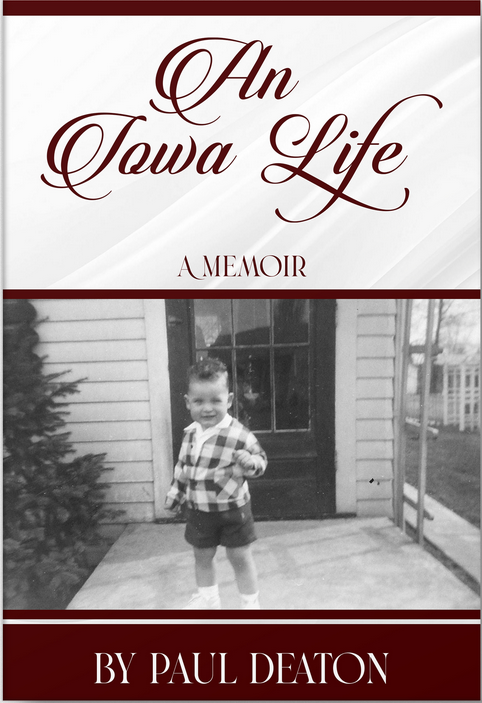
Part of writing an autobiography involves photographs and art work. The visual arts convey something much different from narrative text. In An Iowa Life: A Memoir, the first volume of my autobiography, I included a single photograph of me as a toddler. In volume two, I may include more than one, depending upon the expense. The book is not available to the public at present, but may be once early readers all provide feedback. Here is the cover with the photograph:
The way I used photographs in volume one was to describe something based on them, using my narrative to control the meaning. This is important because we don’t want to distract the reader from the energy of the narrative by introducing a photograph that can be interpreted in multiple ways. By describing photographs, instead of inserting them into the text, we can better guide readers.
Part two begins in 1981, a time when I took many film photographs. I keep the prints in boxes near my writing space, and in a few photo albums we made. I don’t know how to process them, yet at a minimum, I will get them out and look at them. There are a host of projects one could create with old photographs. A couple of days ago, I cleared access to the piles of boxes where the photographs rest.
I had a flip phone with a camera and took this photo of Senator Barack Obama on Sept. 17, 2006. The video of that year’s Harkin Steak Fry is here. It was one of the first digital photographs I took. The quality is not the best, yet it records the moment.
Obama at the Sept. 17, 2006 Harkin Steak Fry
Obama is in the rope line after he gave his keynote address. You can see Chet Culver and Tom Vilsack behind him. I shook his hand and was surprised at how genuine he was in our brief conversation. He had quite a handshake.
On May 3, 2008, I bought my first digital camera and took this photo after opening the box. Once I entered the realm of digital photography, the number of images exploded. Cameras in smart phones changed how I looked at photography. Now I take many exposures of a scene and then pick and edit the best one. There is no additional cost for multiple exposures and device memory seems unlimited.
My first photograph using a digital camera on May 3, 2008.
This has been a roundabout way of getting to the topic. In figuring out how to address photography in part two, I need to:
Find all available photographs in our house.
Look at them and set aside the ones I can use in the narrative.
Pick a small number for inclusion in the book.
While I look at them, I need another photo project in the works in which to use them. Posting on social media is one. Making specific albums, both paper and digital, is another. I might enlarge and frame a few of them. Each requires a significant investment of work.
Reviewing photographs should help make my picture-taking better. I hope to be cognizant and thoughtful in this process. I hope to be a better photographer.
My storage system has been good in that few have been damaged. Determine how to store them going forward.
I need to get rid of some of them. I don’t want to pass along photos that are meaningless to whoever inherits them.
I will read or reread a couple books about photography. In particular, The Photographer’s Eye by John Szarkowski, Photography and the American Scene by Robert Taft, Wisconsin Death Trip by Michael Lesy, On Photography by Susan Sontag, and others. If you know of a current book about photography, please drop a comment with the name and author.
At the beginning, this project is hopeful. It should be a fun year reviewing the images of my past and recalling the living memories behind them.






 Journey Home

You must be logged in to post a comment.