I decided to make a five day retreat, beginning today, at home. I’m not exactly sure what that means in 2022, yet with our child in Chicago, and my spouse in Des Moines, it’s just me here in Big Grove. It is telling the first thing I did when alone was to create structure.
When I went on a retreat in high school, a bunch of us boys crowded into one of the Saint Ambrose College dormitories for an overnight. The key takeaway had little to do with religion. A couple of classmates filched whisky and dandelion wine from their parents’ liquor cabinet and brought it. While I didn’t drink any, the main point of the weekend was doing what our parents wouldn’t let us. Priests supervised us, but, you know, post Vatican II.
A few things are determined the next few days. For one, I’m changing my morning schedule. Instead of making coffee and heading to my writing desk immediately after waking, I plan to work in the kitchen. With only me in the house, I can make as much noise as I like, when I like, without worrying about disturbing someone. I can turn the radio volume up.
After kitchen work will be reading, the usual minimum of 25 pages per day. The book I’m reading is good, so likely more than that. During the snow storm, clearing the driveway will be important. It’s easier if I blow it a couple of inches at a time, multiple times a day, instead of waiting for it all to accumulate. All these activities are intended to restart old habits, develop new ones, and provide fresh perspective. After “morning chores” the day begins. After today’s regimen I got a lot accomplished by 9 a.m.
While bunkered in during the blizzard I’ll pay more attention to food preparation. There are plenty of provisions and an open book on how much hot pepper I can use in cooking. No fancy dishes, just personal favorites on the spicy side made with butter, eggs and other dairy products.
Dinner was simple when I returned from the road last night: a veggie burger made into a cheeseburger with a bagel for a bun, potato chips, and dill pickles on the side. It served.
Soon, maybe tonight, I will make stuffed bell peppers. Saturday, Christmas eve, will be chili and cornbread. After that, I haven’t decided. Some sort of festive, holiday fare, no doubt.
The reason I need a retreat is to get organized for 2023. The big stuff: writing, gardening, home repair, and cooking are all necessary components. To take a step back and review where I find myself is an important part of setting appropriate goals for the coming year.
I’ll definitely write about the experience daily. I hope some readers will follow along.
Editor’s Note: This is a post written in 2012. I am reposting because of the rise in authoritarianism and extreme right-wing politics. We should never forget the Holocaust.
In 1974 I visited the site of the former concentration camp near Dachau. In the museum space I saw film footage of bulldozers pushing piles of emaciated dead people into mass graves. That memory persists. There were artifacts from the camp, including clothing, footwear, and a host of morbid items, like candles made from people, and lamp shades made with human skin. The people who ran the camp were sick, as much for the idea of a pogrom as for all of the weird things they did as experiments on humans and their physical being.
Then, it was hard to believe the people of Dachau did not know what was going on within those walls. Perhaps the people of Dachau were more like us than we know. Today, I am prepared to believe some didn’t know about the camp the same way people in Big Grove don’t pay much attention to neighbors, except for pleasantries in the yard or on the street, and if one is doing something noxious that is detected by others. Despite all the paranoia about government taking peoples’ rights, we live and let live in American society, to a large extent.
At the same time, there is a type of intolerance that is wide-spread in Iowa, noticeable when talking to someone at their front door in neighborhoods around the state. It has nothing to do with membership in the National Socialist, or any political party.
The horror of the final solution surpasses anything else of which I am aware. In the ranking of gruesome, Rwanda’s genocide, seems equally brutal, and maybe it is because I have read recently about it. A person can occupy oneself with reading like this only so much.
Considering the fact of Dachau and the final solution, I don’t understand why anyone would characterize other Americans as member of the National Socialist Party. It is ridiculous to believe it, except for the case of a few fringe groups. The horror of the final solution is diminished each time we refer to it as a comparative to something much less evil. Such rhetoric diminishes us personally as well.
For me, visiting Dachau was enough to cure me of the use of this hyperbole.
It is getting easier to box up books to donate to the friends of the public library used book sale. I donated seven boxes so far and three more are ready to go. Creation of two large sorting tables has helped move library downsizing along.
The room I built for writing has bookcases on all four walls. For the first time in years I am dusting and rearranging them. I’m not sure there was any consistent method in how they were shelved.
A lot of space is taken with collections by author: Norman Mailer, Saul Bellow, John Irving, Joan Didion, Jane Smiley, Vance Bourjaily, David Rhodes, Ruth Suckow, James Baldwin, Hamlin Garland, Al Gore, William Faulkner, William Carlos Williams, William Styron, W.P. Kinsella, and others. There is a case to be made the collections by author belong in boxes. If I labelled the boxes, I could draw on the books when I need them, leaving shelf space open for my current research and interests.
I keep thematic collections: U.S. Presidents, Iowa City and Iowa writers, Iowa history, reference books, cookbooks, gardening books, art books, and poetry. One shelf is devoted to a printed copy of my blogs. Another has volumes on ancient history. I find myself asking the question, “which books are meaningful for life going forward?” Not as many as there are.
With retirement during the coronavirus pandemic, things changed to enable this sorting and downsizing. Our automobile remains in the garage most days. The weekly shopping trip has become a special event, for which I shower, shave and consider which clothes I might wear to the store. There is time to work on the project especially when weather is wintry.
Part of the great book sort is learning more about myself by remembering who I have been. A different me bought a copy of The Great Escape by Paul Brickhill at the corner drug store soon after seeing the then recently released film. I used money earned from my newspaper route in grade school. Today, I feel compelled to buy John Irving’s latest book, The Last Chairlift, in part for his Iowa City connections, in part for his discussions of the LGBTQ community, and in part to fill out my shelf of Irving novels. Sorting books juxtaposes all the different versions of me during the last 60 years. There are more than a few of them.
I am lucky to have lived to be seventy. Book sorting is teaching me to be more deliberate in life, to consider each element of life’s construct. I also realize there is not enough time left to read everything I want. If luck holds, I will read everything I need.
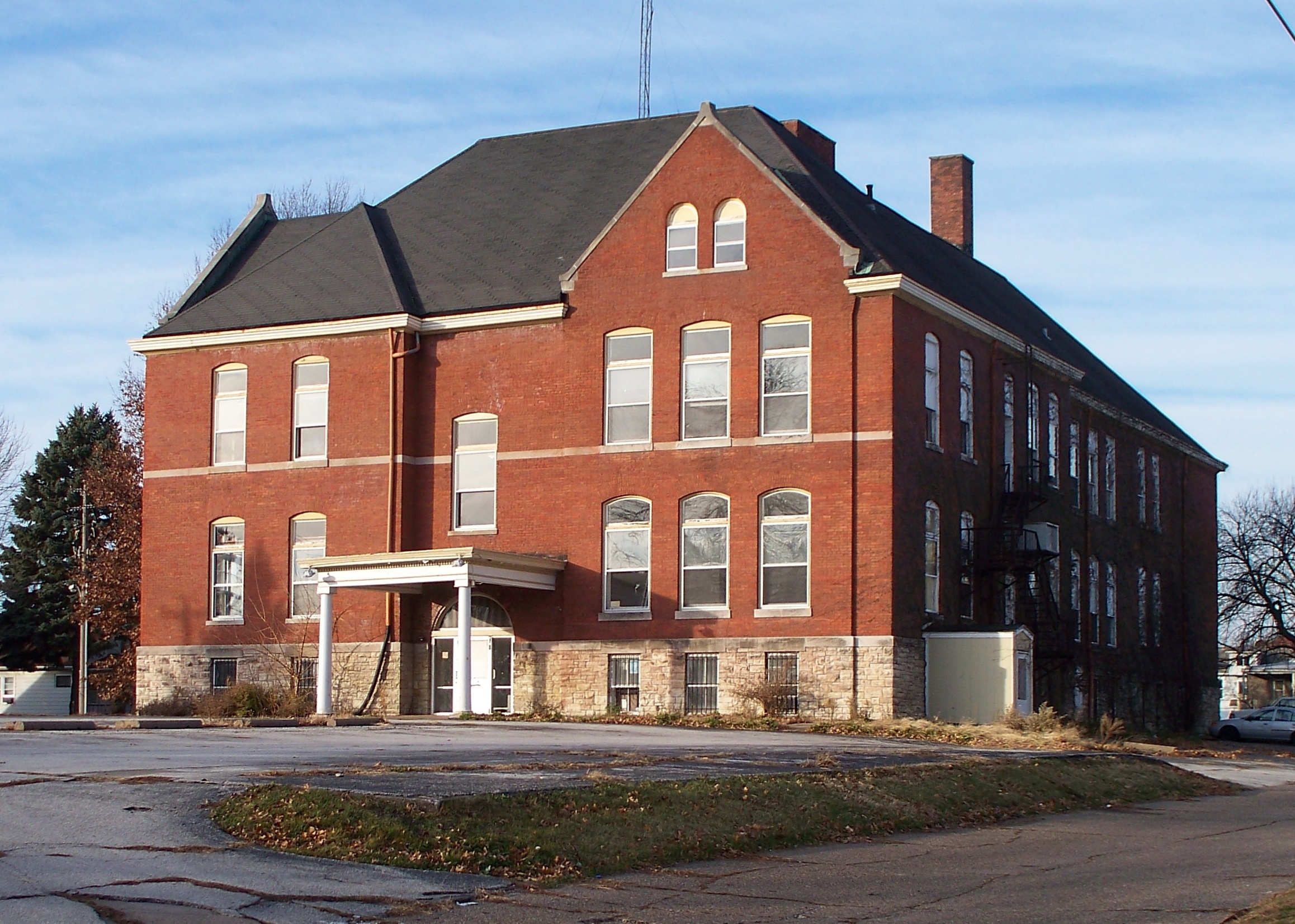
Jackson School building acquired by Holy Family Church for a first through eighth grade school in 1944. Photo by the author.
Yesterday I read a short book of photographs depicting a narrative of important events, people and things in the history of Davenport, Iowa. It covered a broad range of topics under the umbrella of the dominant white culture. It served its purpose, yet it wasn’t the best.
Davenport: Jewel of the Mississippi by David Collins, et. al., was published by Arcadia Publishing in 2000. It is one of a series of similar single-subject books made available at large, chain bookstores like Barnes and Noble, which may be where I bought it. Like many short books (128 pages) more is left out than included about the city.
The story is told in photo captions, so there is little detail. For example, there is a photo of Joe Whitty who founded Happy Joe’s Pizza and Ice Cream Parlor, which had hundreds of franchises in its best days. The caption doesn’t mention the name of his restaurant, relying on the reader’s knowledge to invoke that memory. If that’s all one knew about Joe Whitty, it would be fine. It makes a point in the narrative.
As with anything, personal memories are more important when writing autobiography. I remember when Joe Whitty and his family came to Davenport and rented a home two houses north of our family. He opened a bake shop at Mercy Hospital and became its dietary director, according to his obituary. I used to play with his eldest son, who assumed responsibility as president of the company for 39 years. I also know a franchisee who had multiple restaurants. There is a lot more to the story. Rather than reflect what the picture-book says is history, I should draw on my own experience in telling my story.
How does one use such a picture-book when writing autobiography?
If nothing else, reading the book created epiphanies about my life. The narrative is a certain kind of boosterism, highlighting things that may have been important to the authors. If I made a list of topics to cover from the book, they would be selected based on what memory I have of them. That could be useful.
For example, there are more photos of Bix Beiderbecke in the book than of any other person. He was born in Davenport and lived on Grande Avenue in early life. He became a world renown cornet player and died of pneumonia at age 28. In 1971, the Bix Beiderbecke Memorial Society was organized after a musical group from New Jersey came to see Beiderbecke’s birthplace and play music near his grave. Following that, the Davenport BixFest became an annual event in the band shell on the levee near the Mississippi River.
I have little interest in Bix boosterism. I attended the BixFest once or twice and ran multiple times in the Bix 7, which is a 7-mile foot race through Davenport that attracts some of the best runners in the world. Other connections include that the first thing I saw when emerging from the Paris Metro on the left bank in 1974 was a large poster of Beiderbecke. I also lived with one of my band mates on Walling Court near the Beiderbecke home. These stories, I believe, are more interesting than the broad cultural aspects of Bix commemoration. They are important to my autobiography.
Despite my dislike for the picture-book narrative, I plan to get a pad of Post-It Notes and annotate photos that prompt significant memories. I’ll pick a few people I knew — Rep. James Leach, Father James Conroy, and Mayor Kathryn Kirschbaum — and leave out more famous or special ones who had little connection to my life. There is no need to re-tell the story of Ronald Reagan living at the Vale Apartments and working at WOC Radio.
There are also plenty of important buildings among the photos. Places like the Lend-A-Hand Club, Sacred Heart Cathedral, and the Mississippi Hotel are all meaningful. I envision using them to evoke something in my narrative when needed.
I have two copies of the book, so I can write in the margins of the one used for research. I doubt I will. As curator of a several thousand book library, I resist writing in books. This project is more about me than the history the picture-book posits. I want to preserve the books in good condition as long as I own them.
Holy Family Catholic Church, Davenport, Iowa on July 28, 2013 – Wikimedia Commons.
When Mother brought me home from being born to Fillmore Street, the major institutions in our neighborhood – health care, church, and school – were well established.
On Dec. 7, 1869, the first patient was admitted to Mercy Hospital at Marquette and Lombard Streets, situated on what was then the outskirts of Davenport. The hospital had been home to the Academy of the Immaculate Conception of the Blessed Virgin Mary, established in 1859. Parents were unwilling to send students so far from the city center and the Academy moved. The property was placed on the market for sale, and then given to the Sisters of Mercy to start a hospital. Over the years there had been substantial expansion of the hospital.
Holy Family Catholic Church was established August 18, 1897 when the Diocese of Davenport, the Right Reverend Bishop Henry Cosgrove, appointed Father Loras J. Enright as pastor. Like Mercy Hospital, Holy Family was situated on the outskirts of Davenport, surrounded by farmland. Following is a lightly edited excerpt from the current church website:
In 1898, the first Holy Family Church was built. It almost immediately proved to be too small for the needs of the congregation. That same year, the present church building was begun. Its basement served as the church for almost 10 years. The entire church building was completed in 1909.
Before the turn of the century, the original church building was utilized as a two-room schoolhouse. It remained the education center of the parish until 1944 when the Right Reverend Monsignor T.V. Lawlor, Holy Family’s second pastor from 1943 until 1961, purchased the old Jackson public school for Holy Family students.
My maternal grandmother was a devout Catholic, despite being excommunicated. Her religion infused our home life before my brother and sister were born. The Sisters of Mercy and the relationship between the Catholic Church and early Davenport settlers provided an ever-present background to life in my hometown. Our family visited the cemetery on River Drive where 1873 cholera victims were buried in a mass grave. Sisters of Mercy tended the sick at the time in a makeshift hospital at a downtown warehouse. Antoine LeClaire’s grave marker is prominent near the entrance to Mount Calvary Cemetery where many of my family members are buried. In the mid-20th Century, there were multiple obvious connections to the city’s 19th Century foundations.
Today is the third day of renewed effort on my autobiography. Since last winter, I lost my place. Searching for it led me down a different path, one of considering structure different from the chronological timeline I wrote last year. There are considerations.
The first part was written in chronological sequence, which is okay and will likely persist. I tell a story from history, memory, and a few artifacts from the first two decades of my life. This part of the writing was engaging. My parents and maternal grandparents did not tell a single narrative of how they came to be in the Quad Cities by 1950. My grandfather did not live there. I didn’t know my paternal grandparents who both died before I was born. Every tale about the past came in asynchronous short stories. The few times any longer narrative was woven, mostly in writing by Mother, it seemed imbued with interpretation rather than facts. If I pieced the stories together in a new narrative there would be significant gaps and flaws, both mine and theirs. Getting a chance to write my story may have biases, yet by making it mine, the narrative is more complete and satisfying.
As I begin the 2022-2023 winter writing project I need to finish the narrative I started, yet want to break it and present different threads going forward in time. There are natural breaks which I will call “pivot points.” A pivot point was a time when, in a specific place, I considered my options and made a decision about where I would take my life. Here is my current reckoning of these pivot points as I navigate through this winter’s writing.
Leaving Davenport
Most young people make a decision in high school whether to graduate and what to do next. This was complicated for me by the death of Father during my junior year. There was never a question about finishing high school. It was going to university that hung in the balance after he died.
I had begun to look at options my junior year and had discussions about them with Mother and Father. I was on a trajectory to attend University, yet Father’s death brought a pause in moving forward.
I remember the conversation with Mother clearly. It took place during daylight in the living room where she sat on the couch and I sat on the chair next to where we kept the telephone. I explained I was willing to give up university in order to stay in Davenport and help her get through the loss of Father. In no uncertain terms she told me to leave and I did.
Living at Five Points
Before I left for military service I put my belongings into storage. Some were at Mother’s house, some in storage with a moving company before the advent of commercial storage units, and I took a small amount of belongings with me based on a conversation with my Army recruiter. When I returned from Germany I got an apartment near Five Points in Davenport to figure things out. I reunited most of my belongings, including a considerable number of new ones brought back from Germany.
I reconnected with friends who stayed in Davenport. We had one of the few parties of my life at Five Points. I cooked a lasagna dinner on Nov. 25, 1979 and we sampled wine mostly from the Rheingau region of Germany where I lived. I was a terrible cook yet dinner was eaten. At the end of the evening, I cut up my military ID card recognizing it was the official last day of my active service. We toasted the event with shots of Jägermeister.
At Five Points I felt like youthful times were ending and weighed what to do next. I decided life in Davenport was not for me and that was that. I was eligible for the G.I. Bill, applied and was accepted to graduate school, and in Summer 1980, moved to Iowa City and never looked back to my home town.
Marriage
After finishing graduate school in May 1981 I went on a trip down south to visit friends from the military. I evaluated returning to military service and decided visiting those who stayed after their initial enlistment would give me an idea of what it was like. I drove my yellow Chevy pickup to Fort Benning, Georgia, Fort Rucker, Alabama, and then to Houston where I stayed with a buddy who went to work for Exxon Oil Company. After the trip, I decided to stay in Iowa City and find a job.
At 30 years old, I recognized that I hadn’t found a mate, and would be unlikely to do so unless I worked at it more than I did. Iowa City offered the best opportunity in the state for people like me, so I got an apartment on Market Street and found a job. It was a complicated time, yet one of the main decisions was to settle in and see if marriage would be possible. We married on Dec. 18, 1982. I remember being at the church like it was yesterday.
Empty Nest
When our child left home in 2007 for a year-long internship with the Walt Disney Company in Orlando it set things in motion to be who I am today. My interest in the paid work I had been doing since 1984 waned. I wanted more from life. With our child a two-day car trip from home, I began to look at options. On July 3, 2009 I left work for the transportation and logistics company that employed me for almost 25 years.
Transportation and logistics has been part of who I am from the time I got my first newspaper route in grade school until I left paid work at the home, farm and auto supply store permanently during the pandemic. The decision to end it as a career in 2009, while still young, was hard to make. I’m glad I did it. The company bought me one of those big sheet cakes and I brought cupcakes baked by a neighbor working from home the next day. I got a phone call from the owner, and looked around at what I helped build for the last time.
I remember sitting in the car in the parking lot after my shift. I sat for a while in that moment. I turned around and exited the parking lot the back way, an exit I had never before used. That pivot made the difference in who I am.
Hard to say if this is a final list of pivot points. As always, writing a post helps me formalize what had been vague notions floating through my consciousness for a while. Now I better figure out where I left off last winter.
Peak migration. The noise of hundreds of waterfowl could be heard throughout the neighborhood. The big flock can be seen in the distance.
The lake is crowded with waterfowl stopping to rest during migration. We often take it for granted this exists, even if the noise of their gaggles can be heard inside our house. I saw them swimming during yesterday’s walk along the state park trail.
Today is Thanksgiving Day, a national holiday created by President Abraham Lincoln on Oct. 3, 1863 during the Civil War. He proclaimed,
I do therefore invite my fellow citizens in every part of the United States, …to set apart and observe the last Thursday of November next, as a day of Thanksgiving… And I recommend to them that while offering up the ascriptions justly due to Him …, they do also, with humble penitence for our national perverseness and disobedience, commend to his tender care all those who have become widows, orphans, mourners or sufferers in the lamentable civil strife in which we are unavoidably engaged, and fervently implore the interposition of the Almighty Hand to heal the wounds of the nation and to restore it as soon as may be consistent with Divine purposes to the full enjoyment of peace, harmony, tranquility and Union.
National Park Service website. Written by Secretary of State William Seward. Proclaimed by President Abraham Lincoln.
We Americans seem to be condemned to live in the shadow of the Civil War in perpetuity.
Today I am thankful for readership gained for my public writing. It is difficult to determine precise numbers because my main publication places here, on Blog for Iowa, and in a number of Iowa newspapers for whom I write letters to the editor and opinion pieces, each have quirks of reporting that obscure how many people saw my work. I do know 2022 was a good year for viewership.
Blog for Iowa
My most read post was a letter of support for Iowa gubernatorial candidate Deidre DeJear. It was the fourth most viewed post on the site this year. It was my effort to call attention to the race when most news outlets minimized her candidacy. A shorter version was published in the Des Moines Register.
Also popular was a post with Democrat Elle Wyant’s press release announcing her candidacy to represent House District 91 in the Iowa legislature. Her campaign benefited from the mention because there was so little information available from formal news outlets early in the campaign.
I published a series of posts about Carbon Capture and Sequestration in Iowa in 2021 and a couple of those posts did well again this year. It is a popular topic for our readers. New posts, cross-posting Sheri Deal-Tyne’s Physicians for Social Responsibility article on the subject, and my recent update were well-received.
I lost count of how many times my letters and opinion pieces were published in Iowa newspapers this year. The Quad City Times has daily circulation averaging 54,000 so when I published there, the reach was the greatest. The next most significant places were in the Cedar Rapids Gazette (my local daily newspaper) and Des Moines Register which each have average daily circulation of about 33,000. The other newspapers are important to my work, yet less in reach.
Publishing a letter in the newspaper is a tribal affair. From time to time people reached out via email to complain to or compliment me. When we write in public, we take what we get. Most telling is when I am with people in real life. I get comments, mostly positive, about them seeing my letters. I usually thank them and suggest they could also write a letter. I make it a practice of posting a version of my letters on this blog as a way to be sure I save a copy.
The most important letter I wrote may be to the Des Moines Register, titled, “The Second Amendment is not Good Enough for Republicans.” It was about the public measure to enshrine strict scrutiny into the Iowa Constitution and have an impact on law-making about gun control. I opposed it, yet it passed.
Journey Home
Journey Home is my home base where I post daily when I have a topic. My most popular posts this year, in descending order by number of views, were,
Last Walk in Solon, about my participation in the Solon Beef Days parade.
Dissolving Society, about neoliberalism tendencies in Iowa’s Republican administration.
With Thanksgiving comes awareness that winter is approaching. This winter will be the second where the majority of my writing goes off line and into my autobiography. I am thankful to have had a life worth living and to be passing my stories along to our child. I’m almost ready to go.
Reflection about what we are doing comes naturally at Thanksgiving. It is something I’ve done since before leaving home in 1970. I don’t know what the new year will bring except for hope. We should hold hope close and go on living.
On Monday I created a Mastodon account on the epicure.social server. It is a small space on the internet and one never knows if “small” will survive. I don’t plan to leave Twitter until the bitter end or when I croak, whichever comes first. Mastodon is my insurance policy, a place to go if I need one. If the server fails, I can move to another Mastodon server. Having networked multiple servers is a feature of Mastodon.
Christopher Bouzy, creator of BotSentinal.com posted, “Twitter will not be relevant two years from now. No platform can survive catering to one group of people, and once journalists migrate to another platform, Twitter is done. And if you think it won’t happen, ask MySpace how things are going.” Bouzy is not wrong, although he has an interest in starting a Twitter substitute platform and therefore is biased.
In any case, there seems to be significantly less Twitter traffic in my timeline. The same is true for other social media platforms I follow. People just are not feeling it right now. This is good for productivity as I move indoors. Fewer distractions facilitate a more rapid growth toward a solid 4-5 hour daily shift of writing.
Ambient temperatures are forecast to reach the low 50s this afternoon. I scheduled a walk along the lake trail. Getting enough exercise is a winter issue, especially once snow flies. I take advantage of every opportunity to exercise that presents itself.
As time moves toward winter, how we spend it changes. With thoughtful planning we can be productive and perhaps useful to others. Productivity is what I most hope for between now and the end of the year. With hope comes value in society. That’s something we need now more than ever.
This photo represents about half my cookbook collection. None of these made the first cut represented by what is visible on bookshelves in my writing room. What the heck am I doing?
Going through them is not the same as sorting them. As I make and look through each pile, I have thoughts about how to use them. The categories are beginning to appear.
Mostly vegetarian
There about three dozen books devoted to vegetarianism or with mostly vegetarian recipes. I categorize myself as mostly ovo-lacto vegetarian and my spouse is vegan, so these are of particular interest. There are also books with instructions for how to prepare almost any vegetable imaginable. The best of these will be keepers and the others will be sold, donated or given away.
Culinary reference books
By this I mean books related to cooking yet are not comprised mostly of recipes. For example, Anthony Bourdain’s Kitchen Confidential is in this stack. So is Molecular Gastronomy: Exploring the Science of Flavor by Hervé This. Some of these will go into my main library as reading material. A few may go on the cookbook shelf to be built for the dining room.
Souvenirs and memorabilia
When I was in Texas, I bought a souvenir cookbook with recipes from Texans. When I was in Georgia, I got a similar volume written by Georgians. There is a book about cooking potatoes presented as a gift. I’m not sure how many of these memories remain important. Once I have a pile, I’ll have to go through them and decide.
Books of yearning
Some books, by their title or cover or introduction beg to be examined more closely. Eating Cuban by Beverly Cox and Martin Jacobs is one of them. The Greens Cook Book by Deborah Madison is another. I yearn to spend an afternoon with books like these to dream about culinary invention.
Community cookbooks by geography
The City of Solon near where I live makes a cottage industry of community cookbooks. There is one for the one-room school house and one for the PTA, along with several others. A new one gets published regularly. Our home cuisine is so different from these recipes, I’m not sure of their relevance to our kitchen garden. The most interesting cookbook is titled The Solon PTA Cook Book with “Favorite Bohemian and American recipes.” The advertisements all have two and three digit telephone numbers which were phased out by 1920. No one currently living would have submitted a recipe, so that opens it up for use in my writing. On the back page of the cookbook, readers are admonished, “Aw shucks Mom. Put that cook book away and bring the family up to Lowell’s Cafe for a delicious steak, chicken or fish dinner.” Lowell’s Cafe is now part of history.
Community cookbooks by broader geography
Community cookbooks that were published outside Iowa can be first to go. It seems unlikely I will write about Mont Clair, New Jersey, for example. The question is where do I draw the line? A community cookbook from Ely or Mechanicsville might be keep-able. Most of the ones I have from Cedar Rapids and Iowa City are likely not. If I was a part of a community that wrote a cookbook, like the American Trucking Association maintenance council, I may look through it before disposition.
Appliance cookbooks
When we buy major appliances like refrigerators, ranges, and countertop appliances there is often a cookbook inside it. I have a stack of these. I don’t plan to keep any of them. Too much to read in too little time.
We have company coming over the weekend, so whatever I get done needs finishing by tomorrow. As I go through them all, the last thing I feel like is cooking something. Good thing there are leftovers in the refrigerator.
Since ambient temperatures dropped below freezing, I haven’t left the house very much. I’ve been reading, writing, cooking, and working on a few small projects. I wasn’t ready to bunker in.
I gave up on picking up more garden mulch with the mower. I disassembled the grass catcher and put it in place on the shelf. I also moved the electric snow blower closer to the garage door. With the subcompact Chevy Spark there is a lot more room in the garage. Step by step, I’m getting organized.
The small ceramic heater running next to my chair is doing the job of keeping my writing room warm. I hung a blanket on the door to retain heat, and that is doing its job as well. Now it’s time for me to do my job of writing.
Where does my writing get noticed? When I post on Twitter, the response can be huge. Yesterday I posted,
Thus far there have been 3,872 impressions and 154 engagements. That is a lot.
When I post on Blog for Iowa, it garners many more views than here. Before the midterms I posted about Iowa Democratic gubernatorial candidate Deidre DeJear and the post got 507 views. That, too, is a lot.
Year to date this site got about 8,000 views, with the leading sources being search engines and the WordPress Reader. Thanks so much WordPress community for following me.
Now that cold weather is here, my in-person contact with humans reduced noticeably. I don’t like it, yet here we are. Hopefully my writing will improve and bring with it better cooking, reading, and a cleaner, more organized home. Despite the calendar suggestion we have another month of Autumn, it feels like winter is here.





 Journey Home
You must be logged in to post a comment.