Maytag Range delivered to our kitchen on May 22, 2023.
We replaced the Kenmore range purchased in 1988 with this new Maytag model. Technicians from the small appliance dealer did a good job delivering, installing, and explaining it. More than once they referred me to manuals dropped on the counter. Although it will take time to understand the features of the range, I will attempt to live up to the promise this technology offers. I expect to prepare many future dishes using the device. The inaugural meal was black beans and rice.
A future is not always assured. I took a spell while tending the covered row of herbs and vegetables, then made a retreat indoors. I have had two conversations about such episodes with my medical practitioner. He said if they were infrequent and do not persist, there was little to be done about them. Easy for him to say. Most days spells recede behind the proscenium arch where the curtain is down more than up on my aging frame. From time to time, spells appear as players to complicate life. We are in act one of what can be expected to be five. Here’s hoping I live to denouement and a final, dignified curtain call and bow.
This is the longest I have been away from posting since I can remember. My spouse will be spending a week with her sister who is moving from a rental to a house in July. There is a lot of packing to be done. While she’s gone, I hope to finish planting the garden, organize for summer, and begin regular writing again. I hope to be done with the intense rasher of friends who died this year. Appliances died in equal numbers, yet it is not the same.
I miss my friends, appliances not so much. Appliance transitions brought discussion with banks, business owners, sales folks, delivery drivers, and technicians. It is a way to go on living whereas my dead friends and family offer little engagement for the future except in memory. As we age, we do the best we can.
On the way home from the grocer I stopped for gasoline. After fueling, I pretended I was in Thomasville, Georgia again and bought a Yoo-hoo chocolate drink and lottery ticket at the gas station. Playing the long game, I bought a Powerball ticket instead of a scratch-off. If we can’t see a future beyond the now, then we will never live a long one. Validating the statistics of lotteries, my ticket was not a winner in Monday night’s drawing. At least we have the new range and the prospect of delicious meals.
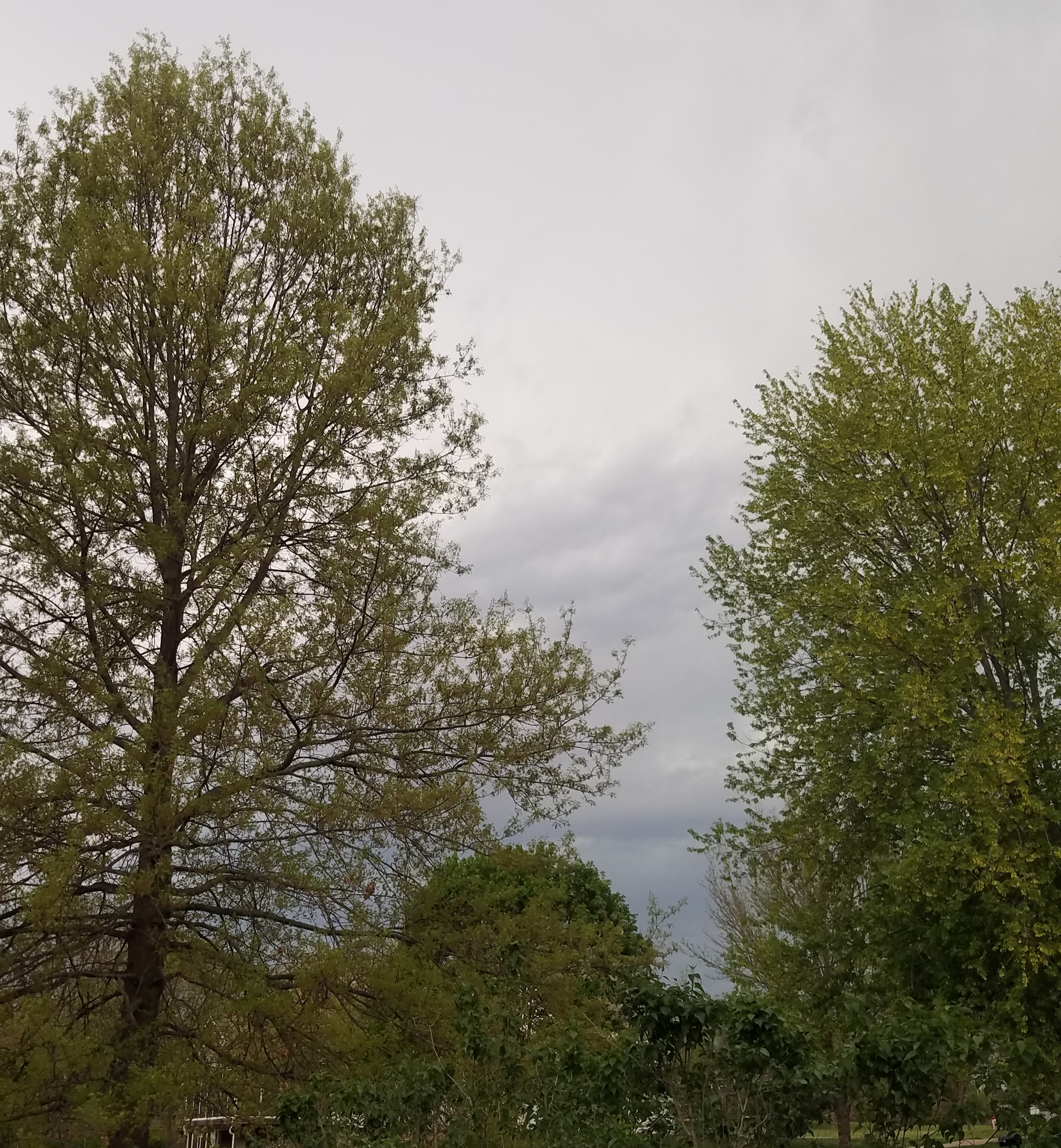
I’ve taken to opening the garage door and watching storm fronts roll in. Probably, I’m carrying baggage from the Aug. 10, 2020 derecho.
Multiple reasons have me running behind, with a short time to get the garden in by Memorial Day. I’ll be taking a break from writing to focus on spring and all. One never knows how many more springs we’ll get. I intend to enjoy this one.
Take care dear readers. Hope to see you again soon. Hope you enjoy what remains of Spring!
Should a person be sensible and find a job, or follow their passions? This is a false choice, although one many feel compelled to make. I’m not sure those two options often exist concurrently.
My insight into this choice may be the result of getting a new eyeglasses prescription filled. On Friday they were ready at the warehouse club, the first prescription I filled since before the pandemic. I can see clearly now and it’s a revelation. Well, no. That’s not it. Maybe it’s something else.
At our tenth high school class reunion in 1980, I described myself as a writer. Here’s the entire passage from the booklet the organizing committee issued:
Paul lives in Iowa City and attended U of I, BA 1974, and the United States Army Infantry School. He is a writer. He is also a First Lieutenant in the U.S. Army Reserves. M.A. candidate in American Studies at U of I.
Unpublished journal, Summer 1980.
It was out there. I was a writer. Decision made! Not so fast!!
One of the last nights I spent in Davenport in 1980 was with two friends at a bar called The Mad Hatter. We walked to the Palmer Student Union where another friend was performing with his guitar. We had a discussion about how a person had to give up her artwork after taking a job at John Deere. She was tired after work, raising a child, and found little time or desire to make art. I knew if I took a full time job after graduate school I might find myself in the same situation. I had just declared myself to be a writer! I decided to stick it out at least until I finished graduate school.
I had enough money saved to pay for graduate school with help from the G.I. Bill. After graduation I wanted to remain in Iowa City, so I got an apartment and found a low-level job without benefits working for the university. One thing led to another and I met someone, got married, and together decided we needed more money to afford a house and everything else involved in a long-term relationship. Things happen. I didn’t put my writing on hold.
During that first year after we married I made an earnest attempt to write the book about which I had been talking for so many years. The working title was Going Home, and I summarized it in a journal entry:
Going Home will begin with a descent from high culture – Vienna – to low culture – Davenport – á la William Carlos Williams. Then will come a rebuilding – a putting together of a new life from the pieces. A new ascent, with both feet placed firmly on the ground. So, from Vienna, to Davenport, to Iowa City, to Northeastern Iowa. Descent to the ground, but then both feet planted firmly, beginning a step at a time, making a new beginning.
Personal Journal, Iowa City, June 17, 1983.
I’m not sure today what exactly that meant. The image of “both feet planted on the ground” recurred in my journals. It would also be an argument for a common life, free from external structures. At various times, I called the book the 1969 Novel or Going Home, yet it never became much more than an idea about Iowa contrasted with Europe… or something. I made outlines and wrote passages. I made reading lists and trip itineraries. I made research notes for much of 1983.
In each section of Going Home, I want to provide the reader with two things. First, I want them to be able to relate to the personal experience from which each scene is written, enabling them to say, “I’ve been there.” Second, I want them to be able to see that the given experience functions ideologically in the novel, giving the characters some sort of influence. Too, I want the sections to teach the reader a way of life.
Personal Journal, Iowa City, Iowa, June 27, 1983.
I wrote about the book extensively in my journal without getting anything significant down on paper. I had the idea, likely from Emerson, of turning away from the courtly muses to everyday life. I did extensive reading to form a moral framework for the novel. This is all well and good, yet here’s the issue: I had no clue what it meant to be married.
It is significant that at this crossroads there was no real choice between following my passion to be a writer and doing what was sensible. In seeking to write, I sought realization of who I was regardless of any framework for living. The pent up desire to become a writer compelled me to continue to live as best I could: writing, earning money, having a family life, the whole shebang. It would have been easier if Morpheus had offered me a one-time choice between the blue and red pills.
It is important to refrain from framing life as a choice between options. This seems too simplistic. A dilemma means a choice between disagreeable alternatives, yet devising an arbitrary choice is just that: arbitrary. It would be a false choice.
While we might feel good about defining a choice and making a decision, the results seem unlikely to endure. We owe it to ourselves to accept complexity in life and deal with it outright. We can’t settle for second best when both choices are sub-optimal.
It sometimes helps to get a new pair of glasses, to see clearly, even if they are not responsible for choices we make.
The last few days of April have been marvelous. Rain subsided, ambient temperatures were mild with low humidity. It has been a spring month, as good as they get. No more close friends have died this month, so there has been psychological relief as well. We needed a breather.
Spinach planted in the ground on April 15 is up. Onions are doing well. Yesterday I planted cauliflower, cabbage and kale, and there are two more rows in that plot for broccoli, collards, and other leafy green vegetables.A mad garden rush will be happening in May with the target of getting the initial planting done by Memorial Day, which this year falls on May 29. Gardening is going well.
The Biden administration announced that it intends to end the presidential declaration of national emergency and the U.S. Department of Health and Human Services (HHS) public health emergency attributable to the COVID-19 pandemic on May 11, 2023. I was at a restaurant last night where a couple of people continued to wear a facial mask. With my full regime of COVID-19 vaccinations, I did not.
According to the Centers for Disease Control and Prevention, there have been 104,538,730 reported cases of COVID-19, 1,130,662 deaths attributed to it, and 55,743,629 doses of vaccine administered. There are currently 9,167 hospitalizations due to the coronavirus. It was, in no uncertain terms, a public health disaster. The scale of 1.1 million U.S. deaths is difficult to wrap one’s head around as we close in on the end.
The Iowa Legislature has taken up budget bills, which means we are close to the end of session. Thank goodness. There has been so much controversy over bills it had been like drinking from a fire hose trying to understand what is happening. Republicans won super majorities in 2022, and are exercising their power like never before. Democrats are hanging on, trying to get a message out. Democratic messaging has been like trying to light a candle in a derecho: word is not getting out beyond political junkies.
Our blogging group went to dinner Friday night at Royceann’s Soul Food Restaurant in the South District Market in Iowa City. The menu has a fixed number of daily items on it and diners can order a meat and two sides for $18. It is a bit tough for vegetarians to find something on the menu, and tougher for vegans. I ordered cabbage, cornbread, and macaroni and cheese. The preparations were distinct and tasty. I plan to return to try the collards with cornbread. I usually say I can cook better than what I find in restaurants, yet not this time.
Our furnace gave up the ghost this month. We have been discussing which new one to get and have made a decision. When an expensive item hits a household on a fixed income, it takes some wangling to determine how to pay for it. We have it figured out.
I have finished reading seven books in April. Check out what I’ve been reading on the Read Recently page by clicking on it at the top of this page. I got new glasses for the first time since 2019. It’s great to be able to see clearly again. Hope your April was as good as mine. Thanks for reading my post.
This year I donated roughly 700 books to the public library used book sale and to Goodwill. Goodwill is less picky about what they will accept, so they received the majority of them. Many of my donations still had the Goodwill price tag from when I bought them. Library downsizing has only just begun.
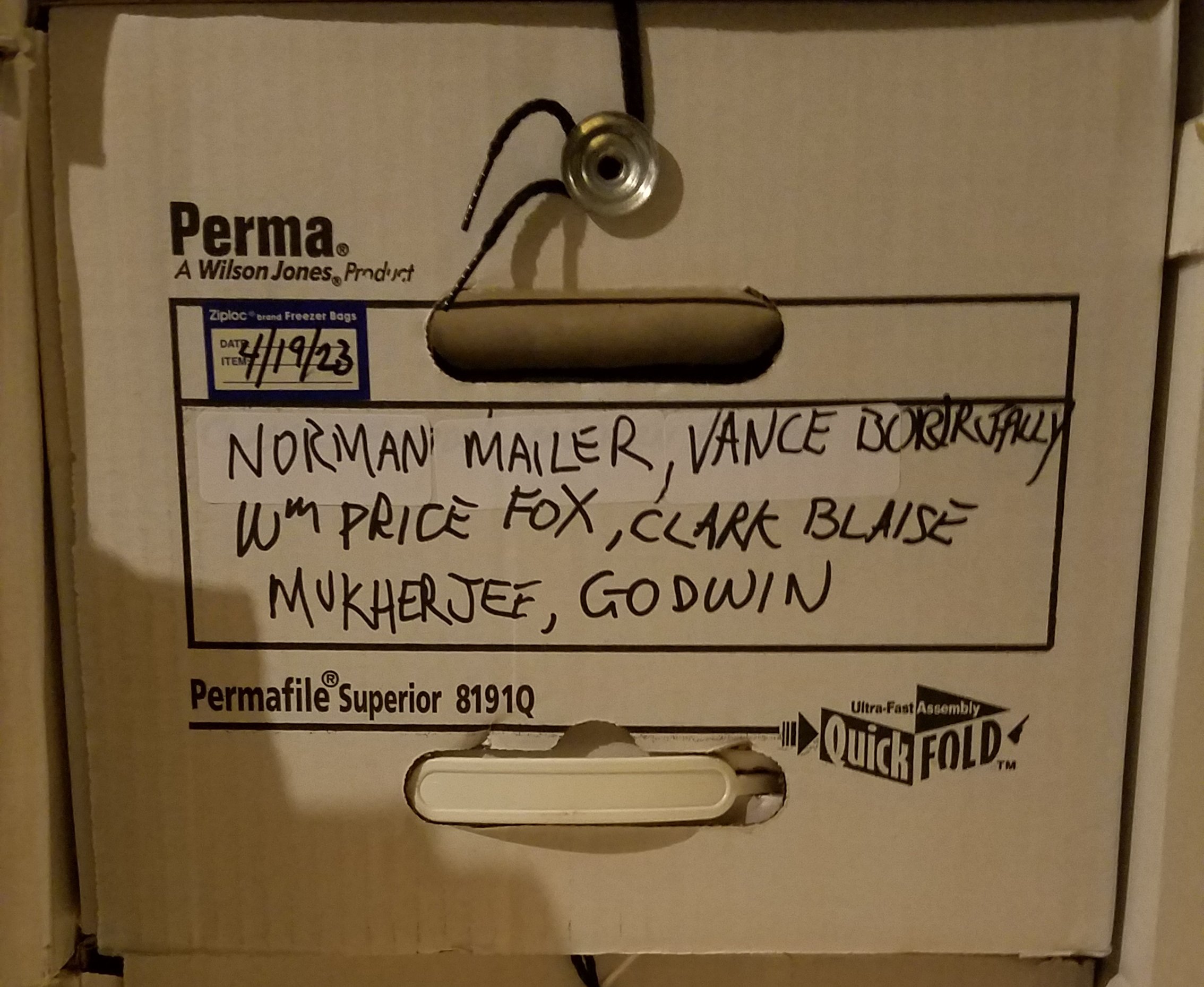
All but The Moviegoer of my collection of Walker Percy novels went into boxes and out the door. I felt a bit sad about that, but as Vonnegut said, “So, it goes.” I had to decide about my collections by author. Other authors, that I worked equally hard to collect, went into bankers boxes with the names and date packed on the outside. Who knows if one will get into the boxes again, yet they are available and take up no precious shelf space. A few — Bellow, Didion, Irving, Morrell, Faulkner, and William Carlos Williams got their own special shelf space. It wouldn’t be my library without those authors.
I wrote previously about poetry and that decision seems solid. The shelves are easily accessible so when I want to read poetry I can get at the stacks.
Cookbooks are impossible. Half of what I gave away was cookbooks. I can’t seem to part with many more. Yet I must. Truth is, I hardly use cookbooks any more. Having learned how to cook, they serve as cultural artifacts related to places and people with which I have some connection. Reference material for the church where I was baptized, or the American Studies department where I got my degree. In seventy years of living, we generate a lot of connections. A cookbook has usually been involved. They also serve as examples of how to prepare a particular dish or ingredient. Keeping many of them takes up space that could be devoted to other topics. This sorting is far from over.
Hundreds of books about Iowa history and by Iowa authors needs reduction to a shelf of about a dozen to hand off to our child when they are ready. I also wrote about this. More of those got boxed up, leaving the first tier to be read and re-considered on the shelf.
The space for books about U.S. presidents is settled at eye level on two long shelves. The ones by or about presidents in my lifetime is sorted. I had two copies of Eisenhower’s White House memoirs and one is on the bench waiting to be packed up for Goodwill. I have a blank space for the second volume of Obama’s presidential memoir. No space was left for a Trump memoir, I mean, you got to be kidding me.
My African-American studies section has grown, and I need a space for American Indian books. I can’t bear to part with all the ancient writings, although the chances of reading some of them are slight. I may get into Plutarch’s Lives, or I may not. Keeping them for now.
Art books take up too much space. Having so many is a function of my interest in certain artists like Picasso, Joan Miró, Georgia O’Keeffe, Warhol, Hopper, and the like. Some I bought at the artist’s retrospective, and some I picked up at used book sales. Until I get to the point of running out of space, most of them will stay right where they now are.
A byproduct of sorting is finding more books to read. The to-read shelves are packed to overflowing. I’ve also found some lost friends, like George McGovern’s autobiography, Grassroots, and Joe Biden’s Promises to Keep. I put Biden’s memoir into a box, thinking he would never be president. Now it’s up in the presidential lineup.
The great book sort is proving to be beneficial. I have a better understanding of what I have, and organized them into projects for future writing. For now, there are some empty shelves. There won’t be for long.
With enough perspective, the social importance of objects is diminished.
I’ve been inside the Statue of Liberty in New York harbor, and saw it up close. It’s name, “Liberty Enlightening the World,” by sculptor Frédéric Auguste Bartholdi, simply states what it represents. Since installation it has come to mean more.
At the reopening after restoration of the statue, on July 3, 1986, President Ronald Reagan said, “…we celebrate this mother of exiles who lifts her light beside the golden door.” The golden door is a political addition, and not needed. It is a corruption. It permeates everything. It was only when I viewed the Statue of Liberty from Windows on the World atop the World Trade Center did I realize how imbued with cultural attachments it is. From my seat overlooking New York harbor, the statue seemed minuscule, less significant than the movement of boats under a clear night sky.
My belief about culture-imbued words used in poetry came from epiphanies like this. The best poets stay away from that kind of cultural insertion, instead using language to create meaning. My reading of poetry is a search for such verse, without culture bombs dropped into the text. It is hard to find.
The first books I bought after earning money delivering newspapers were collections of the poetry of Robert Frost and Carl Sandburg. I later added the poetry collection of W.B. Yeats. The books lay on a shelf at the M.L. Parker department store and spoke to me. I purchased them. Poetry did not become a key organizing principle for my home library, yet volumes were often available at a discount or given to me. The number of poetry books grew. Today, I have eight 23-inch shelves of poetry in my library.
In the late 1970s and ’80s I wrote poetry as a form of creative expression. Some of it was good, most wasn’t. A few have been posted here. It was a way to be a writer. There is a project of going through those pages, editing them and re-writing the poetry from today’s perspective. When I previously did that, results improved. There may be a book of poetry in me, yet I am a prose writer. I don’t often write it, yet do read poetry often.
Like everyone, I have favorites. I will go on reading Charles Bukowski until I’ve read every available verse. I only recently discovered Mary Oliver. Can you believe it? She’s among the best. Eventually I will get to Sven Armens’ two books purchased at a used bookstore in the county seat. Armens was my undergraduate Shakespeare teacher, a figure more suitable to being a character in Othello than poet or Shakespearean scholar. A reader needs to expand beyond favorites. That is the purpose of my eight shelves of poetry: be there when I need to consider language.
If I were a poet I would emulate characteristics of Vachel Lindsay, particularly his Rhymes to be Traded for Bread. Poetry as literal currency. I remember visiting the Vachel Lindsay house in Springfield, Illinois, and thinking how dull it must have been for Lindsay to be planted in a single location for any length of time. I see Lindsay walking into Kansas and other Midwestern places more than being planted in Springfield. I should return to reading Lindsay.
Having a wide selection of unread verse creates a go-to place when I’m stuck for what to read next. These going to poetry moments are unlikely to deliver me to re-reading Edmund Spenser’s The Faerie Queen, yet maybe I should. The use of inventories in his writing has been influential in mine. Better to list the cultural attributes one seeks to invoke rather than assume readers will understand all the references in a single, culturally well-known object as an author hopes.
A writer has to use nouns, dammit! Better that verse explores the meaning of nouns. I would rather poetry be all verbs, suggesting action and an ever-evolving thought process. One can’t escape the nouns, though. I’m not hopeful I’ll find such verse in my eight shelves of poetry. I plan to continue the search, a couple of volumes each month.
Seeded tomatoes and peppers and set them on a heating pad under a grow light.
Saturday seemed busy. It could have been more productive. As a retired septuagenarian, there is never any difficulty staying busy. I do wonder if I could produce more during each day. More production is the American way.
A key aspect of America’s peculiar institution of slavery was efficient use of slaves. Especially on sugar plantations, but on others as well, every daylight hour was to be spent working in the fields or processing crops. If a slave died from being over worked, no problem. They could easily and inexpensively be replaced by another. The lives of slaves on a plantation were short.
The average lifespan of enslaved Africans who worked on colonial sugar and rice plantations was seven years. Extreme physical demands relied on equally extreme instruments of torture to ensure control over enslaved peoples and to protect plantation profits. The economies and societies they built were denied to them, along with human dignity.
National Museum of African American History and Culture website.
Making enslaved humans productive was essential to accumulation of wealth in the highly lucrative production of sugar, rice, cotton, tobacco and indigo. A system of overseers and supervision was developed. While slavery ended with the Civil War, those techniques from plantation days persisted in practice and in many cases are revered by business efficiency experts. In 1850, the average life expectancy for a slave was 36 years.
We’re not accumulating any wealth here, yet feeling like I’m accomplishing more would be a boon. Here’s what I have in mind:
About this time last year I stopped regular, daily work on my book. This year I plan to spend less time in Summer and Spring, yet write something or work on research every day. The major obstacle is I can’t seem to get through all the boxes of research documents in a timely manner.
Reduction of my book stacks will continue. The goal is to donate every time I shop over in Coralville, or about every other week. I have a process and things are moving more quickly now. Some time each day on this.
My goal is to read 25 pages per day. For historical books with a lot of detail, that’s probably right. When reading fiction, it’s too low. The idea is to adopt different goals for different kinds of books. If I can’t read 50 pages of fiction per day, there is something wrong with me.
Our refrigerator and pantry are good at keeping food and there is too much of it. I plan to work down the excess by cooking differently. Maybe I’ll find a few recipes that are keepers.
Listen to more music. I wrote this playlist in 2005. It is a story of my life in music. Back when I played, I sang all of these.
Cripple Creek (Traditional)
Lord Franklin (Traditional)
Shenandoah (Traditional)
Big Rock Candy Mountain (Harry McClintock)
House of the Rising Sun (Traditional)
500 Miles (Hedy West)
The Cruel War (Traditional)
Blowin' In The Wind (Bob Dylan)
Pack Up Your Sorrows (Pauline Marden and Richard Fariña)
Wabash Cannonball (William Kindt)
This Land is Your Land (Woodie Guthrie)
Freight Train (Elizabeth Cotten)
The Hammer Song (Pete Seeger and Lee Hayes)
Good Night Irene (Huddie Ledbetter said he didn't know who wrote it)
Someday Soon (Ian Tyson)
Early Morning Rain (Gordon Lightfoot)
Four Strong Winds (Ian Tyson)
Both Sides, Now (Joni Mitchell)
What About Me? (Scott McKenzie)
The City of New Orleans (Steve Goodman)
You Ain't Going Nowhere (Bob Dylan)
I Shall Be Released (Bob Dylan)
It's All Over Now, Baby Blue (Bob Dylan)
The Dutchman (Michael Peter Smith)
Set my skepticism regarding doctors
     aside for now,
     while considering
     the pediatrician and poet.

Set it on that basket,
     where it's shine might
     illuminate this moment.

Would we have him as our physician?
Would we travel into the city with him?
Would we seek his company?
Would he have sought ours?

To have his eyes, his struggles...
     his medical practice,
     his practice of poetry...
     It was all one.

I took the basket to the garden,
     to dig potatoes,
     and struggle to get out
     from where I rooted with singular purpose.

~ Written in the Calumet, circa 1990.
The first draft of part one of my autobiography is finished. The narrative begins with my maternal great, great grandfather’s arrival in 19th Century Minnesota and continues until I finished graduate school in 1981. It is a good place to end winter writing as my focus turns to the garden. Caesura.
I’m not finished with the narrative. I sent part one to a reader, and may send it to one or two more. I needed a break from the writing.
I identified as a writer after returning from military service. It persisted. I diligently worked at writing during the first year of our marriage. I felt the urge to do more to earn money and support our small family, and found a new job by March of year two. The birth of our child in year three changed everything. I found outlets for writing through the years yet it wasn’t until 2007, when our child left Iowa, and I started a blog, that I began to find a consistent voice.
Much research and sorting remains. On Saturday I spent several hours reviewing digital files. I deleted so many, One Drive sent me an email asking if I was sure I wanted to delete them. There were some useful passages and many more hours of this lie ahead.
That’s not to mention the artifacts laying around in boxes. All of it needs review. Yet there is a garden to plant and tend to. I’ll work things out in the pre-dawn hours of each day.
The next chapters will be more challenging, as by the time of our marriage, life had gotten complicated. A spouse, a new job, a child, and the challenges of working in the Reagan era all created demands. I met them as well as I was able.
I wrote the outline for part two and have about 60,000 words. As I find relevant writing and subjects, I can copy and paste them there. Once the garden is in, hopefully by Memorial Day, I can take another look at what I have.
In the meanwhile, I had no idea what a big task this would be. As long as my health remains good, I’ll continue to write and edit until this work is done. There is so much invested in it, I can’t abandon it now.
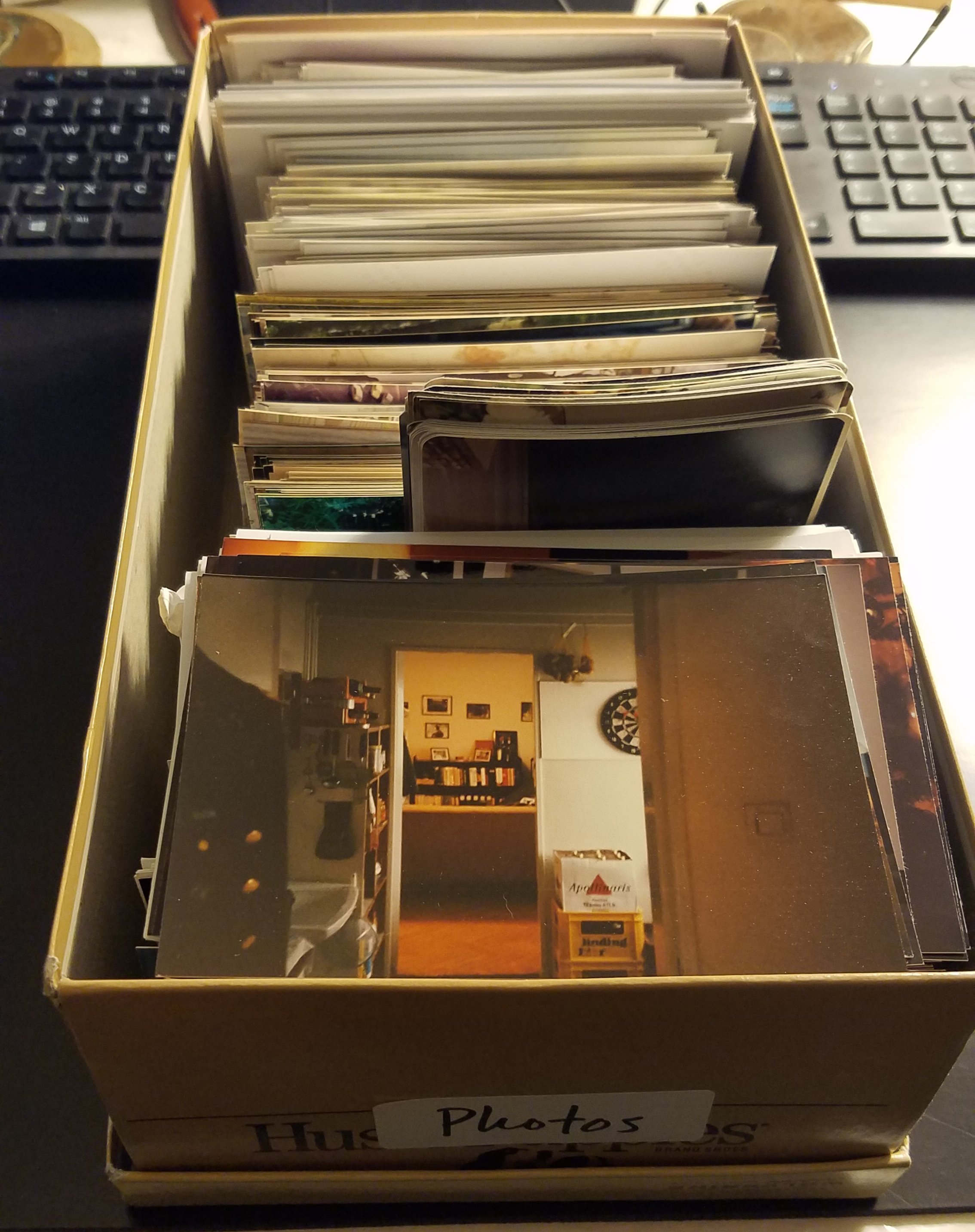
Shoe box full of print photographs, March 21, 2023.
I found a passport I thought was lost in a box of photographs on Monday. It expired in 1983, issued by the American Consulate in Frankfurt, Germany. I put it in the drawer with the previously expired passport it replaced. One less thing nagging at me as a result of the discovery.
I was opening unlabeled bankers boxes to see what was inside. It makes no sense to stuff things in a box without a label, yet that’s where I find myself. Along with some transportation memorabilia, one box contained this shoe box full of photographs. The images covered the entire timeline of the book draft I had finished Sunday. I thought these photos were lost forever.
My habit of making photo albums (using selected images after developing and printing batches of photos) resulted in this collection. It contains remainders of rolls of film from several of those albums. The prints are all mixed up, with different sets of film stuck in the shoe box in what appeared to be random order. At a minimum, I must organize them the way I discussed a few days ago. This is a big and welcome find!
Next will be to organize and edit the images to create another layer of the book narrative. I also want to label them in groups, so I can more quickly find something for my writing. This will take longer than I want, yet it should improve the writing.
I looked through a few hundred photographs yesterday afternoon after chores. I have living memory of taking most of those shots, recognizing them and the place they were taken almost immediately. The harder part is determining what these moments of reality mean in the context of my septuagenarian life. I expect that will be a collaborative project. Already I sent a duplicate of a photo taken in 1981 to the subjects. There will be more of that type of sharing.
It seems best for the autobiography to have been drafted before looking at these photos. Tapping memory and public documents enabled a reasonably researched narrative. Now that I found more photos, we’ll see what else memory dredges up for inclusion in the book.
With Spring arriving yesterday afternoon, it will be challenging to make time for writing. Yard and garden work is also important. After sunrise, I will be drawn outdoors. All the same, how could writing about these memories not be meaningful? I can’t wait!





 Journey Home
You must be logged in to post a comment.