Categories
Writing

Zucchini Bread from a Church Cookbook

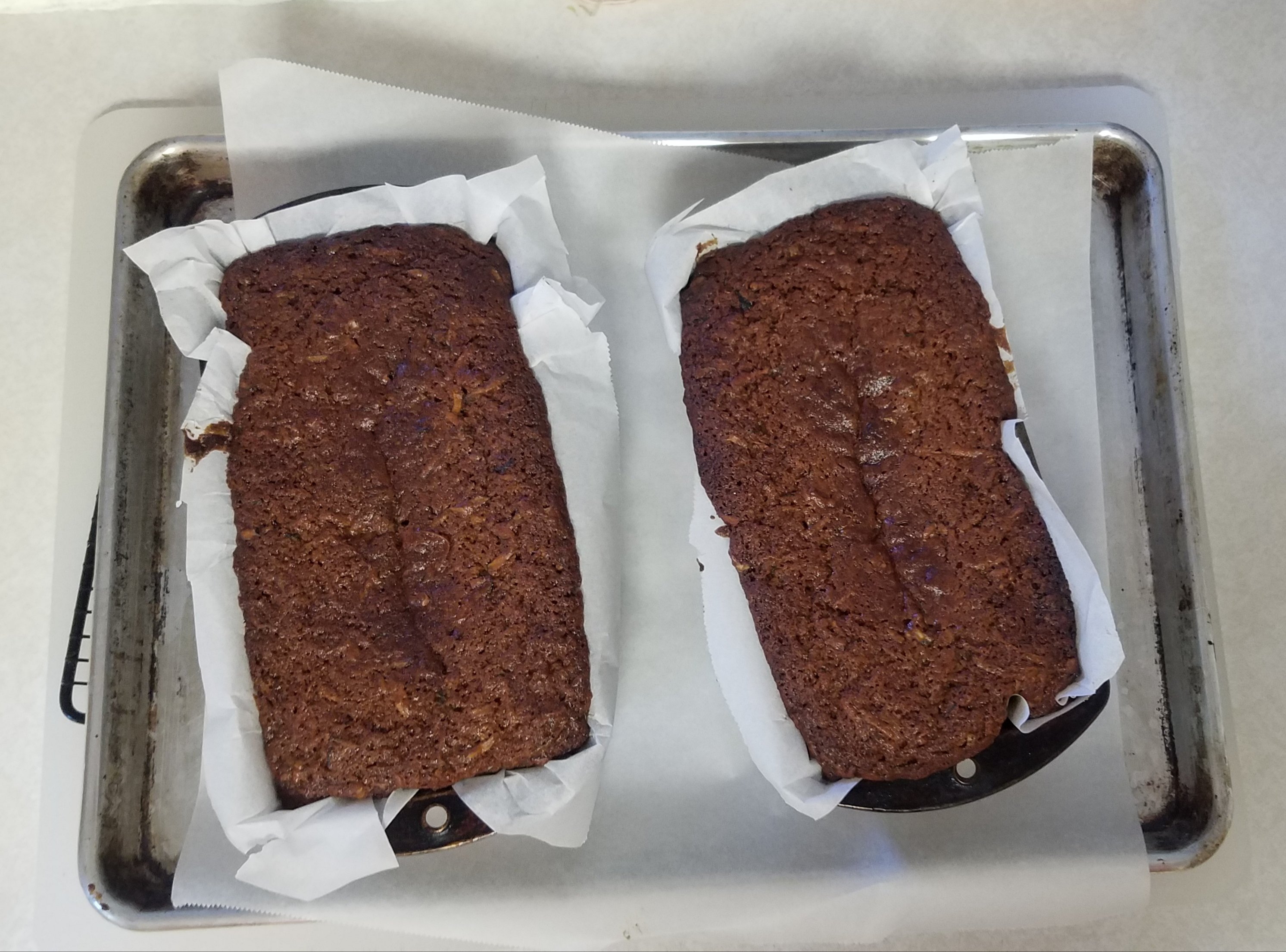
Zucchini bread, June 30, 2023.

The garden is producing zucchini, so much there is pressure to do something with it. Zucchini bread is a traditional way to use the excess… some of it, anyway.

Zucchini bread is a seasonal dish predicated on having a surplus of the vegetable. Home cooks don’t usually go out and buy zucchini. Confronted with garden reality, or a gift from a friend, there is an urgency to do something with it before it spoils.

I reached for recipes from my childhood neighborhood during the 1950s through ’70s. The recipe I found didn’t really work in 2023.

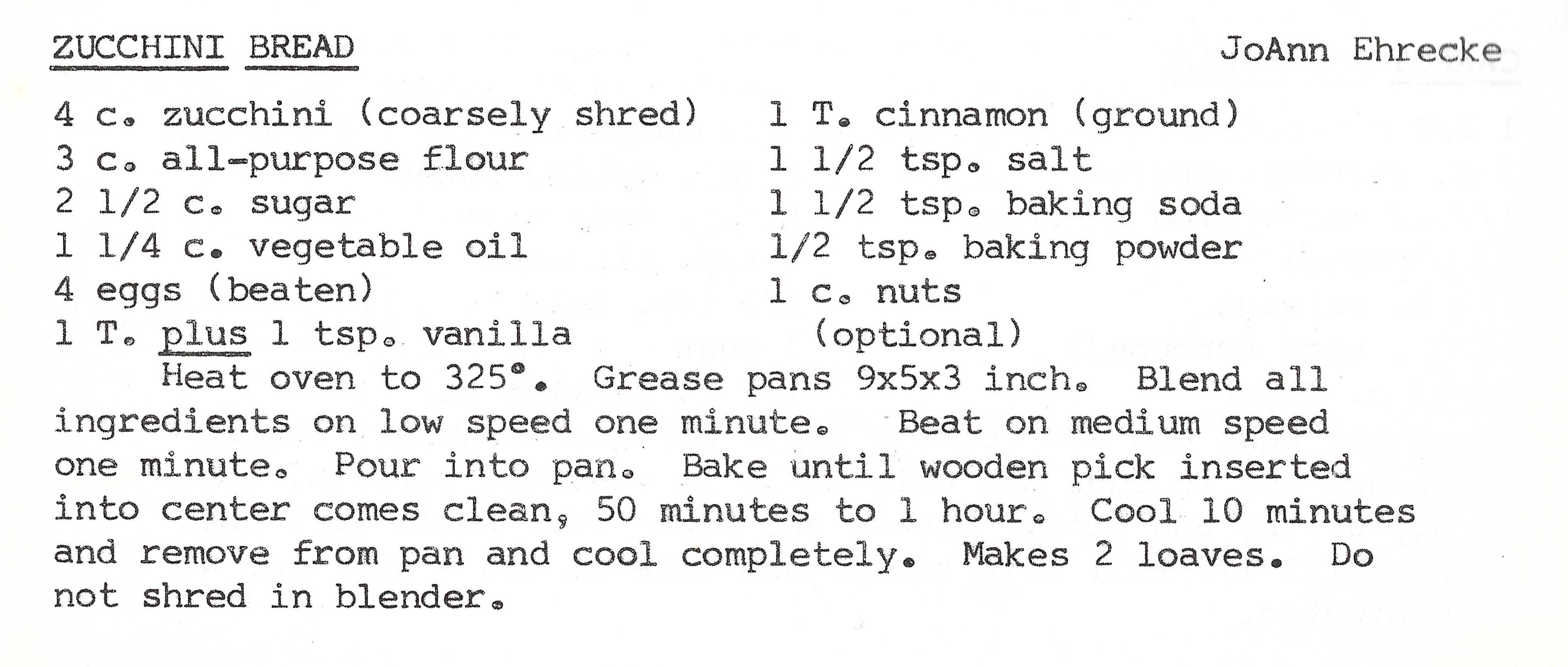
JoAnn Ehrecke submitted a recipe for zucchini bread to the Family Favorites cookbook published by Holy Family Parish, Davenport Iowa in 1977. It used four cups of shredded zucchini, which is a lot. I had been to the Ehrecke home at least once while I was in school, so the recipe came with a positive vibe. Not only is it a product of the 1970s, it is set in that time. I followed the recipe with some adjustments to accommodate vegan eaters and modern times. The result was a dense, sweet loaf, more like cake than bread. We’ll use it, but won’t return to this experimental recipe.

There were problems:

While I knew to put the grated zucchini in a tea towel and press the excess moisture out, there was no such instruction in the recipe. If I hadn’t performed this basic culinary task the loaves would have been a disaster of moisture.

My typical egg replacement is applesauce. I think the recipe relies on the leavening quality of eggs to give it a rise. Applesauce added flavor, but not leavening. Applesauce also tends to be a substitute for oil in recipes, although in our vegan cornbread recipe it serves as an egg.

Along those lines, 1-1/2 teaspoons of baking soda and 1/2 teaspoon of baking powder did not seem like enough leavening. The crumb wasn’t a crumb at all. More like a gooey, sweet mass with a crust. There are positive qualities in that, but it is not a bread.

Finally, the baking time of 50-60 minutes was too short. The 325 degree oven worked, yet it took longer. A toothpick did not come out clean until 90-100 minutes. When I cooled and cut into a loaf, it was exceedingly moist inside. The flour taste was gone and the sweetness of the sugar and flavor of apples and cinnamon stood out. That part was good.

The saving grace of this result was a loaf that could be used as a dessert. Cut a thick slice and re-heat it in the microwave or fry it to make a crispy crust. Drizzle with apricot preserves, honey, or your favorite jam, add in-season fruit like raspberries, or pour on a little chocolate ganache. It would be good to go for regular or formal dining.

The path to this dessert was unexpected. Recipes in old church cookbooks assume a lot, much of it lost in the decades since that culture thrived. In any case, we’ll have dessert for a week and I used up the three largest zucchinis. Now what shall I do with today’s crop of zucchini?

Categories
Writing

Newspaper Writing

Editor’s Note: This is one of 100 newspaper articles written for the North Liberty Leader, The Solon Economist, and the Iowa City Press Citizen beginning in 2014. The North Liberty Leader stopped publication in early 2022. The Solon Economist remains on the bubble. This is an example of the collaborative type of writing produced with my newspaper editors. The whole experience of freelancing was beneficial if low-paid.

Iowa City Community School District board meeting on Jan 28, 2014. Photo by the author.

Van Allen school to be expanded
Four new classrooms will serve 100 additional students

By Paul Deaton

IOWA CITY (Feb. 5, 2014) – Paintings by Van Allen and Penn Elementary School students on the walls of the Iowa City Community School District (ICCSD) school board meeting were a colorful backdrop as Superintendent Stephen Murley and the board held brief discussions during an equally brief meeting on Jan. 28.

The board held the second of three readings of Appendix 9 , the ICCSD capital projects planning and approval process document that guides the board in its oversight and implementation of the district’s facilities master plan. The long-range plan was adopted on July 23, 2013, and proposes to spend an estimated $252 million on capital improvement projects during a 10 year period. Included in the plan is an addition to Van Allen Elementary School in North Liberty.

Following the formal meeting, the board’s Operations Committee met, and began with an update on the Van Allen design project by representatives of the architectural firm Neumann Monson and Van Allen Principal Pat Brown.

On Dec. 17, 2013, the Iowa City school board approved a project design expenditure of $123,250 for Van Allen. The design was to include additions to the current structure, containing four classrooms to house approximately 100 additional students. A committee of staff volunteers worked with Neumann Monson during the design development phase of the project. Three schematic designs were evaluated, with a final preference for additions to existing pods two (on the East side of the building housing Kindergarten through second grade) and three (on the West side of the building housing grades three through six. The design would create about 5,600 square feet of new space and fall within the approved budget of $1.68 million.

Principal Brown explained the criteria the committee developed for the addition.

“One of the things we’d like to do is to continue, as much as possible, is (keeping) like grades together so that we can group our first grades together, second grades together. Our teams do a lot of collaboration in their planning and delivery of instruction. It works much better when we keep those grades together,” she said.

Brown said another important criterion was flexibility of classroom design.
“We are anticipating growth in the North Liberty area. And as we’ve seen with enrollment, kids don’t always come to us in neat packages with the numbers just right as they move up through the grades. (The additions) could give us growth on both sides of the building.”

“We will have additional classroom space to meet student instructional needs in a positive learning environment,” said Brown in an email after the meeting.

Current enrollment at Van Allen for K-6 is 489 students. In addition, the elementary school also serves 27 preschool students. Projected enrollment for the year 2022-2023 is 527 based on the school’s current attendance area.

According to Brown, there are plans to rezone the attendance areas in North Liberty and Coralville beginning this spring. Additional students will likely be zoned into the Van Allen Elementary attendance area to help with projected elementary population growth.

“North Liberty enrollment projections for the school-aged population taken from the U.S. Census (2000-2010) shows an increase of 122 percent. Coralville increased 29 percent,” said Brown.

Van Allen Elementary School was Iowa’s first LEED certified public school. LEED (Leadership in Energy and Environmental Design) is a set of rating systems for the design, construction, operation and maintenance of greens buildings intended to help building owners be environmentally responsible and use resources efficiently. Van Allen received a silver LEED certification, and features natural lighting, recycled building materials, geothermal heating and cooling, and natural landscaping. Neumann Monson expects to preserve LEED certification with completion of the project.

The board will hold a public hearing on the final project design in April. Once the design is approved, Neumann Monson expects the bidding documents to be prepared for distribution to contractors by April 24, and returned by May 16. Construction is to begin June 1, with a construction completion date not later than June 30, 2015.

~ Written for the North Liberty Leader.

Categories
Writing

The Dam Breaks

Checking the Earliblaze apples on June 26, 2023.

The cartomancer drew an Ace of Spades, indicating things that have been in disarray in my life may be coming together. After mild spells of undiagnosed dizziness today and yesterday, I feel the dam breaking and am ready to portage to the other side as the impoundment pool is released. That means I will return to writing my autobiography soon.

I sent the first half to four friends from whom I hope to hear feedback. Two have responded and two are married and will respond together when both finish reading. The feedback garnered thus far has been invaluable.

The next decision is whether to work on the part just reviewed or work to get the rest of it up to the same level of completion. The second part is problematic in that there are multiple narrative threads which represent a lot of work. At the same time, revising what was reviewed makes some sense while the feedback is fresh.

In part two there will be the experiences with family before our child attended formal school. Those are the most important years and they are over before we realize it. It is important to capture some of those fleeting essences while we can. We brought her home from the hospital to Cedar Rapids, Iowa where we lived the first 30 months, then moved to the Calumet region of Indiana where she started Montessori School, followed by public schools. We moved to Big Grove Township in 1993. That’s one narrative.

I lived through the post-Reagan years of turmoil in the workplace and have things to say through the frame of living in the Calumet and recruiting truck drivers and mechanics. More than anything, in interviewing some 10,000 people, I learned and felt directly the pain Reagan’s initiatives put so many working people through. I want to tell that story.

The challenge of being a writer intensified with the advent of computer technology. Of what was this new tool capable? What were realistic expectations? How did it change the way I wrote? How did writing in public change from my first letter to the editor in 1974 until today? Another narrative worth exploring.

During my career in transportation I traveled all around the country. I spent the most time in Indiana, Michigan, Illinois, Georgia, Tennessee, Ohio, Pennsylvania, New York, West Virginia and other states. I used to bring a magnet home from each new place and filled up the front of the home refrigerator with them. I spent time with some of the poorest people in the country and with large corporations far removed from the reality most of us know. Sorting that out will be a big task in itself and seems worth doing.

There is a lot in front of me. It appears to be in the cards for me to get going again. I can feel it. I am ready.

Categories
Writing

Writing in Public

My writing desk, December 1979.

My first letter to the editor of a newspaper appeared in the Quad-City Times on Dec. 30, 1974. I had just returned to my home town from Europe after college graduation. I did not like the culture I experienced in Davenport. The letter was a way to express my opinion in public and garner feedback from other members of the community. It worked to a fashion before the time of social media. It would not be my last letter to a newspaper complaining about living in society.

There are risks when writing in public. When I wrote letters to the Cedar Rapids Gazette, in response, I received anonymous threatening letters in the mail. It was a form of intimidation for having an opinion with which someone disagreed. Because the letters were anonymous, and didn’t threaten me physically, I discarded them and wrote more letters to the newspaper. I’m not certain I’ll write any more letters to the editor, yet I won’t let intimidation be the reason to slow me down.

In Iowa, we are considering the incident of a prominent meteorologist named Chris Gloninger who received a death threat after educating his viewers about climate change. Repeated email harassment over his weather reports led to a case of PTSD, after which he resigned his position. I seldom watch television weather reports, so I likely don’t understand the situation. Harassing a T.V. meteorologist via email is a lazy person’s way of “sticking it to the man.” How infantile!

In his upcoming book, The Hidden History of American Democracy: Rediscovering Humanity’s Ancient Way of Living, author Thom Hartmann closes with the following:

You may think your voice is but a faint whisper in the wilderness, but there are ways you can amplify it at no cost other than a bit of effort. Write letters to the editor of your local newspapers. Become active on social media. Volunteer with the dozens of great good-government groups and organizations devoted to saving our environment, our democracy, and our world.

The Hidden History of American Democracy: Rediscovering Humanity’s Ancient Way of Living by Thom Hartmann.

Hartmann reiterates one of the best remedies for feeling impotent or down is to take action. We can’t let the inevitable naysayers get to us when we do.

Good luck Mr. Gloninger. May your future be bright.

Categories
Writing

2023 Garden Is In

Cleaning radishes, herbs and kohlrabi.

In December I started seeds indoors, which led me to yesterday when I declared initial garden planting finished. There are some tasks remaining to be accomplished, when isn’t there in a home garden? The seven vegetable plots and six fruit trees are in production of food for our kitchen garden. There should be excess available to give to others, including donations to the local food bank. It took a lot more work to get this far this year.

Garlic was planted Oct. 15, 2022 and it suffered some issues because of the mulch I used to cover it over winter. Despite some failures, there will be plenty for another year. The main task in the garlic patch before July harvest is weeding. I harvested most of the scapes this week. Next to the garlic is a covered row that produced early greens, radishes, and herbs. There are new seedlings of bok choy and lettuce varieties ready to go into rotation.

The next plot was potatoes in containers, onions, leeks, spinach, snow peas and sugar snap peas. There were plenty of spring onions as I thinned the starts to proper spacing. The main difference this year is being able to weed the onions. It looks like a fine crop of onions is in production, both for storage and eating now. I also stuck last year’s chives, some kohlrabi, two fennel plants, dill and cilantro on the side of the onions. Everything is growing well and there has been no sign of the Colorado potato beetle.

I eliminated the narrow path between the two largest plots and fenced them together with one entrance. Half of this space is the main tomato crop and the rest an assortment of tomatillos, okra, summer squash, zucchini, green beans, fennel, kohlrabi, celery, Brussels sprouts, bell peppers, cabbage, chard, kale, collards, onions I started from seed, and cucumbers. The greens in this plot were started later, so I haven’t harvested anything yet. There will be an abundance of cucumbers, squash, greens, and bell peppers if they produce.

There is a complete plot of cruciferous vegetables: five kinds of kale, collards, broccoli, cauliflower and three kinds of cabbage. Putting these together helps manage the white butterflies that lay eggs on the leaves to produce little green worms. If one doesn’t stay on top of pest control, the crop will suffer. Thus far all the harvested greens look good.

One of the plots is situated under two oak trees grown from acorns. The shade protects squash plants, and this year I picked a variety of pumpkin, butternut squash, and acorn squash. I used a no till method and left last year’s ground fabric in place. The seedlings are thriving. So far, so good.

The last garden plot has hot peppers, eggplant, fennel, tomatoes and celery. There is a bit of space where I plan to plant five seedlings of two varieties of sweet peppers. I don’t usually mix sweet and hot peppers in the same plot, but the space is just right. It appears the peppers will take and there will be an abundance. My main interests here are Guajillo chilies for prepared pepper sauce for cooking, thin red hot peppers for red pepper flakes, and jalapeno and Serrano for eating fresh. Since I am the only connoisseur of hot peppers in our household, there should be plenty.

The three apple trees planted soon after we moved here are bearing fruit this year. The Red Delicious tree particularly has been well-beaten by wind storms and is amazing in its survival. The pear tree is bearing, as is one of the new apple trees planted next to the garden. If there is a good crop, the pantry needs more applesauce, a dozen pints of apple butter, and replenishment of the apple cider vinegar jars.

We started some flowers, which need transplant into the space in front of our house. We are just learning about growing flowers. I successfully started a stevia plant for indoors. I’m not sure how much it will produce, yet we are looking forward to making our own sweetener after this year’s experiment.

The main benefit of declaring the garden planted is the ability to turn to other work, including writing for this blog. There is a period from now until the garlic comes in to organize the garage for some projects.

The garden is ready. Now all we need is rain, weeding and pest management. We feel lucky to have the space for a big garden.

Categories
Writing

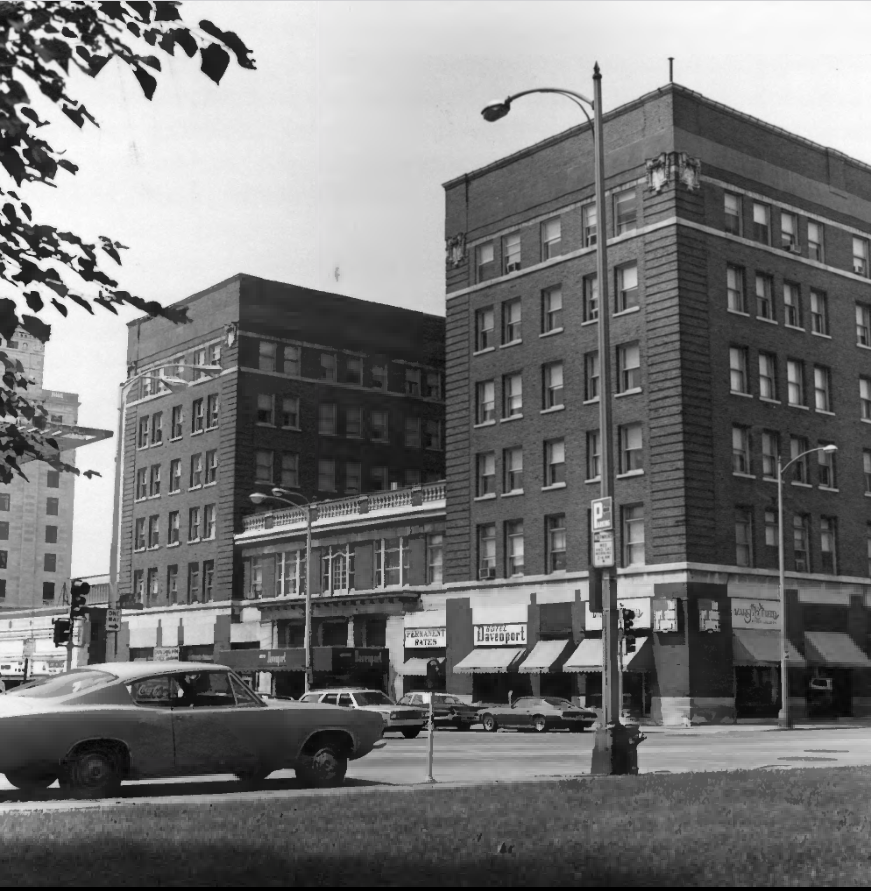
District of Tall Buildings

Davenport Hotel circa 1980. Photo Credit: National Park Service.

When a group of men gathered at the Rock Island home of George Davenport in 1835, they had a mind to purchase land and lay out a town on the Iowa side of the Mississippi River. With native tribes removed, something needed to be done with the land, or so they believed. By any measure, the enterprise was a commercial venture in a relatively optimal, if arbitrary location. Its lackluster beginnings would haunt the city until I was born more than a century later.

In Spring 1836, Major William Gordon surveyed the place that would become the City of Davenport. He and his business partners, including George Davenport and Antoine LeClaire, offered a sale of lots to a party from Saint Louis who had been transported by steam boat to participate in a two-day auction. Sales were much less than expected. The sellers did not have clear title to the lots at the time of the sale and that likely contributed to poor sales.

There was never a question Davenport would be settled by non-natives. As original forests were clear cut upstream, and rafts of logs floated to river towns on the Eastern border of Iowa, there was money to be made. The lumber business was profitable, yet not sustainable. It was one more instance of profiteering in the city’s history.

The lumber business gave rise to the railroads. When the Davenport Hotel was constructed in 1907 it was situated equidistant between the two major rail stations in the city. “Erection of the Davenport Hotel inaugurated a period of building that would bring Davenport’s central business district fully into the era of the ‘tall buildings,'” according to the National Park Service website. Other tall buildings were built around it, including The Dempsey Hotel (1913), The Blackhawk Hotel (1915), The Davenport Bank and Trust Company Building (1927), and The Mississippi Hotel (1931).

Temple and Burroughs Architects created the Davenport Hotel building in the Renaissance Revival style. The structure was an important feature of the city’s commercial center. Located in Antoine LeClaire’s first subdivision of Davenport, one couldn’t get more center city. As commercial needs changed in downtown, some of the tall buildings were converted to housing. My maternal grandmother lived in government-subsidized housing in the Mississippi Hotel for many years.

The May 28, 2023 collapse of part of the Davenport Hotel building should be a wake-up call for city governments everywhere. The response of the City of Davenport has been as lackluster as the city’s founding. What seems obvious today is these tall buildings are getting old and literally falling apart.

At least there is political hay to be made in this national story. Florida Governor Ron DeSantis just announced he will send a crew to Davenport to help in the recovery of the building collapse. Is it a coincidence he is also vying for position in the 2024 Iowa Republican caucuses?

There may be dollars to be made from old building stock. City staff needs to energize and make sure none of the other tall buildings in the commercial district collapses while developers pursue the almighty dollar. History has shown, they are likely to nod their heads toward developers and let the action play out as it did last month. What a sorry way to run a city.

Categories
Writing

Toward Future Dishes

Maytag Range delivered to our kitchen on May 22, 2023.

We replaced the Kenmore range purchased in 1988 with this new Maytag model. Technicians from the small appliance dealer did a good job delivering, installing, and explaining it. More than once they referred me to manuals dropped on the counter. Although it will take time to understand the features of the range, I will attempt to live up to the promise this technology offers. I expect to prepare many future dishes using the device. The inaugural meal was black beans and rice.

A future is not always assured. I took a spell while tending the covered row of herbs and vegetables, then made a retreat indoors. I have had two conversations about such episodes with my medical practitioner. He said if they were infrequent and do not persist, there was little to be done about them. Easy for him to say. Most days spells recede behind the proscenium arch where the curtain is down more than up on my aging frame. From time to time, spells appear as players to complicate life. We are in act one of what can be expected to be five. Here’s hoping I live to denouement and a final, dignified curtain call and bow.

This is the longest I have been away from posting since I can remember. My spouse will be spending a week with her sister who is moving from a rental to a house in July. There is a lot of packing to be done. While she’s gone, I hope to finish planting the garden, organize for summer, and begin regular writing again. I hope to be done with the intense rasher of friends who died this year. Appliances died in equal numbers, yet it is not the same.

I miss my friends, appliances not so much. Appliance transitions brought discussion with banks, business owners, sales folks, delivery drivers, and technicians. It is a way to go on living whereas my dead friends and family offer little engagement for the future except in memory. As we age, we do the best we can.

On the way home from the grocer I stopped for gasoline. After fueling, I pretended I was in Thomasville, Georgia again and bought a Yoo-hoo chocolate drink and lottery ticket at the gas station. Playing the long game, I bought a Powerball ticket instead of a scratch-off. If we can’t see a future beyond the now, then we will never live a long one. Validating the statistics of lotteries, my ticket was not a winner in Monday night’s drawing. At least we have the new range and the prospect of delicious meals.

Categories
Writing

Spring Break

Front rolling in.

I’ve taken to opening the garage door and watching storm fronts roll in. Probably, I’m carrying baggage from the Aug. 10, 2020 derecho.

Multiple reasons have me running behind, with a short time to get the garden in by Memorial Day. I’ll be taking a break from writing to focus on spring and all. One never knows how many more springs we’ll get. I intend to enjoy this one.

Take care dear readers. Hope to see you again soon. Hope you enjoy what remains of Spring!

Categories
Writing

Clearer View of Writing

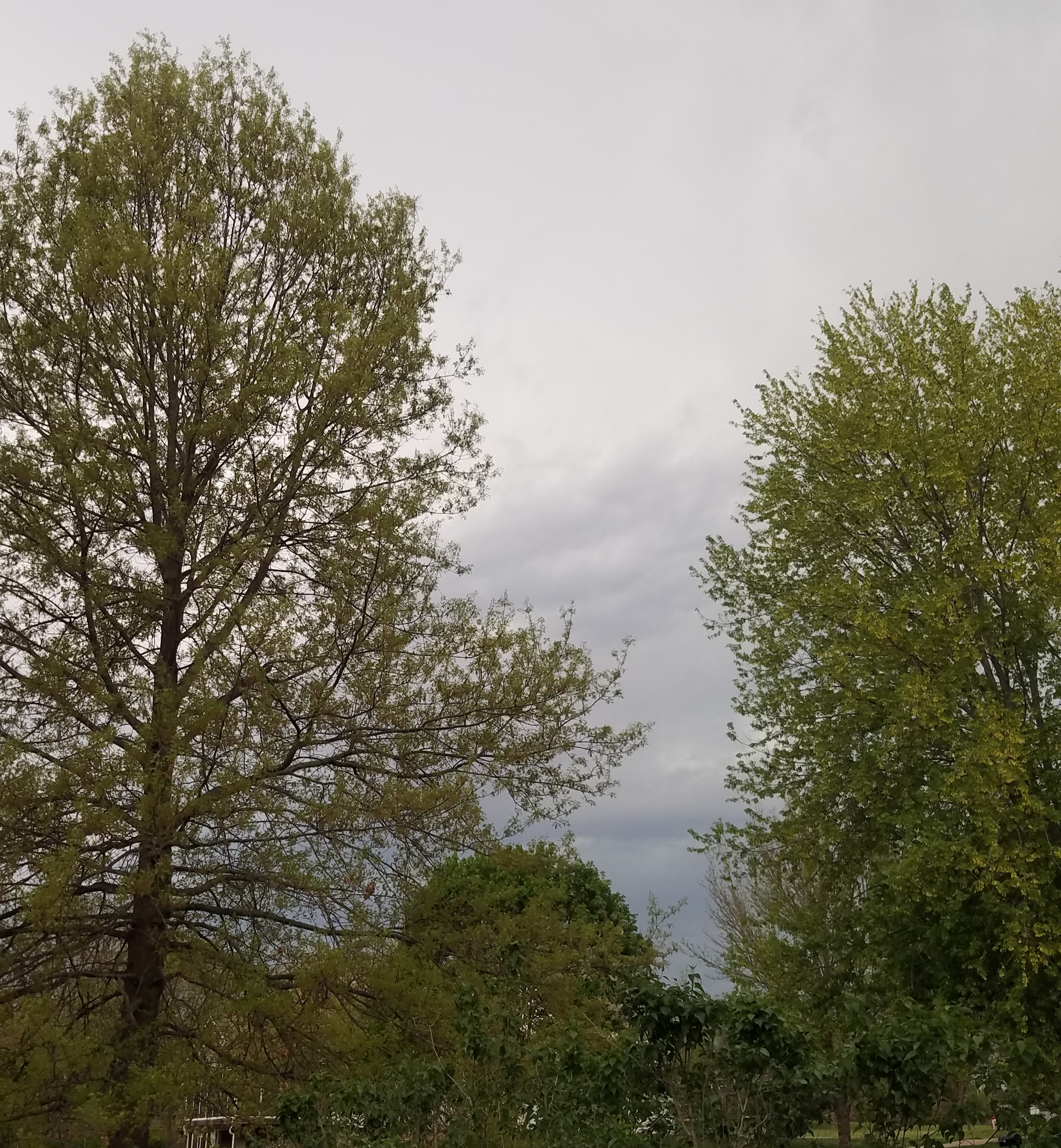
Spring clouds

Should a person be sensible and find a job, or follow their passions? This is a false choice, although one many feel compelled to make. I’m not sure those two options often exist concurrently.

My insight into this choice may be the result of getting a new eyeglasses prescription filled. On Friday they were ready at the warehouse club, the first prescription I filled since before the pandemic. I can see clearly now and it’s a revelation. Well, no. That’s not it. Maybe it’s something else.

At our tenth high school class reunion in 1980, I described myself as a writer. Here’s the entire passage from the booklet the organizing committee issued:

Paul lives in Iowa City and attended U of I, BA 1974, and the United States Army Infantry School. He is a writer. He is also a First Lieutenant in the U.S. Army Reserves. M.A. candidate in American Studies at U of I.

Unpublished journal, Summer 1980.

It was out there. I was a writer. Decision made! Not so fast!!

One of the last nights I spent in Davenport in 1980 was with two friends at a bar called The Mad Hatter. We walked to the Palmer Student Union where another friend was performing with his guitar. We had a discussion about how a person had to give up her artwork after taking a job at John Deere. She was tired after work, raising a child, and found little time or desire to make art. I knew if I took a full time job after graduate school I might find myself in the same situation. I had just declared myself to be a writer! I decided to stick it out at least until I finished graduate school.

I had enough money saved to pay for graduate school with help from the G.I. Bill. After graduation I wanted to remain in Iowa City, so I got an apartment and found a low-level job without benefits working for the university. One thing led to another and I met someone, got married, and together decided we needed more money to afford a house and everything else involved in a long-term relationship. Things happen. I didn’t put my writing on hold.

During that first year after we married I made an earnest attempt to write the book about which I had been talking for so many years. The working title was Going Home, and I summarized it in a journal entry:

Going Home will begin with a descent from high culture – Vienna – to low culture – Davenport – á la William Carlos Williams. Then will come a rebuilding – a putting together of a new life from the pieces. A new ascent, with both feet placed firmly on the ground. So, from Vienna, to Davenport, to Iowa City, to Northeastern Iowa. Descent to the ground, but then both feet planted firmly, beginning a step at a time, making a new beginning.

Personal Journal, Iowa City, June 17, 1983.

I’m not sure today what exactly that meant. The image of “both feet planted on the ground” recurred in my journals. It would also be an argument for a common life, free from external structures. At various times, I called the book the 1969 Novel or Going Home, yet it never became much more than an idea about Iowa contrasted with Europe… or something. I made outlines and wrote passages. I made reading lists and trip itineraries. I made research notes for much of 1983.

In each section of Going Home, I want to provide the reader with two things. First, I want them to be able to relate to the personal experience from which each scene is written, enabling them to say, “I’ve been there.” Second, I want them to be able to see that the given experience functions ideologically in the novel, giving the characters some sort of influence. Too, I want the sections to teach the reader a way of life.

Personal Journal, Iowa City, Iowa, June 27, 1983.

I wrote about the book extensively in my journal without getting anything significant down on paper. I had the idea, likely from Emerson, of turning away from the courtly muses to everyday life. I did extensive reading to form a moral framework for the novel. This is all well and good, yet here’s the issue: I had no clue what it meant to be married.

It is significant that at this crossroads there was no real choice between following my passion to be a writer and doing what was sensible. In seeking to write, I sought realization of who I was regardless of any framework for living. The pent up desire to become a writer compelled me to continue to live as best I could: writing, earning money, having a family life, the whole shebang. It would have been easier if Morpheus had offered me a one-time choice between the blue and red pills.

It is important to refrain from framing life as a choice between options. This seems too simplistic. A dilemma means a choice between disagreeable alternatives, yet devising an arbitrary choice is just that: arbitrary. It would be a false choice.

While we might feel good about defining a choice and making a decision, the results seem unlikely to endure. We owe it to ourselves to accept complexity in life and deal with it outright. We can’t settle for second best when both choices are sub-optimal.

It sometimes helps to get a new pair of glasses, to see clearly, even if they are not responsible for choices we make.

Categories
Writing

April 2023 in Big Grove

Trail walking in Spring 2023.

The last few days of April have been marvelous. Rain subsided, ambient temperatures were mild with low humidity. It has been a spring month, as good as they get. No more close friends have died this month, so there has been psychological relief as well. We needed a breather.

Spinach planted in the ground on April 15 is up. Onions are doing well. Yesterday I planted cauliflower, cabbage and kale, and there are two more rows in that plot for broccoli, collards, and other leafy green vegetables.A mad garden rush will be happening in May with the target of getting the initial planting done by Memorial Day, which this year falls on May 29. Gardening is going well.

The Biden administration announced that it intends to end the presidential declaration of national emergency and the U.S. Department of Health and Human Services (HHS) public health emergency attributable to the COVID-19 pandemic on May 11, 2023. I was at a restaurant last night where a couple of people continued to wear a facial mask. With my full regime of COVID-19 vaccinations, I did not.

According to the Centers for Disease Control and Prevention, there have been 104,538,730 reported cases of COVID-19, 1,130,662 deaths attributed to it, and 55,743,629 doses of vaccine administered. There are currently 9,167 hospitalizations due to the coronavirus. It was, in no uncertain terms, a public health disaster. The scale of 1.1 million U.S. deaths is difficult to wrap one’s head around as we close in on the end.

The Iowa Legislature has taken up budget bills, which means we are close to the end of session. Thank goodness. There has been so much controversy over bills it had been like drinking from a fire hose trying to understand what is happening. Republicans won super majorities in 2022, and are exercising their power like never before. Democrats are hanging on, trying to get a message out. Democratic messaging has been like trying to light a candle in a derecho: word is not getting out beyond political junkies.

Our blogging group went to dinner Friday night at Royceann’s Soul Food Restaurant in the South District Market in Iowa City. The menu has a fixed number of daily items on it and diners can order a meat and two sides for $18. It is a bit tough for vegetarians to find something on the menu, and tougher for vegans. I ordered cabbage, cornbread, and macaroni and cheese. The preparations were distinct and tasty. I plan to return to try the collards with cornbread. I usually say I can cook better than what I find in restaurants, yet not this time.

Our furnace gave up the ghost this month. We have been discussing which new one to get and have made a decision. When an expensive item hits a household on a fixed income, it takes some wangling to determine how to pay for it. We have it figured out.

I have finished reading seven books in April. Check out what I’ve been reading on the Read Recently page by clicking on it at the top of this page. I got new glasses for the first time since 2019. It’s great to be able to see clearly again. Hope your April was as good as mine. Thanks for reading my post.