Categories
Writing

Weekly Journal 2024-03-03

Morning coffee.

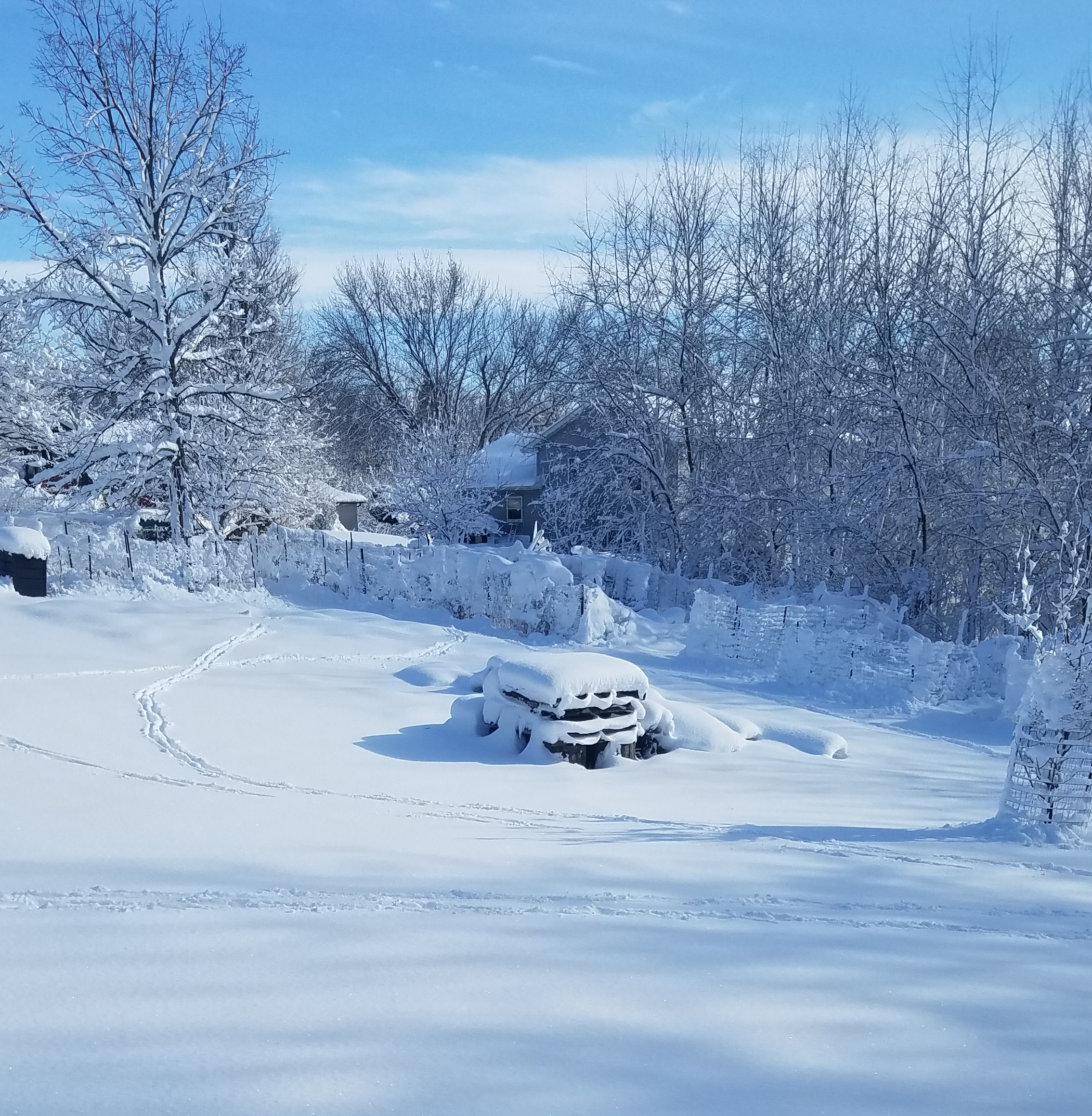
The week started with days where the ambient temperature reached a high in the 70s, dipped on Wednesday to the teens, then rose again the rest of the week. The expectation for first week in March is highs in the 30s and 40s, so it seems unseasonably warm.

Creamed crumbles on toast

I don’t have many meals derived from Mother’s cooking. As important as cooking has become to me, I can count on one hand the number of dishes I now make that she did, too. One of those is variously called chipped beef on toast or creamed beef on toast. Mother made this for Father as a reminiscence of Southern cooking in which he came up. I don’t use beef in our kitchen, yet I made this for breakfast one day. I use vegetarian recipe crumbles as a meat substitute.

Saute half cup of finely diced onions in two tablespoons of butter and add one finely chopped clove of garlic. Season with salt and pepper. Add dried home made hot pepper powder. Add a cup of recipe crumbles and cook until thawed from the freezer. Add two tablespoons of all purpose flour and combine everything while on medium low heat. Add one cup of milk (cow milk or oat milk, whatever is the kitchen standard) and combine. Lower the heat and cook until the mixture thickens. Toast and cut into 3/4-inch squares two slices of bread. Pour the creamed crumble mixture evenly over the toast and enjoy.

Tracking writing

I edited the first ten chapters of my book. I created a spreadsheet to track what I did and how the daily word count changed. The fact that I am now including numbered chapters is a revelation. It helps organize topics in a way I hadn’t considered. I now gather topics from different places in the narrative over a span of years under a single header. It helps reduce the amount of duplication that plagued me from the cut and paste method of composition with which I began. I am satisfied I made progress last week.

Email rabbit hole

I have email files beginning in 1999. There are hundreds of thousands of stored emails and I don’t plan to read them all. When I begin a session of email reading, I become lost for hours in a rabbit hole of forking paths. For example, the emails I wrote and received about updating the county plan for dealing with a contagious disease epidemic seem prescient in light of the coronavirus pandemic ten years later. This research will yield a paragraph, maybe two in my chapter about the coronavirus pandemic which closes the book.

What I seek the most is emails from friends and family to use in other parts of the narrative. Facts are recorded with dates attached to them and they help evoke memories of that time. The trouble I see is advancing technology may render some of those files obsolete. For now, the current version of Microsoft Outlook opens all the saved files, yet I’m anxious to go through them even if it would be better to wait until I’m writing those parts of the narrative.

Publication

I decided to publish Part I of the autobiography first. The narrative goes through finishing graduate school and taking work at the university where my spouse and I met. I was 30 years old on our wedding day: a clean breaking point for the narrative. The second part of the book will be more difficult to write because there is so much material to condense. I delay that challenge by deciding to finish part I this year, God willing.

Summary

It was a good week. Hopefully increased garden tasks can be added to my life without compromising the writing. March brings the pressure of spring and I am ready for it. On Friday, March 1, we saw the first Robin in our yard, along with another flock of smaller birds. Spring is definitely coming.

Categories
Writing

Weekly Journal 2024.02.25

Morning coffee.

Beginning today, I plan to post a weekly journal of significant activities for the week ending on Sunday. This week, I already wrote about my trip to pick up soil mix, cooking lentil soup, movies, and a short, developmental piece from my work in progress autobiography. This week’s entry may be short.

The purpose is to make a conscious decision to reduce how many times I post here and use that time to advance my autobiography. With spring arriving in four weeks, I need more writing time. I debate changing how I describe my autobiography to my “WIP,” or work in progress like all the cool writers do on Threads. Autobiography seems like too big a mouth full and I don’t like “memoir.”

On Saturday and Sunday, I’m filling in at Blog for Iowa for a while, and those posts will be cross posted here without comment. I strive for a broader audience and put more effort into selecting topics for those Iowa readers. I’ll also cross post any writing that gets published in the newspaper, or other places in the real world, also without comment. A letter to the editor is often a re-working and shortening of something else I posted here, so it seems like duplication to publish the letter like the one that made last Thursday’s Cedar Rapids Gazette here as well.

I’ve pretty much given up on a range of topics that used to be important to me. Cooking, recipes, gardening, local food, and others remain parts of my life. I just don’t feel I have anything new to say. I am weary of writing about “organic practices” when so many people are food insecure. I plan to give those a rest unless I prepare a great dish and want to preserve how I made it. I may highlight unique ways I find to increase food security among those who need it.

I’ve been taking a lot of photos of morning cups of coffee. I post them on my Threads account, tag them a certain way, and there is a group that goes into a frenzy of liking them. These posts get, by far, more views than any others I put up. It’s sad, but it’s something.

That’s it for this week. Let’s all make it a great one next week!

Categories
Writing

Not a Painter

Self portrait.

When I review my 50 years of writing I find recurring stories. For example, the one I tell about Father’s political organizing during the John F. Kennedy campaign was repeated at least a dozen times. As I write my autobiography is seems better to distill those versions into a single narrative, one for the record, one which becomes the story. When I’m gone, who will have time or make it for all those versions? What are those previous efforts? They record a narrative that is part of me the way an artist makes sketches in a notebook.

Most of my writing is unpaid. I don’t seek financial return for investment in narratives. Writing helps me understand a complex world and my role in it. It provides a way of seeing the world outside living memory. When I pass, my living memory goes with me, except for the renderings I make as artifacts. Even then, only the writing would remain. I am not a famous person so the narrative may well end with me.

Writing this blog, journaling, and posting on social media are all rough drafts. Some are better than others. None of them is an autobiography the way my actual draft autobiography is. It is important to keep writing and re-writing our history in hope of getting a version that seems right. In the end, I’m not sure that is possible. In the end, the version will be final, like it or not.

Creative endeavor is important in every life. I systematically explored various creative outlets outside writing: playing music, drawing, painting, ceramics, photography, cooking, gardening, and others. To support these endeavors, I studied the world through travel, visiting museums, visiting cities, formal education, living in a foreign country, working a career that involved meeting thousands of people, and reading more than most people. Creative endeavor means different things, yet for me it was always being an artist, at least in part.

It seems important not to muddle things. While I painted a bit, I am not a painter. I made ceramic pots, yet I am not a potter. I devoted long hours to playing the guitar, and am not a musician. I am a writer. Knowing that, the next step is being the best writer I can be. I discovered it takes a few rough drafts.

Categories
Writing

Nuclear Disarmament — Get a Grip

Trinity Marker near Bingham, N.M.

There is not much traction in Iowa for nuclear disarmament causes. Iowans are occupied with a state government taking public money away from public school systems and giving it to private ones. In several important ways Iowa is becoming a paternalistic, uneducated, and cruel place to live and that occupies a lot of our bandwidth. All the same, Iowans know the risk posed by nuclear weapons. If used, they could disrupt society all over the globe. Few, if any, people want that.

“Presidential leadership may be the most important factor that determines whether the risk of nuclear arms racing, proliferation, and war will rise or fall in the years ahead,” Daryl G. Kimball, Executive Director of the Arms Control Association wrote. Most Iowans are aware of the existential threat posed by nuclear weapons. However, they don’t vote for a president based on nuclear weapons policy positions. In fact, Republicans no longer write a national platform, so who knows what their policies are? Elections today have become more tribal in nature and much less issue oriented.

A lot is at stake regarding nuclear weapons proliferation during the 2024 election. As the primary season began in Iowa, the expected nominees for president are Joe Biden and Donald Trump. We have a good idea how they will address nuclear weapons related issues based on their past behavior. Biden would follow time-tested methods of controlling nuclear weapons at home and abroad: through negotiations, treaties and agreements with nuclear armed states and with those like Iran and North Korea that develop nuclear weapons capabilities. Trump is belligerent and it’s hard to know what he would do. The uncertainty about his potential actions if elected president is itself a nuclear risk. A crucial factor in whether one of today’s nuclear challenges erupts into a full-scale crisis, unravels the nonproliferation system, or worse will be the outcome of the U.S. presidential election.

“Russian President Vladimir Putin’s full-scale attack on Ukraine and threats of nuclear use have raised the specter of nuclear conflict,” Kimball said. “To his credit, Biden has not issued nuclear counter threats and has backed Ukraine in its struggle to repel Russia’s invasion.”

Well before Putin’s nuclear rhetoric regarding Ukraine, Trump engaged in an exchange of taunts with North Korean leader Kim Jong Un in 2017. In response, North Korea pursued its own nuclear weapons program, creating more risk of a nuclear detonation.

Trump hasn’t seen a long-standing international agreement he likes. The New Strategic Arms Reduction Treaty expires in 2026. Trump didn’t agree to an extension in 2021 when he was in office. Biden extended it by five years just under the wire. If elected, Trump seems unlikely to sign a new agreement with Russia. Biden, on the other hand, proposed new talks with Russia on a post-2026 nuclear arms control framework.The war in Ukraine seems likely to delay progress on such talks.

In November, senior Chinese and U.S. officials held the first arms control talks in years. Progress seems possible with Biden. Trump? Not so much.

Iranian leaders continue to increase capabilities to produce weapons-grade uranium in response to Trump’s 2018 decision to withdraw unilaterally from the 2015 Joint Comprehensive Plan of Action. He proposed imposing tougher U.S. sanctions to pressure Iran into negotiating a new deal. They now are threatening to pull out of the NPT if the United States or other UN Security Council members snap back international sanctions against Iran, according to Kimball.

The U.S. has not ratified the Comprehensive Nuclear Test Ban Treaty. The Trump administration did not help when in 2018 it declared the U.S. did not intend to ratify the treaty, and in 2020 when senior Trump officials discussed resuming explosive testing to intimidate China and Russia. Biden, on the other hand, has reaffirmed U.S. support for the treaty; and his team proposed technical talks on confidence-building arrangements at the former Chinese, Russian, and U.S. test sites.

How do nuclear disarmament activists get a grip on the need to disarm, both in the U.S. and abroad? Article VI of the Nuclear Non-proliferation Treaty already called for elimination of nuclear weapons. The question is one of political will. On that, we look to the November elections to see if the country will have any.

~ This article was first published in the February 2024 edition of The Prairie Progressive.

Categories
Writing

In Living Memory

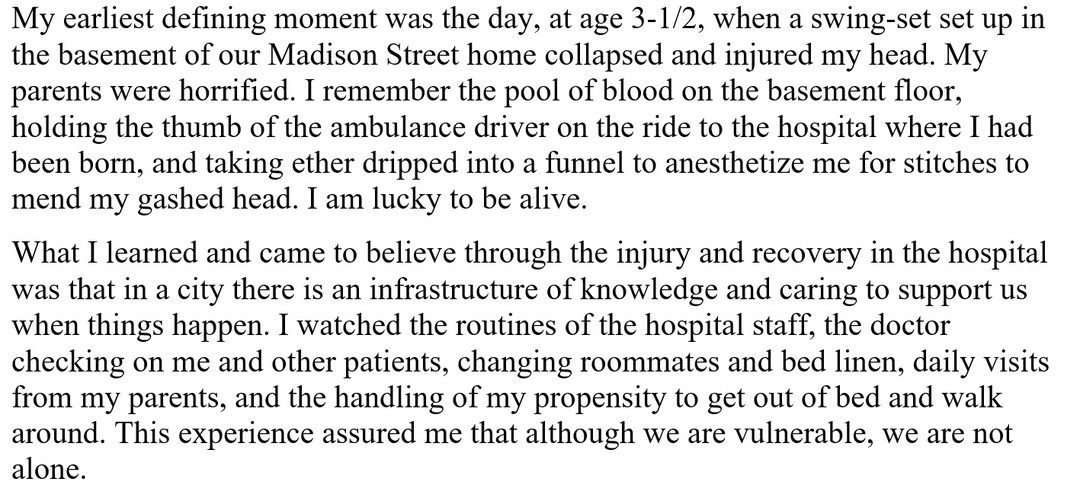
Cautiously, I’m sharing bits of my work in progress that readers of this blog may have heard about. I shared the image above with a Canadian poet on Threads in response to a question, “What did you learn from your childhood experiences? It was different from other garnered responses, and it stands alone. I think the writing here was solid.

It took a good while to write those two paragraphs. Because they originate in living memory, outside of language, I understood what happened and assigned meaning only after repeated drafts preceded by long consideration. Probably why it takes me so long to write autobiography.

That I called this experience a defining moment means, at least in part, I thought about what happened a lot. There is a scar on my forehead to remind me of it every time I look in the mirror. Any more, I don’t think about the scar and what caused it, but over a lifetime I remember those days, what happened, and what the experience means to me now.

How does one communicate about living memory? These paragraphs are one way, and as written, I don’t have any revisions. I captured something that resonates. Over the years, I wrote a lot about RenĂ© Descartes, including this passage:

I studied René Descartes at university and spent substantial effort considering his first principle, cogito, ergo sum, or in English, “I think, therefore I am.” I wrote about my Cartesian outlook toward life. We are isolated beings, wrapped in a veil of humanity, closer to God, or its divine essence than we realize. Such veil, metaphorical or not, is woven of delicate threads, like the lace of Morbihan, or silk from China. We could spend a lot of time marveling in its delicate needlework or shimmering surface. Yet we are compelled to reach out beyond the veil.

Attending University, Blog Post, Feb. 19, 2022.

If I entered a funk about my work in progress after having some people read a draft, then I am now coming out of it feeling ready to begin anew. There is a story, more than one, residing in memory. I felt compelled to start that story. 127,511 words in, the compulsion to finish it strengthens. There is little timing of my creative endeavors. I only know, for this work, the time is now.

Categories
Writing

Why I Blog

Writing space circa 1980.

I hadn’t breathed fresh air since Saturday. Even though it was too early for mail, I opened the garage door and walked to the box. Basking in an ambient temperature of 35 degrees, surrounded by sunlight, I breathed. This winter writing life is my best life. From time to time I get outdoors to stay grounded.

This morning I awoke dreaming about California. Where did that come from? There is a post in that.

There was a 1960s trip in the family station wagon so Father could attend a union convention. Mother and we kids went along and spent time with our aunt and uncle in Anaheim, including trips to Disneyland and Knott’s Berry Farm. I wore a madras sports coat and a shirt with a Nehru collar. We visited another uncle in Simi Valley whose residence was surrounded by pastures. California didn’t seem much different from Iowa in the 1960s. Maybe that’s because so many Iowans were migrating there.

In 2006 I attended Oracle OpenWorld in San Francisco. Our company was installing one of the Oracle transportation management software programs. The project taught me a lot about business software. This contemporaneous blog post by John K. Waters describes the conference scene:

My dogs are still barking after five days at Oracle OpenWorld 2006. The Big O took up all three wings of San Francisco’s Moscone Center last week for this humongous event, filled every available downtown hotel conference room, and blocked off Howard Street with tents and Vegas-sized video displays. About 42,000 conference attendees swarmed over three square blocks of the City by the Bay for keynotes, educational sessions, vendor exhibits, and special events. On Tuesday night, about 20,000 attendees spilled into the Cow Palace for a conference-sponsored rock concert. On the bill: Elton John, Joan Jett, Berlin, and Devo. A football-field-length stage with seven (count ’em, seven) massive video displays dominated the keynote auditorium. Conference organizers even put Oracle CEO Larry Ellison’s racing yacht on display at the foot of the escalators in the North Hall. It was easily the biggest and flashiest local conference I’ve seen in 10 years of tech-trade-show hopping.

Oracle OpenWorld 2006: The Tech Conference that Ate San Francisco, ADT MAG, Oct. 30, 2006.

I stayed away from the conference at a hotel in Chinatown. Because of jet lag, I couldn’t sleep and jogged through the streets in the middle of the night. Hundreds of homeless people slept and lived on Market Street. I suppose there is a post there, I may have written it in my journal in the pre-internet writing days. What seems memorable from the conference is exposure to many of the CEOs of tech companies and hearing their views of the future of technology. I also determined one hasn’t really lived until seeing Larry Ellison on stage with a penguin.

I made other trips to California yet these two stand out. It is so far away. Most of my interaction with California originated in media experiences through actors, writers and producers who made things for mass culture: movies, television, some books and music. There was Joan Didion’s interpretation of California. It helped more than anything to form my views of the state.

Not long after OpenWorld I started on modern social media in 2007 when our child left Iowa after college. It was a way to stay in touch as they became their own adult person. Since then, social media has become a form of creative expression while learning to live in a complex world. The immediacy of it all was shocking at first, and I have grown to depend upon it as an important way to see the world. Social media includes my first blog, which also began in 2007.

More than anything I write, people read my blogs and letters to the editors of newspapers. I don’t write for the attention, although like today’s sunlight I enjoy being surrounded by it. In a way, I need it. After almost 50 years of writing in public, blog writing is just the current manifestation of my search for a way of seeing to inform my way of living. It serves. As long as it does, I will continue to write blog posts.

Categories
Writing

Driveway Photo

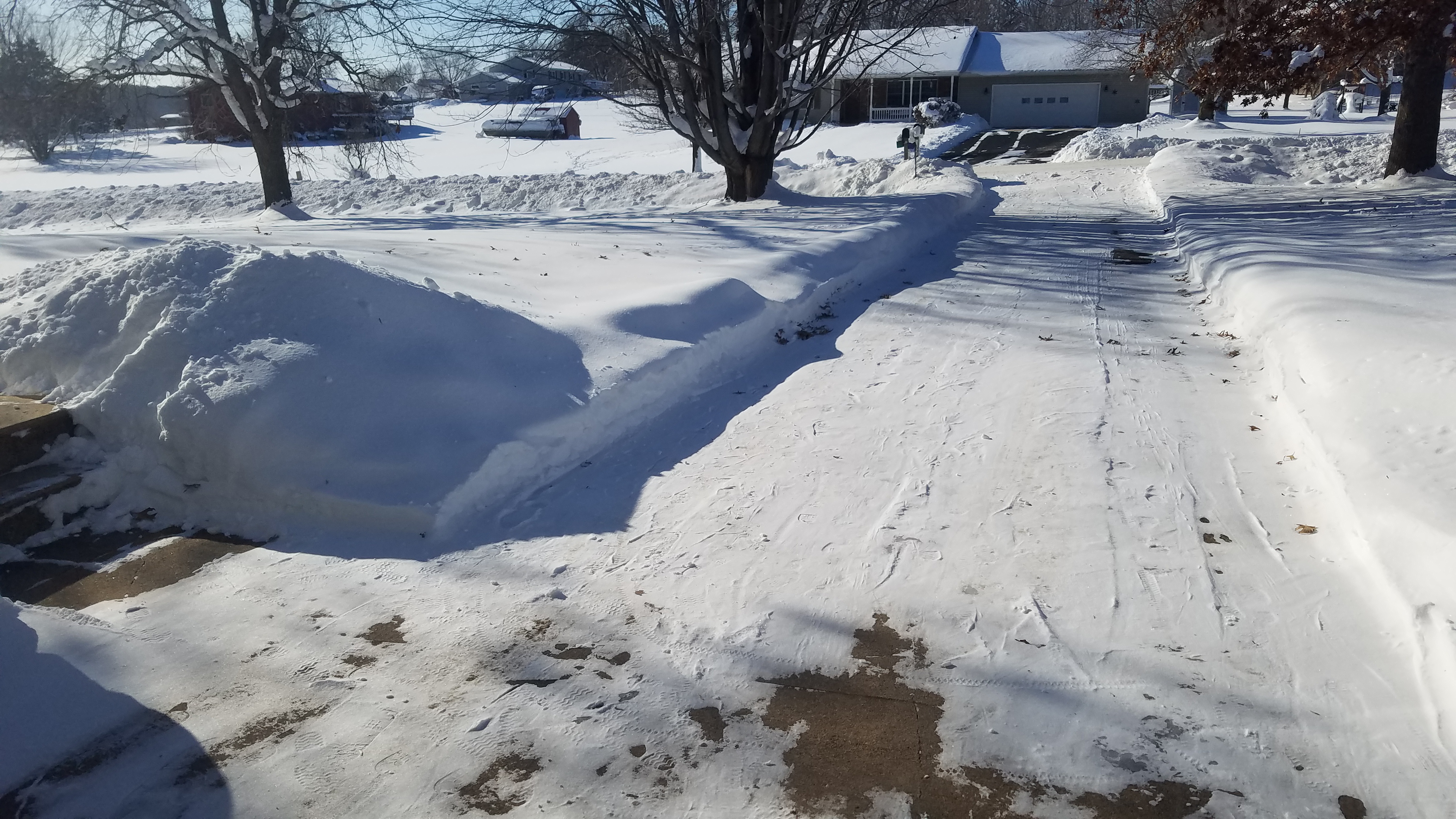
Driveway photo, Jan. 20, 2024.

Before the contractor installed the driveway we parked on the chip and seal road. We specified a concrete driveway, although in retrospect, today I’d install asphalt. Concrete held up over 30 years and is good for many more. The asphalt just looks better and its dark color absorbs heat from the sun, benefits I hadn’t considered in 1993. Rain is forecast, so the concrete cracks will soon be showing themselves again. It’s just a thing in the life of a septuagenarian who lived in the same place for more than 30 years.

In the end, our home suited me as a writer. In a rural subdivision we are far from city life, yet there are enough people around to help in case of an emergency. The state park is a three minute walk with its five-mile hiking trail. Because of the lakes, there is an abundance of waterfowl. I believe we’ve seen specimens of every bird native to Iowa here. We also see most kinds of mammals, a snake or two, and amphibious creatures at certain times of the year. There is a lot of inspiration in that.

As home construction began I made at least weekly trips to observe progress. One time I parked on the street and walked over to the high wall that had been dug for the foundation. I sat on the edge and had a moment’s quiet while I looked over the footings toward the lake. I felt then this would be our home base for many years to come.

I left on and returned from a lot of trips on our driveway. Other family members did too. Travel is mostly finished except for errands and visits to immediate family.

As I begin year three of my eighth decade on Earth there is a lot to do. I have a reasonable rasher of good health, a secure home, plenty of good food to eat, and enough of a pension that finances get tight yet we make ends meet. Importantly, my ability to think remains reasonably sound, as far as I can tell. I do forget things now and then. It seems like more than I did, but not enough to worry. All of this, combined with seven decades of experience, and there is plenty of material for writing.

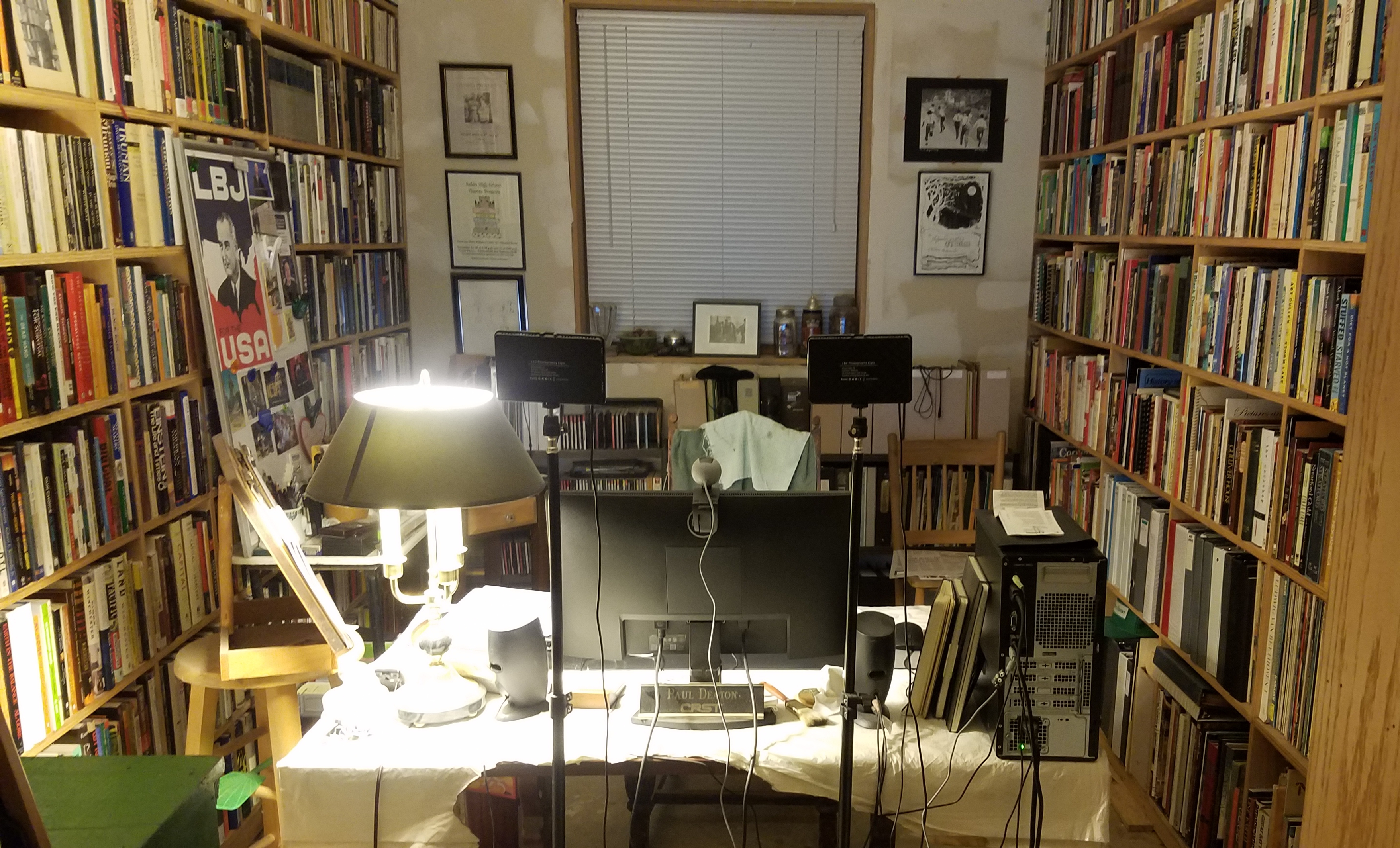
Writing table.

The challenge of aging, especially in America, becomes dealing with isolation. I wrote about this before. Being a writer requires a balance between isolation and being with people, so writing is a natural occupation for a septuagenarian. The scales tip toward the isolation side as we age. Without the continuous commotion of being at events or with other people, I’ve been able to discover myself in a way that was unexpected. At some point, I’ll know who I am and be ready for a new debut in society. If anyone will have me, that is.

The recent winter storm brought me indoors. For a while, I need that. I’ll also be ready for spring and trips to the vendors that support my garden. There is a lot of catching up to do. For now, I’m feeling isolation and coping with it by writing. It is the one thing I know how to do that works.

Categories
Writing

Receipts of Racism

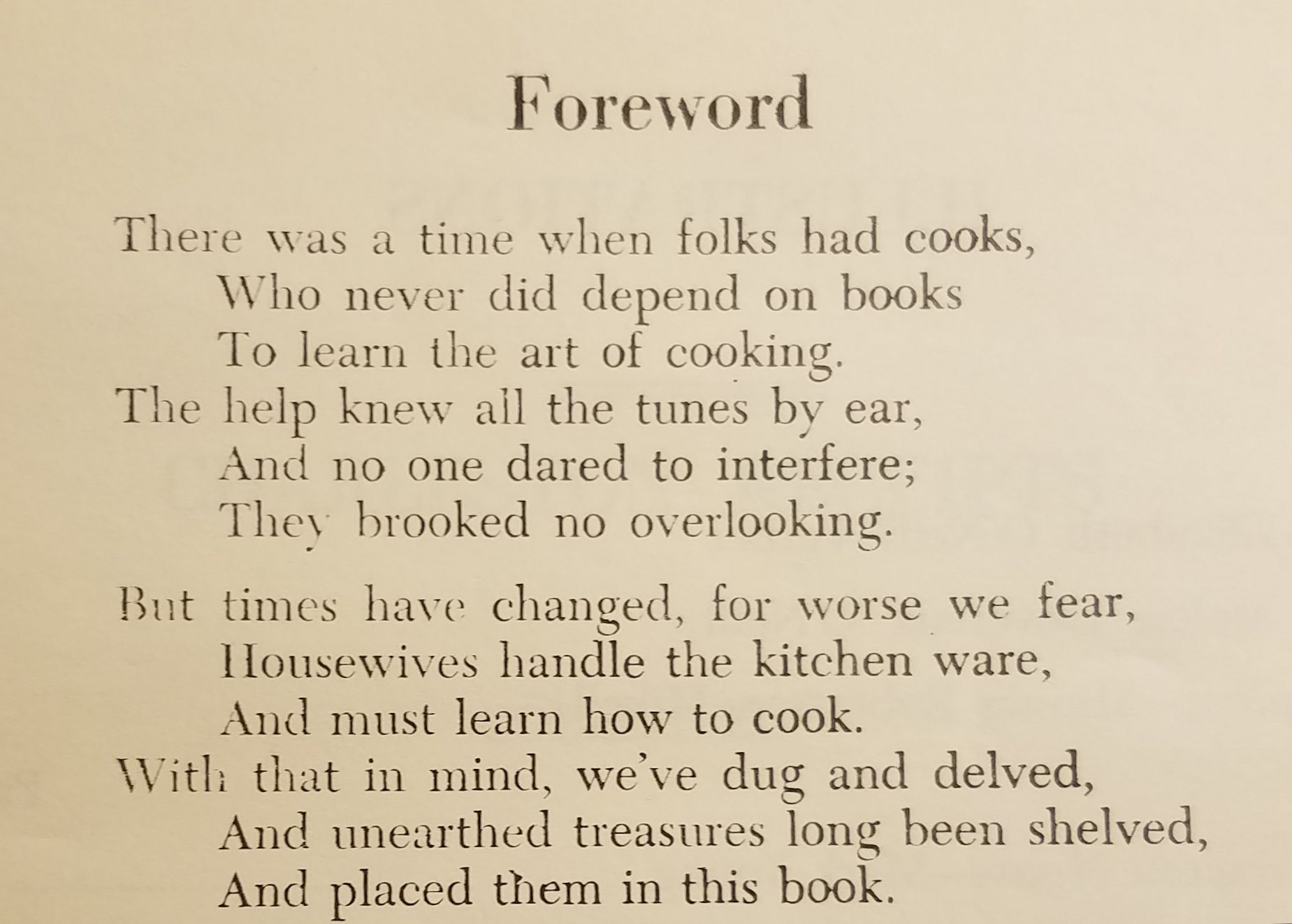
Excerpt from Charleston Receipts by The Junior League of Charleston, South Carolina, 1950.

I don’t know about this forward to a 1950s cookbook, Charleston Receipts. The unspoken part is cooks in the first verse were mostly black women, and housewives in the second were white. It is not overtly stated, but I’m certain it was implied. This book trades on fond remembrance of antebellum food culture. The word plantation is used in the names of some of the receipts (not recipes, per the author).

A large number of white women and girls worked as servants in the United States. It is possible the reference is not racist. Home cooking and cleaning were common employment for female Irish immigrants and those of other nationalities. When Grandmother left the Minnesota farm in the 1910s, she was employed as a servant in a home in Minneapolis. She worked as a cook well into her sixties. In the 1970s, people I knew in southern Indiana continued to employee a black woman as a home cook. It bothered me then, and it bothers me now. A person has to live, but not like this.

I have two copies of the book and one was missing its binder. Copies were readily available in thrift stores and used book stores. I read all the pages and saved a few from the volume without a binder to refresh my memory. There was a multi-page section about hominy, “long a favorite in the Carolina Low Country.” The section begins, “Man, w’en’e hongry, ‘e teck sum egg or cheese an’ ting an ‘eat till e’ full. But ‘ooman boun’ fuh meck wuck an’ trouble. ‘E duh cook!” I don’t recall the name of this type of language but it is stereotyped and hearkens to minstrel shows of the 1830s, which characterized blacks as lazy, ignorant, superstitious, hypersexual, and prone to thievery and cowardice. Charleston Receipts is racist, although I am confident the Junior League of Charleston, which published the book, would deny it.

When I stopped in Charleston enroute to military service in Germany, I had a couple days before dropping off my pick up truck at the port. Charleston traded in slave culture then, and they do now. I saw for the first time up close, slave auction blocks, shackles, and whips used on enslaved humans. I searched the internet and found today there is the Old Slave Mart Museum that tells Charleston’s role in slave trade from 1856 to 1863. They were domestic slave traders then, one of the biggest in the country for collecting and selling human chattel.

In writing my autobiography I find the racist side of my personal history was in plain sight. I didn’t understand that then, mostly because my parents taught me a person is a person and that was that. It helped this outlook to have made a family trip to the plantation where Grandfather was on work release from prison and see my father sharing memories with a group of black men we encountered there. They seemed like old friends. It was a formative experience.

Racism never died out, although I forgot about it for a while… until I began writing my story. In that context, it is hard to miss, even in old cookbooks.

Categories
Writing

Garden in Winter

Garden in winter, 2024.

We got a dusting of snow last night, enough to use the electric snow blower on the driveway after sunrise. The forecast next week is for rain after ambient temperatures dip well below freezing this weekend. Is this the end of winter? I doubt it. I hope not.

In two weeks I begin planting seeds in indoor trays for the garden. This year I bought all nursery-started onions, so the first seeds into soil mix will be varieties of kale. Kale is a mainstay of our kitchen and the early start brings an early crop. After kale, I follow a time-tested, weekly procession of seedling starts that continues until the first week in May when I plant squash. I learned and developed this process while working for area vegetable farmers.

While I’m ready for spring, I’m not ready for winter to end. So much remains undone. I nudged my autobiography along, but have not had the long writing spells needed to finish the work this year. Based on feedback from a reader, I returned to part one for some revisions. I could easily spend another year there while part two remains in infancy. Partly this is a process of learning how to write. In part, I want to declare the work finished. The present obstacle is boxes and boxes of artifacts needing review and disposition before finalizing the narrative. I need external prompts to generate the narrative.

I began to dream during the blizzard. They have been dreams about travel, and topics I can’t remember. I don’t think much about dreams, they have little significance to me. I do notice the change in sleep patterns. For the most part, I’m sleeping through the night for a solid five or six hours.

I stand at the dining room window and look at the snow-covered garden. I have the plan about half worked out. Garlic is in the ground and I left space for a covered row on the west side of that plot. Tomatoes are planned with a return to my previous fencing method to keep deer from jumping it and eating tender seedlings. The next task is picking a spot for cruciferous vegetables. If I keep looking at the space, a plan for the rest will emerge.

Like much of my eighth decade of living, time goes too quickly. Part of me wants to apply discipline to get things quickly done. Part of me wants to take it easy, something I was unable to do much during my working years. Somehow I’ll find a balance as I understand what it means to age in America during a time of political turbulence. There is no universal understanding. We do the best we can.

Categories
Writing

Banned Books Distraction

Screenshot from Banned in the USA: The Growing Movement to Censor Books in School, PEN America, Sept. 19, 2022.

When the Iowa Legislature convened on Monday, House Majority Leader Pat Grassley reprised his position on banning books in schools. The Cedar Rapids Gazette reported:

Grassley doubled down on House Republicans’ efforts to remove books with sexual content from public school libraries and said Republicans may pass additional legislation to clarify or expand on the existing law.

In December, a federal judge temporarily blocked much of a law passed last year, Senate File 496, that banned books that depicted or described any of a list of sex acts from public schools and prohibited teaching about gender identity and sexual orientation before seventh grade, among a host of other regulations.

Lawmakers vow tax cuts, grieve school shooting by Caleb McCullough and Erin Burphy, Cedar Rapids Gazette, Jan. 9, 2024.

We couldn’t read Catcher in the Rye by J.D. Salinger in K-12 when I attended in the 1960s. It was no big deal. I used my newspaper route money to buy a copy at the book store. Since when do we need government intrusion in work that school teachers, librarians and parents should already be doing? We don’t. In some ways, the focus on banning books is a distraction from a more significant problem: K-6 reading skills.

Would-be book banners argue that readers can still purchase books they can no longer access through public libraries the way I did when I was a grader. That is only true for those with the financial resources to do so. For many, particularly children and young adults, schools and public libraries are the only means to access literature.

When people talk about the “culture wars,” control of books available to K-6 students is a core issue. USA Today summarized:

Banned books are not new, but they have gained new relevance in an escalating culture war that puts books centering racism, sexuality and gender identity at risk in public schools and libraries.

A dramatic uptick in challenged books over the past few years, an escalation of censorship tactics, and the coordinated harassment of teachers and librarians has regularly put book banning efforts in news headlines.

Book bans are on the rise. What are the most banned books and why? by Barbara VanDenBurgh, USA Today, Sept. 29, 2023.

There is a basic tenant of society, supported by research, that children of less educated parents will read less and society will be the worse for it. The corollary is children of well-educated parents will read more and in so doing expand their horizons to see a better life beyond immediate family. Teaching reading in school has been a mainstay of elevating children above the social station in which they were born, creating possibilities for life that would otherwise rely upon chance and happenstance.

Government should fund programs that encourage reading, make sure funds are not abused, and then shut the hell up. Leave reading curricula to those who know it best: teachers, librarians and parents. Passing a new law revising a state book banning process is of value only as political fodder. It would not help with a more fundamental problem of reading skills in K-6 students.

On Friday, Jan. 12, Iowa Attorney General Brenna Bird filed notice of appeal of the federal district court’s decision to halt implementation of Senate File 496. The distraction continues.