
Never again should humans detonate atomic munitions. It is 90 seconds to midnight according to the Bulletin of the Atomic Scientists Doomsday Clock. Read what you can do to mitigate the dangers in our nuclear armed world by clicking here.

Nuclear abolition, climate change, environmental degradation, nature, peace and justice.
Never again should humans detonate atomic munitions. It is 90 seconds to midnight according to the Bulletin of the Atomic Scientists Doomsday Clock. Read what you can do to mitigate the dangers in our nuclear armed world by clicking here.

I had been mowing with my John Deere lawn tractor for about 15 minutes. Life was good as I prepared the yard to be more presentable when overnight guests arrived later in the day. I stopped, turned off the engine to move something, and when I returned to the driver’s seat the engine would not crank. After trouble shooting to see if I could resolve the issue, I called the repair shop and they picked it up that day. They said they would have it for three weeks, most likely, because of a backlog of work. I’ll have to hire someone to mow as the lawn will turn into a jungle of natural habitat if I don’t.
We brought the equipment home from my father-in-law’s estate before the turn of the millennium. When it breaks down, there is always a question of whether repair parts will be available. The company says, “Nothing runs like a Deere,” yet they no longer make or stock every part for every model going back to the company’s founding in 1868. Planned obsolescence has become part of their business strategy. If my tractor can’t be fixed because parts are not available, I’m not sure what I will do. There are several suitable models under a thousand dollars. I really don’t want to spend that kind of money to mow the lawn half a dozen times a year. There is a case to replace it now to avoid future price increases. I would rather have just finished mowing the lawn than deal with this now.
This personal experience feeds into the broader issue of Right to Repair. When we own something, like my John Deere tractor, we shouldn’t have to beg the dealership to have access to repair parts and fix it. I’m not that mechanical as a basic social skill so I rely on others for car, tractor, chainsaw, trimmer, home appliance, and other repairs. We are subjected to their rules, and one of those is availability of repair parts. I bought more than a few new appliances because repair parts were no longer manufactured or stocked. It’s a rook deal!
When I worked in transportation I became aware of increased technology used in mechanical devices, Class 8 vehicles particularly. This changed the landscape in multiple ways. Importantly, equipment developers sought technology to make things better or comply with new laws. It was one more component to include in an automobile or refrigerator that cost something, and when the initial sale was made, increased net margin for the seller and manufacturer. What is often forgotten is any new maintenance issue related to failure of electronic components. There are no work-arounds when a computer chip fails.
When my John Deere would not start, I quickly diagnosed the problem as an electrical failure. I’ve had the tractor long enough to recognized the layers of failure it demonstrates. When I was on the phone with the service writer they agreed. So now we wait.
We bought a quarter acre lot in 1993 because it was available. We liked the proximity to the state park hiking trail and the public school system. There was abundant room for a garden and an orchard. What we didn’t foresee then was the inability to get ahead financially enough to completely eliminate the lawn in favor of a giant garden. Such projects are the endeavor of youth, so I’ll be dealing with mowing for as long as we live here. We don’t plan to move. We’ll stay and deal with interactions from a variety of service technicians. I’d better maintain a friendly relationship with them. Life could be worse.
One of the arguments that went under the radar this year was whether the Holocene era is over, giving way to the Anthropocene, the era of human dominance over the planet. For what it’s worth, the panel voted we are still in the Holocene, a period that began some 11,700 years ago with the end of the last ice age.
Few opponents of the Anthropocene proposal doubted the enormous impact that human influence, including climate change, is having on the planet. But some felt the proposed marker of the epoch—some 10 centimeters of mud from Canada’s Crawford Lake that captures the global surge in fossil fuel burning, fertilizer use, and atomic bomb fallout that began in the 1950s—isn’t definitive enough. (Science, March 5, 2024).
The Anthropocene Working Group (AWG) has not given up and will be working the next ten years until another vote is taken. In the Science article, author Paul Voosen indicated the AWG are news hounds. “‘The Anthropocene epoch was pushed through the media from the beginning—a publicity drive,’ says Stanley Finney, a stratigrapher at California State University Long Beach and head of the International Union of Geological Sciences, which would have had final approval of the proposal.”
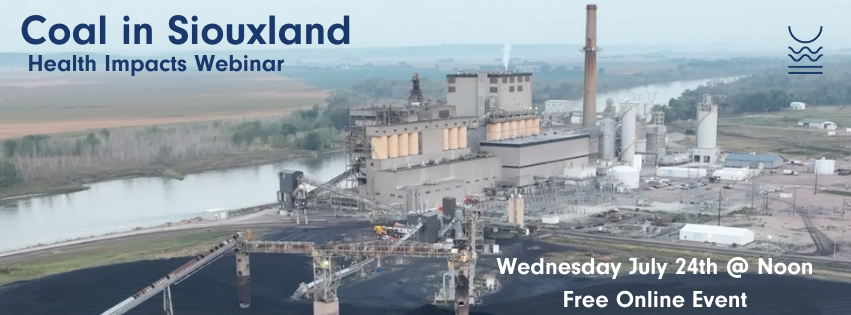
What does this have to do with the price of tea in China? Expect climate deniers to be all over this news, saying humans don’t influence climate change. That would be hogwash. Luckily, there are people in Iowa doing something to mitigate the effects of human influences on the climate. People like the Iowa Environmental Council who announced this free webinar:
Communities near coal plants operated by Iowa’s power companies see higher rates of asthma, COPD, cancer, and other pollution-related diseases. A new report from the Iowa Environmental Council, written in partnership with the American Lung Association, Physicians for Social Responsibility, and the Winnebago Tribe of Nebraska’s Comprehensive Healthcare System, highlights how two coal-fired power plants outside of Sioux City affect the health of the region.
Join us Wednesday, July 24 for a lunch hour webinar about this new report examining the relationship between pollution from coal plants and lung disease in Woodbury County.
Coal in Siouxland Health Impacts – free webinar
Wednesday July 24
12:00 pm – 1:00 pm
Online (Register Here)The report finds that the two MidAmerican Energy coal plants have been associated with causing at least 1,400 premature deaths since 1999 and the region’s rates of asthma and lung cancer outpace statewide averages. Despite these impacts, MidAmerican Energy claims they will operate these plants for an additional 25 years.
Can’t make it for the live event? Register to attend and a recording will be made available to view later at your convenience. Contact us with any questions at iecmail@iaenvironment.org. We hope to see you there!
– Your friends at IEC

There’s a lot of chatter about the energy demands of artificial intelligence. As Iowa looks at inviting new data centers into the state, the usual suspects are dragging out the same old sawhorses to devise worn out solutions to meet this demand. One of the ideas floated was re-opening the Duane Arnold Energy Center near Palo, Iowa, owned by NextEra Energy. That would be a bad idea.
Erin Jordan of the Cedar Rapids Gazette reported, “John Ketchum, CEO of NextEra Energy, which has owned Duane Arnold since 2005, told Bloomberg on June 12 he had inquiries from potential data center customers interested in the 600 megawatts generated by the Iowa reactor. ‘I would consider it, if it could be done safely and on budget,’ Ketchum said.”
The stickler here is “on budget.” When has refurbishing a nuclear power plant been done, one closed down after being damaged in the August 10, 2020 derecho, and four years into de-commissioning? I suspect zero is the number. How does one budget for that? What if they run into something unexpected? Who pays? NextEra would likely seek to be indemnified from unexpected costs.
In 2010 I wrote, “On December 16, 2010, the United States Nuclear Regulatory Commission renewed the license for the Duane Arnold Energy Center in Palo, Iowa for an additional 20 years, extending the license to the year 2034.” The power plant would serve its normal term of 20 years, and the renewal followed a process to extend it by 20 more. How long can Duane Arnold’s life be extended? At some point, basic components, like concrete and rebar can show fatigue. Extending the life of Duane Arnold beyond 2034 would have been a dicey proposition. In fact, it was not viable and NextEra decided to shut it down early.
Iowa has been asleep at the wheel regarding nuclear power. During public hearings on the license extension, very few people made comments. I suspect people who engage about the value of nuclear power have their arguments. I would propose a completely different approach from letting companies like NextEra drive the locomotive toward supplying data center electricity.
In the first place, Bill Gates is supposed to be solving the problems that prevent society from moving forward with new nuclear power. He has a test site in Kemmerer, Wyoming using a small modular reactor, not old-style behemoths like Duane Arnold. Let Gates see if he can solve nuclear power’s problems and then do this thing right. That should play out before we look at re-opening Duane Arnold to run for less than a decade. I am skeptical Gates is actually doing much different, yet he invested time and resources to solve the problems.
Better yet, public utilities are supposed to be experts in providing electricity to users. Let them come up with their own solution beginning with a blank page. If a data center requires the electricity it takes to run a small city, let the utilities figure out how to do that. Will there be government money to pay for this boondoggle? I hope not and say let public utilities figure out how to finance it without government dollars.
I am weary of hearing about Duane Arnold. In my mind, the plant is shutting down, and that’s what they told the Gazette on the first approach for the recent article. Real solutions to our energy problems exist. More are being developed. It’s time we pursued the latest technology rather than hitching Duane Arnold up to the wagon for one more trip to market. We owe it to our future and our progeny to innovate. So we should.

In the first place, it is difficult to recognize this gathering of large rocks in the photo as Stonehenge. Mostly, the significance of an act of vandalism may have been more prominent in the minds of two vandals than in anyone else. I get it. Summer was about to begin. That’s a big day for some. Just Stop Oil, the organization behind the vandalism, said their motivation was to demand the next UK government end extraction and burning of oil, gas and coal by 2030. Whatever. Apparently it took an oversized hair dryer to blow the powder paint from the rock surfaces without harming colonies of lichen that developed there. If people know about the incident, it’s been forgotten by now.
Having done my tour of duty on the Salisbury Plain, my memories are scant. I stayed at a youth hostel, and made visits to Salisbury, Bath and Stonehenge. Another traveler, who spent the previous few weeks wandering about the moorland of southwest England, invited me to accompany him. I declined. It sounded too much like Iowa, and a bit dreary. I bought a post card at the Stonehenge gift shop and worked my way from the chalky plateau to the chalk cliffs of Dover and then to Calais, where my journal of Salisbury and England was pinched with my backpack after crossing the channel in a hovercraft.
I never looked back on England, and don’t understand the fascination with Stonehenge at solstice. It is an old thing, shrouded in lost history. I’m more thankful the days start getting shorter, and planning for autumn can begin in earnest.
One surviving account of my visit to Stonehenge remains.
Very sunny here today near Stonehenge, and other ancient ruins. Stonehenge yesterday brought to attention the very tourist like notions of seeing something only to tell your friends about it when you get back. It may be that these days this is the notion you should have or at least most common, but it is also a notion of which I refuse to partake. It is only a very insensitive person who will go look and come back in one hour as the tour bus takes, but then there’s hours and barb wire fence to keep you from doing it any other way. Yet here too comes the notion that since there are so many books and pictures and articles about Stonehenge why even bother the few minutes to even see the thing.
On the way from the rocks to the return bus, the drivers were talking and one said to another, “It’s too bad it started to rain. It spoiled their trip.”
Here it seems that there is such a “holiday” preconception among these drivers (and all Britons as well) that it prevents them from seeing what is really, actually there: some rocks with barb wire about them with people crowded within these premises. At any rate, I was no different from the others when I paid my 65p and walked, took some photographs, and bought some postcards which I today mailed to the states.
Journals, Winston Churchill Gardens, Salisbury, England, 11:45 a.m. on Aug. 27, 1974
In the 5,000-year history of Stonehenge, Wednesday’s protest is less enduring than the lichen that over millennia colonized the massive stones. I don’t wish ill on the two vandals. I just hope they receive their just desserts. I’m sure the ancient druids could care less about this week’s events.

What will we humans do when we’ve found everything we once lost? If Sir John Franklin’s 1845 voyage of HMS Erebus and Terror to find a Northwest Passage is an indication, we will continue singing the same songs events raised up, even as more of the actual history becomes known. Lord Franklin is a classic folk song and hard to release from repertories. John Renbourn discussed new discoveries about the fate of Franklin’s crew found in 2014 and 2016. He said it ruined the song forever. When he sings it, Renbourn does not change the lyrics. Click here to hear the whole story and listen to his version of Lord Franklin.
Enter the June 9, 2024 discovery by the Royal Canadian Geographical Society of the last vessel of Antarctic explorer Sir Ernest Shackleton found in the Labrador Sea. The wreck of Quest lay upright and intact on the seabed at a depth of 390 meters. Rediscovery occurred this week and next steps, I feel certain, will be forthcoming.
My point is we are going to run out of historical artifacts to find. What then?
As the Bill Anders photograph from Apollo 8 confirms, Earth is a finite place. Humans are polluting our air, water, and land at an unprecedented pace. The population of humans is growing. What we haven’t found is a way to live without dire consequences for our planet and the people and other wildlife who inhabit it. Isn’t it time we made that discovery?

We live in the only home we planned and built. When I arrived from Indiana in 1993, ahead of the rest of the family, our lot was a vacant remainder of Don Kasparek’s subdivision of his farm. There were two volunteer trees and tall grass.
A deal on another lot had fallen through, and there was an urgency to find a place to settle. This lot, with its proximity to Lake Macbride and a reasonable school system was to be it.
I remember sitting on the high wall after the contractor dug the lower level from the hillside, before the footings were in. A cool breeze blew in from the lake — the kind that still comes up from time to time.
We built a life here in Big Grove Township over more than 30 years.
Today is still a time of transition. The trajectory of life seems clearer and much work remains unfinished. Slow and steady wins the race, they say. Like this turtle, I hope to make it to the finish line of a better life.

Moving the automotive economy toward electric vehicles is a good thing for multiple reasons. An important benefit is to decrease reliance on burning stuff in an internal combustion engine. In the late 19th Century, Rudolph Diesel invented an engine that could burn almost any liquid fuel, including whale oil, tallow, paraffin oil, naphtha, shale oil, and peanut oil. Despite the initial available diversity, the economy followed a track to perfect the gasoline engine and use it for transportation. To a large extent, that’s where we are now, with Diesel’s namesake fuel relegated to trains, buses, heavy trucks, boats, and power generators.
In 2022, we needed a new car and could not confirm a delivery date on available electric vehicle models. They were in high demand and manufacturing could not keep up. We ended up with a three year old used car that got 38 miles per gallon of gasoline. In addition to supply falling short of demand, there are other problems with electric vehicles.
Electric vehicles reduce emissions and are often much kinder to our planet than gasoline and diesel alternatives. Those are positive attributes. The world is not ready for EVs and people experience barriers to using them in the form of charging station infrastructure, insurance, and affordability, in addition to the ability to timely buy one. The federal government has begun to create an environment for the advancement of EVs and Republicans are fighting it tooth and nail.
The latest conflict between doing what’s right for a majority of U.S. citizens, and Republican support for the fossil fuel industry, occurred after March 20, when the U.S. Environmental Protection Agency released a new tailpipe rule on vehicle emissions. “Joe Biden has launched a relentless onslaught of regulations infringing on American consumer freedom,” Congresswoman Mariannette Miller-Meeks wrote in her weekly newsletter. She decried that the administration’s “heavy-handed mandate forces American automakers to prioritize electric vehicle (EV) production and sales.” Well, yeah. That’s the point, along with preserving a livable world. The member of congress failed to mention all the positive things the president is doing to make EVs affordable for consumers.
The decision to EV or not to EV is not the choice of a single consumer. As individuals we have rights, yet the government must not leave the choice of whether we have a livable world in the hands of personal choice. To move the ball where it is needed regarding EVs, the government can and should be involved in nudging industry and consumers to move toward them. Under Biden, government accepted this role. The scale at which the administration proposes to increase EVs as a percentage of the global fleet is staggering. It is also what is needed to address the climate crisis.
My choice would be to use public transportation for every thing. As long as I have to drive because I live in the country, I expect to eventually convert to an EV and learn to love it. We must support the administration as we can, perfect what is flawed about their approach, and never lose sight of the big picture of slowing the greenhouse effect so we can maintain a livable world. In our current political situation, that means electing Democrats.

If HRH the Prince of Wales can’t make a go of organic farming, I don’t know who might. In his 1993 book Highgrove: An Experiment in Organic Gardening and Farming, he and co-author Charles Clover lay out the expenditure of resources, including consulting from prominent Brits with expertise in gardening, animal husbandry, and farming, to convert his estate in Gloucestershire to organic production. While there were successes, the end result was they couldn’t completely and satisfactorily convert it.
Highgrove had three rules: convert from conventional to organic production cheaply, deal with the public direct when possible to keep prices down, and add value.
How does a farmer add value to their crops? One of the approaches Highgrove made was using organic grains to bake bread for retail markets. It was more expensive, but with the prince’s imprimatur they found entree and some sales.
Highgrove could not solve some problems with using all-organic bread ingredients grown on site. They had to blend Highgrove wheat with high protein, organically-grown Canadian wheat to produce the soft crumb British bread-eaters crave. There were also no known producers of organic palm oil needed to “give good loaf volume.” Prince Charles decided to go to market with some compromises, sufficing to say the bread was made using organic flour grown on the property and branded as the “Highgrove loaf.”
While we don’t need to be the future king of England to know it, adding value to common commodities is a ubiquitous practice. It is the foundation of capitalism. Have a few hundred tons of wheat? It will be worth more if it is turned into bread, biscuits and the like. Such added value and the revenue derived from it is used to offset higher input costs for organic vegetables and grains.
The book was a solid read, recommended for those in the contemporary discussion about alternatives to food production based largely on chemical inputs. While the Highgrove story is interesting in itself, it is a long setup for my main topic. What are we made of?
…in the sweat of thy face shalt thou eat bread, till thou return unto the ground; for out of it wast thou taken: for dust thou art, and unto dust shalt thou return.
Genesis 3:19, King James Version
While our lives are nourished by bread and everything around it, we are not the bread we eat.
Most of the elements of our bodies were formed in stars over the course of billions of years and multiple star lifetimes. However, it’s also possible that some of our hydrogen (which makes up roughly 9.5% of our bodies) and lithium, which our body contains in very tiny trace amounts, originated from the Big Bang.
The Natural History Museum, London.
We are stardust, literally.
We are stardust
We are golden
And we’ve got to get ourselves
Back to the gardenWoodstock, Joni Mitchell
We are such stuff as dreams are made on…”
The Tempest, William Shakespeare.
I need to sleep more, think less, and get in the garden. Now that rain let up, maybe I can.

On Friday, May 3, Al Gore was awarded the Presidential Medal of Freedom by President Joe Biden. Al Gore is deserving of this recognition.
Here is the announcement. Al Gore was one of 19 people to receive the medal yesterday:
Al Gore is a former Vice President, United States Senator, and member of the House of Representatives. After winning the popular vote, he accepted the outcome of a disputed presidential election for the sake of our unity. He was awarded the Nobel Peace Prize jointly with the Intergovernmental Panel on Climate Change for his bold action on climate change.
My decision to associate with Gore through the Climate Reality Project was a game changer, introducing me to climate activists all over the planet. Joining Climate Reality upgraded my understanding of the climate crisis and everything around it.
What is next for the Climate Reality Project? I don’t know yet presume succession plans are already in place for Gore’s retirement.

 Journey Home
You must be logged in to post a comment.