Driving out of Flint, Mich. on Bristol Road wasn’t in the plans.
I interviewed some 30 people, all but one male, for truck driving jobs at the Days Inn across from the GM plant. Tired and ready for sleep, I went to the van to get my overnight bag and found all four tires had been slashed.
In the parking lot with a driver I later hired, the tire service came and replaced them. Around 10:30 p.m. I decided to drive the four hours back home to Indiana. The drive seemed much longer as I fought sleep and considered the day’s events.
In his film Roger & Me, Flint native Michael Moore identified Nov. 6, 1986 as the date of the announcement that General Motors would start laying off thousands of workers to move jobs to Mexico. Eventually, Mexican labor would prove too expensive and GM moved some of those jobs to Southeast Asia and elsewhere where people would work on the cheap building cars and auto parts.
I made about a dozen recruiting trips to Flint in 1988. There was a lot of interest in our non-union jobs, a lot of anger, and few hires. As a trucking terminal manager in Northwest Indiana I interviewed countless people seeking work in Wisconsin, Illinois, Indiana, Ohio, Michigan, Pennsylvania, New York, Kentucky and many other states. I took a pencil to it, and found I had interviewed well over 10,000 people from 1987 until 1993. My life was forever changed by that experience as one applicant after another told me their stories of adjusting to devastation in the rust belt as the policies of President Ronald Reagan and his cronies eviscerated the middle class. We are still in the wake of his administration.
It was the end of an era as large-scale work sites like Buick City laid people off and eventually shuttered their plants. Flint is just one example of the hellhole the steel, auto, and other manufacturing towns became. Flint went from being an award-winning auto maker to being an EPA cleanup site. People still live there, but what was no longer exists.
Today we hear of the water crisis in Flint.
Nearly two years ago, the state decided to save money by switching Flint’s water supply from Lake Huron to the Flint River, a tributary that runs through town and is known to locals for its filth, according to CNN. Because of the corrosive nature of water in the river, iron oxidized discoloring tap water, and more importantly, lead began leaching from the pipes in the water system.
“Everything will be fine,” former Flint Mayor Dayne Walling said as he downed a glass of water.
It’s not fine. It won’t ever be fine.
Flint went to hell, literally, after GM began shedding jobs to cheap foreign labor. Violent crime rates rose, people left the city, and today 40 percent of the population lives below the poverty line. Employees dependent on union jobs had trouble coping when the jobs were gone, resulting in complex social and psychological problems. I experienced some of their anger that day in Flint and I won’t forget because it permanently changed me.
I get why Reagan is lionized for what he did to Flint and dozens of other manufacturing cities. The anger is still here. We are still in Reagan’s wake.
One week into my new job at the home, farm and auto supply store I believe I can make it.
I move a lot of 40 pound bags of pet food, 50 pound bags of bulk grains and 70 pound sand tubes, providing upper body exercise without straining my back or shoulders. I can do the work.
While the rest of the ten grand needed to finance this year’s adventure remains elusive, I am confident of finding it. Thing is, the rest of life can’t wait until I do.
Because of three things, January will be about politics: the beginning of the Iowa Legislature’s second session of the 86th General Assembly, the impending Feb. 1 Iowa political caucuses, and President Obama’s last State of the Union Address next Tuesday. Any available time will be spent on political activity.
That said, priority one remains getting back to consistent, daily work on creative projects, beginning with a return to writing 1,000 words per day. The way days progress, mornings offer the best time to get that done. Evenings have been a mixed bag of meetings, shopping, cooking and existential errands. As the sun sets later, there will be more opportunity for activities that require physical activity, including work at a second job when I find it.
Despite challenges, I am hopeful. Such hope being enough to stave off the grim reaper for yet another year.
The good news about finishing three full weeks at the home, farm and auto supply store is the company offers health insurance that meets the Internal Revenue Service “minimum value standard” for less money than coverage available through the government’s health insurance marketplace or elsewhere.
The bad news is all of the pay from this full-time job will fund health care insurance, co-pays and deductibles for our family if we seek any care. If we don’t need health care once the coverage goes into effect Feb. 1 that will leave us roughly $150 take home pay per week. We’ll need more than that to pay the rest of our expenses.
Ada Blenkhorn and J. Howard Entwistle wrote the song “Keep on the Sunny Side” in 1899:
There’s a dark and a troubled side of life;
There’s a bright and a sunny side, too;
Tho’ we meet with the darkness and strife,
The sunny side we also may view.
Most people know the version Mother Maybelle Carter sang on the 1972 record album Will the Circle Be Unbroken produced by William E. McEuan. I favor the original A.P. Carter version which hearkens back to our family roots in Southwestern Virginia. Dig deep enough and you’ll find we’re shirt tail relatives on the Addington side, which is Mother Maybelle’s maiden name.
Not only may we view the sunny side, keeping there will be the only thing that gives us hope. This first job sets a foundation upon which to build the rest of my worklife.
What else?
In the works are spring at the Community Supported Agriculture project, summer editing at Blog for Iowa, and fall weekends at the apple orchard. These were all discussed during my interview with the home, farm and auto supply company, so getting time off shouldn’t be a problem.
The most excitement I felt in a while was finding the Seed Savers Exchange 2016 seed catalog in the mailbox yesterday.
Someone gave me a packet of their scarlet kale seeds last year and it was a great addition to the garden. Too bad all of my customers are used to getting kale for free, or it could be a source of some income.
It is conceivable I could generate a thousand or so dollars from the garden this year by expanding the planting area and selling excess. Circumstances may have me doing that.
It is a reasonably warm fall day near the lake — a time for hope and getting lost in seed catalogs.
On Thursday I made the last garden harvest and brought the water hose inside the garage. Snow began to fall yesterday around 5:30 p.m.
I am writing and waiting for daylight to shovel the driveway.
More is changing than the weather. I started a new, full-time job at the home, farm and auto supply store Nov. 12. All other paying work ended. The coming weeks will be a time of figuring out how to make the rest of our revenue budget while supporting my writing. I’m beginning again, which is much different from starting over.
A political organizer from the Bernie Sanders for president campaign found me yesterday and emailed a canvass. Email is impersonal, and I don’t recognize the canvasser as being from our precinct. I responded with my lack of support for Sanders. She wanted to know more. Instead I emailed I was on a hiatus from politics until after Jan. 1, 2016. That’s as true as is any effort to divorce oneself from politics.
I’ve been more concerned about my writing. Specifically, whether I should continue to publish for free. This blog, and others, help me practice the craft. The same can be said for my newspaper writing, except the difference was having an editor. An editor helps improve the quality of work. At what point does this editor-less, non-paying work become less relevant? I don’t know.
The project on local food slowed with my new job. I’ve written a lot about agriculture, gardening and food, so there’s material for a memoir. Some figuring out of life, work and play is required before taking it up again.
Everything is in between. Crossing the line to a new construct is possible with the new year, spring latest.
There is snow to shovel and a shift at the supply store. Those things take precedence in this moment.
Author at Kraft Foods Oscar Mayer plant on Second Street in Davenport, Iowa, Nov. 25, 2011 Photo Credit Dan J. Czolgosz
DAVENPORT — The Kraft Foods Oscar Mayer plant on Second Street will be razed as its new owner, Kraft Heinz, plans to move operations and layoff much of the workforce at the long-time meat packing plant.
Wednesday’s announcement, that Kraft Heinz will close seven plants in the U.S. and Canada over the next two years as part of a downsizing that will eliminate 2,600 jobs, or roughly 14 percent of its North American factory workforce, was widely anticipated by workers.
The company plans a new Davenport facility, contingent upon government financial support, however, some view it as a devil’s bargain because the net impact will be to lose about 800 jobs.
United Food and Commercial Workers Local 431 had not been consulted about the changes.
“They threw the union under the bus,” plant employee Curtis Grant of Eldridge said in an interview with the Quad City Times.
Concessionary bargaining is nothing new to Local 431 whose members ratified a four-year contract with Kraft Foods Oscar Mayer on Nov. 13, 2014. The sticking point in those negotiations was insurance and pensions.
“Now with Heinz, the company is basically telling Davenport give us subsidies to shutter the Second Street plant and build a new facility on the north side or we will close completely and take all the work to Missouri,” said a local worker who requested anonymity via email. “Both the city and the union are painted into a corner. And now with them talking about building a new $200 million plant, the building trades are excited to get those jobs. It’s a devil’s bargain.”
In the takeover of Kraft Foods by Heinz, business partners Warren Buffett of Berkshire Hathaway and global investment firm 3G Capital hope to reduce expenses by $1.5 billion by exploiting synergies among operations and consolidating back office functions including supply chain management, accounting and administration.
On Friday, Berkshire Hathaway reported third-quarter profits more than doubled to $9.4 billion as the completion of the Kraft-Heinz merger boosted the paper value of its stake in the food giant. The deal was good for the third richest man in the world.
Thursday, the Iowa Department of Economic Development announced a $4.75 million incentive plan for the Davenport plant closing, including $3 million once the facility is razed.
“We are glad that Davenport, was able to successfully compete for a new, state-of-the-art manufacturing facility that will certainly position it for future growth,” said Debi Durham, director of the IEDA in a press release. “As major brands merge in this sector, consolidation and modernization will be the outcome.”
Durham said to the Quad City Times she is aware of the potential negative perception of providing state-funded financial assistance to a company that is downsizing its workforce both in Iowa and nationally.
“The optics are not lost on us, and believe me, the sensitivity is not lost on us. We care about people,” she said. “So we do the plays that we believe give us the greatest opportunity for the future, and I think that was what you saw here today.”
Durham said offering financial assistance to a company that is downsizing is not unique and could become more common as more large companies merge.
“We’re going to see more of this,” Durham said. “You’re seeing large mergers going on at a very high level between equals. And any time that happens and we have facilities, that’s something to watch for us.”
It appears Durham’s department has become like a turkey vulture picking over the carrion of what used to be a robust manufacturing economy and the middle class it supported.
If we consider what the Davenport plant makes – bologna, Lunchables, and other branded, highly processed meat products – this day had to come. In part, consolidation of the food industry is a reaction to the fact that tastes have changed and sales of some traditional products have declined. The processed meats industry is experiencing declining consumption of meat in general, and an interest in healthier options, according to data aggregator Statista, Inc.
The World Health Organization supports moderation of consumption of preserved meats to reduce the risk of colorectal cancer and has been doing so since 2002. On Oct. 29, WHO released a new report regarding the connection between red meat and cancer. Juxtaposition of this story with news about Kraft Foods Oscar Mayer, and Buffett’s third quarter financial results tells a broader story. Things have changed since Oscar F. Mayer immigrated from Germany and began selling sausages from his butcher shop in Chicago in 1883.
This story hits personally because not only did my maternal grandmother, my father and I work at the plant, the rise of Oscar Mayer as a global brand framed my early participation in our consumer society. I’m not alone in that.
When the Mayer family sold the company to General Foods in 1981, the Reagan revolution that resulted in decimation of the middle class had already begun. While it would have been hard to predict today’s outcome in 1981, what’s happening is not surprising in that context.
The two year transition to plant closure will hopefully enable employees to figure out what to do with the rest of their lives. Perhaps that is the best that can be expected.
Here is the entire statement provided to employees at one of the affected plants:
“Following an extensive review of the Kraft Heinz North American supply chain footprint, capabilities and capacity utilization, we are announcing the closure of seven manufacturing facilities in North America: Fullerton, California; San Leandro, California; Federalsburg, Maryland; St. Marys, Ontario, Canada; Campbell, New York; Lehigh Valley, Pennsylvania; and Madison, Wisconsin. In a staged process over the next 12-24 months, production in these locations will shift to other existing factories in North America.
We are also planning to move production from our existing Davenport, Iowa, facility to a new, state-of-the-art location within the Davenport area; and move part of our cheese production from our Champaign, Illinois, facility to other factories within our network, which will create will make Champaign a center-of-excellence in dry and sauce production. Both moves will take up to two years to complete.
Our decision to consolidate manufacturing across the Kraft Heinz North American network is a critical step in our plan to eliminate excess capacity and reduce operational redundancies for the new combined Company. This will make Kraft Heinz more globally competitive and accelerate the Company’s future growth.
We have reached this difficult but necessary decision after thoroughly exploring extensive alternatives and options. This action will reduce the size of our North American factory-based employee population by a net number of approximately 2,600 positions.
At the same time, we will invest hundreds of millions of dollars in improving capacity utilization and modernizing many of our facilities with the installation of state-of-the-art production lines.
We will treat our people with the utmost respect and dignity. At the appropriate time, affected employees will receive severance benefits, outplacement services and other support to help them pursue new job opportunities. Kraft Heinz fully appreciates and regrets the impact our decision will have on employees, their families and the communities in which these facilities are located,” Michael Mullen, SVP of Corporate & Government Affairs.
“Additionally, Kraft Heinz is announcing that in 2016 we will move Oscar Mayer and our US Meats Business Unit from Madison, Wisconsin to our co-headquarters in Chicago. The move will bring 250 jobs to the Chicago area.
Members of the Oscar Mayer and US Meats Business Unit will have the opportunity to move with the business to Chicago. The move centralizes all our U.S. Business Units to our co-headquarters of Chicago and Pittsburgh, which will drive increased collaboration and efficiency.”
It became clear at CRST Logistics I couldn’t combine writing with a career the way William Carlos Williams, Wallace Stevens, and every college teacher who took ink to paper did.
I transitioned to being a purveyor of writing and speaking. It has been tough to consistently secure enough income to support the new métier.
Yesterday I finished the season at the orchard. Freelancing for the newspaper slowed down. It is time once again to set writing aside and work on that necessary task – generating cash to pay expenses.
What do I want to do? Whatever I can to cover ongoing expenses, pay down debt, and enable my writing.
While not a neophyte in the art of the job search, I have a lot to learn. The work I’ve done in retail and as a correspondent may not be around the way it has been.
A recent article at Business Insider lists jobs that are at risk of being automated. The list includes not only retail salespersons and newspaper correspondents, but loan officers, receptionists, taxi drivers, security guards, fast food cooks, bartenders, financial advisers, and musicians. These are all position I might have considered. Suffice it this job search must identify more sustainable work than what these professions offer.
“A significant factor in the decline of the quality of jobs in the United States has been employers’ increasing reliance on ‘non-regular’ employees,” Steven Hill wrote at Salon, “(It is) a growing army of freelancers, temps, contractors, part-timers, day laborers, micro-entrepreneurs, gig-preneurs, solo-preneurs, contingent labor, perma-lancers and perma-temps.”
I embrace such a lifestyle, yet creating a sustainable portfolio of such work has been challenging. Careful attention to budget and managing expenses is essential and is the easier part of the process. What is hard is recognizing the life-cycle of a specific engagement and properly planning for a continuous revenue stream.
“Where I landed after a career in transportation was with a portfolio of activities, some paid and some not,” I wrote in a presentation for the Solon Public Library, “I value all of the work I do and have to make choices on how I spend my time. My life is a systematic and thoughtful process of continuous evaluation and improvement.”
I need to get better at it.
The transition of newspapers, like what is happening at Gannett, is ongoing and incomplete. More and more, the local paper has articles written by reporters further up the organizational structure, blocking out space for freelancers. I enjoyed a good run writing for the Iowa City Press Citizen, but there hasn’t been a story offered in a month. The lesson learned is it is okay to take work to build experience, but as a freelancer the thread to the newspaper can be dependent upon a particular editor. Mine left a while back.
In a world where companies increasingly do away with full time employees using apps and algorithms to manage a pool of part-time workers, being a fulfillment person in such a system has its vagaries and downside. To make such jobs work requires a personal infrastructure to take care of basic needs separately from companies who offer employment. For many years this was exactly what companies wanted – a flexible, variable labor expense that could be ramped up during peak demand and ramped down during the slow times in a business cycle. I developed a support structure where part-time or temporary jobs can be plugged in, but underestimated the continuous need for business development.
During a recent interview for a retail sales position, I was asked my salary requirements. I need between $20,000 and $24,000 per year to pay expenses and may have priced myself out of the job. The reality is we must make our own opportunities or subjugate our lives to what has become a new form of indentured servitude. Instead of booking passage to prosperity in a new world, today such workers struggle to get by in a society that seems interested only in making a buck from you’re here today, gone tomorrow labor.
I worked for great people during much of my working life. Going forward, knowing my potential manager before taking a job will be an important consideration. This learning came from constant experimentation and reflection on the jobs I’ve held since re-purposing in 2009. It’s no secret a significant reason people leave jobs is they don’t get along with their manager.
Yesterday I multi-tasked at the orchard, something we do when the end of season draws near. In addition to helping customers find apples to pick, I prepared samples of eight varieties of apples. Customers, other employees and I had many engaged conversations about apples, their parentage and uses – it’s great work if you can get it. It was the last day of the season and my manager invited me back next year.
The consensus in social media was Walmart’s substantial stock decline on Wednesday – in advance of lower earnings projections – couldn’t have happened to a better group of jerks.
When people talk about re-distributing wealth, in part, they mean taking it from the Waltons, even though it was not just members of the one percent that got hit as Walmart stock is part of many portfolios owned by small investors and retirement funds.
The $14.7 billion valuation loss came after the CEO Doug McMillon briefed a group of financial analysts that earnings would decline sharply between now and 2018 because of a substantial investment in human resources which includes employee training, raising the average wage to $10 per hour, and adding more middle managers to improve the customer experience. The company also plans a significant investment in technology to be more competitive in e-commerce.
That Walmart would point to their February decision to raise the wage of its associates as a contributing cause of the lower earnings projection was called out by union members.
“Walmart should be ashamed for trying to blame its failures on the so-called wage increases. The truth is that hard-working Walmart employees all across the country began seeing their hours cut soon after the new wages were announced,” said Jess Levin, a spokesperson for the United Food and Commercial Workers International Union.
It’s a fools game for unions to use Walmart as a proxy argument for the need for union representation, something that should stand on its own merits. The discussion about wages and needs of low income workers is not about wages. It is more about valuing work in our society. Whatever one thinks of the pay and benefits at Walmart, they provide jobs – more than 2.2 million of them globally.
A complicating factor is 260 million people per week shop at Walmart globally. The average U.S. Walmart shopper is a white, 50-year-old female with an average household income of $53,125. Walmart is a mainstay of an economic system where people rely on low prices as wages have been stagnant.
At the same time Walmart’s stock value declined, some view it as a buying opportunity. On whatever rocky shoals the company finds itself, the fact remains that as a mature business four percent of the global population shops there every week. It isn’t going anywhere. The Waltons’ stake seems likely to rise in value again, and there is no serious activity underway to take anything from the Waltons.
Walmart is a target because it is the largest private employer in the U.S. Fairly or not, the company is used as a proxy for what’s wrong in our economic system. Focusing attention on Walmart is a diversion from what should be our target. It has less to do with Wall Street and everything to do with valuing work people do everyday with low or non-existent pay.
As long as we complain about Walmart and fail to take action to respect workers, the Waltons will be fine, and the rest of us no better than we were before they rose to the one percent.
Leaves of soybeans turn, painting a landscape of green, amber and gold as the plants die, pods wither and beans dry in the field. Tall corn is also losing its green, its growing season done. Soon harvest will be here.
Freedom comes with being an unpaid blogger. Posting what I will with only the sense of propriety and culture gained over six decades restraining me, on days like today, I write about myself.
Outbuilding in Johnson County
Yesterday started with interviewing a farmer for a freelance article. Before going to the county seat, I interviewed another. When people talk about a “career” they often don’t consider how complicated a farmer’s life is. There is income from farm operations, but it often doesn’t cover the bills, so growing vegetables, selling eggs and becoming a sales representative for a national business are added into the mix.
People don’t farm alone. There is always a network of family and friends to lend a hand with the physically demanding work. It has been that way since we took the land from those who lived here before in the 19th Century.
Caucus Card
After the interview I drove into the county seat at Linn and Market Streets to meet up with organizers for the Hillary Clinton campaign. I signed a caucus card and offered to canvass some area people I know, bring food to their Iowa City office when I come to town, and help organize an event or two.
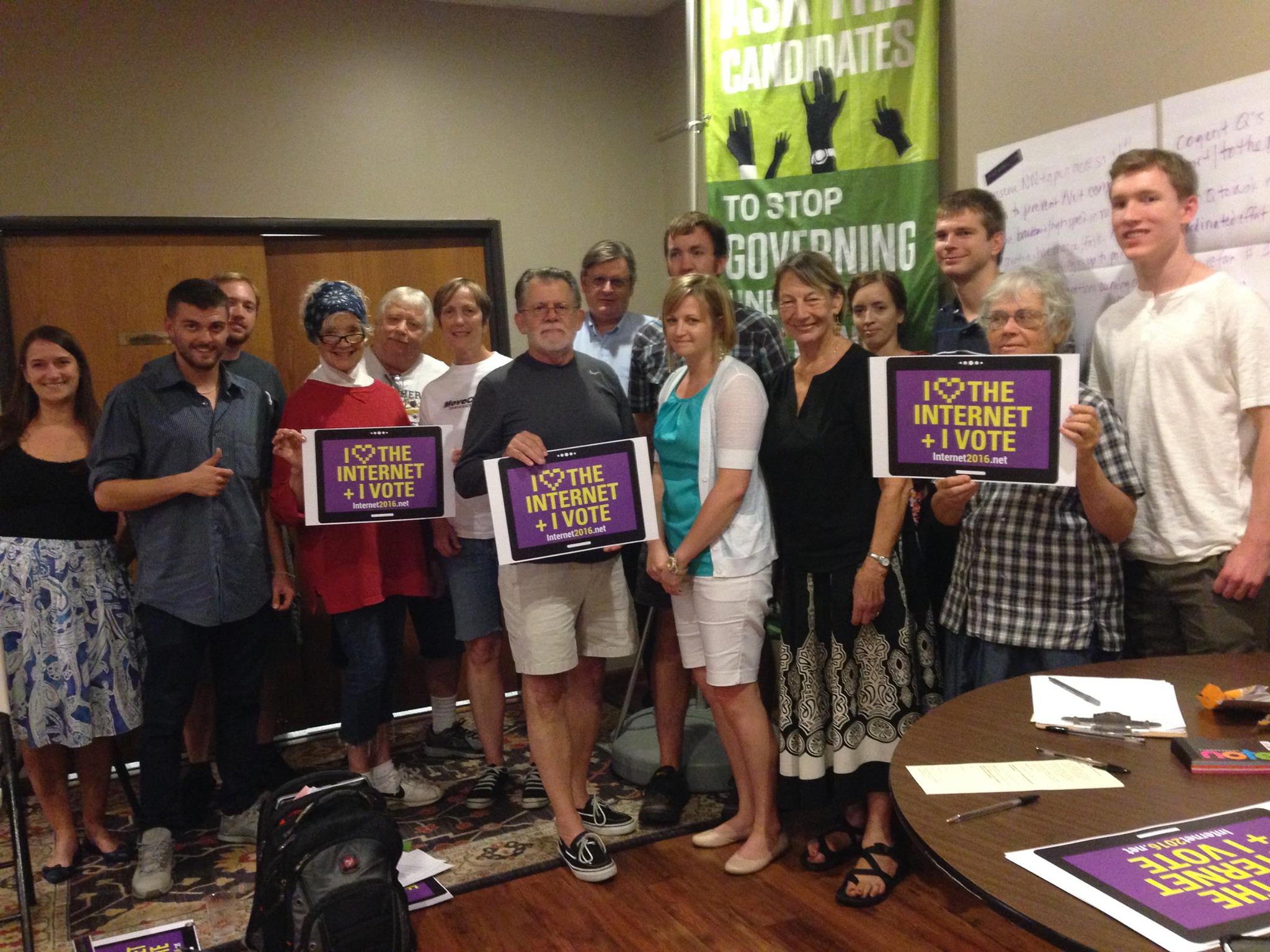
After that, I walked to Old Brick where Free Press Action Fund had organized a meeting about advocating for Internet access, affordability and freedom. More than a dozen people attended and at the end we took this group photo.
Free Press Action Fund Training at Old Brick
It was a long day, capped by getting caught in a rainstorm. Luckily it relented before getting thoroughly drenched.
I attended the Solon City Council meeting regarding the minimum wage ordinance passed on Sept. 16.
This is a discussion worth having in the extended Solon community as we celebrate our dodransbicentennial.
A couple of things are worth mentioning.
It served no purpose for outside parties to participate in the discussion. Those from Davenport and Muscatine may as well have saved the gasoline. In the end the City of Solon must decide for itself where it stands regarding support of business at its intersection with social justice. If city residents don’t like what council is doing regarding minimum wage or anything else, then vote them out. Better yet, get involved and run for office.
None of the media coverage or statements at the meeting indicated the input of people who actually work for minimum wage in Solon was considered. The discussion was the less for that. The median household income of Solon is well above that of Iowa City and the rest of Iowa, so hourly wage is not a concern here as much as it is in larger urban areas. Nonetheless, the input of minimum wage workers would have added to the discussion.
During the recess following the minimum wage discussion someone said, “It’s just like the Scott Walker recall.” No, it’s not. I had expected the meeting to be more confrontational, but it wasn’t. Speakers and council achieved a level of decorum that stands as a model for other municipalities to emulate.
That Solon is having a discussion about minimum wage is an important step toward long-term economic vitality. We can thank the Johnson County supervisors for kicking things off. Their action served to prompt a discussion in which the city council members can be held accountable for their decision.
Peter Fisher of Cedar Township Addressing the Solon City Council
SOLON — The Solon City Council received more than 50 media and members of the public in its chambers this evening. In a unanimous vote, council rejected the Johnson County ordinance to raise the minimum wage in favor of state regulations. They collapsed three required readings into this one, so the decision is final.
Seventeen speakers on multiple sides of the issue made statements and appeals to council members. In the end, everything proceeded as it must have been foreseen by the mayor and council.
My last post about mau-mauing the city council got it wrong in that everyone who spoke, and the audience generally, were well behaved and non-confrontational. It didn’t make a difference.
Here are my takes:
The presence of people who lived outside the city made matters worse. Locals are well aware of what happened in Wisconsin during the unsuccessful recall of their governor. Kevin Samek of Solon mentioned Scott Walker by name during his remarks. Council supporters made clear outsiders weren’t welcome. One person said, “It’s just like the Scott Walker recall again.” Not in a good way regarding the coalition of organizations who were present.
Business owners don’t like the publicity. This is not a shocker, but word of a potential boycott got their attention. Jay Schworn of Salt Fork Kitchen said he hadn’t wanted to get involved until word of a potential boycott spread around on Facebook.
There were no minimum wage workers present. This voice should have been heard from and wasn’t. One speaker, whose name I couldn’t understand said she knew three Solon families working minimum wage jobs and couldn’t attend because they were working. One business owner said he employed a number of high school students at $7.25 per hour and they were a problem because of the limited hours they could work. He preferred hiring mature staff at a higher wage.
If people don’t like government, they should run for office. Solon voters made this council, except for one appointment. If it is perceived as broken, only they can fix it. The filing deadline in the Solon city races is tomorrow.
Public comments were a rich soup of heartfelt words deployed in a way that doesn’t work any more when persuading elected officials. For those of us who follow politics, there are lessons to be learned. I plan to listen to every minute of the audio recording — at least twice.


 The most excitement I felt in a while was finding the Seed Savers Exchange 2016 seed catalog in the mailbox yesterday.





 Journey Home
You must be logged in to post a comment.