Categories
Living in Society

Into New Political Space

2012 OFA door hanger

Two new people, one man and one woman, decided to represent Big Grove Township on the county Democratic central committee. I’m thankful and moving on to new engagement in society beyond politics.

The presidential selection process this cycle was tainted by a bad finish. The caucus results reporting system failed. This weekend the Iowa Democratic Party is re-canvassing some of the caucus results twelve days after the event. It is a futile effort because we know the result. We had many great candidates and a few clinkers. The number of candidates continuing to March 3 Super Tuesday has been winnowed, and for the most part the best survived Iowa. There are really only four who seem viable: Pete Buttigieg, Amy Klobuchar, Bernie Sanders and Elizabeth Warren. Today’s re-canvassing won’t change that.

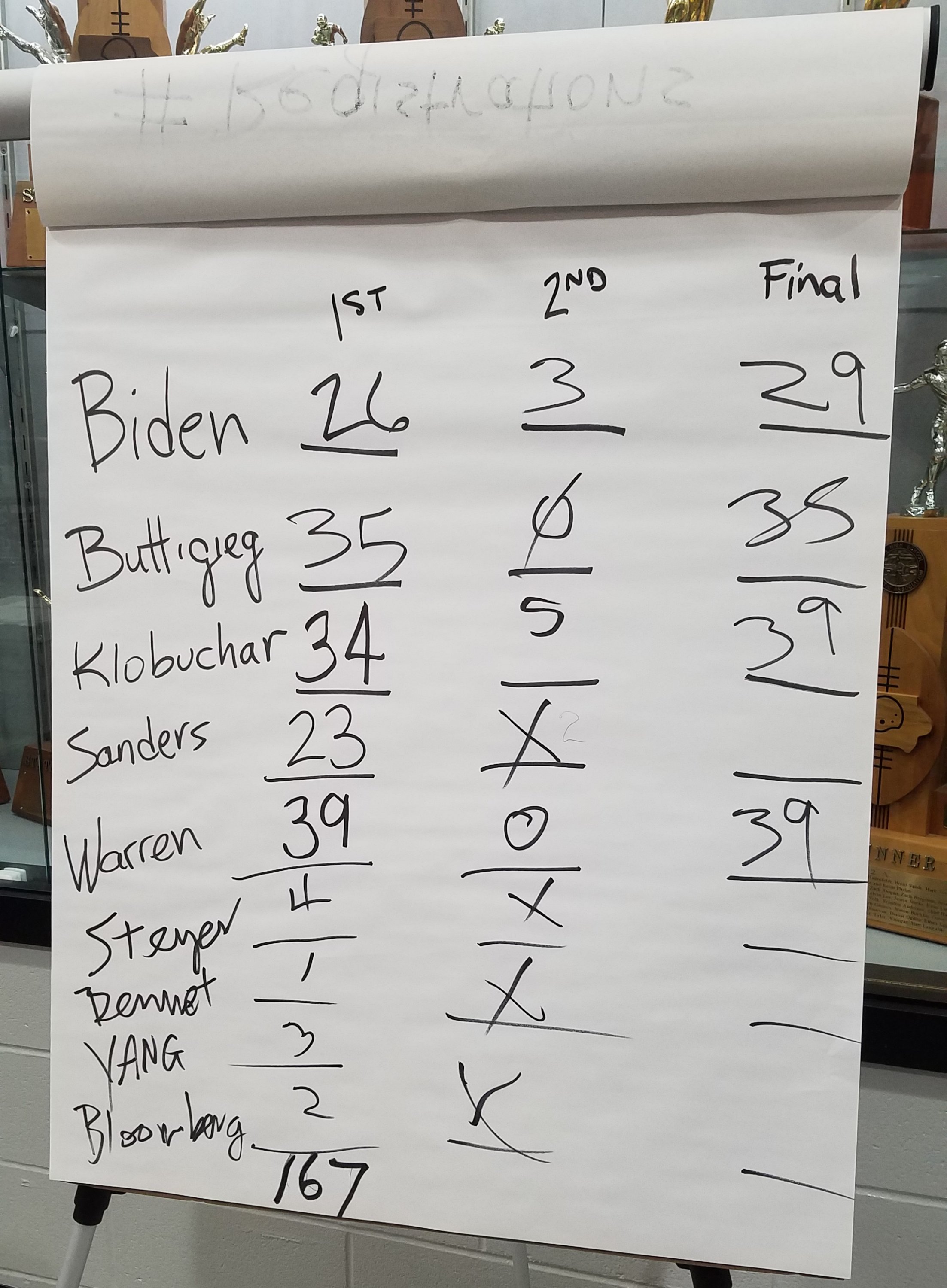
Big Grove Township went Obama – Obama – Trump during the last three general election cycles. In the caucuses those years, we advanced Clinton, Edwards and Obama in 2008; Obama in 2012; and Clinton, O’Malley and Sanders in 2016. This year we advanced Biden, Buttigieg, Klobuchar and Warren with Klobuchar and Warren each having 39 people, Buttigieg 35, and Biden 29, with everyone getting a single delegate to the county convention. Sanders was not viable here, his support from 2016 was cut roughly in half.

The best comparison in presidential campaigns is between 2008 and 2020. Both years we had a significant field of candidates with an unpopular president. We came out of 2004 with a new understanding of how to run a campaign thanks to the ground-breaking work of Howard Dean and his campaign manager Joe Trippi. Dean wasn’t viable in our precinct caucus that year but the lessons stuck, particularly around fund raising, use of databases to target specific voters, and what they called open source campaigning — using the internet to expand a campaign’s voter base. Trippi wrote about his campaign innovations in his underappreciated book The Revolution Will Not Be Televised: Democracy, the Internet, and the Overthrow of Everything.

The campaign techniques pioneered by Trippi in 2003 and 2004 were consolidated, refined, and advanced by David Plouffe who managed Barack Obama’s successful campaign. In The Audacity to Win: The Inside Story and Lessons of Barack Obama’s Historic Win, Plouffe details the process which included integrating diverse databases to micro-target potential voters. He re-booted how traditional door knocking was done, changing from the knock every house process my father followed during the 1960 John F. Kennedy election to a specific and highly targeted list of potential voters. The results showed it worked in 2008, less so by Obama’s re-election campaign when locals were feeling some buyer’s remorse.

Beginning in 2016, with wide adoption of social media, campaigns changed again and produced an environment where media personality Donald J. Trump thrived. Hillary Clinton had a strong background in policy development and relationships with key figures in the Democratic Party. She also had a vast donor network from her family’s long history in American politics. It turned out those things didn’t matter as much, and in retrospect, she had those advantages in 2008 and Obama was able to catch up and pass her. Trump won the election in the electoral college, which is the win that mattered.

In 2020 campaigning changed again. I focused my work on assuming responsibility for running our caucus for the first time since my neighbor who was previously caucus chair moved out of the precinct. I canvassed fewer voters this cycle than I had since 2008 and 2016. The presence of a large field of candidates and my understanding of and maturity in the precinct led me to believe door knocking was not as important. The solid turnout at caucus validated my belief, or maybe confirmed my bias.

The lack of a clear winner in the Iowa caucus is evidence of a breakup of Democratic support. Campaigns bought access to the party voter database and those who used it mailed campaign literature, phoned me, or knocked on our door. Not only has the electorate been divided by repeated computer profile targeting such as I experienced, the campaign process supported more candidates being viable beyond the precinct than in previous cycles. This had two tangible effects: it made the Iowa caucuses less relevant by advancing five candidates, (Biden, Buttigieg, Klobuchar, Sanders and Warren) and it created division that needs mending for the electorate to join together long enough to support the nominee at the Democratic National Convention, at least through the general election.

As we turn toward November, what is the role for someone like me? I see these things:

  • I’m done with targeted voter lists. There is a bad assumption that there is not enough time to contact everyone, so the list of targets is reduced. We have to contact everyone we can about this election because winning it will not be based on party affiliation, but on person to person contact. We must change our thinking as some candidates already did this cycle.
  • If we elect a Democratic president, the work is only a third done. Democrats must retain control of the U.S. House of Representatives and flip the U.S. Senate to Democratic control. In Big Grove precinct this means getting people to participate in the process and turn out for the June 2 primary. I favor Rita Hart for congress in Iowa’s second district and the best of five Democratic U.S. Senate candidates. There will be more work to be done on this front.
  • As a writer I have a platform, and I will use it to promote Democratic and progressive causes. Here I mean Blog for Iowa which gets better traffic than this space.
  • I’ll volunteer with the county party, especially after the national convention when we expect to have a full slate of candidates.
  • I’ll donate what I can to favored candidates. It seems unlikely I’ll hit the federal maximums.

The election of two neighbors to the central committee is a positive development for me. It frees me to think differently about our future and to put politics on a lower shelf in the pantry. That may be the best outcome of the 2020 Iowa caucuses.


Categories
Living in Society Social Commentary

Stars and Stripes For a While

Photo Credit – Wikimedia Commons

Defense Secretary Mark Esper wants to end federal funding for Stars and Stripes and re-purpose the $15.5 million to support the “Warfighter.”

Whatever.

When I worked for a logistics company we used the word “Warfighter.” It seemed a synonym for an ATM to me.

Esper’s reasoning is a joke because those funds represent 0.002 percent of the Defense Department budget. Elimination of federal funding represents about half of the news organization’s annual budget, according to Stars and Stripes.

One has to believe Stars and Stripes’ Congressionally mandated editorial independence from the Defense Department is the unspoken problem under the current commander in chief. Esper is a former Heritage Foundation chief of staff and Heritage is the lead agency in implementing movement conservatism in our government. It’s not hard to connect the dots.

I suggest defense money be diverted from development of new nuclear weapons we don’t need to maintain financial solvency of a newspaper first published during the Civil War. Stars and Stripes has been in continuous publication since World War II.

I ask politicians to audit the Pentagon as a first step toward fiscal accountability. I keep asking. If the president can gin up billions in defense budget excess to build the Mexican border wall, there is surely $15.5 million for an independent newspaper to be found in some boondoggle project.

Stars and Stripes was not a big deal to me when I served. We could buy it at the Post Exchange and received free copies only irregularly — mostly when we were on extended maneuvers in the Fulda Gap. If I wanted news, I listened to Armed Forces Radio, or walked down the hill from my quarters to the Mainz main railway station to buy France Soir, Le Monde, or the International Herald Tribune. Of those, only Le Monde survives in print edition today.

Esper’s military service occurred after mine and to be honest, I don’t know the role Stars and Stripes plays in military life today. Our military has access to the internet, and to some extent are able to access information like I can from my Iowa writing table. Our information infrastructure changes constantly, and Stars and Stripes should not be insulated from change.

If Stars and Stripes is a piece of nostalgia, I agree it should be tossed in the bin of history, something the proposed budget cut will ensure. The issue is the squelching of independent voices in our government. The relentless and systematic purging of differing opinions is a problem for us all.

We know the tune, but it is changing to Stars and Stripes Forever For a While under this administration.

~ A version of this post appeared in the Feb. 20, 2020 Solon Economist

Categories
Living in Society

Can Michael Franken Beat Joni Ernst?

Michael Franken

I’d just secured the last part of my barter share from a local CSA — a large bag of heads of garlic. I put seven or eight of them into a lunch bag and headed along Highway One toward Iowa City to meet with U.S. Senate candidate Michael Franken.

Franken is running for the Democratic nomination in the June 2 primary. He has a plan.

He believes he can address three key aspects of incumbent Senator Joni Ernst’s appeal: (1) He was raised in rural western Iowa and said, “We were as rural as they get.” (2) As a general grade officer he has a different kind of military experience from Ernst. (3) He had plenty of experience in castrating hogs during his farm upbringing, and worked a stint in a slaughterhouse. He believes these three things address Ernst’s popularity and provide him a good chance to win in the general election.

On Feb. 8, I had my third conversation with the retired Navy Vice Admiral at a coffee shop near Interstate 80. The first two were the result of his fundraising call time. The third was on assignment for Blog for Iowa. I presented the bag of garlic as a gift and began the interview.

Franken returned to Sioux City in 2017 after serving a distinguished naval career. His last assignment was as Deputy Director of Military Operations for the United States Africa Command. If one names a significant military action since 9-11, Franken was most likely involved. His work included military operations in Libya, Mogadishu, Somalia, and combating pirates near the Horn of Africa. Unlike Ernst, Franken has a diverse portfolio of command experience, the gold standard of military service.

Of the primary candidates in the race, Franken has the longest resume of experience working on legislation in the Congress. In 1996 his legislative work began with an assignment as legislative affairs for Senator Ted Kennedy. It continued in between other assignments, totaling ten years in legislative affairs, with his most recent assignment finishing in 2015. He believes his work as a legislative assistant gives him a sound foothold to get things done for Iowans should he succeed in the primary and defeat Joni Ernst.

The unique story about his opposition to the 2003 Iraq War was highlighted in his announcement video which can be found here.

According to Open Secrets, the campaign has raised a total of $333,719, spent $208,934, and has cash on hand of $124,784 as of Dec. 31, 2019.

BFIA: Name two or three of the major naval operations in which you participated.

FRANKEN: I’m very unique in terms of after 9-11 I only served operationally in the Navy one time. The rest of the times were all joint. Due to my exposure early on, due to my relationships developed mostly in Washington, D.C., and at U.S Central Command, and U.S. Pacific Command, I was acceptable replacement for often-times Army officers, U.S. Seals, Marines, etc. There have been eleven, as I recall, named operations since 9-11. I participated in nine of them.

BFIA: Why Iowa after military service?

FRANKEN: As you get more senior in life you’ve got options. What was reasonably apparent was I’ve worked for every president and been in the military since the Carter administration. I just didn’t care as a three-star going back to Washington D.C. with the expectation that I would have a position that close to the administration. I just didn’t want to do that. My prerogative after 36 years of active service.

I requested to retire and (it was) granted by the Trump administration. I came back to a consulting business in Washington D.C. (Chartwell Strategic Advisors, LLC.) where my wife and I owned a home. We have a special needs daughter whose treatment happens in Washington.

When it got to be after the 2018 election I wanted to ensure that the Democratic party had someone who negated the items which got Joni Ernst elected so that it was a level playing field for an aspirant in the Democratic Party. When I saw that not unfold to my liking, I gathered a team together, submitted my nominating papers, and embarked on a run to represent the State of Iowa as best I can.

BFIA: Why does your experience best qualify you to be the Democratic nominee?

FRANKEN: The prime objective is Joni Ernst rode three horses to her candidacy, a. the ruralness, b. the military, and c. the pig thing. So first of all ruralness.

BFIA: Have you ever castrated a hog?

FRANKEN: Hell yes! I can castrate a hog with my eyes shut. I worked three years in a hog-kill plant — stick pen, rendering, chitterlings table, head table, floor… four months, 2,500 hogs a day. I can do it with my eyes shut. Thank you very much young lady I know the difference between the curly end and the snouty end.

My father planted a machine shop. The nearest town was Hudson, S.D. He did it specifically so there would be a long distance between him and any city for implement repair. We got running water in our bathroom just a couple of years before I was born. I’m the youngest of nine.

I mean, I know how to make soap. We had home made soap. We all knew how to sew. We butchered animals in the back. I mean we were as rural as they get… Don’t tell me about Iowa values… piling in the station wagon all of us to go to church on Sunday morning. When I took a bath the water was the color of tea and was tepid because I was last. I’m pretty rural. All those rural homonyms, I got you on that.

BFIA: Ours is a progressive blog. What is your message to our readers?

FRANKEN: Job number one is to congeal around a presidential candidate who can win in the general election against President Trump. Step number one. When the party, when the machinations happen and we congeal around a candidate, fall in, build up your voting base, get those, convince those who are on the fence that four more years of this will not be beneficial to the State of Iowa. All they need to do to see whether I’m right about that is to look in the rear view mirror.

Ask some basic questions. From a national security perspective are you more assured of your future? Is the sanctity of the family farm better? Is education better? Is health care better? I’m sure your stock portfolio is better but how many people does that pertain to? Tell me if you like the national discourse that’s presently going on. Do you think it’s going to improve? Step number one, do that.

I’m that guy that talks about sacrifice. If you are 85 percent for candidate such and such, and 95 percent for something and you’ve got your nose bent out of line because the guy or woman got 85, then frankly be happy that we have such great candidates that you even can choose from more than one. If you look at the cast of characters from 2016, the Republicans weren’t so blessed. Yahoos versus professionals. Let’s march forward.

Step number two. We need to control the senate from the Supreme Court designation to controlling the unhelpful tendencies of a potential second term. First and foremost we need to control the senate.

When you march forward to the general election and you look at the primary. Look at the primary in terms of ties, not who is nice, who they know, who they think would be fine. “Fine” is a bad word. Who’s going to win? Don’t think in four letters think in three letters, “win.” Who can beat Joni Ernst? Who can sit toe to toe, debate her, expose her voting record, pick it apart, corral a national effort behind the person to beat her.

She will have all of the strength of the Republican party behind her. Money will be no object for the Republicans to maintain that seat. You need to win her on the essence of the discussion. You need to punish her in every debate. She needs to whimper in the corner because she’s been supporting special interests in this state, at the behest of special interests and corporate greed, and been hammering the citizens of this state into the rich soil.

If you can’t choose which candidate is that, can do that, then let’s have a debate among the Democratic candidates well before the primary. in every county we can. I’m game. I sign up.

~ Editor’s note: The garlic presented to the campaign was appreciated as some were experiencing cold symptoms. Admiral Franken posted his garlic cold treatment the next day. During the interview he provided responses to addressing the climate crisis, the national debt and the deficit. Any errors in transcription belong to the author. His campaign website is frankenforiowa.org/about.

Michael Franken’s Cold Treatment
Categories
Living in Society

Thom Hartmann Interview, Part I

Thom Hartmann

If the Iowa precinct caucuses created doubt about the efficacy of our voting process, we are not the only ones with concern.

Thom Hartmann, the number one progressive-talk-show host in the United States wrote the book, The Hidden History of the War on Voting: Who Stole Your Vote and How to Get It Back. It will be released by Berrett-Koehler Publishers on Feb. 11.

Blog for Iowa reviewed the book here and on Jan. 21 interviewed Hartmann about it and his work as a progressive. Hartmann was engaged and spoke freely about his book, about his concerns about voting in the U.S., and about his work as a progressive writer and radio personality.

We will run the interview in multiple posts, beginning with Hartmann’s comments about this book. The interview was transcribed from audio and is presented with only minor grammatical corrections for clarity.

BFIA: Can you tell me about the background, why you came up with this Hidden History series?

Hartmann: I’ve noticed a couple of trends. One is that people have less and less time to read books, and myself included. But I think it’s just ubiquitous. Spread across the culture. You can blame screens, you know, or phrenetic lifestyle, cause of the bite that Reaganomics is taking out of the middle class. I’m sure it’s a whole bunch of different factors but the simple reality is people don’t just sit down and spend ten, fifteen, twenty hours reading a book like they did twenty-five, thirty years ago.

So I wanted to come out with a series of small books that were books that a person could read in a weekend or maybe even in a long afternoon. I also have been just an absolute history fanatic my whole, entire life. My Dad wanted to be a history teacher when he grew up, a college professor. He had to drop out of college because Mom got pregnant with me and that was the end of that. But he had 20 thousand books in his basement; a lot of them were history. And we talked history all my life, you know, until my Dad died.

I proposed this to BK Publishers, said I’d like to do a series about things that are contemporary issues that have historical roots that most people are unaware of the roots. They don’t know where this came from, how this came about.

The first one we did was the Hidden History of the Second Amendment which is kind of self explanatory. The second was the Hidden History of the Supreme Court and the Betrayal of America. That is how the Supreme Court basically flipped us into oligarchy in the 1970s and it also takes on the issue of judicial review, something most people don’t know anything about the background of and how angry Thomas Jefferson was about it. The third one was the Hidden History of the War on Voting. I argued it should be titled “Republican War on Voting” because there is no Democratic war on voting. They didn’t want to make it seem too partisan.

It’s fairly evident when you read the book who’s trying to prevent you from voting and who isn’t.

BFIA: Thank you. In the voting book, which is the most recent one I read, is there anything you would like to highlight in particular.

HARTMANN: I think the big aha! For a lot of people who have read the book has been Red Shift and voter suppression. Red shift is something that started showing up around 2000 in the United States.

Around the world exit polls are the gold standard to determine if an election has been fraudulent or not, whether there is election fraud. Historically, and in fact, most countries in the world vote by paper ballot. They don’t vote electronically. As a result it takes a couple of days to count the vote.

Every European Country, Canada, take your choice. I lived in Germany for a year and when they have elections in Germany they call the elections when the polls close because they do it based on exit polls. Exit polls are never more than one tenth or two tenths of a point off, even though it takes them four days to count the vote. We saw this in the U.K. very recently with Boris Johnson.

In the United States our exit polls had always been within a tenth of a point or so of our election outcome. But in 2000 this strange thing started showing up. It got really bad in 2002, 2004, 2006 and 2008, when what showed up was that in a handful of states, that started out four or five and now it’s more like ten or fifteen, the outcome of the election is anywhere from two to five percent more Republican than the exit polls. And that’s why it’s called Red Shift toward the Republican Party.

And for a long time, and this is not a secret, the exit polling companies were so freaked out about this they didn’t know what to do. I mean this was a crisis for them in the 2004 election, the John Kerry-George Bush election. There was substantial Red Shift, including in Ohio where George Bush supposedly won that election.

So when we first saw these changes in numbers, how they almost always benefited exclusively Republicans, we concluded and they seem to follow the widespread adoption of electronic voting machines. The first guess of most people was that this was rigged or hacked voting machines.

I think one of the things we have learned in the years since then, particularly over the last ten years or so, that Republicans are more open and up front about their strategies. We’ve gotten access to some of their memos going back 15, 20 years, (showing) that what they have been doing in states where the Republicans control the state they throw hundreds of thousands of people off the voting rolls in the year before an election, in particular they do it in the Democratic cities.

And then when those people show up to vote they’re told, “Oh I can’t find your name on the roll, but here is a provisional ballot you can vote on this.” They don’t realize that provisional ballots are only counted if an election is contested. So those votes literally never get counted, with very few exceptions.

But when they walk out of the voting place and speak to the exit pollster, who says, “How did you vote?” They’ll say “Oh, I voted for John Kerry.” And they write that down as a John Kerry vote, neither the pollster nor the voter realizing that because the voter will be on a provisional ballot that that vote will never be counted.

In most states if you want to your provisional ballot votes to be counted you have to show up at the secretary of state’s office within 48 hours, and prove that you are who you are, and where you live, and you are a citizen, and basically go through the whole process of re-registering to vote, or proving that your registration was inappropriately removed, which most people don’t even know they have to do much less know that they can do.

I think that’s probably a better explanation for Red Shift because the red shifts seem to be the worst in the states that had the most aggressive voter purges.

Click here to order your copy of The Hidden History of the War on Voting.

~ Watch for future installments of this interview coming soon.

Categories
Home Life Living in Society Writing

Pivot From the Caucus

Palmer House Stable, Solon, Iowa, Feb. 8, 2020.

While the Iowa caucus news cycle lingers, I am already gone.

After a Saturday of political engagement — an interview with Michael Franken of Sioux City who is running for the Democratic nomination as U.S. Senator from Iowa, and a town hall meeting with my state representative Bobby Kaufmann — Michael Wines of the New York Times contacted me about my experience at the Big Grove precinct caucus. I told him the story… which is metastasizing.

The narrative is repeated so much I might resurrect a circus like Ringling Brothers and Barnum and Bailey to take it on the road. As locals know, circuses are an Iowa thing and four of the Ringling brothers were born in McGregor, Iowa. What more fitting outcome for the caucuses?

Nontheless I am pivoting away from politics. I’m in a position to do so because of great caucus turnout. I’m confident our four delegates to the county convention will show up. Two volunteers stepped up to participate as precinct representatives on the county central committee. Despite lingering interest in what we did, the news cycle will eventually move on. It’s time for me to go.

I unsubscribed from the county party weekly newsletter, thanking the public relations chair, and saying, “I have less need to stay abreast of what party insiders are doing.” There is life beyond politics.

Toward what will I pivot? Will a divot of politics follow?

Our big family news is on Feb. 5 we made the last payment on our daughter’s student loan. Including loan interest, our contributions, and her work study and scholarship, the cost of her four-year education was about $140,000. In the box of letters I sent Mom during college, I wrote my monthly bill at the University of Iowa was $50. Add in the scholarship I had and my college expense was about $6,800 for four years.

My freedom from politics will be used to become a better citizen. Monday I start a brief term on the county Food Policy Council. If that proves to be engaging, I’ll volunteer for a full, four-year term. I’m writing more for Blog for Iowa, have written up one interview, two more are done, and there may be more. I hope to have a better garden this year. I invested in an electric tiller, bought some rolls of mulching, and began planting onions on Friday. There are plenty more projects in the works. There are also the farm jobs, which have been reduced from three to two this season.

A group of us were sitting around a table in the break room at the home, farm and auto supply store on Wednesday. The discussion was about retirement as a couple of us have retired but continue to work because of the social engagement a job involves. Our store manager was there and he told me, “If I were you, I’d retire as soon as possible.” Depending on how the next couple of months go, I may take his advice and help on one of the federal election campaigns.

For now, I’m on to what’s next while sustaining ourselves in a repressive national political environment. Life will be better, at least I hope so.

Categories
Living in Society

Where Next After an Iowa Caucus?

Caucus Result: Last share of bartered garlic from a local farm.

The Iowa Democratic Party website reports caucus results from 100 percent of precincts this morning. My precinct results are still wrong.

Our four delegates will get seated at the March 21 county convention because of the paper trail, so no worries. It still bugs me.

I don’t have time to dwell on it. I reported the errors to our county party chair and to my state senator. The two campaigns showing zero people after the second alignment and no delegates have copies of the caucus math sheet. In the bigger scheme of things, Super Tuesday should be the shakeout we need in this Democratic presidential nominating process. The mixed Iowa results should deprive campaigns and the media from making sweeping statements about which candidate was the winner. It is likely a good thing.

That there is a statistical tie for top delegate-getters Pete Buttigieg and Bernie Sanders in the first complete reporting isn’t surprising as the electorate of caucus-goers is not of one mind. If this were a race for U.S. Senate or U.S. House of Representatives, the nomination would go to a convention to be decided because neither had garnered 35 percent. In the presidential nominating process, the district and state conventions will simply elect a proportional number of delegates to the Democratic National Convention for each candidate. The national convention is the ultimate decider.

Before I move on from the caucus, one last comment on the erosion of registered Democrats in our precinct.

The decline in registered Democrats in Big Grove precinct is about 20 percent since 2008. Then we had five delegates to the county convention, this year we had four. Then there were six candidates in the first alignment (Biden, Clinton, Dodd, Edwards, Obama and Richardson). Monday there were nine. What’s bothersome is the number of Republican registrants stayed about the same over 12 years and no preference registrations grew. We registered some new Democrats at our caucus, but not enough to offset the trend to less people who identify as Democrats.

People ask should Iowa have a first in the nation precinct caucus. The better question is what will we do to convince like minded people to join us in taking our government back from moneyed interests? Because we’re publicly debating the wrong question our efforts to grow the party are stymied.

This year is the U.S. Census and in 2022 the first election after redistricting. Republicans have repeatedly said they aren’t going to change Iowa’s non-partisan redistricting process. Many feel they can’t be trusted.

I see growth of the county where I live and a likelihood that Big Grove precinct will become more Democratic after redistricting. If that happens it will make my political life more tolerable but it doesn’t address the underlying trend toward an exodus of partisan Democrats.

We don’t know the half of what’s going on in our government, nor have we in my lifetime. I don’t have a crystal ball to tell the future. I do have confidence our country will correct course. It might be too late to make a difference.

Our industrial age exploits natural resources as if they were an endless commodity. They aren’t. Global warming and the unpredictable impact it is having everywhere is science. The success of our political system is it requires engagement from people who have a stake in its outcomes. We are getting better at it in Big Grove precinct. Here’s hoping the same thing is happening in the other states and territories… and all over the world.

Categories
Living in Society

Organizing in an Iowa Caucus

2020 Big Grove precinct caucus results

I’m running behind because I slept until 4:20 a.m. this morning. I’m usually up getting dressed about 3:30.

It’s not because I still tired from the run up to the Iowa Democratic precinct caucuses, although that is a factor. It’s because I woke before midnight and couldn’t get back to sleep, thinking about the phone application we used to report our results to the Iowa Democratic Party.

This post is not about the process that kept me up last night. I learned a lot about the application over the last few days, but have little more to say than what I’ve already posted in social media. I thought this would be a short post before I get ready for my shift at the home, farm and auto supply store.

It’s about how campaigns organized in our precinct.

We had nine groups after the first alignment. Let’s call the bottom four the second tier (Bennet, Bloomberg, Steyer and Yang). The top tier, each of which have had substantial showing in Iowa polls, was Biden, Buttigieg, Klobuchar, Sanders and Warren. Second tier first.

None of the second tier had much ground game here. They benefited from nearby rallies, mailings, and media coverage. The Steyer group created the largest number of spoiled ballots after they weren’t viable, crossed out his name and wrote Biden over it. A strong local network is necessary to be viable in our precinct and the lower tier didn’t have one. For perspective, in 2008, Bill Richardson, Biden and Chris Dodd all had local caucus organizers. Tulsi Gabbard was the only candidate who held an event in our precinct so it was surprising she had no alignment group. Her host was snow birding in Florida and not on my satellite caucus list.

Bernie Sanders was not viable on Monday. Their group posted a respectable 23 in the first alignment but were unable to persuade others to join them in the second alignment. Viability was 26, so it was a heart breaker. Sanders had a telephone campaign, but as I told one of the county campaign leaders, I hadn’t heard of anyone supporting Sanders. They assured me they would win our precinct and the state. Support didn’t materialize. They parachuted an organizer in the week before the caucus and without a perceptible ground game it was game over. Sanders’ numbers were halved from 2016 when Hillary Clinton dominated the caucus here.

The Biden campaign was similar to Sanders. A long time activist said they were the precinct captain for Biden and proceeded to take a two-week trip out of state before the last weekend. Biden parachuted a precinct captain in for the last week and they achieved viability in the first alignment getting 26 of 26 needed. In 2004 the parachute method of campaigning worked for John Kerry, but in 2020 it was a failing tactic.

The lesson here is a local organizing presence makes a difference. Some of us learned that from Howard Dean. While Dean had few, or maybe zero supporters in the 2004 Big Grove caucus, it was clear some campaigns learned the lesson of his and campaign manager Joe Trippi’s work since then.

The top three in the first alignment had strong local organizers and finished in a narrow band. Warren led first alignment with 39, Buttigieg was second with 35, and Klobuchar was third with 34. In second alignment no one joined Buttigieg or Warren and five joined Klobuchar who was the second choice of many. End result was Klobuchar and Warren on top with a delegate each, and Biden and Buttigieg also getting delegates.

A Warren organizer was working in the precinct for more than six months before the caucus.  The top three were in a tight band but their support was strong and if there is a winner, Warren won our caucus. The numbers show it.

A couple notes. The Klobuchar precinct captain was a strong leader who started early in the Warren camp but switched to Klobuchar. She knows who to call and called me to say I should switch to Klobuchar like she did. Her efforts are the reason Klobuchar tied Warren with the largest number of people in their group. The two of us faced off in 2008 when I was precinct captain for the John Edwards campaign and she was precinct captain for Hillary Clinton. We tied at 75 people in each of our groups and they won the coin toss to determine who would get a second delegate. Barack Obama had 97 that year. The precinct had more Democrats and delegates to award back in the day.

There was a surge in support for Klobuchar here in the final month. She started with a base of people who knew her already or had relatives in Minnesota, and grew that base. As Klobuchar said on caucus night, she was punching above her weight.

This needs to be addressed: Our precinct has some of what one of my Facebook friends called functional homophobia, “which means straight folks who are just fine hanging around gay folks — as long as said gay folks know their place, which isn’t in the White House.” A few Democrats railed about the gay candidate during the long run up to caucus night, saying to me, “I’m not going to vote for a homosexual.” I don’t know what this means except our prejudices run deep and even long-time Democrats can be biased or bigoted.

The Buttigieg and Warren precinct captains represent the next generation in Democratic politics. It was their first time getting so active and each had a strong organization behind them. If they are our future, I’m ready for it.

Gotta get ready for work. More on the caucus coming soon.

Categories
Living in Society

After an Iowa Caucus

Another campaign is over.

I am tired and borderline sick.

Tired because I didn’t get to sleep Monday night until 1 a.m. Tuesday morning, messaging back and forth at midnight with a local reporter.

Sick because a good friend was sick, came to our Democratic precinct caucus, and spent a few minutes with me.

The Big Grove Democratic precinct caucus was some fun and a lot of what I expected. I will provide analytics in a future post but here’s what was important: attendees were engaged and respectful. While everyone didn’t get the outcome they wanted, many did.

This was my first time as caucus chair for a large group. In 2016 I was Hillary Clinton’s precinct captain. In 2012 I was chair of Cedar and Graham precincts in a consolidated caucus. In 2008 and 2004 I was caucus secretary. Because of years of public speaking experience dating back to my time in the military I felt comfortable at the microphone and dealing with issues that arose during the event.

I had a great team of volunteers for secretary, registration and crowd control. We started registration a little after 6 p.m. and the line was gone a couple of minutes before our 7 p.m. starting time. I estimated 50 minutes for check in during my planning, which was about right.

Many pixels have been spilled about the new reporting application used by the Iowa Democratic Party. It took me a couple of days to figure out the process, however, by Monday morning I was running test scenarios to familiarize myself with it. I reported our results using it at about 10 p.m. without any issue.

Tuesday I was contacted about a potential on-air interview about the reporting application. MSNBC Field Producer Dan Gallo had obtained a copy of an email thread in which county caucus chairs discussed the application and I was on it. I phoned and told him my story. It turned out to be a nothing burger because from a user standpoint, it worked as expected. That’s pretty boring for television and the on-air interview didn’t happen.

Most of my friends who were caucus chairs in other precincts were tired Tuesday as well. The six and a half hours from arrival at the high school to returning home from turning in my materials to the county party weren’t long. They were intense. Recovery will take a few days.

Tuesday I gave an interview to a student from Northwestern about the caucus. He asked a couple of questions about the application which I said worked from my end. He asked about all the news stories and the then unreported results. I said it’s not my fault the national media had plane tickets booked to New Hampshire and a filing deadline they couldn’t meet. They may have planned to write about the outcomes, but the outcome they decided to write about became there were no results. The narrative was a bucket of malarkey.

People said they wanted more transparency with what went on at the Iowa caucuses. The state party worked toward that end. The new process was complicated and is taking more time for state-wide results to be tabulated. It is transparent. What do you want? This isn’t Burger King where you can have it your way.

The count of presidential preference groups was accurate. We counted four times in our precinct, and reported results in the application and on paper. If it takes more time to report aggregated results accurately, so be it. Accuracy and the paper trail are what matters more than feeding a media narrative.

Attendees in our precinct watched the process unfold and when it was finished, ratified the numbers and slate of delegates to the county convention and our new central committee members. To a person people with whom I spoke left caucus with a feeling they had contributed to the Democratic process. In the end that’s what the Iowa caucuses are about and will continue to be about for as long as we hold them.

I’m feeling better as I write. This campaign is finished and another has already begun as our eyes turn toward the general election. Being tired and sick will pass, it is passing as a new day begins.

Categories
Living in Society

2020 Iowa Caucus Day

I spent most of the last three days understanding and preparing for my role as chair of our 2020 Iowa precinct caucus tonight. I’m ready.

According to the voter rolls we have 462 registered Democrats in Big Grove precinct. More are expected to register at the caucus. Our party affiliations will likely decline from the 562 we had in 2008.

We never know who will show up. In 2008 we had 247, a record number. With the loss of Democrats in the precinct I expect less. We won’t know until registration closes after everyone in line at 7 p.m. is checked in.

I’m seeing a couple of articles saying you shouldn’t “vote” for Elizabeth Warren because then Biden wins. Malarkey!

Reasons people support Elizabeth Warren as I do are complicated. For one night we should stand with our candidate, the one we want to advance in this way too long nomination process, and let the chips fall.

By mid March we’ll know who are the contenders for the nomination. Iowa will have faded into the background. If our candidate is not viable tonight, that’s another thing… one that will be decided in the dynamics of those rooms.

Since I began preparation for my role I’ve been thinking about what Obama said: Respect. Empower. Include.

Those are my guideposts in the crazy politics of the Iowa caucuses.

Categories
Work Life Writing

Two-Day Work Week

Soft shell taco, Spanish Rice, and refried beans. Midwestern staples.

Yesterday was my Monday and today is my Friday at the home, farm and auto supply store.

A two-day work week suits me.

I’m ready to call it quits from an operational standpoint. Spring is coming with its multitude of outdoors work. The two days could readily be used for more productive endeavors. It’s the paycheck that keeps me there. There is always a use for the income.

The Iowa precinct caucuses are Monday, which leaves four days to prepare for my role as temporary chair. I’m pretty well along but little else will get done in the run up to Feb. 3. After that I can focus on pruning fruit trees, getting our income taxes prepared, spring gardening, and everything else that has been delayed by winter.

Spring isn’t here, but it won’t be long.