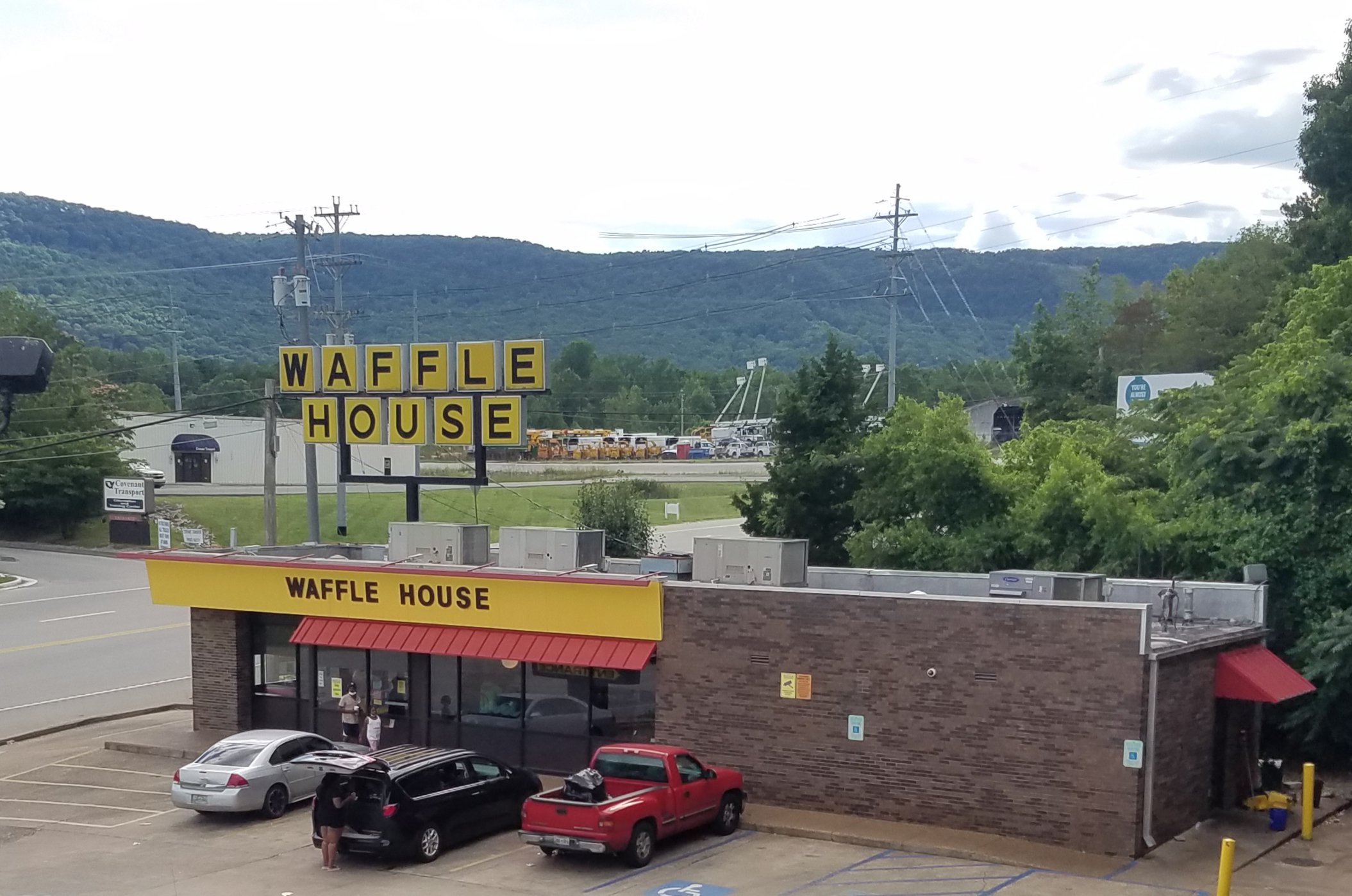
One of multiple Waffle Houses at this exit in Chattanooga
We convoyed from Lake Alfred through Georgia to overnight in Chattanooga. She drove in front with a mobile command center and an application called “waze.” I brought up the rear, keeping my eye on her and the rental between the lines.
We arrived at our lodging and decompressed. That means we parked the vehicles, ordered Italian via Uber Eats, and got on our mobile devices to catch up.
I walked to the side of the building, took this photo, and posted it on Twitter:
No doubt “regulars” have stepped in to prepare orders. There was a lot going on at that exit off the Interstate.
We continued north before sunrise. Coming down the far side of Monteagle, I trailed in the truck full of her stuff from the last ten years. She turned on the windshield washers to see. The over spray hit my windshield a few car lengths back. I turned my wipers on too. That says something about parenting, although I hesitate to say what it is. I’d rather dwell in the complexity a while longer.
Mariannette Miller-Meeks sounds like she’s having trouble dealing with a narrow win in her 2020 election. On June 22, she said on FOX News, “Democrats want Americans to believe state election laws are broken so they can then sell their ‘Corrupt Politicians Act’ as a means to fix the ‘broken’ system.”
The appeal Rita Hart made to the certified election results is evidence election laws are working as they were designed. I understand neither Miller-Meeks nor prominent Iowa Republicans liked the appeal. They should have let the law play out as it is designed to do and as it ultimately did. Instead they complained and made exaggerated claims like this one on FOX News.
“Corrupt Politicians Act” is the same framing used by the right wing Heritage Foundation to characterize the “For the People Act.” Miller-Meeks likely used the Heritage talking point because it’s curious she rolled out this opinion piece at the same time Heritage used the phrase to activate their followers to oppose S.1.
In her FOX News statement, Miller-Meeks naively admitted the irony in proposing the “For the People Act”: Democrats demonstrated the legislative process is not broken. With a slim majority, Democrats walked through the front door and proposed to stop recent Republican-passed laws that aim to modify the voting process.
Agree or disagree, it is the hallmark of our form of government. Miller-Meeks should spend more time in her district talking to voters from all parties to build on her six-vote margin in 2022.
~ Submitted to several local newspapers. First published in Little Village on June 24, 2021.
The garden did not need watering last night. This morning, after sunrise, the ground was still wet. Thunderstorms and rain are forecast all day, so it looks good for the garden getting plenty of moisture. We need rain.
Wednesday was a punk day of running existential errands. I’m preparing for a special project that will have me mostly off the internet for a while. We need that from time to time.
While I’m gone, I leave you with this image of the full moon setting behind the trees. I don’t know what it means but I could look at the moon for hours. The picture is no substitute, yet with it, maybe we’ll get by.
Advertisement for the sale of President Thomas Jefferson’s slaves.
The president’s remarks on signing a law to make Juneteenth a federal holiday.
East Room – 3:51 P.M. EDT
THE PRESIDENT: Thank you, thank you, thank you.
Well, thank you, Madam Vice President.
One hundred and fifty-six years ago — one hundred and fifty-six years — June 19th, 1865 — John, thanks for being here — a major general of the Union Army arrived in Galveston, Texas, to enforce the Emancipation Proclamation and free the last enslaved Americans in Texas from bondage. A day, as you all know — I’m going to repeat some of what was said — that became known as Juneteenth. You all know that. A day that reflects what the Psalm tell us: “Weeping may endure for a night, but joy cometh in the morning.”
Juneteenth marks both the long, hard night of slavery and subjugation, and a promise of a brighter morning to come. This is a day of profound — in my view — profound weight and profound power.
A day in which we remember the moral stain, the terrible toll that slavery took on the country and continues to take — what I’ve long called “America’s original sin.”
At the same time, I also remember the extraordinary capacity to heal, and to hope, and to emerge from the most painful moments and a bitter, bitter version of ourselves, but to make a better version of ourselves.
You know, today, we consecrate Juneteenth for what it ought to be, what it must be: a national holiday. As the Vice President noted, a holiday that will join the others of our national celebrations: our independence, our laborers who built this nation, our servicemen and women who served and died in its defense. And the first new national holiday since the creation of Martin Luther King Holiday nearly four decades ago.
I am grateful to the members of Congress here today — in particular, the Congressional Black Caucus, who did so much to make this day possible.
I’m especially pleased that we showed the nation that we can come together as Democrats and Republicans to commemorate this day with the overwhelming bipartisan support of the Congress. I hope this is the beginning of a change in the way we deal with one another.
And we’re blessed — we’re blessed to mark the day in the presence of Ms. Opal Lee. As my mother would say, “God love her.” (Applause.)
I had the honor of meeting her in Nevada more than a year ago. She told me she loved me, and I believed it. (Laughter.) I wanted to believe it. (Laughs.) Ms. Opal, you’re incredible. A daughter of Texas. Grandmother of the movement to make Juneteenth a federal holiday.
And Ms. Opal is — you won’t believe it — she’s 49 years old. (Laughter.) Or 94 years old, but I — (laughter). You are an incredible woman, Ms. Opal. You really are.
As a child growing up in Texas, she and her family would celebrate Juneteenth. On Juneteenth, 1939, when she was 12 years old, the white — a white mob torched her family home. But such hate never stopped her any more than it stopped the vast majority of you I’m looking at from this podium.
Over the course of decades, she’s made it her mission to see that this day came. It was almost a singular mission. She’s walked for miles and miles, literally and figuratively, to bring attention to Juneteenth, to make this day possible.
I ask, once again, we all stand and give her a warm welcome to the White House. (Applause.)
As they still say in the Senate and I said for 36 years, “if you excuse me there for a point of personal privilege,” as I was walking down, I regret that my grandchildren aren’t here because this is a really, really, really important moment in our history.
By making Juneteenth a federal holiday, all Americans can feel the power of this day, and learn from our history, and celebrate progress, and grapple with the distance we’ve come but the distance we have to travel, Jim.
You know, I said a few weeks ago, marking the 100th anniversary of the Tulsa Race Massacre, great nations don’t ignore their most painful moments. Great nations don’t ignore their most painful moments. They don’t ignore those moments of the past. They embrace them. Great nations don’t walk away. We come to terms with the mistakes we made. And in remembering those moments, we begin to heal and grow stronger.
The truth is, it’s not — simply not enough just to commemorate Juneteenth. After all, the emancipation of enslaved Black Americans didn’t mark the end of America’s work to deliver on the promise of equality; it only marked the beginning.
To honor the true meaning of Juneteenth, we have to continue toward that promise because we’ve not gotten there yet. The Vice President and I and our entire administration and all of you in this room are committed to doing just that.
That’s why we’ve launched an aggressive effort to combat racial discrimination in housing — finally address the cruel fact that a home owned, to this day, by a Black American family is usually appraised at a lower rate for a similar home owned by a white family in a similar area.
That’s why we committed to increasing Black home ownership, one of the biggest drivers of generational wealth.
That’s why we’re making it possible for more Black entrepreneurs to access — to access capital, because their ideas are as good; they lack the capital to get their fair — and get their fair share of federal contracts so they can begin to build wealth.
That’s why we’re working to give each and every child, three and four years of age, not daycare, but school — in a school. (Applause.)
That’s why — that’s why we’re unlocking the incredibly creative and innovation — innovation of the history — of our Historical Black Colleges and Universities, providing them with the resources to invest in research centers and laboratories to help HBCU graduates prepare and compete for good-paying jobs in the industries of the future.
Folks, the promise of equality is not going to be fulfilled until we become real — it becomes real in our schools and on our Main Streets and in our neighborhoods — our healthcare system and ensuring that equity is at the heart of our fight against the pandemic; in the water that comes out of our faucets and the air that we breathe in our communities; in our justice system — so that we can fulfill the promise of America for all people. All of our people.
And it’s not going to be fulfilled so long as the sacred right to vote remains under attack. (Applause.)
We see this assault from restrictive laws, threats of intimidation, voter purges, and more — an assault that offends the very democracy — our very democracy.
We can’t rest until the promise of equality is fulfilled for every one of us in every corner of this nation. That, to me, is the meaning of Juneteenth. That’s what it’s about.
So let’s make this June- — this very Juneteenth, tomorrow — the first that our nation will celebrate all together, as one nation — a Juneteenth of action on many fronts.
One of those is vaccinations. Tomorrow, the Vice President will be in Atlanta on a bus tour, helping to spread the word, like all of you have been doing, on lifesaving vaccines.
And across the country this weekend, including here in Washington, people will be canvassing and hosting events in their communities, going door-to-door, encouraging vaccinations.
We’ve built equity into the heart of the vaccination program from day one, but we still have more work to do to close the racial gap in vaccination rates. The more we can do that, the more we can save lives.
Today also marks the sixth anniversary of the tragic deaths of — at Mother Emanuel Church in Charleston, South Carolina. A killer motivated by hate, intending to start a race war in South Carolina. He joined his victims in a Bible study class, then he took their lives in the house of worship.
It’s a reminder that our work to root out hate never ends — because hate only hides, it never fully goes away. It hides. And when you breathe oxygen under that rock, it comes out.
And that’s why we must understand that Juneteenth represents not only the commemoration of the end of slavery in America more than 150 years ago, but the ongoing work to have to bring true equity and racial justice into American society, which we can do.
In short, this day doesn’t just celebrate the past; it calls for action today.
I wish all Americans a happy Juneteenth. I am shortly going to — in a moment, going to sign into law, making it a federal holiday.
And I have to say to you, I’ve only been President for several months, but I think this will go down, for me, as one of the greatest honors I will have had as President, not because I did it; you did it — Democrats and Republicans. But it’s an enormous, enormous honor.
Thank you for what you’ve done. And, by the way, typical of most of us in Congress and the Senate, I went down to the other end of the hall first and thanked your staffs because I know who does the hard work. (Laughter and applause.) They’re down there. They’re at the other end, but I thanked them as well.
May God bless you all. And may God protect our troops. Thank you. (Applause.)
Now, I’d like to invite up, while I sign, Senator Tina Smith, Senator Ed Markey, Senator Raphael Warnock, Senator John Cornyn, Whip John [Jim] Clyburn, Representative Barbara Lee, Representative Danny Davis, Chair Joyce Beatty, and Sheila Jackson Lee, and Ms. Opal.
On Tuesday the number of U.S. deaths due to COVID-19 surpassed 600,000. If the pace of COVID-19-related deaths in Iowa continues as it is today, it will continue to be one of the leading causes of death in the state. While the Biden administration’s plan to address the coronavirus pandemic is showing positive results, there is a steady grind of cases and deaths that won’t go away.
COVID-19 vaccine is available at no cost everywhere, mostly on a walk-in basis at pharmacies and medical clinics. There is no vaccine for young children yet, but there will be. About half of Iowans have been vaccinated and the goal is to reach 70 percent of the population. Vaccine hesitancy is a thing here. It will be difficult to get enough people vaccinated. The consequence of failure to vaccinate enough is the virus will continue to spread among unprotected people, and variants of the virus can be propagated, potentially requiring a booster shot to defend against them.
While trail-walking yesterday I met a neighbor I’ve known since we moved here. He pulled his recumbent bicycle to the side of the trail and we chatted for a bit. When you’ve known someone going on thirty years there is a lot to discuss. We are both glad the pandemic restrictions on social interaction have begun to ease. It has been a heck of a year, we agreed.
My personal work docket is filling again, although life is not like it was before the coronavirus pandemic. There are new priorities. Things we used to do without much consideration are called into question. The world shifted and the feeling is palpable. Combined with abnormally dry weather conditions and looming drought, the feeling is unpleasant.
Life goes on. The garden is full of blooms — tomatoes, zucchini, squash, peppers, beans and tomatillos. There are insects, yet I fret about whether pollination will occur in time. I’m doing what I can to encourage bees by letting the clover in the lawn grow, letting mustard and arugula plants to go to flower, and advising the bees there are great blooms just yards way. Well that last may be a bit crazy, but that’s where we are.
The good news is the apple bloom set resulted in almost perfect spacing of the fruit, the best I’ve seen in years. It looks to be a great crop. The mulberry tree is full of ripe fruit sweeter than I remember. There is hope nature will do its work for another season.
I don’t know the meaning of the coronavirus pandemic going forward. It is a shared experience many of us won’t forget. Like so many new things involving humans, we’ll just have to live with it and hope we do better when the next contagious disease outbreak occurs. Those of us that have worked in public health expect another outbreak.
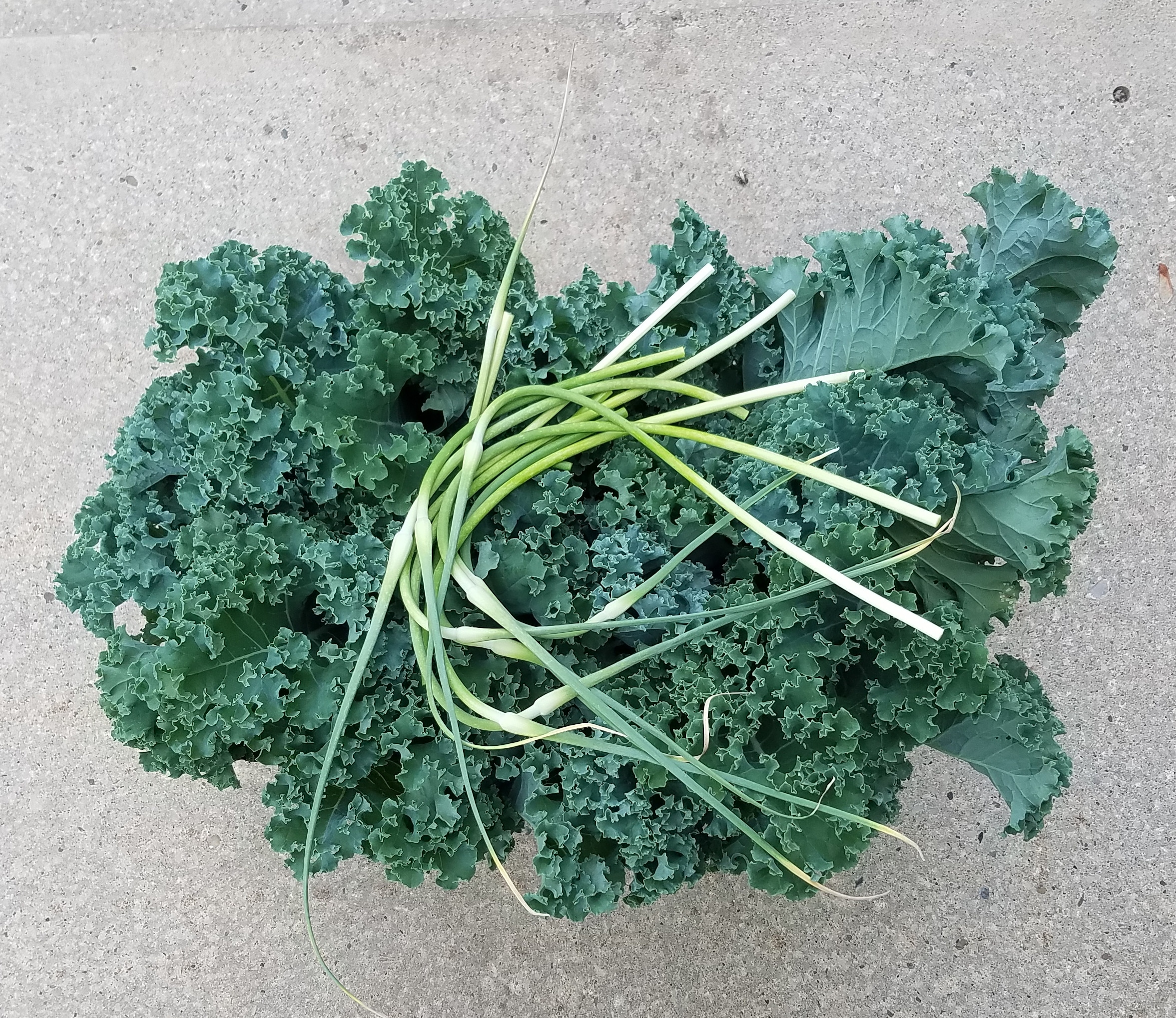
Second food bank donation: Winterbor kale and garlic scapes.
After ending her relationship with a large entertainment company in Florida last November, our daughter decided to move to the Midwest to pursue creative endeavors. Her new apartment rental agreement starts July 1. We plan to make some storage space in our home for extra possessions in case she needs it. Logistics and storage is part of what a parent offers an adult child.
We’ll see if storage space is actually needed. I looked at her new apartment online at a real estate marketplace company website. It appears she will have plenty of room as she is moving from a situation where she rents a single room in a house shared with others to a three-room apartment. She is planning the move and we are standing by to help as we are asked.
The storage space here can likely be created by discarding packing material accumulated over the years. Once finished with that, I’ll consolidate building materials in one spot and use the platform of the loft bed I built for her in college for any new storage items. Prepping the space is likely a one-shift job.
Since we married, we lived in five different places, including the current home since August 1993. The idea of us moving seems like too much work. Our home has become our main financial investment and the majority of our net worth. We are lucky to have a home we own outright. Even if financial conditions get dire, we’ll try to retain ownership.
After years of accumulation — from settling estates, from auctions and tag sales, from failing to dispose of outdated clothing, appliances and the like — we are filling it up. That needs to change as we prepare the home for our aging. For the time being, we can still make more space.
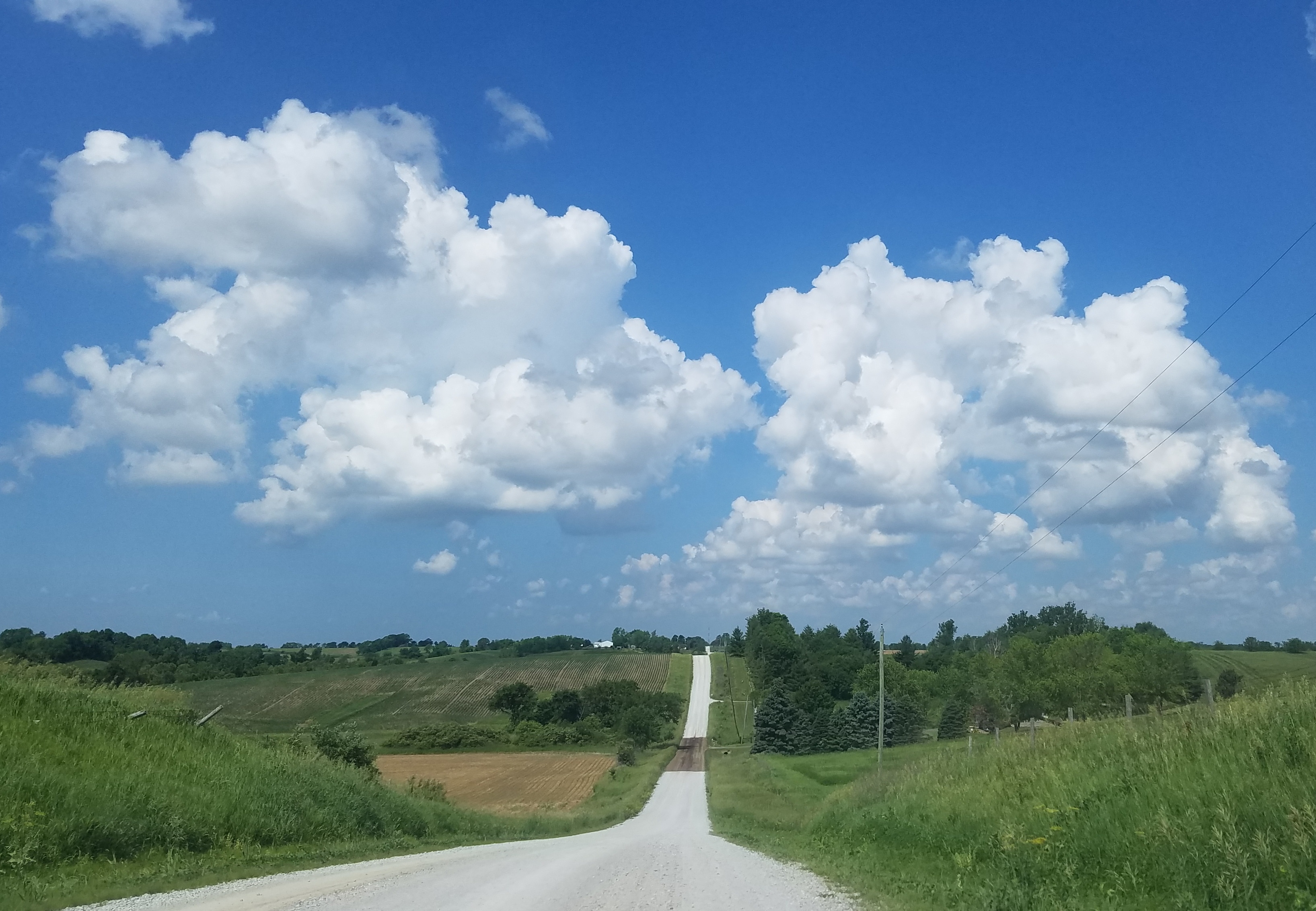
We rely on the county secondary roads department to keep farm-to-market routes in good shape. Each spring, gravel roads need grading and gravel application. While they are not well-traveled, people notice if they are in disrepair. Secondary Roads did a great job on those I use, like the one in the photograph taken after my shift at the farm.
My soil blocking at the CSA is winding down. Yesterday I started early because of mid day heat. I showered afterward and went to the wholesale warehouse to get provisions. That’s my work for the week so the next scheduled trip off property is not until Monday to deliver produce to the food pantry. That is, unless she calls ready to come home.
Having the house to myself is a little weird. I set up a music station on the dining room table. The three-in-one device plays radio, compact disks or audio cassette tapes. We keep things pretty quiet most of the time, so it is evidence of temporarily letting loose. Last night I played my Greg Brown CDs. Brown tells a story I’d like to believe about Iowa.
The menu I wrote for the both of us is out the window. There was leftover rice so I used it with other bits and pieces from the ice box to make a dish: leftover beans, kale, onions, bell pepper, and seasonings. That served as breakfast and dinner on Wednesday.
In addition to drinking a Coca-Cola on Tuesday, last night I drank the first beer since March 13, 2020 at the beginning of the pandemic. I bought a case of Stella Artois at the wholesale warehouse and with temperatures in the upper 80s, I relished the first taste.
There is a big bowl of limes to be used up. I have something mixed with vodka in mind, although I am no mixologist or hard-liquor-drinker for that matter. For complicated reasons I am reluctant to open the bottle of Stolichnaya Russian Vodka purchased at the Me Too grocery store in Cedar Rapids around 1986. I hauled it out to Indiana and then brought it back to Iowa. The label says, “Imported from the USSR” and that’s half the story of its travel. Once I open it it’s a matter of time before it will be gone. I’ll probably hang on to the unopened bottle a while longer. In all this time, only about an ounce has evaporated through the sealed cap. I’m not keen on vodka consumption anyway.
Peas are ready to pick in the garden, so that’s first up when the sun rises. Some kind of stir fry will follow. There will also be soup today. Ambient temperatures are forecast for the 90s this afternoon, so garden work will be finished early, and most of the day will spent indoors.
It seems too hot for early June. The drought in Western states is horrific. The Colorado River basin is disastrously low on water and it seems doubtful rain will come in needed amounts. My worry is the drought is creeping eastward. I lived through the 2012 drought and worked outdoors in it. I don’t want to repeat that experience, yet may have to. Fingers crossed we get back to normal weather before long.
My reading pace slows down in the summer. While I used to get summer started by re-reading The Great Gatsby by F. Scott Fitzgerald, the story has become so familiar I leave it on the shelf now. It’s close by in case I change my mind. I wrote about it here on the occasion of its copyright expiration in January. Here are nine books on my to-read list for Summer 2021.
Weather for Dummies by John D. Cox. I spend part of each day studying the weather forecast and living in the climate. I’ve become adept at interpreting available, free weather radar in terms of how the forecast might impact mundane tasks like mowing the lawn, walking or bicycling on the trail, and gardening. I need a more thorough understanding and Bill Gates recommended this book in his recent How to Avoid a Climate Disaster: The Solutions We Have and the Breakthroughs We Need. Gates’ book made me mad in a couple of ways, yet I’m taking his recommendation about this book.
Stuffed and Starved: The Hidden Battle for the World Food System by Raj Patel. In case you missed it, I post about food and the food system quite often. I noted Mark Bittman referenced Patel’s book a couple of times in his recently published Animal, Vegetable, Junk: A History of Food, from Sustainable to Suicidal. Since I already had purchased Patel’s book, I’m moving it into the top nine for this summer’s reading.
Devotions by Mary Oliver. A person needs poetry and there is so much from which to choose. I read Oliver’s American Primitive and liked it a lot, leading me to buy this collection of selected poems. I don’t think I can go wrong.
Land: How the Hunger for Ownership Shaped the Modern World by Simon Winchester. Winchester is among my favorite authors. Every chance I get to read for entertainment, I find one of his books and have not been disappointed. I particularly enjoyed The Alice Behind Wonderland but every one I read was memorable.
Unworthy Republic: The Dispossession of Native Americans and the Road to Indian Territory by Claudio Saunt. There has been much discussion about how terrible Andrew Jackson was toward native and enslaved people. It’s time I learned more than the brief study I gave him in graduate school.
World Vegetarian by Madhur Jaffrey. Of the many cookbooks in my collection what I need most is development of our vegetarian cuisine. I like Jaffrey’s writing and expect to explore her world this summer to find inspiration for our kitchen garden.
Trouble in the Stars by Sarah Prineas. I found this young adult book by my political pal Sarah Prineas surprisingly engaging. There is something about the style of young adult fiction that keeps the story moving quickly along. There is more to this book than the primary narrative. Take a look!
Turning Pointe: How a New Generation of Dancers is Saving Ballet from Itself by Chloe Angyal. Halfway into this book, I find it engaging and a bit of a stretch of my interests. (The only other book I read on ballet was Gelsey Kirkland’s memoir Dancing on my Grave). I met Angyal at a book event featuring Sarah Smarsh and Connie Schultz soon after she moved to the Iowa City area. Angyal spent most of her time here writing this well-researched and informative book. It’s my current read and I look forward to finishing it this summer.
Birds in the Morning, Frogs at Night: Sharing Life Along the Road by Maureen McCue. When Maureen and I met on the Johnson County Board of Health we started a friendship that led to public advocacy on the gravest threats to society: the climate crisis, nuclear weapons, and public health risks of how utilities generate electricity. This is her story. I’ll be sure to write more once I finish it.
What books are you planning to read this summer? If you’d like to share, please leave a comment. Happy reading!








 Journey Home
You must be logged in to post a comment.