We are out of storage space in the house, so something has to go.
Before the library’s March 7, annual used book sale, I donated more than 600 books. It was pleasurable seeing them laying on tables in the main meeting room while people browsed through them. I hadn’t realized how many French language books I had until I saw them together in a box on a table. The donation process continues. I named it “The Great Book Sort” and made an entry on my daily planner with no ending date.
This is a form of curation unlike others I began. My process is developing, yet the main activities were to clear my five-foot-squared sorting table and place a box or two at a time on it. As I take them out of the box, some go directly into the stacks in my writing space, others into a box for donation. The rest are divided into piles to keep, maybe to keep, books that can easily be checked out from the library, and those relegated to the garage or to the bedside table. By the time I’m done, the 3,000 spaces in my writing room will reflect my reading life, and part of my intellectual history.
I did some advance work. First, I decided the only authors whose works I will keep in their entirety are Saul Bellow, Joan Didion, William Carlos Williams, and John Irving. They rest on the top shelf to my left, watching over my every activity.
I mentioned my nine shelves of poetry in another post. There is a presidential history section which needs curating. Same with art books, regional history, reference books, farming-related books, and American Studies topics (native, black, women, and pioneer culture).
I began culling cookbooks. The two remaining shelves are ones I expect to use and the rest are either gone or in several boxes in the stacks to be reviewed once more, then likely donated. We have a project list that includes a new cabinet in the dining room for cookbooks. We are a distance from actually getting that. The recipes I keep in the kitchen are handwritten in spiral bound books and a collection of papers clipped together. Mostly this system works.
Part of this curation will be to refine the categories of what is on the shelves. Right now there are too many categories.
A home library is personal. My story in books is evolving from random collections into something more usable in daily life. I will never read everything again, yet the comfort of good books, carefully curated and surrounding me is a net positive. The Great Book Sort is a project worth doing.
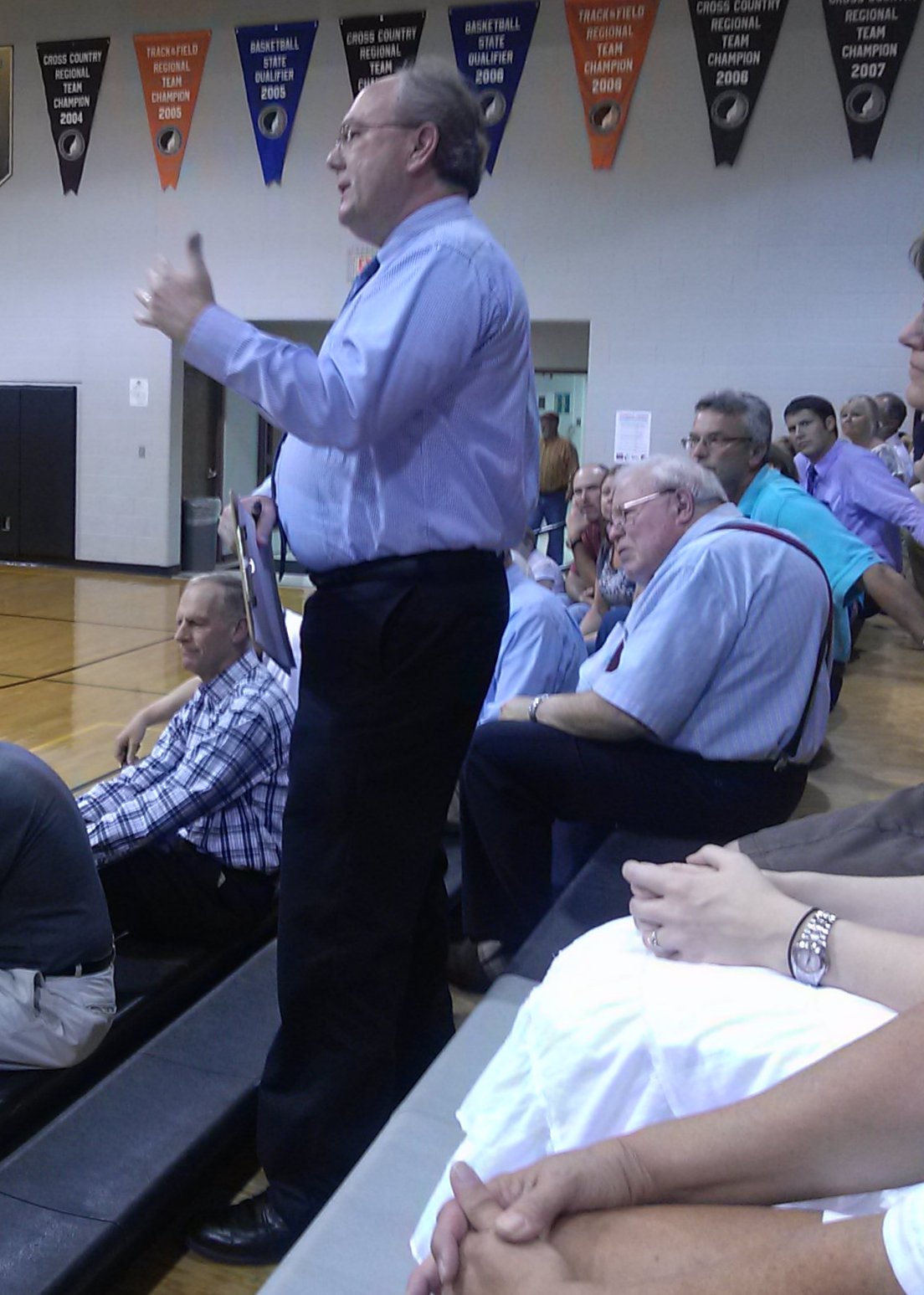
West Branch School Board Member Mike Owen at a public meeting with Governor Terry Branstad.
The Ankeny Community School District defined SSA (State Supplemental Aid) as the cost of living adjustment for school budgets. “To keep pace with rising costs, SSA needs to at least match inflation. If it does not, we would need to thoughtfully consider our budgeting strategy and staffing plans,” according to their website. Each cycle public debate is whether the amount approved by Republicans meets Democratic expectations to support public schools. Mostly it does not and Iowa Republicans have been in the majority longer than kindergarten students have been alive. They have the votes to pass what they will.
Tuesday’s front page headline that Iowa City Schools were years behind in audits is not making the case for more money in SSA. While next year’s level of two percent was approved in February, the financial issues cast a cloud over the school board’s independence. Republicans with a mind to consolidate government operations at the state level might be salivating at the prospects manifest in this local failure.
When I was covering the Iowa City School Board for the North Liberty Leader newspaper, I had a working relationship with their Chief Financial Officer, which I needed to write my stories. While the superintendent tried to maneuver him away from me, I usually got answers I needed. I spent decades in management at a large company and the district’s CFO was as good as any financial officer I have known. What happened, besides changing CFOs?
“The district’s most recent audit — completed two years after the end of that fiscal year — details corrective action needed, including previous district leadership not appearing to properly reconcile the district’s balance sheet,” according to the Cedar Rapids Gazette. “What reconciliations were available contained unknown variances.”
During a board meeting this week (March 5), board member Jayne Finch asked interim Chief Financial Officer Kim Michael-Lee to describe the status of the district’s books “in a few words.” Michael-Lee responded: “Unbalanced, unreconciled,” according to KGAN, the local CBS affiliate.
It’s not a good look found in a financial records audit by an outside firm just before a vote on budget cuts.
At a March 10, meeting, the school board voted to table a proposed $7.5 million budget cut until district finances could be presented in reasonable order. Because of inaccurately applying property tax revenue to appropriate budget line items, board members were unclear as to whether they could meet financial demands, including bond obligations, by June 1.
This is all a long lead in to: WTF Iowa City? Applying revenue to accounts is boilerplate accounting. If you can’t balance the checkbook, you keep working until you figure it out. Basic incompetence calls attention to the problems and when they see a problem like this, elected officials may use the only plan in their playbook: consolidate authority for school board finances at the state level.
Here’s hoping the Iowa City Community School District straightens things out in a timely manner. Let’s not give Des Moines any reasons to make Iowa more of a nanny state.
On Wednesday I received a COVID-19 booster, and it knocked me down. I felt fine the rest of the day, but on Thursday I could barely stay awake. Even three days later, on Saturday, I was still feeling the aftereffects. Except for when I actually tested positive for the coronavirus, vaccinations had never felt this way. I was out in the yard Saturday and feeling better in the afternoon. Now a blizzard is on its way to eastern Iowa late Sunday.
I don’t think much about aging, yet signs are present. Some joints are stiffer, I need a new pair of glasses, I can’t run as well as I could. Let’s not get into my organs, yet they are changing, too. My sleep pattern is to bed early, sleep for 4-5 hours, then wake to read for an hour, and catch an additional 2 hours of light slumber. The vaccination had me sleeping through the night on Thursday, but I’m already back to the usual. A person can live with all of this. Acceptance is better than fighting it.
While at the pharmacy checking in for my shot, we discussed how the bill would be paid. By reviewing my medical records, I knew the billed cost is around $200. With billing computerization through Medicare and my supplemental insurance, the attendant could look it up on the spot. Insurance paid for all of it. Without insurance, I would likely have skipped it. If this were a reasonable country with healthcare for all, such concerns wouldn’t exist.
I checked with the household on provisions, and we can last through the blizzard. Goodness knows there is plenty of indoors work to be done, even if I would rather be outside. I wonder if less tolerance for cold temperatures is also related to aging. I wonder if I’m losing my hearing or just getting cranky. A week before spring, it’s likely some of each.
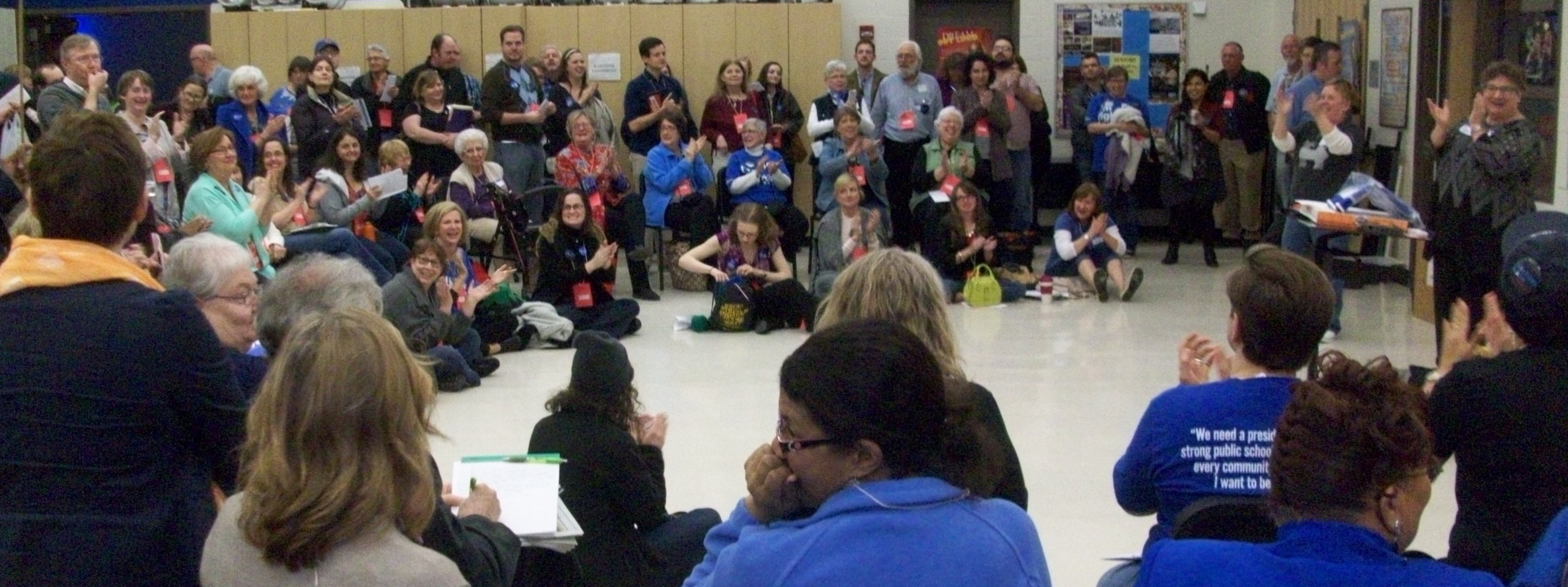
Hillary Clinton Delegates and Alternates at the Johnson County Democratic Convention March 12, 2016
My week in Iowa politics was about planning the county convention and finding a Democratic candidate to run for House District 91 and Senate District 46. One success and two failures.
At our precinct caucuses I volunteered to be on the committee on committees and attended the county-wide Zoom meeting. As in previous cycles, I volunteered for the Arrangements Committee where my background in transportation and logistics prepared me for anything that might happen. The co-chairs of the committee are great and the team put together what has the potential to be a valued convention. My first contribution was writing a paragraph about spreading contagious diseases for the convention booklet as follows:
Respiratory illnesses such as COVID-19 and influenza continue to circulate in our communities. To help reduce the risk of transmission, the Arrangements Committee will make face masks available at check-in for any attendee who wishes to use one.
I also volunteered to be an usher, directing people to designated sections of the seating area, to help set up and tear down, and be a general floater. We are almost ready with one week to go.
The search for candidates to run for the state house has been challenging. Because of a lack of interest in running for a seat currently occupied by a Republican, we have been seeking a person to prevent the Democratic ballot from being blank. In my experience, that’s not the best situation for voters or for candidates. While we are part of the so-called “liberal Johnson County,” our area has been trending Republican after twice voting for Obama as president and for Trump three times. I have been represented by a Republican House member beginning in 2013, and a Republican Senator after redistricting in 2023. Last cycle, no Democrat on the ballot was the top vote-getter.
In the 2022 Iowa Senate election, Republican Dawn Driscoll and Democrat Kevin Kinney duked it out in an expensive election to determine the future of the new district. The senate district leans Republican and Driscoll became our current senator, also defeating Democrat Ed Chabal in 2024. A few Democrats were kicking the tires on a run this year, yet no one is apparently collecting nominating petitions. Senate District 46 has no election in 2026.
Finding a Democrat to run in House District 91 has also been challenging. Elle Wyant ran in 2022, and Jay Gorsh in 2024. Both were great people who had commitments at work that held them from proper campaigning. As of the filing deadline, no one has stepped forward.
Even though the right candidate could beat Republicans in this district, after ten years of Bobby Kaufmann, and a new district favoring Republicans in 2022, I am resigned to work with Republicans to get anything done. My email contacts with my state senator and representative have been cordial and their responses quickly delivered. There is not much else to do if no Democrat will run.
Another local political issue took time this week: the event we are holding for Democratic candidates for county supervisor on March 28. Thanks to the Republican nanny state, we are electing supervisors in new districts instead of at large. The result is a slew of Democratic contenders to run against incumbents across the county. More on this next Saturday.
Keep working it, people. You know that’s the only way to win back our state!
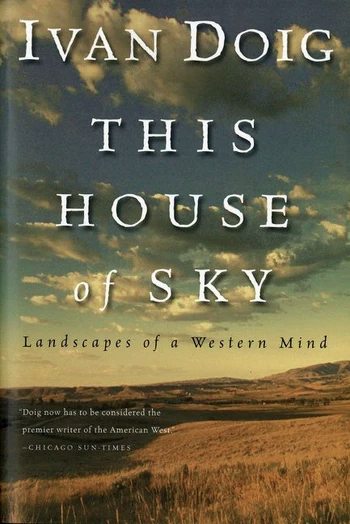
This House of Sky: Landscapes of a Western Mind by Ivan Doig is exactly what the title suggests. Descriptions of the author’s rural Montana life are vivid in their presentation of the hard-scrabble ranching life in which Doig came up. Out of that challenging youth — farming, sheep herding, haying, rural community — he became a writer giving voice to western life.
“In my Montana upbringing, I had worked in a lambing shed, picked rock from grainfields, driven a power buckrake in haying time and a D-8 Cat pulling a harrow during summer fallowing and a grain truck at harvest, herded sheep, trailed sheep, cussed sheep — even dug a well by hand and whitewashed a barn –and now I didn’t seem to be finding other people who had done any of that,” Doig wrote in the introduction.
I worked eight years on a farm that raised lambs, although not on the scale of Doig’s Montana. It was an entry point into a life I hadn’t known existed. My experience provided me a way into This House of Sky that many readers might not have. Life experiences can be a form a literacy regardless of how many books we read.
My grandmother grew up in farming communities in Minnesota and Illinois, and could likely relate to the grandmother in the book. Working from a home, while isolated on a farm, took a lot of knowledge, skills, and energy. Such women literally made a home from almost nothing. While Grandmother did not read a lot of books, I might have persuaded her to read this one.
When This House of Sky was published in 1978, many Americans still had farm connections. Today, far fewer do as that knowledge of hand work was eclipsed by mechanization. Today people don’t harvest hay the same way Doig describes before he left home.
Is there a modern readership for the book?
While I brought farm experience to the book, other readers might bring something else. This book can meet readers where they live. Doig’s detailed description of Montana has many common hooks, including the arc of his’ father’s emphysema, the culture of nine bars and saloons in White Sulphur Springs, and the role of women and men in western society.
Whatever a reader brings to This House of Sky, there is a thoughtful world to explore and briefly inhabit.
I listened to WBBM Newsradio on the drive into Chicago, just as I’ve done since the 1980s. The steady patter of headlines, weather, and traffic “on the eights” prepares you for the city — by the time the skyline is near, you’re already in tune with heavy traffic. That morning they were running a contest for tickets to Madama Butterfly at the Lyric Opera House, a bit of high culture drifting through the stream of brake lights, engine noise, and honking horns.
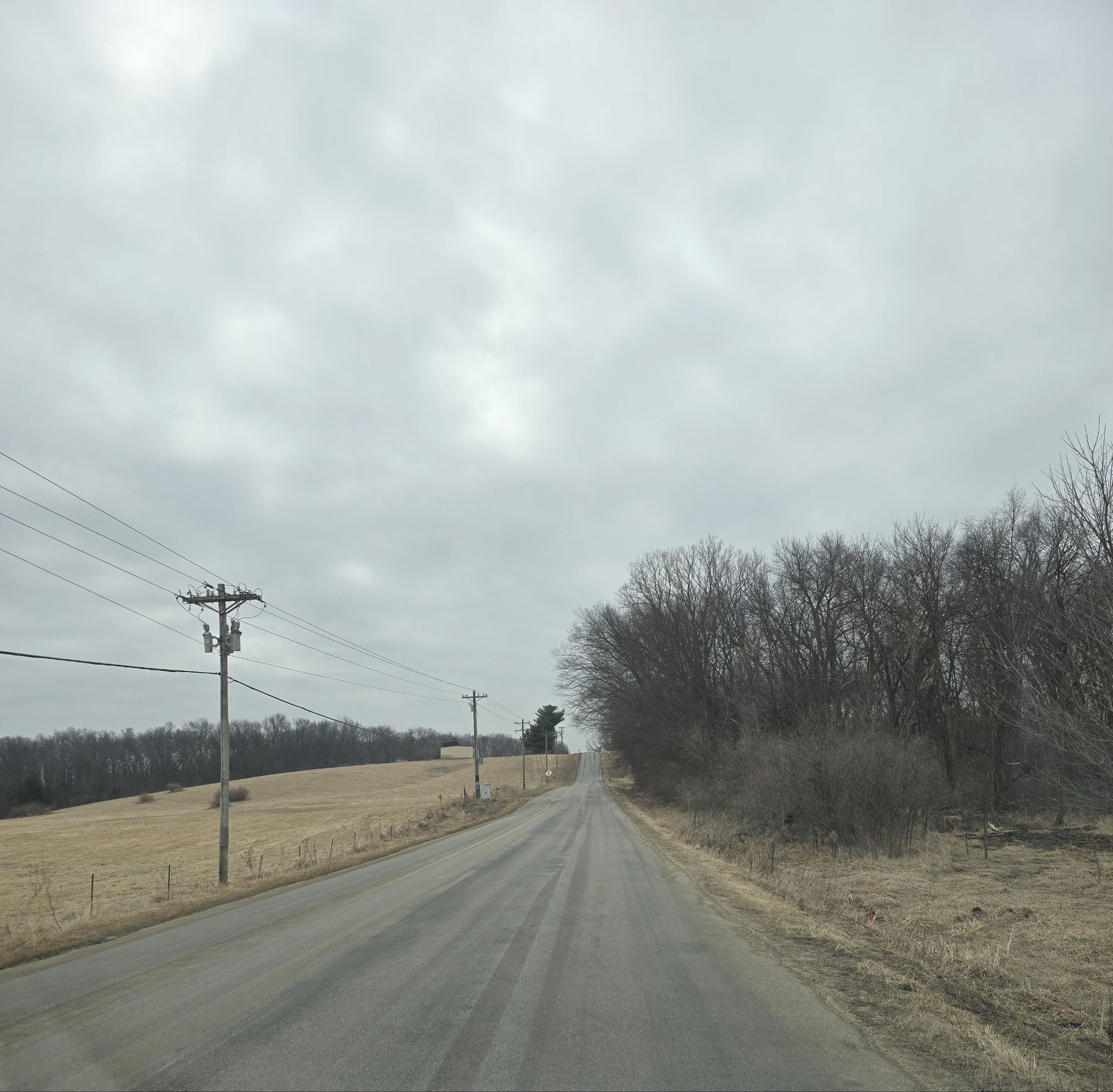
It had been a foggy morning, with Southwest Airlines canceling 113 flights, according to the radio. To bypass toll roads, my map application routed me through rural central Illinois, where farmers were already in the fields. Old-style telephone poles ran parallel to the highway, their double wires fading in and out of the fog. Beyond them lay tan and brown fields waiting for spring.
After reaching my destination in the western suburbs, my host put me directly to work assembling a piece of IKEA furniture. Once you learn to read the pictograms, the parts go together with ease.
It was spring-cleaning time, and I was there to help. After the IKEA project, I adjusted the rolling screen door leading to the patio, unpacked and sorted boxes of personal belongings, and helped assemble a shelving unit. It was a physically busy two days with our child near Chicago. By the time I got home, I was sore in places I didn’t know existed.
The best part of the trip was being with our child, sometimes talking and sometimes not. Working together on projects made the trip worthwhile.
After a day of driving and work, my hosts served a vegetarian curry for dinner. I enjoyed the table conversation — particularly the part about Chicago politics — and we covered how the work environment had changed and is changing. It creates a constant uncertainty, whether it is getting a resume format correct, social behavior at work, or diminished expectations for career advancement. As a member of the boomer generation, I took a bit of good-natured flak about how easy I had it. I didn’t argue. The work paradigm shifted.
I was up early the next day. The instant espresso in my travel bag helps in an unfamiliar place: I can make my own coffee while the household slumbers. The plan that day was a trip to buy groceries when Aldi opened.
Grocery shopping is different when a person doesn’t have a lot of money. When an item attracts interest, there is an immediate query into low-cost grocers like Walmart to compare prices. When the budget is tight, spending a few minutes cost-comparing is time well spent.
We wore face masks into the grocer. When money is tight, it is not worth the risk of exposure to influenza, COVID-19, or other human-transmitted diseases. Being sick means less time to earn income, and that matters.
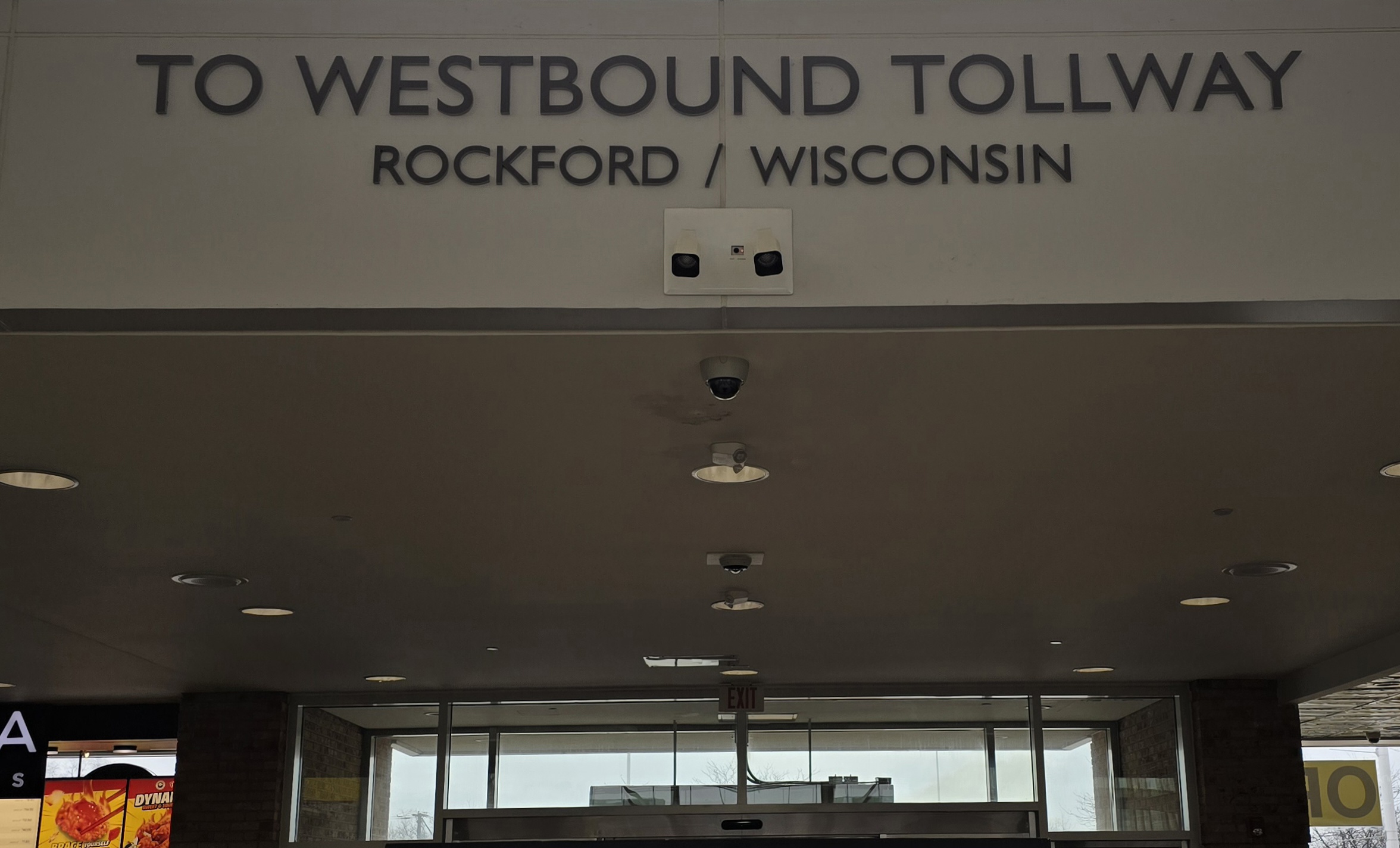
After groceries were put away, we said our goodbyes and I got into the car — packed with boxes traveling with me into storage — and headed to the Jane Addams Memorial Tollway, westward bound. It is good to be with family, even if only a short while.
I stopped at the Belvidere Oasis which was busy and noisy with commercial drivers talking on Bluetooth devices. There was little social distance between us. I ate a large Caesar salad for lunch, then headed west.
It was raining when I started, yet the sky cleared toward the Mississippi River. WVIK Public Radio in Rock Island came into range, a marker of getting closer to home. Familiar miles passed quickly.
Entering Iowa, I turned off the radio and focused on the road ahead, taking in a landscape on the cusp of spring.
The township where I live was established before Iowa Statehood. There were oak, walnut, hickory, ash, elm, and cottonwood thriving here among numerous pure springs. The first sawmill and grist mill was built in 1839 by Anthony Sells on Mill Creek. Put the big groves of trees together with the sawmill and you have us. The forests were long gone when we bought our lot here. What dominates the landscape is culture we and others brought with us to an area where all trees indigenous to this part of Iowa once existed in abundance yet no longer do. Part of that culture was roads.
HF2667 and SF2394 have been introduced in the Iowa Legislature. They essentially let industry interests, meaning real estate developers, the Master Builders, the Home Builders, and the Concrete and Asphalt Associations, mandate what cities and counties are allowed to do with regard to design standards for roads in new developments. On March 4, HF2667 passed in the House 61-36, so this week’s action is in the Iowa Senate.
The industry wants freedom to set very low road design standards. They want those standards to be uniform for all new development in the state. They want standards to ignore differing local conditions such as soil types and terrain. If local governments wanted better local standards, taxpayers would have to foot the bill, not developers. These bills are wrong for Iowa.
Iowa road design standards are currently developed by experts at the ISU Institute for Transportation. A proposed law would shift control of the program to the Iowa Department of Transportation. The bill would require statewide compliance and impose financial penalties for non-compliance, even when local governments make changes based on site-specific conditions. The fiscal note estimates the change would remove $450,000 in revenue from Iowa State University and require the DOT to hire two employees costing $231,000. Another concern is which private-industry representatives might serve on the new board overseeing the program.
If the new bills became law, that could enable developers to build subpar roads in new developments and prevent local governments from having control. It is part of the Republican agenda of making Iowa a nanny state.
Developers must address roads while planning a subdivision, at the same time accountants put a pencil to it and determine potential profit. Saving money on roads is part of extracting every last dime out of a project. When low-quality roads break down, the cost is paid by taxpayers and homeowners, not developers.
When our developer turned his farm into a housing subdivision, he didn’t know what he was doing. There was a lawsuit regarding wastewater treatment. He spent the least possible amount on our two miles of roads, using chip and seal pavement. Evidence of his lack of financial expertise can be found in his declaration of bankruptcy.
The building trades behind the new bills do know what they are doing: extracting every possible penny from a project for investors. If the bill passes, it would play right into their hands.
Note: This passage was cut from my current autobiographical work, so I am posting it here.It is a bit dated.
I wrote about Father’s political work and before I close, I want to write about mine. I functioned at the lowest levels of politics and got elected one time to be a Township Trustee. The word “grassroots” is overly used, but that is where I functioned.
In the political world, so many people want to be strategists and speak at a high level about what is or isn’t the best thing to do in the elements of a campaign. It is the source of the increased swarm of media pundits and poobahs. It is the lifeblood of political bloggers. Political campaigns are not only about strategy.
The tactics of a campaign matter: messaging, voter contact, fundraising and public relations. Where strategy trumps tactics in importance is in defining the playing field. Strategies are too often based on false assumptions, and ragged history. The mistake is to take the external features of campaigning as the playing field. Avoiding mistaken strategy is the key to winning elections, something I hope my candidate will do no matter upon which election I am working.
The Rules and Bylaws Committee of the Democratic National Committee voted to advance a series of first in the nation states for the 2024 presidential nominating calendar. Iowa was not one of them. The plan includes South Carolina first, followed by New Hampshire and Nevada the following week, then Georgia, then Michigan. The plan is expected to be approved by the DNC early the next year.
If one didn’t know Iowa were to be booted from the early states, they had not been paying attention.
Iowa and New Hampshire, both of which have state laws requiring them to go first, are considering next steps. If either state chooses to disregard DNC and changes the schedule, there are penalties, including losing delegates at the Democratic National Convention. Delegates are the whole point of the nominating process. There may be state penalties for failure to go first, but let’s face it, any state could pass such a law and who would enforce it? What will happen next in Iowa is presently unknown.
In 1968, the Democratic National Convention was a disaster in several ways.
Outside the convention hall, anti-war demonstrators protesting the Vietnam War roamed Chicago streets. The Chicago police department, under the direction of Mayor Richard J. Daly, used force in an attempt to maintain control.
During the evening of Aug. 28, 1968, with the police riot in full swing on Michigan Avenue in front of the Democratic party’s convention headquarters, the Conrad Hilton hotel, television networks broadcast live as the anti-war protesters began the now-iconic chant “The whole world is watching.”
At home, I saw televised news reports from Michigan Avenue. A friend was inside the Conrad Hilton with Harold Hughes who ran for president that year. Bill hoped the nomination of Hubert Humphrey, in a smoke filled room away from the convention, was something that would never again happen. South Dakota Senator George McGovern was assigned the task of re-designing the nominating calendar and process, which he did. We have been operating under the McGovern plan ever since.
Most Americans of voting age participate in presidential politics. Here is a brief summary of my memories. Consider it my farewell gift to the Iowa caucus.
Harry Truman: I was 13 months old when Harry Truman left office. I have no living memories of his administration.
Dwight D. Eisenhower: Our family didn’t like having a Republican president yet were thankful for his plan to build the Interstate Highway System. I recall talking about how it was designed so that military vehicles hauling missiles could travel under the roads and bridges that crossed the Interstates. We didn’t like Eisenhower yet accepted his credentials during World War II yielded a competent chief executive.
John F. Kennedy: Father worked on the Kennedy campaign and shared some of that with me. If there was a Camelot, I’m over that now. I wrote previously about this. Click here to read that post.
Lyndon Baines Johnson: I stuffed envelopes for the 1964 Johnson campaign at the Democratic office in downtown Davenport. I came to expect that all elections would be like the Johnson landslide. I was young.
Hubert Humphrey: Based on conversations with my father, I felt the Humphrey nomination was tainted. Partly, I didn’t understand how the convention got so out of hand. I resented the corruption evident in Chicago Mayor Daly. Richard Nixon won in 1968.
George McGovern: My main memory of McGovern’s campaign was a rally before election day at the University of Iowa Pentacrest. I don’t remember if I voted. I wrote more extensively about the 1972 election here. Richard Nixon won reelection.
Jimmy Carter: I was in between finishing Officer Candidate School at Fort Benning, Georgia and traveling to my first assignment in Mainz, Germany during the 1976 presidential election. After Nixon’s resignation in disgrace, I literally didn’t care who was elected president that year.
Ted Kennedy: Turns out I didn’t care for Jimmy Carter enough to support him for a second term. I caucused for Ted Kennedy in Davenport and he wasn’t viable. I declined to join my union friends with the Carter group and went home.
George McGovern: My spouse and I caucused for George McGovern in 1984. We attended a forum in Des Moines where he, Walter Mondale, Jesse Jackson, Fritz Hollings, and others appeared. At the precinct caucus, I joined the platform committee and was selected to go to the county convention as a McGovern delegate. It was my first taste of Johnson County politics.
Michael Dukakis: We lived in Lake County, Indiana in 1988. I remember saying to myself during the June primary election, “Who’s bright idea was running Dukakis?” He lost to George H.W. Bush.
Bill Clinton: Still in Indiana in 1992, I supported Bill Clinton. I took our three-year-old daughter into the voting booth so she could press Clinton’s name on the touch-screen voting device for me. I didn’t devote a lot of time to Clinton’s campaign or to politics. Back in Iowa for the 1996 election, I continued to be inactive in politics. I judged Clinton could be nominated without my help and didn’t attend the precinct caucus. Clinton won Iowa 50.26 percent to Robert Dole’s 39.92 percent.
Al Gore: I skipped the caucuses in 1996 as I believed Al Gore would win the nomination without me. He did, and as we know, the U.S. Supreme Court stopped ballot counting in Florida during the general election, giving the win to George W. Bush.
John Kerry: I quickly came to believe the George W. Bush administration was the worst. In the first days after the Sept. 11, 2001 terrorist attack, I rallied around the president. It didn’t last long. I wrote about my transition here. All three of us attended the 2004 precinct caucuses in Big Grove Precinct together and caucused for John Kerry. I helped run the caucus as secretary that cycle. I joined the Democratic central committee again and worked on the Kerry campaign. I also decided that after his performance in the White Water controversy, long-time U.S. representative Jim Leach had to go. In 2006 we elected Dave Loebsack to the Congress.
John Edwards: Despite all the negativity that came out about John Edwards after his last presidential campaign, I have no regrets having worked to make him the Democratic nominee in 2008. I spent time with him, his wife Elizabeth, and their children. This precinct caucus was the best attended in my almost 30 years living in Big Grove Township — about 260 people. I served as caucus secretary again and it was challenging to make a count. There wasn’t enough room in the school cafeteria and some of the voters stretched out into the hallway. I recall Edwards had a contingent from the care center in wheelchairs and on gurneys. In the end, Hillary Clinton and John Edwards tied and Clinton won the coin toss. Barack Obama got the most delegates and won the general election.
Barack Obama: During the 2012 precinct caucuses I led two precincts other than my own: Cedar and Graham. The caucus began with live video of Obama, then we broke into precinct groups. There wasn’t anyone willing to lead the caucus among the eight people in each group. I convinced a friend to be secretary. Obama’s reelection was not a given yet his campaign was thorough enough to win a second term.
Hillary Clinton: I led the Clinton delegation to the 2016 precinct caucus. We had so many delegates we could send some to the Martin O’Malley group to make them viable and deprive Bernie Sanders of a delegate. I decided being a Clinton leader took precedence over running the caucus. It was a good decision. As we know now, Clinton won the nomination and lost the general.
Elizabeth Warren: I led my own caucus for the second time in 2020, supporting Elizabeth Warren for the nomination. I was well organized and the process proceeded smoothly. We split our four delegates with one each to Warren, Amy Klobuchar, Pete Buttigieg and Joe Biden. Biden placed fourth in Iowa. It wasn’t until South Carolina that the Biden train started to roll out of the station. Buttigieg won Iowa by a small margin yet any momentum was halted by a computer failure in the application we used to report our results. This disaster was likely a prime catalyst for removing Iowa from early in the nominating process this week.
Joe Biden: Joe Biden hasn’t announced whether he will run for president in 2024. One assumes he is in good health and will live long enough to serve a second term. If the DNC is successful in removing Iowa from the early states, as it appears they will be, presidential politics will be a lot different in Iowa. I hope it will be better.
It is recent enough as I type, we all know what happened next. I supported Kamala Harris for president.
Dishes don’t wash themselves, so I went to the kitchen and started cleaning up. Each of us in the household does their share of work, and I like nothing better than clean plates and silverware waiting for supper. Being a blogger is a lot like living with a family. Between now and the primary I will fill in for Dave Bradley on weekends while he takes care of family stuff.
My plan is simple: on Saturdays, write about my personal political activity the previous week, and on Sundays write about Iowa politics more broadly. Campaign season already started with competitive June 2, Democratic primaries for governor, U.S. Senate, and other races.
Veterans of Iowa politics, going back to our 2004 defeat, feel frustrated about how to approach organizing and activism in today’s world. It is no longer enough to harp about knocking doors, making phone calls, and sending mailings based on a central organizing principle. Most of the people I see on a daily basis are not Democrats. Even so, we have meaningful conversations about important things. How do we transition ourselves and our party to be more relevant?
I believe we must write letters to elected officials. Letters to newspapers remain important because political staff do read them. I had three active letters this week:
I received a response from U.S. Senator Chuck Grassley to this email message from Jan. 26, 2026:
I watched the videos of the deaths of Renee Good and Alex Pretti. Major news media verified what I saw are real footage that depicts the killing of two U.S. Citizens who were no threat to federal agents. Good and Pretti were exercising their constitutional rights when federal agents killed them.
This can’t go on.
As our U.S. Senator I expect you to do something to prevent additional killings like this. I don’t presume to tell you how to go about that. The measure of whether you succeed will be the de-escalation of tension in states where federal agents have landed to address the administration’s concerns about immigration, including Minnesota and Maine.
As a U.S. Army veteran I am appalled by the apparent lack of training and control of these federal agents. Now is the time to put your experience in politics to work and do something most everyone can agree is the right thing to de-escalate these tensions.
Thank you for your service and for reading my note.
I reached out to elected officials twice. The emails are self-explanatory.
Vote No on Senate File 2293 – Feb. 21, 2026
Dear Senator Driscoll,
I live in your district and urge you to vote no on SF 2293 which is scheduled for debate in the full senate next week.. The bill changes Iowa Code to remove the requirement for a state history research center in Iowa City
My reasons are the same as when I wrote you Feb. 11: When I studied at the University of Iowa, I took advantage of the State Historical Society research center in Iowa City. It provided a different type of resource than what was available to me at the university. The availability of the staff, artifacts, books, microfilm, and other materials were important to my education and should remain in Iowa City for future students to use like I did.
That said, I am open to alternative solutions, such as incorporating the materials into the University of Iowa Libraries, in effect, making them the research center. I would be ready to have that discussion.
Please vote no on SF 2293 should it come up for a vote this week.
Thanks, Paul
Impeach the president
Rep. Miller-Meeks
It is time to impeach President Trump and I ask you to take a leadership role in this effort.
The president seeks to usurp the power of the Congress in multiple areas, yet his claims about his authority to impose tariffs is so far out of line, even the U.S. Supreme Court overruled him. As you are aware, immediately after the Supreme Court ruled against the tariffs he imposed, he initiated new ones, and then revised those in a way that created chaos in international markets and among our allies.
Yesterday the Dow Jones Industrial average dropped 1.6 percent in reaction to the president’s tariff vacillation. This is no way for a government to run, hence my request the U.S. House draft articles of impeachment, approve them, and send them to the U.S. Senate for trial. Thank you for reading my message.
The congresswoman replied with a form message within an hour. That tells me someone is reading these missives, even if I don’t like the answer.
I don’t know if I will change any minds, yet we have to do something. We’ll see what else I come up with between now and the June 2 primary.
Those following the president’s public statements about Iran knew trouble was brewing when on Thursday, Feb. 26, after a meeting in Geneva, Switzerland between U.S. and Iranian envoys, mediated by Oman, and with the International Atomic Energy Agency present, the administration provided no readout to members of the press.
“The U.S. reticence is likely in order to give US President Trump maximum space to decide if he wants to continue pursuing diplomacy or, as a massive U.S. military buildup in the region portends, strike Iran in order to try to get a better deal,” wrote Laura Rozen from Diplomatic.
This morning, Israel and the United States bombed Iran.
On Feb. 20, the Arms Control Association issued this statement:
Another U.S. aerial military strike on Iran, as President Trump said on Friday he is considering, would not advance the goal of blocking Iran’s potential pathways to acquire nuclear weapons if its leaders were to decide to do so. Rather, a U.S. attack would undermine ongoing diplomacy between Iran and the United States and damage efforts to secure return international inspectors to sensitive sites that were bombed in 2025 by Israel and the United States. Even a “limited” U.S. military strike runs a serious risk of igniting a wider, more intense, and prolonged regional conflict, and such an attack would be inconsistent with the U.S. and international law.
This came from our local chapter of Veterans For Peace on Tuesday:
The U.S. is on the cusp of a war on Iran. Although the U.S. stands on the brink of what may be the most consequential military action in over two decades, there has been no public debate nor congressional briefing, let alone a vote to authorize it. What can peacemakers do? As of now, Feb 24th, war has not broken out. There is a Massie-Khanna effort in the House, and a Kaine-Paul effort in the Senate which would prohibit military action against Iran unless there is a declaration of war or specific authorization from Congress. So, #1, we need to encourage Iowa members and other members of Congress to support those resolutions. (Congress’ switchboard # 202 224-3121). #2 we need to bear witness before war breaks out. Will that stop war from breaking out? – most likely not. But I would submit that silence is not an option. SO, what shall we do?
Hit the streets with local activists to demand No War and Hands Off Iran. Where? When? Please, let us “reply to all” with suggestions and advice by Saturday, Feb 28th. Peace, Ed Flaherty
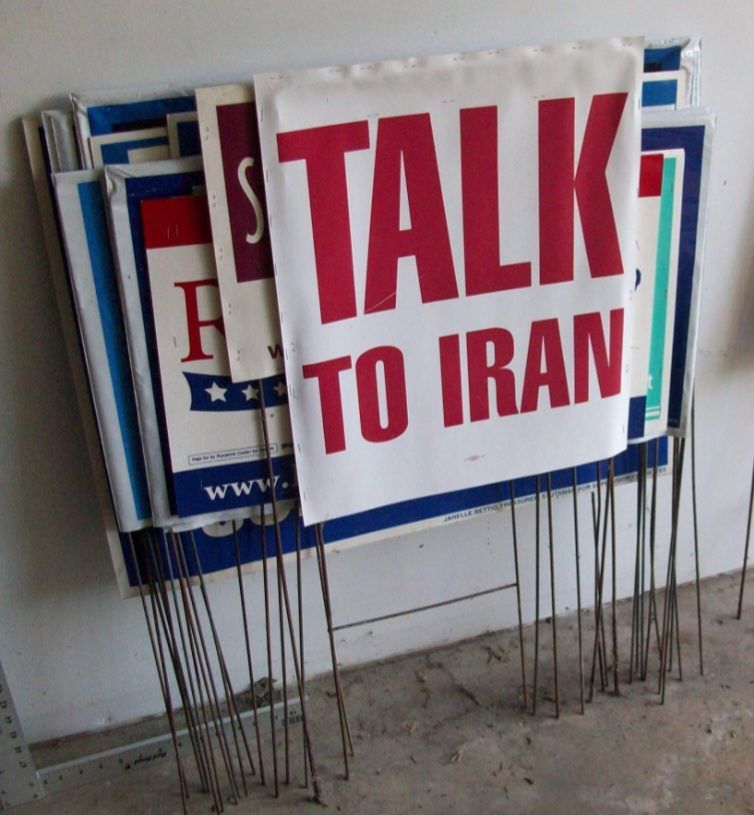
When will the Congress reign in the president on matters of war? Talks with Iran should continue before more combat.



 Journey Home
You must be logged in to post a comment.