Categories
Home Life

Summer Reading 2013

Photo Credit: Wikipedia

LAKE MACBRIDE— The Friends of the Solon Public Library decided to do away with the Memorial Day Weekend used book sale. The decision leaves a gap in my usual habits for summer, and adjusting to change as best as is possible, I picked these books for 2013 summer reading.

“The Great Gatsby” by F. Scott Fitzgerald. It is a marker that summer has begun and I read it every year. I plan to clear a spot under the locust trees in the garden and read it there this time. I have an old Persian rug  to lay on the grass, and a folding chair. I would prefer an Adirondack chair, but haven’t built one to my specifications— yet.

“How the Other Half Lives” by Jacob Riis. Revisiting Riis reminds me of the lives of immigrants in New York, and how the 1880s resonates with today.

“Cooked: A Natural History of Transformation” by Michael Pollan. His latest work, and I try to keep up with Pollan, even if I feel he is a bit too special.

“Murder as a Fine Art” by David Morrell. Morrell has been promoting this period piece on his Facebook page for a while. I took a modern fiction class from him during my undergraduate work at the University of Iowa.

“Reinventing You: Define Your Brand, Imagine Your Future” by Dorie Clark. I met Clark at a Democracy for America training session in Cedar Rapids a few years back, and have been following her burgeoning career.

“Revenue Matters: Tax the Rich and Restore Democracy to Save the Nation” by Berkley Bedell. Bedell sent me a copy of this book when it came out, and I owe him a report on it.

“Inside the Red Zone: A Veteran for Peace reports from Iraq” by Mike Ferner. I met Mike in Dubuque with my peace and justice work, and have delayed reading his 2006 book for too long.

“Doing Time for Peace: Resistance, Family and Community” edited by Rosalie G. Riegle. I met peace activist Brian Terrell in Iowa City and he has an article in this book. He is being released from prison again today. My interest is in the role of civil disobedience in creating social change. I am skeptical of the way it is currently being used, with celebrity arrests, and a small group of people who seek arrests the way gunfighters in the late nineteenth century notched the handle of their pistol. I hope to learn something.


Categories
Living in Society

On Senate Adjournment and Health Care

Dome IA State CapitolBIG GROVE TOWNSHIP— In her remarks before adjournment sine die of the first session of the 85th Iowa General Assembly, Senate President Pam Jochum made a statement that included the following, “the biggest challenge of this session was how to help Iowans who, despite working every day, still cannot afford health insurance.”

The Iowa Senate addressed the issue in Senate File 446, the health and human services budget, which was 60+ pages and reported from the conference committee late yesterday. Some house members wanted to read the bill before voting, and were concerned that there would be time. It was difficult determining the status of things in the wee hours of this morning, but the house adjourned until 9 a.m. this morning, giving legislators time to pull an all-nighter and read the bill.

At the warehouse where I work with some of the same people Senator Jochum referred to in her statement, there is neither a health care plan provided, nor is there adequate pay to enable workers to buy a health insurance policy. This forces employees to seek medical care in their social networks and on the open market, and is at the core of the problem SF 446 seeks to address. Like it or not, business interests drive dependence on programs like Medicaid.

It is unclear by how many layers temp jobs like mine get outsourced: at least two or three. The job is organizationally far removed from the parent company that ultimately buys our labor. American business, in its global footprint, bankruptcy declarations and restructuring, mergers and acquisitions, and increased outsourcing, successfully stripped away the part of employee compensation related to providing health care, while improving productivity and decreasing the cost of labor.

For a single person, buying private health insurance can cost $350 per month or more. For a family of two, a monthly premium can be more than $800. Do the math. At an hourly wage of $9.25, with limited overtime, and no paid holidays, disability insurance or sick leave, a person can expect to earn just short of $18,000 per year, taking home about $15,000. There is no room in the budget for health insurance.

Why do people take jobs like mine? Regardless of the social commentary about living wages, minimum wages, prevailing wages, and general working conditions, the money is green at outsourced jobs, and people need it to help get by. There appears to be no shortage of people willing to work slightly above minimum wage, without benefits.

My co-workers have no time to worry about getting sick, or about how to pay for health care. The presumption is any illness will get treatment in one’s social network, with a visit to a clinic, emergency room or doctor’s office being the last resort. Whatever the Iowa government does with the Senate’s health and human services budget, it will be a band aid on a problem that wants a better solution— one that lies more in the global business community and with workers than with government.

We’ll see the Iowa house reaction to the senate bill today. Presumably the conference committee had support for the bill before reporting it out of committee. Here’s hoping the legislative band-aid does some good if and when it is signed into law.

Categories
Living in Society

Passenger Rail and Eminent Domain Get Married

Iowa State Capitol
Iowa Capitol

LAKE MACBRIDE— What will it take for the Iowa House to get a bill considered on the floor of the Iowa Senate? Representatives Dave Jacoby and Bobby Kaufmann are hoping that pairing a Senate Democratic priority— funding passenger rail in order to be eligible to receive a substantial grant from the Federal Railroad Administration to upgrade railroad tracks to handle 79 mile per hour traffic— with House File 219— an act relating to eminent domain authority prompted by a controversy in Clarke County— will do the trick.

Rep. Bobby Kaufmann has invested considerable political capital in the eminent domain issue. A March 11 story in the Muscatine Journal provides some background information, including the fact that HF 219 passed the Iowa House 93-6. According to Kaufmann, he recruited Rep. Dave Jacoby to co-sponsor the eminent domain bill, asked Jacoby to help write the language, and has spoken publicly about his positive relationship with the popular Coralville Democrat. Eminent domain is one of Kaufmann’s signature issues this session, and he has a lot riding on the outcome, personally and politically. The text of their joint press release is below.

To outsiders, it is unclear what is the secret sauce for getting Republican house bills like HF 219 to an up or down vote in the senate.  What is clear is the process is complicated. Democrats can appreciate the complexity, and for the most part, the results of the Senate’s actions. In any event, how this bipartisan collaboration plays out will be something to follow in the closing days of the first session of the 85th Iowa General Assembly.

Kaufmann-Jacoby Joint Press Release May 21, 2013
Kaufmann and Jacoby offer a compromise to the Senate

Rep. Dave Jacoby (D-Coralville) and Rep. Bobby Kaufmann (R-Wilton) have offered an agreement on two key issues that have garnered a lot of interest in the last several legislative sessions.  “The eminent domain language passed the Iowa House four times this session, each time with over 90 votes,” said Kaufmann.  “There has also been much bipartisan support in the Senate, but it has not been brought up for a vote.”  The legislation ensures that land cannot be condemned for recreational purposes by skirting the 2006 law.  A controversy in Clarke County has been an impetus for the bill.

The passenger rail proposal which includes matching federal funding for an initial run between the Quad Cities and Iowa City (with possible expansion to Des Moines) has met with significant resistance.  The $5.5 million dollars would be a part of the state match.  “Passenger rail is an important initiative for my district, and our local Chambers of Commerce.  This compromise reflects the continuing spirit of all legislative districts being heard and I believe gives both issues new life and a new pathway into becoming law,” said Rep. Jacoby.

As the 2013 session winds to an end, proposals like this could very well be the lynch pin to adjourning.

Categories
Social Commentary

Grammar School No. 6

South Door
South Door

DAVENPORT— That the building at 1420 W. 16th St. was used as a Catholic grammar school, and housed a convent on the top floor, was air-brushed from the article in the Quad City Times reporting the building’s conversion to a senior living facility. One supposes the secular developers would have freaked if it were mentioned.

Its public history as Jackson School or Public School No. 6 was news from the article to me, although one never thinks to ask the history of a building as a grader. We were caught up in the existential reality of learning to read, operating a paper route, waiting turns to swing on the swing set, playing marbles, softball, red rover and four square in the playground, and figuring out how society worked. When I was last there, the building was abandoned— replete with broken windows in my former second grade classroom.

Grade School
Grade School

It was here I took piano lessons, plagiarized the encyclopedia for a report on Johannes Brahms, experienced Kennedy’s assassination, heard Charlotte’s Web read by the fourth grade teacher, lost my Baltimore Catechism, served Mass in the convent, sang songs from the play “The Sound of Music,” learned the Palmer method of handwriting, and spent some of the best days of my life with people I would come to know well. I finished sixth grade in the building, before moving to the new school on Marquette Street. It was the best of times. Times before society started chipping away at native instincts.

The conversion to senior living space is okay with me, although there is an unseemly side to the government money, without which the project would not likely move forward. The neighborhood has declined, and this island of new among the worn down homes seems out of place. Not my problem, I guess. The proposed rent is much higher than our budget would allow for an apartment.

J.P. Morgan Chase Bank N.A., the Renaissance Companies, and Baxter Construction Company will likely make out on the government backed deal. Private companies often know how to negotiate their profits, something government these days does not. At least the construction company is based in Iowa, keeping some of the money in-state.

Regardless of the building’s use going forward, it will always be a source of memories for me. Memories to be revisited from time to time as life brings me back to the old neighborhood.

Categories
Home Life

Night Air

Lambs
Lambs

LAKE MACBRIDE— Arriving home after midnight, it is difficult to resist pausing in the fragrance of the twelve-foot lilac bushes.  19 years passed since planting them in a row, angling from the corner of the house toward the surveyor’s mark. They are mature, as am I.

No cloud blocked my view of the crescent moon and stars. The moon was yellow— as in a children’s book— descending into the atmosphere on the horizon. Alert, I breathed the perfume of spring.

One can’t help but sense spring’s transient nature in the night air. Bound to our memories, and becoming aware of our pausing, we linger until the house lights beckon. And we go in.

Categories
Sustainability Work Life

Revolution in the Home Kitchen

My Great Grandmother
Great Grandmother

LAKE MACBRIDE— The idea that a revolution should take place in the home kitchen is not unique to this blog. My focus on the relationship between the home kitchen and local food— that the latter won’t be viable in the way it could be without changes in the former— is not unique either. However, a recent New York Times article, “Pay People to Cook at Home” by Kristin Wartman demonstrates the disconnect between what is going on at the grassroots level regarding local food and priorities in urban cultural centers.

Wartman, a nutritionist and blogger, posits the following,

“Those who argue that our salvation lies in meals cooked at home seem unable to answer two key questions: where can people find the money to buy fresh foods, and how can they find the time to cook them? The failure to answer these questions plays into the hands of the food industry, which exploits the healthy-food movement’s lack of connection to average Americans.”

Her solution, as the title of the article suggests, is to pay people to cook at home, “(to place) a cultural and monetary premium on the hard work of cooking and the time and skills needed to do it,” including a government program. My suggestion is she hop on the shuttle from her home in New York City down to Washington, D.C. and witness the vast sea of farm industry lobbyists on Capitol Hill. She may then realize that hell would freeze over before any help in paying home cooks would be forthcoming from the federal government.

One can agree with the idea of placing a cultural premium on the value of home cooking, although we don’t necessarily want to return to the era of my great grandmother and her kitchen garden (see photo). The question is how, as a society, do we get there?

The future of local food and a revival of home cooking with whole foods is more dependent upon economics than upon time. If the economics are great, people will find the time. It is common knowledge among local food enthusiasts that the current economic paradigm regarding food, cooking and eating depends upon cheap energy.

Wendell Berry recently asked Michael Pollan, “what will be the effect on farming, gardening, cooking and eating of the end of cheap energy? Are physical work and real cooking going to remain optional?” Readers can listen to Pollan’s answer here. The gist of it is that as cheap energy fades from view, people will be required to become more self-reliant as a form of adaptation to the environmental crisis. This would likely drive more of whatever were least expensive, including local food and home cooking if they provided superior value, something it is not clear they do, at least for now.

The relationship between local food systems and cheap energy is important. I dismiss so-called food miles as an overly simplified argument. There is a complex but valid argument about the relationship between artificially low energy prices and high prices in local food systems that is worth pursuing. It is further complicated  by the fact that the end of cheap energy will be delayed due to the proliferation of hydraulic fracturing and the abundance of natural gas it produces. The complexity of the relationship between energy prices and local food requires further exposition in another post.

People can agree that obesity is a national and local problem. They can agree that chronic diseases, related to eating habits (including salt, sugar and fat consumption), drive a segment of higher health care and related health insurance premium costs. Where there is difficulty agreeing is in answering the question whether to take a homemade brown bag lunch to work, or spend the 30-minute break going to the gas station to have $1 per slice pizza for lunch. Today, the economics of direct food prices drives the decision at one of my workplaces.

The revolution in the home kitchen will begin once we deal with the environmental crisis, cheap fuel and the false notion that there is not enough time for what is important. The economics of food are driven by these things. That won’t happen anytime soon, not until the importance is escalated by some imminent, existential reality. It is not as simple an answer as creating another government program.

A better answer may be to seek ways to recognize the value of all work in society. That too is a complex problem wanting an answer. Something this blog is working toward.

Categories
Home Life Kitchen Garden

Sunday is Laundry Day

Old Sweatshirt
Old Sweatshirt

LAKE MACBRIDE— Yesterday’s wind died down to reveal almost perfect weather conditions today. A little cold— frost is evident on the leaves of thyme— but not the hard frost about which gardeners often fret. My April 30 assessment proved accurate: it is still time for planting.

While the yard is too wet for mowing, there is laundry to do, and a day to organize. Today will include the first cut of lawn— an abundant and sustainable source of mulch for the garden. It will take four hours to make the two cuts, bag and spread the grass clippings on garden plots. The five-gallon gasoline container was filled yesterday, so if the mower starts and the sun shines, we’re ready to go. The neighbors will appreciate the results.

Garlic Patch
Garlic Patch

The other big task for today is digging and delivering spring garlic to the CSA for inclusion in tomorrow’s shares. I estimate two to three hours for the project. There is so much spring work to do, the balance of the day will be easily filled.

Before I finish my third cup of coffee and second breakfast, head down to remove the old sheet from the door to my study and put away the space heater for the season, I want to write about the sweatshirt in the photograph.

While making kits at the warehouse, it occurred to me the sweatshirt is as old as some of my cohorts who were born in the 1990s. It was a gift during a boondoggle of a trip to Aventura, Florida, where a group of corporate transportation equipment maintenance executives met to discuss braking systems. There were a number of these so-called “maintenance councils” sponsored by equipment manufacturers. While invited to join a many of them, one had to be selective. Brakes are important in trucks, so I went.

Turnberry Isle
Turnberry Isle

Last to arrive, my schedule prevented me from playing golf on the one of the resort’s courses that morning as other council members did. My plane landed at the Hollywood airport as dinner was being served and the taxi delivered me to the restaurant as speeches, mostly related to tenure on the council, began.

When describing the trip as a boondoggle, it means everything was included: air fare, luxury hotel accommodations, meals, greens fees for golfers and entertainment. There was even a budget for gifts like the sweatshirt, although corporate policy prevented me from accepting anything too extravagant. Corporate staff had our beds turned down, and reviewed our final hotel bills to ensure everything within reason was paid by the corporation.

During the event, golfing was available, but I’m no golfer. As an alternative, we toured the inland waterways, went deep sea fishing and experienced the constant fawning of sales staff, engineers and corporate interns present for the event. The company wanted the experience to be unforgettable as they held a council meeting to discuss brakes. In transportation, a brake failure through improper manufacturing or maintenance is a liability— and there are lawsuits.

While doing the laundry, I noticed the sweatshirt was frayed at the seams. It won’t last much longer. I donned it again to head downstairs, and then to the garage and garden. Not because of the memories, but because it was something to keep away the chill as the sun burns off the frost and new work begins.

We launder our memories as well as our clothing, in hope of something. Better experiences and memories, I suppose. Memories we make ourselves, away from the exigencies of corporate masters and lawsuits. Eventually old clothes will wear out. There will be something else to wear— something we produce ourselves, rather than the gift of a corporation looking out for their own interests. At least that is what one believes on laundry day.

Categories
Home Life Work Life

Saturday Miscellany

Lettuce Patch
Lettuce Patch

BIG GROVE TOWNSHIP— The editors are in Jamaica on vacation, so work at the newspaper was rearranged to finish the proof reading today and create tomorrow as my first day off paid work since Good Friday. The fill-in copy layout person wanted Mother’s Day off work, so I finished my part of producing the weekly newspaper before lunch.

I called Mother today and had a long chat. For the first time in a long while, she had listened to some of my advice and reported she took it. The two of us are not much for the Hallmark Holidays, but we have a special call each year on or before Mother’s Day. I am thankful to be able to hear her familiar, octogenarian voice letting me know what is going on in her life.

Otherwise, today has been a miscellany— some of which is worth recounting, the rest, not so much.

Censored on the Internet
Tweet Expunged

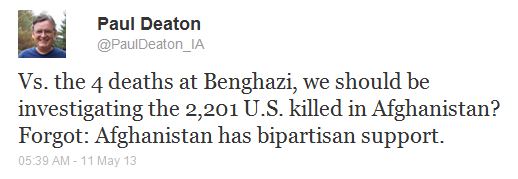
For the first time, one of my tweets on twitter was expunged. A person is not saying much, if from time to time, someone doesn’t react negatively to it. Don’t know why it is gone, but I suspect someone ratted me out to the twitter-gods on the Internet. It was likely over the use of a question mark rather than a period. The reason I have a copy is Iowa City Patch re-tweeted me, generating an email with the content.

Rand Paul gave a speech at an area fundraiser today, giving credence to the idea that his presence is to help Republicans organize for the first in the nation 2016 Iowa caucuses. Paul’s visit was intended, at least partly, to generate some interest among no preference and Democratic voters. From reading other accounts of the event, the Republican party faithful represented most of the attendees. Rand Paul ≠ Ron Paul, and there could be trouble for the Republican organizers trading on the Paul name. Trouble would be fine with me.

In our state representative’s weekly newsletter, he outlined the reason for his opposition to new nuclear power, especially in rural Wilton, where he lives. It is more than the NIMBY (not in my back yard) approach he mentioned at the Morse town hall meeting. He suggested, perhaps unintended, that the issue will be a live round during the second session of the 85th Iowa General Assembly.

Garrison Keillor’s “A Prairie Home Companion” plays on the kitchen radio Saturday nights beginning at 5 p.m. I have been listening off and on since graduate school. For a while, one of Keillor’s prominent sponsors has been Allianz, the German financial services company. The International Campaign to Abolish Nuclear Weapons (ICAN) pointed out that Allianz owns 4.45 percent of the shares of the top 20 producers of nuclear weapons. Allianz has investments in Alliant Techsystems, BAE Systems, Boeing, Lockheed Martin, Northrop Grumman,  General Dynamics, Honeywell International and others.

ICAN has called for divestment in these securities, and I have been pondering what to do since hearing. Long standing behavior is hard to change, especially when part of our lives is built around it. I have invested a lot in “A Prairie Home Companion.”

It is habit and memory that turns on the radio. Memory can’t be changed, but habits can. Familiar and comforting as ” A Prairie Home Companion” is, I’ll find something else to do while preparing our Saturday night meal. It is a disappointing development in a world full of wonder.

Categories
Social Commentary

Getting Out

Tomato Cages
Tomato Cages

LAKE MACBRIDE— The last eight weeks have been a retreat from my recent life in society. Eschewing standing relationships, wrapped in a cocoon, endeavoring to earn money for the tax man, insurance companies and lenders, the universe of human contact has been reduced to a very small circle of family, close friends and work. I got out yesterday to attend a political meeting. It was a mixed bag.

On the positive side, I spent time with like-minded people I have known for a while, engaging in ideas and strengthening relationships. On the downer side, there is a lot of work to do to make social progress, and the voices heard often are the loudest, regardless of the efficacy of their arguments. My take-away was an unsettling feeling of cultural dissonance.

The droning of talking points— the would be muezzin called for prayer from a seat in the back of the room. Her schedule followed no holy book, her themes were less than holy— the whims and fancies of enthusiasms founded in self-identified diatribes. She leveraged the event to support her secular devotions. Absent another voice, it’s all those gathered would hear. We have to be an alternative voice to the vapid droning.

It cannot be that social progress can be made only by the affluent class, people that earn more than a living wage. But it takes an economic platform to be active in society— source of finance, a safety net. It is beyond the means of most people. Many struggle to achieve such a platform their entire lives, wrapped in a social cocoon, getting by as best they can.

We each feel a sense of dignity and worth that comes from our indigent circumstances. We live in a society that would suppress our native instincts and bend our will to meet the economic, social and political needs of others. We must resist with all of our strength, remaining true to ourselves.

There is a personal responsibility to contribute to social progress, and it is hard to do under any circumstances. After examining yesterday’s events, my conclusion is that I have to get out more.

Categories
Living in Society

Divided Government Comes Home

Morse Fence
Morse Fence

MORSE— State Rep. Bobby Kaufmann held a town hall meeting at the Morse Community Center, where 25 people gathered this afternoon to hear what is going on in Des Moines. He wanted to hear what we had to say, and some members of the audience had a lot of it. Kaufmann reported that local celebrity, Laurie Tulchin of the Newport Road clashes,  helped pay for the hall.

Johnson County Republican party chairwoman Deborah Thornton approached, after the formal part of the meeting, and asked me to sign a petition changing how we would be represented on the county board of supervisors. I don’t support the proposal and said so. She said, “that’s okay,” and moved on to others, after mentioning the Rand Paul event coming up in Coralville. It was an example of the new Republican diligence in what they may see as a Graham township opening to expand their base. Kaufmann won only 42 percent of the vote in Graham precinct during the 2012 general election. I know Graham precinct and believe her effort was futile. However, one had to appreciate her diligence and persistence.

I liked Bobby Kaufmann the first time we met, and still do. What is surprising is now that I have a Republican representative in the state house, I also like divided government. Even more than the so-called trifecta, when Democrats, under Chet Culver, controlled the governorship and both houses of the legislature. (Note: The three branches of government are executive, legislative and judicial. Legislators seem to forget the judiciary in their tripartite calculus).

In divided government people have to work together to conduct the state’s business, each holding the other party accountable. For a working stiff like me, that’s as good as it gets in government.

After the 2012 general election, I wrote in the Tipton Conservative,

“In the 85th Iowa General Assembly, House District 73 will be typical of Iowa, where our state representative and state senator, Democrat Bob Dvorsky, will be in the majority in their respective chambers. In order for anything to get accomplished, the senate and house must seek bipartisan common ground as a first step.

The mistake of past house Republicans has been to get some house Democrats to join in legislation, call it bipartisan, and lay blame in the other chamber when it was rejected. This went both ways.

Kaufmann has an opportunity to differentiate himself. If he rejects the stale blame game house Republicans have played with the Iowa Senate, and, as he promised during the campaign, works toward bipartisan solutions to get meaningful legislation passed and forwarded to the governor, then he will grow his base of support and help his re-election prospects.

However, if he plays the blame game, his prospects for re-election diminish.”

It is too early to tell how the session will play out, and for me, everyone is too chummy over in Des Moines. Today, Kaufmann demonstrated that whether or not he read my letter, he gets what I had to say and has been working toward getting something done in divided government. He repeatedly mentioned his relationship with Democrat Dave Jacoby of Coralville (and their seven lunches together this session). He gave Jacoby credit for helping craft bills that gained true bipartisan support when put to a vote. It is hard to legitimately complain about that.

As a citizen, I believe our legislature doesn’t need to do dumb things like prop up the nuclear power industry, support economic development deals like the one with Orascom, or turn away an expansion of Medicaid in some reasonable form. If I don’t agree with Kaufmann on some important issues, he is doing the work of representing the district. At the same time, my state senator is protecting me from Republican bad ideas.

Now that divided government has come home to roost, one finds it not very progressive, but better than expected.