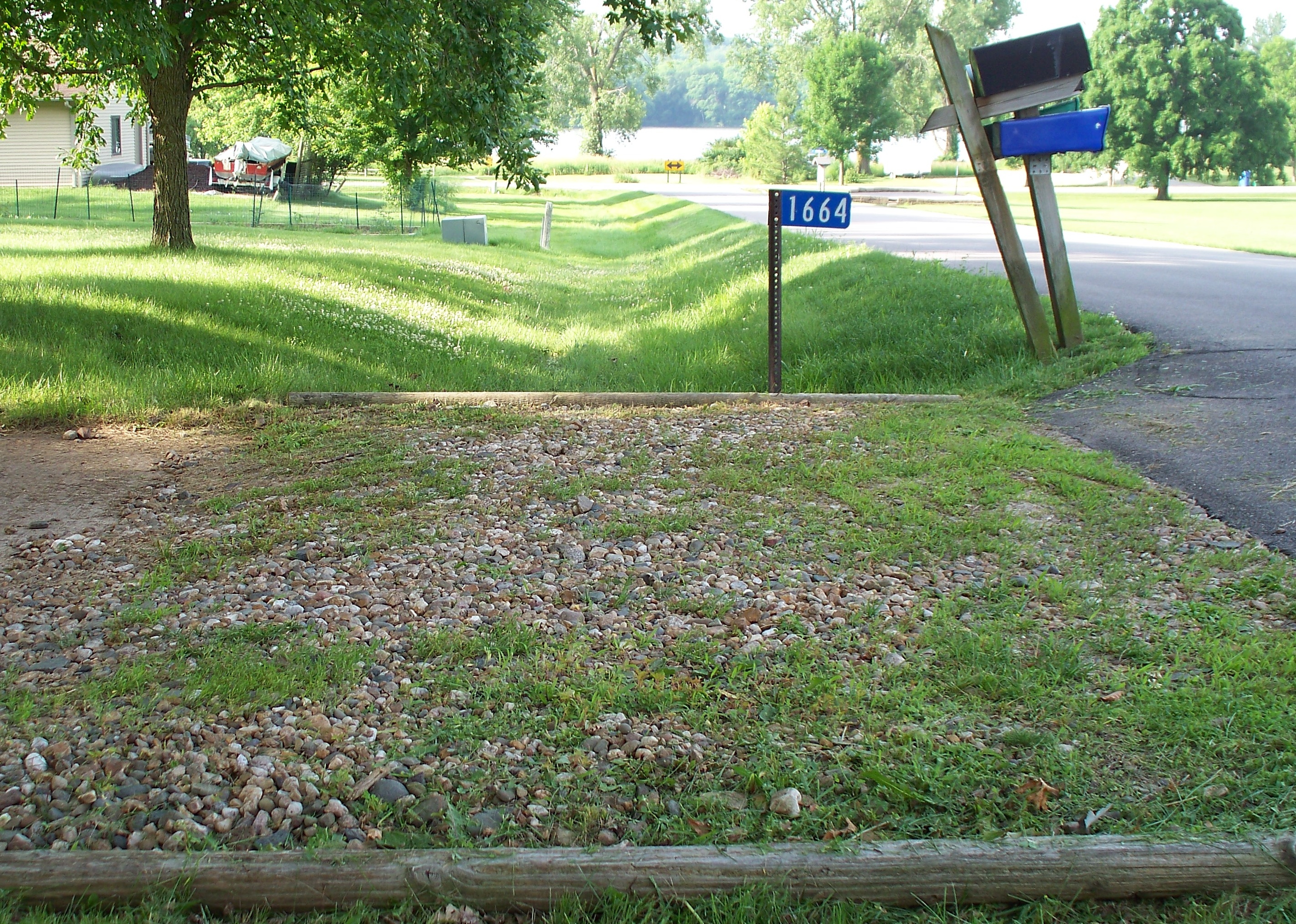
There’s a reason we don’t use fertilizer, weed killer and other chemicals on our lawn and garden. This picture of the ditch in front of our house tells the story. Whatever runoff we may generate will go directly into the lake.
Over the years, I’ve applied strategies to keep the rainwater on-site to keep things green and prevent soil runoff. It took a while, and the effort produced results. Ours isn’t the most beautiful yard, but the ditches on either side of the house don’t fill with runoff very often, and haven’t for years. Because of my approach, the garden requires minimal watering, and the lawn is left to live or die on its own.
It’s raining now with a 75 percent chance of rain in a couple of hours. It’s going to be a day of waiting. Waiting to work my to-do list, which was mostly planned for outside. Waiting for my interview subjects to get back to me for a story. Waiting to get to work inside.
Extra Garden Seedlings
One thing to do is get the garage ready to return my car inside. When the gardening season begins, I use the space to work on seedlings. The only thing remaining to plant inside is another round of broccoli. All of the tomato, pepper and cucumber seedlings will be composted now that those transplanted into the plots have taken.
I’ll also spend a few hours in the kitchen—organizing, cooking and making sure perishables are moving along the right path. Did I mention we have a lot of kale?
Blog for Iowa Story Budget
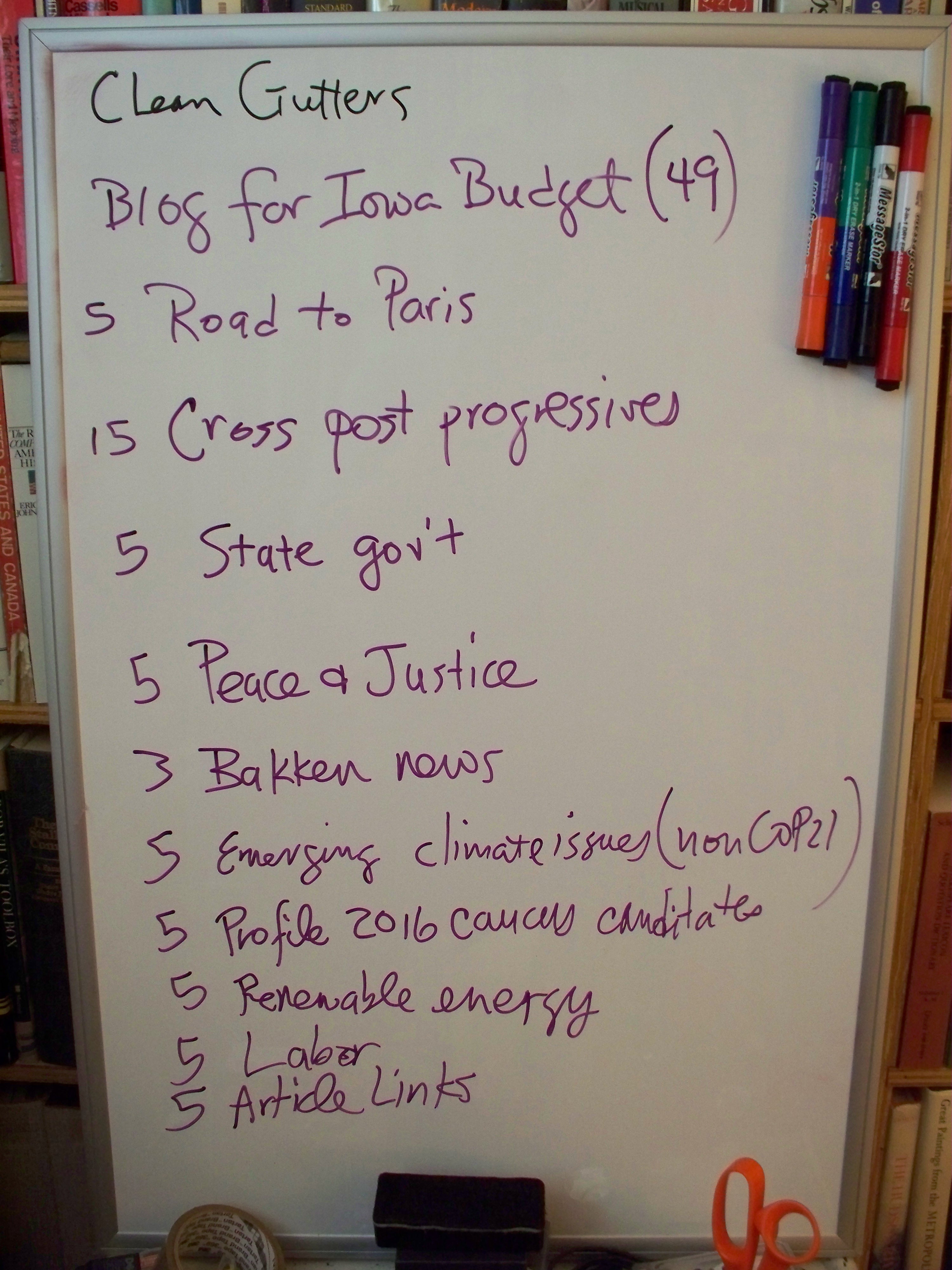
Then there is ramping up for my stint as editor of Blog for Iowa beginning July 1 through Sept. 7. The 49 days of coverage amounts to at least 25,000 words and planning makes the work easier. The first three story lines are identified, and I could begin outlining their content. Or maybe I’ll wait, depending on how the day goes.
In any case, this is a rare day off all the jobs I hold, so I plan to make the most of it. No plans to leave the property today. I’ll be keeping my activity close to home—and liking it.
Buying and selling things is the heart of economic systems. Most people I know would rather be on the production side of the equation, yet someone has to do the selling, and there is a living to be made as a salesperson.
When we lived in Indiana, one of my employees’ spouse worked in sales for a precious metals company. His job was to convince large companies to sell them spent catalysts containing platinum. In a year he had to make only a couple of sales to support his lifestyle of constant engagement with purchasing managers and key executives of Fortune 500 companies. He played a lot of golf with customers.
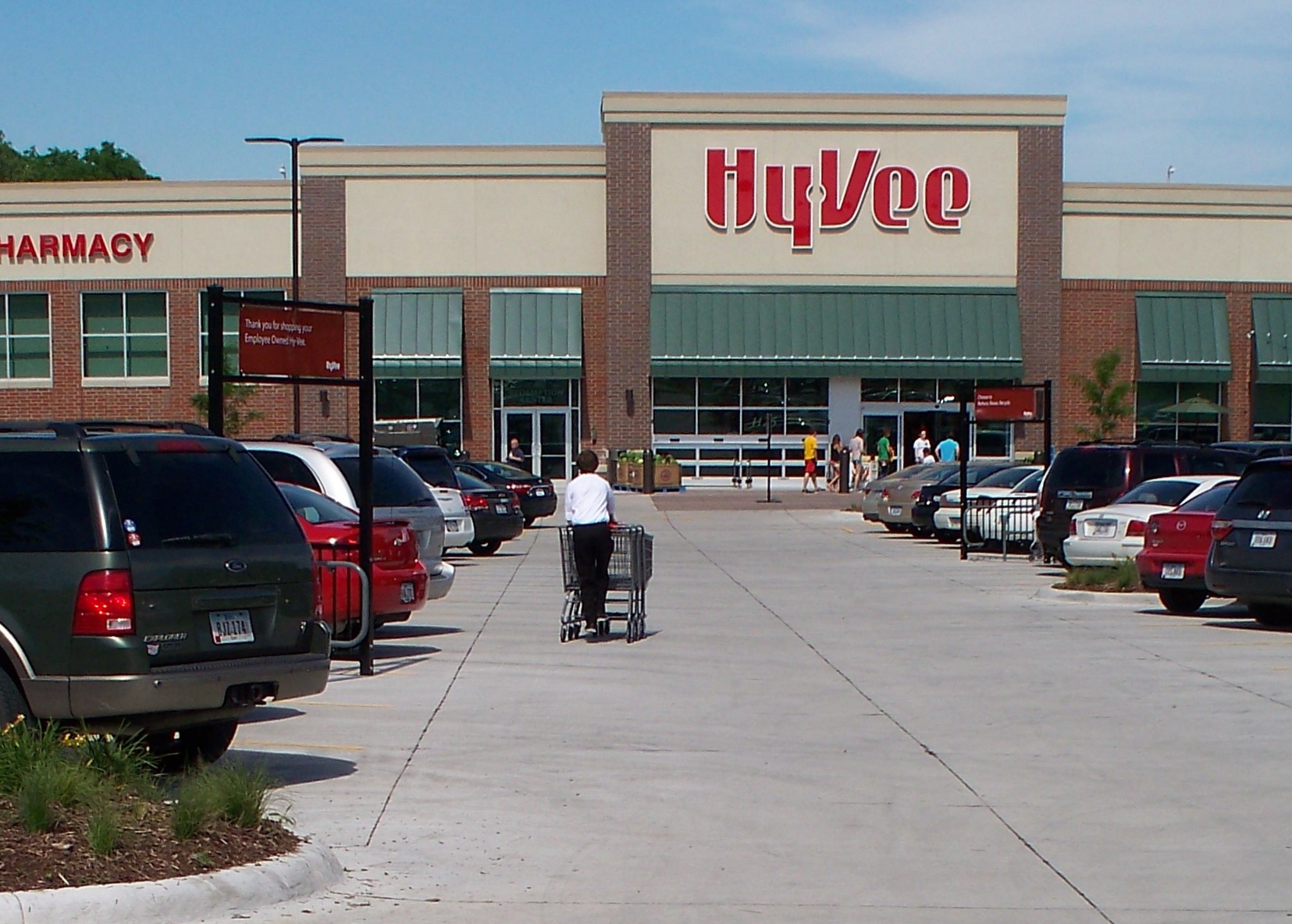
In another corner of the economy, there are those who work retail sales in low wage jobs. Many retailers pay more than minimum wage—they have to to attract workers. Instead of wages, they offer positions such as “team leader,” “shift supervisor,” “crew chief,” and the like. None of them pay a living wage, far from it. It is all hourly work designed to stock shelves, staff cash registers and generate sales from a corporate-designed supply chain that pays the lowest wages the market can bear. Retail workers don’t play a lot of golf.
Retail workers have more than their share of problems. Health, access to health care, relationships, transportation, housing, security, disability, abuse—you name it, problems come in almost every area of life. Financial problems are rife, and the reason many take a job in retail, but low wage workers don’t always make good decisions about jobs. The financial equation is stacked against them before they even leave the house.
This is where I part ways with people who promote increasing the minimum wage as a solution to working poor.
Discussion among low wage workers is seldom about wages, but how to sustain a life. While “extra” money would be nice, and well spent, nice doesn’t make it very far in the tough lives of retail workers. Those who advocate for an increase in the minimum wage do so from a position of privilege most retail workers don’t share. Increasing wages doesn’t get to an essential problem.
With the drive to employ part time workers with less than 30 hours per week and no benefits, a retail worker’s earnings potential caps out around $15,000 per year. In today’s environment, that’s barely enough to buy health insurance, let alone pay bills. Add a 25-mile commute, an older car with high maintenance expense, expensive banking services, physically demanding work, and other complications of working poor, and retail workers enter a trap from which there is no escape. As others have written, it is expensive to be poor.
There will always be a need for workers at the low-wage end of the scale. A system that recognizes all kinds of work and rewards it with the ability to sustainably live an honorable life is lacking. Money can’t solve that problem, even if it makes some feel better about themselves.
Social justice will take more than giving alms to the working poor, including the denizens of retail.
On April 21, 1996 our family gathered in the kitchen around a brand new Acer computer and logged in to the Internet for the first time. We didn’t understand what that meant, then or now.
It was important to our daughter’s education to have home access to information via the World Wide Web. Important enough to spend about three week’s take-home pay on a computer, and pay $25 per month for dial-up service. I had used email at the oil company in 1990, and understood the web’s ability to connect people in far away places. I wanted our daughter to have that.
I had no idea how much Internet access would change our lives, and 20 years later still don’t.
There are obvious effects: communicating with people from past lives; reducing television viewing to almost zero; providing the ability to work from home; and importantly, creating a venue for self expression and creative work.
On most days, I don’t like a lot of what I see and hear when logging in. However, I now rely on the Internet in ways I didn’t before. Particularly important is the ability to connect with different groups of people on multiple platforms like Facebook and Twitter, but also WordPress, Blogger, Feedly, Flipboard, YouTube, Skype and mail groups. I got started on email, and it has been the bread and butter of my Internet presence.
Here are some ways logging in changed my life.
Access to certain kinds of news and information is more immediate. By following corporate media, governmental bodies and key public figures, access to their formal news is available as soon as we log in. There is an inherent bias, but I can’t imagine waiting until radio, television or newspapers report the news any more now that it is on line.
I’ve become more open to sharing things about myself. Albeit I don’t tell secrets and personal stuff, I haven’t minded posting my ideas in a multitude of places on the Internet. By doing so, my personality has changed for the better, at least I think so.
Working with people on a project is easier. While longing for in-person relationships, the Internet has enabled keeping many conversation threads going at the same time. My life has been richer for that, and more productive.
It became possible to earn income using the Internet. Consulting and writing have both been facilitated. I’ve also made a bit of money by selling on eBay.
Family relationships took on a new dimension. While the touch and presence of family members can’t be replaced, the Internet bridges the distance when we are apart. Simple things like sharing calendars and social media have helped me get by when visiting in person is not possible.
Shopping changed forever. Amazon.com changed how I shop for books in a way that still has a wake. The selection grew exponentially and the price doesn’t seem too high. The same holds true with retailers like J.C. Penney where I buy the same types of socks, shirts and slacks over and over. No need to be subject to local store manager peccadilloes.
No idle time, less isolation. Access to the Internet can engage us in positive ways, especially if we keep a constructive attitude. As long as there is an Internet connection, there is little reason to feel isolated, even if one lives in the rural part of the state as we do.
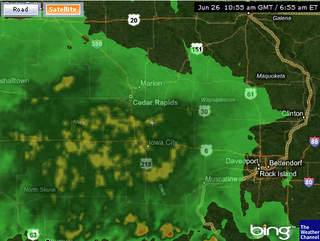
Access to Weather Information. This almost goes without saying, but access to current weather conditions has made life better. The quality of hourly forecasts has improved, and one can plan the day around them.
Conventional wisdom is there are two tickets out of Iowa after the Democratic caucuses scheduled Feb. 1, 2016—the front-runner and one other.
2008 caucus results might be used to argue there could be three, but 2016 is no 2008: two tickets is the number.
If New Hampshire ratifies the Iowa results, we will have our nominee. If the Granite State doesn’t ratify, the nominee will be decided by South Carolina. Given the current political climate, I feel very confident about this.
Democrats have five candidates who expressed interest in running for the nomination as president. Of these only three are viable—Hillary Clinton, Martin O’Malley and Bernie Sanders.
Lincoln Chafee of Rhode Island announced for president, and Jim Webb of Virginia established an exploratory committee, but they fall victims to the honored tradition, “snooze, you lose.” Neither of them capitalized on the pent up demand for Democratic political action to fill the void created by the vast and well publicized Republican field in early 2015.
Hillary leads in the early polling. While she is neither inevitable, nor seeking a crown, she has been a part of the public discussion for so long—arguably since her 1996 book, It Takes a Village—she has name recognition and a presence in American society that creates a substantial obstacle for Democratic presidential challengers to overcome. O’Malley and Sanders are doing “the Iowa work,” garnering substantial attendance at their events. Nonetheless, it seems clear they are vying for the second ticket out of Iowa.
The question is not as much whether Clinton will win the Iowa caucuses. It is whether having three contenders will generate enough interest in partisan politics to build a coalition that can win Iowa—perhaps a swing state in the general election—and win the 2016 general election. That is the uncertainty going into caucus season. I, for one, am trying to be part how that plays out.
Both the administration of elections and the electorate have changed since Bill Clinton’s first election as president in 1992. What matters more than the outcome of the caucuses (Tom Harkin and Uncommitted got the two tickets out of Iowa that year) is the redistricting processes of 2000 and 2010 that created electoral maps which relegated decisions on national elections to a comparatively small number of swing states. There is also a flight from partisan politics, as reflected in the Iowa voter registration numbers, where no preference is a larger group than either political party.
We can support or detract from the Iowa caucuses as much as we want, but campaigns have to be more about the general election than collecting caucus cards from Democratic activists. This is an advantage to Hillary Clinton’s campaign.
The Iowa Democratic Party has become reliant on national interest in the Iowa Caucuses to generate financial resources which pay for campaign offices and staff to do the party work. Prominent figures in the party have publicly said so. That’s the reason we have an interest in remaining first in the nation, and having a “competitive” caucus.
To put this into perspective, it is important to engage in politics. The most productive work we can do is talk to people we know about issues that matter. We could also debunk the myth that we are polarized, except in the non-functional congress which we have the power to change.
My take away is worry less about the outcome of the Iowa caucuses and turn our attention to winning the general election. They are related, but not the same, and that is an important distinction.
The premeditated killing of an Iowa Children’s Museum employee by a mall security guard in Coralville on Friday will have ripples in the community beyond the current news cycle. It was murder, the very definition of the word.
“In cases like this, where the shooter confesses to premeditated murder, there is a case to be made for capital punishment,” I said.
“Oh?”
“I understand you came up as a Quaker, but still,” I replied.
“I can think for myself.”
So too can we all.
Of the people I spoke to about the shooting, only one had been at the mall when shots were fired and was visibly shaken. When there is a murder in an innocuous place—to which most locals have been at one time or another—something changes. Murder becomes personal.
The movie theater gave rain checks to ticket buyers as the mall closed after the shooting—a sign of hope life could return to normal.
There will be a memorial for the victim later this morning at the mall, said the county attorney at a Saturday press conference.
Listening to Martin O’Malley in Mount Vernon Photo Credit O’Malley Campaign
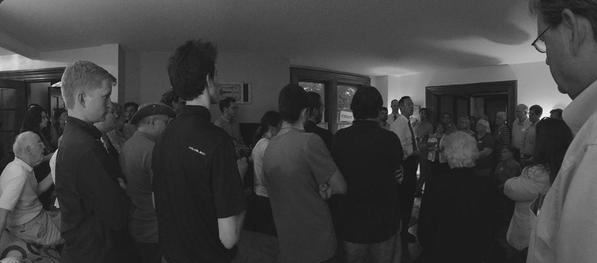
MOUNT VERNON—In his family’s modest living room, Nate Willems introduced former governor Martin O’Malley to about 75 guests on Thursday.
O’Malley announced for president May 30 and was a regular presence in Iowa during the run up to the 2014 midterm elections. Because of that, Democratic activists are sympathetic to his message and polite. Not a lot signed support cards at the end of last night’s speech. It may be too early for that.
The message was about O’Malley’s 15 years of executive public service as mayor of Baltimore, Maryland from 1999 until 2007, then as governor until January 2015. Among his twitter hashtags is #newleadership, presumably differentiating himself from the Clinton/Bush dynasties. He was concise and repeated those points during the house party.
In my April 11 post I asserted, “O’Malley is a story teller. Will we like the narrative?” That observation was borne out last night.
O’Malley stumped on core Democratic issues, similar to the April speech. It’s hard to find fault with his broad positions. On climate change, I don’t like the narrative.
An audience member asked O’Malley what he would do as president about CO2 and methane emissions. The answer to this is easy. President Obama presented the U.S. plan for reduction of greenhouse gas emissions to the United Nations Climate Change Conference, or 21st Conference of the Parties in Paris this December. The U.S. plan relies upon the Clean Power Plan advanced by the Environmental Protection Agency for most of the proposed reductions. All O’Malley had to say was, “I support the Clean Power Plan” to satisfy climate voters. He didn’t.
Instead of a simple answer, he changed the question to one about “climate change.” He enumerated 15 things he did as governor to address climate change. It was an admirable punch list, but reducing CO2 and methane emissions is not the same thing. He missed the point of the question.
His brief statement on the campaign website did not provide much depth either:
Launch a Jobs Agenda for the Climate Challenge
Clean, renewable sources of energy represent one of the biggest economic opportunities in a century. And the threat of climate change is real and immediate. We must make better choices for a more secure and independent energy future—by limiting carbon emissions, setting renewable energy targets, driving innovation, seeding new industries, and creating good local jobs.
My take away from the event is that before I sign an O’Malley card for the February caucus, I need to get beyond the superficial narrative created for the campaign. Not just about climate change, but about each of his positions. This is Iowa, so that’s possible.
Some of my regular political companions were dismissive of O’Malley last night. I’m not ready to cast aside any of the five in the game at this point.
Political Miscellany
For the first time I interacted with a candidate’s D.C. staff via twitter. I posted this message:
Haley Morris, O’Malley’s national press secretary, liked my tweet.
While I was at the house party, first congressional district Democratic candidate Monica Vernon called. It was very noisy, so I explained I didn’t have money to donate, and when she was still interested in talking to me, asked her to call back in an hour after the O’Malley event.
I called her and we talked about ways I could help her campaign, even though I live in the second district. Of the three Democrats in that primary, she seems to be the only one really working.
I track how many views each post gets when I am live tweeting an event. It tells me whether or not there is an audience. Curiously, the following tweet had not been viewed by anyone. Could that mean someone is moderating the twitter without us knowing and behind the scenes?
Finally, I appear in the right side of the frame of the photo above. The women who took it almost knocked a lamp over getting into position with me behind the Willems’ couch. Note my ear seems very large compared to the image of the candidate. At least with that big ear I was listening.
A Bloomberg/Des Moines Register poll published last week contrasted how Democrats and Republicans weigh subjects in their approach to selecting a candidate running for the 2016 nomination for president in their respective parties.
Republican likely caucus goers surveyed were most interested in the budget deficit, national defense and taxes; Democratic likely caucus goers surveyed were most interested in energy, income inequality and the nation’s infrastructure.
One of the few places the two results were close was on job creation, favored by both Republicans and Democrats 86-14. The partisans have different approaches on how best to create jobs.
This framing of Republican versus Democratic by news organizations does us a disservice. It perpetuates the lie that people are divided.
For those of us who talk a lot to people from diverse backgrounds, we can see it is simply not the case. More people want to join together and work toward a common goal than get involved with political discussions.
That is especially true in our small community where we can join a non-profit, serve on committees, volunteer at the fire department, at church, or at the library, or if we are simply celebrating a special event like our sesquicentennial, or hanging out Wednesday night for music in the bandstand. Political party preference just doesn’t matter that much.
There is data to back this up.
According to the May report of the Iowa Secretary of State, the number of no party preference active voters in Iowa House District 73 exceeds either of the main parties by a distance (with 1,492 more no party registrants than Democrats and 1,817 more no party registrants than Republicans).
My point is this: we have more in common with each other than we disagree. What matters more than partisan debate is working toward common goals.
Large news organizations may not get this, but if we look around at the familiar faces near us, we should.
I have been spending time near Linn and Market Streets in Iowa City for most of my adult life. I lived on Market Street after getting my master’s degree—my last long stint of bachelorhood before marrying in 1982.
Within a small radius, so much happened that anytime I return, the trip is imbued with memories. But for the traffic, I would stand in the intersection for hours. I mostly settle for a window seat at the nearby coffee shop for my daydreaming.
Our daughter was born here, and performed the role of a dog on Gilbert Street. It was also one of the few times I remember her performing the guitar in public. We had breakfast at the Hamburg Inn No. 2 after pulling all-night security at Riverside’s Festival Theatre in City Park. Hamburg Inn No. 1 was gone by then.
“Shady streets, very old white frame houses, porch swings, lilacs, one-pump gas stations, and good neighbors…” wrote W.P. Kinsella in Shoeless Joe. “We have a drugstore with a soda fountain… It’s dark and cool and you can smell malt in the air like—a musky perfume. And they have cold lemon-Cokes in sweating glasses, a lime drink called a Green River, and just the best chocolate malts in America. It’s called Pearson’s—right out of a Norman Rockwell painting.”
Pearson’s is now the bank in the photo.
We still favor Pagliai’s Pizza and I bring home a pie from time to time when I’m near around supper time. It is one of the places that hasn’t changed much through the years.
Down the street on Jefferson the university had a portable building where students could drop off punch cards to run on the computer in the early days of programming. Who knew what computing would become?
I was briefly enrolled in James A. Van Allen’s astronomy class—a chance to learn from the legendary physicist directly. I had to drop after registering for more classes than I could handle that semester. More than any teacher I remember, he stretched the limits of my ability to learn.
After so many years of wanting to hear him, when Saul Bellow read from Something to Remember Me By at Macbride Hall, I did.
I met James Hansen, Bill Fehrman, Beau Biden, Elizabeth Edwards, and heard countless speakers—too many to list. With each visit I recall one or another who made an impression. How could I forget Toni Morrison, introduced by Paul Engle, and the bat flying around her head at Old Brick?
I bought books at Murphy Brookfield, Prairie Lights, Iowa Book and Supply, the Salvation Army, the Haunted Bookshop and at the State Historical Society. I still have most of them.
Rich with 45 years of memories, I look forward to each return to Linn and Market—for a cup of coffee, a meeting with my nearby editor, and often, just to sit and remember before a meet up with a friend or two. For me, it will always be home.
We’ve seen it so many times before progressives should be used to it.
The folks at Run Warren Run, financed partly by MoveOn.org, threw in the towel and are “suspending operations,” according to the MoveOn.org website. Hard to run a campaign when Senator Elizabeth Warren said repeatedly she’s not running for president in 2016. Fanboys and fangirls are nonplussed and will literally move on.
Non-Democrat Bernie Sanders announced his Democratic presidential ambition April 30, and pent up demand for a left-leaning presidential candidate burst the scene the way @POTUS and @Caitlyn_Jenner set records for ramping up Twitter followers.
Politicos are enraptured in fandom.
The allure of candidates who fit an intellectual ideal drew me in too. In 1980 it was Ted Kennedy; in 1984, George McGovern. After that, I was busy with a career and life, and moved to Indiana where the presidential elections seemed less important than they do in Iowa. No one else generated this type of excitement, especially when we’re in it for the long term.
Make no mistake, Sanders drew reasonable crowds at his Iowa and Minnesota events. They haven’t reached the bin-buster level yet, even if the room was too small at the Robert A. Lee Recreation Center in Iowa City last Saturday, and he drew several thousand people in Minnesota on Sunday. He’s had a good campaign launch, but as Slate points out, the front runner has little reason to worry.
While Sanders confidently told Katie Kouric, “My goal is to win this election,” his election is as likely as those of Presidents Ted Kennedy and George McGovern unless he begins to ramp it up among caucus-goers who are swing voters.
There’s no talking to most fan boys and girls about this. I’ll note one of the very few political questions I’ve heard on the street and at the convenience store has been “Did you see Bernie Sanders?” There is something there.
The art of politics is partly about excitement in a campaign. The problem is people don’t seem to be able to distinguish between events in the corporate news cycle and excitement, let alone momentum (whatever that is).
Note that no 2016 Democratic candidates for president are in Iowa this week.
Yesterday’s article by Paul Waldman of The American Prospect asks the right question, “Does the Iowa Caucus Still Matter?” He correctly points out that our star was diminished by the Republicans in recent cycles. While Jimmy Carter made the most of the caucuses, his style of personal campaigning will be, if it already hasn’t been, relegated to the dustbins of history.
Fandom is not for me, any more than cosplay or being a Trekkie has been. It is a form of enthusiasm, as described by the little known theologian Monsignor Ronald Knox. Not good for the long haul, even if Bernie Sanders has devilish eyes.
Memorial Day is mostly about the Civil War. These shirt tail relatives and at least one direct ancestor pictured here (Thomas Jefferson Addington) made it back, but many did not. Men from this Virginia county fought both for the Union and the Confederacy. The photo was taken Memorial Day, 1912. I favored the Confederacy when I was young, but once understanding came, switched sides.
It’s a mixed bag as to whether people understand the meaning of Memorial Day. It’s not Veterans Day. We have another holiday for that. Many politicians get it wrong and talk about taking care of veterans. Today is about remembering soldiers who gave their life in the line of duty.
This is also the first of four days mostly off work and I was at it early. Reading in bed at 3 a.m., up around 5 a.m. to work in the kitchen, and then outside to mow at 2 p.m.
When I finished the mowing, I took a rake to the turned soil, working it for tomorrow’s planting if the dry holds. The vegetation in our yard is growing out of control. Four days may not be enough to get the yard in shape.
During the peasant’s revolt of 1381, 14 year-old King Richard II capitulated completely to the rebel demands at Mile End. He ended up reversing his decisions, but for a brief moment the peasants rose up, believed they had ended their servitude and changed the course of history in ways we can’t even fathom today. The pessimist in me says it was inevitable Richard’s promises would not be kept. The optimist in me looks to the possibility of common people joining together in a cause to overturn, even if only for a while, the status quo and embark on a new and more just path in society.
Have to hope the latter is possible and that it has some local application.





 Journey Home
You must be logged in to post a comment.