In these waning hours of spring I have no regrets.
There are challenges created by the coronavirus. There is a legacy of challenge from the before time. Many are substantial and require action. Summer starts at 4:43 p.m. today and with its new season comes hope of means and methodology to address what challenges us in a new paradigm.
Last night I had planned to escape into one of my favorite movies, The Matrix most likely, although Out of Africa or Blade Runner maybe. Instead, I listened to former Barack Obama campaign manager David Plouffe interview Joe Biden’s campaign manager Jen O’Malley Dillon. The podcast made me hopeful that Democrats could win the Nov. 3 election. For my first ever podcast, it was not bad.
I became familiar with O’Malley Dillon when she was Iowa State Director for John Edwards’ presidential campaign. I re-read some of her emails from 2007 this morning and don’t have a memory of meeting her in person. She became part of the 2012 and 2016 Democratic presidential campaigns. She knows who she is and what she’s doing.
While I listened through headphones that cover my ears, I began to walk about. I had to roll up the 12-foot cord and stick it in my pocket so I wouldn’t trip on it. I did dishes and started a load of laundry that included my used home made face masks. I’m not a pod person but might be if others are this engaging. What she said revealed where political organizing stands in the coronavirus pandemic.
O’Malley Dillon thought the entire presidential campaign would be conducted virtually. She reported how the rate of contact through text messaging was high, and that because of the coronavirus it was important to keep canvassers safe. I am reluctant to relinquish in person campaigning and adapt to text and phone banking. The podcast put me on the way to overcoming my hesitation and joining the campaigns of Biden, Greenfield and Hart as a canvasser.
The tradition of canvassing is long in my family. My father organized for JFK in 1960. Working with his union, he was part of a substantial effort to elect Kennedy. Even though Richard Nixon won Iowa with 56.7 percent of the popular vote, our family celebrated Kennedy’s election. After the assassination, I did a small part in helping elect Lyndon Johnson by a landslide. Taking the in person part of canvassing out because of the coronavirus goes against the grain.
So much is at stake in the Nov. 3 election we have to get involved. While I’m busy with our garden I’m also figuring out how I will engage to elect Democrats. O’Malley Dillon and Plouffe put me on the road to doing that before the Summer Solstice.
Shopping in person is my least favorite thing in the third month of the coronavirus pandemic.
I dislike losing control and exposing myself to maladies real and imagined. Since the pandemic is real, personal shopping activities are reduced to a minimum. That bodes ill for the economic recovery. Our household will be just fine with less shopping.
Some stores require customers wear a mask and others don’t. I have two clean, homemade masks in the car with me and wear them into retail establishments. Most retailers have taken action to protect their workers, but customers? “The customer is always right” has taken on new meaning.
In our neighborhood things are loosening up. We live next to a large lake. Foot traffic to the boat docks and trail was heavy over the long weekend as families made their way to get out of the house. A couple of residents are planning yard sales in early June. Rest assured there will be no social distancing in those driveways and garages. One neighbor plans to walk the streets to distribute popsicles in celebration of a child’s birthday. Don’t get me started on the ice cream truck that plays an annoying version of Scott Joplin’s The Entertainer while hawking wares. At least the parcel delivery drivers wear masks, if the USPS contractor does not.
The small town convenience store is a barometer of what’s going on in the community. I had to get gasoline to finish mowing so I stopped at one on the way to the CSA to pick up our weekly share. I paid at the pump. Tension rested over everything as I stood fueling. They were busy yet activity seemed subdued compared to previous holiday weekends. No one was wearing protective equipment. I used only my right hand to touch anything. When I got back in the car I cleaned up with a sanitizing wipe kept for that purpose.
I didn’t go inside to play the lottery, which I normally like to do. Last time retail clerks wore masks and gloves, although they hadn’t put up a plexiglass barrier like other convenience stores. That was several weeks ago and they may have changed. Money is dirty whether there is a pandemic or not.
We are out of milk. That’s the sign it’s time to make a shopping trip. Dread it though I do, I’ll venture out. I have a list so I can spend the least possible time inside the store. There won’t be any impulse purchases today and that’s bad for the economic recovery as well.
Being an American is a mixed bag. We have some of the smartest people on the planet working on big issues, but everyday folk could care less. Part of the problem is a lack of political leadership. Part of it is tied to a progressive deterioration of learning. Everything gets politicized and in practice facts have been cut loose from their mooring. We are on our own to study and make a determination of what to do with our lives. Some call that “freedom.” I call it re-inventing the wheel.
If the past weekend taught anything it is summer will not be repressed. People have priorities and one of them is re-enacting trusted and valued behaviors. In the age of the coronavirus people will have their summer. I believe most of us will survive. What do I know?
Friday J.C. Penney filed Chapter 11 bankruptcy, another victim of the coronavirus pandemic.
To say I disliked the in-store experience is an understatement. To say how much I loved the on-line experience is impossible. They are a great alternative to Amazon where we can find affordable attire. Fingers crossed they come out of bankruptcy.
What will a retail experience look like on the other side of COVID-19? I don’t think anyone knows.
I’m reading another Obama administration memoir, this one by Ben Rhodes. I also read Samantha Power, David Plouffe, Jill Biden and Michelle Obama. On the bookshelf waiting is Susan Rice… I’m just passing time though, until the big guy’s book is finished and released.
It’s hard to believe the Obama administration existed at all in the age of Republican control. It’s like an Arthurian legend we lived through except now it is transformed into myth. So much so it’s easy to believe it never happened. It did happen and the memoirs serve to remind us of another possibility than the one dominated by a needy president.
I stopped and stood outside the garage breathing the fragrance of lilacs. They are close to full bloom and won’t last much longer. It is difficult to stop and experience flowers yet we must. A lot depends on the fragrance of lilacs.
I participated in a Zoom conference with friends yesterday afternoon. We are on the last mile of cable with our internet provider and the connection is sometimes inconsistent. After being dropped five times during the call I gave up. It was good to see everyone again, even if intermittently.
Life on the other side of COVID-19 will be different. For me, it precipitated full retirement and that change alone is big. There’s more though, and not just about one person’s experience of the pandemic. If anything, we are getting used to living with less. That should be good for us, and good for society. I’m confident J.C. Penney will try to adapt to the new reality. If they don’t, the world will be the less.
The lilacs will soon be in full bloom. They don’t last long. What does?
Social distancing in the coronavirus pandemic has me well ahead in the garden, creating an in between time to consider life’s possibilities.
This week I plan to plant tomato and pepper seedlings and get everything I can into the ground. We are past the last frost, although with as chilly as it’s been, things aren’t growing well yet. There’s no hurry.
That said, there has been plenty of arugula, lettuce, spinach, spring garlic, pak choy, mustard greens and spring onions. What we don’t get in greens from our garden we get from the CSA spring share. I have big salads on the dinner menu three times this week and side dishes of stir fried greens every other day but Friday. When I was a younger gardener I didn’t understand the importance of greens to the enterprise. Now I do.
I’ve taken to hanging a U.S. flag over the garage door. The one I use flew over the U.S. Capitol. I paid $16 for it through our congressman. For a long while I flew the flag I took with us on field maneuvers in the Army. I flew that one from the radio antenna during non-tactical road marches. It got worn so I replaced it. Flags wear out. Everything does.
I’m down to my last face mask so Jacque has been getting input on what kind she should make for me. The one I have is a dust mask from the garage workshop. It fits snugly. It serves. The new one will have parts of an obsolete vacuum cleaner bag as the filter medium. While Americans have poor discipline in their behavior to prevent spread of COVID-19 (or lack of discipline, more likely), we’ll do our best not to catch it or transmit. The main thing is going out only when we need to. With the garden and plenty to do inside it shouldn’t be a problem. It’s better for us anyway.
Today’s challenge is figuring out what to do beyond getting through each day. I’d been dodging the idea of retirement and now that the pandemic flipped me to this new status I’m not sure what to do with the rest of my life. I’m not used to working without a clear plan. I need to make one and for that I need new priorities. It’s an in between time for now and those decisions will be delayed for another day.
For the time being, the allure of lilac scent beckons me outside.
When I was a grader, Mother would send me to the corner grocery store to secure provisions for the evening meal.
We had a corner grocery store. It was a block and a half away from home. There were no supermarkets within walking distance.
I don’t recall its name. A family owned it and the husband was the butcher. When it closed, run out of business by the multi-location Geifman Food Store that situated a block and a half away, they moved to the west end of town where the butcher was murdered in his store.
I was a paper boy for the Times-Democrat. The hyphenated name is from a 1964 merger into what eventually became part of Lee Enterprises and is now the Quad-City Times. I delivered the evening edition after school and the corner grocery was near the end of my route. At that time paper boys collected subscriptions directly from customers. When I finished weekly collections I’d stop at the store to buy a package of baseball cards or a candy bar. I remember a six-pack of 10 ounce bottles of Pepsi sold for 60 cents, the lesser known sodas bottled a few blocks away sold for 54 cents. Mother discouraged us from drinking soda.
The corner grocery store was an important part of our family life. Then it wasn’t.
Grandmother grew up on a farm and knew how to cook. She knew where food came from and how to prepare a live chicken. In our early years she lived near us, next door when I was a toddler, upstairs when I was in the first grade. After that she was a regular guest for Sunday dinners and special occasions like Easter when she checked in with her grandchildren and helped mom in the kitchen.
In the 1960s we began to eat more food prepared outside our home. Mom also began experimenting with different food preparations. We developed a taste for tacos and I recall the corner grocery didn’t carry some Mexican ingredients we liked, requiring me to walk to nearby Geifman’s. It was a sign of the end of the corner store.
In 1966 Joe Whitty moved to Davenport and ended up living with his young family in a rental the second house north from ours. It was across the street from a family that owned the dairy. He worked at the nearby hospital where I had been born, first as a baker, then as dietary director. He went on to establish a chain of pizza and ice cream stores. One of the ice cream stores ended up on the lot where the corner grocery store had been, although after I left Davenport.
On the other side of the church where I was baptized, about two blocks away from home and next to the Geifman Food Store, was a restaurant called Chicken Delight. They had a radio jingle, “Don’t cook tonight, call Chicken Delight.” The chain was founded in Illinois in 1952 and grew to have more than 1,000 locations. It was a take out and delivery only place and I don’t recall eating their chicken during the eleven years I lived at home there. Without the dining room we had little interest. If we had their product at home, I have no memory of it.
Chicken Delight was not known for its quality as each store followed their own cooking process, sometimes with their own equipment. That’s unlike the McDonald’s franchises which grew to prominence in the 1960s. McDonald’s prided itself on consistent quality in all their stores. They even had a “Hamburger University” near Chicago to train managers in how to operate with consistent results. Today there are not many Chicken Delight stores and most that remain are located in Canada. The women in our house knew how to make chicken and the family consensus was ours was better. Eventually one of the former neighbor’s pizza restaurants located in the Chicken Delight space.
That’s not to say we didn’t dine out in the 1960s, we did. We favored local, family run restaurants like Riefe’s Family Restaurant and Bell Eat Shop. Our parents knew both families. When McDonald’s built a restaurant on Brady Street we drove over there as a family once in a while. Their burgers and fries were different from Mother’s. They were cheap too. We ate in the car. We also drove to the A&W Root Beer stand where servers brought trays of food and drinks that hung on our car windows. The rise of automobile culture made home delivery pizza popular and inexpensive.
Grandmother would take us to Bishop’s Buffet on special occasions. We enjoyed being able to pick what we wanted from a generous selection of items like Mom and Grandmother made at home. In some ways it was a form of nostalgia. Grandmother insisted on paying the bill. These family events were important to her.
That’s the range of our 1960s dining experience outside home. A lot has changed since then. When Grandmother was born in the 19th Century people cooked most meals at home or took a dish to a potluck for weddings, funerals or other occasions where they ate what others had prepared. Prior to the current pandemic food prepared outside home comprised more than half of American diets according to the USDA. When the coronavirus recedes I expect there will be a rebound in restaurant eating.
It takes work to remember these things. Memories are not always accurate. What is important now may not have been important then. In the end, it is up to the author to research and present each story leaning on known facts. We must resist the temptation to tell a story only because the narrative flows or with ideological intent. It is hard to listen to one’s own voice and ignore what others may have experienced or have to say about something. We each own our memories even though there are shared experiences. We must be true to ourselves.
I’d like to be writing more pieces like this. I hope I will.
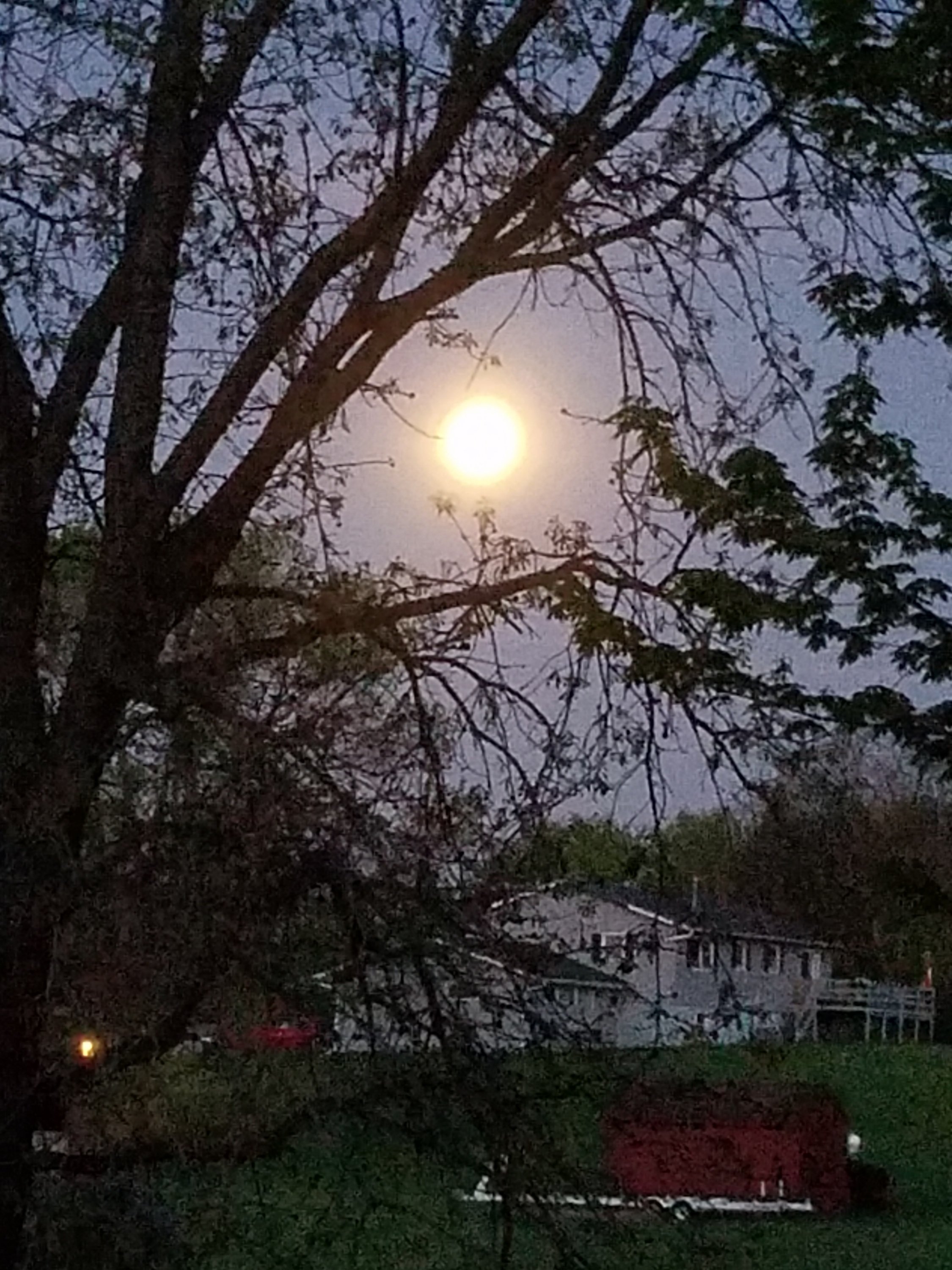
Supermoon viewed through the atmosphere, May 7, 2020.
I participated in a United Parcel Service webinar about challenges posed to supply chains by the coronavirus pandemic.
Rich Hutchinson of Boston Consulting Group presented an overview of our response to the pandemic that made plain, clear sense. He used three Fs — Flatten, Fight and Future — to frame his discussion.
We read and see a lot of information about the pandemic. In Iowa we fixate on daily reported number of cases and deaths. We need a break from that. The take away from Hutchinson’s analysis was as global corporations and mid to large size businesses use the pandemic to re-engineer their approach to supply chain and how they operate their businesses, regular people should be doing the same.
We understand what flattening the curve means, the first F. By reducing spread of COVID-19 we take the peak load off the bell curve of hospital bed usage and ventilator deployment so our health care system can handle the pandemic. In Iowa we began flattening the curve eight weeks ago with the governor’s March 9 proclamation of a disaster emergency due to COVID-19. Thus far the health care system has been able to handle the caseload. Hutchinson expected this phase of the pandemic to last several months with regional variations depending upon the extent of community spread of the disease.
Recent surveys show most people are not ready to end sheltering at home and restriction of business operations, although the president and the Iowa governor favor easing restrictions now. Governor Kim Reynolds issued new orders to ease restrictions yesterday. Whether we agree or disagree with elected officials’ approach, at some point people have to do more than shelter at home and shop on line or in limited trips to retail establishments that remain open. When the flatten the curve stage of the pandemic is over, COVID-19 will persist into the next phase. To cope with it, new approaches to what we previously took for granted about social interaction must be developed and adopted.
The second F, fight COVID-19, is not much discussed, but needs to be. Fighting the pandemic is expected to be book ended by an end to the first phase (i.e. the curve has been flattened) and development and implementation of either a cure or herd immunity. Policy implemented during the flatten the curve phase continues but will be relaxed. It could get ugly. Cases of COVID-19 continue to exist and spread during the fight phase, including additional significant outbreaks. The expectation is this phase will last another 12-24 months until there is a cure. This is the scariest part of the pandemic because as severe restrictions on business and social interaction are relaxed, identification of cases of COVID-19 and deaths are expected to continue in our daily reporting.
The most important phase is our future, the final F. I’m concerned about what the future will look like. My spouse retired last year and I retired last month because of risk of COVID-19 exposure. It seems likely my consumer behavior will change and be more limited than it was last year. With retirement this would happen without COVID-19. Society is not in a place where it makes sense for our political leaders to tell us “the economy is opening.” Nor would the advice President George W. Bush gave as we were coming out of the recession, “to go shopping,” make sense. I empathize with small business owners like cosmetologists, nail salon operators, and barbers who are itching to get back to work and generate operating income. At a minimum we need to deal with the pandemic for at least another couple of years and accommodate new behavior to protect us from the disease. How will businesses create needed changes in light of an extended pandemic? Our path forward is unclear at this writing.
If the question is whether workers will offer themselves as human sacrifice on the altar of late stage capitalism, Americans seem unlikely to do that. That’s not who we are. We expect more from our political leaders than they have given. The vacuum of leadership at the top — the president, the legislative branch of the federal government, and the Iowa governor — created a disconnect between corporations which can lobby government and people like me who lack such standing and may be forced to return to society beyond its digital aspects. My bottom line is no one is providing us with the type of information we need to make it to the new future us. That is as much a problem as the pandemic itself.
The first step in developing a future, post-pandemic life is recognizing our current location in the process. For a newly retired person it is easier to develop a future life than for those in their prime earning years. Our lives depended on so many beliefs and assumptions which have now been scrambled. If nothing else, Americans are a resilient people and we’ll figure it out together. Here’s hoping.
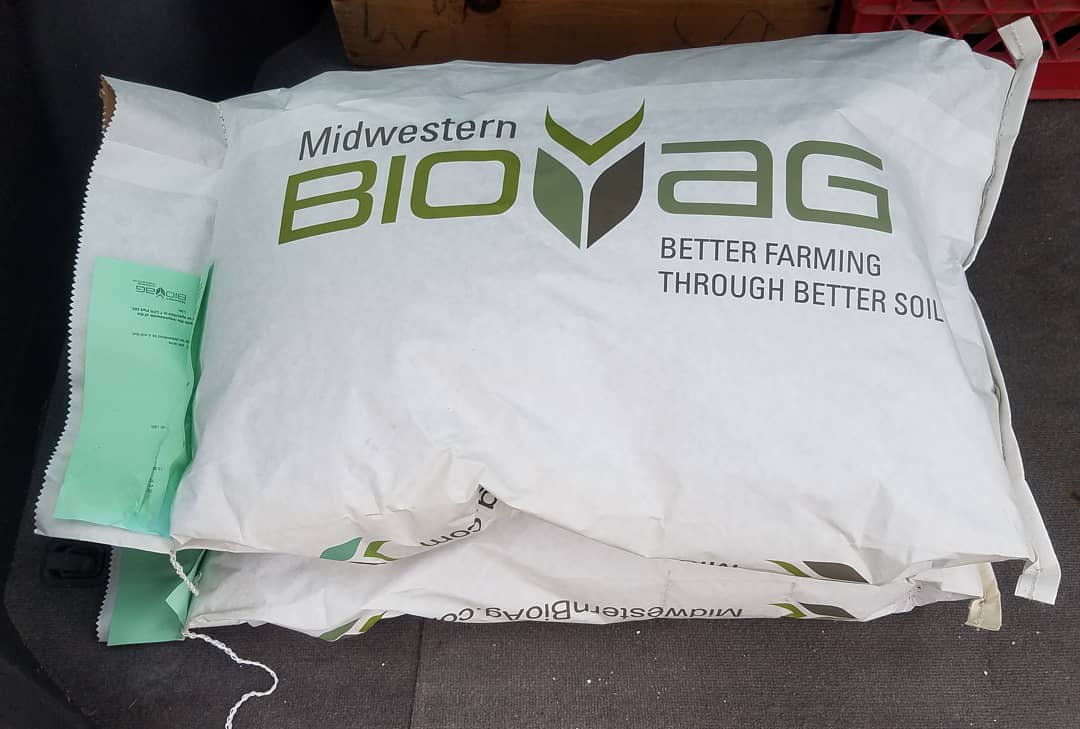
Aerobically composted chicken manure granules for garden fertilizer.
It rained overnight. The driveway was damp as I stepped outside to look at the sky. Clouds were clearing and the big dipper stood out, pointing to the North Star. We are not lost.
It’s a good day to live.
As of yesterday the official number of deaths from COVID-19 was 21,050. By official, I mean those submitted to the National Center for Health Statistics and recorded based on death certificates. There is a lag in the data as the coronavirus reaches exponential spread in the United States. It takes a while to prepare and submit death certificates.
Iowa is in dire shape. We’ve slowed growth of the bell curve yet a surprising number of cases in meat packing plants and care facilities drives the number of cases upward. According to the Institute for Health Metrics and Evaluation, “After June 26, 2020, relaxing social distancing may be possible (in Iowa) with containment strategies that include testing, contact tracing, isolation, and limiting gathering size.” June 26 is two months away. We’re not out of the woods, and we can’t see the edge of the forest.
I donned protective garb and went out. On Tuesday I went to the wholesale club to provision up on dairy, fruit and vegetables, and a few pantry items. Grocery shopping is my least favorite thing during the pandemic, so I got enough to make it another two weeks.
Yesterday I drove to Monticello to pick up two 50-pound bags of aerobically composted chicken manure crumbles for the garden. I followed their limited contact pickup procedure which was writing the check at home and turning it in after I backed up to the loading door. The warehouse worker loaded my trunk while I returned to the driver’s seat. I also stopped at the public library to pick up supplies for the volunteer project on which my spouse is working. No contact social distancing all around.
In a certain sense, we just crashed into the isolation that is social distancing. A couple of things clarified. I’m not sure I will return to work at the home, farm and auto supply store after my 30-day leave of absence. If I do resign, I doubt I’ll reapply any time soon. It also seems clear our pensions will pay our basic bills with something left over. We’ll continue to pay down debt, although likely at a slower pace.
My daily life remains an educated mishmash. My schedule from 3 a.m. until sunrise is pretty good. It’s the rest of the day that seems to have little planning. What holds me back is besides gardening and a few household maintenance items, I don’t know what will be my main direction after the pandemic recedes.
There is no going back to a life lived prior to the pandemic. These days are good preparation for living more with less resources. Maybe I will be able to retire from paid work. If retired, I’ll still need productive work. In the middle of the coronavirus pandemic it’s hard to determine what that is. Defining post-pandemic life will take deliberate planning. If I approach it with considered hesitancy, it’s because I know what’s at stake.
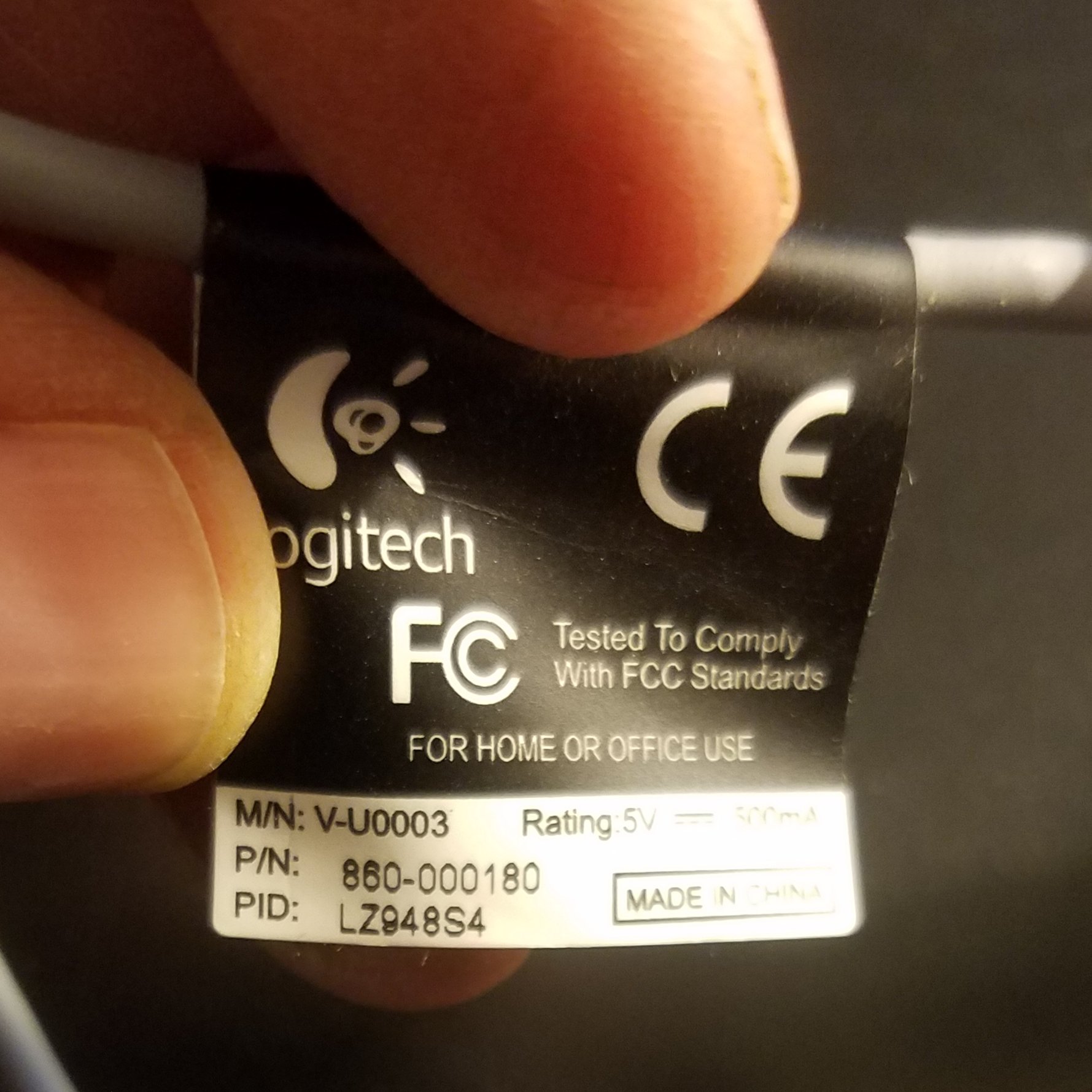
Identifying the Logitech C250 web camera to find a driver.
It’s been 21 straight days of posting about life in the coronavirus pandemic. Thanks for reading. Two things became clear:
First, life as we knew it was scrambled and for the most part that’s been a good thing. When social good comes in the form of staying at home and distancing from others in public to avoid spread of the virus, it’s not a huge personal challenge for a retiree. Many of us needed relief from a busy schedule where it was hard to keep up anyway. The least important parts of my to-do list have fallen off, enabling focus on better priorities.
Second, the coronavirus will be around for a while, into 2022 at least. Once a vaccine is developed, we expect COVID-19 will be among the diseases addressed in annual flu shots. For those of us who get our flu shots, that’s a positive. We’re not there yet, but there is confidence in scientists working to understand the virus and developing a response. For now, we wait. What else is there to do as vaccine development takes time.
My last shift at the home, farm and auto supply store was on April 2 before taking a coronavirus leave of absence. I’ve gone to the farm for two shifts with another today. We practice social distancing in the greenhouse, which means most of my time is spent alone, doing my work. I’ve been grocery shopping twice, wearing a mask and trying to stay away from other shoppers and staff. I picked up volunteer work for my spouse at the library where the worker brought it to the door. We maintained a distance and chatted for a couple of minutes. She’s also one of my kale customers.
There is already pent up demand to get among people again, not just for me, but generally. In Iowa the number of confirmed tests for COVID-19 is still increasing, as are the number of daily deaths reported by the Iowa Department of Public Health. We are a distance from resuming normal activities as the “curve” is still progressing on the upward side of the bell. So we wait.
When I interviewed a U.S. Senate candidate on Thursday, we used the newly popular video conferencing platform Zoom. Since I didn’t know we were using Zoom until minutes before I was to log in, I didn’t have time to address my lack of a web camera. It looked pretty lame for just my name to show on the screen, although the interview went reasonably well.
A physician friend gave me his old monitor for my desktop when he upgraded. It has an October 2003 manufacture date. My technology works, but it’s old.
Digging through boxes of electronic gear, of which there seem to be a large number, I found the Logitech C250 web camera that plugs into a USB port, downloaded the driver, and am now ready to go on Zoom, Skype or whatever platform requires it. With social distancing, I’ll need it, probably.
No end to the pandemic is on the horizon. At the same time, the advent of spring is undeniable. A time of hope, of making plans, and for planting seeds. This year I’m increasing the productivity of the garden by using more space. Friends and neighbors may need the produce as the coronavirus pandemic continues.
At noon yesterday I decided to take a 15-hour break from reading news.
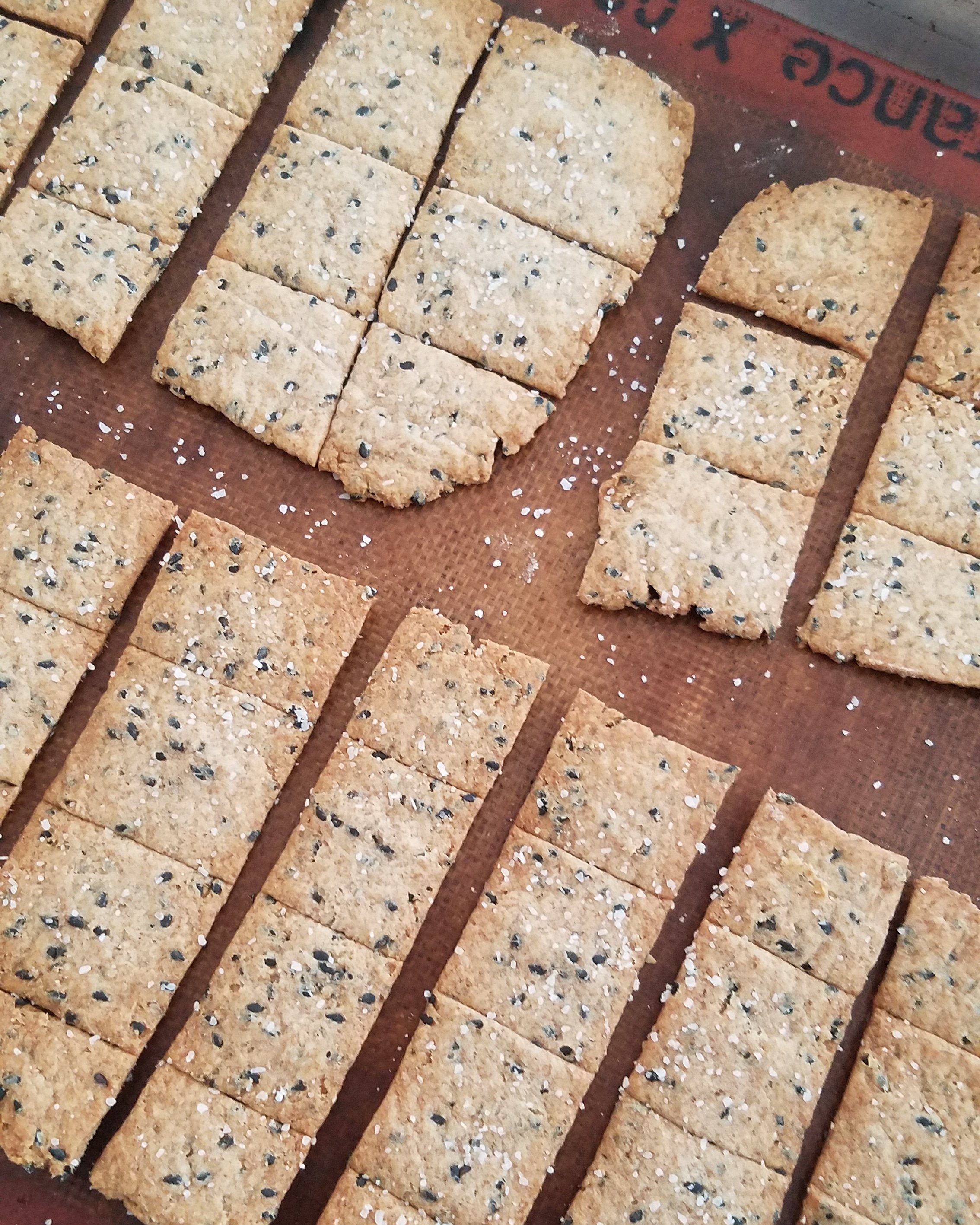
I got work done in the house, including making the crackers in this photo.
I slept through the night and feel ready to go. There is pent up demand to get outside in the garden, conditions are favorable, it’s all systems go.
Part of dealing with the coronavirus pandemic is managing time while social distancing. When the weather keeps us indoors for a couple of days we don’t want to go crazy. The news makes me crazy. Now that I recognize that, it’s possible to do something about it.
Once the sun comes up, it’s out to the garden I go.
Last night’s snowfall should melt by sunset as the forecast is ambient temperatures in the 40s. The sound of melting snow moving in the gutter is already background for this morning’s work.
Three inches of heavy, wet snow is melting on the car parked in the driveway. I won’t get into the garden again today. Early vegetables are in, so no worries.
Last night I participated in a Facebook live interview of former Admiral Michael Franken who is running in the June 2 Democratic primary election for U.S. Senate. With the coronavirus pandemic, in person interviews are taboo. We discussed his name recognition, the climate crisis, arms control, media reform, the postal service, federal research funding of infectious disease in livestock, unions, China, and the military budget. Here’s the link. My interview ran about an hour.
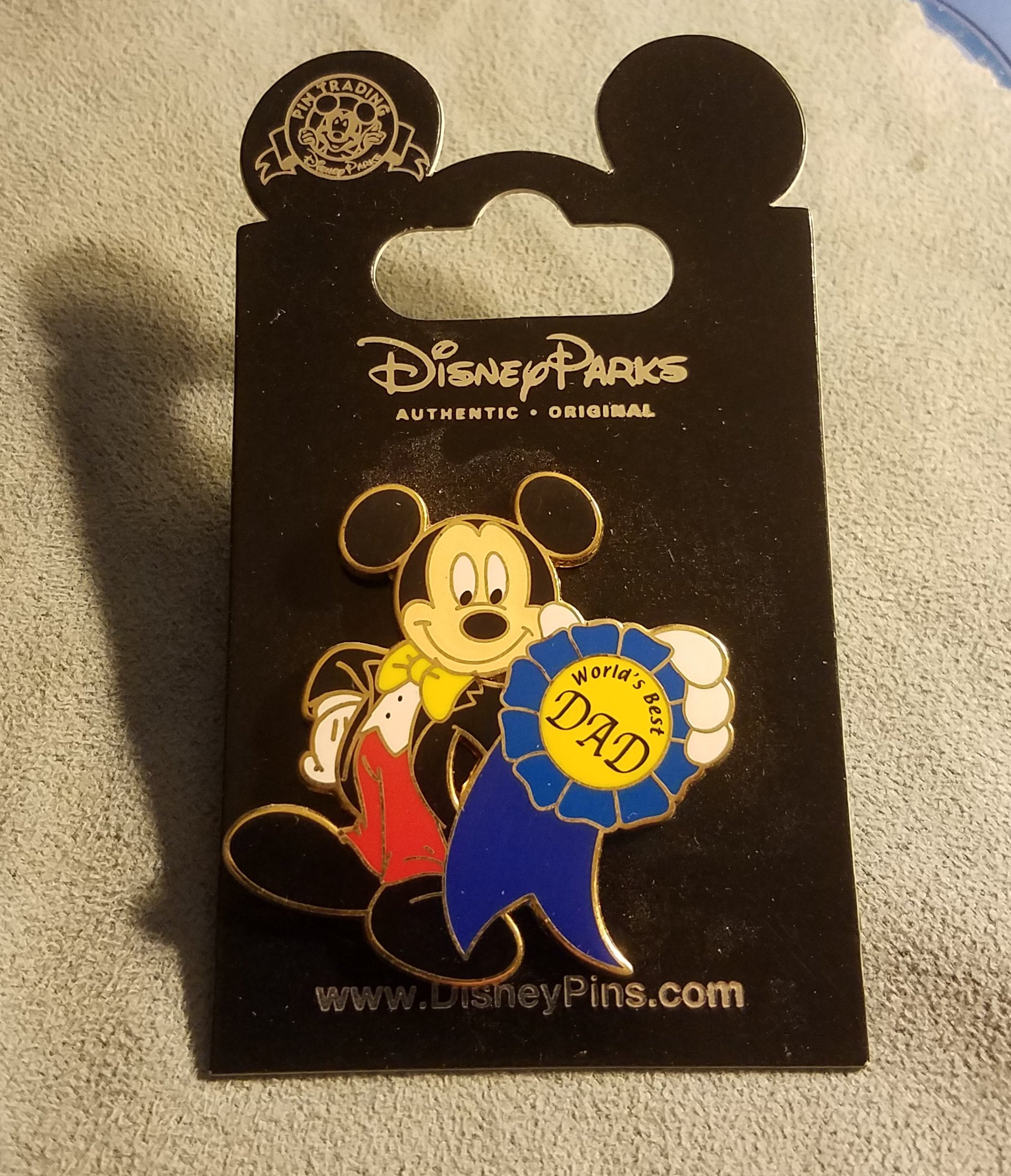
We received a package from our daughter who, along with tens of thousands of employees and contractors at the Walt Disney Company, is going on furlough Sunday, April 19. According to artifacts unearthed in the box, I am the “world’s best Dad.”



 Journey Home
You must be logged in to post a comment.