I couldn’t sleep on Wednesday night so I read José Andrés’ new book Change the Recipe: Because You Can’t Build a Better World Without Breaking Some Eggs. It was a quick read and I was up all night doing it. Of interest was he discussed his interactions with President Biden over the Hamas-Israel War. He described World Central Kitchen in Ukraine and, of course, many of the now famous past operations during which they fed people. I like Andrés for his approach of standing on the ground and talking to people when he’s doing something, as opposed to waiting for committees to decide. It wasn’t a deep book, but I knew little about his origin story before reading it. I’m tired but better for the book.
There have been setbacks in the garden. The riding lawn mower developed electrical problems and will be at the shop for as many as three weeks. It sees heavy use clearing weed growth in the garden so I’ll have to do it by hand until the new electric mower I ordered arrives on Sunday. I need a push-style mower anyway because the ditch in front of the house is very steep and I’m getting too old to survive if the riding mower flips over while I’m mowing.
We are experiencing high humidity that began late Wednesday. Today it was 87 degrees Fahrenheit and very humid. Late afternoon it became windy. I know when to stay out of the garden, so I don’t pass out. Hopefully tomorrow I can get back to work. I can also finish planting the first plots.
One day at a time.
Editor’s Note: Another short post while I focus on the garden. Thanks for sticking with me.
Maple trees have been releasing seeds for about a week. They are everywhere. As mentioned, I think the abundance is because the Autumn Blaze maple is dying and in one last effort at procreation is releasing them. We will hate to lose that beautiful tree.
Another short post today about competing demands for my time.
To get a garden planted I need to focus on that. I have a large garden and only a fraction is planted. I have been turning down other commitments to organize things. Specifically, Women’s March, Indivisible, National Education Association, Veterans for Peace, the county Democratic Party, and others have asked for a part of my time. I have to say no more than yes until the garden is planted.
Partly, as I age, I am slowing down. By the end of a six-hour garden shift, I am achy and worn out. I persevere yet have to manage my time, energy and pain to stay on track to get the right things planted at the right time. Thank goodness there is ibuprofen.
After a walk on the trail, I’ll be back at it. There is always something that needs doing.
Being a bit out of it yesterday after Satuday’s late (for me) festivities, I managed my daily walk on the trail and tended newly planted collards and kale seedlings. Last year was a garden bust for our favorite leafy greens. We are still living off frozen from 2023.
There won’t be much action here for a while. There is a lot to do during gardening season.
Editor’s Note: This is a work in progress for a chapter in my autobiography titled Toward a Kitchen Garden.
Mother was a good cook based on the meals she served us while growing up. She took home economics in high school yet learned most of her skills related to cooking at home. She would make dishes for Father that reminded him of his southern roots, like creamed beef on toast. I remember her meatloaf served with mashed potatoes and a vegetable, her beef soup served on rice, and carrots and peas. The meatpacking plant where Father worked had a full-service butcher where employees got a discount. There were experiences with organ meat (kidneys and liver) which was inexpensive. This suggests a mostly meat as the main dish diet.
Mother was the first woman I knew who prepared tacos in her kitchen. In retrospect, a contributing reason she took up this dish was the introduction of pre-packaged tortillas and other “Mexican” ingredients into our local grocery store before the advent of Mexican food sections like one can find at a supermarket today. It was another chance to use many ingredients normally found in her pantry to make something different and special.
When we ate outside food, Chicken Delight was walking distance from our home. I remember ordering take out or delivery pizza from them more than chicken. When we ate out as a family, it was at a restaurant like the Bell Eat Shop where I mostly ordered a hamburger and fries. We had a long tradition of dining at Riefe’s Restaurant. Smelling their kitchen from our rented home across the alley is one of my earliest memories. Eventually, each of these restaurants closed, with Riefe’s closing permanently on Dec. 23, 2015.
Those things said, I do not have strong memories of what or how Mother cooked, or about what food I ate before leaving for university. Mother kept me out of the kitchen while she was cooking and brought serving dishes to the dining room table where the family gathered for a meal. I did not develop an interest in Mother’s recipes.
I began cooking in my junior year at university. I lived in a trailer home with my high school friend Dennis and tried various dishes to save money and avoid eating out. I tried baking bread and didn’t understand how yeast worked. I used the resulting loaf as a door stop for a while. What food I made during the rest of my undergraduate years is lost in history.
At some point I learned to make tuna and noodle casserole. I served it to Mother before leaving for military service, and then when I had some friends over to my apartment in the military. I liked the taste of it, yet it was not a sophisticated dish. It was what I knew how to make.
Perhaps my most influential culinary experience was in South Georgia. I worked on a logistics project in Ochlocknee in 1997-98. I decided to stay in the nearby county seat at a motel with cable television—a needed escape after working 14 to 16-hour days. I had access to cable television’s TV Food Network.
I developed an insatiable curiosity about food and its preparation. Emeril Lagasse, Mario Batali, Susan Feniger, Mary Sue Milliken, Julia Child and others prepared food on screen, and I was captivated, watching episode after episode on Georgia weekends. Food is a common denominator for humanity, and I couldn’t get enough. My involvement in the local food movement today has its origins in the contrast between that uninviting place in South Georgia and my food escape. There is a broader point to be made than one person’s transient addiction to a television network while away from home. It is that American food pursuits, and the economy around them, continue to be based partly upon curiosity.
It seems clear that American curiosity about food and food preparation drives what we find in markets. It is a commonplace that corn syrup can be found in every aisle of a traditional mega mart, but it is the endless combinations of diverse ingredients that attract our attention then get us to buy. By developing and marketing new things—for example, quinoa mixed with chocolate or chicken, troll or pole and line caught tuna, gluten and GMO free products, and a host of others—purveyors of the consumer economy seek to engage us through the current sales cycle. I suspect we will stop buying at some point, returning to staple foods, or moving on to what the food marketers deem next.
I began using a process I now call “improvisational cooking.” What does that mean? There are two broad categories of cooking. Most regular dishes and meals allow for variation in taste, ingredients, seasoning, and cooking methods. Others, like baking, do not. It’s what I’m doing today, and I believe how many Americans organize their cuisine. It means creating a food ecology from which I pull in elements from our garden, local farms, and area markets to prepare meals based on what’s readily available.
Occasionally I purchase items on-line or via snail mail when I want something that’s not locally available. For example, I recently bought bags of dried Mexican-grown Guajillo chilies and Mexican oregano on-line. At the end of my cooking day, it is a never-ending process that produces, as Tamar Adler called it, “an everlasting meal.” Exploring the symbiosis between traditional and improvisational cuisine is a popular topic when talking to friends and neighbors about cooking.
Improvisational cuisine draws from the broader society. For example, when I make tacos today, typically for breakfast, they are more improvisational than Mother’s were, but use some of the same techniques. I buy raw flour tortillas to cook as I need them and occasionally make my own with corn Masa. The tortilla is a delivery system for a pan-fried amalgam of fresh vegetables, herbs and spices, a sauce, and protein topped with salsa or hot sauce, fresh tomatoes in season, and a form of soft cheese. It is a recognizable dish even though the ingredients vary from day to day and from season to season.
I do use recipes. My go-to recipes are memorized or written in a red spiral-bound notebook I bought on vacation in Stratford, Ontario. In the back I put a few loose-leaf handwritten recipes from Mother and my maternal grandmother. My go-to cookbooks are Julia Child’s Mastering the Art of French Cooking, Joy of Cooking by Marion Rombauer Becker, and a couple of others. I am downsizing my collection of hundreds of cookbooks yet kept three shelves on display in my writing area. The influence of Mother and Grandmother is more one of technique rather than a particular dish.
An example of a cooking book I read cover to cover is Tamar Adler’s An Everlasting Meal: Cooking with Economy and Grace. More than anything, she presents a narrative about cooking that goes beyond a single meal or dish to how we connect them together. I also read Anya von Bremzen’s Mastering the Art of Soviet Cooking: A Memoir of Food and Longing. Again, for its narrative more than cooking tips.
I studied church and organizational cookbooks extensively. I adopted very few recipes from them. I keep cookbooks that have some sentimental value, ones in which recipes by friends appear, and a set of a dozen or so from my old neighborhood in Northwest Davenport. The purpose of acquiring these cookbooks has been to understand the development of kitchen cookery beginning in the 1950s and ’60s. People used a lot of gelatin and lard back in the day, that’s for sure.
There is a lot of good stuff in cookbooks, although a lot of repetition as well. Over the years I’ve been enthusiastic about certain chefs — Child and Rombauer Becker, Rick Bayless, Mario Batali, Giada De Laurentiis, and Tamar Adler. I’m hoping to find new inspiration in Anthony Bourdain, José Andrés, Sally Schneider and Nigella Lawson. In any case, the result I envision is a new repertory of about 25 main course recipes that have predictable nutritional value and can be made with mostly local ingredients. I also hope to learn new ways to prepare vegetables. Whatever I learned from studying cookery reduces itself into repeatable main dishes made using understandable preparation techniques. A family only needs so many recipes.
I am now lacto-ovo-vegetarian which requires and fosters a constant dialogue about nutrition, cooking, ingredients, flavors and diet. Being vegetarian strips away most traditional dishes, like the ones I ate while growing up. Occasionally we mimic meat dishes in our household with the growing number of manufactured meat substitutes. If we make a pie chart of our diet, those meat substitutes would occupy a tiny slice. I have also been diagnosed as diabetic, which means closer monitoring of blood sugar as well as related dietary changes.
The cuisine we developed in Big Grove Township focused on techniques to use readily available ingredients to make repeatable dishes. We used to regularly eat pasta, pizza, macaroni and cheese, bread, chili, soup, casseroles, toppings with rice, and manufactured non-meat burger patties. Fresh and frozen vegetables are basic. Fruit is seasonal and desserts infrequently made or purchased. With my spouse becoming vegan, elimination of dairy products became my newest learning opportunity as a cook. I continue to develop that list of 25 main course recipes.
When the garden comes in vegetables dominate the plate. Tomatoes are a favorite and we have fresh with most meals while they last. When lettuce comes in, we make big salads for dinner. For the time being, I don’t bake bread very often, eschew meat and meat products, and use only a few manufactured products for their ease and serviceability within the context of our cuisine.
Most nights it’s easy to get a meal ready for dinner. Our repertory includes easy and complex dishes which satisfy if done right. I prepare dinner for both of us four or five nights a week and we are on our own for breakfast, lunch and snacks. It works.
If we are serious about sustainability and local food systems, we must get beyond curiosity, and distraction from the challenges of a turbulent world. We must get to the production of things that matter in our lives on the prairie. At some point during the last ten years my talk about a “local food system” became talk about a “kitchen garden.” The goal of having a kitchen garden is to produce food aligned with our culinary habits that helps meet a basic human need. We have to eat. It may as well be enjoyable. We’ve all eaten our share of food that doesn’t please our palate. A kitchen garden should address that.
A kitchen garden is a reaction to the culture of consumerism. An important distinction is reaction, not rejection. I will continue to buy black peppercorns, nutmeg, vanilla bean extract, refined sugar, and all-purpose flour milled elsewhere. How else will we get such necessary ingredients?
While I am a local foods enthusiast, and my diet centers around being that, I am not doctrinaire. Other people must consume the results of my kitchen work. Despite several issues with his behavior and written output — including bigotry, racism and patriarchy — I like the Joel Salatin idea of a food shed. That is, secure everything one can that is produced within a four-hour drive of home. I am also not doctrinaire about “food miles.” I’ve written often on the topic and if we work at it, we can secure most of our food produced within less than an hour’s drive from home.
For the time being, I’m mostly ovo-lacto-vegetarian, which means consumption of dairy products and the good and bad that goes with them. I’m not of one mind on this. For example, I’ll buy a gallon of skim milk from the local dairy 6.2 miles from my house, yet I’ll also stock up at the wholesale club for half the price. I take local eggs from the farm when offered, yet I also buy them at the club. Maybe it’s best to become vegan and eschew dairy altogether. I’m not there yet.
In a free society, people should be able to do what they want with only minimal restrictions to protect the commons. In our consumer society, that is a joke. For a local food system to be sustainable beyond the initial curiosity of trying it out, something fundamental must change. It is a need— perceived or real— to change from the act of consuming to the act of production. That involves a lot of hard work, and I’m not sure it could be done in the current society.
In my kitchen garden cooking remains a work in progress.
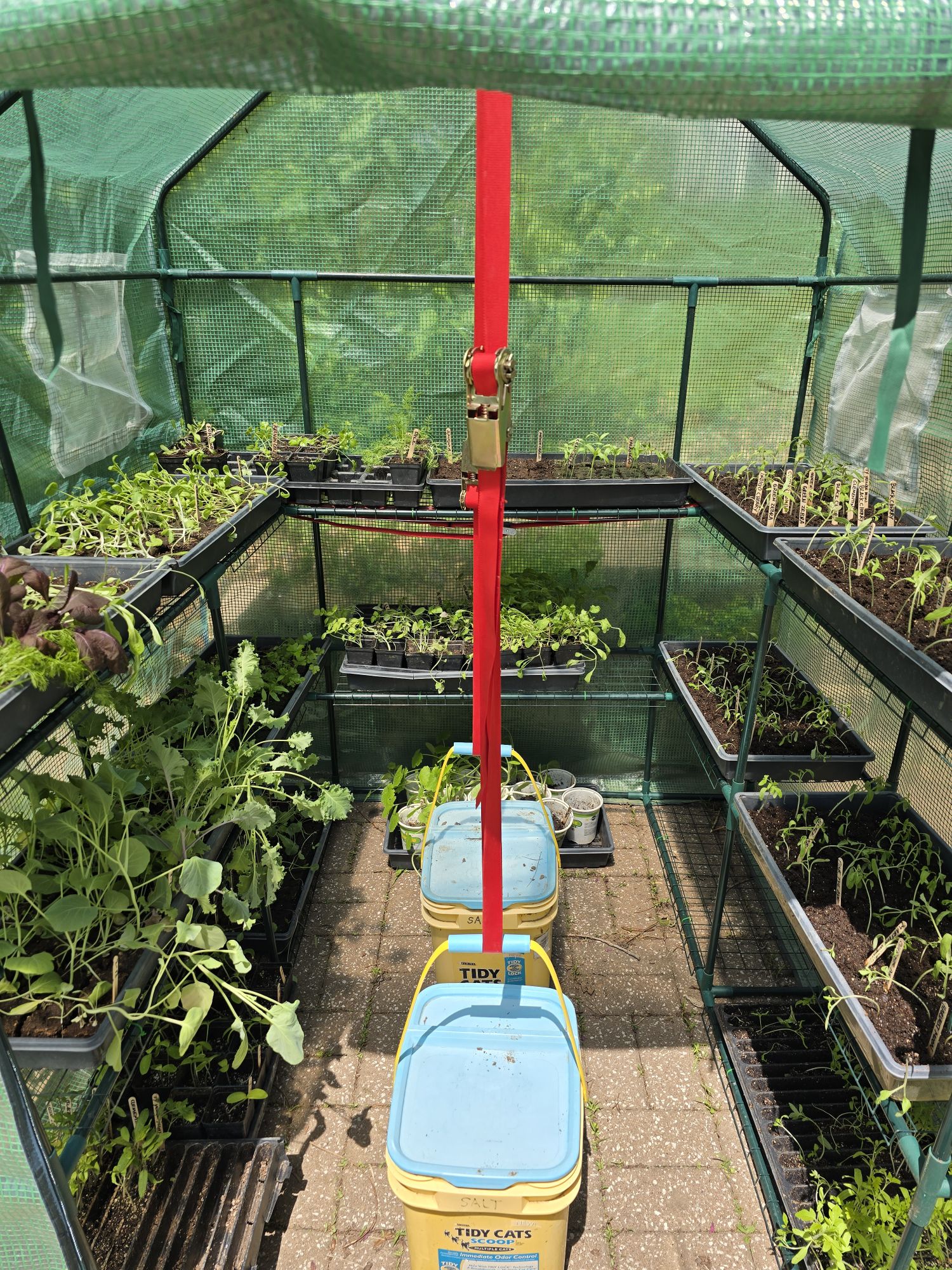
Over the weekend I assembled the greenhouse, moved trays of seedlings from inside the house, and transplanted tomato starts from channel trays into full-sized blocks. I feel I am way behind on the garden, yet things are moving.
The first day outside is always dicey for the seedlings. It is plenty warm, but the direct sunlight can be strong on them. Lettuce is wilting a bit. I make sure the trays are well watered and cross my fingers, hoping they will recover overnight. I’ll have a better idea how everything went at sunrise this morning after ambient overnight temperatures were in the 40s.
The tray of cruciferous vegetables, kale and collards, is ready to go into the ground. The plot is cleared so I just need to turn it over, fertilize, till the ground, lay down sheets of garden cloth and plant. “Just” is doing a lot of work in this paragraph.
While I enjoy watching seeds grow into vegetables and fruit, I have been less enthusiastic about the garden this year. I plan to cut back by two plots, leaving five. When time allows, the plot by the compost bins will be converted into some kind of storage. In time, I may put up a shed for garden tools. I plan to take better care of the plots that are in production.
I am hoping to get a crop, yet also cut back on the number of varieties. I grow what I can use in the kitchen-garden rather than production of the most produce possible for its own sake. It has me looking at things differently. Any more, I put up tomato sauce and pickles in canning jars and freeze leafy green vegetables to use until the following season. If I have a big garlic or basil crop, I make pesto and freeze pureed garlic and olive oil.
I had a pain in my left hip for the last couple of weeks. Today, I relented and took two ibuprofen after breakfast. It worked. I was able to get through a four-hour shift of loading the greenhouse. I don’t like taking pain medication, but after today’s experience, I might do so again. I find it is a gardener’s friend.
On a cool Saturday morning I planted 20 varieties of tomatoes on my bench in the garage. There has been a home-garden tomato crop at almost every place we lived since we married in 1982. I am a couple days late getting seeds into channel trays compared to last year. If all goes well, there will be plenty of tomatoes, beginning in August. I know how to produce a crop.
After noon I watched the BlueSky hashtag #handsoff. Users posted images of Hands Off! demonstrations from all over the country. It was a decent showing of people opposed to the administration, more protesters than usually turn out for nation-wide protests. There is a lot about which to be upset. I did not attend one of several events within half an hour drive of home. I decided an hour’s driving could be better spent.
Instead, I had a 50-minute phone call about unions during the Reagan years. I forwarded a chapter of my memoir in progress to a friend who was a member of the United Auto Workers union during that time. It was a good conversation about things we don’t usually discuss.
After getting his masters, my friend got a job as a teacher in the Saint Louis area. He rose to become president of the National Education Association local. He told me his Sheryl Crow story. Crow had worked as a music teacher for the district and wanted to cash in her pension to head out west. There was a recommendation she leave it in place in case she needed to start over. Of course, she didn’t need that. His Sheryl Crow story is better than mine, which is I heard her play at the Senator Tom Harkin annual steak fry on Sept. 19, 2004.
I had a restless night Friday. The U.S. Senate protected the billionaire class and left the rest of us behind, voting in favor of the reconciliation bill early Saturday morning. Next the bill goes to the House. Its future there is uncertain. The Republican majority is so thin that Texas Governor Abbott is postponing a special election in Houston to replace U.S. Rep. Sylvester Turner who died in March. His action takes one Democratic vote off the table. We are in the hard ball league with our politics, where nothing matters except for the income of the owners. We are not the owners.
Cool ambient temperatures kept me out of the garden again. Soon, though, I’ll get out there and dig this year’s plots. Probably, there will be tomatoes. One never knows, yet we plant the seeds.
During a recent trip to the grocer we got talking about Sloppy Joe sandwiches. Early in our marriage we would buy a can of Sloppy Joe sauce and mix it with MorningStar Farms Recipe Crumbles to make a sandwich filling. It was the basis for many a quick, tasty meal. We discussed adding it back into our meal rotation for “something different.” We read the ingredients on the name brand and store brand cans of sauce and decided to make our own.
What distinguishes a Sloppy Joe from a Maid-Rite (a.k.a. loose meat sandwich) is the tomato sauce. Following is the recipe I put together from an online recipe modified to match our preferences and what we have on hand in our pantry.
Sloppy Joe Sandwich
Ingredients:
One small onion – diced
One medium bell pepper – diced
Two cloves fresh garlic – finely chopped
Salt and pepper to taste
Half teaspoon chili powder
Teaspoon paprika
1/3 cup ketchup
1/4 cup water
1 tablespoon Dijon mustard
1 tablespoon brown sugar
1 tablespoon vegetarian Worcestershire sauce
One 15 ounce can of prepared tomato sauce
One 12 ounce package of MorningStar Farms Recipe Crumbles
Sandwich rolls.
Mix the dried spices, ketchup, Worcestershire sauce, water, mustard, and brown sugar in a small dish and set aside.
Sauté the onion, bell pepper and garlic until soft over medium high heat in a tablespoon of extra virgin olive oil.
Add the spice mixture and stir to incorporate. Add the Recipe Crumbles and incorporate. Finally add the can of tomato sauce and stir until incorporated.
Turn the heat down to a simmer and cook until the sauce thickens and extra water evaporates.
Serve on a toasted bun with any desired condiments and toppings.
Ambient temperatures were in the high 70s on Friday. I walked out to the garden and had a look. After dumping the compost bucket into the bin, I turned over a spade full of soil in this year’s garlic bed. The moisture level is about right for planting. I thought I’d give it the rest of the day’s high temperatures to dry and plant garlic today. Last year was such a mess, I didn’t get garlic into the ground in November as usual. My farmer friends tell me with late planting, I will still get a crop.
Some parts of the garden have two years of clean up to do. Tearing down fencing, pulling up fence poles, recovering plastic sheeting for another use, and taking care of the vegetable stalks will require a multi-day project. I’m determined to get a garden in this year.
My views about the garden are changing. For example, the last year or so we have had something digging tunnels in the lawn just under the surface. I don’t know if the pest is eating the roots of grasses and other plants, or what it is doing. I’m inclined to not plant potatoes this season because they are cheap at the farmers’ market or grocer, and it will give the little animals one less food source. Potatoes have never been a main crop for me.
It was good to be out in the warm sunlight with a fresh breeze blowing against me. The soil felt good, the way it should feel after a mild winter. Once I get going, it should take me about 90-120 minutes to get the garlic in the ground.
After planting, it needs mulching. I plan to use last year’s tomato stalks and leaves and grasses mowed into a bag from the lawn. I have to watch this type of mulch more carefully so it doesn’t get matted and prevent the garlic shoots from getting to the light as they grow. With wheat straw you can just mulch it and forget it until harvest. I want to avoid this input cost.
Off and gardening we are. I expect I’ll need more time working the plots to get away from the national news. Respite, as good as it gets.
Kale and collard seedlings planted Feb. 13, 2025. Pinkish hue from the grow light.
I delayed indoor kale planting for a week until Feb. 13. I will delay planting the other cruciferous vegetables and herbs by two weeks or more. Live and learn. It is an exciting time of the year with seeds going into soil. My heating pad and grow light held up for another year.
2024 was a marginal year for our garden. I couldn’t get the plots planted. Deer started jumping the fence and ate two successive plantings of cruciferous vegetables. Then, weeds grew everywhere. I couldn’t get some crops harvested when they matured. I got decent crops of garlic, tomatoes, cucumbers, lettuce, and collards. I hope to renew my efforts with vigor this spring. May gardening do better in 2025.
The main work is clearing the old plots, weeding, and pulling up the plastic sheeting in a way that preserves it to use again this year. This means a LOT of work. I tried making very large plots last year and the result was deer jumped the fence more often, as mentioned. The idea that plots should be smaller, leaving no landing zone for deer proved to be most effective. Given the Social Security Administration life expectancy table, I have 11 more gardens to plant. No more experimenting with plot size at this stage of life.
I bought two batches of seeds. There will be herbs, lettuce, Asian greens, cauliflower, green beans, and a lot more. The apple trees should produce this year. The Red Delicious tree planted in 1995 has been a work horse. Storms, including the 2020 derecho, have damaged it so it looks like half a tree. I will keep harvesting Red Delicious apples from it until the last windstorm takes its final toll.
Despite all the talk about inflation, food continues to be a smaller percentage of our household budget. Insurance is the killer, ironically. Car, home, life, an multiple health care policies add up. We garden because we control inputs, plus the produce tastes better than store-bought. Our garden will continue in this enduring culture of life again this year.
Gold Rush apples at Wilson’s Orchard and Farm Oct. 22, 2022.
During the eight years I worked with Paul Rasch at Wilson’s Orchard I learned a lot about apples. I was offered a chance to return after the coronavirus pandemic, yet I declined. Things had changed too much as they diversified their offerings. They moved from being mostly a seasonal apple orchard to being more of a year-around event destination with multiple big crops available for u-pick, musical entertainment, special dinners, and of course the rebuilt barn that could host a wedding or other special event. It would be difficult to recapture how I felt about my tenure in the earlier years by taking the job. I’m okay with everything.
When my apple trees fruit, I don’t hardly go to the orchard. I can get all the apples I need for a year from the five remaining trees. At the end of each season, regardless of whether I have apples, I buy Gold Rush apples from the orchard because they keep really well in the refrigerator. On Feb. 14, I’m still eating last season’s apples, even though they are getting wrinkled. They seem sweeter now than they did when they were just-picked.
When I have apples, I replenish my stores of applesauce, apple butter, apple cider vinegar, and dried apples. In the beginning, I would process every good apple I grew. A person only needs so much of processed goods. Today I make what I need to replenish the shelves and leave the rest for wildlife to eat fresh and over the winter. Invariably, every apple I leave in a backyard pile is gone by spring.
I’ve gotten to Henry David Thoreau’s view of apples:
Early apples begin to be ripe about the first of August; but I think that none of them are so good to eat as some to smell. One is worth more to scent your handkerchief with than any perfume they sell in the shops. The fragrance of some fruits is not to be forgotten, along with that of flowers. Some gnarly apple which I pick up in the road reminds me by its fragrance of all the wealth of Pomona, carrying me forward to those days when they will be collected in golden and ruddy heaps in the orchards and about the cider-mills.
Thoreau captures something I can’t. I think about this quote every time I take a wrinkled Gold Rush apple from the refrigerator drawer and inhale its perfume.




 Journey Home
You must be logged in to post a comment.