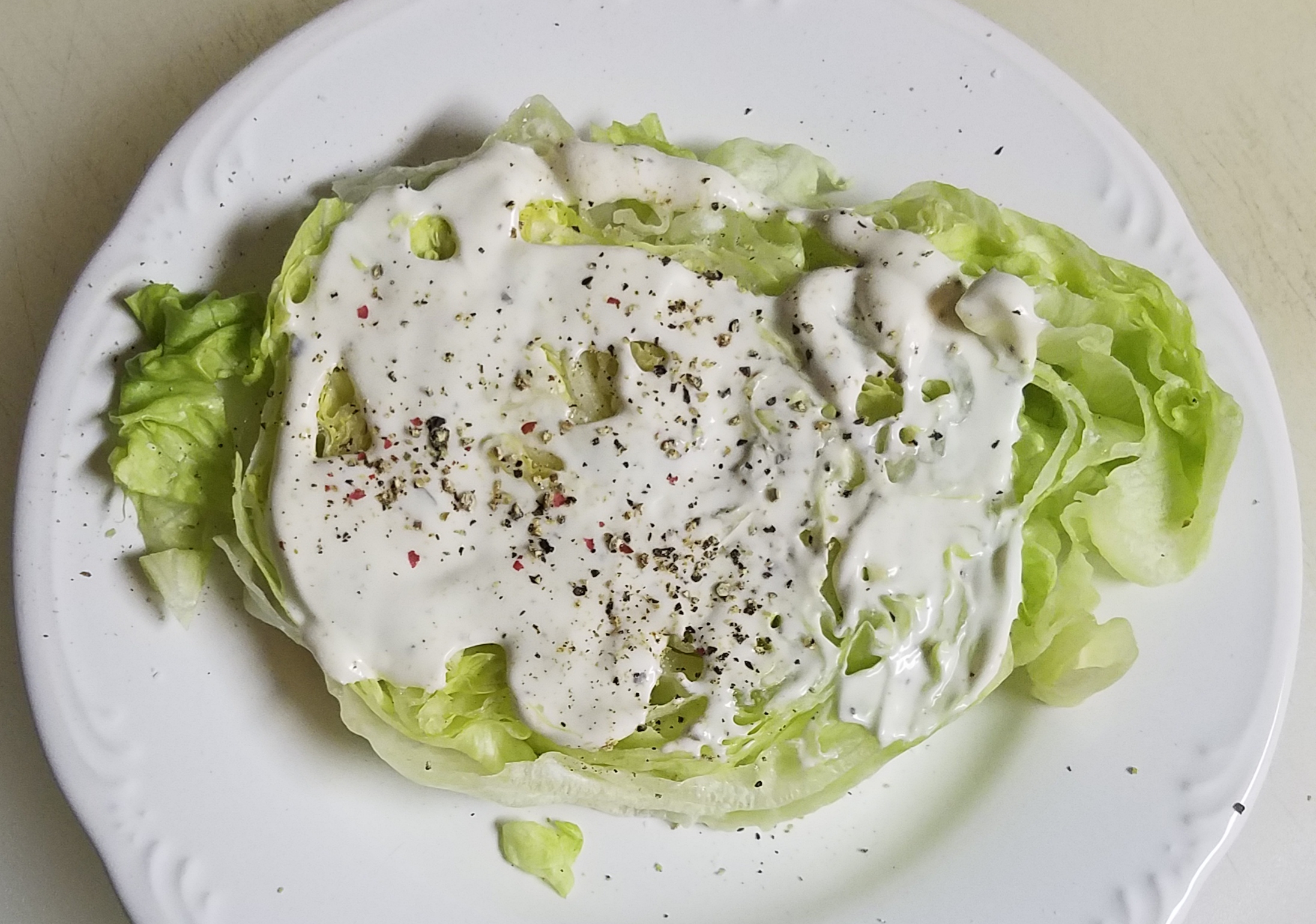
Iceberg lettuce with ranch dressing and black pepper.
When there were decent heads of organic iceberg lettuce at the grocer I bought one. We usually don’t eat lettuce unless we grow it. Iceberg lettuce is much maligned and actually pretty good. It made a nice winter treat.
I placed the unopened bag on a refrigerator shelf where it rested for a week. It yielded some wilted leaves for soup and four 3/4-inch slabs like the one in the photo.
We like the lettuce my farmer friends and I grow. With implementation of row cover in my garden, the kitchen had the leafy greens most of the season. I can’t imagine buying another bag of loose, mixed greens at the market. It is never as good as home grown and recalls for contamination have been too frequent. The whole head of iceberg was just the pick-me-up needed to inspire spring planting.
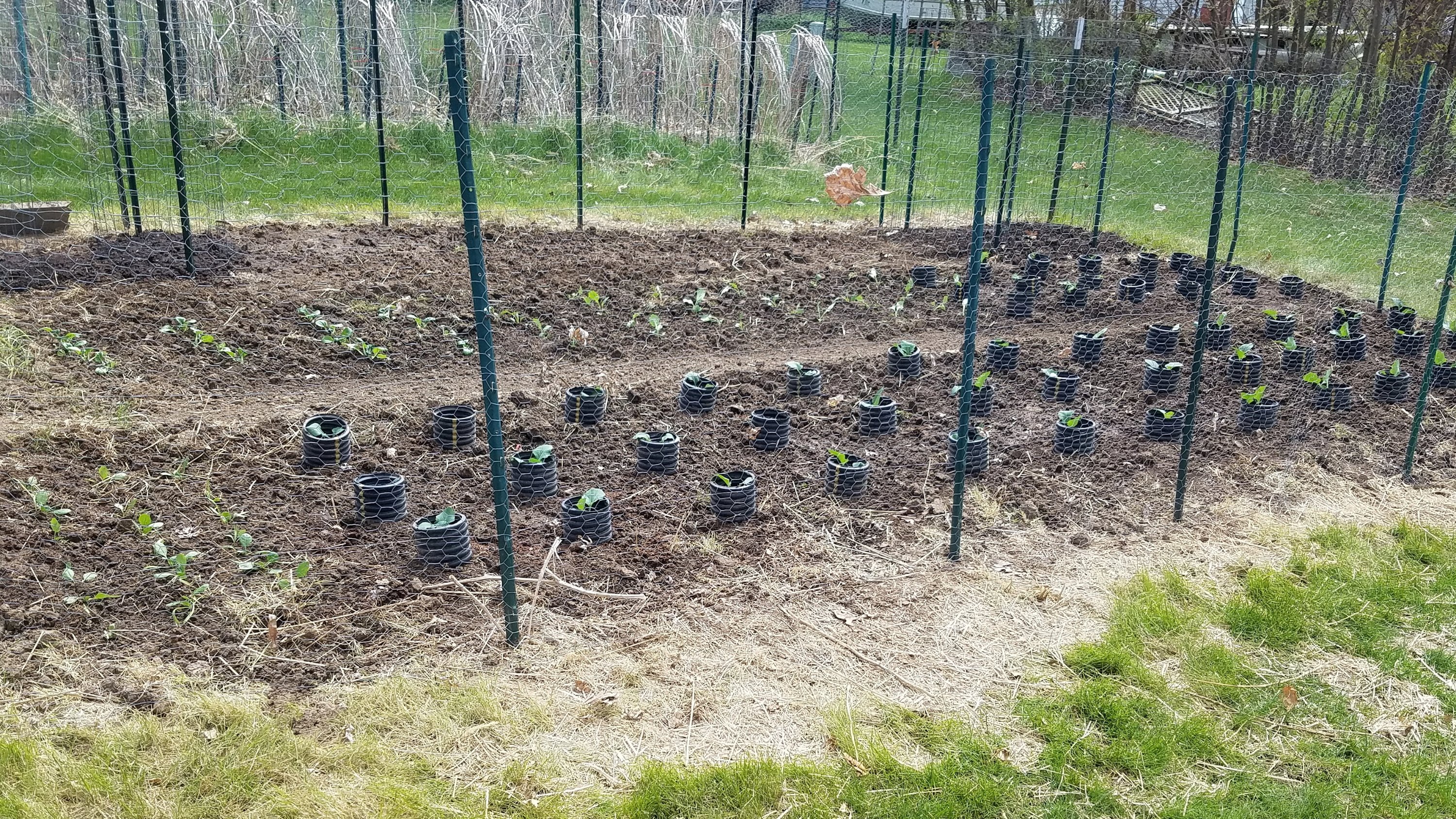
Garden planning is proceeding slowly yet I know what I’m doing about lettuce. I had about twelve feet of row cover last year. Under it I planted radicchio, lettuce and herbs. This year I have materials for 36 feet of row cover.
I expect to do a better job of rotational lettuce planting so I don’t have too many heads ready at the same time. I count nine varieties of lettuce in my seed drawer. Of those, Magenta is our favorite. I also have a stack of arugula seeds, six varieties. I’d like to get to the point where arugula grows wild so no planting is required. I hear tales of chefs who dug up wild arugula (a.k.a. Rocket) and transplant it to a raised garden plot where it thrives. If I could succession plant it this year, that would be good enough for 2022.
Lettuce is a cash crop for local farmers. They sell it to restaurants and make good margin. It seems normal to pay $5 for a bag of local lettuce at the farmers market. As long as I grow my own, it’s a bargain.
Because of high winds I’ve been indoors all day. Gusts approached 40 miles per hour, began around midnight, and continued all day. A small snow drift formed across the driveway.
I had the last of the iceberg lettuce for lunch. While eating it I thought I’m ready for spring.
2021 has been a great year of progress in the kitchen garden. As the seed orders find their way to us via U.S. Postal Service, some reflection on the positives seems in order.
Apples
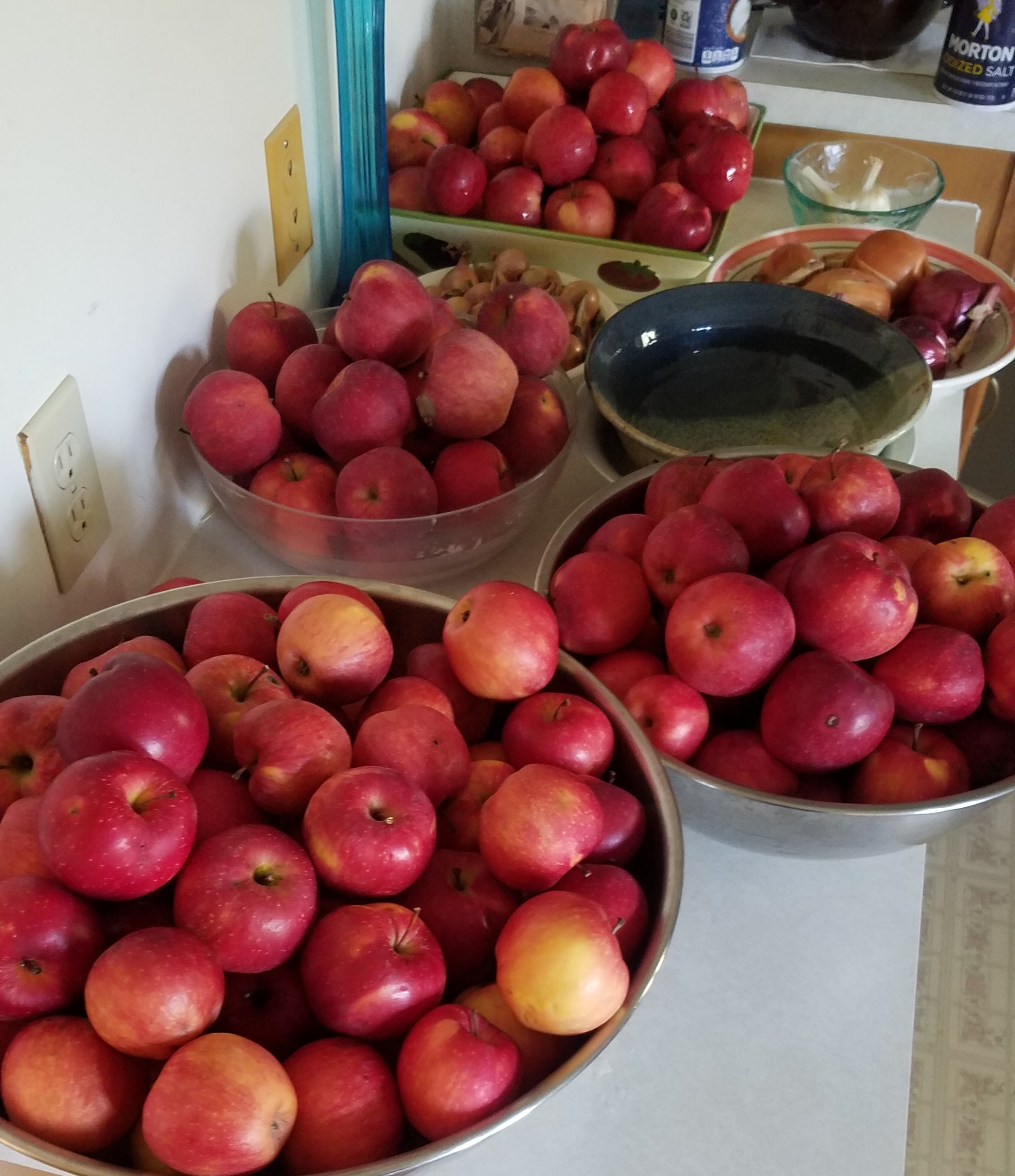
This has been one of the best years for apples. In our yard the three legacy trees bore abundantly and we used them for everything we needed. At the orchard (by this I mean Wilson’s Orchard and Farm, where I worked from 2013 until 2019) there was an abundant crop to supplement the two varieties that yielded here. The pantry is loaded with everything we need in terms of processed apples. We should have enough apple butter, applesauce, dried apples and cider vinegar to last two years until the next big crop. If our trees bear next year, that will be a bonus.
We had enough to take what we needed, let our neighbors pick some, and plenty for the deer once we harvested the best ones. The combination between our trees and a nearby commercial orchard meant we didn’t have to buy a single apple from the grocery store.
Vegetable broth
Each garden year begins with a couple dozen quart jars of vegetable broth. As I grow a diverse number of greens, I switch which ones dominate. Turnip greens have produced a consistently tasty broth, yet they all are good. We use this broth to cook rice, in soups, and as an alternative to using oil when frying vegetables for some dishes.
Guajillo Chilies
It took a few years but the integration of Guajillo Chilies into our cooking is complete. The main product is a cooked and preserved pepper combined with garlic, salt and apple cider vinegar in a food processor. Once the fresh chilies are gone, this becomes the main way I use chilies in cooking. I tried the technique with jalapeno peppers and while a little hotter, it also serves for our culinary needs.
Polish-style Soup
When growing up, Mom’s cooking was pretty “American.” That is, outside the occasional Polish-style ravioli brought home from visits to LaSalle, Illinois, Polish heritage cooking was absent. That was also true of memories of my maternal Grandmother who often found paid work as a cook in settings where American cooking prevailed. It was discovery of the cook book Treasured Polish Recipes for Americans by the Polanie Club that enabled me to come to terms with my heritage.
Based on studies of the soup chapter, I developed a consistent soup recipe that uses vegetables grown in our garden. The ingredients in the book were the same as what I have been growing for years. The main characteristics of the soups are they are thickened with barley, I add lentils as a source of protein, and use onions, celery, broccoli stem, parsley, grated zucchini and other frozen vegetables from the growing season. I use whatever greens are in season, and frozen kale if they are not. I also add potatoes, turnips, and whatever root vegetables are on hand. Settling on a soup recipe has been a long time coming.
Sweet Bell Peppers
After years of experimentation I finally produced enough bell peppers to eat raw, use in cooking, and preserve in the freezer. This was a watershed year.
Tomatoes
I grew the largest number of tomato plants ever and had plenty to eat fresh, can, freeze, and give away. The main successes were:
Developing a method to extract moisture and freeze the pulp into small servings using a cupcake pan was a breakthrough. The idea is to use a couple of tomato “buttons” to make pizza sauce for our weekly, home made pizza. I use them in everything to add a small amount of tomato sauce when needed.
I learned to grow enough Roma tomatoes so I can use them to can whole. I’m still working off a backlog of preserved tomatoes, but the system is in place for growing to match canning needs. Romas are the best to can whole.
Our local food bank welcomed my extra tomatoes. My weekly seasonal donations took the pressure off of using tomatoes in a timely manner.
I grew a wider variety of tomatoes this season, maybe 25-30 varieties. The benefit was I discovered some new favorites and we had tomatoes for every dish throughout the season.
I can extra liquid from tomatoes if I don’t use it fresh. I try to use everything and the canned liquid goes into soups.
I planted earlier than my peers in the local food movement and because of that, I had tomatoes earlier than they did. I risked frost only once or twice and using old bed sheets to cover the plants, was able to make it through without damage.
Squash, eggplant and cucumbers
I’m pleased with the way the squash came out. There was plenty of zucchini, and pumpkins and acorn squash produced beautiful fruit that tasted good. A little goes a long way with zucchini and I grew and preserved enough for soup all winter. I also froze cooked pumpkin flesh in one cup sized buttons to use in pumpkin bread.
A little eggplant goes a long way for us. I had six or seven varieties of seeds and planted some of each. I’m looking for enough to make one or two eggplant Parmesans and roasted rounds for the freezer. I had plenty this year.
The cucumber crop wasn’t as big as we’d like although it produced enough for plenty of canned sweet pickles to last us until next year. I’m on the way to striking a balance of varieties to meet our needs and this will be an ongoing experiment.
Garlic
The garlic crop was the biggest yet with large heads, about 75 of them. The disease that was prevalent last year was absent this year. That’s because I was particularly diligent to pick clean cloves for seed. The main uses are fresh in cooking and in the prepared chili sauces mentioned above. I still harvest enough green garlic from the volunteer patch I planted decades ago.
Celery
There was a new celery seed this year and it produced a better crop. We eat celery fresh in season and use it in cooking. The extra gets sliced in soup style and stir fry style and we produced a lot of it this year. We’ll be eating it all winter.
Greens Patch
I set aside a plot for cooking greens and the concept proved to be useful. We had greens for the entire season. The main change was cutting back the number of kale plants and planting chard , collards and mustard as alternatives. I also grew several kinds of cruciferous vegetables like kohlrabi and bok choy. I plan to further develop this concept.
Onions
I grew seven varieties of onions and shallots and would term it a success. It is the second year of having a big crop and the quality was quite good. I used a mixture of plants I started from seed and starts from the seed store. The starts from the seed store, along with the shallots, did the best. The challenge is picking storage varieties and then using the shorter storing onions first. This all worked out in 2021.
Herbs
I successfully grew parsley for the first time. There was plenty of it to use fresh and I used the cupcake pan method to freeze some in water to add to soups during winter. I also had plenty of chives, savory, rosemary and basil. I froze many parsley stems for use in winter cooking. I feel more confident after this season and will likely expand my herb growing next season.
Row Cover
I bartered for some row cover and used it to grow an eight foot row of lettuce and herbs. It made a huge difference. It enabled succession planting in a way I hadn’t had before. More planning is in order for 2022 to make row covered vegetables a bigger part of the garden.
Reverse side: Stella Marrs, P.O. Box 2273, Olympia, WA 98507.
I plugged in the grow light for the first time since summer to move a flat of Ajuga plants indoors. We reclaimed them from the yard, where they spread and spread, all the way down to the drainage ditch. We transferred them from my father-in-law’s home before he died in the 1990s. At the nursery Ajuga plants are quite expensive, maybe $6 per pot. We’ll have plenty at no cost but our labor if we take care of them. They grow like weeds.
On Thanksgiving I plan to lay out the 2022 garden and prepare the first seed order. Second seed order, actually, as I already have the onions and shallots to start in late December. I hope to clear the dining room table and sit down to consider what seeds we have and what we want to grow in consultation with my spouse. It could be a family tradition, one that means something special. We’ll see how it goes as I don’t want to get ahead of myself.
We are not big on year-end holidays and usually spend them by ourselves. Once we make that decision each year, everything hinges on how we feel. There is a slate of phone calls, emails and the like. Being a vegetarian household, the deer, geese and wild turkeys are safe from us as the meat culture is absent. Most people would call what we eat “side dishes.” At a point long ago we reviewed the nutritional values and found we had a well-balanced, if nontraditional Thanksgiving meal.
I don’t know where I got this postcard yet I like it. I do garden organically, although I gave in and started using composted chicken manure as fertilizer. It improved the yield. I don’t use manufactured herbicides or insecticides, organic ones work fine. I get organic seeds when I can find them. To see the face of the farmer, I look in a mirror.
Friday morning there was a partial eclipse of the full moon. It looked awesome set in a bed of bright stars. I couldn’t get a decently framed photo so I didn’t take any. Memory will have to serve.
We have provisioned up for Thanksgiving and have everything we need. If the orchard releases Gold Rush apples today, I’ll go get some along with a half gallon of cider. If the Gold Rush are not available, I’ll stay home and make my own cider for Thanksgiving. I saved enough garden apples in case I needed them.
With the holiday season upon us, the rush to year’s end has begun. 2021 is almost over and we are ready to begin again. I’m here for that. I’m looking forward to another gardening year.
Like most people, I want a decent meal when it is time to eat. In 2012, I launched a major study of the local food scene and was not disappointed in the results coming into and out of our kitchen. By working at a number of farms, growing and expanding our home garden, and participating in legislative advocacy, I learned so much about where food originates and conditions which engender growth of a variety of fruit and vegetables.
The impact of local food systems on our home life reached its peak in development of the kitchen garden idea. Now that the work is finished, I have less interest in writing regularly about food. It is an assumed part of a background against which I pursue other interests. I’ve learned what it means to know the face of the farmer. I maintain an interest in doing so. I just won’t write about it as often. Mainly, others are doing a better job of writing about our food system.
Food is basic to a life. It is not the most important thing. I am glad for the work I did, yet I feel it is finished. It is time to concentrate on more important aspects of life. It is time to keep a focus on life closer to home.
It’s the end of apple season and with a vegan in the house, using butter in a dessert is out the window. I took the apple crisp recipe from my hand written cookbook and modified it after reading a couple of vegan recipes. The first test batch didn’t meet standards so I tweaked it and came up with this keeper.
Vegan Apple Crisp
Preheat the oven to 350 degrees. Shelf positioned so the baking dish is in the middle of the oven.
Filling:
8 good sized apples
2 tbs wheat flour
2 tbs lemon juice
1/4 cup apple cider or juice
3 tbs arrowroot (mix together with lemon juice and apple cider)
dash salt
1-1/2 tsp cinnamon
1/2 tsp ground ginger (fresh if you have it)
a few grates of nutmeg
Grease the baking dish. Reserve the arrowroot mixture and mix everything else in a mixing bowl. Don’t beat it to death! Add the liquid and incorporate. Pour into the baking dish.
Topping:
1 cup rolled oats
1/2 cup each of wheat and almond flour
1/2 cup brown sugar
dash of salt
1 tsp cinnamon
1/2 cup extra virgin olive oil
Using a pastry blender mix everything together and make sure it is well incorporated. Don’t beat it to death! Sprinkle on top of the filling and bake for 30-35 minutes, making sure the topping starts to brown.
Philosophy of cookery. Peel and slice enough apples to fill whatever baking dish you want to use. Mine is 9 x 13 x 2 inches. Adjust the amount of topping to match the amount of apples. The batch can be doubled or halved. It would likely freeze well in an airtight container.
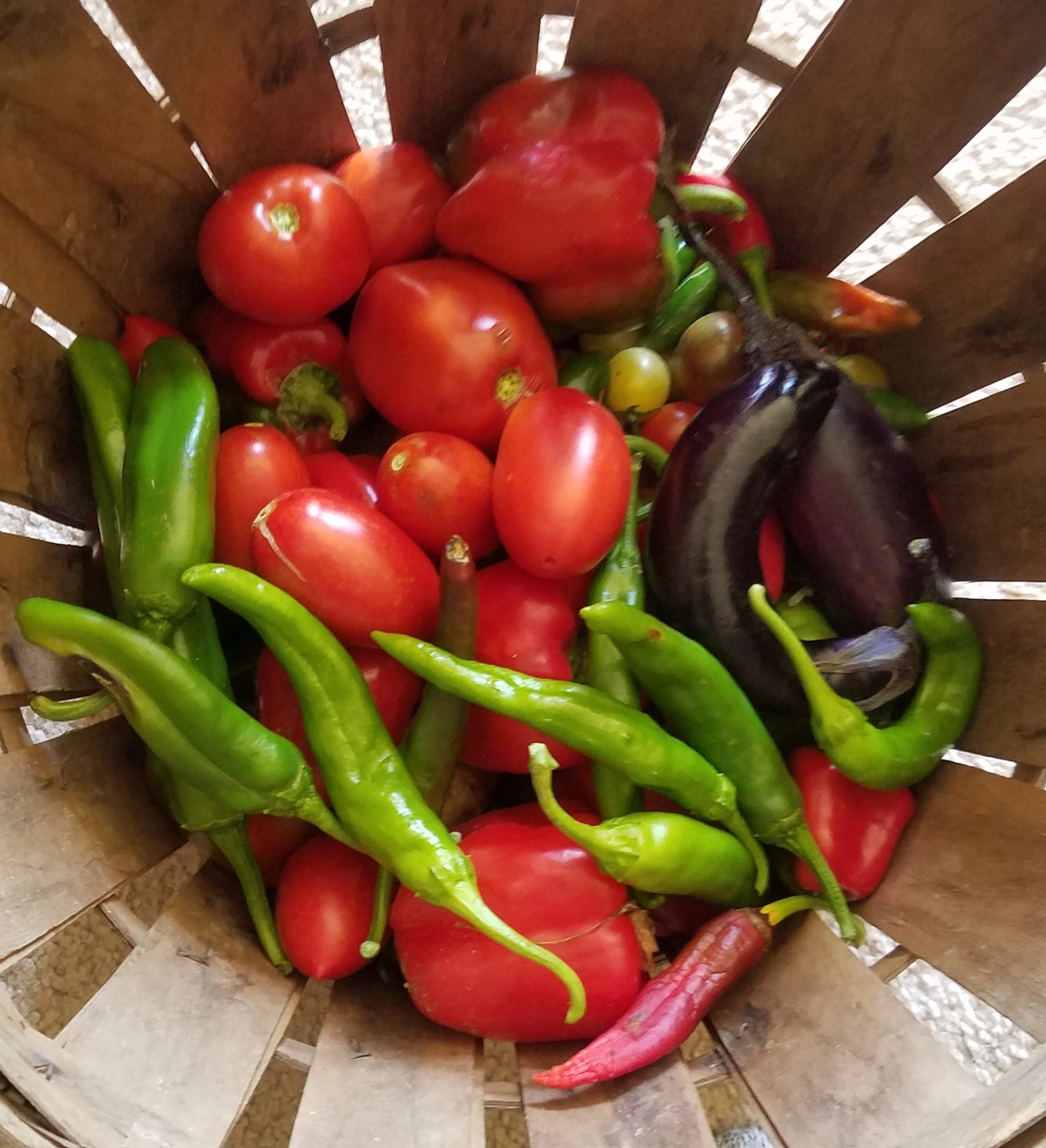
Five gallon bucket of mostly peppers: Guajillo, jalapeno, Serrano and sweet bell.
Some parts of Iowa had a frost warning last night but not here in Big Grove. At 3 a.m. ambient temperatures were in the 60s and all was well with the gardening world.
That is, except for little green worms devouring kale and collards as they do at the end of season.
Kale plant with little green worms.
Despite the kale infestation there was plenty of chard for the kitchen as I gleaned the garden Friday morning. The season is bound to be over soon, even if exceptionally warm temperatures due to climate change extended it.
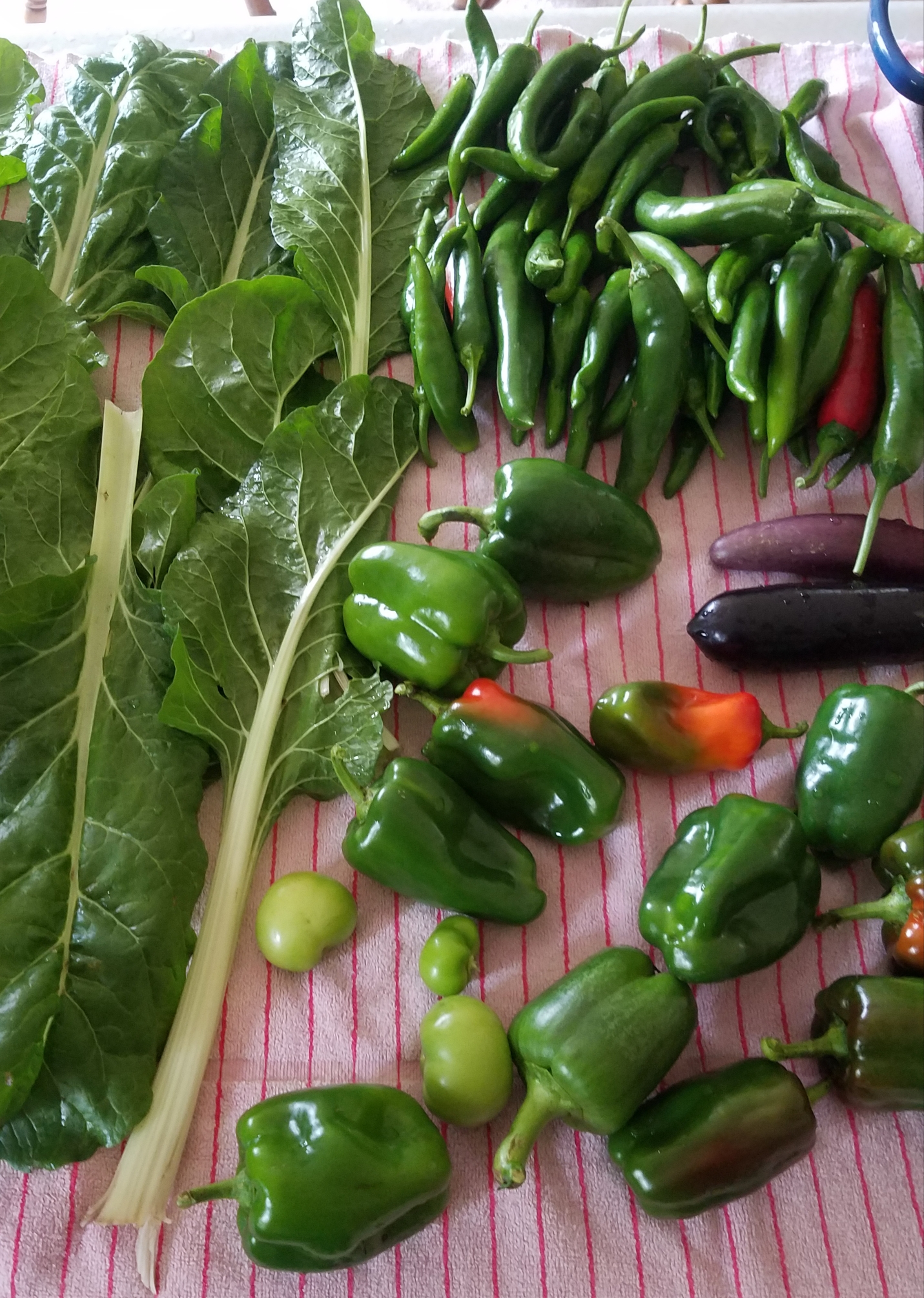
Chard, Guajillo chilies, eggplant, bell peppers and tomatillos drying on the counter.
There were a few tomatoes, mostly small versions of Granadero which produced well this season. The tomato patch is ready to be deconstructed, the fencing rolled up and stored for winter. The question is when I’ll feel like doing it.
Jalapeno and Serrano peppers drying, along with other garden items on the counter.
Partly because of the long season there are many peppers: Guajillo, jalapeno and Ace bell peppers grew better this year than ever. I’ll prepare Guajillo chilies with garlic and apple cider vinegar as a condiment for storage in the refrigerator. The jalapenos are a bit of a surprise as they didn’t produce much earlier in the season. They are big ones, so that increases the possibilities for cooking. My jalapeno needs have already been filled so I’ll have to get creative.
At the end of Friday I picked some basil for pizza making. Basil went into the sauce and whole leaves on top in a pseudo-Midwestern version of pizza Margherita. Fresh mozzarella would have been better, but we make do with what we have. If I try this again, I will wait to apply the basil topping until about a minute before cooking is finished. The pizza was eminently edible. This from a man who at a younger age would eat leftover pizza from a box left overnight in the living room.
Midwestern-style Pizza Margherita.
There is at least one more pass through the garden to get Brussels sprouts and maybe some more chard. The herbs under row cover could use another picking. There are plenty of pepper flowers but it seems unlikely they will make it to fruit. It’s been a good garden season and even the gleaning was bountiful. As fall turns to winter, I’m ready.
Ash and Maple trees starting to turn, Oct. 7, 2021.
It may be a while before the first hard frost. Peppers, tomatoes, Brussels sprouts, and greens continue to grow in the garden. I want one more picking of Red Delicious apples before letting the rest go to wildlife. Fall is in the air and hopefully rain will come with it. It remains exceedingly dry.
Wednesday I mulched the garlic patch so planting this year for next is finished. I won’t start onions and shallots until late December in channel trays under a grow lamp. As I look to 2022, this year has been a great one for our garden.
For now, accept it that fall is coming and with it a an eventual end of the growing season. We live on the edge between abundance and scarcity. Hopefully we’ll have enough food between the pantry and commercial shopping to last until spring. One never knows in a time of climate change.
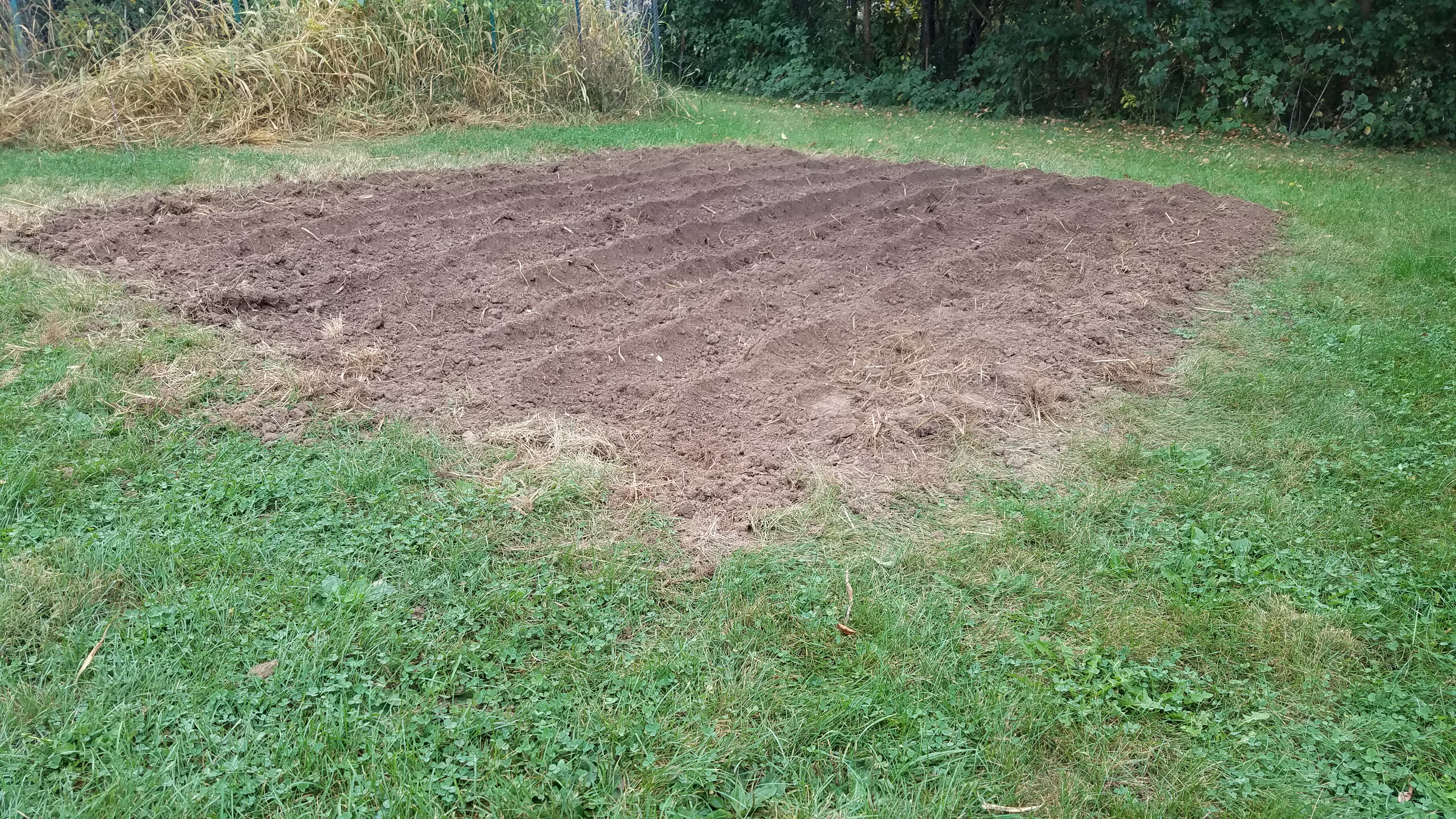
A fine mist of rain began just as I finished tilling the garlic patch. It felt good as I cleaned the electric rototiller tines. I’m not sure I found all the Bur Oak acorns squirrels buried in the plot. We’ll see this spring.
Garlic is in the ground the longest time of anything I plant. Three months the first year and the six or seven more next. It doesn’t take a lot of effort yet there is a specific skill set to getting good results. I learned from one of Iowa’s experts.
I set aside the best garlic heads from the last crop for seed. Last year I planted about 75 cloves and this year about 100. As I broke open the heads and separated the cloves, some had a bad spot. Those were set aside to be trimmed and used in cooking. A gardener wants seed garlic to be free of defects if that’s possible.
A lot of the seconds of garlic will go into a batch of Guajillo chili sauce using fresh chili pods. I also have dried Guajillo chili pods that need to be used up and I’ll use that to make taco filling with kale. The garlic will all get used.
There is a lot going on in the kitchen garden in October. Every minute presents an opportunity to get something done.
Ambient temperatures are forecast to reach the high sixties today. It’s time to plan fall gardening and get to work.
The biggest task ahead is garlic planting. I cleared the plot where I had onions this year. The next work is to spade the soil, fertilize and till it. What’s left of the garlic harvest remains in the rack. It requires trimming, cleaning and sorting. I need about 100 of the best cloves for seeds and the rest will go into storage. It was a good crop and I hope next year will be better.
Because there were so many tomato plants the vines are still producing. They are not the best tomatoes yet fresh ones add value in the kitchen. Once frost comes, I will tear down the bed, stack and repair cages, and save the landscaping fabric and fencing for another year’s use.
I made the first pick of Brussels sprouts this week and they will produce into October. The plot where they are is the most diverse and will require gleaning it until frost kills everything. There will likely be tomatillos, peppers, cherry tomatoes and more sprouts. It will be the last plot to be torn down.
The main fall crop is apples. I went through the apple butter in the pantry and there is plenty to last two years and more. The same is true for apple sauce so the question is what to do with the abundance. I offered some of it to a neighbor who is coming next weekend to pick with their family. I plan to take the best fruit, make some baked goods and juice for apple cider vinegar and fresh cider. I also need to prune dead branches while leaves are still on the trees (so I can see what’s what). I don’t know what to do, if anything, about the scar on the Red Delicious tree where the derecho took a couple of big limbs. I’m resigned to eventually losing it. There is a lot of apple work ahead in the garden.
My greens plot was a success this year. We had plenty for the kitchen and the kale and collards will continue to produce into October. Some years kale makes it through November and last year it over wintered. There is landscaping fabric to recycle there along with fencing. Every plot needs work to prepare for winter.
As I organize and reflect on what happened, the overarching feeling is “where did the time go?” I’m thinking about my fall seed order already. Once the pension checks arrive this month I’ll reduce thoughts to an order and place it.
It’s been a great gardening year in a cycle that never ends.
Jonafree apples at Wilson’s Orchard and Farm, Sept. 17, 2021.
Large commercial farms in Iowa don’t grow apples the way they did. Iowa is mostly a corn, soybeans, oats and hay state when it comes to field crops. People don’t often grow apple trees at home either. Apples remain the most significant Iowa fruit crop and there are plenty around if you know where to look.
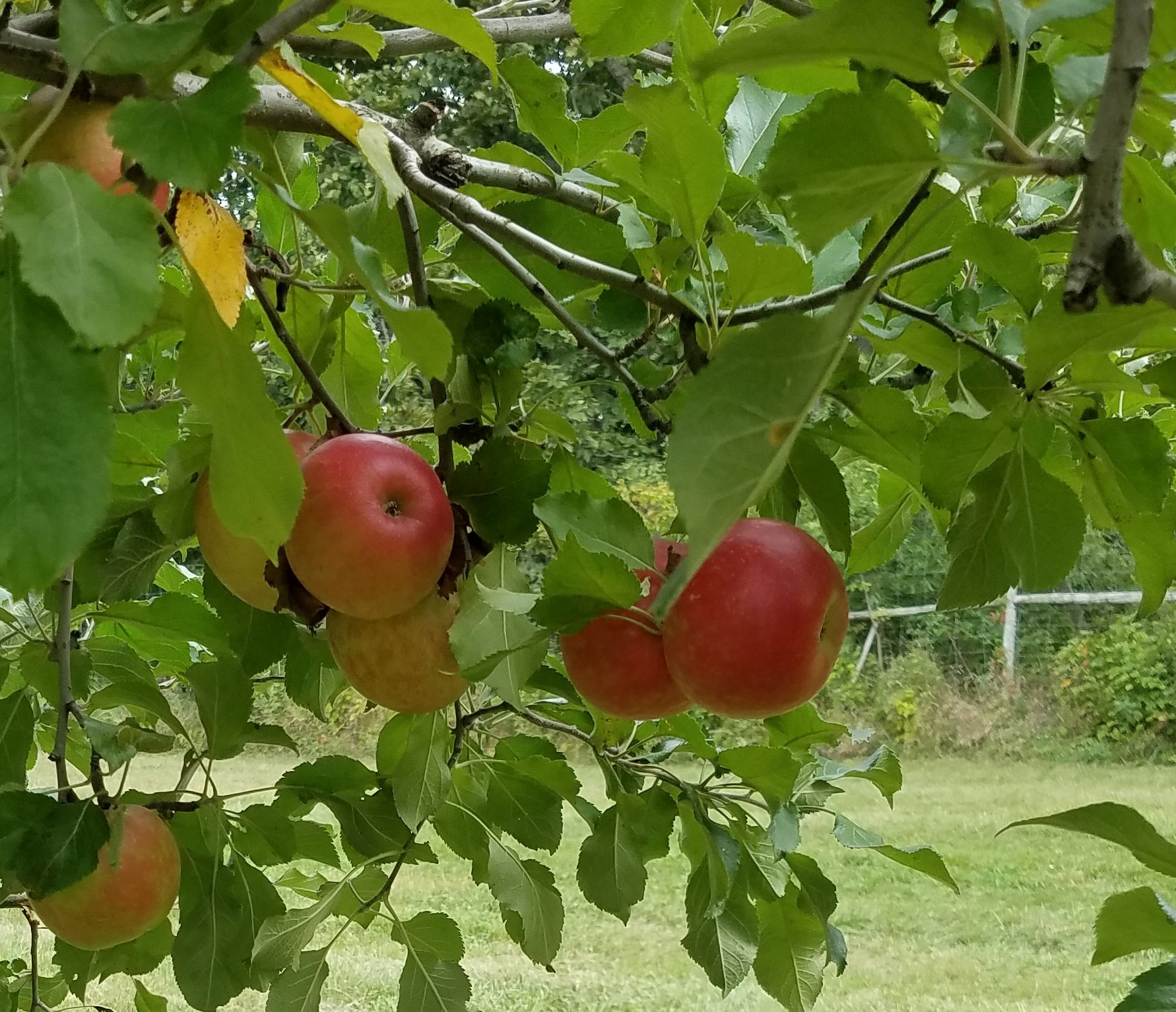
My backyard apple orchard has five trees. This year two varieties produced, Red Delicious and Earliblaze. Besides eating them fresh, I made apple cider vinegar and applesauce from Earliblaze, which were ready first and are done. I just started the Red Delicious harvest and made apple butter, and apple sauce from them so far. Preserving apples will get us through next year when the harvest is expected to be light. This year we have all the apple nutrition we can use with our own apples. Food in a kitchen garden is about more than nutrition.
To get more variety I went to a local orchard where trees are loaded with fall crop apples. Many varieties are ripe and ready to pick now. It was easy picking as the crowds had not hit them the way they will once autumn arrives Sept. 22.
“The full docket for apples this week includes Crimson Crisp, Jonathon, McIntosh, Cortland, Jonafree, Golden Supreme, Honey Gold, Honeycrisp, Song of September, Blondee, Burgundy, Bonner, Sansa, Cortland, Gala, and Ginger Gold,” according to the weekly marketing email from Wilson’s Orchard and Farm. In addition to apples, the farm began growing pumpkins and flowers which add to the scenic experience. In addition to picking apples I got in my daily exercise walking up and down the hills.
My goal was to come home with six or eight Crimson Crisp apples plus a few other varieties. (I planted a Crimson Crisp apple tree in the back yard and it hasn’t begun to fruit). I came home with a bag full of half a dozen varieties, plus some Honeycrisp for home storage. The flavors are distinctive in each, worth savoring.
People do it all the time yet I don’t know how they eat apples produced in other states and trucked into local grocery stores. Nutritionally they may meet requirements, but OMG! With all the locally grown apples and their diverse, often marvelous qualities why would you? As we eat through the ones I brought home we share and discuss each one. It is an experience of Iowa’s apple season and part of our local culture. At least it can be.
Apple time signals the beginning of autumn and the end of the growing season. It will be a rush to get everything done before snow flies. The main work of food production moves from the vegetable garden to the kitchen as bushels of apples become available. Apple time in Iowa connects us to the cycles of the season. Although the seasons have changed due to planetary warming and the greenhouse effect, we enjoy what persists during apple time.






 Journey Home
You must be logged in to post a comment.