Timbers are falling too frequently in the forest of life. Mike Tandy died on March 31 in Davenport.
Our roots together were in high school stage crew. When we formed the band in 1973, Mike would sit in, playing bass from time to time. He was a good guy and always dependable.
I missed Mike and Jan’s 1978 wedding while I was living in Germany. I missed a lot of weddings those years. When I returned to Iowa the following year, I presented a belated wedding gift and got caught up.
Mike was a teacher. He taught Language Arts at Davenport Central High School from the day he arrived until he retired. He directed plays, coached sports, and did all the things a teacher would. More than anything, Mike was devoted to family and friends. I felt lucky to be one of them.
Mike and Jan attended our wedding. The last time I saw him was at a 2019 reunion of stage crew and band friends in Coal Valley, Ill. Like always with Mike, we had a lot to catch up on. It always felt there was not enough time to say everything we wanted. We did our best until it was time for him to be with his family. When he said he had to go, he meant it. I felt there would always be a next time.
I am thankful for our time together. Rest in peace, my friend. You were too young to be gone already.
Seeded tomatoes and peppers and set them on a heating pad under a grow light.
Saturday seemed busy. It could have been more productive. As a retired septuagenarian, there is never any difficulty staying busy. I do wonder if I could produce more during each day. More production is the American way.
A key aspect of America’s peculiar institution of slavery was efficient use of slaves. Especially on sugar plantations, but on others as well, every daylight hour was to be spent working in the fields or processing crops. If a slave died from being over worked, no problem. They could easily and inexpensively be replaced by another. The lives of slaves on a plantation were short.
The average lifespan of enslaved Africans who worked on colonial sugar and rice plantations was seven years. Extreme physical demands relied on equally extreme instruments of torture to ensure control over enslaved peoples and to protect plantation profits. The economies and societies they built were denied to them, along with human dignity.
National Museum of African American History and Culture website.
Making enslaved humans productive was essential to accumulation of wealth in the highly lucrative production of sugar, rice, cotton, tobacco and indigo. A system of overseers and supervision was developed. While slavery ended with the Civil War, those techniques from plantation days persisted in practice and in many cases are revered by business efficiency experts. In 1850, the average life expectancy for a slave was 36 years.
We’re not accumulating any wealth here, yet feeling like I’m accomplishing more would be a boon. Here’s what I have in mind:
About this time last year I stopped regular, daily work on my book. This year I plan to spend less time in Summer and Spring, yet write something or work on research every day. The major obstacle is I can’t seem to get through all the boxes of research documents in a timely manner.
Reduction of my book stacks will continue. The goal is to donate every time I shop over in Coralville, or about every other week. I have a process and things are moving more quickly now. Some time each day on this.
My goal is to read 25 pages per day. For historical books with a lot of detail, that’s probably right. When reading fiction, it’s too low. The idea is to adopt different goals for different kinds of books. If I can’t read 50 pages of fiction per day, there is something wrong with me.
Our refrigerator and pantry are good at keeping food and there is too much of it. I plan to work down the excess by cooking differently. Maybe I’ll find a few recipes that are keepers.
Listen to more music. I wrote this playlist in 2005. It is a story of my life in music. Back when I played, I sang all of these.
Cripple Creek (Traditional)
Lord Franklin (Traditional)
Shenandoah (Traditional)
Big Rock Candy Mountain (Harry McClintock)
House of the Rising Sun (Traditional)
500 Miles (Hedy West)
The Cruel War (Traditional)
Blowin' In The Wind (Bob Dylan)
Pack Up Your Sorrows (Pauline Marden and Richard Fariña)
Wabash Cannonball (William Kindt)
This Land is Your Land (Woodie Guthrie)
Freight Train (Elizabeth Cotten)
The Hammer Song (Pete Seeger and Lee Hayes)
Good Night Irene (Huddie Ledbetter said he didn't know who wrote it)
Someday Soon (Ian Tyson)
Early Morning Rain (Gordon Lightfoot)
Four Strong Winds (Ian Tyson)
Both Sides, Now (Joni Mitchell)
What About Me? (Scott McKenzie)
The City of New Orleans (Steve Goodman)
You Ain't Going Nowhere (Bob Dylan)
I Shall Be Released (Bob Dylan)
It's All Over Now, Baby Blue (Bob Dylan)
The Dutchman (Michael Peter Smith)
The veins on my arms do not stand out. Ever. The clinic drew blood for my semi-annual checkup and it took two staff members four pokes to obtain a sufficient sample. I’m an adult and can stand the pokey pokey. I also know about my hiding veins.
The blood test results were posted same day on a health profile hosted by the hospital. Let’s just say I have some work to do after last winter.
My high school friend Mike Tandy died on Thursday. He was on stage crew and close friends with most of our 1970s band members. He occasionally played bass guitar. He was a teacher most of his working life. Rest in peace, buddy.
The last ten days have been relentless with deaths of people I knew well. Now that spring is here, maybe I’ll get some relief. In any case, I bookmarked the three funeral homes in my home town for easy reference.
A thunderstorm blew through Big Grove Township last night. It was severe enough for us to retreat to our safe place on the lower level. After the 2020 derecho, it was no biggie. A little hail and moderate rain fell. We lost electricity for an hour or so. When the lights and stove went out, I put away the dinner I was making and took the ingredients back out when electricity returned. I left the half-cooked brown rice on the stove and without additional heat, it turned out exceptionally well. We need to replicate that process without the loss of electricity.
I binged on poetry reading at the end of the month, finishing books by Czesław Miłosz, Alice Walker, Adrienne Rich, and James Wright. I liked each one in different ways. The fewer mass culture references in poetry, the better. None of them was clean enough for my liking. It bugged me a little that Walker repeated she was “writing poetry again.” Just show me, don’t tell me is a basic tenet of poetry.
The cleaning of an external hard drive proceeds a little each day. Unfortunately, there are unique and useful files on it, so the computer spends several hours each day with the transfer. My obsessive compulsion about saving my computer work paid off in the new finds I have made. It is a drudgery, though.
I don’t care about sports, yet last night’s win by the University of Iowa Women’s basketball team against number one ranked South Carolina was a big deal. I noticed in social media, some friends flew to Dallas for the game. We talk a lot about how divided the country has become. Yet, if one can’t get behind the success of this team, you may be the problem and need a look in the mirror.
It’s tomato and pepper planting day in Big Grove. I had better get after it.
Charlene Mae Vorwald Hawks, 93, died on Tuesday, March 21, 2023. During high school, after Father died, I got to know her son Tim and was a frequent visitor to their home on Grand Avenue in Davenport. I don’t remember when we started calling her Char. I have two strong memories of her.
The first was at their family home. The front door of the house opened into the living room where I was waiting for Tim. Char came in to say hello as parents of friends did in those days. As we conversed, one of her daughters came down the stairs ready to go out for the evening. Char immediately sent her back upstairs to address the hem length of her skirt, which was deemed too short to leave the house. There was resistance, then compliance. I can’t recall what Tim and I did afterward as it was anti-climactic.
The second memory is when I returned from military service in November 1979. I contacted her about her recent American Studies degree. We talked about my attending graduate school on the GI Bill. She encouraged me to pursue an American Studies degree. Based on her advice, I tracked down the graduate college dean, D.C. Spriestersbach, over the Christmas holidays when most faculty were not around. Char wrote a letter of recommendation and helped me get enrolled in the January term.
The obituary published on the funeral home website tells her story:
Charlene Mae Vorwald Hawks, 93, of Dubuque died Tuesday, March 21, 2023. Visitation will be from 3 to 7 p.m. Friday, March 31 at the Egelhof, Siegert and Casper Funeral Home and Crematory, 2659 Kennedy Road. Mass of Christian Burial will be celebrated 11 a.m. Saturday at Resurrection Catholic Church, preceded by a Eulogy at 10:45 a.m. Graveside services will be at St. Joseph’s Catholic Cemetery, Bellevue, Iowa.
Charlene “Char” was born in Dubuque, Iowa, on Jan. 12, 1930. She was the only child of Elmer and Monica (Theisen) Vorwald. While born an only child, Char saw her cousins on both sides of her family as siblings. She spent many joyous days with them and loved them dearly.
Char earned her BA in Classical Languages from Clarke College. She continued her education while raising her children, earning her MA and PhD in American Studies from the University of Iowa.
Char married James Edward “Ed” Hawks on November 19, 1951, at Nativity Church in Dubuque. Together they shared an unparalleled love and an eternal partnership. The years were filled with raising their children, enjoying their grandchildren and great-grandchildren, and traveling the country. Wherever their travels took them, Ed commented that they met a relative of Char’s. Their best days were spent at an old stone house, lovingly called the “Rock House,” near Bellevue. Their seven children, and their children’s spouses, are Tim (Mary Lew McCormick), Shorewood, WI, Teri (John) Goodmann, Dubuque, IA, Cathy (Tony) Topf, Wonder Lake, IL, Laura Hawks, Iowa City, IA, Susan Hawks, Sugar Grove, IL, Carolyn (Bill) Bates, Donahue, IA, and Lisabeth Hawks, South Elgin, IL. Char is also survived by 21 grandchildren and 22 great-grandchildren. Char was preceded in death by her parents, Elmer and Monica Vorwald and her husband Ed Hawks.
Char was a force of nature and transferred that energy toward many different pursuits through her life. She volunteered for the March of Dimes, Girl Scouts, and the St. Paul the Apostle School Board all in Davenport, IA. Char was a proud member of Rotary International Club and was recognized as a Paul Harris Fellow. After earning her advanced degrees Char worked at Augustana College (Rock Island, IL) as an adjunct professor and the Director of the Reading and Writing (Lab) Center. At Augustana College, Char became a beloved mentor of many students. Never one to retire, Char and Ed opened Hawk Hollow Antiques and Collectibles in Bellevue, IA and Galena, IL. In all these endeavors Char developed close, life-long friendships that brought her much joy.
Memorials may be made to Hospice of Dubuque; the Sisters of Charity of the Blessed Virgin Mary; Our Lady of the Mississippi Abbey; or Luther Manor Communities. Char never met a person, plant, or book she didn’t love. In lieu of a memorial, feel free to donate a book to a library, volunteer time to a literacy organization, plant a tree, or plant some flowers. These meet Char’s greatest wish to make the world a better place. Family, faith, and education were most important to her.
The family wishes to thank the nurses and staff at Luther Manor Communities and Hospice of Dubuque for their loving care and generous spirit.
I made a couple of trips to the Rock House, once with Tim about the time they were installing a furnace, and another for Tim and Mary Lew’s wedding reception. It was always a time away from quotidian affairs spent with friends and family. Char Hawks has now gone home and will be missed.
My life in politics is winding down as I turn to long delayed tasks and projects. When I returned to politics at the end of George W. Bush’s first term, I devoted time to everything political. I won an award as an activist. Hopeful candidates continue to see, in the database that tracks such things, I donated sizable amounts to congressional candidates. None of that time and money remains for politics as I stride down the inevitable path toward life’s end. There is too much else to do.
We Iowa Democrats were beaten hard during the last few general elections. While 2010 didn’t kill us, the return of Terry Branstad as governor that year was the beginning of the end. 2022 was the end with Republicans taking all but one statewide office, all four seats in the Congress and increasing their already large majorities in the state legislature. I support what Rita Hart, Zach Wahls and Jennifer Konfrst are doing to resuscitate the Democratic body politic, yet time and money are things of which I have little extra to spare. Basic living has to come first.
Unless we nominate a corrupt, lazy bastard, I expect to vote Democratic.
A generic life expectancy table says I have plus or minus 13 more years to live. It seems like a lot of time, yet if I engage in political campaigns, the days, months, and years will fly by like songbirds migrating back to Iowa in spring.
What is all this stuff that needs doing? I don’t know… we made a list. The bigger problem is thrill is gone from politics. When you get beat down three elections in a row, it is time let go of it so the next generation can make the world they envision. William Butler Yeats summed up where we are in a 1920 verse that continues to resonate:
The Second Coming

Turning and turning in the widening gyre
The falcon cannot hear the falconer;
Things fall apart; the centre cannot hold;
Mere anarchy is loosed upon the world,
The blood-dimmed tide is loosed, and everywhere
The ceremony of innocence is drowned;
The best lack all conviction, while the worst
Are full of passionate intensity.

Surely some revelation is at hand;
Surely the Second Coming is at hand.
The Second Coming! Hardly are those words out
When a vast image out of Spiritus Mundi
Troubles my sight: somewhere in sands of the desert
A shape with lion body and the head of a man,
A gaze blank and pitiless as the sun,
Is moving its slow thighs, while all about it
Reel shadows of the indignant desert birds.
The darkness drops again; but now I know
That twenty centuries of stony sleep
Were vexed to nightmare by a rocking cradle,
And what rough beast, its hour come round at last,
Slouches towards Bethlehem to be born?
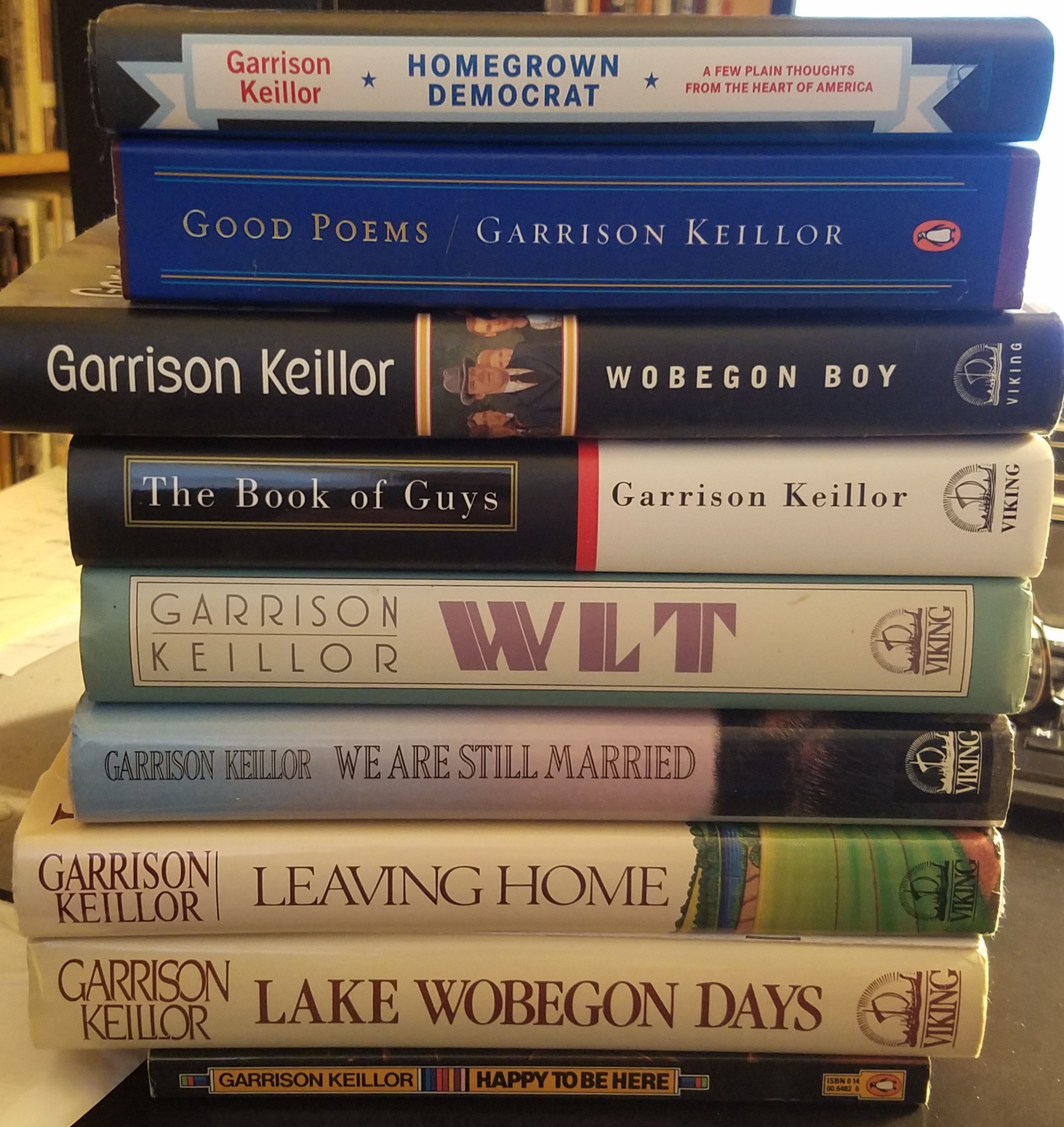
Selection of books by Garrison Keillor waiting disposition.
It’s time for decisions… about Garrison Keillor.
Specifically, what should I do with this pile of books? Most were purchased at thrift stores for a dollar or less. I may have purchased the poetry book new, and maybe Homegrown Democrat. I can’t recall. Keillor’s books never made an impression on me the way Saul Bellow, Joan Didion, or John Irving did. He fancied himself a modern day Mark Twain, or something. I didn’t see it. Had I read more of Keillor, it may have been different. It’s getting late to start reading him now.
These nine books have been gathering dust in a row on the bottom shelf of the right-side stacks. They have been within reach for years. I could see them from the chair I bought for a buck from L.P. “Pat” Foster at Sharpless Auctions in the early 1980s. It is my writing chair for Pete’s sake! Keillor is a writer! The collector in me amassed the Keillor volumes back when I was in a more accumulating mood.
Disposing of Keillor’s books is a practical problem. Do I expect to read them? No, not likely. Will I refer to something he wrote in my writing? Maybe, yet it is hard to imagine when the radio show made the dominant impression. Do they have sentimental value? Maybe. Are there more worthy books for retention waiting in the next room for shelf space? Yes definitely and that will be the decider.
Keillor’s allure was when A Prairie Home Companion was live on Saturday night, the signal coming through the clock radio atop the Kenmore refrigerator in our Midwestern home. I did things in the kitchen and listened. In important ways, his show made Saturday nights for a long time. I miss them. Will I miss the stack of books? If I would miss them, I might have picked one of them up over the last ten years.
I remember when he signed off the air in 1987. It felt momentous. Our two-year old child wanted to go for a walk in the neighborhood at the same time. No regrets about going with her instead of hearing Keillor live. We all must make choices.
I rigged my cassette recorder to capture the last show while we were gone. When we returned from our walk, I discovered the tape had run out before the show ended. Keillor never went over, except this time. I was able to re-record it on Sunday when it aired on a different radio station that broadcast from the Quad Cities.
We now know Denmark didn’t work out, nor did his then new marriage. He came back to radio. There were other problems, they said. I’m not sure what happened, or in what order. I didn’t pay much attention to his personal life. The star of the show was always the yarns he spun. It felt like it would never end.
In a June 16, 2016 New York Times article aligning with his second departure from the radio program, Cara Buckley wrote, “Everything about “Prairie Home” — the Guy Noir and Lives of the Cowboys sketches, the spots for Powdermilk Biscuits and the Ketchup Advisory Board, the monologues about the fictional Lake Wobegon — sprang from Mr. Keillor’s imagination. But the man spinning the plates at the center of it all managed to stay a mystery, even to people who know him well.”
These days, I’m spinning my own plates. To use a more local metaphor, I don’t have enough time to card my own wool, and spin my own yarn to make a sweater. Plate-spinners have gone out of fashion.
I wish I could have one of those Saturday nights back. Like the one I shared with our child in Colorado Springs in their first apartment there. We went to the grocer together, prepared dinner, and talked to each other with the sounds of a Prairie Home Companion in the background. Those were golden times whose embrace is fleeting.
I will figure it out. These septuagenarian days are also fleeting. In the universe of things to do with used books, these will likely go to the public library’s used book sale. I may have bought some of them there. It seems likely they will find readers in our community, even if I can’t find the time in our prairie home to be one of them.
Set my skepticism regarding doctors
     aside for now,
     while considering
     the pediatrician and poet.

Set it on that basket,
     where it's shine might
     illuminate this moment.

Would we have him as our physician?
Would we travel into the city with him?
Would we seek his company?
Would he have sought ours?

To have his eyes, his struggles...
     his medical practice,
     his practice of poetry...
     It was all one.

I took the basket to the garden,
     to dig potatoes,
     and struggle to get out
     from where I rooted with singular purpose.

~ Written in the Calumet, circa 1990.
The first draft of part one of my autobiography is finished. The narrative begins with my maternal great, great grandfather’s arrival in 19th Century Minnesota and continues until I finished graduate school in 1981. It is a good place to end winter writing as my focus turns to the garden. Caesura.
I’m not finished with the narrative. I sent part one to a reader, and may send it to one or two more. I needed a break from the writing.
I identified as a writer after returning from military service. It persisted. I diligently worked at writing during the first year of our marriage. I felt the urge to do more to earn money and support our small family, and found a new job by March of year two. The birth of our child in year three changed everything. I found outlets for writing through the years yet it wasn’t until 2007, when our child left Iowa, and I started a blog, that I began to find a consistent voice.
Much research and sorting remains. On Saturday I spent several hours reviewing digital files. I deleted so many, One Drive sent me an email asking if I was sure I wanted to delete them. There were some useful passages and many more hours of this lie ahead.
That’s not to mention the artifacts laying around in boxes. All of it needs review. Yet there is a garden to plant and tend to. I’ll work things out in the pre-dawn hours of each day.
The next chapters will be more challenging, as by the time of our marriage, life had gotten complicated. A spouse, a new job, a child, and the challenges of working in the Reagan era all created demands. I met them as well as I was able.
I wrote the outline for part two and have about 60,000 words. As I find relevant writing and subjects, I can copy and paste them there. Once the garden is in, hopefully by Memorial Day, I can take another look at what I have.
In the meanwhile, I had no idea what a big task this would be. As long as my health remains good, I’ll continue to write and edit until this work is done. There is so much invested in it, I can’t abandon it now.
The back seat of the Chevy Spark is loaded with boxes of books to be donated to Goodwill. Between this load and the previous two, I downsized by about 500 books. It doesn’t look like I made a bit of progress.
The goal is to reduce the library so it fits in my writing room, which holds about 2,000 books. Remaining books should be linked to some actual or potential writing project. I’m done keeping books because I might refer to them later. As I look at each book, this is a litmus test: am I going to read or use it now, or not. There is a long way to go to reduce the quantity to fit the space.
It snowed overnight and the ground is covered. It should melt during the next couple of days, yet today will be indoors work. I’m ready for spring.
The house is getting crowded with vegetable and flower seedlings. I finished with early planting yesterday. Next week I tackle tomatoes, peppers, arugula, and lettuce. Once there is a warm, clear day, I’ll move the mulch and set up the portable greenhouse so all the seedlings can move there. With the cold, wintry mix weather, I haven’t felt like outdoors work.
I drafted an obituary for my high school friend‘s widow this morning. It is difficult to compress 71 years of life into 500 words. This is especially true for a physician who has had countless contacts with people in the community, and lived a full life. An obituary still serves as a public notice of death and is important.
Facts need research before going to publication. In several ways, the obituary is a last chance to get things right. We owe getting it right to the deceased, and to the survivors. I tend to be less specific if I don’t know something with certainty. Thus far, no one has complained I left anything out.
I finished my 19th book of the year and need to browse the stacks for the twentieth. Lucky for me, there are still plenty of options.
Tracking down remaining folks from our cohort in the old neighborhood was possible. Joe Garrity died Wednesday night and his grade school classmates at Saint Vincent’s deserved to hear the news. That neighborhood no longer exists in the real world, yet I found most of them.
Joe was born the day before I was on Dec. 27, 1951. He lived with his father after his mother died in an automobile crash. Saint Vincent’s, where since 1895 the Catholic Church had cared for children as an orphanage and school, was not far from where they lived.
I met Joe in high school in 1966. We remained friends until near the end when Parkinson’s Disease had his spouse writing his letters and emails. He would occasionally sign a holiday card. We corresponded by mail, and later, email after we both left Davenport in 1970 for university.
I would sleep over at his house when his father was on the road as a truck driver for The Rock Island Lines. In one of my first cooking experiences, Joe and I would make pizza using a Chef Boyardee boxed pizza kit. They had a big house and we had it all to ourselves. The pizza was good.
I referred Joe to the Turn-Style department store where I worked in high school. He started work and didn’t last long. I remember him wearing the vest that made a uniform for us as we worked the sales floor.
We were both in the National Honor Society. A group of us high achievers formed an inter-mural basketball team. We had a high grade point average yet weren’t very good at basketball. We also recruited the only Hispanic in our class to join our team. He later showed us around the LULAC club in West Davenport.
After graduation, Joe went to Georgetown for his undergraduate studies. A group of us from high school visited him and another fellow classmate at Georgetown over the Thanksgiving weekend during our freshman year. He graduated and returned to Iowa to attend medical school, receiving his MD in 1978. When orthopedics didn’t work out for him after an initial period in the program, he became an emergency room physician. We lived together in University Heights while I finished graduate school and he commuted to Dubuque and other workplaces.
While I lived in Mainz, Germany, Joe and his brother Bill made a brief stop on a European tour. Bill lived in Washington, D.C. and attended many cultural events there. He wanted to see an opera at the Mainz Opera House. I got us tickets to Giacomo Puccini’s Tosca. After a long day at work we had dinner at a Yugoslavian restaurant near the opera house. I made it through most of the story. Then… just as Tosca was dramatically preparing to jump from the parapet to her death… I fell asleep. When we visited a jazz club the following day, Bill fell asleep on his bar stool and fell. We were all very tired.
The last few years have been tough for Joe with recovery from a fall, surgery, and fractures, in addition to Parkinson’s Disease. At the end, the coronavirus invaded the household and Joe didn’t survive.
There are only so many friends of more than 50 years. Joe Garrity will be missed.
UPDATE: I helped Bonnie write the following obituary, which was distributed graveside:
Joseph G. Garrity, 71, of Dubuque, died on March 22, 2023. He was interred at Casper Creek Natural Cemetery near Galena, Ill.
Garrity was born on Dec. 27, 1951, of Eileen Honore Quinn and Harry Patrick Garrity, in Davenport. He grew up there, attending St. Vincent’s Catholic School and Assumption High School. In 1970, he entered Georgetown University, where he earned his undergraduate science degree. Returning to Iowa, he earned his Doctor of Medicine at the University of Iowa in 1978.
Joe Garrity practiced medicine as an emergency room physician in Evansville, Indiana, and in Dubuque, later working at Medical Associates’ Acute Care clinic and Occupational Medicine for 30 years. He was a 36-year resident of Galena. Toward the end of his life, he and Bonnie split their time between Galena and Washington, D.C., eventually moving to Dubuque.
He married Bonnie Lamar on February 14, 1987, in Galena. His life’s passions were art, exploring the world, and trekking in the foothills of the Himalayas. He especially enjoyed his treks to the base camps of Mt. Everest, K-2, Mt. Elbrus in Russia, and to the top of Mt. Kilimanjaro.
Joe Garrity is survived by his wife Bonnie Garrity, by his brother Michael Garrity (Diane) in Dubuque, sister Nancy Waack (Jim) in Rutledge, Missouri, and ten nieces and nephews. In addition to his parents, he was preceded in death by his brothers William and Harry, and nephews Michael and Gregory Waack.
Memorial contributions made be made to: Casper Creek Natural Cemetery P. O. Box 195 Elizabeth, Illinois 61028
Joe’s expanded obituary appeared on April 19, 2023 in the Galena Illinois Gazette here.





 Journey Home

You must be logged in to post a comment.