Categories
Environment

Live Blogging The End Times

With Al Gore and company in Chicago, August 2013

The climate crisis remains with us. A series of news articles reported stresses on Earth to which climate change contributed or caused: Canadian wildfires, heated ocean temperatures off the coast of Florida, the failure of a generation of Emperor Penguin fledglings to survive because of melting sea ice, Hurricane Hilary in California, Maui wildfires, and others come across our news feeds like we are live blogging the end times. Climate change made each of these disasters worse. These stories are likely the tip of the iceberg.

I don’t need a news feed to know our community is at risk due to climate change. Our subdivision is conserving water on our public well because the Silurian Aquifer is faltering with increased usage. A deep and extended drought, combined with a lack of rainfall means surface waters have not been able to recharge the aquifer to keep up with water demand. I don’t mind conserving water. There is not an endless supply. It’s worse when generational expectations are not met.

Local environmental activists continue to remind us there is a climate crisis and the time for action to mitigate its worst effects is now. It will take all of us to address the climate crisis, especially our elected officials.

Here’s the rub. People enjoy our current life in society so much we don’t want to change it, even when inconvenienced by the impact of the climate crisis. Even when the inconvenience takes the form of the current extended drought and we don’t have access to the same amount of water coming from our faucet we did a few months ago.

In his 2017 book, Confessions of a Recovering Environmentalist and other Essays, Paul Kingsnorth captured this notion:

For most of my twenties, I had put a lot of my energy into environmental activism, because I thought that activism could save, or at least change the world. By 2008 I had stopped believing this. Now I felt that resistance was futile, at least on the grand, global scale on which I’d always assumed it would occur. I knew what was already up in the atmosphere and in the oceans, working its way through the mysterious connections of the living Earth, beginning to change everything. I saw that the momentum of the human machine — all its cogs and wheels, its production and consumption, the way it turned nature into money and called the process growth — was not going to be turned around now. Most people didn’t want it to be, they were enjoying it.

Confessions of a Recovering Environmentalist and other Essays, Paul Kingsnorth.

Kirkpatrick Sale lays bare the connection between climate and society in a recent issue of Counterpunch, “All the talk about ‘climate change’ directs the world’s attention away from what is the real central problem: the effect of unmitigated capitalist growth ravaging the resources and systems of the earth and its atmosphere.”

They both make a point.

I can’t recall how many times I heard Al Gore mention the pollution we dump into the atmosphere. “Every day we’re continuing to pump 162 million tons of global warming pollution, greenhouse gas emissions, into the atmosphere, as if the atmosphere was an open sewer,” Gore said everywhere during the last ten years. While some of this is caused naturally, most of it is a result of humans, that is, the unmitigated capitalist growth and exploitation of resources and systems Sale mentioned.

I joined the Climate Reality Project in August 2013 in Chicago. Gore’s training came at a time I needed it. I had just retired from my big job in 2009, and had seen the film, An Inconvenient Truth. I intended to work on climate change during my retirement years. Gore explained the impact of greenhouse gases on the atmosphere and oceans in clear, concise terms. The training was more than useful. There are now 50,000 trained climate activists like me. It may not be enough.

The issue mostly omitted during discussion of climate change is how it permeates everything in society. In Iowa there is no going back to the way the land and water was before the Black Hawk War in 1832. The environment has been completely re-worked to accommodate what is now conventional farming. We take what has become known as industrial agriculture for granted.

Are we living in the end times? I don’t know, and don’t believe we can know. What is known is there are solutions to the climate crisis if only we would apply them to the problem. This can be done without major disruption to our way of life.

If you are interested in a just and sustainable future that addresses the climate crisis, visit The Climate Reality Project at this website.

Categories
Living in Society

What Should We Fear?

B-61 Nuclear Bombs

The United States is a country where we constantly balance security and liberty. During my youth, we were taught to believe that a large nuclear weapons arsenal, with a triad of land-based missiles, aircraft-dropped gravity bombs, and submarines would deter the Soviet Union from attacking us. When the attacks of Sept. 11, 2001 happened, we shifted to a concern that a small group of terrorists had brought havoc on the country by bombing three locations with hijacked aircraft and could do it again. We subsequently gave unprecedented authority to the President to manage our security.

While it seems unlikely that one of the nuclear armed states would initiate an attack with nuclear weapons in the sort term future, the reality of ease a terrorist group has of constructing a single nuclear weapon with fissile materials collected from across the globe is as present as ever. Osama Bin Laden notably consulted with nuclear engineers at his last residence in Abbottabad, Pakistan. Terrorists have said they would use nuclear weapons if they could get the materials to make them and likely would. In the United States, we are free as long as we defend against this possibility.

What are Iowans doing to protect us? On Monday, Aug. 21, the governor’s office issued a press release saying Governor Kim Reynolds had joined four other governors at Eagle Pass, Texas to “ban together to secure border. The typo/misspelling aside, Reynolds had serious intent:

Texas is ground zero, front and center of the border crisis,” said Governor Reynolds… “On day 1 of the Biden Administration, they reversed policies that protect the sovereignty of this country and its citizens. Iowa is located at the intersection of two major interstates, and it is a pathway for Mexican cartels and humans traffickers in the Midwest.

Governors Reynolds, Abbott, Pillen, Stitt and Noem Ban Together To Secure Border, Office of the Iowa Governor, Aug. 21, 2023.

During this brief moment of grandstanding, the Republican governors seem to have forgotten the Biden administration has been working on the causes of illegal immigration, almost since day one. Vice President Harris has been charged with determining what can be done with the governments of Mexico, Honduras, Guatemala, El Salvador, and others as people in those countries, including children and families, fled in record numbers. Migration from the region has spiked due to a web of factors, including poverty, corruption, racism, disease, natural disasters and gang violence, according to the Los Angeles Times. Governor Reynolds didn’t mention or acknowledge what the administration is doing because her trip was more about winning the 2024 election by scaring the electorate.

Let’s not forget that drug dealers won’t be stopped by improved security across the southern border. They have the resources, staffing, and technology to create innovative solutions to deliver their wares to the United States, including submersible ocean-going vessels, and aircraft that don’t touch land until they arrive in country. Republicans belied the complexity of dealing with threats from Mexico and Central America at their Eagle Pass photo opportunity. They distract us from other, more realistic threats to our security and liberty. They are going to have to do something other than point an accusing finger at the president to be credible.

Among our biggest threats to security are proliferation of assault-style weapons. There are droughts, derechos, tornadoes and heat waves made worse by climate change. The threat of terrorists securing enough fissile material to make a nuclear bomb, continues to be an issue. What about all these threats to our security? The governors did not mention them at Eagle Pass and more’s the pity. It is time to band together with fellow Democrats to ouster the governor when she is up for reelection in 2026.

In the meanwhile, to get involved with Iowa Democrats, click on this link.

Categories
Writing

August Heat Wave

Part of the shore of Lake Macbride after continued drought conditions.

It is supposed to get hot during Iowa summer, yet not like this. On Wednesday and Thursday, ambient temperatures climbed to nearly 100 degrees with heat indexes approaching 120. I got outside shortly after dawn and walked along the lake shore. Neighbors were also on the trail early to beat the heat. The air was like soup. I spent most of the days indoors after walking and tending the garden.

August is almost a five week month. The writing I have done for Blog for Iowa is helping me get in practice to take up my autobiography again after Labor Day. My readership on this site after cross posting has not been as good as usual. Perhaps that is because my long-time readers are used to a different kind of writing. That’s okay. The small stipend I received to cover a vacation helped pay for necessary, existential things around the house. Things like pumping the septic tank.

I asked my friends on social media what book I should read next. There were plenty of suggestions. I picked The Circle of Reason by Amitov Ghosh, to be followed by A Fever In The Heartland by Timothy Egan. If you have reading suggestions, please leave a comment. Rarely has someone recommended something that I didn’t evaluate and read it.

It occurs to me I haven’t been to the farmer’s market in a couple of years. As I scaled up the garden, I needed less outside produce. I can’t imaging going to the orchard for apples as my trees have more than I can harvest before they fall. The pear tree is keeping us in sweet fruit, so I skipped all the commercial berries, peaches, nectarines and the like in favor of eating from our yard.

The heat is not good for septuagenarians. I feel healthy, yet realize I have to take it easy on working outdoors when it’s hot and humid. All the indoors time has not been particularly good for me, yet I’m able to process vegetables and fruit and cross things off my electronic to-do list. I look forward to autumn.

More and more I feel like a survivor. My parents and grandparents are gone, and I never had an excessive number of friends when I lived in Davenport before 1970. My political friends are aging and dying. I don’t feel like driving, except when I have to get groceries or run an errand. I need a haircut.

My spouse has been at her sister’s home for the last month, so I do what I want indoors. Notably, the radio has been on whenever I want to listen. Our child has their own life, which increasingly doesn’t involve parents. All of this means I am forced to deal with aging in America, which includes a large rasher of loneliness. I’ll be fine. As a writer, I crave being alone with my thoughts and writing.

The pattern of a hot August lives in memory. Living in this week’s excess heat hasn’t followed any traditional pattern. We have a new air conditioner so that’s a plus. (I raise a toast to Willis Carrier, the inventor of air conditioning). Except for dairy products, there is no reason to leave the house. Some say I should give up dairy products, but I’m not ready. When I went outside to get the mail, the neighborhood was exceedingly quiet. So quiet, it was eerie.

I can see the end of this heat wave and it gives me hope. Soon my spouse will be home and we’ll get back to whatever passes for normal. We survived the coronavirus pandemic without contracting COVID-19. We’ll survive this.

Categories
Living in Society

History Of A Wing Nut

Mariannette Miller-Meeks at the Iowa State Fair, Aug. 13, 2010. Photo credit – Wikimedia Commons.

Can Democrat Christina Bohannan beat Republican Mariannette Miller-Meeks during the second contest between them in 2024? One can only hope… and do everything possible to see that she does. Going into her sixth campaign for the Congress, Miller-Meeks has become a wing-nut institution. Iowans deserve better.

When Miller-Meeks first ran against Congressman Dave Loebsack in 2008 she got shellacked 57.2 percent to 35.4 percent. In 2010, Republicans regained lost ground in Iowa, yet Loebsack beat Miller-Meeks for the second time, 51.0 to 45.9 percent. In 2014, Miller-Meeks lost to Loebsack for the third time 52.5 to 47.4 percent. As many of us recall, when Dave Loebsack retired in 2020, Miller-Meeks beat Rita Hart by six votes. After decennial redistricting, she was re-elected in 2022, without moving into the district, defeating Christina Bohannan 53.4 to 46.6 percent. Iowa began turning deep red in 2010 and while it took Miller-Meeks a while to get going, she followed the trend.

I met Miller-Meeks at a 2008 parade in Johnson County. Costumed as a physician, she circulated among people along the parade route next to her “ambulance.” Good times. During one parade, I had a conversation with her about abortion, the constant conservative issue since Roe v. Wade was decided. “It’s settled law,’ she said. “So that is that,” I said to myself. We now know she jumped on the Dobbs bandwagon when it overturned Roe.

Where to begin with wing nut Republican Mariannette Miller-Meeks (R-IA01)? As a Member of Congress she has learned the double-speak of Washington politicians. These days it is hard to separate truth from hyperbole from outright misrepresentation. She didn’t always used to be this way.

When Terry Branstad was elected governor in 2010, he appointed Miller-Meeks as director of the Iowa Department of Public Health. I wrote a couple of posts after her appointment, including this paragraph:

Where Iowa’s public health is likely to suffer under a (Miller-Meeks) directorship is in developing an understanding of the relationship between Iowa’s agricultural and energy systems with public health. In “Iowa Coal & Health: A Preliminary Mapping Study” by McCue, Deaton, Nost and Rachow the authors point to inadequate collection of data in Iowa regarding adverse health events. While the IDPH does collect data used in the study, the quality of data was a constant source of criticism by geographers who collaborated on the project who were familiar with similar data in other states. It seems unlikely that MMM will invest in data collection improvements despite affirmation of support for the methods of scientific inquiry during her congressional campaign. At the same time, as a proponent of nuclear power to control toxic emissions from coal fired power plants and concentrated animal feeding operations in the state, she is expected to kick the ball down the road for the decades it would take to bring adequate megawatts of nuclear energy on line.

MMM and the Iowa Department of Public Health, Blog for Iowa, Dec. 11, 2010.

12 years later, my position was vindicated. Her views regarding energy in the Iowa economy haven’t changed but her messaging has.

In an Aug. 17 column in the Solon Economist, she bashed what she called “President Biden’s radical energy policies.”

For two years, Americans suffered the consequences of President Biden’s reckless and misguided energy policies. Low to middle-income hard-working families are bearing the brunt of Biden’s all-out war on domestic fuel production which led to record inflation, weakened our national security, and constrained American energy production. House Republicans passed H.R. 1, the Lower Energy Costs Act, the first pro-energy permitting reform in 40 years, to empower our producers to deliver the affordable and reliable energy that our country needs to thrive.

Following through on our commitment to America by Mariannette Miller Meeks, The Solon Economist, Aug. 17, 2023.

Where to start with this paragraph of malarkey? In the first place, The U.S. House passed H.R. 1, The Lower Energy Costs Act with only four Democratic votes. It was hardly bipartisan. Perhaps the reason few Democrats voted for it is the bill fulfills a wish list for the fossil fuel industry, including the following:

The bill expedites the development, importation, and exportation of energy resources, including by

  • waiving environmental review requirements and other specified requirements under certain environmental laws,
  • eliminating certain restrictions on the import and export of oil and natural gas,
  • prohibiting the President from declaring a moratorium on the use of hydraulic fracturing (a type of process used to extract underground energy resources),
  • directing the Department of the Interior to conduct sales for the leasing of oil and gas resources on federal lands and waters as specified by the bill, and
  • limiting the authority of the President and executive agencies to restrict or delay the development of energy on federal land.

In addition, the bill reduces royalties for oil and gas development on federal land and eliminates charges on methane emissions.

It also eliminates a variety of funds, such as funds for energy efficiency improvements in buildings as well as the greenhouse gas reduction fund.

H.R. 1 – 118th Congress 2023-2024.

Miller-Meeks would undo progress made to reduce greenhouse gas emissions to support the fossil fuel industry. She would hobble efforts to produce the affordable, clean energy she purports to support.

Importantly, H.R. 1 went nowhere: It was not taken up by the Democratic U.S. Senate. It seems premature for Miller-Meeks to be doing a victory dance.

Miller-Meeks held a town hall meeting in Iowa City on Aug. 14. Tom Cook of Iowa City attended and had this report, published in the Cedar Rapids Gazette:

One can see how far out of touch Miller-Meeks is with Iowans by her description of the same event in her Aug. 20 newsletter to constituents.

I’m still waiting for her to listen to First District voters about energy policy. If she would listen, I’m skeptical of persuading her to break free from the influence of fossil fuel companies. She’s not listening to anyone but lobbyists in Washington D.C.

If you would like to help Christina Bohannan defeat this wing nut, sign up on the website located here.

Categories
Living in Society

The Trouble With Issues

Iowa Capitol

Like many of our readers, I traveled to Des Moines and Washington, D.C. to advocate for issues. I remember visiting Congressman Dave Loebsack in Washington, shortly after his 2006 election to the Congress with a list of a dozen issues to cover. It was quickly clear which issues most interested him. Because I had gotten to know him during his 2006 campaign, he patiently listened to them all.

Issues-based politics has become a bane to normal political life. People have issues. I have issues with most of them. The Aug. 17 People Over Politics Town Hall Meeting in Shueyville got a burr under my saddle over issues.

Iowa House Democrats surveyed the electorate and developed four issues which most voters, regardless of party affiliation, could support: lower costs for Iowans, supporting Iowa’s public schools, protecting reproductive freedom, and legalizing marijuana. The idea was to use these issues as a wedge to convince more voters to elect a Democrat in a conservative district. State Representatives Amy Nielsen and Elinor Levin did a good job of presenting the premise and walking us through the issues.

“What about water quality?” asked one attendee.

“What about climate change?” asked another.

“What about CO2 pipelines and eminent domain being used by private companies to secure right of way for them?” said someone else.

The representatives gave measured responses to each of these questions, explaining that water quality and climate change, as issues, don’t move voters. With CO2 pipelines and eminent domain issues, both parties are divided in the response. All are important to the future of Iowans. The important part, from my perspective, is moving voters to support a less conservative house or senate candidate. According to the survey, these issues are not particularly useful in doing that.

State Representative Chuck Isenhart asserted on X, “Not being on the list (of four) shouldn’t mean that we don’t talk about them at all.” I agree. I devoted much time in my life to addressing the climate crisis. As much as I want to both elect a Democrat to my house district, and solve the climate crisis, they are different types of endeavors. A basic characteristic of debate over issues is that when one talks about one issue, others are excluded. To win back conservative districts, we need to focus on parts of the Democratic agenda that have broader appeal.

There are multiple ways to cover issues with voters. In the best of circumstances, a canvasser can have a conversation with a voter that leads to a constructive discussion of more than the big four. One has to go beyond them to secure a commitment. If anything, the issues most Iowans can support will be an effective beginning place.

The trouble I have with issues that surfaced in Shueyville is some of the activists lost perspective of a larger strategy. If one comes to politics only when we want something, that is, as a single issue voter, we haven’t differentiated ourselves from many Republicans. We need to win some seats currently held by Republicans. To do that we need to find and focus on common ground that exists, like those four issues the House Democrats identified.

In my experience, abortion is a tough one for compromise. People hold strong positions for or against access to abortion. While the survey shows more than half of Iowans liked the protections of Roe Vs. Wade, for many voters supporting reproductive rights is a deal breaker. Once those voters are identified, it’s time to shut the conversation down, make a note, and move on to the next contact. Single issue voters are unlikely to yield.

A person can get tired of their issues not being addressed by government. Waiting for action is never good. That will continue for Democrats as long as Republicans hold the trifecta. House Democrats are offering a potential path forward.

Categories
Living in Society

The Trouble With Political Door-Knocking

2012 Obama For America door hanger.

The numbers vary among different legislators and political activists, yet somewhere between 65,000 and 90,000 registered Iowa Democrats did not vote in 2022. It seems like an easy problem to solve. Reach out to those voters, the ones that still live in the state or district, and encourage them to vote. Easy-peasy lemon-squeezy… done before you know it. It surely will make a difference!

Not so fast!

While a good number of political activists swear that in-person contact — at people’s homes or by telephone — is the most effective way to get voters to vote, Democratic activists who attended the Aug. 17 People over Politics town-hall meeting in Shueyville were skeptical. One activist, who was critical of the Iowa Democratic Party, said “door knocking doesn’t work,” based on his personal experience. I spent time at the doors during State Senator Kevin Kinney’s 2020 campaign and must admit that between people not being home, having already voted, and living complicated lives, door knocking wasn’t the best use of my time in a campaign. All the same, what else is there to do?

On Sunday, Aug. 20, about 50 political activists gathered in Iowa City for training in how to canvass in the No Off-Years campaign designed to begin talking to voters now and gain commitments to vote in November 2024. Johnson County, the Iowa City-Coralville area particularly, has a different set of challenges to address with a high density of Democrats. The goal is to match or beat the Iowa Secretary of State’s 2020 voter turnout percentage of 74.0 percent in the county (86 percent of active voters). Statewide the election had 76.0 percent turnout (81.2 percent of active). In this usage, “to canvass” refers to a lot of door-knocking. The county party laid out the plan to address infrequent voters in an Aug. 22, email:

Our GOTV team begins canvassing on September 10. We will go out on six separate dates in September and October. We will be talking to Democrats who are “inactive” or who vote infrequently as well as liberal to moderate “no party” voters, and learning what issues are of importance to them and their families. This information will be very helpful in understanding how to best appeal to No Party voters whose top issues align with Democratic values.

Email from Johnson County Democrats, Aug. 22, 2023.

If people are not motivated to vote and door knocking and telephone calls don’t work to get them out, what is the approach activists should use to get ready for November 2024? An answer to this question is above the pay grade for most volunteers. Right or wrong, the assumption, at least in Johnson County, is that door knocking does work, so full steam ahead. That may not work as well in districts like House District 91 where Democrats are not concentrated in a few areas, and the Republican won the state house race in Johnson County and district-wide.

I am in the “door knocking is one tool in the organizer’s kitbag” camp on the spectrum of how to win voters over and get them to the polls. The main trouble with political door-knocking is in places like Johnson County, a substantial, machine-like organization is created to contact voters and use a specific script when they do. Door-knocking and telephone calling is scheduled in shifts where the volunteer has little control over which voters are contacted, or why they were chosen for attention. One has to have faith in the system that the masterminds of developing canvass lists know what they are doing. The recent lack of success Iowa Democrats experienced hasn’t instilled such faith.

Let’s get back to the basics. In 1964 John F. Kennedy lost Iowa yet his constituents were hard at work trying to make a difference. I watched my father do his voter contact planning and it was not complicated. 1). Pick up a mimeographed page with a generic city block printed on it from the union local. 2). Learn the names, addresses, and phone numbers of every voter on the block and add them to the form. 3). Meet with neighbors and ask if they would vote for JFK and how certain they were. 4). Make a note on the sheet. 5). Follow up when the election got closer. It all sounds so simple. A person was in charge of a geographic turf, gathered needed information on all voters, and engaged them to get out those voting for JFK.

Obama used a similar system in 2008, although his campaign provided names, addresses and contact information. Our neighborhood organizer had a paper list of every voter in their turf and worked them until they knew where each person stood on voting for Obama, and if they weren’t, whether they were persuadable. Unlike JFK, Obama won Iowa that election and in 2012 as well. It was the in-person localized contact that made a difference during the Obama campaign. So what happened?

Data heads took over voter targeting and the voter contact operation by managing a voter database comprised of available voter information.

With the rise in campaign technology beginning with the Howard Dean campaign in 2004, how campaigns were conducted changed. Obama brought the technology of campaigns together and we had an edge on Republicans. That didn’t last long.

How Do Iowa Democrats Proceed? Journey Home, Aug. 10, 2023.

Working from a voter database instead of from a neighborhood has its merits. When there aren’t enough volunteers, it can prioritize which voters get contacted. For Democrats, that is usually people who don’t vote consistently or meet certain demographic profiles like age, sex and area of residence. Under the “we don’t have enough volunteers so the party will pick which voters to contact” method, volunteers can be disenfranchised. Some of this dissatisfaction surfaced at the meeting in Shueyville.

It seems a bit much to ask Democratic activists to have blind faith that the party and its data heads know what they are doing. Democratic support for candidates in Iowa degraded beginning with the 2010 election, culminating with the 2016 election when Republicans gained a legislative trifecta. While the Israelites were made to wander in the wilderness for forty years for their disobedience and lack of belief, let’s hope it doesn’t take Iowa Democrats that long to get with the program. 40 years of Republicans in charge could be hella bad.

Don’t like door knocking and phone calling? Stop complaining and do something else that makes a difference. Something like taking ownership of your neighborhood and maximizing how many votes can be produced for your candidates. The Iowa Democratic Party must determine how to better empower this kind of activism.

To get involved, click on the Iowa Democratic Party website.

Categories
Living in Society

Iowa High School Democrats

One of the issues discussed at an Aug. 17 meeting in Shueyville, with representatives of the Iowa House Democrats, was registering high school students to vote. There are processes and conflicts in doing so within some school districts. To hear attendees tell about it, it was a struggle.

State Representative Elinor Levin nodded when I mentioned House Minority Leader Jennifer Konfrst had been promoting Iowa High School Democrats as an organizing tool. Never heard of it? It is a national organization for Democratic high school students with state and local chapters.

High School Democrats of America empowers and encourages students to take on an active role in the fight for Democratic victories across the country. In addition to fostering civil discourse among those with opposing viewpoints, HSDA provides a platform for members to impact the political process in a substantive way and make their voices heard on a national level.

Iowa High School Democrats State Team

The purpose of Iowa High School Democrats is to cultivate democratic values in the state of Iowa. By advocating for democratic beliefs and getting democratic leaders elected to office. It is comprised of the following teams:

Communications Team:

Our talented Communications Team will harness the power of social media to craft engaging and relatable posts. By doing so, we aim to effectively address the critical issues that profoundly impact today’s youth. Our team members are dedicated to ensuring that our messages resonate with authenticity and relevance, enabling us to connect with our audience on a deeper level. We are here to also to support the democratic leaders in Iowa.  

Program/Development Team:

Our passionate Program/Development Team combines their research skills with a genuine commitment to advancing our youth organization. They work tirelessly to enrich our curricula by providing a wealth of additional resources to our members. Together, we explore innovative ways to expand Iowa High School Democrats, including the exciting development of school chapters. With their creative brainstorming sessions, our team is continuously striving to take our organization to new heights.

Policy Team:

At the heart of our organization, the Policy Team diligently stays informed about various laws and emerging issues. Their dedication allows us to collaborate closely with the Communications Team, ensuring that the information we share remains relevant and impactful. Our Policy Team is committed to making a positive impact through their research and collaborative efforts.

The group is just getting started. For more information, or to join, contact the founder at Sawsow05@gmail.com.

Registration for National Membership is here.

Categories
Living in Society

People Over Politics Visits House District 91

On Thursday, Aug. 17, the Iowa House Democrats People Over Politics tour of conservative districts came to House District 91. About 20 people, all residents of the district, attended the town hall-style meeting at the Shueyville Community Center. About all we had in common was that we were Democrats who held a deep dislike for our Republican State Representative Brad Sherman.

The 90-minute session was mostly an airing of grievances as State Representatives Amy Nielsen, who previously represented Shueyville, and Elinor Levin from Iowa City moderated the discussion. Until now, there had been few gatherings of Democrats in the district. It was a great opportunity to hear from Democratic representatives about what’s happened at the statehouse, ask questions about the legislative session, and express our legislative priorities.

People Over Politics was the Iowa House Democrats response to increasing extremism among majority Republicans. After surveying the electorate, Democrats distilled four issues about which most Iowans (not just Democrats) can agree. Following are the four key issues from their website:

Lower Costs for Iowans

Too many Iowans are still struggling to make ends meet today. Their wages simply aren’t keeping up with the rising costs of healthcare, food costs, child care, and utility bills. While we recognize the state legislature cannot control all the ups and downs of the national economy, we can take action to help lower costs and reduce living expenses for Iowans.

Here is how we put more money in the pockets of Iowans:

Expand access to affordable child care.
Lower taxes for working families instead of more handouts to big corporations.
Create more affordable housing options.
Expand the use of renewable energy to lower gas prices and utility costs as well as create good jobs.

Supporting Iowa’s Public Schools

For generations, Iowans have counted on great public schools to educate our kids and be the heart of communities large and small. But we’ve lost ground and our public school kids are losing out and teachers are leaving the classroom.

Here is how we renew our commitment to great public schools:

Fully fund public schools to keep up with rising costs and guarantee every kid in every zip code gets a great education.
Raise pay for educators and give them a seat at the table.
Stop the Governor’s private school voucher plan to ensure public money is used to help public school.

Protecting Reproductive Freedom

Everyone deserves the right to make their own health care decisions, especially when it comes to reproductive care and abortion. Lawmakers have no place interfering in someone else’s decisions about when to start a family. A majority of Iowans support reproductive freedom and believe that private health care decisions belong between an individual, their family, and their doctor.

Here is how we will protect the reproductive freedom of Iowans:

Stop the Governor and Iowa Republican ban on all abortion.
Guarantee reproductive freedom by putting it in Iowa’s Constitution.
Expand access to reproductive health care across Iowa.

Legalizing Marijuana

It’s time. A majority of adult Iowans support legalizing marijuana for recreational use. Legalizing marijuana for adult use will keep Iowans safe, stop our tax dollars from going to neighboring states, improve the quality of life for Iowans suffering from chronic illnesses, and stop wasting state resources to unfairly punish Iowans

Here is how we can do the right thing and keep Iowans safe, while moving Iowa’s future forward:

Regulate a safe product that Iowans already use
Use new tax revenue to invest in education and local communities.
Save taxpayer dollars and stop clogging up our courts and prison system with non-violent offenders.
Fixing Iowa’s broken medicinal cannabis program to help those undergoing cancer treatment, and others with chronic conditions like epilepsy, deserve access to improve their quality of life.

Iowa House Democrats People Over Politics website.

Iowans are tired of their representatives playing politics in the statehouse instead of listening to their constituents. Brad Sherman is one of the worst in that regard. The grievances of the group covered a broad span of topics. While a single meeting among voters won’t accomplish much. The hope is it is the beginning of an organizing process that will provide an opportunity to replace radical conservatives currently representing us.

To learn more, visit the Iowa House Democrats People Over Politics website, found here.

Categories
Kitchen Garden

In The Summer Kitchen

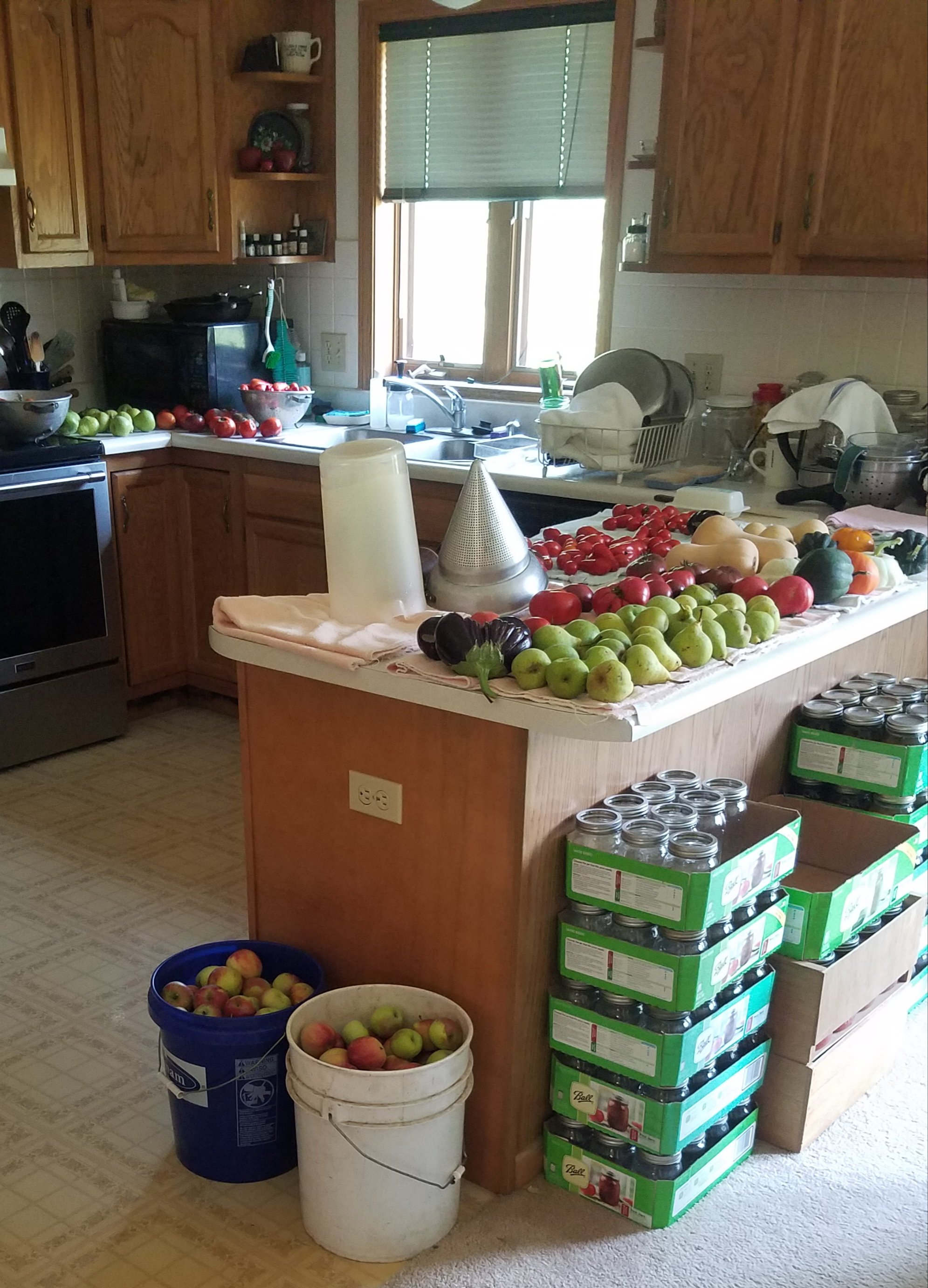
Produce in our summer kitchen.

The orchard where I worked for eight seasons before the coronavirus pandemic has Red Haven peaches from the owner’s cousin in Michigan. They are among the best peaches I have yet eaten. I didn’t buy any this year because the pear tree we planted at our daughter’s high school graduation party is producing in abundance. Our pears are misshapen yet sit down and stand up sweet and delicious. I’ll save my peach buying for another season.

It is hard to keep up with the garden’s abundance. On the counter are tomatoes, pears, apples, squash, and eggplant waiting to be processed or cooked. In August, this could be a full time job. I truly want to can tomatoes for winter. Luckily, they have a reasonable shelf life and I can process them before spoilage. Half of the challenge in the kitchen is knowing what to process, how, and in what quantity.

Physical stamina is another thing. A person can stand at the counter slicing tomatoes for only so long without rest. I do it until my back gets sore and then stop and sit for a while. It extends the overall time to get things done. It also allows me to continue until the work is finished.

The way the harvest comes in makes for canning batches of two or three different items. I currently have apple sauce, tomato juice, diced tomatoes, and salsa verde ready to be processed in a single batch. We’ll see how the morning goes and whether there are enough tomatoes to make a complete batch. I know there are enough apples to make seven quarts of sauce for a single batch. Usage in cooking determines whether to put things in quart or pint jars. For example, tomato sauce is for pints, and whole tomatoes for quarts. Apple sauce is for quarts, apple butter for pints. Navigating through canning and food preservation is a learned skill.

Ten years ago, I preserved everything I could from the garden. That resulted in many extra jars of pickles, applesauce and apple butter. Unless there is a specific reason, I now limit my seasonal output to what we can use in a year or two. I do not see a future of canning pickles the way I did in 2016 when I generated 24 quart jars. Cucumbers are so abundant, I can make fresh refrigerator pickles that last for a year. The canned goods are tasty, but also too much when trying to process everything.

My cruciferous vegetable plot was an unmitigated success this year. I put up all my kale early in the spring and now pick fresh when I need it. Soon I’ll pick a couple crates for the food banks, but I don’t like to inundate them with kale. Same for chard and collards. We have frozen broccoli and cauliflower enough to last until spring. The broccoli plants are still producing small floret bunches.

When I’m busy in the kitchen, it is time for a batch of soup. The problem is the refrigerator and freezer are full, so there is no place to store a couple quarts of home made vegetable soup.

The rack of garlic is dry enough to process and clean. I’ll save the 25 biggest heads to break apart and plant as seeds in October and put the rest in a crate for storage on the lower level of the house. Because the garlic season lasts from October to July, I tend to forget about it. It is a mainstay in our kitchen where we use some almost every day.

There is no place I’d rather be than in our summer kitchen. When one grows a kitchen garden, meals are better and we engage in the process enough to forget our troubles. It’s where I’ll spend many of the coming days.

Categories
Writing

No Off-Years

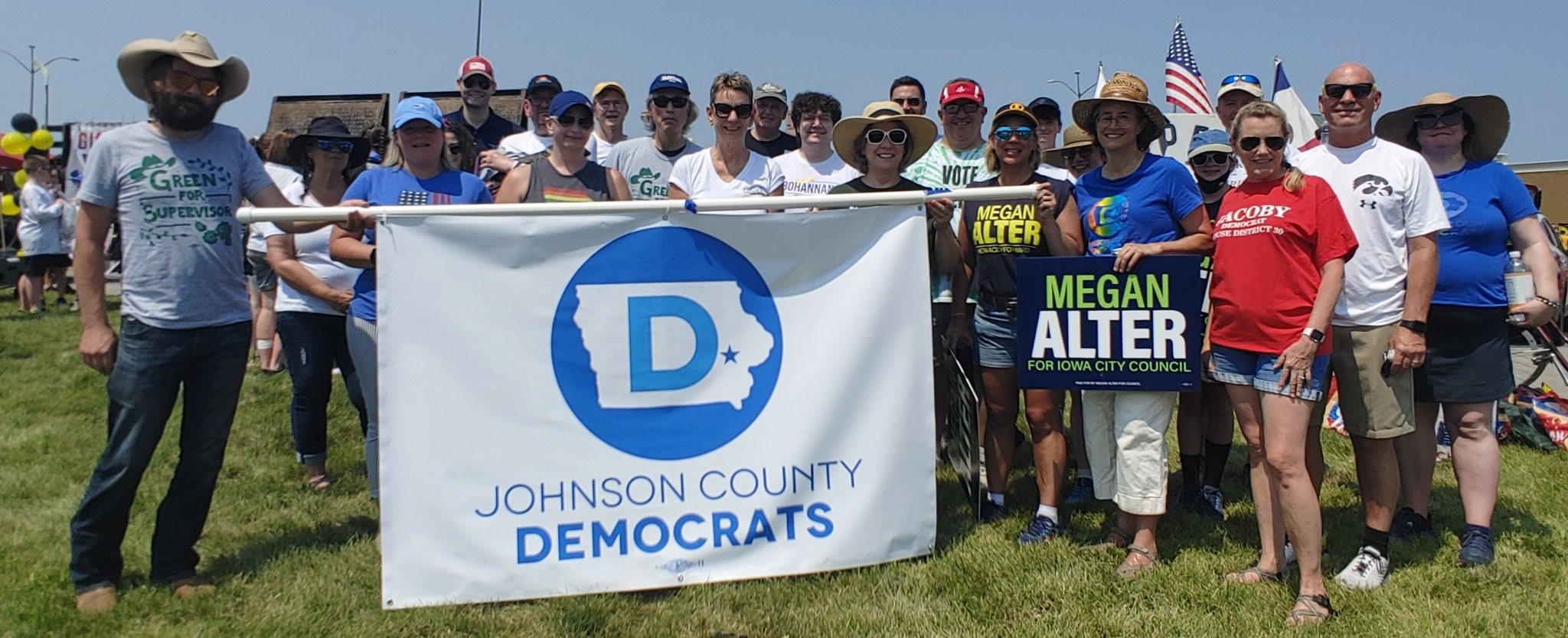
Johnson County Democrats at a summer parade. Year unknown.

The Johnson County Democrats created a political campaign called “No Off-Years.” In a recent email, State Senator Zach Wahls explained:

I’m reaching out to invite you to join our “No Off-Years” campaign – a movement that goes beyond the elections every two years and focuses on doing the important organizing work that will turn Iowa blue again.

Our democracy thrives when we, the people, are actively involved in shaping its path. It’s not just about rallying before elections – it’s about keeping our momentum going consistently. That’s the idea behind “No Off-Years.”

Traditionally, we’ve concentrated on election periods, but I believe Democrats and anyone who values progress must stay engaged throughout the year. We need to foster lasting change, build connections, and ensure our voices are heard, no matter the season.

Email from State Senator Zach Wahls, Aug. 16, 2023.

A local organizer from Solon, got down to brass tacks while promoting training for a September canvass:

This is the path forward to better governance in the state of Iowa. We need to knock on doors and talk to our neighbors about why we think it is important support democratic candidates and really turn out and vote in huge numbers.

Email from Seth Zimmerman, Aug. 14, 2023.

What I’m hearing is Democrats developed special messaging focused on identifying where voters are politically, and encouraging them to join the mainstream Democrats in turning out for the 2024 general election.

Whatever No Off-Years becomes, I support the effort unequivocally. So should readers.

My friends and I have been talking about how to support the effort. Our small coterie of the 70-plus crowd has been debating whether to walk turfs to knock on doors at all. If they do so, some need a walker and there are various kinds from which to choose. Our theory is if one is door-knocking with a walker, 1). a person can sit and rest when needed, and 2). we might get a few sympathy votes. Making phone calls to friends and neighbors makes more sense for us than knocking doors, although that has its issues. Our conclusion in numerous telephone conversations is the next generation needs to step up and manage most of the in-person part of this campaign.

It is important to note that the main purpose of pre-election canvassing is to target and identify potential voters for our candidates, then get them out to vote. I recall the first Obama campaign during the general election. Our neighborhood organizer had a well-annotated list of everyone in the neighborhood and crossed them off once they committed to voting for Obama or said they wouldn’t. As election day approached, we were able to assess each uncommitted person on the list and make a last-ditch effort to persuade them before the polls closed. We didn’t perceive this as rallying before the election, but rather dotting our i’s and crossing t’s to bring every possible voter to the polls.

Iowa Democrats have bottomed out in our election of candidates in federal, state and local races. There is a need to change that going forward if we want to be a viable party that attracts new people. The No Off-Years campaign is worth trying. After all doing nothing is a worse option.