Categories
Sustainability

Grounding Drones Vigil in Iowa City

Grounding Drones Vigil

IOWA CITY— About 50 people gathered at the intersection of Clinton and Washington Streets to witness against our wars on Friday. Voices for Creative Nonviolence (VCNV) stopped by to join the vigil as part of their peace action called “Covering Ground to Ground Drones,” a 190-mile walk from the Rock Island Arsenal to the Iowa Air National Guard Facility at the Des Moines airport, planned site of a new drone command center. The purpose of the witness is to call attention to the fact of non-combatant casualties resulting from the U.S. weaponized drone program in Afghanistan, Pakistan and Yemen, something the corporate media has not adequately done.

The Central Intelligence Agency has acknowledged they don’t always know who their drone targets are, or what, if any connection they have to U.S. national security interests, so there is a specific and public reason for the protest. The information about drone targeting was only recently revealed after an investigation of classified documents by NBC News.

Kathy Kelly
Kathy Kelly

Voices for Creative Nonviolence coordinator Kathy Kelly was on hand at the vigil, chatting with people gathered. In a Sept. 8, 2010 article on Huffington Post, she summarized the challenge her group faces, “corporate media does little to help ordinary U.S. people understand that the drones that hover over potential targets in Afghanistan, Pakistan and Yemen create small ‘ground zeroes’ in multiple locales on an everyday basis,” comparing drone strikes to the terrorist attacks of Sept. 11, 2001. Kelly is one of a small number of people who made an effort to see the civilian perspective of the U.S. drone program by traveling to Afghanistan and Pakistan.

Veteran for Peace
Veteran for Peace on the Telephone

In the background, a Veteran for Peace, his banner waving in the wind on the University of Iowa Pentacrest,  coordinated his trial for trespassing at a drone piloting unit in New York state on his telephone. Several people at the vigil had previously been arrested for civil disobedience while protesting the drone program. The legal aspect of the peace movement is not insignificant, with its intentional arrests and trials. It is a drain on time and resources, but is part of the gig.

Brian Terrell Picking a Sign

Peace activist and Catholic Worker, Brian Terrell was present. He had just been released from a six-month prison sentence for trespassing at Whiteman Air Force Base, Mo., where he attempted to deliver an indictment of the U.S. drone program to Brigadier General Scott A. Vander Hamm, the base commander. John Dear S.J. of the National Catholic Reporter wrote in a Jan. 8 story about Terrell, “they tried to make the case that dropping bombs on women and children in Afghanistan and Pakistan will not lead to peace— much less improve our own security— but will inspire thousands of people to join the violent movements against the United States.” Like on so many issues, neither the corporate media nor the public is paying much attention to the work of Voices for Creative Nonviolence, Catholic Worker, Veterans for Peace and others in the peace movement.

When we compare the U.S. anti-drone protests to other political unrest, it is pretty tame. Part of it is its nonviolent aspect. Part of it is the lack of underlying tensions in society like those that caused a nation-wide protest over the Gezi Park development in Istanbul, Turkey, where tens of thousands of people turned out in protest across the country. While one can have deep respect for nonviolent action against injustice, there is little depth to the current drone protests outside the core groups. This renders them ineffective at best, a drain on resources that could be more effectively applied to more significant targets at worst.

After the vigil, the group slow-marched to the Iowa City Public Library for a potluck meal and to hear speakers. In the end, it was another day in the county seat of the most liberal county in Iowa. Outside the small enclave of peace activists, few were paying attention, and that is unfortunate.

Old and Young Demonstrators
Categories
Environment

On James Hansen

James Hansen
James Hansen

IOWA CITY— It’s hard to believe, but a lot of people don’t know who is James Hansen of Denison. He is a retired NASA scientist who took the first sentence of NASA’s mission statement, “to understand and protect the home planet,” to heart and explored the science of climate change. That is, it was the first sentence of the NASA mission statement until the George W. Bush administration removed it.

Hansen’s concern about the kind of world he will leave his grandchildren led him to continue to speak out about the need to mitigate increasing carbon dioxide and other greenhouse gases in the atmosphere— the cause of global warming.

I met Hansen on Jan. 27, 2008 in Iowa City, and his message hasn’t changed much, except maybe to express increased urgency about the need to mitigate rising temperatures related to burning fossil fuels before it is too late.

If readers don’t know about James Hansen, they should. Check out his brief bio at the Columbia University website here. In this 17 minute TED talk, from February 2012, http://on.ted.com/Hansen, Hansen presents, in easy to understand terms, the science of global warming and the urgent need to do something about it.

There is no debate about global warming. The debate is over what to do about it. According to Hansen, we should stop subsidizing the fossil fuel industry and implement a carbon tax. We should do it now.

Categories
Kitchen Garden

A Shift at the Farm

Working in the Barn
Soil Blocking and Seed Planting

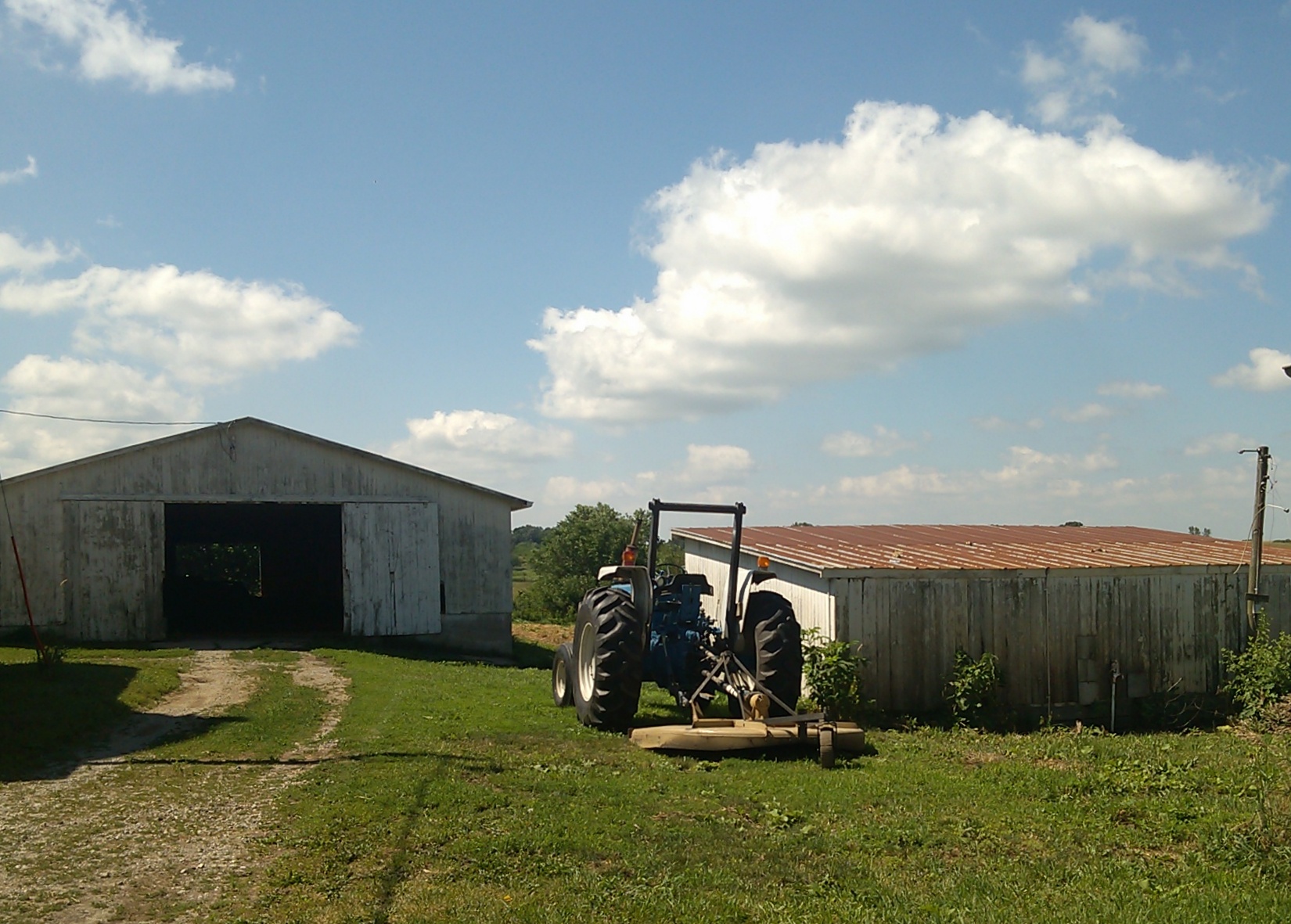
RURAL CEDAR TOWNSHIP— A real concern about severe weather hangs over the farm. When there is a forecast of thunderstorms and gusts of high wind, we move cars, tractors, wagons with seedlings on them, and other equipment into the barns. The vegetables growing in the field stand on their own, and a crop failure for any reason would be disastrous. It’s too late to start over.

In a community supported agriculture (CSA) project, unlike with commodity producers, the risk of a crop failure is not only financial. Shareholders would have to find food elsewhere. When a person joins a CSA, the expectation is to share in good and bad outcomes. However, there is a practical aspect of crop failure in that people have to eat. Industrial food supply chains, against which CSAs compete, are diversified enough to provide food during hard times. The effect of a failure would be to erode some of a CSA’s hard earned loyalty of members. Yesterday’s storm passed without significant damage and concerns receded like the flood waters. Equipment came back out of the barn.

Field of Garlic
Field of Garlic

After my shift of soil blocking and planting, I walked among the fields to look at the progress. The scapes of garlic are forming, plenty of rhubarb remains, and the rainy spring has everything growing.

With some crops, a process of laying down irrigation lines and then plastic on top is used and was a learning experience. It makes sense to protect against drought in a farm business, and when customers have other options, irrigation can help ensure there is a harvest.

At home, I water my garden, but sparingly. Partly to conserve water, but also because the vegetables should produce on their own. Home gardening is more about living within the actuality of the season, rather than producing a fungible commodity. It’s not really about the vegetables, but a way of life.

That’s not to say I wouldn’t sell excess— I have. Having a harvest is important, but not critical. There is a part of us that wants to connect with the elements in a fundamental way. Gardening fulfills that desire. Knowing the face of the farmer and where food comes from is essential to maintaining sanity in a turbulent world. That there are risks is part of the paradigm.

Yesterday’s themes— risk, irrigation, coping with crop loss and customers— in the context of working on a CSA, served to instruct as another shift on the farm ended. The compensation for this work is not only in vegetables.

Categories
Kitchen Garden

Chance of Rain and Falafel

Lettuce
Lettuce

LAKE MACBRIDE— Watering the garden this morning was a no-brainer. It hasn’t rained for a couple of days and the ground was dry and crunchy yesterday. We may get some rain after lunch, a 60 percent chance of precipitation beginning at 3 p.m., but why not let the plants benefit from the moisture now? Probably should have watered after returning from Coralville last night.

Baked Falafel
Baked Falafel

One of the blogs I follow posted a recipe for baked falafel, so I tried a batch this morning. They recipe came out well, but raised the question of what kind of sauce. Improvising by mixing two teaspoons of mayonnaise with a teaspoon of branded Il Primo Giardiniera Spread from the ice box, falafel made a great second breakfast before heading out to the farm. Today’s recipe, already modified by adding some olive oil and a bit of water to bind the mixture, will be a starting point for perfecting this snack-type dish for regular use.

Full day’s work ahead, so better get to it.

Categories
Home Life Kitchen Garden

Trimming the Mulberry Tree

Tractorcade Hits Big Grove
Tractorcade Hits Big Grove Township

LAKE MACBRIDE— Reaching into the cooler, forearms covered with sawdust and sweat, I pulled out the last remaining bottle of chilled water. At 86 degrees and the air full of gnats, my mouth was dry.  I drank greedily— momentary coolness quenching my thirst.

The mulberry tree grew from a seed dropped long ago by a bird sitting on the rebar marker of the corner of our property. Because of the way it grew, three of us now own a part of that tree, although I have been its caretaker. In this tree I first saw Cedar Waxwings eating berries. Under it, the deer and rabbits graze on the fallen mulberries. While a volunteer, it has been a good tree and too long neglected.

A neighbor asked me to trim it because the branches were so low he couldn’t get under it with his riding mower. I thought to myself, “that’s my problem too.” Today it was pruned. It looks much better with all the low hanging and dead branches cut away. The mulberries are beginning to ripen, indicating the turn of the season to summer.

The Great Eastern Iowa Tractorcade is a thing here. Farmers from all over get together in Cedar Rapids and for four days, go on extended excursions in tractors of all kinds. Some of the equipment is older than I am and still working in fields. The caravan extended a long distance, and based on the errand I was running when I passed the tractorcade, it took more than an hour for them all to pass the lane to our home. It is a chance for families to do something fun to show off their farm pride. Children of farm parents take time off city jobs to participate.

Row of Lettuce
Row of Lettuce

It’s the lettuce season and more in the local food arena. The lettuce in our garden looks better than I have ever grown it. The CSA has been providing four or more heads of lettuce per week, so between both sources there is enough to be generous with our friends.

The lettuce seeds I planted last week have sprouted, growing the next batch of seedlings to plant later in the month.

I picked the second cut of spinach from the first row of plants, washed and froze the leaves on a cookie sheet with a silicone mat. Once they were frozen, I bagged them for cooking later in the year. We usually make a spinach-rice casserole with frozen spinach leaves.

Each day is bringing plenty of work, and progress in getting the yard and garden in shape. After so many years of neglect, it needs it. At the end of a day, before an evening meeting, supper is a salad made with what’s on hand in the fridge. A simple spring life in Big Grove.

Dinner Salad
Dinner Salad

Categories
Living in Society

Media Day with Legislators

Media Moderators
Media Moderators

CORALVILLE— Bob Welsh of the Johnson County Task Force on Aging knows how to put on a show. His legislative forum this afternoon, billed as the Iowa Press format, attracted what could be called a gaggle of media. James Q. Lynch of the Gazette/Source Media Group was the only reporter present who had been on the actual Iowa Press, but representatives of Iowa Public Radio, KWWL Television, the Iowa City Press Citizen, the Solon Economist/North Liberty Leader and others were present to hear what key legislators had to say.

On the panel were state senators Bob Dvorsky and Joe Bolkcom, and representatives Mary Mascher and Bobby Kaufmann, all of whom were well behaved, yet passionate about the topics discussed. Adam B. Sullivan of the Press Citizen and Lyle Muller of the Iowa Center for Public Affairs moderated.

With the press ready to listen/photograph/record/quote/tape/notate, it is regrettable no real news was forthcoming. The initial discussion of a law to protect from elder abuse was engaging, but the discussion led the same place the first session of the 85th Iowa General Assembly did on this issue: inconclusive. The rest of the forum’s topics have mostly been covered by the media.

Topics included the property tax bill that passed, TIF reform, how to pay for infrastructure repairs and maintenance, education reform, medical marijuana, the health and human services budget including Medicaid expansion-Iowa style, passenger rail, eminent domain, and transparency during the final days before sine die.

There was unspoken but clear agreement that Iowa Department of Education Director Jason Glass’s departure to become a school superintendent in Colorado’s Eagle County School District won’t make a difference to education reform.

Some quotes:

Sen. Bolkcom: “After three sessions we’re learning to dance better.”
Sen. Dvorsky: “I was one of the people behind closed doors.”
Rep. Mascher: “At some point you have to govern.”
Rep. Kaufmann: “I had the votes (for passenger rail).”

Perhaps the only news may have been that the four legislator agreed on many issues despite their partisanship. That’s what we expected at the beginning of the session, so not really news.

Categories
Home Life

Reluctant Downsizer

1000 BooksLAKE MACBRIDE— The pledge was to downsize by 1,000 books and this time I mean it. In fact, here’s photographic evidence of my commitment to this round of downsizing. The books in the photo will go to the local library for their used book sale. I really mean it.

Inculcated by American consumerism, it seems normal to collect stuff for later use whether it is books, groceries, clothing, shoes, tools, whatever. As the years aggregate, there is less of later in which to use all of this stuff. Using an on-line life expectancy calculator, mine is 89 years with a 75 percent chance of making it past 81. At two books per month, I can expect to read about 675 books during the my remaining time and that would be a hopeful schedule. Suffice it to say, in a time where publication on the Internet is exploding, there will be no shortage of articles and books to read. Downsizing by 1,000 books is a modest start to a much bigger downsizing.

When I visited the Library of Congress in 2009, there was a display of the books Thomas Jefferson sold to the government after the British burned the Library of Congress in 1814. That is, of what remained after a second fire in 1851 destroyed two thirds of Jefferson’s books. The exhibit was a reconstruction of Jefferson’s library using the original bill of sale. It is a cool display for book lovers, and my inevitable conclusion was that while Jefferson may have been an avid reader, there is no way he read all of the books he accumulated. I didn’t feel so bad about the size of my library after that.

There may have been a 19th century reason for personal libraries of books, and even a 20th century reason, but libraries today serve a more varied function than being the repository of printed matter. Public library programs like downloadable e-books and audio-books press the limits of copyright laws to make written material more accessible. In a corporate culture that seeks to make a fungible commodity of everything, books have been and will be included. Already some of the books in my photo are available on-line, some for free. Among other reasons, we keep personal libraries for sentimental attachment, to work on specific projects, and for convenience. All valid reasons, but how many books need to be on hand? The answer is less.

As spring turns to summer, some of my time will be taken counting out the books to be donated to the library to make my pledge. It’s time to let go and focus on more important endeavors, like sustaining our life on the prairie in a turbulent world— something that does not require a large personal library, as comforting as one might be.

Categories
Environment Sustainability

Keep on the Sunny Side

Atherton Wetland
140th Street – June 9

BIG GROVE TOWNSHIP— The flood water is receding on the Atherton Wetland, bringing hope the Iowa River and Coralville Lake have crested despite today’s rain. It’s good news at a time we need it.

All hell is breaking out on the national scene, and it is not good. Where to start?

Sergeant Robert Bales’ cold-blooded killing of 16 non-combatant men, women and children in Kandahar province in Afghanistan came to light and defies reason. According to NBC News, Bales didn’t know why he did it. According to the article, “Bales’ lawyers have said the married father of two suffered from PTSD and brain injury after four combat deployments and was under the influence of drugs and alcohol the night of the raids on family compounds in Kandahar province.” There had to have been more wrong than this. The massacre points to another failure of military leadership.

There was news that the Central Intelligence Agency didn’t always know who it was targeting and killing with drone-launched Hellfire Missiles in Pakistan. The article reported, “about one of every four of those killed by drones in Pakistan between Sept. 3, 2010, and Oct. 30, 2011, were classified as ‘other militants’… The ‘other militants’ label was used when the CIA could not determine the affiliation of those killed, prompting questions about how the agency could conclude they were a threat to U.S. national security.” That non-combatants were the target of the CIA drone program was no surprise to those of us following reports from inside Pakistan, but the revelation was shocking nonetheless. The news makes timely the Covering Ground to Ground the Drones action this week in Iowa by Voices for Creative Nonviolence.

Finally, the news that the N.S.A. is monitoring metadata from our phone calls and information from a number of major Internet service providers was chillingly Orwellian. New York Times columnist Maureen Dowd quoted George Orwell’s 1984 yesterday, “there was of course no way of knowing whether you were being watched at any given moment. How often, or on what system, the Thought Police plugged in on any individual wire was guesswork. It was even conceivable that they watched everybody all the time. But at any rate they could plug in your wire whenever they wanted to.”

For one, I was prepared to be constantly monitored by God’s omniscience by my Catholic upbringing. The federal government is no one’s god, and this intrusion on privacy, while apparently supported by all three branches of the federal government, just isn’t right.

In a turbulent world, these national issues are a distraction from work toward sustainability. As the Ada Blenkhorn/J. Howard Entwisle song the A.P. Carter family used to sing goes,

There’s a dark and a troubled side of life;
There’s a bright and a sunny side, too;
Tho’ we meet with the darkness and strife,
The sunny side we also may view.

Here’s to keeping on the sunny side as it will help us every day and may brighten our way. At least the flood waters are abating… for now.

Categories
Home Life Kitchen Garden

Summer is Coming

Radishes
Radishes

LAKE MACBRIDE— The weather was perfect today: temperatures in the high sixties and low seventies; sunny, then partly cloudy; and not a trace of humidity. Days like these are the harbinger of summer.

The lawn looks like a lawn, neatly trimmed and the grass clippings collected for mulch. A good part of today was spent weeding and mulching the garden. Everything is beginning to look good.

Because of the abundance, we’ve eaten fresh salads almost every night for dinner the last two weeks— spring fare that never gets old.

A simple and tasty salad dressing is to put equal amounts of balsamic vinegar and first cold pressed extra virgin olive oil, and a teaspoon of Dijon mustard in a small Mason jar. Add a pinch of Kosher salt and pepper to taste and shake until emulsified. Adjust to taste by varying the amounts of the ingredients. If available, add finely chopped herbs like oregano, thyme or basil before mixing. Serve immediately and make only enough for the meal. A millennial might write “yummy,” and so do I.

Today was the day to start reading “The Great Gatsby.” After the garden and yard work I set up a folding chair in the garage and upended a five gallon bucket to use as a table. From the refrigerator came a dozen spring onions and a handful of radishes. I poured a small dish of Kosher salt in which to dip them. From the cooler in the garage came a locally brewed beer. To the sound of birds in the lilac bushes and the engines of four wheelers in the neighborhood, I dove into the story of Nick, Daisy, Myrtle, Tom, Jordan and the rest of them. The dinner party at the Tom Buchanans took place two weeks before the longest day of the year, which is coincidentally what today is. It is a summer ritual in Big Grove to read Fitzgerald’s novel, almost since we lived here. At some point, I recognized it as an almost perfect novel of summer— an escape from the worries we found when propelled here so many years ago.

I’ll finish the book before the weekend is over, and get ready for summer.

Categories
Kitchen Garden

In the Onion Patch

LAKE MACBRIDE— The harvest was 100+ spring onions, but that was not the plan. The weeds had taken over the onion patch when I went to pull them yesterday— they were too intertwined with the onions to separate them, and while attempting to preserve the onions, I ended up pulling them out. One of the produce drawers in the refrigerator is now half full of clean spring onions, which isn’t all bad.

The trouble was the onion sets should have been mulched immediately upon planting— a lesson for next year. Part of the problem is that my supply of mulch (a.k.a. grass clippings) wasn’t ready then. Another issue is that while I spaced the onions well in the rows, the rows need to be further apart to enable the gardener to access them for weeding. Live and learn, but this year won’t bring the big onion harvest for which I had hoped.

After clearing the onion patch, I mowed and bagged the lawn and now there is a tall pile of mulch where the hope of onions used to be. This afternoon’s forecast is for a 10 percent chance of precipitation, so a-mulching I will go around the Brussels sprouts, broccoli, peppers, and everything else.

It will be easy to fill the onion patch with other plants, as two trays of seedlings are ready for transplanting. They will now see service in the space formerly known as onion patch.