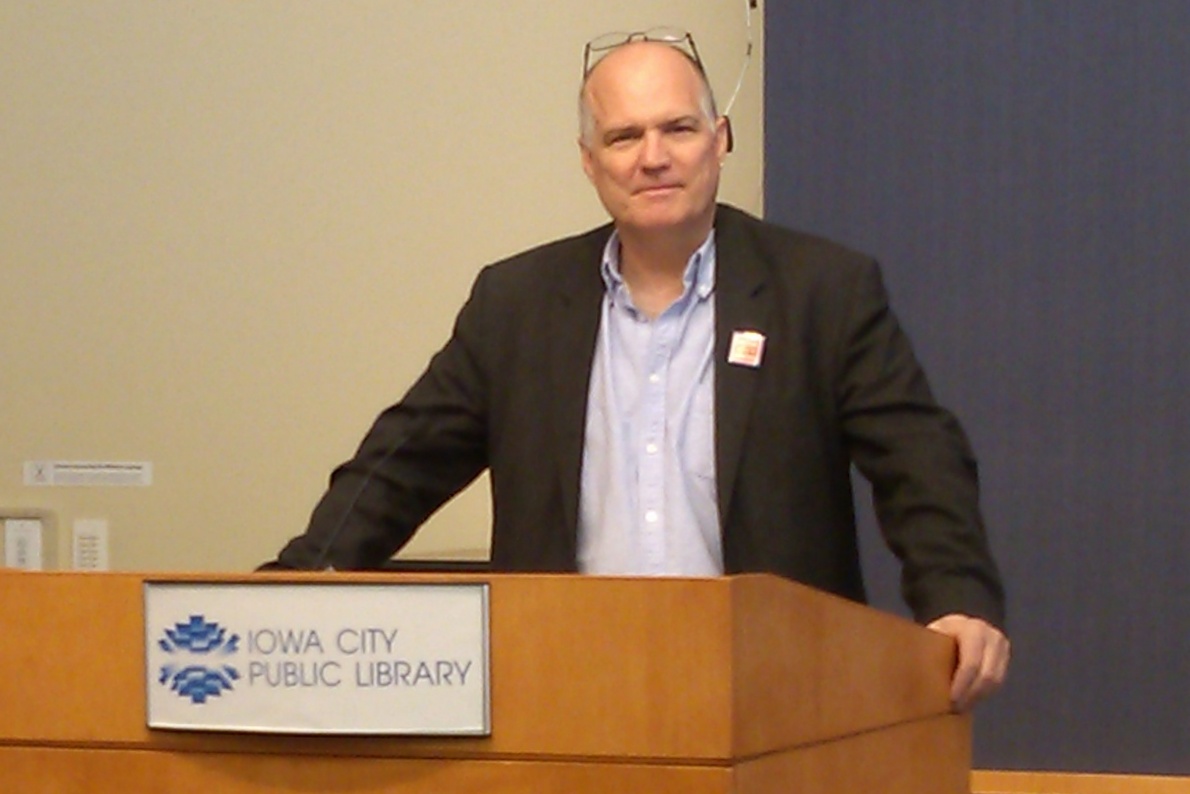
 Prepared remarks for the Solon Public Library Money Smart Week presentation on April 19, 2014.
Thank you for coming to my talk titled “Alternate Living: Focus on Finance.”
This talk is partly about me, but it is really about you. I seek to present some of the ideas and financial tools I use to make a life, as an example of how to cope in a society that has changed dramatically since I grew up in the 1950s.
I hope to generate a discussion in the second part of the hour, that focuses on the idea that alternative living is not only possible, but is a necessary approach to life expectancies that stretch into our 80s and beyond thanks to adequate nutrition and good health that is endemic to our way of life in Iowa. I hope you find value in hearing my story.
My father worked at a meat packing plant in Davenport for $85 per week, and my mother worked at home. We had enough money to afford a home with a mortgage, food, clothing, parochial schools, transportation, health insurance and vacations on a household income of around $4,500 per year.
As we know, things have changed. In 2011, the estimated median household income in Solon was $61,394 or 14 times what my parents generated. Many people I meet believe that amount of income is not only needed, it may not be enough.
Something else has changed in 60 years, and what I am most concerned about is the value of work, the kind my mother did at home, and my father did at the plant, has been degraded and replaced with something else in our burgeoning consumer society. It has taken us away from the foundations upon which lives used to be built. Our lives must be about something besides consumption of stuff, and appreciating the value of work is a starting point.
My story is about getting back to a kind of living that is more diverse than holding one or two well paying jobs in a household and slaving away to save enough for retirement, whatever that is in the 21st century. One that enables us to earn a living wage, contribute to the broader society, and sustain our lives on the Iowa prairie.
I re-purposed my life in 2009 after 25 years in transportation and logistics. Our daughter graduated from college in 2007 with minimal debt, and my wife Jacque and I were in reasonably good financial shape. We had no chronic health conditions, and hopefully, a lot of years to live.
When I left CRST Logistics in Cedar Rapids, I was on track to earn a six figure salary, so with Jacque’s income from her part time job, we were doing better than average. I might have stayed on, and pursued the rewards of longevity, but there were vulnerabilities.
The Toyota Financial Services job seeker web site, says it in black and white: normal retirement age is 62, which is my current age. As I approached traditional retirement age, I didn’t know where I stood in the broader scheme of the company. I had contributed to the rapid and sustainable growth of CRST from a $60 million trucking company that thrived after the Motor Carrier Act of 1980 deregulated trucking, to a full transportation solutions company that earned more than $1 billion in revenues last year. I felt too young to slow down, but the company could hire three people for my salary, and when I left each position I held, they usually did. This is normal in large organizations, something we don’t hear much about. While I was treated fairly where I worked, there is no obligation for any company to keep employees until retirement. That’s just the way it is.
Another important aspect of my work was I felt ready for a change. While I helped build the company over 25 years, and had experienced its growth and the opportunities that go along with that, I felt stale. When our daughter graduated from college, I was not adjusting well to being an empty nester. This feeling increased as she chose to leave Iowa.
I felt ready for a change and on July 3, 2009, left the company for good. I was not ready to retire, even if I had a retirement cake and party when I left, and an unexpected call from the owner expressing his thanks for my 25 years of work.
If there are stages to life, which one am I in? My colleague at the Solon Economist, Milli Gilbaugh wrote about the trouble defining that stage past middle age, and before elderly, in a recent column.
I suppose it is nearly impossible to find a word for the stage of life I’m in; a word that seems accurate and inoffensive to everyone. As a matter of fact, I’ve had trouble knowing just what to call myself for some time.”
Ages seem to be rather neatly divided into 20-year segments, up until we reach 60 and are unceremoniously thrown into the ‘elderly’ cauldron, ready or not. The term ‘child’ generally includes everyone from birth through their teens. After that they are ‘adults’ for another 20 when they suddenly enter the category of “middle age” that will last until they turn 60. After that, we are apparently doomed forever to be ‘elderly’ which I think begins too soon and lasts too long.
What we need here is another 20 year category between ‘middle age’ and “elderly” that includes the years from sixty to eighty.
I couldn’t agree more. With good health, proper nutrition and financial sustainability, there is a lot of living to be done between 60 and 80.
Where I landed after a career in transportation was with a portfolio of activities, some paid and some not. I value all of the work I do and have to make choices on how I spend my time. My life is a systematic and thoughtful process of continuous evaluation and improvement.
My recent work has been general farm work, warehouse work, issue and candidate advocacy, public speaking, and writing. This is much different from my transportation career, which included experience in operations management, personnel recruitment, procurement and logistics. I have served on a number of non-profit boards, including the Johnson County Board of Health, and the Solon Senior Advocates, and am currently serving a four year term as one of three Big Grove Township Trustees. It keeps me busy, and there is a process to achieve financial sustainability over time, and that’s what I want to spend the balance of my time describing.
There are four financial tools I want to discuss, retirement, financial management, research and development, and investment.
Let me cross retirement off the list right away. What an outdated concept in an era when companies are shedding liabilities like pensions and health insurance like there is no tomorrow. Perhaps there is a role for retirement among people who perform physical labor for a career, as they may truly need to slow down and take it easy at age 62. But the idea that we save for a lifetime to enjoy a well financed retirement life, as we hear from financial planners of every stripe, is a joke. The reality is that people in the United States have one of the lowest household savings rates in the world, ranking 22nd among industrialized nations. We say we should be saving for retirement, but aren’t. A better process for aging is needed.
We all know life doesn’t stop, and neither do expenses. What I propose as a replacement for retirement is re-imaging what the years between ages 60 and 80 could be: a portfolio approach to financial sustainability. It begins with the idea that all work has value whether it is compensated or not.
If you look at my weekly activities, they include about 20 hours working as a shift supervisor at a warehouse, 10-15 hours working for the weekly newspaper, 3-5 hours working on a farm, 20 or more hours writing at home, and 5-8 hours volunteering with various organizations. The balance of my time is spent gardening, cooking, reading, doing chores and most importantly, networking.
I am constantly seeking new opportunities to earn income, but have little interest in going back to work that requires 60-70 hours a week of my time and excludes other opportunities. There is too much risk in that. Like large companies that have research and development operations, so too, we should be constantly in the hunt for interesting opportunities for engaging and useful work. When we find a new opportunity it needs to be evaluated and fit into time constraints. There is a process for that.
This is where financial management comes in. It is important to use a few tools that are common in business to evaluate and make improvements in our financial situation. Most important is periodic reporting and planning.
Each month I sit down and write a report of what happened. This is not a personal diary, but a tool to think about what happened, what is important, and what needs to change to sustain our lives. I share this with my spouse, so I have an audience and potential feedback.
The report begins with a general discussion about health and welfare. If we don’t have and maintain good health, getting along can be a challenge. It pays to formally think about it, put it into words and make needed changes on a regular basis.
The second section is a financial report that covers periodic income and expenses, and highlights things that were different about a particular month. It included a budget analysis, which helps identify problems before they happen.
I also keep track of certain activities, like events, meetings, business development activities, and others and record them in the third section. I refer to this often as memory sometimes fails me.
The final section is a balance sheet depicting assets and liabilities. This is a basic and fundamental tool to know where one stands financially and the library has some good resources on this.
My goal is to develop a stable analytical platform from which I can explore opportunities for part time work, temporary jobs and projects that will produce value. My current focus is to add more farm work.
Over time, the kinds of activities may change, but the biggest risk we may face is getting stuck in something that is neither sustainable nor good for us. Retirement is replaceable, and that can be a good thing, especially if we have a process for positive change.
Research and development is mostly about networking. I have found it is important to get out of the house and talk to real people about what is going on in society. There are more than enough volunteer opportunities, so most often, I seek to develop a particular interest when I network with people, that will hopefully point to income opportunities.
One of the key roles work with non-profits served after leaving my transportation career was to introduce me to a wide range of people n the community. There is value in friendship and working on a common purpose, and it is important to maintain engagement in some non-profit volunteer work as part of a sustainable portfolio.
Lastly, I want to discuss investment, and I don’t mean stocks and bonds. Financial resources are important, but I found the best investments have been in myself.
The key lesson I learned has been that many small investments of time and resources are better than staking a single claim on something big. The benefit is that if one source of income goes away, or an investment doesn’t make a return, it is not devastating to replace part of a financial system rather than a single high stake investment. This is what successful business people do, and why shouldn’t we operate the same way? We should.
This has been my personal story about choices I made for sustaining a sound financial life, and some of the tools I have used. Thank you for coming to listen and now let’s open the floor to questions.





 Journey Home
You must be logged in to post a comment.