Empty milk bottles, an empty wine bottle
   and a salad dressing bottle...
      filled with water and white tulips --
         whose time will soon be past.

There is a dead spider in a milk bottle.
   I remember those milk bottles
      being left on the back porch, filled with milk.
         How it was...

Contemporary life has changed.
We drive to the Stop N Shop to get our milk
   in plastic jugs (#2 recyclable).
And glass milk bottles are the stuff of collectors
   and flea marketers.

They hold tulips well.

~ April 21, 1991 in the Calumet
Tag: Writing
Writing about writing, autobiography, cross posting selected work from other places.
I cut the white tulips.
   They were almost gone.
      Petals dangling down,
         ready to fall to the ground.

They still smell fresh,
   as flowers do... in the clear
      glass vase
         where I put them on my desk.

Others bloom now,
   still others are yet to bloom
      now and next year.

It's time I left them for a while
   to multiply, and grow, and flourish.
      Instead of transplanting them each October.

~ April 21, 1991 in the Calumet
Categories
Dark and Blustery Morning

On the 100th anniversary of publication, The Great Gatsby by F. Scott Fitzgerald was a quick read. In this case, less than 24 hours in four sittings. I highly recommend reading it. There is not much new to say since I wrote about it when the copyright expired in 2021. My new takeaway: a novel needn’t be long to be effective, engaging, and relevant. Gatsby is a product of that unique time, yet relevant to American society today.
It is a blustery day in Big Grove Township with winds forecast in the 25-30 m.p.h. range all day. With ambient temperatures in the low 50s, it is again on the chilly side for garden work. I realize there are few perfect days for gardening. I will get outdoors again to enjoy the sunshine.
He returns. There were big cumulus clouds of the kind Georgia O’Keeffe painted in 1965 when she was 77 years old. Cast against blue sky, these real clouds were a wondrous summer scene.
I went to breakfast with a neighbor and that set back the whole day. We had a good conversation and learned we have a lot in common, including time spent in the Calumet region of Indiana. I’ll be playing catch up the rest of today and tomorrow. Wish me luck.
Categories
Weekend Creations
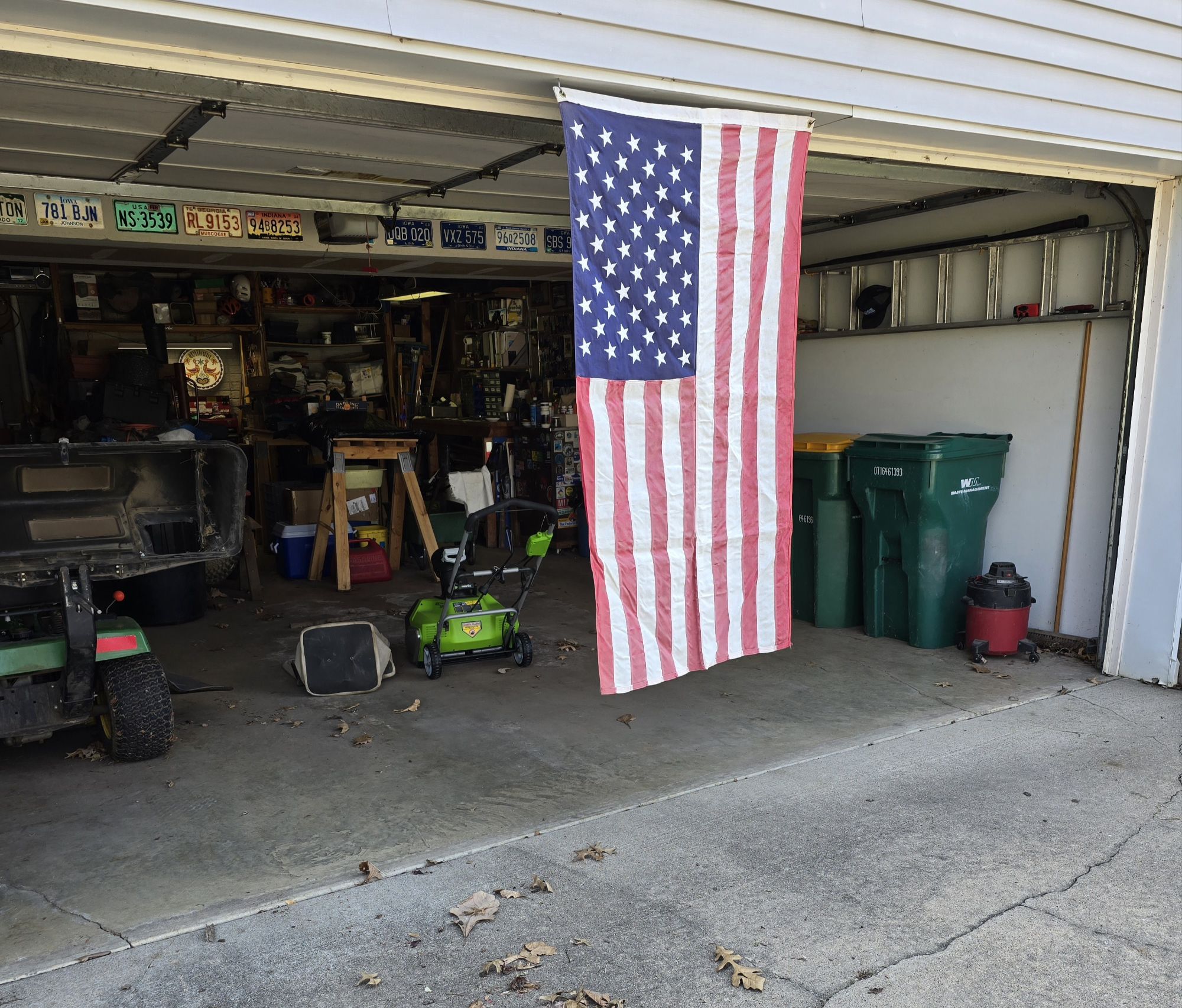
Editor’s Note: This is fifth in a series of posts about my creativity while living in Indiana. Check out the first post here.
When we lived on West Post Road in Cedar Rapids, our child was transitioning to talking in human language and walking. Singing and running soon followed. I determined the best time for my creative endeavor was in the early morning hours before the rest of the household woke and I had to leave for work. On good days, I got in two solid hours of reading and writing.
After moving to Indiana before our child started preschool, working in the garage became a main creative activity. The ranch-style home on a crawl space had inadequate room for much of my creative inventory except for some book shelves in the living room and a place to put the word processor. In the garage I had a workshop, a writing desk, and boxes of stuff brought from Iowa. My longer spells of creative activity occurred on weekends and vacations and included all aspects of my life muddled into one process. I continued through winter by acquiring a propane construction heater.
Elizabeth is in the driveway washing the car windows. I am in the garage, writing at my desk, listening to the radio WJOB.
The garage is a place where we can let our imagination go. Much time is spent organizing and moving supplies, but the creative endeavor is what we live for.
What assumptions are behind this garage and the endeavors in which we engage? (Personal Journal, Merrillville, Indiana, Sept. 12, 1992).
Our child was often outside with me playing in and around the garage. It was a main activity we did together. Some days they would ride the Big Wheel tricycle up and down the driveway, sometimes play on the small deck where there was a sandbox shaped like a turtle (called Shelly), sometimes playing in the backyard and garden, and much time hanging out with me inside the garage. All of those memories combine into one of just being together. I felt it was what fathers did.
I built a workbench out of two by fours custom designed to match my 73-inch height. At times I would use it to build or repair something. At times I would spread out papers on a project in progress. It was well built and survived the move to Iowa in 1993 where it occupies a prominent place in the current garage.
Characteristic of warm days in my creative space was to open the garage door and hang an American flag on the door frame. The flag was one I used in Mainz while on Autobahn road marches with armored vehicles. Garage door up! Flag hung! I was open for business!
In my journal I described some conversations about what we should call this space. We tried out names and settled on The Deaton Family Workshop. I wrote that on a student-sized chalkboard and placed it where all who entered could see. We possessed a secret life with each other in the garage and were co-conspirators regarding our lives in the Calumet.
Today I continue to put the garage door up and hang a flag. It is not the same one. This American flag once flew over the U.S. Capitol and was acquired through my congressman. It is fading from exposure to sunlight and needs to be replaced.
When I’m open for business in the garage today, it is not the same feeling as before our child left home. I do the best I can. I don’t mind remembering what once was when we simply went outside and played together. Days like that are no longer commonplace. Once in a while we get together and simply be with each other. I look forward to those days.
Categories
Saturday Restlessness
I can't shake it...
Here with me is...
a feeling of tension.

I am okay...
I am going forward in time.

Yet I am restless
going forward in time...

Passing through cultures and societies,
accomplishing things:
doing laundry,
vacuuming,
or cleaning the closet...
all satisfying.

I washed dishes
and prepared burritos for lunches next week.
I have accomplished this.

But I need more.

    ~ August 3, 1991 in the Calumet
Categories
Places to Create

A writer needs a place to work. Somewhere safe, secure, and with adequate room to spread out. I’ve written in my share in public places: restaurants, coffee bars, grocery stores, and parks. These locations serve for a moment, but eventually we need to return to a home base. Since 1974, I found many of them, including my drill sergeant’s office at Fort Jackson, S.C., an apartment not far from the Mississippi River, in the lower level of the first place we lived after our wedding, and others. Five of them stand out.
Five main places I wrote, where I felt I had a writing space, are as follows: In my Bachelor Officer Quarters in Mainz, Germany; my apartment at Five Points in Davenport; my apartment on Market Street in Iowa City; in the garage behind our house when we lived in the Calumet; and finally a very long spell, maybe 30 years, in the room I built on the lower level of our home in Big Grove Township. All of them afforded reasonable quiet, and freedom to write what I wanted. I took advantage of the spaces as best I could.
After seeing the Pablo Picasso retrospective at the Museum of Modern Art in 1980, I became enraptured by his artistic process. Before his 1973 death he was exceedingly successful. David Douglas Duncan’s 1980 book Viva Picasso: A Centennial Celebration 1881-1981 depicts Picasso as he created his work. From these photographs I took inspiration for my own studio stolen from small spaces where a busy family lived.
When I lived near the main railway station in Mainz, Germany, my apartment had two large desks which I pushed together to use as a writing place. My apartment was at the end of the hall in a building called the Bachelor Officers’ Quarters. As a corner room, it was fairly quiet. My schedule had me away from garrison for two to three weeks at a time so part of what I did there was spread out mail and make sure what needed addressing was. I received and wrote a lot of letters. I had a big map of the region pinned to the wall. Next to it was a large bulletin board, and then an American flag I used when we road marched with armored equipment on the German Autobahn. While I wasn’t there much, I felt like a writer when I was.
I left the Smith Corona portable typewriter Mother gave me to use at university in storage and bought a new Olympia portable typewriter in Mainz. I used a blue three-ring, loose leaf binder to keep my journal. The chair had a straight-back, dining room-style. Behind the desk was a bookshelf I made from planks set on wine bottles I had emptied out by drinking the contents. My source of news and information was a multi-function AM-FM radio that could also receive short wave signals. I was still trying to be a musician so I bought an inexpensive guitar at a local music store. In the early years I had no telephone or television. About year into my tour of duty I went to the German phone company and had a land line hooked up, not that anyone called me while I was there. This writing space was my escape from serving in the military.
The image above is my writing space at Five Points in Davenport. I wrote previously about this apartment where I pulled my life together after serving four years in the military. I was determined to be a writer. Note the oak desk. I purchased it when I arrived in Davenport after living in Germany. It followed me until the present day, although it is used mostly for storage and layout space today.
I recently described my apartment on Market Street in Iowa City here. It was a transitional space from youth into marriage, although I had no idea that’s what it was when I lived there. I did know I was a writer.
When we lived in Indiana, the house we bought did not have space for my writing. I moved to the garage. This was problematic when it was cold because there was no insulation. I bought a construction heater and had a local propane service deliver a bottle which I leaned up against an exterior fence. It was very noisy as it burned the fuel.
I’m reading my journals from Indiana and more than any other prior period, I produced writing that stands up to the years since then. I developed the idea that a creative person had to integrate all aspects of their life into one continuous band of creativity. My garage was an escape, yet it brought together my work life, my home life, and everything else I did in the Calumet. This was a significant change.
In a discussion with our child we came up with a name for the place, The Deaton Family Workshop. I did some of my creative work on the word processor we brought from Iowa, which was located inside the house between the dining area and the living room. Still, the garage was my main creative studio.
Finally, There is my current writing space. I use a chair I bought for a dollar at an auction, and a library table inherited from the father-in-law’s estate. I described building this place in a post called, A Place to Write. It has well-served the writing process.
Each place I wrote is important. The hard part was to envision that I am a writer. Working a career in transportation and logistics distracted me from that. Now, though, I can focus on the actual writing. In the main, given a space, that’s what my life has always been about.
Categories
Tools to Create
When I began writing after university I used a bound journal to enter my experiences. In the 50 years since those first beginnings, the technology changed, and with it, the type of writing I did.
I migrated from bound journals to a loose leaf binder in the military. This was a faint image of the famous journals in literary history, Samuel Pepys for example. I spent a lot of time recording my thoughts and evolved continuously in how I presented myself.
When we got our first home word processor in 1987, I worked at my writing with the intent of making a completed text I would use in another application. I produced letters mostly, but a few journal entries. I also maintained the format of my earlier journal-writing. The word processor replaced the three typewriters I accumulated.
We bought our first home computer on April 21, 1996 and installed it in the kitchen where the extra phone jack was located. We connected to the internet via dial up. I had used computers at work, including for email, but having a home computer was a revolution. Thus began a period of experimentation with online writing.
In 2006, a group of consultants from Hyderabad, India convinced me to move to a new email platform called Gmail. At the time I needed a referral to get into Gmail, which the guys gladly gave. I spend as many hours drafting emails as I do other forms of writing. Email changed how I did correspondence forever and for the better.
As our child finished college in 2007, I joined the social media platforms Facebook and Twitter to keep in touch. I stayed on both for a long time, yet terminated both in the revival period of American oligarchs, Twitter in 2024 and Facebook in 2025. Social media became a creative outlet as well as a news source. I continue to post on BlueSky which rose in the wake of the transition of Twitter to X. For now, I expect to continue.
Also in 2007 I posted my first blog on the platform Blogger. Eventually I transferred to WordPress which seemed more user friendly. Even though I wrote thousands of blog posts, I printed them out in book form using a service. The concern about hours and hours of creative effort vanishing into the ether because of an electrical failure or an errant keystroke has me seeking the comfort of paper.
Today I write book-length projects in Microsoft Word, which I began learning while I was working at the oil company. At the time, it was MS-DOS based and not nearly as functional as it is today. Microsoft Word facilitates saving single documents so I don’t lose them. It also provides a form of security that seems less available on the internet.
Creative people need tools to create. In my case it was basic pen and paper for the first 20 years. After personal computers came along, the whole world of writing changed, not only for me but for everyone. I would not want to go back.
Categories
This Studio
This studio...
   is a place for creative endeavor
is only a studio...
      a place for solace
by my declaration...
      from this quiet place
that it is so.

     ~ Sept. 9, 1990
Categories
Creative in Indiana
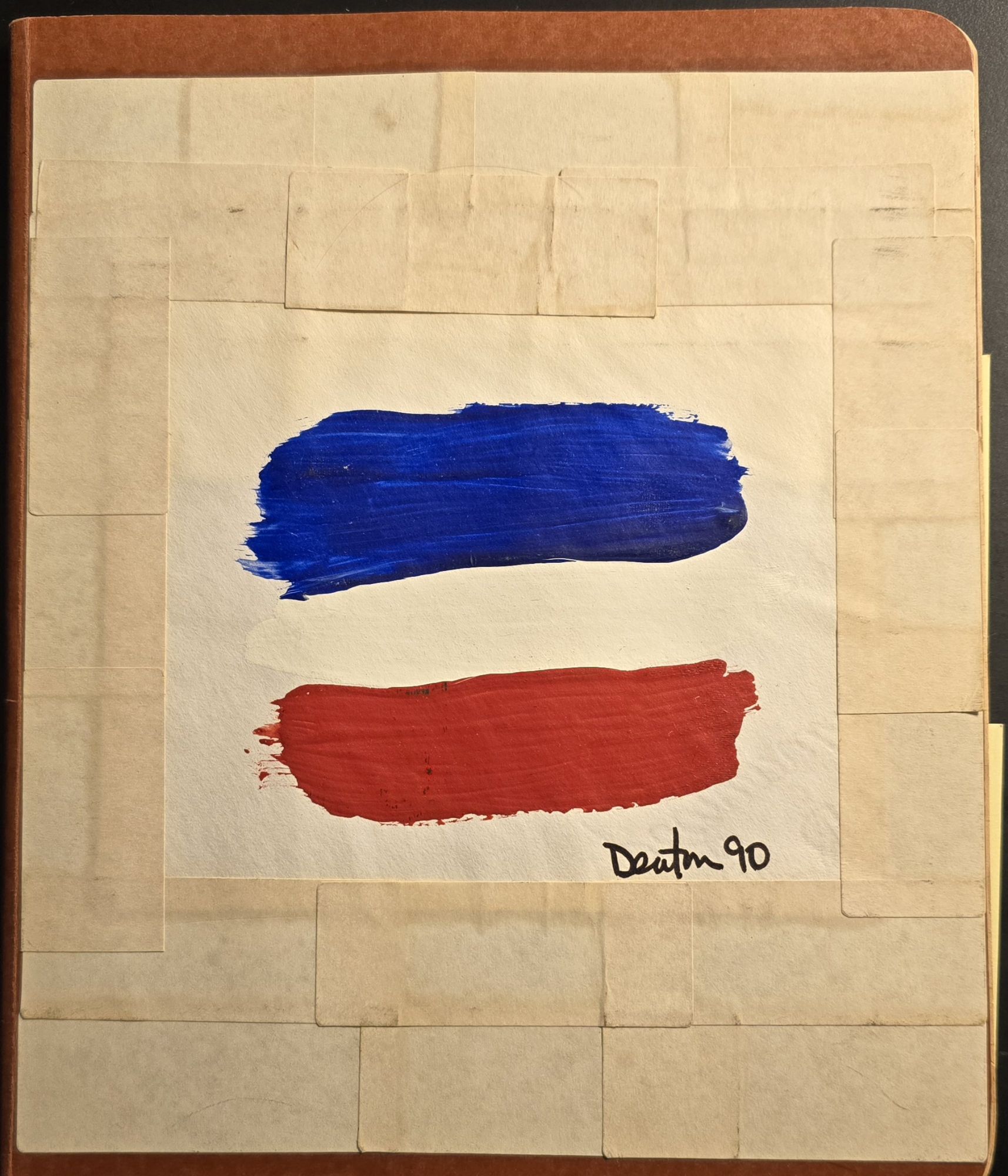
The home we bought in the Calumet region of Indiana was situated in a subdivision called Lincoln Gardens. Everything was about Lincoln, it seemed. We could hear traffic on the Lincoln Highway, U.S. Route 30, a few blocks from our home. My employer was Lincoln Sales and Service after the highway. We moved there in January 1988.
The first two years were a unique time in my life. I was hired by the trucking company in part because I had been an infantry officer in the U.S. Army. My first supervisor was a Marine who served in Vietnam who was looking for a certain type of “aggressive” individual. He hired me right away. The transfer to Indiana seemed like part of the deal. It was either go to Indiana or find a new job.
I was interested in providing for our young family, so I transferred to the Calumet. I was interested in being creative. As often as I could, I escaped into our detached garage and let my imagination flow. I wrote about this in a notebook filled with automatic writing:
The garage is my refuge in a time when my life is complex and difficult. The raw materials of lumber, papers, and cultural artifacts are everywhere, along with the tools to make them into my creations. Like this booklet. I find hours of distraction possible there. A clutter of colors, shapes, textures, and cultural objects. It is no wonder the trip to the garage took so long. I was engaged in other things there, distracted from the endeavor at hand. (Excerpt from an automatic writing piece, Sept. 9, 1990).
Our family has been able to build a long history together. They always supported my creative energy even if it caused me to withdraw from life from time to time.
If there was anything aggressive about my personality it was the drive to live a creative life on my terms. I was okay if there was an audience of one, resigned to it if that had to be. Yet during that period, I tried to create things with a broader circulation. When I wrote this piece, I had left the comfort of an Iowa trucking company and began work at the ninth largest corporation on the planet. It was as if I severed myself from every Iowa thing. It was go-time as a creative artist and writer.
Comes a time when we must trod the boards and perform the role in which we cast ourselves. For me, it is a role of my own creation in a theater of my own design. The individuality of the words spoken alienates most of the people who know me in other social settings. I write for the ages, not for today’s people. I would enjoy the financial success of a Michener, a Bellow, an Updike, but that may never come to pass.
Instead, from my outpost in Lake County, I produce works, texts to be sent out. Items created in the midst of many social forces. Items that, in some cases, are so idiosyncratic that they might have little worth beyond the borders of my property. But slowly, texts are created. Not many, not quickly, but they mount up, one-by-one. (Excerpt from an automatic writing piece, Sept. 15, 1990).
I have living memory of weekends in our Indiana garage. I hoped to create an art form that would combine all aspects of my creative energy and experience yet have broader appeal. I was hardly successful. Perhaps the best success came from setting aside creative endeavor and taking our child to go swimming on a Saturday afternoon.
I was privileged to be part of a close family, one willing to do things a bit differently than other people who lived in our region. A life based on my creative impulses moderated by the logic of my spouse and our child’s youthful innocence. That nurturing environment helped me to be who I am.
Categories
Korean Grocery

Someone shared a photo of the interior of a Korean grocery store in Niles, Illinois in a social media post. I had to visit the next time I was in the area, so this week, I did. The experience was a bit surreal.
For the first time in a long time, I entered a grocery store and left without buying anything. It was the H Mart in Niles, an Asian Grocer larger than the American grocer I frequent near home. They had aisles and aisles of foodstuffs with Korean lettering on the packages. Two of us walked from end to end to see what was on offer. It was a lot. It would be easy to drop $500 in one visit and not scratch the surface of what was available.
There was a food court near the entryway. It was well past the lunch hour when we arrived, and two hours until supper time. I would have thought someone would be eating, yet few were. Every person behind the counters was not doing anything, just standing or sitting, I suppose waiting for a customer. The store was almost empty of customers on a Wednesday afternoon.
At the other end of the store near the exit was a row of other kinds of merchants, such as the nail salon that stood out. In between were well-stocked, well-faced shelves. There were a couple of stockers, who each had a single box of a product to refill a shelf. This is unlike our grocer in that here, the stock person fills a large flatbed cart with dozens of items which are wheeled to the floor and parked while the entire aisle is re-stocked. Maybe it’s a cultural difference, although I’m struggling to figure out why.
There was a lot of seafood, reminding me that marine life everywhere on Earth is under pressure from over fishing. There were many kinds of pickled products, including kimchi and daikon radishes. I wouldn’t know how to choose one type of pickled product for a meal among so many options. There were small shelves of U.S. company products. Notable was a wide set of shelves of Spam products, actually multiple sets in different locations in the store.
South Koreans eat lots of Spam, according to National Public Radio. It is the second-largest consumer of Spam in the world, eating roughly half as much as the United States, which has six times as many residents. U.S. soldiers introduced Spam to Korea during the Korean War. Dishes such as Kimchi Spam Musubi, Bibimbap bowl with Spam, and others are considered to be delicacies. When my uncle was stationed in Persia during World War II he ate so much Spam in his rations he never ate it again after military service. To each their own, I suppose.
The reality of H Mart did not measure up to the internet posting. In person, it seemed a vast, well-stocked warehouse for people with a specific culinary interest. How does one decide which pancake mix to choose when there are so many? Maybe there are too many varieties. Inside H Mart it is a world of its own.
They even had boxes of Aunt Jemima pancake mix, with the iconic figure on the box, from before Pepsico took a step into the future of racial equality and removed her. Quaker Oats, a subsidiary of Pepsico, may have felt it was doing the right thing by removing the aunt’s image. In the bright neon lights of the store there was consumer comfort in seeing her image persist. Maybe they got the message about DEI and put Aunt Jemima back in her place.
I found the visit fun, the most fun I’ve had in a while. I don’t get out much. Since I didn’t buy anything, it was cheap fun. I don’t know if the internet ruined me for experiences like this. I would never have seen the inside of H Mart without that social media post. It is one more bit of reality incorporated into my online world view. I just need to develop a taste for kimchi and I’ll be set.
 Journey Home
You must be logged in to post a comment.