Categories
Writing

Weekly Journal 2024-03-10

Garlic on March 5, 2024.

Garlic is up in the garden: yield looks pretty good. Somehow building a brush pile escaped me this week so I need to get cracking on that. Many robins and other birds have arrived. Lilacs are beginning to bud. All signs are present for an early spring.

Class reunion

Nothing can sober a person like figuring out who died from one’s high school class. For my class of 1970, our research shows 42 of about 260 classmates have died. That is in line with what insurance company actuarial tables suggest should be our experience. It doesn’t make dealing with those deaths any easier. “Who died?” was the most frequently asked question at our 40th reunion in 2010 so the planning committee is front loading work to have a better answer this time.

When I work on the organizing committee for a reunion I’m more likely to attend. My main interests are finding out what people have been doing during the years since we graduated, planning the event, and catching up on news. I would not likely attend if I wasn’t on the planning committee. The event is in July, dubbed the 50th Reunion (Delayed) because we canceled during the coronavirus pandemic when our 50th would have been.

Charlatan

I finished reading Charlatan: America’s Most Dangerous Huckster, the Man Who Pursued Him, and the Age of Flimflam by Pope Brock this week. It is a well-researched and easy to read book about early 20th Century medical practices and associated quackery. Dr. John Binkley, the charlatan, is reminiscent of B.J. Palmer, son of the discoverer of the chiropractic principle, who lived in Davenport. Palmer started the first radio stations west of the Mississippi River in Davenport and Des Moines, paraded elephants through the city streets to advertise the chiropractic principle, and had a museum called Little Bit O’Heaven at his chiropractic school. The museum had artifacts collected during his global travels. While chiropractic thrives into the 21st Century as a respected medical profession, its trajectory in the early years is tied to that of the goat-gland charlatan depicted in this book. Worth reading for this and other reasons.

State of the Union

I viewed video of the entire State of the Union Address. It took me multiple segments to get through it. Biden did an excellent job, of the kind I expect from a Democratic president. I also viewed video of the Alabama housewife (and U.S. Senator) who delivered the Republican response. They have nothing! Seriously, Biden got criticized for having a campaign TikTok account. Do Republicans not know about the numerous objections among users to federal attempts to regulate TikTok? OMG! Governor Kim Reynolds made a press release reacting to the State of the Union with a tepid response. Why did she even bother if she had nothing to say? Republicans really do want to take the country backward.

Hope your week went as well. Cheers!

Categories
Kitchen Garden

Not Gardening Weather

About 200 cell blocks with broccoli, kale, chard, collards, celery, herbs and more on March 2, 2024.

Yesterday a large flock of pelicans arrived on the lake. It’s a sign spring is coming.

While checking the mail, someone I’ve known since we moved here in 1993 was walking their dog. We had a discussion about the weather and about my garden which is one of the largest in the area. Our consensus of two was it is going to freeze again. It is too early to start digging garden plots.

In my fourth week of indoor seed planting, things seem to be going well. Most seeds have sprouted on schedule, and despite growing indoors, are developing in a way that will make for sound seedlings. Soon it will be time to assemble the portable greenhouse and move some outside.

There was a Red Flag Warning on Sunday, which means a risk of wildfires. I will delay brush burning until the warning ends.

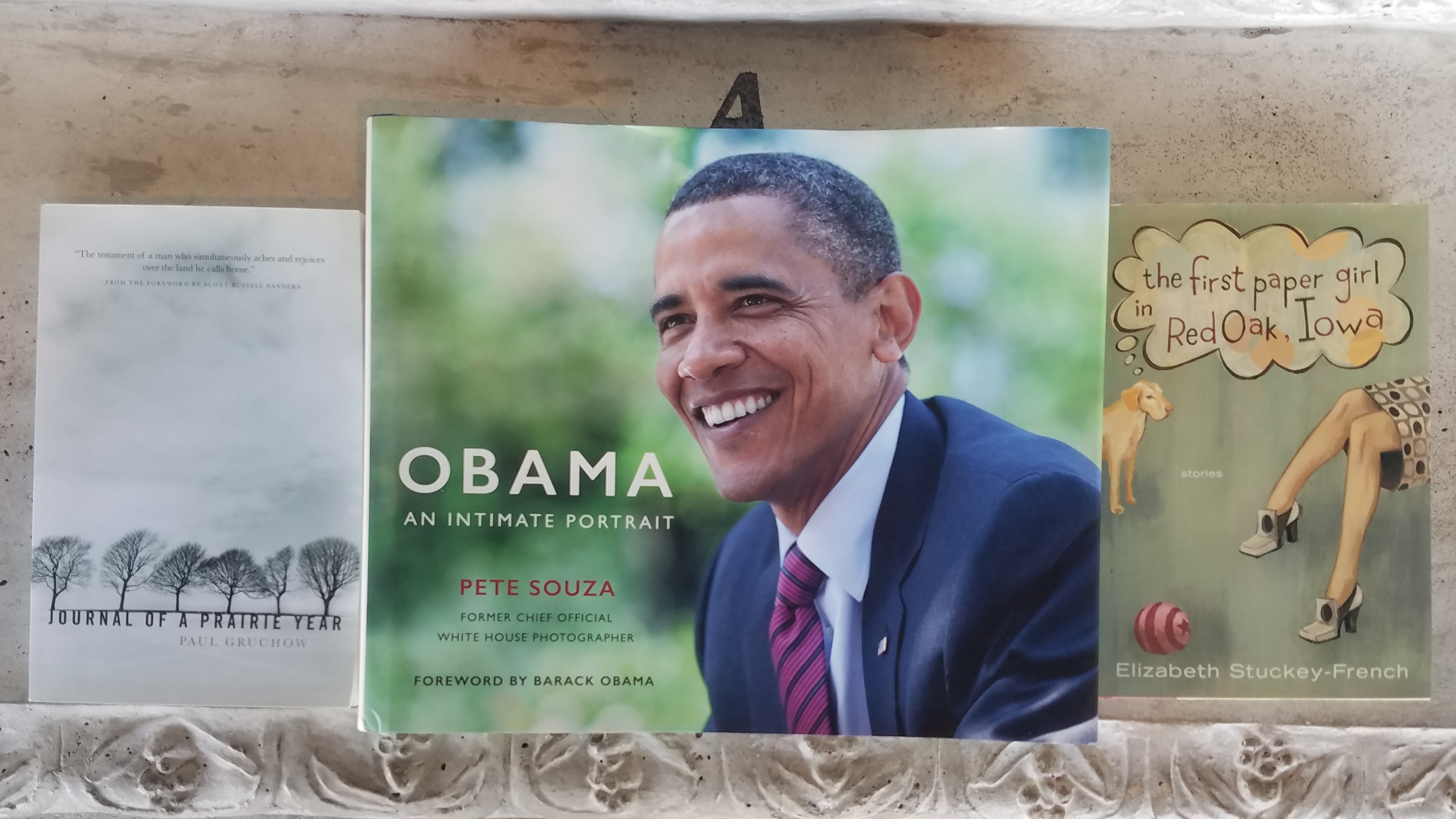
I got these on Saturday at the Solon Public Library Annual Used Book Sale for a free will donation.

On Saturday I went to the public library and bought three books at their used book sale. I began reading the Pete Souza book as soon as I got home and couldn’t put it down until I turned all the pages. It is incomprehensible we went from Obama as depicted in these photos to Trump. I began to tear up a couple times while reading it. I am usually more reserved.

This led me to thinking about the presidents during my lifetime and this brief rating:

  • Truman: Don’t recall as president.
  • Eisenhower: Okay for a Republican/Interstate Highway System
  • Kennedy: Favorable
  • LBJ: Vietnam/Voting rights/Medicare
  • Nixon: OMG!
  • Ford: Not Nixon
  • Carter: Malaise/Camp Davis Accords
  • Reagan: JFC!
  • George Bush: Reagan-lite
  • Clinton: +/- Neocon
  • George W. Bush: Bad, very bad
  • Obama: My president
  • Trump: Nightmare/insurrectionist
  • Biden: What I expect from a Democrat

Spring is two weeks away and the days tick by much faster than I’d like. By my count, I can expect 14 more springs during my lifetime. I plan to find enjoyment in each of them. Hopefully pelicans will be a part of them.

Categories
Writing

Weekly Journal 2024-03-03

Morning coffee.

The week started with days where the ambient temperature reached a high in the 70s, dipped on Wednesday to the teens, then rose again the rest of the week. The expectation for first week in March is highs in the 30s and 40s, so it seems unseasonably warm.

Creamed crumbles on toast

I don’t have many meals derived from Mother’s cooking. As important as cooking has become to me, I can count on one hand the number of dishes I now make that she did, too. One of those is variously called chipped beef on toast or creamed beef on toast. Mother made this for Father as a reminiscence of Southern cooking in which he came up. I don’t use beef in our kitchen, yet I made this for breakfast one day. I use vegetarian recipe crumbles as a meat substitute.

Saute half cup of finely diced onions in two tablespoons of butter and add one finely chopped clove of garlic. Season with salt and pepper. Add dried home made hot pepper powder. Add a cup of recipe crumbles and cook until thawed from the freezer. Add two tablespoons of all purpose flour and combine everything while on medium low heat. Add one cup of milk (cow milk or oat milk, whatever is the kitchen standard) and combine. Lower the heat and cook until the mixture thickens. Toast and cut into 3/4-inch squares two slices of bread. Pour the creamed crumble mixture evenly over the toast and enjoy.

Tracking writing

I edited the first ten chapters of my book. I created a spreadsheet to track what I did and how the daily word count changed. The fact that I am now including numbered chapters is a revelation. It helps organize topics in a way I hadn’t considered. I now gather topics from different places in the narrative over a span of years under a single header. It helps reduce the amount of duplication that plagued me from the cut and paste method of composition with which I began. I am satisfied I made progress last week.

Email rabbit hole

I have email files beginning in 1999. There are hundreds of thousands of stored emails and I don’t plan to read them all. When I begin a session of email reading, I become lost for hours in a rabbit hole of forking paths. For example, the emails I wrote and received about updating the county plan for dealing with a contagious disease epidemic seem prescient in light of the coronavirus pandemic ten years later. This research will yield a paragraph, maybe two in my chapter about the coronavirus pandemic which closes the book.

What I seek the most is emails from friends and family to use in other parts of the narrative. Facts are recorded with dates attached to them and they help evoke memories of that time. The trouble I see is advancing technology may render some of those files obsolete. For now, the current version of Microsoft Outlook opens all the saved files, yet I’m anxious to go through them even if it would be better to wait until I’m writing those parts of the narrative.

Publication

I decided to publish Part I of the autobiography first. The narrative goes through finishing graduate school and taking work at the university where my spouse and I met. I was 30 years old on our wedding day: a clean breaking point for the narrative. The second part of the book will be more difficult to write because there is so much material to condense. I delay that challenge by deciding to finish part I this year, God willing.

Summary

It was a good week. Hopefully increased garden tasks can be added to my life without compromising the writing. March brings the pressure of spring and I am ready for it. On Friday, March 1, we saw the first Robin in our yard, along with another flock of smaller birds. Spring is definitely coming.

Categories
Living in Society

Art Books

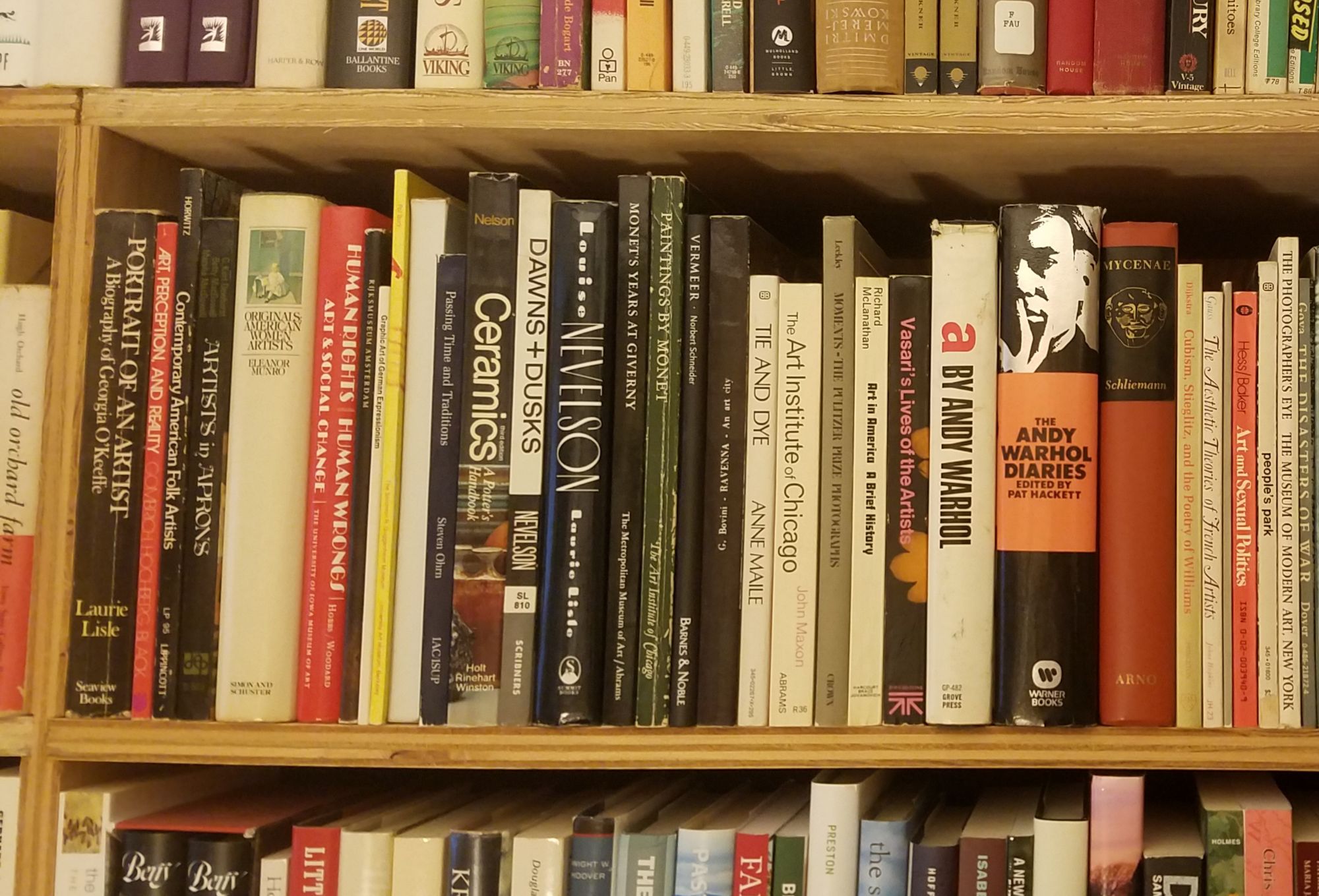
Shelf of art books

My relationship with the world of art is tenuous at best. A few high school and university friends practiced the visual arts. They were, and in some cases still are, multidisciplinary artists. I viewed myself as a multi-media creator yet throwing a pot, painting a watercolor, or drawing a sketch are activities in my portfolio that have been lost to exigencies of living a modern life. I have a lot of art books and art memories. It’s a big topic, so I’ll limit myself to three things: books in my library, artists I’ve seen or knew in person, and major shows I attended.

Art books take up too much space. When I built the bookshelves in my library I designed a shelf to accommodate them. Having so many is a function of my interest in certain artists like Picasso, Joan Miró, Georgia O’Keeffe, Andy Warhol, Edward Hopper, and the like. I saw major retrospectives of each of these artists and usually bought a book to remember the work. I picked up many art books at used book sales. Until I get to the point of running out of space, most of them will stay right where they are in the library.

Among the pantheon of artists who lived during my lifetime, three come to mind: Joan Miró, Louise Nevelson, and Leslie Bell.

I saw a major Miró retrospective in Paris in 1974. I wrote in my journal, “The show of Joan Miró was very complete and what impressed most were the ceramics and weaving. The paintings lacked something in such great numbers, better just a few to contemplate rather than such overdose.” Later, on a 1978 trip through Italy with friends, I saw the artist filming a program for French television at Fondation Maeght in Saint Paul de Vence. While Miró is known as a Catalan painter, the unexpected encounter on the French Riviera cemented him as French to me.

Louise Nevelson came to Iowa City for the installation of Voyage at the University Lindquist Center. I happened to be at the installation site when the artist walked up to have a look at the space. She was scheduled to give a lecture at the Museum of Art later that day. The University describes the work in place:

Voyage was the first sculpture purchased with funds provided by the Art in State Buildings Program, initiated in 1978. With public works such as Voyage, Louise Nevelson creates a visual dialogue using existing scenery and groups of vertical elements, evocative of trees or plant like forms. Nevelson preferred to see her large-scale outdoor sculpture, which she undertook in the last fifteen years of her life, as environmental architecture. Voyage fits this description as it commands attention within the closed-off courtyard of the Lindquist Center. Yet, it does not overwhelm the entire space. The work invites dialogue with the viewer, offering a variety of shapes, forming spatial relationships with both the spectator and the architectural environment.

Iowa Facilities Management website.

One local artist I knew well was Leslie Bell, an art professor at Saint Ambrose University. Les was a couple years ahead of me in high school. I came to know him more as a musician than a visual artist. He was good at whatever he did. I recall picking him up while hitch hiking to a friend’s home. I engaged his band to play at our fifth high school class reunion. He was part of a small group of intellectuals in the Quad Cities. He helped create a film festival around the time I returned from military service. We were not close friends. He was an example of someone successful in making art a career. He influenced many students at Saint Ambrose. I thought about him while I tried to figure out how to live in my home town as an adult in the early 1980s.

I visited so many art museums during my life. During trips to Europe I made a point to see the works of Johannes Vermeer, which are not gathered in a single location. I saw a lot of them. I made a point to see Monet’s work in Paris. I bought a book of Byzantine mosaic images when visiting Ravenna, Italy in 1974. I saw the Picasso retrospective at the Museum of Modern Art in New York City, the Andy Warhol retrospective at the Art Institute of Chicago, and the Georgia O’Keeffe retrospective somewhere. The latter was so much about the artist and not about the location of the retrospective. Seeing art in person is essential and I did my share of it.

How shall I use the couple hundred art books in my library? For reference, of course. There has to be something more than that. I’ve been creating so long, I don’t need many references. As long as I have the space, they can sit on shelves waiting for my attention.

Categories
Writing

Weekly Journal 2024.02.25

Morning coffee.

Beginning today, I plan to post a weekly journal of significant activities for the week ending on Sunday. This week, I already wrote about my trip to pick up soil mix, cooking lentil soup, movies, and a short, developmental piece from my work in progress autobiography. This week’s entry may be short.

The purpose is to make a conscious decision to reduce how many times I post here and use that time to advance my autobiography. With spring arriving in four weeks, I need more writing time. I debate changing how I describe my autobiography to my “WIP,” or work in progress like all the cool writers do on Threads. Autobiography seems like too big a mouth full and I don’t like “memoir.”

On Saturday and Sunday, I’m filling in at Blog for Iowa for a while, and those posts will be cross posted here without comment. I strive for a broader audience and put more effort into selecting topics for those Iowa readers. I’ll also cross post any writing that gets published in the newspaper, or other places in the real world, also without comment. A letter to the editor is often a re-working and shortening of something else I posted here, so it seems like duplication to publish the letter like the one that made last Thursday’s Cedar Rapids Gazette here as well.

I’ve pretty much given up on a range of topics that used to be important to me. Cooking, recipes, gardening, local food, and others remain parts of my life. I just don’t feel I have anything new to say. I am weary of writing about “organic practices” when so many people are food insecure. I plan to give those a rest unless I prepare a great dish and want to preserve how I made it. I may highlight unique ways I find to increase food security among those who need it.

I’ve been taking a lot of photos of morning cups of coffee. I post them on my Threads account, tag them a certain way, and there is a group that goes into a frenzy of liking them. These posts get, by far, more views than any others I put up. It’s sad, but it’s something.

That’s it for this week. Let’s all make it a great one next week!

Categories
Living in Society

A Day Near the Lake

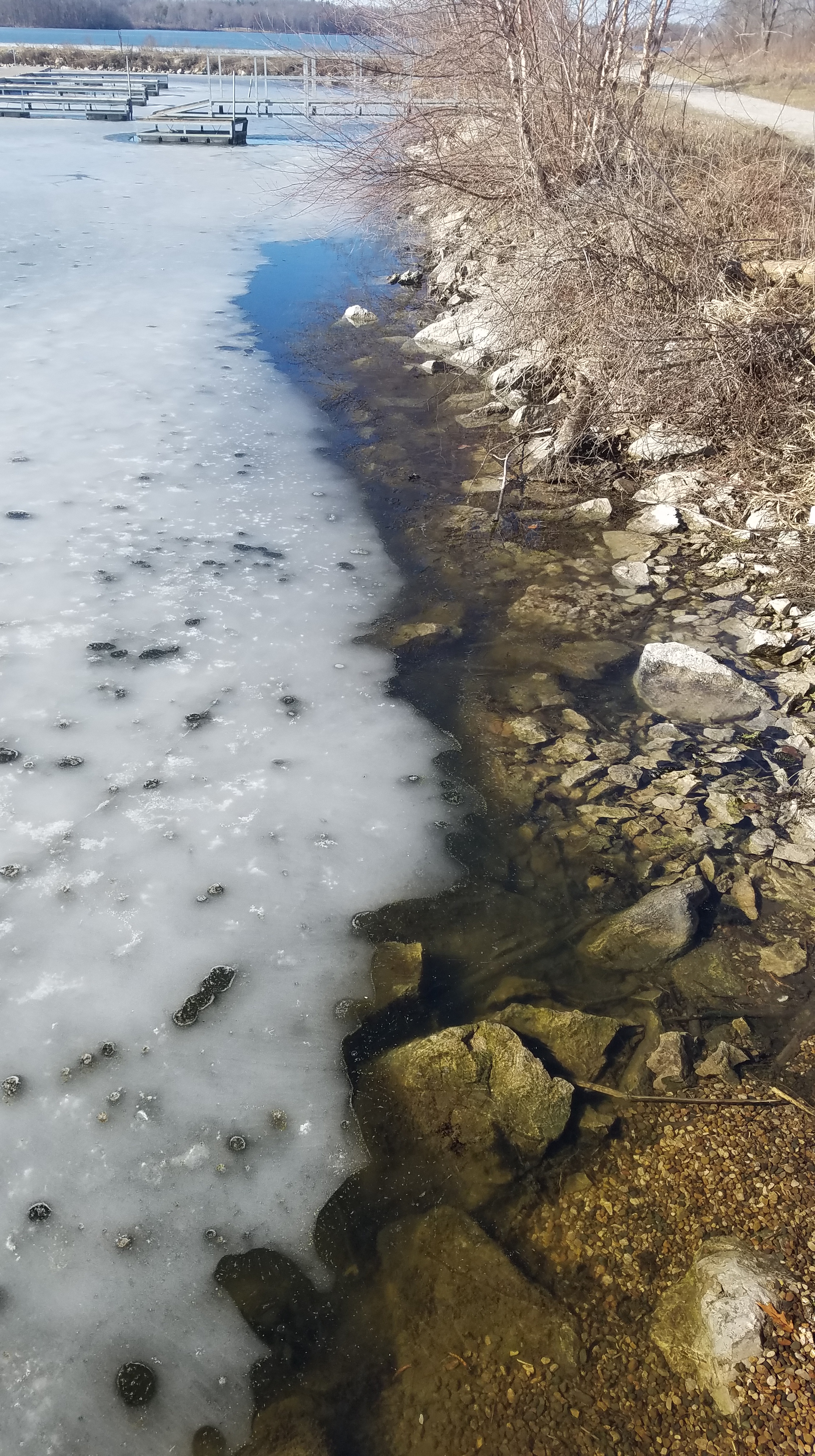
Lake shore during the big thaw, Feb. 9, 2024.

It is good to begin walking the lake shore trail now that most snow melted. Getting outdoors and breathing fresh air is a boon to our existence. Not that many in modern American society care much about that.

How do we measure happiness? Certainly, the GDP (Gross Domestic Product) doesn’t adequately factor it in. Neither does the CPI (Consumer Price Index). Maybe these indices should consider human welfare instead of production numbers and the price of things. There are ways to do that.

Not holding my breath.

As far as being a human, living in the United States, I’m doing fine. We have adequate retirement pensions, plenty to eat, basic necessities, and a positive net worth when the value of the house is added. We get along better than billions of other humans do. But am I happy? I don’t know, which by default is a no.

The next time I walk on the lake shore trail I’ll have to give the matter of personal happiness some thought. Not too much thought, though. That would be just another job.

Categories
Living in Society

My Pandemic Story — Part 1

COVID-19 home test and home made facial mask.

When I was on the county board of health we updated our pandemic response plan multiple times. It was all in a day’s work, although most revision work was done by staff. The board was expected to agree. I read the document and it looked okay to me. That was ten years before the coronavirus pandemic entered society. At least the public health department had a plan.

Before too much time escapes, I want to write my story of what happened during the pandemic. A basic framing of the pandemic is as follows:

  • 3/11/2020 WHO declares COVID a pandemic.
  • 2/15/2022 Pandemic normalized by Iowa Governor Kim Reynolds.
  • 9/18/2022 “The pandemic is over,” Joe Biden said.
  • 5/11/2023 Federal COVID-19 public health emergency declarations ended.

COVID lingers in society. People continue to get the virus and die from it today. There are tens of thousands of COVID-19 admissions to hospitals each week. The coronavirus remains with us and it looks like it will be with us for a long, long time.

Soon after the WHO declared COVID-19 a pandemic, on March 13, 2020, I got together with a grade school friend in the county seat. We had lunch in an almost deserted restaurant, then ended our day together at a bar in Tiffin. Patrons crowded around the bar while my friend and I took a table at some distance from them. There were many more empty seats than people that afternoon. We had little idea what the coronavirus would mean to our daily lives.

By March 18, the coronavirus was spreading throughout the county. News media reported most deaths were among people over age 60. I was in reasonably good health but I didn’t want to take chances at my retail job where I was exposed to and had contracted all sorts of viruses. They offered an unpaid leave for the duration of the pandemic. There was no argument at home when I decided to take it. They optimistically gave me a month, by the end of which we expected the public health emergency to be over. I then decided we were making it okay on our pensions and retired on April 28, 2020.

During the time since March 2020, I wrote 307 posts tagged coronavirus. I also kept a journal in which the coronavirus was a constant presence. Thus far we avoided contracting COVID-19. I wish I could say the same about everyone I know but can’t. Both friends and neighbors died of COVID-19.

I want to write at least a few thousand words about the pandemic for my autobiography. The main changes brought by the early pandemic were concerns about having enough food, maintaining isolation at home, leaving paid work, and figuring out how to best cope with the virus. I will spend some time reviewing the impact of social media and video conferencing technology. I became familiar with Zoom, Google Meet and Discord as a way to participate in meetings remotely. Video conferencing had a long-term effect on how we live.

As far as today’s pandemic goes, we are still coping with information about the spread of new virus strains and surges in case counts. I want to stay current on COVID-19 vaccinations. If I hear there is a surge in case counts, I’m more likely to wear a facial mask when grocery shopping or in an indoors public space.

I have homework to do before finishing this story. There will be a Part 2, and as many parts as needed to tell the story. This post is a way to get started.

Categories
Writing

Not a Painter

Self portrait.

When I review my 50 years of writing I find recurring stories. For example, the one I tell about Father’s political organizing during the John F. Kennedy campaign was repeated at least a dozen times. As I write my autobiography is seems better to distill those versions into a single narrative, one for the record, one which becomes the story. When I’m gone, who will have time or make it for all those versions? What are those previous efforts? They record a narrative that is part of me the way an artist makes sketches in a notebook.

Most of my writing is unpaid. I don’t seek financial return for investment in narratives. Writing helps me understand a complex world and my role in it. It provides a way of seeing the world outside living memory. When I pass, my living memory goes with me, except for the renderings I make as artifacts. Even then, only the writing would remain. I am not a famous person so the narrative may well end with me.

Writing this blog, journaling, and posting on social media are all rough drafts. Some are better than others. None of them is an autobiography the way my actual draft autobiography is. It is important to keep writing and re-writing our history in hope of getting a version that seems right. In the end, I’m not sure that is possible. In the end, the version will be final, like it or not.

Creative endeavor is important in every life. I systematically explored various creative outlets outside writing: playing music, drawing, painting, ceramics, photography, cooking, gardening, and others. To support these endeavors, I studied the world through travel, visiting museums, visiting cities, formal education, living in a foreign country, working a career that involved meeting thousands of people, and reading more than most people. Creative endeavor means different things, yet for me it was always being an artist, at least in part.

It seems important not to muddle things. While I painted a bit, I am not a painter. I made ceramic pots, yet I am not a potter. I devoted long hours to playing the guitar, and am not a musician. I am a writer. Knowing that, the next step is being the best writer I can be. I discovered it takes a few rough drafts.

Categories
Living in Society

Political Action in 2024

Photo by Element5 Digital on Pexels.com

There are two parts to turning the country around and both run through the ballot box.

The first is voting: making sure we take care of ourselves by checking our registration and then voting in person, either early or on election day. Encourage everyone we know to do likewise.

The second is changing the public narrative about life in Iowa and in the United States. We should not accept narratives being fed to us by major media outlets, churches, interest groups backed by wealthy people, and political parties. Instead, we must develop new narratives that properly reflect how we live despite our differences. I predict this will change how we vote.

If we can do those things, there is a chance to make society a better place to live. I believe this is possible in 2024.

In Iowa, the political strategies and tactics Democrats used during the 2006-2008 election cycles have become obsolete. Not because talking to people lost importance to winning votes, but because we, as a society, have grown ever more suspicious of people we don’t know. Have to ask, what happened to Democrats after Obama won his first presidential election? We may feel we have to ask, but that’s the wrong question. What was an ability to win elections in 2006 and 2008, was an all in, once or nothing endeavor whose usefulness waned by 2010 when Republicans began re-taking control of state government.

I door knocked for Democrats during the 2022 election cycle and can attest the game changed since 2008. In the Johnson County part of House District 91, Democratic voter registrations outnumbered Republican and Democrats still couldn’t win that part of the district. At the doors, I heard people have complicated lives where voting was not among the highest priorities. I did the best I could, yet my efforts and those of fellow Democratic canvassers couldn’t get the job done. It wasn’t from a lack of effort.

How do we change the narrative about how we live? There are no easy answers. Recognizing how important this is to the process of taking back our government is a necessary first step. I’ll make sure my personal network votes in November. Every other political energy I expend will be devoted to changing the narrative. I believe it can make a difference.

Categories
Writing

In Living Memory

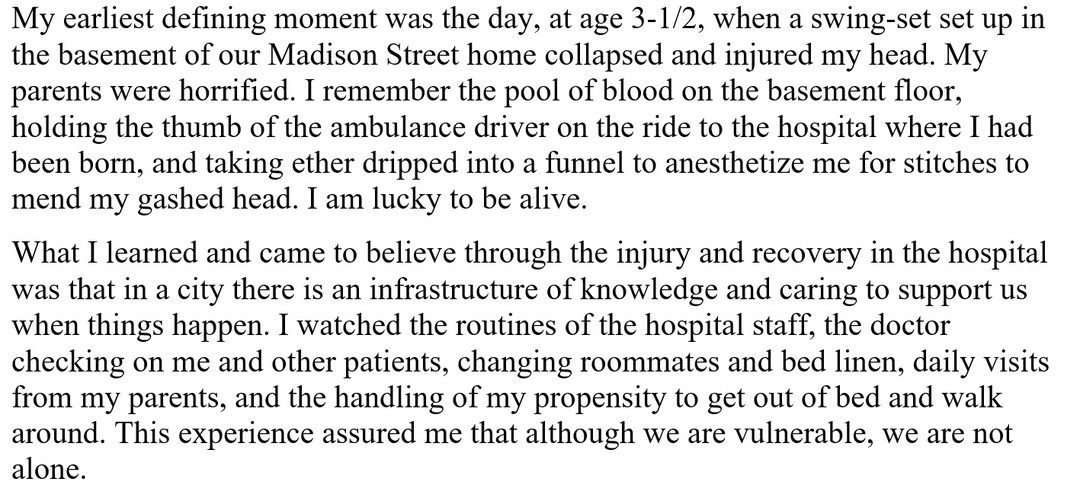
Cautiously, I’m sharing bits of my work in progress that readers of this blog may have heard about. I shared the image above with a Canadian poet on Threads in response to a question, “What did you learn from your childhood experiences? It was different from other garnered responses, and it stands alone. I think the writing here was solid.

It took a good while to write those two paragraphs. Because they originate in living memory, outside of language, I understood what happened and assigned meaning only after repeated drafts preceded by long consideration. Probably why it takes me so long to write autobiography.

That I called this experience a defining moment means, at least in part, I thought about what happened a lot. There is a scar on my forehead to remind me of it every time I look in the mirror. Any more, I don’t think about the scar and what caused it, but over a lifetime I remember those days, what happened, and what the experience means to me now.

How does one communicate about living memory? These paragraphs are one way, and as written, I don’t have any revisions. I captured something that resonates. Over the years, I wrote a lot about René Descartes, including this passage:

I studied René Descartes at university and spent substantial effort considering his first principle, cogito, ergo sum, or in English, “I think, therefore I am.” I wrote about my Cartesian outlook toward life. We are isolated beings, wrapped in a veil of humanity, closer to God, or its divine essence than we realize. Such veil, metaphorical or not, is woven of delicate threads, like the lace of Morbihan, or silk from China. We could spend a lot of time marveling in its delicate needlework or shimmering surface. Yet we are compelled to reach out beyond the veil.

Attending University, Blog Post, Feb. 19, 2022.

If I entered a funk about my work in progress after having some people read a draft, then I am now coming out of it feeling ready to begin anew. There is a story, more than one, residing in memory. I felt compelled to start that story. 127,511 words in, the compulsion to finish it strengthens. There is little timing of my creative endeavors. I only know, for this work, the time is now.