Categories
Writing

Imagining a Narrative

Early Spring Rhubarb at the Farm

It’s been difficult to imagine myself in a post worklife world.

When I left my last transportation job work no longer defined me. I could become something new and different. Ten years later work continues to occupy a role in my story. That’s not unusual in the United States. I also don’t think it is that good.

Mostly retired, a pensioner, I lack a forward-looking narrative. Living a life, working part time for wages, those are not worth narration. They are part of the human journey, the arc of which often seems uncertain.

So I drift… read and write. I will read and write as long as I’m able… and take care of necessities.

Framing a life in work was abandoned. The actuality of it proved harder than writing these words. If I spend time in public, outside the flickering light of lamps and screens… sunlight through the French door, I’ll want a narrative more than “I’m a pensioner.”

I like the word pensioner, yet it’s an unusual introduction. My pension is from Social Security, it is real, and it pays many of our expenses. It reflects more than 50 years of work, during which I contributed to the fund. “I am a pensioner” seems okay, but I wouldn’t lead with that because it sounds so awkward, so work-related. There is more to life than a reference to work that generated a pension.

I told a life story in my post Autobiography in 1,000 Words, which seems long for a personal narrative. I like the facts presented yet they doesn’t say who I am, who I’m trying to be. Maybe I’d better know that first.

Should I present as writer? People recognize me as such. I don’t like talking about writing projects, so no, I wouldn’t lead with that.

Should I present as a gardener? I garden and post about gardening in multiple places. Why does a personal narrative have to be about only one thing? It doesn’t.

To whom would I tell a personal narrative if developed? I think about Dunbar’s Number and the cognitive limits it suggests. If we only get 150 stable relationships because of physiological limits, why am I even worrying about a personal narrative? My 150 knows me and I know them. Isn’t that enough?

Last Saturday a group gathered at Old Brick in the county seat and discussed political advocacy. That’s where this post about personal narrative originated — I felt I needed an elevator speech as I introduced myself. We all need a brief chat about who we are when meeting people.

I am genuinely interested in meeting people and hope any conversations will be more about them rather than me. If I talk in terms of their interests, it’s because I’m curious about how people live their lives. I need to hold up my side of the conversation.

“Hi. I’m Paul, a pensioner from rural Johnson County. I spent 50 years in the work force and now I’m here talking to you. What’s your name?”

I don’t know, pretty lame. It’s a conversation starter, and could lead somewhere the way an ignition switch on an automobile begins a trip. It’s not flashy but may serve. Maybe that’s all that’s needed and I’m over thinking this. Maybe such a brief speech is enough.

The arc of life is bending toward the unknown — an opportunity to imagine what could be. Maybe that’s the narrative, at least it could be.
Categories
Living in Society Work Life

Potluck Luncheon

Hay Bale

It runs counter to the Western Christian tradition but employees at the home, farm and auto supply store held a potluck luncheon on Ash Wednesday.

While others were submitting to dust from a priest’s thumb, my co-workers were feasting on loose meat sandwiches, deviled eggs and Amish Wedding fare in the form of pickled green beans and jalapeno-stuffed mushrooms. Tater tots revolved under the heating element of a shared pizza-cooking appliance.

One person brought red checkered tablecloths for our industrial tables in the break room, providing a festive look to the event.

The only penitence among my colleagues was related to over-eating.

The last Chevy Cruze rolled off an assembly line at the Lordstown, Ohio GM plant yesterday. I looked at photos of workers standing around the vehicle and had to look away. Too many memories of heartbreak among factory workers I’ve known. I conducted thousands of interviews with laid off workers when we lived in Indiana. Enough to understand the look in their eyes. Another sad day in the evolution of American manufacturing in the rust belt.

After work I stopped to secure provisions at the warehouse club, comme d’habitude. A farmer called me while I was contemplating the value of pre-cut aluminum foil sheets to be used wrapping root vegetables before baking. The issue was whether I needed a restaurant-sized box of 500 sheets rather than an inexpensive roll of aluminum foil to be replaced from the grocery store as needed. The farmer and I talked about legislation before the first funnel of the Iowa legislature. After 10 minutes we hung up and I decided to wait on the foil squares. I’ve been thinking about this for over a year.

Our county political party is re-organizing tonight. The meeting starts a little earlier than normal and word is the current party chair will seek another term. He’s the mayor of a small city near our border with Linn County. If he wants another term, I’ll vote for him. In our liberal county we tend to find a new chair each cycle, whereas counties with less Democrats in them tend to keep their party chairs for much longer periods of time. The chair has done a good job including old timers like me. The main work of the county party this year is preparing for the 2020 Iowa caucus. I know the drill, and since no one stepped up in 2018, I’m planning to run it again next February.

On my way home from work I noticed a number of homes along the route displayed political yard signs for the same candidate for city council in North Liberty’s March 12 special election. Placement is on or near property where signs saying “Lock Her Up” and “Trump-Pence” continue to be displayed more than two years after the 2016 general election. A reminder that even in the state’s most liberal county the overall political color continues to be red.

The best news this week was after my initial soil-blocking efforts at the farms I feel better with no soreness to report. Now if the frozen ice-pack that is our yard would thaw, I’d be ready for spring. It won’t be long.

Categories
Work Life

Cold For Now

Winter Travel

A colleague at the home, farm and auto supply store is itching to get on the road.

Last year he drove for a local asphalt company making pretty good dough. When the seasonal job wound down he returned to retail.

“I can’t do this for ten years,” he said, referring to both his age and the retail work he had undertaken.

He asked my advice about working for a large truckload common carrier driving over the road. I told him it’s a hard life.

Because of his type of driving experience, the firm to which he had applied required he attend a company-approved truck driving school for two weeks. It’s been 20 years since I recruited men and women for that type of school to work program but I provided advice nonetheless.

There will be an agreement. Make sure to read it before signing, I said. During my tenure in driver recruiting, attending a company driving school before employment was not free. Typically the written contract is for a period of employment, up to a year, after which liability to repay the schooling was forgiven. If one quits, for any reason before the term is up, the former employee would be responsible to repay the entire amount. Back in my day it was $5,000 although that likely changed since then. Creditors will dog debtors relentlessly, so the agreement is not to be taken lightly.

Second, do you really want to be gone from home for three weeks at a time? Driving is tedious, sedentary work for van drivers with hours to think about things. There is more physicality in being a flatbed driver, with tarping, chaining and strapping loads, but at a certain age who wants that? Time off changes forever for over the road truck drivers. That’s its nature and it is uncompromising. Most good drivers have a compliant social style, so being assertive doesn’t come naturally, especially with their dispatcher. They sometimes fail to realize that in addition to doing a good job as a driver, one has to be assertive to get time off. I don’t know what my work buddy will decide but I wish him well.

During winter we’re all itching to do something. A few weeks of isolation during bitter cold spells is welcome. There comes a point when we’re ready to do something else, something less confining. It’s cold for now but the economy of spring has already begun to ramp up with garden seeds and fertilizer finding their way to retail outlets. There is a yearning to break loose the limits of four walls and reach for our potential. It begins mid-winter and makes us restless. Making good decisions rolls up into the wintry mix of unrealized ambitions and present challenges. Friends make it easier to sustain our lives in this turbulent weather.

Categories
Work Life Writing

Digging Out, Getting to Work

Home Made Hot Cocoa

After four hours digging snow in the driveway wind came up and I shut down the operation.

Mid-dig I made a cup of hot cocoa and took a break.

I made it to the road, gaining access for when I leave for a shift at the home, farm and auto supply store in a couple of hours.

The retail store is doing inventory. I expect a day of counting and recounting items with discrepancies between what was found by the scanners and what our computer system shows on hand. The recounting work will take several days.

I texted the farm where I’m scheduled to soil block on Sunday, saying the weather forecast looked dire and asking whether work would continue. The hydrant in the germination shed is usually frozen at this point so we would move soil blocking to the sheep barn where there is running water. It was uncertain she could keep the temperature in the germination shed warm enough to prevent the blocks from freezing at night. She’s researching cold and germination and will make a decision about pushing the schedule back a week by Saturday. The farm published the spring share schedule so the clock is ticking on these starts. The other farm where I work is scheduled to start soil blocking on Feb. 26.

We are having a real winter this year. A winter featuring wild variations in temperature. Variations that make weird noises in the house.

For now, with snow covering the garden, there is little else to do besides work indoors. We draw from the pantry, freezer and ice box for meal ingredients to use food as it nears the end of its storage life. We have a couple pounds of potatoes, a couple of apples, and vast amounts of onions, noodles, canned tomatoes, apple sauce, apple butter, pickles, sauerkraut, and dry goods. We aren’t wealthy but we won’t starve for a couple of months.

This year will be one of transitioning to full retirement. We have our financial structure in place and are gliding into the end of a worklife in society. In many ways, this is what I’d hoped for back in the day of the Whole Earth Catalogue and arguing with conventional farmers in undergraduate school about the efficacy of organic growing. While not in a hurry to complete the transition, we make changes with purpose. Each day taking us closer to what’s next with hope for a brighter future.

I believe we’ll make it.

Categories
Work Life

Working in the Yard

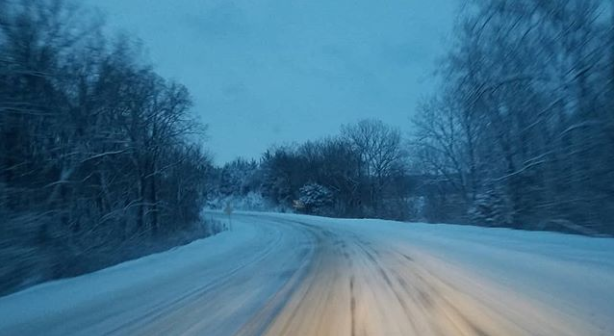
Mehaffey Bridge Road in Winter

Crews were removing about 10 inches of snow from the parking lot at the home, farm and auto supply store when I arrived for my shift.

Part of my work was hand shoveling the areas around the dock so trucks could get in to deliver. There was a lot of snow.

Around 1 p.m., a trailer load of “contractor trailers” arrived from the western part of the state. My job was to unload the five-high stacks from the flatbed truck. It is always tricky business and the snow packed pavement made it more so.

This job is a three person team. The truck driver climbs the stacks of trailers loosening tie down straps and securing the ones I’m lifting with a chain to the forklift mast while a trusted associate ground guides. It took three and a half hours to unload trailers into drifted snow around the edges of the parking lot.

It’s all in a day’s work, the most challenging thing I do.

At the end of the process I felt something had been accomplished.

Categories
Work Life

Meat Packer Narrative

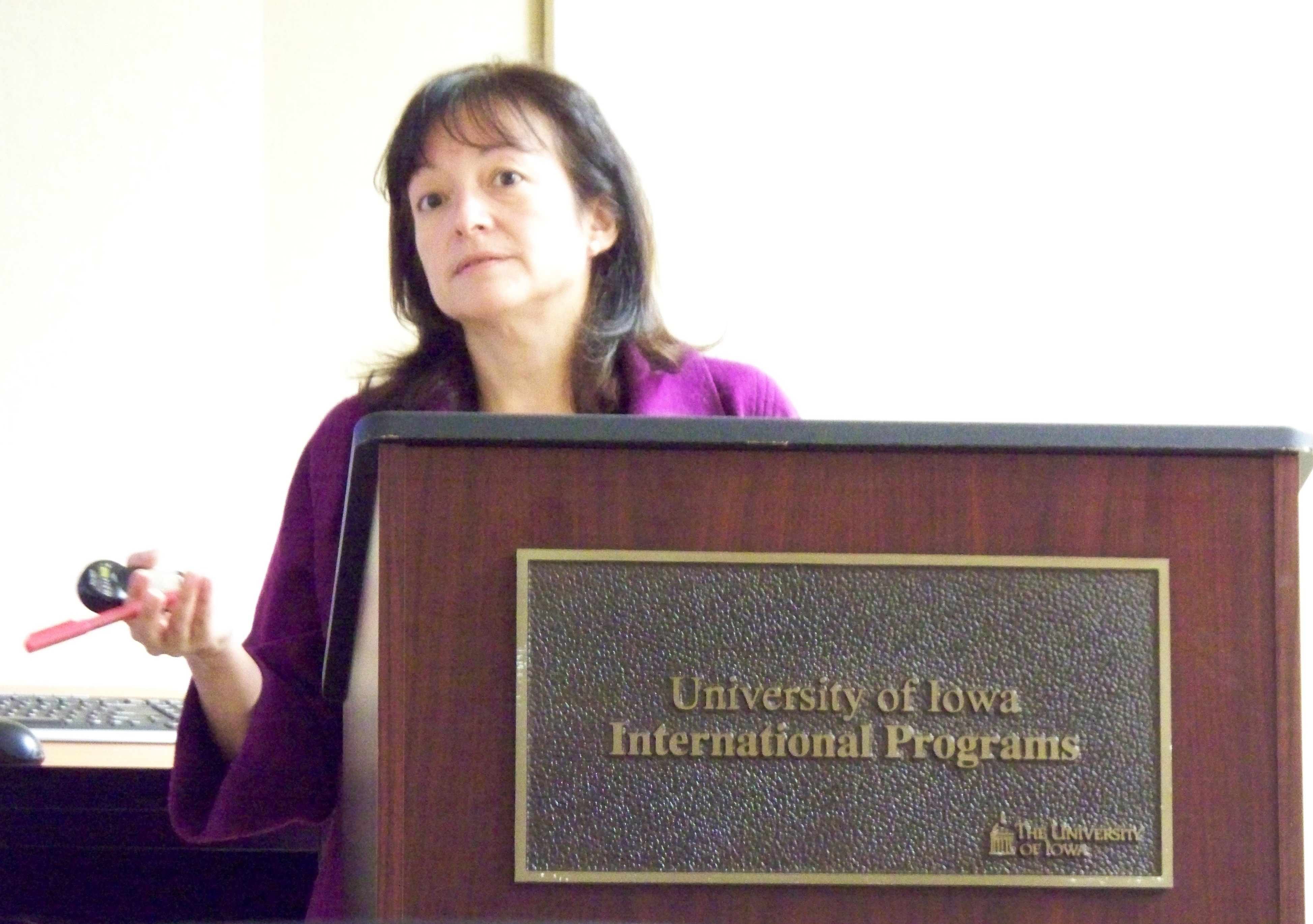
Ana Avendaño, November 2010

Editor’s note: An original version of this post appeared on Nov. 13, 2010. It has been edited because my writing wasn’t as good as I thought back in the day.

Clarity surfaced during a talk by Ana Avendaño, assistant to President Obama and Director of Immigration and Community Action for the AFL-CIO.

She was in Iowa City, talking about the meat packing industry. Her narrative struck me:

Back in the 1970s, meat packing workers were among the highest paid in the country, more highly paid than some auto workers. Multinational corporations, with a strategy of busting unions, began consolidating meat packers, creating a perfect storm for labor and a perfect outcome for themselves. Union workers were replaced with a continuous stream of lowly paid immigrant workers.

“The narrative of the meat packing industry is important to remember,” she said. An emblematic consequence of consolidation has been the immigration raids in Marshalltown and Postville.

Corporate advocacy to break labor unions is a global phenomenon, Avendaño said. “What corporations can’t do in a free market, they are doing through governance,” putting pressure on law makers to make labor law more favorable to their interests. She spoke of the International Monetary Fund and the World Bank as co-conspirators. They hold out loans to countries and “specifically require them to change labor laws in a way that hurts workers,” Avendaño said. “It is the hypocrisy of what we are living through today.”

I worked in a meat packing plant two summers while an undergraduate. It was easy to get a job there. I belonged to a union, the Amalgamated Meat Packers and Butcher Workmen of North America, and at $4.04 per hour, made enough money to get through the next school year. As Avendaño’s narrative suggested, wages were good.

The plant conditions were dangerous and work was physically challenging. My maternal grandmother and father had both worked in the plant and my father died in a plant accident. I never felt in danger, working as a millwright’s assistant in 1971 and on third shift cleanup crew in 1973. I got to see most of what went on throughout the plant and warehouses. It was not pretty.

Avendaño missed something. It’s true low cost operators like Iowa Beef Processors could perform the work cheaper and re-invent how meat processing was done. It’s true unions gave concessions until many of the jobs, especially slaughterhouse jobs, were consolidated in a much smaller number of places. It is also true that at a lower rate of pay, many Iowans no longer wanted to do this work. Enter immigrants.

As Avendaño spoke, adjusting her glasses, and pointing at the PowerPoint on the screen, it hit me. After my father’s death, while rummaging around in his basement workshop, I found a pay stub from his work at Oscar Mayer. He made less than $90 per week.

It was a different world then. How we acquired and made our food was different. Dad shopped at the company butcher because meat was fresher and less expensive. The rise of highly processed foods, farm subsidies that keep prices low, and the invention of a consumer society where we spend more than we earn using credit, had not begun. We made more food from scratch because many of the food items in today’s grocery store aisles did not exist. We lived close to the means of production and $90 per week was a living wage. We were working poor, but didn’t call it that. We had a decent life.

That is where the narrative unravels. Life was not about pay and benefits. It was about what else we did with our time. Even at those wages we couldn’t wait to get out of the plant. We knew we could do better with our lives than work on a production line. Avendaño was advocating improvements in a status quo that while needed for the betterment of workers were no solution to larger problems of corporate hegemony in our lives. It is as if we have stopped trying to improve society, so we can cling to the remaining dregs in a barrel of prosperity long drained by the wealthy class.

That morning, in the darkened room, it seemed a fool’s errand and that was my epiphany.

Categories
Writing

After 50 Years

Author at Kraft Foods Oscar Mayer plant on Second Street in Davenport, Iowa Nov. 25, 2011

Feb. 1 will mark 50 years since Father was killed in an accident at the meat packing plant. Memories of Dad have hardened into meaningful stories. I was thinking of him when I woke this morning.

What I remember most is his trying to get out of life as a factory worker. He never made it.

He didn’t like it that he got his hands so dirty, that work in the plant was degrading. His father felt the same way about mining coal. Father and son, they both tried to escape their work culture and couldn’t. Dad encouraged me to find a different path and I tried. After two summers working at the plant during college, doing some of the hardest work in my life, I declined their job offer to become a plant foreman after graduation. It was the only offer I had.

The most important decision I made after Dad died was whether to leave Davenport and attend the University of Iowa as he and I discussed. Mother encouraged me to go and I did. For years I didn’t understand that the August 1970 trip to Iowa City was it. My relationship with family changed in a way that was unexpected and forever. I didn’t realize it at the time but I mourned Dad’s death long afterward. I don’t know exactly when — probably during military service — I was able to live with the loss.

After a shift Dad would head over to the Knotty Pine or Pete’s Midwest Tavern where he would cash his paycheck and socialize. It was what people did, the culture of meat packing. That night he cashed his check at Pete’s Midwest over his lunch break. I kept the coins from his pocket after he died, Mom used the bills the way she would had he gone on living.

Losing a parent before life begins can be tough. It was life-altering for me. Fifty years later I don’t think of the loss. It is a part of me about which there is no thinking, only doing. What else is there to do except go on living?

Categories
Work Life

Working for Women

Working at the Farm

I ran into my supervisor from the orchard at the home, farm and auto supply store. She stopped to buy dog food.

At the end of our conversation she asked me to consider returning to work in the fall. She paid for the food, slung the 40-pound bag over her shoulder and headed toward her vehicle and the next errand.

While driving home across the lakes, below aimless skeins of geese forming rough wedges, I considered women who were my supervisors over the years. Women were always better than men.

There is a clear division. When I worked in male dominated organizations like the military and in my transportation career, leadership was rough around the edges, sometimes just plain bad. It was as if men had less formal training in how to manage people, despite degrees from Northwestern, Cornell and Wharton. Women almost always understood their limits and knew what they were doing with a view to the long term. In the day-to-day of worklife, women were clear communicators focused on team results. It felt good to know my role and be part of a successful team.

Men, almost without exception, viewed work through a sports paradigm. With driving social styles, they often used brute strength to push an organization over a goal line. The focus was on results in each accounting period using whatever means were available. Women were no less aggressive in meeting objectives. The difference was it was more fun to work in a female-led environment.

My social style is driving, making the biggest challenge in being part of a team to slow down, listen and observe before taking off for a goal line on my own. I’m not afraid to lead and will. It’s more that tasks before us today require a more collaborative, sustainable approach.  The sports paradigm no longer cuts it.

The distinction between male and female supervisors should be superficial. That’s not been my experience.

By the time I arrived in our garage I was thankful for the many excellent supervisors I’ve had, both men and women. Among the women I’ve worked for I don’t recall a single clinker. I can’t say that about the men.

Categories
Work Life

Retail Rumors

Retail Space for Rent

After work at the home, farm and auto supply store I stopped at the warehouse club to get a few groceries. Shopping there is never a quick in and out because of my relationships with people from when I worked there. There’s is catching up to do every week and the expanse of concrete floor serves as our modern piazza.

A person can only get certain kinds of goods at a warehouse club, and some of my friends don’t have membership cards as they work there. A recurring conversation is about my 2015 move down the hill to the home, farm and auto supply store where the idea of pay with benefits takes on an other-worldly aura. My low wage colleagues shop there and like our store’s offerings. Yesterday’s conversation went a little differently.

We’re not over the closures of K-Mart, Sears and Paul’s Discount. We worry that J.C. Penney will close as well, concerns driven around available and reasonably priced goods. On low wages, we don’t shop at Tiffany & Company or Bloomingdale’s so it matters.

The rumor is a couple of shops at the outlet mall in Williamsburg are shuttering in January, and a couple more will close at the nearby Coral Ridge Mall. Consolidation and reduction of competition is not positive. Consensus was we’ll get by and pay more as we often do.

There is a certain inevitability to changes in retail. As stores carry a smaller number of items, it becomes inconvenient to drive here for one thing, there for another, making hard goods available on line more attractive and accelerating the demise of storefronts.

Chaos reigns in many retail establishments. We discussed nearby Kohl’s Department store where certain types of goods fall to the floor where customers trample them. That’s not a positive experience. If I had all day, we could have enumerated them all. Time drew short and we said pleasantries to end conversations in a sociable manner.

Our lives no longer inhabit the town square. In many modern cities, there is no town square. That’s so modern, so American.

Instead of spending time at the piazza we trade in rumors spoken among friends. Maybe society has always been that way and always will. It was yesterday, such self-awareness helping sustain our lives in a turbulent world.

Categories
Writing

Holiday Writing

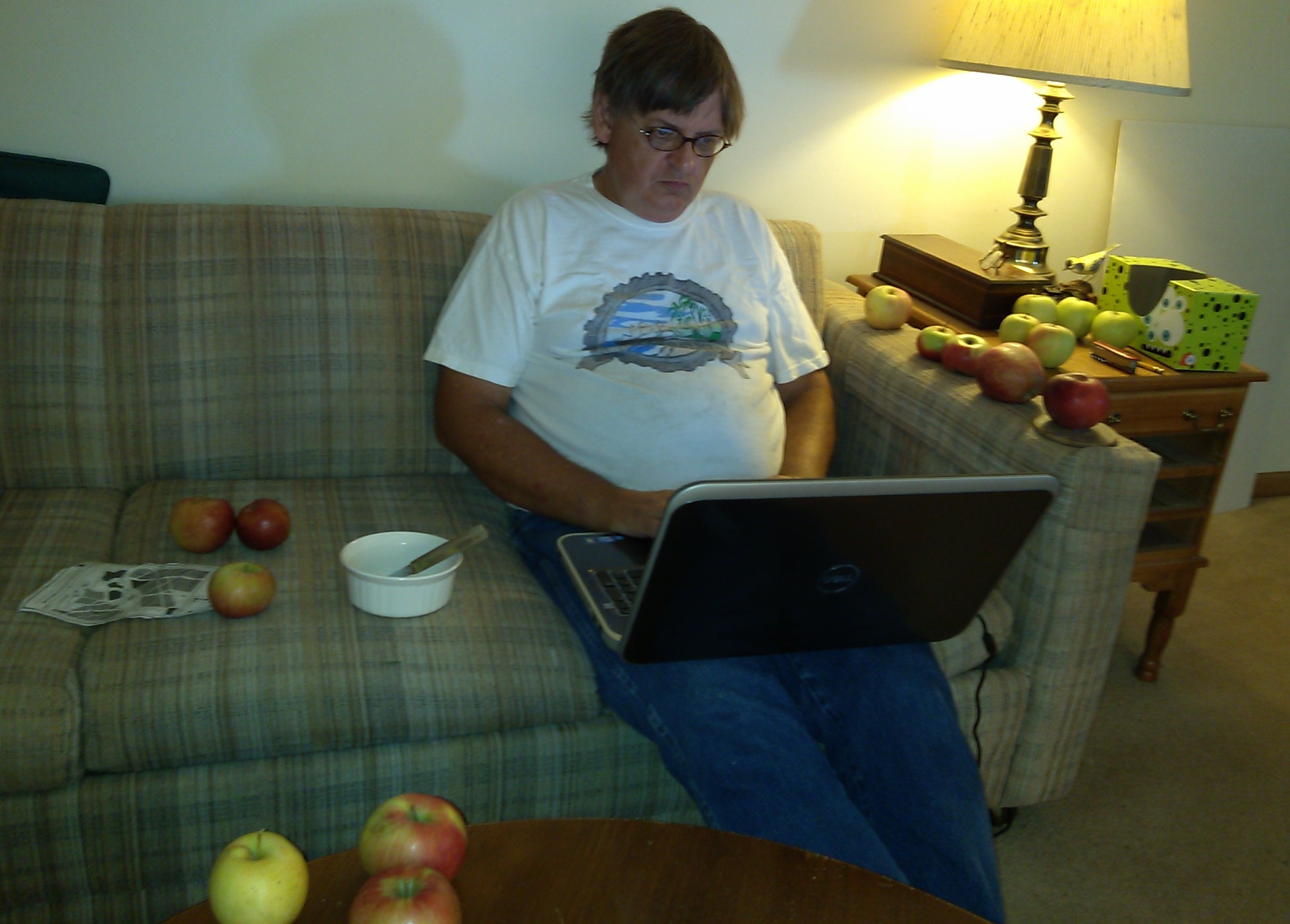
Writing About Apples

In May 1972, in the English Philosophy Building of the University of Iowa, professor David Morrell held up a copy of the book he published the previous year and asserted it represented the future of modern American fiction.

My high school friend Dennis was also in the class and we were skeptical. Morrell wasn’t wrong.

The book was titled First Blood and has been in continuous publication ever since. In 1982 it was made into a movie starring Sylvester Stallone. There were sequels. A student of Hemingway and John Barth, Morrell wrote First Blood while at Iowa where he taught English until 1986 when he gave up tenure to write full time. Last count he had written 32 books.

Morrell is the only undergraduate professor I continue to follow. That’s because when social media rose in the culture he adapted to it and is a constant presence on Twitter and Facebook. He’s easy to follow. Yesterday he posted a link to a video about writing which arrived as I’m figuring out what to write next year.

“The point is to have the passion and the drive to see in a book that it can make you a better person,” he said. “So that even if the book is not published you haven’t wasted your time because you wrote something that is truly important to you.”

That’s good advice. Write to make yourself a better person.

If I took any lesson from Morrell it was his practice of taking a deep dive into techniques he would depict in his fiction. Over the years he learned mountain survival skills, firearms handling, how to drive in emergency situations, and how to fly an aircraft. All of this training served his thriller writing. The take away for me was that writing must be grounded in experience. Not only so it reads well, but so we understand and can communicate life experiences faithfully.

During end of year holidays Big Grove and the lake district gets quiet as people settle into home, family and community. It is respite from the increasing turbulence we see in our politics and in society. I use this time to gain perspective on what I’ve done and written. Today the days start getting longer — an embarkation point for what’s next. Not sure what I want except forgiveness and redemption.

Midst gardening, farming and living there will be writing. I hope to improve my skills and stay grounded in reality… and to become a better person.