Categories
Work Life

Now and Then a Day Off

Parker Putnam Building, Davenport, Iowa

On Saturdays I took the bus downtown to pay my newspaper bill. In the mid-1960s my home town had a downtown, and it wasn’t unusual.

Newspaper carriers collected subscription fees from customers, then remitted the cost of the papers at the building where they were printed. Whatever was left—a few dollars at most—was our margin.

I spent mine on the bus trip, on snacks at the automat inside Parker’s Department Store, and for an occasional book or magazine. Back then there were at least four department stores downtown and I shopped at them all from time to time.

I continue to have an urge to go downtown on my day off, but of course there is no downtown the way there was.

Sometimes I give in and go, but the impulse is less about the trip itself than feeding a connected and primal need. It’s not the same even though today’s mental awareness is connected to that long ago paperboy. Usually I end up buying things we need if I venture out, like food, light bulbs and hydrogen peroxide.

Days off are more complicated than they were. On every day there is some paid work to be done whether at a work site, or at my desk. I don’t mind. Modern life is about choices we make.

After re-purposing, there was no idea where the road would lead, and that was mostly a good thing. I knew there would be constant work to sustain a life outside of the old fashioned single big paycheck. I embraced the change. Some say over 40 percent of the U.S. workforce, or 60 million people, will derive their livelihood from this kind of “freelancing” also known as “working as needed.”

Dig a bit deeper, and what I am doing is a harbinger of the near-term future, which according to the Intuit 2020 Report, is where “2020 will see a new breed of senior citizens with ‘unretirement’ and active engagement best describing their lifestyle choices.” Translation: my cohort will be working for money until we croak.

So even if I feel the urge to venture downtown, a place that no longer exists, capitulating from time to time seems okay. I would argue it is necessary because so much depends on our connections to the past that if we don’t periodically revisit them, sustaining a life in the present would be nigh impossible.

So now and then, I take a day off.

Categories
Work Life

Snow Day

Hiking in Subzero Weather

The warehouse called me off this afternoon because of the weather. It created an opportunity to work my long to-do list and that’s positive, even if I’ll miss the income.

While driving home across Mehaffey Bridge Road on Sunday the front end of my automobile started vibrating at speeds above 35 miles per hour. Slowing down, I made it home safely.

The two brothers at the auto shop in town agreed to check it out Monday morning. I dropped the car off and walked the three miles home in an ambient temperature around seven degrees below zero. The walk was invigorating and needed.

They found one of the brake calipers had gotten  stuck and was causing the vibration. It was a quick repair and I picked up the finished vehicle just as Monday’s snow started to fall.

I had to go to the county seat today, so I shoveled the driveway and ventured out. Between four and seven inches had fallen and the light, powdery snow made for quick removal.

After my meeting I picked up a few groceries, got a haircut, and headed home to weather the cold. The next warehouse shift is not until Friday, and as I mentioned, it’s an opportunity to get things done.

Between the warehouse, the car repair and the long walk home is another topic: consumer credit.

Because of the way we transitioned into a post-career life, we have credit. We have a line of credit against our home at a very low interest rate. We have credit cards to take the bumps out of monthly cash flow. Instead of creating immediate stress, the car repair went on the credit card and when income exceeds expenses, we’ll pay it down. These two financial tools make funding cash flow doable and to some extent, life easier.

Using credit is also a precarious thing to do.

There is the presumption of being able to pay it off, something not always possible. A lot depends upon getting the jobs and hours needed to generate income. Then there is the interest, an expense in its own right. Middle class people should get and use credit in a way that serves sustainability and nothing more. That’s what I try to do.

What else can working people do? What we always do. Keep working toward a life with a newer car, predictable income and less need for credit. However, if we get there, we will continue to take long walks on cold days.

Categories
Work Life

Holidays End

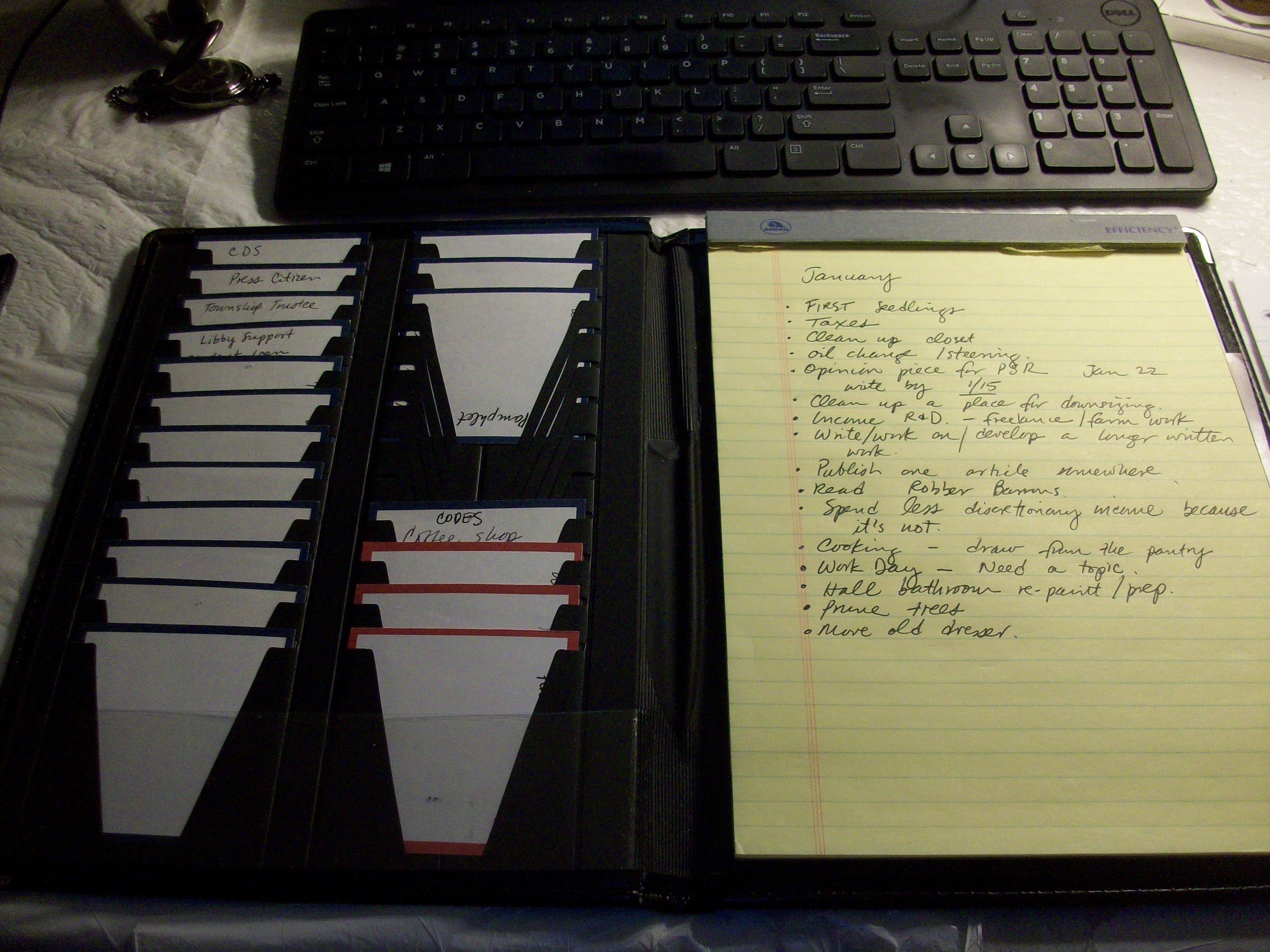
My List - Rough Draft
My List – Rough Draft

This weekend is arguably the end of the holiday season. I previously suggested the holidays end Super Bowl Sunday, this year on Feb. 1, but who except people working for large corporations can write off the whole month of January?

So the work begins.

Part of the work is paid, and more paid work is needed in 2015. Partly to make up for one-time revenue streams that ended, and partly to ensure financial stability which ultimately will lead to financial sustainability. My preference is to find additional free lance writing jobs and some portion of research and development will be devoted toward that end.

The easy resolution to the income shortfall would be to take one of the many $9.25 per hour part time jobs that are available in the area. If it fit in my existing schedule, such a job would fill the cash flow gap short term. I may end up doing this, but am not ready to give up on other options yet.

2015 is planned to be a down-sizing year and some one-time income could be realized by selling some items. This may fill the February cash flow gap, buying me more R & D time, if January affords enough time to work on it. We’ll see if that happens.

At this point the road to a successful 2015 is open and full of opportunities. With an open mind and a ready attitude I have taken the next steps toward sustainability and a life worth living on the Iowa prairie. Here’s hoping for a happy new year.

Categories
Work Life

Energy to Create

Photography Plan
Photography Plan

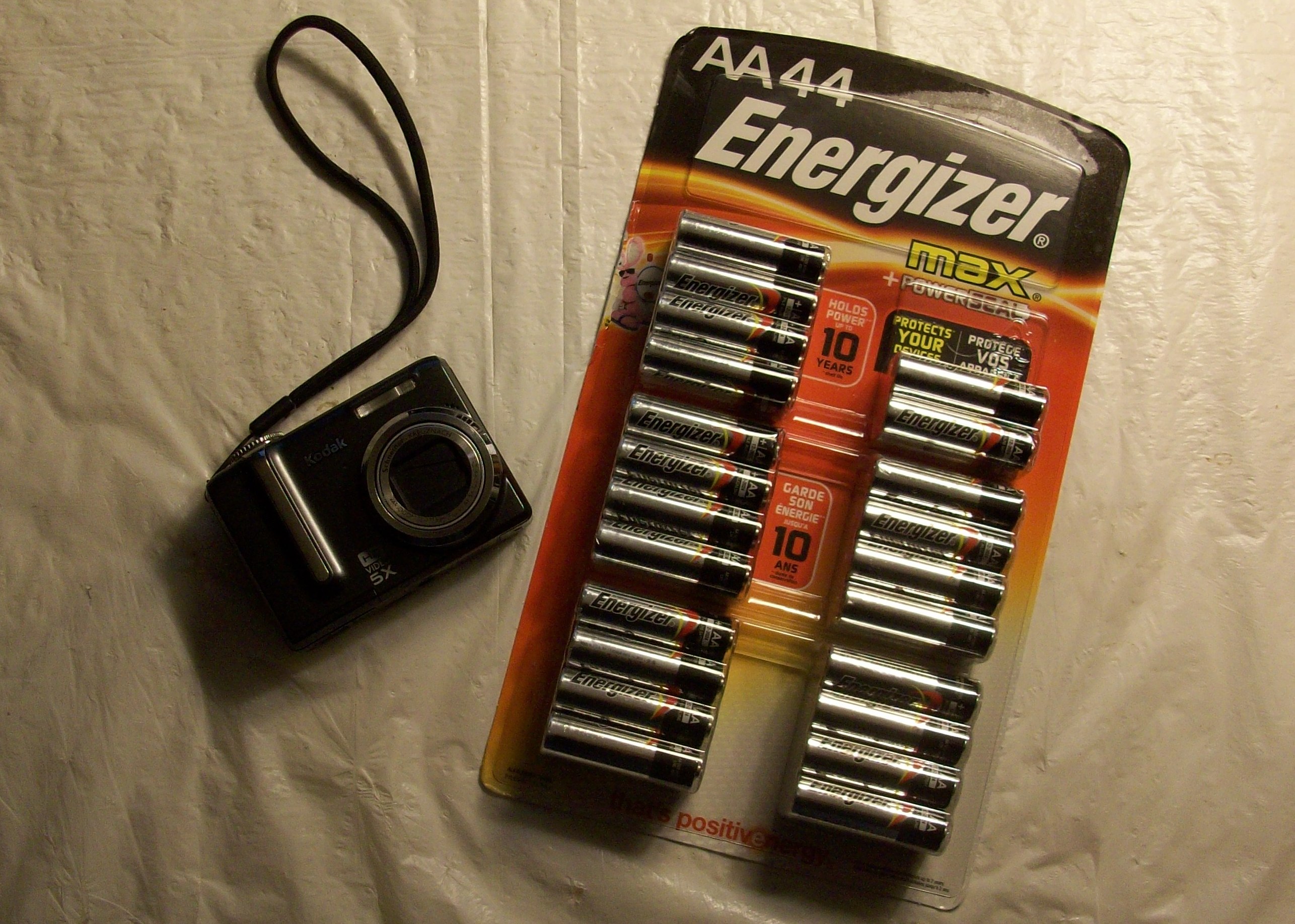
LAKE MACBRIDE— Is it better to use home electricity to power devices or batteries? As readers can see from the image, I opted for battery power and here’s why.

I already own a Kodak EasyShare Z1285 camera that takes two AA batteries.

While cameras come and go in the course of a person’s photo taking, extending the investment in currently owned equipment is more convenient and less expensive. Both of those things matter.

There is also the issue of coal and nuclear generated electricity coming into our house from the rural electric cooperative. While I don’t know how these alkaline batteries were initially charged, they are made of common metals—steel, zinc and manganese—and do not pose a significant health or environmental risk as burning coal and disposing of nuclear waste do. Heavy metals, mercury particularly, were eliminated in alkaline batteries in the 1990s.

The large pack of batteries also frames a project for the new year with the highest resolution digital camera in the house. When the batteries are gone, the project will end.

For now, I am batteried up with energy to create.

Categories
Work Life

No Holiday When Working Poor

Christmas Lights
Christmas Lights

LAKE MACBRIDE— Christmas is a busy time for retail workers. The end of year holidays, stretching from Halloween until the Super Bowl are a key time for companies to close sales that impact annual results. A lot of part-time and seasonal workers are needed to get everything done.

The working poor I know have their hands full of wage-earning opportunities at multiple jobs. For most, having Christmas Day off is not a benefit. It is a time to bank wages for the slow times coming later in winter. If hours were available Christmas Day, many would gladly work them.

My previous retail work ended when I left home to attend college. It was a part-time job stocking shelves in the drug department of a box store. We handled everything from sanitary napkins to record albums. As long as I had money to fuel my car, eat out with friends once in a while and buy some personal items, most of the dollars went into savings for college. In retrospect, it wasn’t many dollars, but a dollar had more buying power in the late 1960s.

My high school job is an example of how some view the current role of low wage jobs in society. They are dreaming. It bolsters an argument to keep minimum wage where it is, or eliminate it altogether. The truth is today people pay living expenses from low wage jobs like I had, and work at more than one job to earn enough to keep the bill collector from their door. Low wages are not about getting people a start in their work life. Working poor is a never ending vortex of not enough money to pay expenses with little time for a break, let alone a vacation or holiday.

There is help for working poor and I don’t refer to government social programs. It is social networking. Car broke down? A loaner is offered. Don’t have a car? Rides are shared. Turned out of your apartment? There is a couch or extra room. Need a job? Maybe you can work where I do. Social networking has always been around. When working poor it is a necessity and way of life.

We live by the choices we make in life, and no one chooses to work poor. The progressive lament that working poor is wrong isn’t helping as life goes on and we make up for losing a day’s wages somewhere else as one of our employers closes for the Dec. 25 holiday. There is no holiday when working poor.

Categories
Home Life Work Life

Waiting in Winter

Waiting Room
Waiting Room

LAKE MACBRIDE— Part of writing a newspaper article is waiting for people to get back.

Phone calls are a mixed bag. I prefer email or text message responses because they allow me to consider my questions—and the subject to consider answers—before hitting the send button.

My stories are somewhat uncoupled from time so I like to get solid quotes which shine the best possible light on people interviewed.

I have half a dozen queries out, and it’s as far as I can go. I wait.

This year’s holiday season is already unlike any previous. Mom went in for surgery last week, and our daughter was here over the weekend because of her work schedule. It’s still eight days until Christmas.

Our decorations are up ahead of schedule, and that’s a good thing. With all of the family visits more regimented and some finished, there will be time to do other positive things.

My first order for garden seeds shipped on Monday. The Winterbor kale is back ordered, which is better than last year, when it wasn’t even available. The garden will get a good start, as I already have the starter soil and trays.

My first two responses have arrived via email, so I had better get back to my newspaper article.

Categories
Writing

Night Storm

The Ditch in Winter
Ditch in Winter

LAKE MACBRIDE— Just before running my mobile phone through the washing machine, I searched the Internet for Hyemeyohsts Storm.

There were a few search results— what little information there was full of controversy. It was 2 a.m. and I hadn’t turned the lights on.

The year Seven Arrows was published, Chuck Storm was a lecturer in the Department of English at the University of Iowa, where he taught a course titled, “American Indian Signs and Symbols.” His wife Swan accompanied him everywhere he went, and would roll cigarettes for him as he told stories once a week for a couple of hours. That was before smoking was banned in classrooms.

I got an A in the course. Everyone did. Storm confronted the administration and made a case for the grade, and got his way. A lot of people who attended the classes weren’t registered. To call it a “class” was a stretch, as the curriculum was disjointed and sometimes incoherent, if one existed at all. What happened each week just happened, and I suppose that was part of the learning.

Storm welcomed us to visit their apartment, and one evening I did. Unannounced, and perhaps a little rude, I appeared at their door, and Swan welcomed me in. They were working with someone who had a issue with film. He was wrapped in celluloid from which he broke free. Afterward, Swan used a hand sweeper—the kind I use to pick up pine needles after the Christmas tree is removed—to clean the carpet, then we dispersed for the evening.

Seven Arrows was a work of fiction, and as such, it was easy to accept. While it claimed to be “the first book about the Ways of the Plains People to be written entirely by an Indian,” it was sometimes uncertain which stories were part of oral tradition, and which were fictionalized.

A number of modern writers have called Storm a fake Indian.

“Hyemeyohsts Storm, whose first name is hard to spell and to say, was another faker who made a minor fortune with his fake Indian book, Seven Arrows,” Dr. Dean Chavers wrote in the Native American Times. “It tried to be a genuine representation of the ceremonies of the Cheyenne people, but it came out as hippie mish-mash, just right for the 1970s.”

Storm has been accused of exploiting native traditions, of selling spirituality, and of being a plastic shaman and plastic Indian. I don’t know about that, and when I knew him he seemed genuine enough—as genuine as any writer I met during my undergraduate studies.

Why life would lead me here is uncertain. A whim from the beyond, as Meyer Baba might call it. What I know is I wasn’t ready to replace my mobile phone, or to consider negativity clouding the view of life as I knew it four decades ago. Perhaps it was just a night storm.

Categories
Work Life

Friday in Big Grove

Garden in Late Autumn

This week mine has been the life of a writer.

Every possible moment was spent producing copy. It is what I hoped for for so many years. A side-effect was the displacement of blog writing as I scurried to make deadlines and accommodate demands for my time. It’s good work if you can get it, and life-changing.

Whether paid work will persist is uncertain, but I felt confident enough to part ways with our local newspaper where I proofread stories and wrote articles about the school board, city council, and a couple of other topics. 39,100 words were filed in 44 stories since January with compensation of $2,125, or less than the amount of our property tax for the period. I’ll finish my last work there this weekend.

What’s next is freelancing for the Iowa City Press Citizen and a slate of business development activities to identify additional paid writing opportunities. I’d get that organized if it weren’t so busy writing.

There is the slate of work that is not writing also begging for my time. For now, that work pays the bills and flows into the well of experience from which I draw for writing. For now, it is enough.

What it has meant is less time to write here. I hope to return to regular blog writing soon. It is uncertain when that will be.

Categories
Work Life

Back Home

Carpentry Crew
Polish-speaking Carpentry Crew in Schiller Park

After three days and two nights in Chicago it is good to be home.

The tail end of a cold persists, but I feel much better after spending a couple of days with peers from around the Midwest making sales presentations. We’re selling blenders on the Black Friday weekend—something else writers do to pay the bills.

I watched this Polish-speaking carpentry crew in Schiller Park get started on a project while waiting for our first conference session to begin. I was impressed by the uniform white T-shirts without logos, and the speed with which the partition wall went up. Wonder if they were hiring?

The exigencies of self-employment are always tapping at us, urging for our attention. Today there is a lot of work in the pipeline, and with a bit of organizing, I’ll be at it—bottom to the chair and typing away as quickly as the stories permit.

Categories
Work Life

Drinking Country Politics

Legislative Forum in Coralville

CORALVILLE— The League of Women Voters forum last night was a bust for the candidates in my house district. The league puts on a good show at the table, but only a limited number of constituents were present, and the television feed went to only one of six county precincts in the district. Major outlets published limited accounts of the action, but mostly the evening passed and little news came out of the forum. It’s been that kind of year in the most local of local politics.

The forum enabled me to get away from writing and household chores for a while to socialize. I’ve never been part of the drinking culture that plagued more famous writers, and might have come into play if there hadn’t been the forum. I have been hearing a lot about drinking on the radio while driving across the lakes to work.

“I belong to the drinking class,” sings Lee Brice in his country hit “Drinking Class,” released in August. Country music today is full of stories about using alcoholic drinks to celebrate or escape unpleasantness in life. I hear enough of them during my 20 minute commutes to the warehouse to see the pattern.

“Monday through Fridays we bust our back,” the song goes. I don’t know who, except a small minority of people, works that kind of job, so the song seems more aspirational of lifestyle— a form of hope to define culture around externals that seem ersatz and manufactured.

“What I’m really needing now is a double shot of crown,” sings the protagonist in the Lady Antebellum song “Bartender.” On Friday night she seeks relief from a relationship gone bad. “There’s only one thing left for me to to do. Put on my favorite dress and sky-high leather boots, check the mirror one last time and kiss the past goodbye.”

The signs and symbols are archetypal. Shots of Jack Daniels and Patron, jeans that are painted on— stereotypical images of guys who get rowdy and women locked into frames we had hoped were long gone from the culture.

From “Aw Naw” by Chris Young:

Aw naw, somebody just bought a shot of that Patron.
Hang on, we’ve been here all night long.
Aw naw, it would be so wrong
If we didn’t dance one more song,
Show off those jeans you painted on…

“On” doesn’t rhyme with “song,” but we can accept it in the vernacular of bar culture. What impresses about this music is the way it draws from people’s everyday experiences to paint a picture of longing and possible fulfillment or caesura.

James Joyce’s “Araby” in Dubliners, is a variation on this theme, albeit a bit obscure for the drinking class. It’s more about me that this story came to mind.

What innumerable follies laid waste my waking and sleeping thoughts after that evening! I wished to annihilate the tedious intervening days. I chafed against the work of school. At night in my bedroom and by day in the classroom her image came between me and the page I strove to read. The syllables of the word Araby were called to me through the silence in which my soul luxuriated and cast an Eastern enchantment over me. I asked for leave to go to the bazaar on Saturday night.

Much different and yet similar. I’d rather listen to the song about lighting watermelon candles upstairs, “Doin’ What She Likes” by Blake Shelton. “Fixin’ up a pitcher of margaritas,” and then calling the fire department when the watermelon candles ignited the bathroom, is a different and more interesting kind of disappointment than in the Joyce story. To weave a story with that imagery requires talent, and it resonates with people.

I’ll continue to listen to country music in the car, but am not ready to join the drinking class. For now, the occasional political event will have to serve as release in a life of work.