Categories
Creative Life

This Week in Photos

As the garden turned from tomatoes to apples, I captured plenty of images. Here are some of them.

Last of the garden tomatoes.
Wild flowers.
Categories
Kitchen Garden

Hints of Autumn

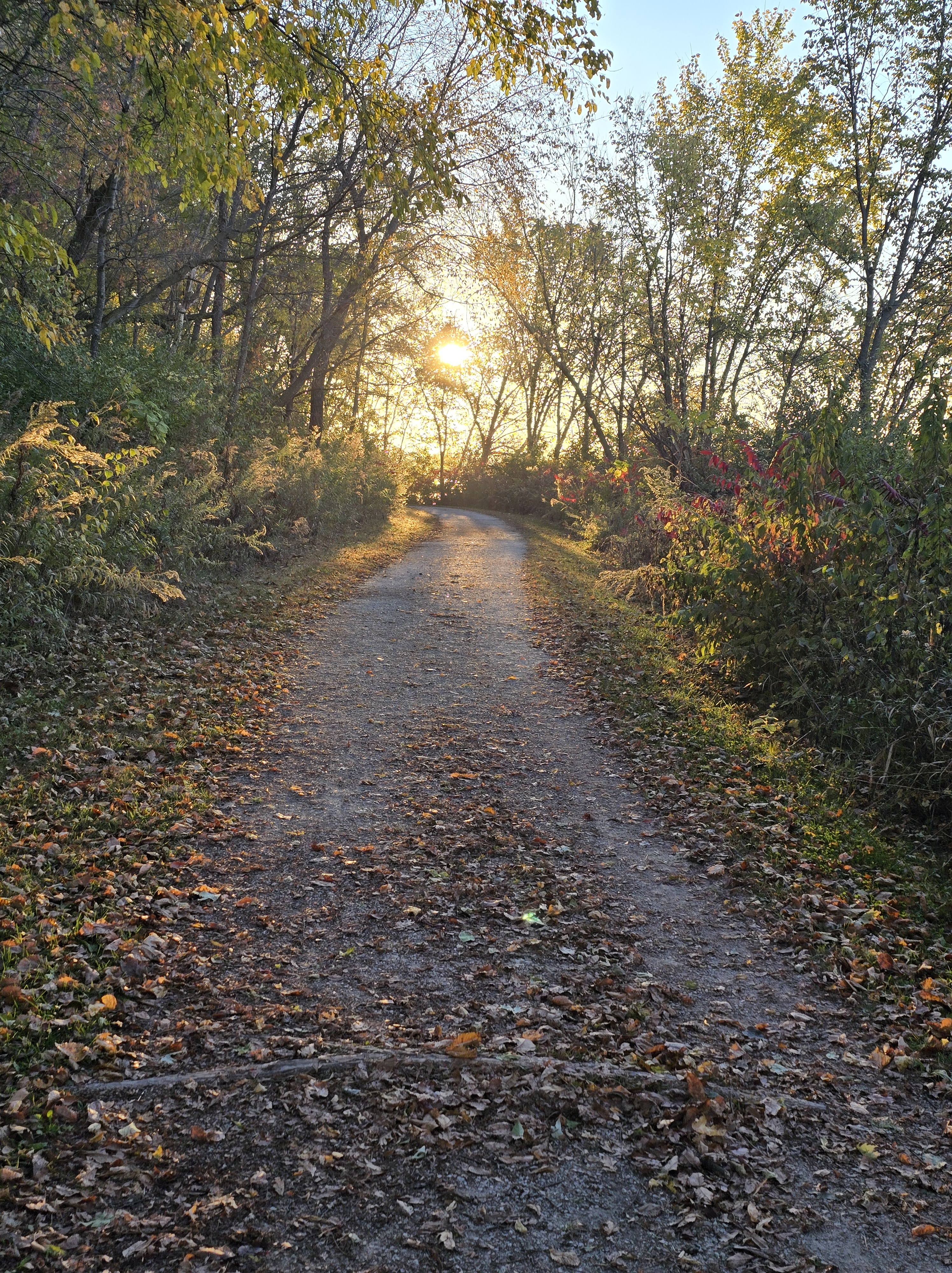
Trail walking before dawn.

Ambient temperatures were in the high 40s as I made my way along the state park trail. The chilly air stimulated bare skin exposed by my short sleeve t-shirt. Even though it was before 6 a.m. three others were out running. Two had lights and one did not. When younger, I used to run five miles each morning in moonlight, so I never carry a light. I memorized the trail and know where the one tree root crosses so I don’t trip on it in the dark. Darkness dissipated as Earth rotated, bringing us into the light.

The weather has been perfect for about a week. It is the kind of summer weather we seek. Thursday the high temperature was below 70 degrees.

The garden is winding down, with only one or two varieties of tomatoes left ripening. There are also hot peppers which will produce until the first hard frost. Leafy green vegetables continue to grow but the freezer and refrigerator have enough to last until next year. I pick what we need to eat fresh and leave the rest. Apples are aplenty. I will end up leaving a lot on the tree for wildlife. Autumn is not here, yet we can sense it is close.

I made enchiladas for dinner on Thursday. I modified my standard ingredients, substituting fresh tomato sauce for the canned I use in winter. There are still garlic scapes in the refrigerator, so I used those too. It is an easy meal for after a long day of working with apples.

The garden garlic has been racked in the garage for three weeks and is ready for trimming and storage. I’m not in a hurry to get that done. Using a small fan to blow on it helped them dry more quickly and thoroughly.

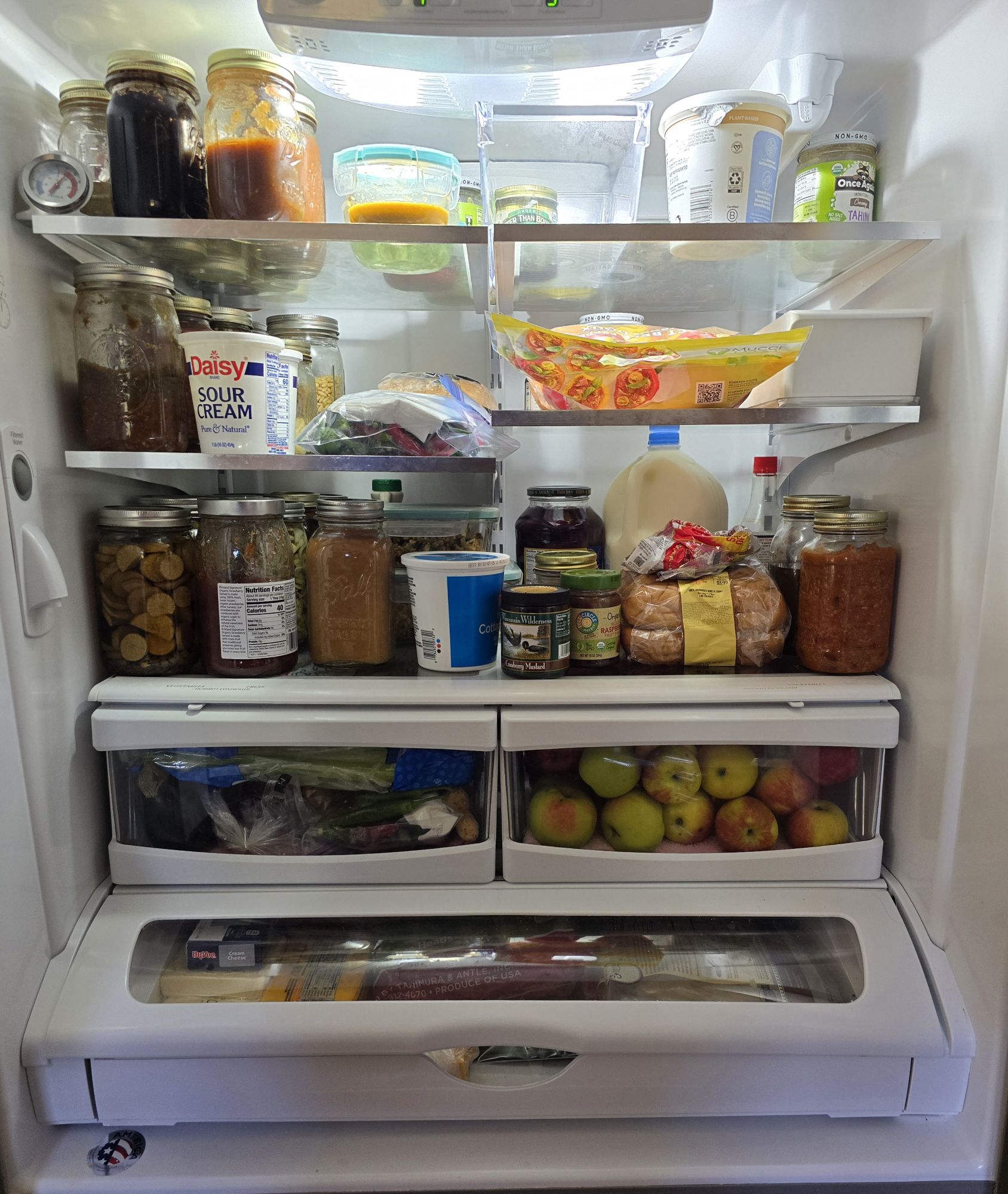
I have five bins holding a bushel and a half of apples, sorted by juicers and saucers, downstairs near the furnace. I plan to fill the other three bins and then turn to sauce first, followed by juicing. We don’t eat much applesauce, mostly using it to substitute for an egg in vegan corn muffins. Once a year we make an applesauce cake. The refrigerator drawer can take a few more of the best apples for storage. This year has been a mad rush in the garden.

When I tear down the squash patch I expect to find a winter squash or two. That operation was ill-advised in that I couldn’t get to the vines and lost track.

The acorns on the Bur Oak trees are full sized. I expect squirrels will make quick work of them.

Such is my life in Big Grove Township. We live our best lives here… as best we can.

Categories
Kitchen Garden

Deep in Apple Season

Low hanging fruit.

Apple season begins in earnest as Red Delicious ripen. I’ll pick the best few dozen for storage and make cider vinegar and applesauce with the rest until my allocation of pantry space is filled. I didn’t know it at the time, yet this is why I planted apple trees.

The Red Delicious harvest began Tuesday and it won’t take long to fill all eight of my tubs with fruit. After that, kitchen work begins as I race the clock to meet goals before the rest of them fall from the tree.

The most challenging work is running three or four bushels through my small juicer. It is worth the effort to have apple cider vinegar. I also jar a couple of quarts of fresh apple juice.

The other four trees have finished. By far, the best flavored apple was first to ripen: Zestar! I canned pints of applesauce from most of the harvest. Crimson Crisp and Earliblaze filled the time gap until Red Delicious ripened. I labeled each jar of applesauce with the variety of apple. The best of each variety was washed and placed in a refrigerator drawer for storage. I should have fresh apples at least until January.

This activity signals the end of summer. 2025 has been a great one for garden produce. Maybe once all the work is done I can kick back and take it easy for a couple of days. I’m not there yet.

First wheelbarrow full of apples.
Categories
Living in Society

We’re Going Home – Walgreens

Photo by Yuugen Rai on Pexels.com

The deal for private equity firm Sycamore Partners to buy Walgreens closed on Aug. 28. We know what that means.

Private equity will restructure the company, sell off what parts it can, restructure real estate holdings, close stores, layoff employees, and increase company debt, while making their executives an obscene amount of money. Walgreens bankruptcy seems likely in the near-term future based on what happened with companies like Toys R Us. Sycamore Partners’ deal is leveraged with “more than double the average debt level used by private equity firms to acquire companies last year,” said U.S. Senator Elizabeth Warren in a letter to them. All of this is what private equity does in the United States. It does not contribute one whit to improving the consumer economy. Importantly, some consumers will lose access to pharmacy services when stores close.

On my way to the wholesale club I pass two Walgreens stores, which seems like a lot. I notice neither of them is within walking distance of residential housing. In other words, they depend upon our automobile culture. A person doesn’t go to Walgreens except to get something specific. This kind of shopping faces competition from online retailer Amazon where we can point, search and click to have a product Walgreens may or may not carry delivered to our home within a day or two. Amazon trucks are ubiquitous in our rural neighborhood. We see them more often than we think of going to Walgreens, whether or not we buy from them.

I have a Medicare Part D prescription drug plan and the company that administers it dictates which pharmacies are available to me. I wanted to use the nearest pharmacy to support their small business but they weren’t on the list. I picked the warehouse club because I go there twice a month for groceries anyway and getting my prescription would save a trip. The last time I went inside a Walgreens, it was because they are a UPS drop off point. I have also shopped there to review their large inventory of over the counter medications to find a specific dosage of vitamin B-12. They did not have it, so I got it by mail order from the manufacturer.

When I was a grader we had a locally owned drugstore with a pharmacy a block and a half from our home. In the mid-1960s, whenever I had extra money from my newspaper route, I would go in there to see what they had. Mainly, I looked for reading material (comic books or paperback novels) and candy. I was infatuated by baseball cards sold with a stick of bubble gum. Over the years, the drug store disappeared as automobile culture and larger scale retailers influenced our shopping. During the ten years I lived there, they were a part of the cultural landscape. In part, discounters like Walgreens contributed to their demise.

The only person I knew who depended upon Walgreens was my maternal grandmother who lived in downtown Davenport. There were no grocery stores there — today we would call it a food desert — but Walgreens sold a few grocery items like milk, butter, eggs, bread, and selected canned goods, all of which she bought. Without an automobile, it was a big production for her to visit a supermarket, involving a bus ride or having a relative pick her up and take her there. She got her prescriptions from Walgreens which was within walking distance.

Access to Walgreens is not important to me. I buy all of my bandages, ointments and sundry health items at the pharmacy in our nearby city. We went without a pharmacy for a while, and I’d like to see them be successful. Thing is, I don’t buy $100 of sundry items from them in a year, so Walgreens or no, it has been a struggle for them to survive.

The world we knew continues to change. Some parts of the future are hopeful and some definitely are not. Big Pharma will figure out how to sell us their medicines. As Walgreens begins the slow dance toward going out of business, I accept it as the failure of large retail franchises that can’t compete with Walmart or Amazon. It is a condition of modern society, and retail in particular. I hope they make it yet doubt they will. There are other causes than saving Walgreens that deserve my attention more.

Categories
Environment

Electricity Today

Photo by Pixabay on Pexels.com

There is a lot of chatter in the national news media about the price of electricity. We are apparently in a war with China over dominance in artificial intelligence, which requires a lot of electricity. National Public Radio reported, “Electricity prices are climbing more than twice as fast as inflation.” We don’t hear that so much here in Iowa except on national media. Why? According to Bill McKibben, “The average Iowan will spend 39% less on electricity than the average American because it produces 57 percent of its electricity from the wind, the second-biggest wind state in the country.” If you throw solar arrays, and other renewable energy into the mix, Iowa’s total share of renewables is 64 percent.

Spoiled as I am by normally low electricity rates, when last month’s electric bill arrived it was 51 percent higher than the same period last year. What the heck? Although the total amount of the bill was comparatively low — typical for Iowa — I had to look at it.

The price per kWh of electricity from our electric cooperative has been stable and predictable. It wasn’t a rate change that caused our increase. Our monthly usage increased from 429 kWh to 745 kWh. The average American household usage is much higher than that. The reason for higher costs was this increased usage.

What happened? The average temperature increased by four degrees year over year. We likely ran the air conditioner more because of it. It was also oppressively hot this July, which meant spending more time indoors and using more electricity with the washer, dryer, stove and our electronic devices. We also had a millennial house guest for an extended stay. They did online streaming from here with a multitude of electric devices which sucked more juice. In sum, the increase was explainable.

Why are people concerned about increasing electricity costs? Donald J. Trump is president. He does not seem well educated about electricity.

On Trump’s first day in office he declared an “energy emergency” for made up reasons. The unstated reason is he extorted oil, gas and coal companies. “Candidate Trump literally told the fossil fuel industry they could have anything they want if they gave massive contributions to his campaign, and then they did,” according to McKibben. Trump’s payback for the bribe was to hobble the renewable energy industry.

The Trump administration immediately began to do absolutely everything in its power to stop this trend (to develop more sun, wind, and batteries) and replace it with old-fashioned energy—gas, and coal. They have rescinded environmental regulations trying to control fossil fuel pollution, ended sun and wind projects on federal land, cancelled wind projects wherever they could, ended the IRA tax credits for clean energy construction and instead added subsidies for the coal industry. Again—short of tasking Elon Musk to erect a large space-based shield to blot out the sun, they’ve done literally everything possible to derail the transition to cheap clean energy. (Trump is shockingly dumb about (electric) energy, Bill McKibben on Substack).

More than ninety percent of new electric generation around the world last year came from clean energy. This was not because everyone in the energy business had “gone woke,” McKibben wrote. Texas, arguably the most un-woke place in the U.S., installed more renewable capacity than any other state last year. It was because you could do it cheaply and quickly—we live on a planet where the cheapest way to make power is to point a sheet of glass at the sun.

I don’t know what happened to Republicans. Senator Chuck Grassley used to be one of the big supporters of wind energy in Iowa because of the way wind turbine arrays meshed with farm operations, giving a farmer another revenue stream.

Under Trump we have taken a step backward and let China, Europe, and literally everyone else take the lead in developing the electricity of the future which taps power directly from the sun.

We can and must do better than this as we consider our energy future.

~Written for Blog for Iowa

Categories
Environment

Republicans And The Damage Done

Iowa Windmill

When I visited the Iowa legislature, one of the people I sought was Rep. Chuck Isenhart from Dubuque. Almost every bill regarding conservation, climate change, renewable energy, and water quality involved him in some way. We were sad to see him lose his last election. Since then, Isenhart has been staying active including writing about environmental issues on Substack.

Why would our national legislators back away from clean energy? Isenhart has some thoughts.

“Just because our gardens are growing cucumbers doesn’t mean we have to make pickles,” Isenhart wrote. “Backing away from clean energy while continuing to subsidize fossil fuels and mandate biofuels puts us in a pickle, making even the wildest dreams come true for those who advocate for an “all-of-the-above” energy future (meaning ‘don’t leave fossil fuels behind’).”

In an Aug. 18 post, Isenhart outlines the damage done to renewable energy programs by Republicans. He starts with his personal story of installing solar panels on his roof and what a good deal it was for him, the utility company, and the environment. The story arrives here:

So – good for consumers, good for business, good for workers, good for the environment. Win-win-win-win. Thus, good for government to keep promoting, no?

Ahhhhh, no. Iowa’s Congressional delegation voted unanimously to unravel most of the federal government’s support for clean energy. Your chance to use the incentive I did is fast running out.

The federal tax credit program for residential solar, wind, geothermal and battery storage now expires at the end of this year, not 2034 as originally planned.

Churches and non-profits with big energy bills can also still get in on the deal through the Elective Pay program with the up-front help of donors who like to see tangible returns on investment like this church.

In related news, Iowa’s congressional representatives Ernst, Grassley, Hinson, Miller-Meeks, Nunn, Feenstra also eliminated the energy efficient home improvement credit (December 31), the new energy efficient home credit (June 30, 2026) and the energy efficient commercial buildings deduction for property construction that begins after June 30, 2026. All of these serve to reduce energy consumption and climate impact. (The Sun Also Sets by Chuck Isenhart on Substack).

We may know how bad Republicans are with advances in renewable energy and the environment. Isenhart lays it out with specifics. Read his entire post here.

~Written for Blog for Iowa

Categories
Living in Society

Giving Back

Sky at dawn on the lake.

Since our family moved to Big Grove Township, I volunteered to make lives better. Any monetary considerations were insignificant. A regular person does not volunteer in the community for the money. Part of living a sustainable life in rural areas is contributing to the general well-being. I did what I could. I felt blessed and had to give back to the community in which I lived.

Within the first year we arrived, the home owners association asked me to join the board. I did. These organizations get a bad rap. In our case, we managed the association like a small city. We provided a public water system, a sanitary sewer district, road maintenance, refuse hauling, and real estate sales and purchases. Over time, we upgraded the roads from chip and seal to asphalt, dealt with changing government standards related to arsenic in drinking water, reduced the number of wells from three to one, complied with changing Iowa Department of Natural Resources standards for wastewater treatment plant effluent, handled a lawsuit, and coordinated activities like road use and maintenance with neighboring associations. If the board doesn’t do these things, they don’t get done. Everyone is the better for such volunteer boards. I served, off and on, for over 30 years.

In 2012, when only one candidate was running for two township trustee positions, I ran a write-in campaign and won. Being a township trustee included managing emergency response and a volunteer fire department with other townships and the city. Toward the end of my tenure, we formed a new entity to manage emergency response. We maintained the local cemetery, and supervised a pioneer cemetery where the first person to die in the township was buried. This work helped me understand how tax levies work and how they were used to support things the county did not, things like a small fire department or saving someone’s life in an emergency. There was only a single conflict during my time on the board, about the main cemetery. All of the trustees showed up at the cemetery to resolve a dispute with an individual. No one wanted the job of township trustee and someone had to do it, so I stepped up.

When the local seniors group had an opening on their board, I volunteered and became its treasurer. This lasted about two years, but it provided insight into this segment of the community. Everything we did, from providing community meals to giving home bound people rides to medical appointments to arranging outings around eastern Iowa, served an often neglected segment of the population. It was a great opportunity to learn about the life of our senior citizens before I became one myself.

The contribution to society with the most personal meaning was financially supporting construction of the current Solon Public Library building, occupied in 2001. We didn’t really have the money in our budget yet having a decent public library is something we valued. We found the money to donate. The small city library went from being located under the city band stand, to a store front, to the old jail, to a modern building specifically designed to be a library. In the beginning, the library was staffed with volunteers from the Solon Young Women’s Club and the Solon Study Club. Today, there are full and part-time paid staff that work alongside volunteers. A library is something the whole community can use. I am proud to have helped build ours.

There are other ways I gave back to the community. Giving back is a personal value to hold dear in turbulent times. We should all find ways to give back to society in this Trumpian time of self-interest. If we don’t, who will?

Categories
Living in Society

Survivor with Plans

Bur Oak tree on Aug. 20, 2025.

The Bur Oak tree near the front of our property is one of the few of our 20 trees unaffected by the 2020 Derecho. Most of the others were blown over outright or began a slow dance with nature to see when their last leaf-out will be. Most of them will be gone in five years because of injuries sustained during the derecho. A lot of work went into planting those trees. I have memories of each of them and who worked with me when planting.

When I wrote the outline for my autobiography, I figured it would end with the coronavirus pandemic. Little did I know that Donald Trump’s assault on society as we know it would be a thing. After eight months, it seems clear the baton I will take up has to do with intellectual freedom, which best matches my skill set. What form it will take is to be determined. I’m going to a rally about saving the State Historical Society building in Iowa City this Saturday. I should see like-minded people there and be able to hook up and get started on developing an initial plan with others.

I expect to be active again soon. Like the oak tree, I expect to survive the storm.

Categories
Living in Society

Summertime Heat

Pears are not ripe yet.

The last week has been a combination of ambient temperatures in the high 80s to low 90s, heat index of 105 or more, and thunderstorms. As a septuagenarian I stay inside with air conditioning once I finish early morning, outdoors chores to avoid passing out in the heat and humidity.

I took a box of cherry tomatoes to the community food pantry. My other Monday errands included filling the auto gas tank and lottery gambling. It was a quick trip, with exposure to people. I like the people part of it, and finishing while it’s relatively cool. Monday errands has become a thing in retirement.

It has been a struggle to mow the lawn, so the grass is growing long. I’ll need the cut grass for garden mulch and if nature dials down the humidity for a day or so, I’ll harvest it. I did manage to mow the ditch as it dried out, and before it got too hot. It was a workout.

When I was younger I would work strait through the heat and humidity. A few years ago I got woozy and had to lay down on the ground to recover. After that I decided to take better care of myself. As an Iowan I’m used to the heat and humidity. As a senior I learned to live another day.

Then there are the big salad dinners of summer.

Big salad (before dressing) with fennel, celery, cucumber, tomato, bell pepper, and broccoli from our garden.
Categories
Kitchen Garden

Arrival in a Thunderstorm

Sunset after a two-hour thunderstorm.

We have visitors from the east this weekend. On Friday they drove through an Iowa summer thunderstorm in an open-bed pickup truck laden with boxes of household goods for storage. The load was well tarped and secured. Some of the boxes got a few drops of rain, but mostly the first principle of transport came into effect: secure your load properly to avoid problems. We hardly used the tall stack of towels I got out to dry the boxes.

The lightning and thunder were exceptional. Enough of it to make a show. Not too much to worry. A few lightning bolts hit close to home, yet for the most part the storm did its work and moved through the area without incident. It saved me from worry about watering the garden.

These August days are busy in the kitchen garden. Apples, pears and vegetables are abundant and both the garden and kitchen are full of them. I enter either place, and suddenly, four hours filled with work rush by. Being engaged in the conversion of nature to foodstuffs seems righteous. Neither “farmer” nor “gardener” nor “cook” are the right words to describe this. It is an amalgam of living in the present, tradition, education, and experience. I don’t feel any specific descriptor is needed.

We cleaned off the dining room table to sit and talk. I made a simple repast of cut garden vegetables, fruit, cheese, and crackers for the visitors. We talked about what we would accomplish this weekend, not thinking too much about the future or the past. As the United States has its authoritarian moment, such discussions define us… help us cope… make us better people.

It is an escape from the storm that has already moved on and left us living.